University of Pennsylvania
ScholarlyCommons
Publicly Accessible Penn Dissertations
1-1-2013
The Decline of the Rust Belt: A Dynamic Spatial
Equilibrium Analysis
Chamna Yoon
University of Pennsylvania, [email protected]
Follow this and additional works at:http://repository.upenn.edu/edissertations Part of theEconomics Commons
This paper is posted at ScholarlyCommons.http://repository.upenn.edu/edissertations/724 For more information, please [email protected].
Recommended Citation
Yoon, Chamna, "The Decline of the Rust Belt: A Dynamic Spatial Equilibrium Analysis" (2013).Publicly Accessible Penn Dissertations. 724.
The Decline of the Rust Belt: A Dynamic Spatial Equilibrium Analysis
Abstract
The purpose of this dissertation is to study the causes, welfare effects, and policy implications of the decline of the Rust Belt. I develop a dynamic spatial equilibrium model which consists of a multi-region, multi-sector economy comprised of overlapping generations of heterogeneous individuals. Using several data sets that cover the time period from 1960-2010, I estimate the structural parameters of the model based on a simulated method of moments estimator. The empirical findings suggest that goods-producing firms located in the Rust Belt had a 13 percent relative productivity advantage in 1960 compared to the rest of the U.S., which shrank to approximately 3 percent by the end of the sample period in 2010. As a consequence, a large fraction of the decline of the Rust Belt can be attributed to the reduction in its location-specific advantage in the goods-producing sector. The transition of the U.S. economy to a service sector economy is a less significant factor. The decline of the Rust Belt generated significant differences in welfare between individuals residing in the Rust Belt and those residing in other areas, particularly for the less educated. Policy experiments show that the inequality in welfare can be significantly reduced by subsidizing labor costs in the Rust Belt or reducing mobility costs.
Degree Type
Dissertation
Degree Name
Doctor of Philosophy (PhD)
Graduate Group
Economics
First Advisor
Kenneth I. Wolpin
Subject Categories
THE DECLINE OF THE RUST BELT: A DYNAMIC SPATIAL EQUILIBRIUM
ANALYSIS
Chamna Yoon
A DISSERTATION
in
Economics
Presented to the Faculties of the University of Pennsylvania
in
Partial Fulfillment of the Requirements for the
Degree of Doctor of Philosophy
2013
Supervisor of Dissertation
Kenneth I. Wolpin, Professor of Economics
Graduate Group Chairperson
George J. Mailath, Professor of Economics
Dissertation Committee
Holger Sieg, Professor of Economics
THE DECLINE OF THE RUST BELT:
A DYNAMIC SPATIAL EQUILIBRIUM ANALYSIS
COPYRIGHT
Chamna Yoon
Acknowledgements
I am greatly indebted to my advisors, Kenneth I. Wolpin and Holger Sieg. Through
active discussions and feedback, they motivated me to aim higher and helped me to
become a passionate researcher. I am truly grateful for their continuous support and
inspirations. I would also like to thank my dissertation committee member, Xun Tang
for his guidance and support.
I am also grateful to Aislinn Bohren, Fl´avio Cunha, Francis X. Diebold,
Han-ming Fang, Jeremy Greenwood, Camilo Garcia-Jimeno, Dirk Krueger, Donghoon
Lee, SangMok Lee, Yoonsoo Lee, Iourii Manovskii, Antonio Merlo, Guillermo
Or-do˜nez, ´Aureo de Paula, Andrew Postlewaite, Andrew Shephard, and Petra Todd for
their valuable comments. I thank all of the Penn Economics faculty for being great
examples of dedicated researchers and teachers.
My dissertation was supported in part by the National Science Foundation through
XSEDE resources provided by the XSEDE Science Gateways program (TG-SES120012).
I thank Albert Saiz for generously providing me with satellite-generated land use data.
Last but not least, I would like to thank my wife, Jisoo, and our son, Jonathan,
ABSTRACT
THE DECLINE OF THE RUST BELT: A DYNAMIC SPATIAL EQUILIBRIUM
ANALYSIS
Chamna Yoon
Kenneth I. Wolpin
The purpose of this dissertation is to study the causes, welfare effects, and policy
implications of the decline of the Rust Belt. I develop a dynamic spatial equilibrium
model which consists of a multi-region, multi-sector economy comprised of overlapping
generations of heterogeneous individuals. Using several data sets that cover the time
period from 1960–2010, I estimate the structural parameters of the model based on a
simulated method of moments estimator.
The empirical findings suggest that goods-producing firms located in the Rust
Belt had a 13 percent relative productivity advantage in 1960 compared to the rest of
the U.S., which shrank to approximately 3 percent by the end of the sample period
in 2010. As a consequence, a large fraction of the decline of the Rust Belt can be
attributed to the reduction in its location-specific advantage in the goods-producing
sector. The transition of the U.S. economy to a service sector economy is a less
significant factor. The decline of the Rust Belt generated significant differences in
welfare between individuals residing in the Rust Belt and those residing in other
areas, particularly for the less educated. Policy experiments show that the inequality
in welfare can be significantly reduced by subsidizing labor costs in the Rust Belt or
Contents
Acknowledgements iv
Abstract v
Contents vi
List of Tables viii
List of Figures x
1 Introduction 1
1.1 A Brief History of the Decline of the Rust Belt . . . 7
2 Empirical Analysis 9 2.1 Model . . . 9
2.1.1 Preliminaries . . . 9
2.1.2 Model Specification . . . 10
2.1.3 Solution Algorithm . . . 19
2.2 Estimation Method . . . 22
2.3 Results . . . 26
2.3.1 Parameter Estimates . . . 26
3 Welfare and Policy Analysis 29
3.1 The Decline of the Rust Belt . . . 29
3.2 Welfare Analysis . . . 31
3.3 The Effects of Place-Based Policies . . . 32
3.4 Conclusion . . . 36
3.5 Table and Figures . . . 38
A Additional Model Specifications 63 A.1 Technology . . . 63
A.2 Utility . . . 64
B Weighting Matrix 65
C Data Inputs 67
D Additional Experiment Results 69
List of Tables
3.1 The Rust Belt Shares of Output, Employment, Population, and
Rela-tive Wage . . . 38
3.2 Composition of Workforce and Population . . . 39
3.3 Annual Migration Rate . . . 40
3.4 The Rust Belt Shares of Output, Employment, Population, and Rela-tive Wage . . . 41
3.5 Composition of Workforce and Population . . . 42
3.6 Annual Migration Rate . . . 43
3.7 Production Function (2.1) . . . 44
3.8 Production Shocks (2.2) . . . 44
3.9 Utility Parameters (2.3) . . . 45
3.10 Skill Production Functions (2.5) . . . 46
3.11 Type Probabilities: P (θ = 1|d0, e) . . . 46
3.12 Actual and Predicted Rust Belt Shares of Output, Employment, and Population . . . 47
3.13 Actual and Predicted Relative Hourly Wage by Sector . . . 48
3.16 Actual and Predicted Annual Migration Rate by Education Level and
Age . . . 51
3.17 Actual and Predicted Migration Rate by Education Level and Period 52
3.18 Actual and Predicted Mean (log) Housing Expenditure by Education
Level . . . 53
3.19 Actual and Predicted Mean (log) Non-Labor Income by Education Level 54
3.20 The Effect of Sectoral and Regional Technological Changes on Rust
Belt Shares of Output, Employment, and Population . . . 55
3.21 The Effect of Sectoral and Regional Technological Changes on Relative
Wages and the Relative Quality of Local Public Goods . . . 56
3.22 The Difference in Welfare across Regions . . . 57
3.23 Relative (Housing Rental Price Adjusted) Skill Rental Prices, rijet
(pHjt )µ 58
3.24 The Effects of Subsidies on Rust Belt Shares of Output, Employment,
Population, and Relative Wage . . . 59
3.25 The Effects of Subsidies on the Regional Difference in Welfare . . . . 60
3.26 The Effects of Subsidies on Employment Rate, Output, and Welfare . 61
D.1 The Effect of Sectoral and Regional Technological Changes on Rust
Belt Shares of Output and Employment by Sector . . . 70
D.2 The Effect of Sectoral and Regional Technological Changes on Relative
List of Figures
Chapter 1
Introduction
One of the most striking changes in the United States economy over the past 50 years
has been the decline of industrial cities in the Midwest and parts of the Northeast,
an area typically known as the Rust Belt.1 The Rust Belt has experienced a relative
decline in population, wages, and housing rents compared to other areas in the U.S.
In 1960, 27 percent of the U.S. population lived in the Rust Belt. By 2010 the
population of the Rust Belt had decreased to 19 percent. Similarly, in 1960, average
wages and housing rents were higher in the Rust Belt than in other U.S. areas by 10
and 7 percent respectively. By 2010 the wage gap was eliminated and housing rents
in the Rust Belt were 13 percent lower than elsewhere in the states. The purpose of
this dissertation is to study the causes, welfare effects, and policy implications of this
decline.
To understand the causes that led to the decline of the Rust Belt, I develop a new
dynamic spatial general equilibrium model which accounts for changes in comparative
advantages in the production of goods and services, changes in natural,
location-specific advantages, and changes in the supply of skilled workers. There are two
1The Rust Belt conventionally includes Illinois, Indiana, Michigan, Ohio, Pennsylvania, and
regions in the economy, the Rust Belt and the rest of the U.S. In each region, there
are three production sectors: a goods-producing sector, a service sector, and a housing
sector. Goods and services are produced using non-educated labor,
college-educated labor, and capital. Changes over time in the overall productivity of these
sectors in each region are affected by area-specific technological change, sector-biased
aggregate shocks, and changes in magnitude of agglomeration externalities.2
The model is comprised of overlapping generations of heterogeneous individuals
who are born in one of the two regions. Individuals can move between regions, but
face potentially significant mobility costs. Individuals are forward looking and choose
among six discrete alternatives: the two location alternatives, each with three
possi-ble work alternatives (employed in the goods sector, employed in the service sector,
and remaining out of the labor force). Individuals also decide on their consumption
of housing services. In each period, individuals receive a wage offer from each region
and sector, which depends on the region- and sector-specific skill rental price and the
individual’s accumulated specific skill. In equilibrium, a region- and
sector-specific skill rental price is determined by equating the skill price to its marginal
revenue product, evaluated at the aggregate level of skill and capital in that region
and sector. The level of an individual’s skill depends on accumulated work experience
in each sector and on the individual’s level of education. Transitions between sectors
also involve mobility costs which can differ across demographic groups.3 I use
stan-dard, finite-horizon dynamic programing techniques to model the dynamic behavior
of individuals.
2The model extends Rosen and Roback’s (1979,1982) static spatial equilibrium to a dynamic
setting.
3My analysis also builds on Topel’s (1986) dynamic general equilibrium of local labor markets
To close the model, I assume that regional governments provide local public goods
funded through property and income tax revenues. Housing services are produced
using capital and land as inputs. Housing rental prices clear the market for housing
services in each region at each point of time.
I define the dynamic, non-stationary equilibrium for this model. Since equilibria
can only be computed numerically, I develop a new algorithm. Computing
equilib-ria for this model is challenging for a number of reasons. First, I need to solve the
dynamic programming problem of workers accounting for a rich set of state variables
in a non-stationary environment. Second, I need to characterize equilibrium beliefs
that workers hold over the evolution of key state variables. Computing full
ratio-nal expectation equilibria is not feasible. Therefore, I adopt a forecasting rule that
approximates the rational expectations equilibrium (Krusell and Smith, 1998). The
equilibrium beliefs must be self-fullfiling. I adopt an iterative algorithm to determine
the parameters of the beliefs process, extending the procedure developed in Lee and
Wolpin (2006). Third, I need to impose market clearing conditions for a large number
of markets. I show numerically that equilibria exist and can be computed with a high
degree of accuracy.
To obtain a quantitative version of the model, I develop a strategy to estimate
the parameters of the model using a simulated method of moments estimator. I use a
variety of different data sources to construct moments used in the estimation. First,
I have obtained data characterizing employment and wages from the U.S. Current
Population Survey (CPS). Second, I use data on region- and sector-specific output
and capital from the National Income and Product Accounts (NIPA). Third, I
ob-tained access to restricted-use data to calculate sector and regional transition from
the National Longitudinal Survey of Youth 1979 (NLSY79). Finally, I use data on
large vector of moment conditions to identify and estimate the key parameters of the
model.4
Based on the estimated model, I assess the causes of the decline of the Rust Belt.
Relative to a baseline in which there were no economy-wide changes since 1960, I
find that 50 percent of the decline in the Rust Belt’s share of output is due to the
reduction in its location-specific advantage in the goods-producing sector. Relative
to the same baseline, the transition of the U.S. economy to a service sector economy
due to technological change explains 25 percent of the decline. The third important
factor that explains the decline of the Rust Belt is the growth of the share of
college-educated people in the U.S. as a whole.5 Agglomeration externalities and local public
goods provision are endogenous mechanisms that reinforce the decline of the Rust
Belt.
I then investigate the welfare effects of the decline of the Rust Belt. I find that
the average welfare of individuals who resided in the Rust Belt at the age of 20 is
2 to 4 percent lower than that of their counterparts in other areas. The regional
difference in welfare for older individuals who are less mobile is significantly higher;
the gap for them increased by up to 9.7 percent of lifetime welfare. It is also larger
for less-educated individuals, who are estimated to have higher mobility costs.
Given these welfare differences, I consider the impact on the welfare gap of
govern-ment place-based policies, such as wage or migration subsidies. I therefore conduct
a variety of counterfactual policy experiments. Wage subsidy programs are a major
part of the Empowerment Zone program that has been implemented in several
dis-tressed communities in the U.S. over the past 15 years. I find that a 20 percent wage
4Estimation is time consuming and is feasible because of super-computing capacity provided by
the Pittsburgh Supercomputing Center. The gains in computing speed allows me to explore a variety of different model specification.
subsidy for Rust Belt employment can eliminate the welfare gap between the two
areas and increase employment and output in the economy as a whole.6 I also find
that migration subsidies significantly mitigate the welfare gap at a relatively small
cost.
This dissertation is related to several strands of existing literature. There are
cur-rently two major explanations offered in the literature for the decline of the Rust Belt.
First, Blanchard and Katz (1992) and Feyrer, Sacerdote, and Stern (2007) argue that
technological change and economic globalization had a profound impact on regions
oriented towards goods-production, especially on the Rust Belt.7 Second, Glaeser and
Ponzetto (2007) argue that the Rust Belt’s location-specific advantage from easier
ac-cess to waterways and railroads decreased over time. Average freight transportation
costs fell more than 50 percent from 1960 to 2010 due to technological improvements
and the deregulation of the transportation sector (Glaeser and Kohlhase, 2003).8 I,
however, quantitatively assess the relative importance of several explanations,
includ-ing those aforementioned, which are potentially counteractinclud-ing by placinclud-ing them within
a unified framework.
Recently, Alder, Lagakos, and Ohanian (2012) argue that limited competition in
labor markets and output markets in the Rust Belt is responsible for the region’s
decline. They theoretically show that lack of competition in either labor or output
markets in the Rust Belt can lead to lower investment and productivity of firms in the
region. In contrast to my dissertation, they abstract away from geographic dimensions
6Firms in the Empowerment Zone were eligible for a credit of up to 20 percent of the first $15,000
in wages earned in that year by each employee who lived and worked in the community.
7Employment in the goods-producing sector decreased from 42 percent to 22 percent of total
employment from 1960 to 2010.
8Furthermore, water transportation became relatively obsolete; its costs increased and its share
such as worker’s location choice as well as regional housing markets.
This dissertation is also related to a large literature in urban and labor economics
that analyzes dynamic labor market adjustments and welfare effects of regional shifts
in labor demand. Blanchard and Katz (1992) find substantial population mobility
in response to regional demand shocks. Topel (1986) and Bound and Holzer (2000)
show that less-educated workers are less responsive to these demand changes, and
thus suffer a larger welfare loss from these shocks.There are three key differences
between those studies and my approach. First, I study the labor adjustment across
sectors as well as across regions. Second, I consider the changes in housing rents
and the quality of local public goods as well as in wages. Finally, I explicitly model
individuals’ expectations about future values of these equilibrium objects.
My dissertation is also related to the international trade literature that studies
local labor market outcomes affected by international trade shocks. Autor, Dorn,
and Hanson (2012) and Kovak (2011) study local labor market outcomes from import
competition in the U.S. and Brazil respectively. They find that greater exposure to
import competition substantially decreases employment and wages in the local labor
market. In contrast to these papers where labor is treated as either perfectly mobile
or perfectly immobile, I allow for a costly labor adjustment.
Several recent studies in the labor and urban literature measure the costs of
mi-gration using a dynamic framework (Bishop, 2010; Gemici, 2011; Kennan and Walker,
2011). Migration costs are estimated to be large, amounting to several times the
av-erage annual earning. However, most of these studies focus on the micro-behavior of
migrants, and thus tend to ignore important macroeconomic aspects such as general
equilibrium effects through the labor and housing markets, or aggregate uncertainties
in the economy. I study migration decisions in response to macroeconomic changes
This dissertation also contributes to the growing empirical literature on
place-based policies.9 The literature on state level Enterprise Zones finds mixed evidence
on the effectiveness of these programs at generating jobs.10 On the other hand, Busso,
Gregory, and Kline (2012) find that the federal-level Empowerment Zone program was
able to substantially increased employment and wages for local workers in the zone.
They also find that the efficiency costs of the programs was relatively modest. I study
the possible effects of alternative policies that were not implemented and calculate
their potential welfare costs.
1.1
A Brief History of the Decline of the Rust Belt
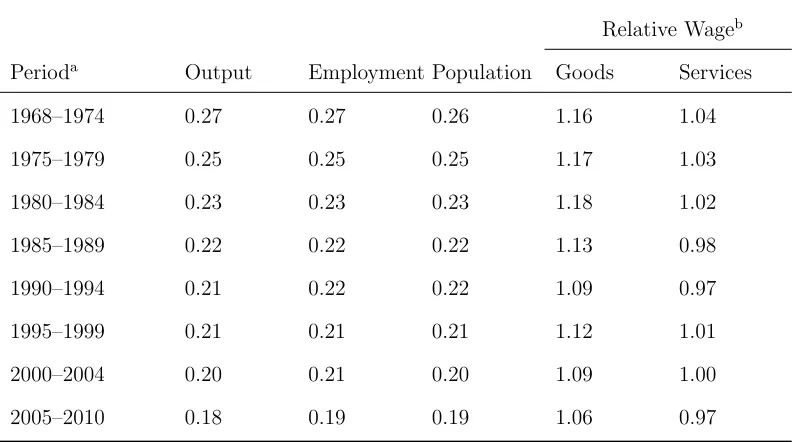
The Rust Belt region has experienced a relative decline in output, employment,
pop-ulation, and wages as seen Table 3.4. Between 1968 and 2010, the Rust Belt’s share of
output decreased by 9 percentage points, from 27 to 18 percent; its share of
employ-ment decreased by 8 percentage points, from 27 percent to 19 percent; and its share
of population decreased by 7 percentage points, from 26 percent to 19 percent.11
The region’s relative drop in wages is most pronounced in the goods sector; the
goods-sector wage gap between the Rust Belt and the rest of the U.S. decreased from
16 percent in 1968 to 6 percent in 2010. The wage gap in the service sector was
smaller than that of goods sector: it decreased from 4 percent to -3 percent over the
same period. Furthermore, the wage drop was not monotonic; there was a relatively
rapid drop during 1975–1994 period. The mean housing rents were higher in the Rust
Belt than in other areas by 7 percent in 1960, but 13 percent lower in 2010.
9See Bartik (2002) and Glaeser and Gottlieb (2008) for reviews. See also Moretti (2011) for an
overview of empirical studies on the place-based policies.
10See Busso, Gregory, and Kline (2012) and references therein.
11All nominal figures were converted to 1983 dollars using the gross domestic product (GDP)
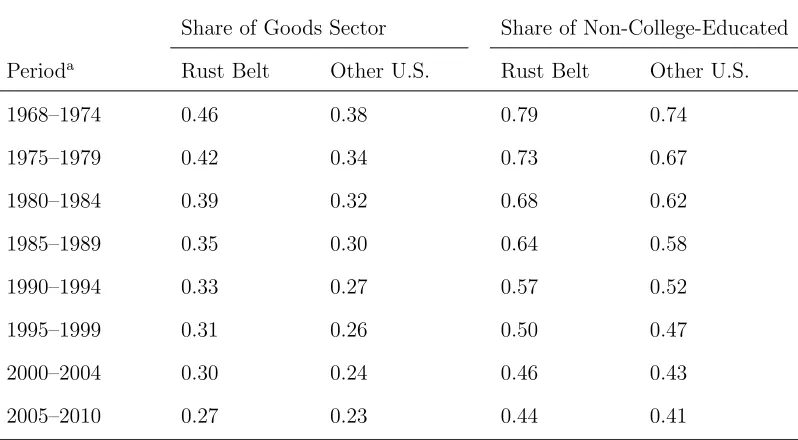
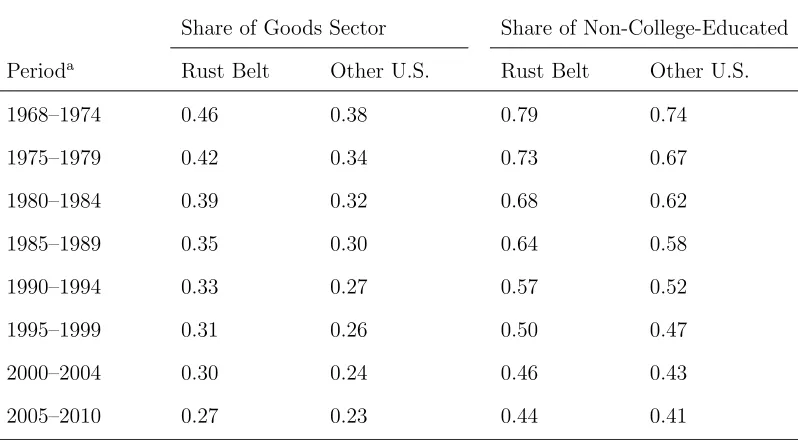
The sector composition of the two regions differed substantially throughout the
period, although similar changes occurred in both regions over time. Table 3.5 shows
the share of goods sector employment in each region.12 The share of goods sector
employment was higher in the Rust Belt by 8 percentage points in 1968–1974 period.
As the U.S. economy shifted from the goods sector to the service sector, the share of
the goods sector decreased in both regions. However, the gap in sector composition
between the two regions also decreased substantially. The share of the
non-college-educated population decreased substantially over the period in both regions (Table
3.5). In 1964–1969 period, the share of the non-college-educated in the Rust Belt was
4 percentage points higher than that of elsewhere in the U.S., but that figure had
increased to 6 percent in 1985–1989 period and then decreased to 3 percent by 2010.
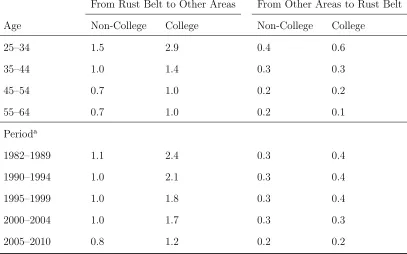
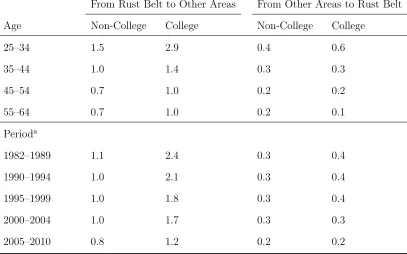
Table 3.6 shows gross flows between regions separately by education level. Younger
and college-educated individuals were more mobile than older and less-educated
in-dividuals. For example, 2.9 percent of college-educated individuals aged 25–34 in
the Rust Belt moved to other areas per year, but that figure was only 0.7 percent for
non-college-educated individuals aged 55–64. The regional mobility rate substantially
decreased over time, especially for college-educated individuals.
12The goods sector consists of the mining, construction, and manufacturing industry categories;
Chapter 2
Empirical Analysis
2.1
Model
2.1.1
Preliminaries
Consider a small open economy with two regions. In each region, there are three
production sectors: the goods-producing sector, the service sector, and the housing
sector. I begin with the assumption that factor and product markets are competitive.
However, these markets differ in their openness. Capital, goods, and service markets
are open, thus the real rental price of capital and real goods and service prices are
exogenous; that is, they are set internationally and taken as given. Labor and housing
markets are not only closed but also regional, and thus their prices are competitively
determined in each region.
On the labor demand side, to capture the efficient allocation of labor and capital
in the equilibrium, it is sufficient to specify production technologies at the
aggre-gate, rather than the firm, level. The setup is that there are eight labor skill types,
two (non-college; college) within each of four regional production sectors (the Rust
U.S.-services). The demand for each skill type is determined by their respective marginal
revenue products. The overall productivity of these sectors in each region can be
affected by region-specific technological change, sector-specific aggregate shocks, and
agglomeration externalities.
At each year between the ages of 25 to 64, individuals have a forecast of how wages
and housing rents will evolve in the future, and choose optimally among six discrete
alternatives: two location alternatives with three work alternatives (goods sector,
ser-vice sector, and out of labor force) within each of the locations. For each period, an
individual receives a wage offer from each region and sector which depends on the
competitively determined region- and sector-specific skill rental price and the
individ-ual’s accumulated sector-specific skill. The level of an individindivid-ual’s skill depends on
accumulated work experience in each sector. Transitions among alternatives involve
a mobility cost which can differ across demographic groups.
Housing services are produced by using capital and land, and are consumed locally.
The housing rental price for each region is determined by the aggregate demand for
and supply of the housing service in that region.
Specific model specification issues are addressed as the details of the model are
presented. Appendix A contains some additional functional form specifications.
2.1.2
Model Specification
Three production sectors are indexed by i ∈ {G: goods;S : service; H : housing}.
Two regions are indexed byj ∈ {1 : the Rust Belt; 2 : the remaining U.S.}.
Technology
The goods-producing sector and the service sector produce output (Y) using
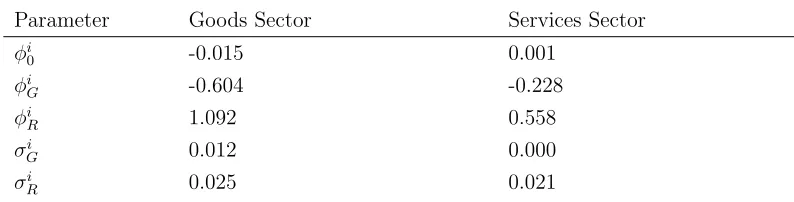
Each sector is also subject to an aggregate productivity shock (ζ). Specifically,
pro-duction of sector i located in region j at time t, valued at the sector’s period t real
price (p), is given by the Cobb-Duglas function,
pijt Ytij =pitζtiβtijaijt Fti LijN t, LijCt, Ktij
=ztiβtijaijt h LijN tα
i
2t
LijCt1−α
i
2tiα i
1t
Ktij1−α
i
1t
(i=G, S j = 1,2), (2.1)
whereβtij is location-specific advantage andaijt is the agglomeration externality of the
sector i in region j. Following Lucas and Rossi-Hansberg (2002), the agglomeration
externality depends on the aggregate skill density in the region:1
aijt = L
Gj N t Djt
!νi1
LSjN t Djt
!ν2i
LGjCt Dtj
!ν3i
LSjCt Dtj
!ν4i
(i=G, S j = 1,2),
where Dtj is the size of developed land in region j at timet.
Sector-specific real productivity, location-specific advantage, and factor shares
changes are assumed to be time-varying. The sector-specific real productivity is
sub-ject to shocks, zi
t = pitζti, that, evaluated at constant dollars (pit is the real price of
sectorioutput), are assumed to follow a joint first-order vector auto-regressive (VAR)
process in growth rates:2
logzit+1−logzti = φi0+ X
k=G,S
φi1 logzkt −logztk−1+it+1 (i=G, S), (2.2)
where the innovations are joint normal with the elements of the variance-covariance
matrixσz
ik,i, k =G, S. The location-specific advantageβ ij
t is assumed to be constant
1I allow spillovers across sectors.
2I do not distinguish between relative product price changes and sector-specific technological
up to 1960, then to follow piecewise linear trends with structural breaks at 1975, 1980,
1985, and 1990. The time-varying factor shares, reflecting factor-biased technological
change, are assumed to be constant up to 1960 and then to follow different linear
trends thereafter.
In each region j, housing services are produced using capital and land:3
Htj =KtHj αH
Djt1−α
H
(j = 1,2).
Demography
The economy consists of overlapping generations of individuals aged 25–64.
Individu-als are initially (at age 25) heterogeneous in terms of their education level,e ∈ {N, C},
and the region where they grew up, d0. In addition, the population consists of nθ
discrete unobservable types (Heckman and Singer, 1984; Keane and Wolpin, 1997) of
individuals who permanently differ in preferences and skill endowments. The
proba-bility distribution of thenθ types is discrete: An individual’s type probability depends
on the place he/she grew up (d0) and education level (e); πθ = P r(θ =i|d0, e) for
i = 1, ..., nθ. Type probabilities are time-varying to the extent that the education
level distribution has changed.
Choice Set
At each age, from a = 25, ...,64, individuals choose among six discrete alternatives:
two location alternatives Ja ∈ {1,2} with three work alternatives Ia ∈ {O, G, S} in
each location.4 They also decide on their consumption level of numeraire and housing
services: ca and ha. I define the following dichotomy variables to denote individual
3I ignore labor input for the housing services production function to simplify the analysis, since
the share of labor input in the housing sector is less than 5%.
decision:
dia =1{Ia =i}
dja =1{Ja =j}
dija =1{Ia =i, Ja=j}.
Preferences
The flow utility at each ageafor an individual of education leveleand typeθis given
by
Uaeθ=X
i,j
γeθijdija +X
j
uq(qtj)dja+uc(ca, ha)−mc
~
da, ~da−1;a, e
, (2.3)
where qtj is the quality of local public goods in region j, uc(·,·) is the separable
consumption branch of the utility function, and mc(·;a, e) is the psychic cost of
switching regions and/or sectors.
The utility specification allows for differential non-pecuniary benefits associated
with choosing each region-sector, given by γeθij for i = G, S, O and j = 1,2. To
capture the strong degree of persistence in the choice of regional alternatives, those
non-pecuniary benefits vary by an individual’s time-invariant type, given by γθj for
j = 1,2. I allow age-varying independent and identically distributed (i.i.d.) stochastic
shocks for the non-pecuniary benefit from choosing alternativeO (out of labor force).
Preference shocks are joint normal with elements of the variance-covariance matrix
given by σO
jk,j, k = 1,2. Specifically,
γθij =γij +γθj (i=G, S j = 1,2)
Individuals have log utilities over local public goods. Specifically,
uq(qjt) =γqlog(qjt).
The consumption branch of utility function has a Cobb-Douglas form.5 Namely,
uc(ca, ha) = (ca)1 −µ
(ha)µ.
Constraints
The individual faces the budget constraint
ca+
X
j=1,2
1 +τP tj pHjt hadja =
X
i=G,S
X
j=1,2
1−τItj −τF
wijat+yet
dija, (2.4)
where wijat is the real wage (earnings) an individual of age a receives from working
in region j and sector i at time t, pHjt is the housing rental price, τP tj is the local
property tax, τItj is the local income tax, τF is the federal income tax, and yet is the
education-type-specific non-labor income in period t.
An individual receives a wage offer in each period from each region and in each
sector. I follow the Ben-Porath-Griliches specification of the wage function. Each
sector-region-specific wage offer is the product of a sector-region-specific competitively
determined skill rental prices (r) and the amount of sector-region-specific skill units
possessed by the individual (l). Skill units are produced through work experience (x)
accumulated in each sector, and subject to idiosyncratic i.i.d. shocks. Specifically, a
type-θ individual’s (log) wage offer at ageaand calendar timetin sectoriand region
j is
logwija = logrtij + logleθaij (2.5)
= logretij +bi1eθ+ X
k=G,S bik2exka
!bi3
+ija.
Sector-specific work experience evolves as xia = xia−1 +dai−1, i = G, S. bi1eθ is the
(sector-specific) education-level-specific skill endowment at age 25 for an individual
of type θ, and the ij
a is an age-varying shock to skill (reflecting, for example, a
health shock). Sector-specific “composite” work experience is a weighted sum of work
experience across all sectors. Thus, in addition to the direct mobility cost associated
with switching employment to a different sector, there is also a loss to the extent
that accumulated work experience in the origin sector produces less composite work
experience in the destination sector, that is, there is a loss of specific skill.
Governments
The regional governments levy a property tax and an income tax based on the
exoge-nously given rates τP tj and τItj, and spend the revenues to provide local public goods.
The quality of local public goods are determined by the per capita expenditure in
each region (Epple and Sieg, 1999).
Given the linear utility specification, individuals do not have incentive to save,
and thus I assume the federal government levies income τF tax and uses the revenue
ΓF t to invest in domestic capital, Kt+1. Specifically
Kt+1 = (1−δ)Kt+ ΓF t,
Capital and Land Ownership
There are remaining rentals paid to owners of capital and land in this economy. λt
fraction of the total rental income is distributed to college-educated individuals, and
the remaining portion to non-college-educated individuals. Within the two education
groups, individuals own identical diversified portfolios of the domestic capital and
land, and thus have equal shares of domestic capital and land.
Market Clearing and Budget Balance
Each individual alive at time t maximizes the remaining expected discounted present
value of their lifetime utility given their age, subject to (2.3)-(2.5), by choosing among
the six alternatives. The maximized expected lifetime utility of an individual who is
age a at time t is given by
Va(Ωat) = max
{da,ca,ha}
A
X
τ=a
Eρτ−aUτ |Ωat
,
where ρ is the discount factor and Ωat is the information set (or state space) at age
a and time t. The information set consists of current idiosyncratic shocks, years of
education and work experience, current and past skill rental prices, housing rental
prices, non-labor income, the quality of local public goods, and aggregate shocks, as
well as other information used to forecast future prices.
At any time t, agents in the economy form a common forecast of the distribution
of future skill rental prices, housing rental prices, non-labor income, and the quality
of local public goods. Based on that forecast and each agent’s current state, the
alternative that is optimal is chosen. Aggregate skill supplied to each regional sector
is the sum of the skill units of the individuals who choose that alternative. Let Nat
are given by
LijN t = 64 X a=25 Nat X n=1
lijnatdijnat1 (enat =N) (i=G, S j = 1,2) (2.6)
LijCt = 64 X a=25 Nat X n=1
lijnatdijnat1 (enat =C) (i=G, S j = 1,2).
The aggregate supply of capital is perfectly elastic at the current rental price of
capital, and aggregate demand is equal to the sum of demand in the six regional
sectors. Given the static nature of the labor demand side of the model, aggregate
skill demand is determined by equating the marginal revenue product of aggregate skill
for each region and sector to its current (equilibrium) skill rental price. The amount
of capital used in each sector at time t is given by equating the marginal revenue
product of the capital to the exogenous rental price of the capital, rKt . Specifically,
∂pi tY
ij t zti, L
ij N t, L
ij Ct, K
ij t
∂LijN t =r
ij
N t (i=G, S j = 1,2)
∂pi tY
ij t zti, L
ij N t, L
ij Ct, K
ij t
∂LijCt =r
ij
Ct (i=G, S j = 1,2) (2.7)
∂pi tY
ij t zti, L
ij N t, L
ij Ct, K
ij t
∂Ktij =r
K
t (i=G, S j = 1,2).
The aggregate housing demand in regionj is the sum of the housing consumptions
of the individuals who choose the region j:
Htj = 64 X a=25 Nat X n=1
hnatd j
nat (j = 1,2).
Given the exogenous supply of developed land, the aggregate housing supply in region
rental price of the capital, rtK, so that
Htj = α
HpHj t rK
t
! αH
1−αH
Djt (j = 1,2). (2.8)
At each time t, the housing demand and supply in each region should be equal.
The regional governments levy a property tax and an income tax based on the
exogenously given rates τP tj and τItj, and spend the revenues ΓjP t and ΓjIt to provide
local public goods. The quality of local public goods is determined by the per capita
expenditure of the regional government,
qjt = Γ
j P t+ Γ
j It
Ntj (j = 1,2), (2.9)
where Ntj is the total population in region j at period t.
Let YtK and YtD denote the total rents at time t for domestic capital and land
respectively. Specifically,
YtK =rKt Kt
YtD = 2
X
j=1
pHjt Htj −rtKKtHj= 1−αH
2
X
j=1
pHjt Htj.
Then, the education-type-specific non-labor income in each period is given by
yCt =
λt YtK +YtD
NCt
yN t =
(1−λt) YtK+YtD
NN t
, (2.10)
where Net is the total number of individuals with education levele in this economy.
equilibrium skill rental prices, housing rental prices, non-labor income, and the quality
of local public goods.
vt=
rGN t1, rN tS1, rGN t2, rSN t2, rCtG1, rSCt1, rCtG2, rSCt2, pHt 1, pHt 2, yN t, yCt, qt1, q
2
t
I assume that the solution to (2.7)-(2.10) for the growth rate ofvtcan be approximated
by the function:6
logvti+1−logvit = ηi0+ 14
X
k=1
ηik logvtk−logvtk−1 (2.11) + ηi15 logztG+1−logztG+η16i logztS+1−logztS.
2.1.3
Solution Algorithm
The solution algorithm is an extension of the method developed in Lee and Wolpin
(2006).7 Given the parameters of the model, observed sequences of output in each
sector, the rental price of capital, the supply of land in each region, and local property
and income tax rates, the algorithm consists of the following steps:
6There can be an approximation error because the environment is non-stationary. For example,
I allow for the growth rates of population and land supply to be non-constant. Therefore, rational expectation would imply that the aggregate state variable process given by (2.11) is also time-varying. Furthermore, I am agnostic as to what individuals know about future technological changes (for example, βijt and αit) or about the future value of other exogenous variables, such as relative product prices, the rental price of capital.
7I assume the economy begins in 1860 when I implement the solution algorithm. The age
1. Choose a set of parameters for the equilibrium aggregate state variable process
(2.11) and for the aggregate shock process (2.2).
2. Solve the optimization problem for each cohort that exists from t= 1 through
t =T. The maximization problem can be cast as a finite horizon dynamic
program-ming problem. The value function can be written as the maximum over
alternative-specific value functions, Vij
a (Ωat), i.e., the expected discounted value of alternative
ij, that satisfies the Bellman equation, specifically,
Va(Ωat) = max i,j
Vaij(Ωat)
Vaij(Ωat) = max ca,ha
Uaij(ca, ha; Ωat) +ρEV Ωa+1,t+1|dijat = 1,Ωat
.
The solution to the optimization problem is in general not analytic. In solving the
model numerically, the solution consists of the values ofEV Ωa+1,t+1|dijat = 1,Ωat
for
all i, j, and elements of Ωat.8 The solution method proceeds by backward recursion.9
3. Let r10, p01, y01, and q10 denote the initial guesses for skill rental prices, housing
rental prices, non-labor incomes and the quality of local public goods att= 1. Given
the initial guess and the distribution of state variables for each cohort alive at that
time and between ages 25 and 64, simulate a sample of agents’ chosen alternatives
at t = 1 by drawing from the distribution of the idiosyncratic shocks to preferences
and skills. Given the simulated choices, proceed as a Gauss-Seidel algorithm. First,
compute aggregate skill supplies using relation (2.6), and equate the marginal product
of the capital in each of the four regional-production sectors to the rental price of
8I adopt the approximation method developed by Keane and Wolpin (1994) to circumvent the
curse of dimensionality.
9The equilibrium aggregate state variable process (2.11) is assumed to govern the choices made
capital, which is observed data. Equate the two production functions to the actual
output in the two production sectors. Solve the equations for the optimal capital input
in each region-sector and for the two aggregate shocks, z11. Calculate the marginal
product of the skill, at the calculated value of skill, capital, and shocks. Letr1
1 denote
the updated skill rental prices at period one.
Second, calculate rentals for capital and land using updated skill rental prices r1 1.
Compute individual non-labor income y1
1 using the relation (2.10). Third, compute
aggregate housing demand using the updated skill rental prices and non-labor income,
r11 and y11. Find the housing rental prices p11 that equate supply and demand of
housing services. Lastly, calculate regional tax revenues using r11, p11, and y11 and
find the quality of local public goods that satisfies the relation (2.9) to have q1 1. In
general, the updated aggregate state variables, v1
1 = (r11, p11, y11, q11), differ from the
initial guesses.
4. Update the initial guesses for the aggregate state variable to be equal to v1 1.
Repeat step 3 until the sequences of aggregate state variables and aggregate shocks
converge, say to v∗1 and z∗1.
5. Guess an initial set of values for the period two aggregate state variables, say
v0 2 =v
∗
1. Repeat steps 3–4 for t= 2 to obtain v
∗
2 and z
∗
2.
6. Repeat step 5 for t = 3, ..., T.
7. Using the calculated series of equilibrium aggregate state variables and
ag-gregate shocks, estimate (2.2), the VAR governing agag-gregate shocks, and (2.11), the
process governing the equilibrium prices.
8. Using these estimates, repeat until the series of aggregate state variables and
2.2
Estimation Method
The model parameters are estimated by simulated method of moments (SMM).10
Specifically, the SMM estimator minimizes a weighted distance measure between
sam-ple aggregated statistics and their simulated analogs. The weights are given by the
inverse of estimated variances of the sample statistics.
The data come from the several sources. The March Current Population Surveys
over the period 1968–2011 and the (restricted-use) National Longitudinal Surveys
1979 youth cohort over the period 1979–1993 provide information on life cycle
em-ployment, location and schooling choices, and wages; various U.S. Censuses from 1960
to 2010 provide data on housing consumption; and National Income and Production
Account (NIPA) provides data on sectoral capital stocks and outputs.11
The simulated aggregate statistics are generated for any given set of parameters
and the derived series of equilibrium prices and aggregate shock by simulating the
behavior of samples of 800 individuals per cohort, starting from cohorts that turned
age 25 in 1929 (and thus would be age 64 in 1968), and ending with cohorts that
turned age 25 in 2010. Therefore, cross-sectional simulated moments contain 32,000
observations. Simulated moments weight each cohort by their representation in the
population of 25 to 64-year-olds.
10The model parameters are identified by a combination of functional form and distributional
assumptions, along with exclusion restrictions. Identification of the wage offer parameters follows from standard selection correction arguments. Utility function parameters are identified because of the existence of variables in the wage function that do not enter the utility function; for example, sector-specific work experience. Identification of production function parameters follows from the existence of valid instruments for input level. Fore example, current and past cohort sizes and renal prices of capital are assumed to be exogenous, and thus are valid instruments. I do not estimate the subjective discount factor. It is instead fixed at 0.95.
11I follow the adjustment procedure that is suggested by Lee and Wolpin (2006) when I combine
The CPS data spans cohorts from 1904 and to 1985 during some period of their
lifetimes between the ages of 25 and 64. CPS data can be used to compute the
choice and wage distributions for those cohorts and ages. However, it does not have
a history of employment choices that would enable the calculation of work experience
because it is primarily a cross-sectional data set. The NLSY79 is a longitudinal data
set that surveys cohorts born from 1957 to 1964 annually from 1979 to 1994 and on a
biennial basis from 1996 to the present. I use the NLSY79 data to calculate aggregate
statistics that represent, or are conditioned on, sector-specific work experience.
The decision period is assumed to be annual in the estimation of the model. To
accommodate the fact that individuals do not necessarily engage in the same activity
over an entire calendar year, the choice variables are defined as follows: an individual
is assigned to the work alternative if he or she worked at least 39 weeks and at least
20 hours per week during the calendar year. When the individual is assigned to the
work category, his or her sector and location is that of the job held during the year
(CPS) or the most recent job (NLSY79). The hourly wage is based on the same job
assignment.
The following is a list of aggregate statistics that are employed in estimation:
1. Career decisions
CPS data
(a) The proportion of individuals choosing each of the six alternatives by year
(1968–2010) and age (25–64).
(b) The proportion of individuals choosing each of the six alternatives by year
and education level (non-college-educated; college-educated).
(c) The proportion of individuals choosing each of the six alternatives by year
(d) The proportion of individuals choosing each of the six alternatives at age
25 by year and location at age 20.
NLSY79 data
(a) The proportion of individuals choosing each of the six alternatives by
ex-perience and education level.
(b) The proportion of individuals choosing each of the six alternatives by
lo-cation at age 20 and edulo-cation level.
2. Wages
CPS data
(a) The mean of the log hourly real wage by region- and sector-categories,
education levels, and year.
(b) The variance of the log hourly real wage by region- and sector-categories,
education levels, and year.12
(c) The mean one-year difference in the log hourly real wage by current and
one-year lagged sector by education level.
NLSY79 data
(a) The mean log hourly real wage by work experience and education level.
(b) The mean log hourly real wage by location at age 20 and education level.
3. Mean non-labor income by year and education levels.
4. Housing expenditures13
(a) The mean of real housing rent by region and year.
(b) The mean of real housing rent by education level and year.
5. Distribution of education level over regions by year and age.
6. Career transitions
CPS data
(a) One-period joint transitions between two location alternatives by year
(1982–2010) and education level.
(b) One-period joint location transitions by age and education level.
(c) One-period joint transitions between two sectors by year.14
(d) One-period joint sectoral and home transitions by age and education level
(matched CPS).
Census data: five-period joint transitions between two location alternatives by
decade (1970–2010) and education level.
NLSY79 data: distribution of years of work experience in each sector.
7. Location- and sector-specific capital and output: by year.15
13Following Poterba (1992), I calculate the user cost of housing for a house of market value V
from the expression,
R= [(1−τy) (i+τj) +ξ]V,
whereτy is the marginal income tax rate,iis the interest rate,τj is the property tax rate, andξis a parameter that captures risk premium and depreciation. I setξ=−0.02 following (Poterba, 1992). I set the marginal tax rate based on tax brackets. For married couples, I impute individual housing expenditures using their wage income share.
14A number of years are missing because identifiers that match households between consecutive
years are not available. The missing transitions are between 1971 and 1972, 1972 and 1973, 1976 and 1977, 1985 and 1986, and 1995 and 1996.
2.3
Results
2.3.1
Parameter Estimates
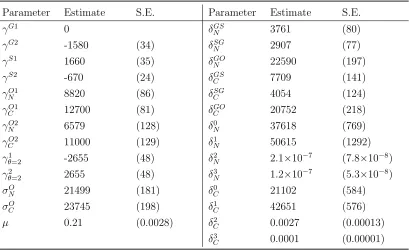
The parameter estimates and their standard errors are shown in Table 3.7–Table
3.11.16 I normalize some parameters because skill is not observable, but must be
inferred from wages. Thus, the constant terms in the skill production functions cannot
be separately identified from the level of skill rental prices. I normalize the constant
term in each sector skill production function for a type 1 person to zero. As a
result, the levels of skill rental prices across sectors are not comparable, although
their changes over time are identified. The non-pecuniary benefits associated with
employment in the goods sector of the Rust Belt are also normalized to zero for a
type 1 person. Therefore, the non-pecuniary benefits of working in the service sector
and consumption values of leisure are relative to this normalization.
The parameters are categorized in the tables as they appear in the model section
according to their equation number. I discuss those that are of particular interest.
Production Function Parameters
Figure 3.5 provides evidence of the significant reduction of the Rust Belt’s
location-specific advantage and the relative decline of goods sector real productivity from 1960
to 2010. The Rust Belt region was 13 percent more productive in producing goods
than other areas in 1960; however, the advantage had fallen to 3 percent in 2010. In
the service sector, the Rust Belt had a small location-specific advantage in 1960, but
had become less productive than other areas in 2010. The combination of product
16LetGbe the matrix of derivative of the moments with respect to the model parameters, andS
price changes and Hicks-neutral technological change led to a relative decline in the
real productivity of the goods sector.
The magnitude of agglomeration externality is small. It explains only one
per-centage point drop in the relative productivity of the goods sector in the Rust Belt.
For the service sector, the agglomeration externality did not play any role.
Utility Parameters
Mobility costs are presented in Table 3.9. The cost of moving between regions within
the same sector is estimated to be significantly larger than moving between sectors
within the same region. For example, for a non-college-educated person aged 26,
the cost of moving between regions is $50,600, but for the same person, the cost of
changing sectors within a region ranges only from $2,907 to $3,761. When changing
regions within a sector, however, the cost is higher for less-educated individuals. For
example, within a sector, the inter regional moving costs are $50,615 and $42,651 for
non-college-educated and college-educated individuals respectively. Conversely, the
cost of changing sectors within a region is higher for college-educated individuals.
For example, the cost of moving from goods sector to the service sector in the same
region is $3,761 and $7,709 for non-college-educated and college-educated individuals
respectively.
Skill Production Functions
Table 3.10 shows the estimates for skill production function parameters. Experience
obtained in a given sector is more transferable to other sectors for college-educated
individuals than for non-college-educated individuals. For example, in the case of
skills gained by non-college-educated individuals in the service sector, the weight on
in the service sector is 0.052. However, in the case of service sector college-educated
skill, the weight on experience gained in the goods sector is 0.047, but the weight on
experience obtained in the service sector is 0.122.
2.3.2
Model Fit
Table 3.12–Table 3.17 present evidence on how well the model fits the data. Table
3.12 compares the Rust Belt shares of output, employment, and population over time
in the actual data to that from the estimated model. The fit for the Rust Belt shares
of output, employment, and population are very close, capturing their decrease over
time. Table 3.13 shows the relative (Rust Belt-to-other U.S. areas) hourly wage by
sector. The fit for the relative hourly wages is also close, although it is slightly
underestimated for the service sector.
The fit of the model with respect to the composition of the workforce and
popu-lation in each region is also close. Table 3.14 shows that the model captures both the
Rust Belt’s higher specialization in the goods sector and the declining goods-sector
share of employment in both areas. As in Table 3.15, the proportion of non-college
educated individuals in each region is also matched very well.
The fit of the model with respect to the extent of state dependence in the choice of
region, in particular, one-period transition rates, is also matched quite well. Table 3.16
shows that the model can fit the fact that young and college-educated individuals are
more mobile than older and less-educated individuals. As in Table 3.17, the estimated
Chapter 3
Welfare and Policy Analysis
3.1
The Decline of the Rust Belt
There are four major exogenous factors in the model that can account for the
rela-tive decline of the Rust Belt: (1) the reduction in the Rust Belt’s location-specific
advantage in the goods sector; (2) the reduction in the Rust Belt’s location-specific
advantage in the service sector; (3) the relative decline of the goods sector real
pro-ductivity in the U.S. economy; and (4) the relative decline of the non-college-educated
population in the U.S. economy. The first three factors are labor demand side
ex-planations for the decline of the Rust Belt. The fourth factor is a labor supply side
change.
To isolate the importance of each factor, I perform the following thought
experi-ment. Suppose the world had stopped changing after 1960 in terms of the four factors
mentioned above. When compared with that world, how would the U.S. economy have
evolved under alternative scenarios in which some of these factors changed as they
did in actuality and others did not, and would those new worlds diverge from what
I consider six counterfactual scenarios. Experiment 1 allows for the reduction of
the Rust Belt’s location-specific advantage in the goods sector. Experiment 2 allows
for the reduction of the Rust Belt’s location-specific advantage in the service sector.
Experiment 3 allows for the real productivity of both sectors to evolve as actually
occurred. Experiment 4 allows for the share of the non-college-educated population in
the U.S. to evolve as it actually did. Experiment 5 simultaneously implements factors
in experiments 1, 2, and 3. And finally, Experiment 6 simultaneously implements
factors in experiments 1, 2, 3, and 4.1
Table 3.20 shows the effects of these four factors on the Rust Belt’s share of
output, employment, and population. I find that each of the four factors accounts
for a substantial part of the relative decline of the Rust Belt. With respect to the
decline of the Rust Belt’s share of output and employment, demand side factors are
important. The results for Experiments 1 and 2 show that about 50 (29) percent of the
decline in the Rust Belt’s share of output can be attributed solely to the reduction in
the Rust Belt’s location-specific advantages in the goods (service) sector. The result
for Experiment 3 shows that the declining real productivity of the goods sector in
U.S. economy explains about 25 percent of the decline.
The labor supply side factor was important for the reduction in the Rust Belt’s
share of the population. My estimate implies that non-college-educated individuals
get higher utility from living in the Rust Belt than the college-educated do. Thus the
reduction in the share of the non-college-educated population generates the relative
decline of the Rust Belt population. Experiment 4 shows that the drop in the share
of the non-college-educated population in the overall U.S. population can account for
1For each simulation, I assume that the distribution of entering cohort’s (age 25) initial location
45 percent of decline in the Rust Belt’s overall share of population.2
Table 3.21 shows the effects of these four factors on the relative (the Rust
Belt-to-other areas) wages and quality of local public goods. As expected, the labor supply
side factor (Experiment 4) cannot account for any part of the relative decline of wages
and the quality of public goods in the Rust Belt. On the other hand, the combined
effect of labor demand side factors (Experiment 5) led to a decrease in the relative
wages and quality of local public goods more than actually occurred.
3.2
Welfare Analysis
In this section, I compute the difference in welfare between individuals in the two
regions in two scenarios: (1) the difference in welfare between individuals who reside
in the Rust Belt at age 20 and those who reside in other areas at age 20; and (2) the
welfare differences for individuals at ages 45–64 with at least 10 years of experience
in the goods sector. The differences are presented in terms of the present value of the
welfare, which are computed over the actual transition path. The welfare differences
are computed for different cohorts and demographic groups.
The first two columns in Table 3.22 show that the welfare losses of the individuals
in the Rust Belt were larger for the non-college-educated population and increased
over time. However, the magnitude of the welfare loss was not large in spite of the fact
that the relative wage of the Rust Belt decreased by more than 10 percentage points
over time. This can be explained by the fact that individuals are relatively mobile
between ages 20 and 25; on average about 8% (22%) of non-college-educated
(college-2More precisely, type 1 individuals get higher utility from choosing the Rust Belt than type 2
educated) individuals moved out of the Rust Belt between ages 20 and 25. The last
two columns in Table 3.22 show that the welfare losses are large for individuals who
are older and have long experiences in goods sector. As expected, the welfare is higher
for individuals in the Rust Belt before 1980 because the older individuals’ remaining
lifetime welfare is mostly determined by the higher goods sector (real) wage in the
Rust Belt (Table 3.23). However, between 2000–2004, the welfare of individuals in the
Rust Belt is lower by 9.7% and 5.8% for non-college-educated and college-educated
individuals respectively.
3.3
The Effects of Place-Based Policies
In this section, I describe the results of simulation experiments designed to examine
how government place-based policies (such as wage or moving subsidies) for the Rust
Belt can influence the dynamic adjustment process, welfare inequality across regions,
and total welfare of the economy.3 To satisfy the budget balance need, the costs of
policies are equally distributed to all the individuals in the economy in the form of a
lump-sum tax.4
First, I consider 10% and 20% wage subsidies for the Rust Belt. The wage subsidy
program is a major part of the Empowerment Zone program that was implemented
in several distressed communities in the U.S. from 1994 to 2009. Firms in the
Em-powerment Zone were eligible for a credit of up to 20% of the first $15,000 in wages
earned in that year by each employee who lived and worked in the community (Busso,
Gregory, and Kline, 2012).
3Total welfare of the economy is sum of all the individual utilities in the economy. As I mention
in Section 3, individuals are owners of labor, domestic capital, and land; therefore, their utilities capture the welfare of capitalists and landlords as well as workers.
4More precisely, each individual’s non-labor income decreases to pay the lump-sum tax.
I also consider a moving subsidy as an alternative policy to mitigate the
wel-fare gap between the regions. Specifically, I subsidize 100% of mobility costs of
non-college-educated (college-educated) 25-year-old individuals who resided in the
Rust Belt at the age 20. The subsidies amount to $37,617 ($21,101) for
non-college-educated (college-non-college-educated) individuals.
Table 3.24 shows the subsidies’ impacts on the Rust Belt’s shares of output,
em-ployment, and population, as well as on the relative wages. The 10% wage subsidy
program reduces the drop in the Rust Belt’s shares of output, employment, and
pop-ulation by approximately 50 percent. However, its impact on the relative wage is
modest. The 20% wage subsidy program enables the Rust Belt to actually increase
its shares of output, employment, and population. In addition, the 20% subsidy
sub-stantially reduces the fall in the relative wage in the Rust Belt. The moving subsidy,
however, exacerbates the decline of the Rust Belt; with it in place, the region’s share
of output, employment, and population decrease further compared to the baseline
case.
Table 3.25 compares the subsidies’ impacts on welfare inequality across regions.
The difference in welfare between the individuals residing in the Rust Belt and those
residing in other areas at age 20 can be reduced about 60%, compared to the baseline
case, by enacting a 10% subsidy. The welfare of the individuals residing in the Rust
Belt actually becomes higher than its counterpart in other areas under the 20% wage
subsidy program. The moving subsidy can also substantially reduce the welfare gap;
the magnitude of its effect is similar to that of 10% wage subsidy.5
Since these policies are implemented at the federal (national) level, it is worthwhile
5The moving subsidy increases the non-college-educated (college-educated) individual’s mobility
to examine their impacts on the entire U.S. economy. Table 3.26 shows the subsidies’
impacts on the employment rate of the economy. The 10% (20%) wage subsidy
increases the employment rate of the Rust Belt by 7.1 (15.9) percentage points. Wages
subsidies also increase the employment rate of the remaining parts of the U.S. This
implies that the wage subsidies generate a net migration flow from the remaining parts
of the U.S. to the Rust Belt; and furthermore, one that is disproportionately composed
of individuals who would have remained out of the labor force in the remaining part of
the U.S. were it not for the wage subsidies that enticed them into the workforce in the
Rust Belt. On the other hand, the moving subsidy decreases the overall employment
rate of the Rust Belt and increases the employment rate of the remaining parts of the
U.S. This implies that the moving subsidy generates a different net migration flow, this
one from the Rust Belt to the remaining parts of the U.S., that is disproportionately
composed of individuals who would have worked in the Rust Belt were it not for
the moving subsidy. The moving subsidy increases the employment rate of the total
economy by reallocating people from the Rust Belt to the remaining part of the U.S.
where overall employment rate is higher.
As seen in Table 3.26, all subsidies increase the total output as the employment
rate increases. The wage subsidy disproportionately increases the output of the goods
sector by increasing the employment rate of the Rust Belt, which has location-specific
advantage in producing goods. On the other hand, the output of the goods sector
decresases under the moving subsidy because the workforce in the Rust Belt migrates
to the remaining parts of the U.S. in which the goods-sector accounts for a relatively
small proportion of production.
Table 3.26 also shows the subsidies’ impacts on the welfare of the economy. The
10% (20%) wage subsidy results in a 0.39% (1.72%) decrease in the total welfare.