University of New Hampshire Scholars' Repository
Languages, Literatures, and Cultures Scholarship
Languages, Literatures, and Cultures
4-1-2016
Autonomous Learning through Task-based
Instruction in Fully Online Language Courses
Lina Lee
University of New Hampshire, Durham, [email protected]
Follow this and additional works at:
https://scholars.unh.edu/lang_facpub
Part of the
Spanish and Portuguese Language and Literature Commons
This Article is brought to you for free and open access by the Languages, Literatures, and Cultures at University of New Hampshire Scholars' Repository. It has been accepted for inclusion in Languages, Literatures, and Cultures Scholarship by an authorized administrator of University of New Hampshire Scholars' Repository. For more information, please [email protected].
Recommended Citation
AUTONOMOUS LEARNING THROUGH TASK-BASED INSTRUCTION
IN FULLY ONLINE LANGUAGE COURSES
Lina Lee, University of New Hampshire
This study investigated the affordances for autonomous learning in a fully online learning environment involving the implementation of task-based instruction in conjunction with Web 2.0 technologies. To that end, four-skill-integrated tasks and digital tools were incorporated into the coursework. Data were collected using midterm reflections, post-surveys and final interviews from two online elementary language courses. The results indicate that the types of tasks and digital tools utilized fostered learner autonomy in different ways. Structured tasks enabled students to work independently to create content, whereas open-ended tasks allowed them more freedom in exploring the understanding of a particular topic through social interaction. Significantly, teacher scaffolding through modeling and timely feedback affected student self-regulated efforts in online learning. The study concludes that personal commitment to the coursework and cognitive
engagement with the learning material contributed to the degree of learning autonomy and the level of social interaction in fully online language learning.
Language(s) Learned in this study: Spanish
Keywords: Learner Autonomy, Instructional Design, Task-based Instruction, Virtual Environments
APA Citation: Lee, L. (2016). Autonomous learning through task-based instruction in fully online language courses. Language Learning & Technology, 20(2), 81–97. Retrieved from http://llt.msu.edu/issues/june2016/lee.pdf
Received: March 11, 2015; Accepted: August 2, 2015; Published: June 1, 2016 Copyright: © Lina Lee
INTRODUCTION
Given the rapid growth of online education supported by emerging technologies, online courses are becoming a more widely popular and viable option for many adult learners. Through watching YouTube videos, listening to podcasts, reading online news, and chatting with native speakers, today’s L2 learners can easily access a wide variety of online resources and connect with others anytime and anywhere. Accordingly, a number of language programs (e.g., UCLA, University of North Carolina at Chapel Hill) have embraced the power of e-learning to offer courses in a hybrid format or exclusively over the Internet with the intention of increasing flexibility, improving productivity, and reducing costs (Blake, 2011; Rubio & Thomas, 2012). In addition to course management systems like Blackboard and Moodle, commercial web platforms designed by language experts, including Livemocha and Mango have been increasingly employed to deliver online course content. While online courses offer some advantages (e.g., convenience, self-pacing) over learning in a traditional classroom environment, there are some inherent drawbacks, such as the lack of face-to-face interaction and the requirement of self-regulation (Gilbert, 2001). Consequently, students may feel less motivated, and thereby engage less actively in the learning process and fail to take full advantage of the learning opportunities afforded by online courses. Thus, it is vital to create stimulating learning conditions that promote interaction and collaboration through
community building, and importantly, to cultivate student interest and ability to learn autonomously.
collaboration, and learner autonomy among others (e.g., Guth & Helm, 2010; Lai, 2013; Levy & Stockwell, 2006). Research findings show that students reacted positively to online courses and performed similarly to those in the face-to-face settings (e.g., Blake, 2011). However, the lack of computer literacy and skills, face-to-face communication, and teacher guidance for active learning are viewed as potential drawbacks of CALL (e.g., Reinders & Hubbard, 2013). Despite the fact that existing research strengthens our understanding of the effect of CALL on L2 development and its affordances of autonomous learning (see below), most findings are drawn from blended courses or technology-enhanced learning in the form of extracurricular activities (e.g., Lai, Zhao & Wang, 2011; Lee, 2010). As of yet, no evidence from L2 research studies has been found regarding the potency of digital technologies on learner autonomy within a fully online context. Understanding how L2 learners perceive and perform their roles in online learning is essential to language educators interested in implementing online courses. Therefore, this study aims to explore the effectiveness of task-based instruction (TBI) mediated by digital tools on learner autonomy using data collected from two online language courses. A series of pedagogical choices were made with the intent of facilitating online instruction to promote active, independent, and interactive learning. Task types, communication modes, student engagement with the course, and teacher scaffolding were examined to address the affordances and limitations of the virtual learning environment.
LITERATURE REVIEW Learner Autonomy and CALL
Learner autonomy is widely recognized as a key element of language learning and has received a great deal of attention from L2 researchers and practitioners over the years (e.g., Dam, 2011). Autonomy takes a variety of forms that can be promoted in different ways and to different degrees depending on each learner and learning context. Autonomy has been defined as “the ability to take charge of one’s own learning” (Holec, 1981, p. 3). While learner autonomy emphasizes independence and self-regulation, it is not the same as study or access learning. Rather, it concerns embarking on the path of self-directed learning through which the learner takes initiatives, monitors progress, and evaluates individual learning outcomes (Benson, 2013). To explore the field of autonomous learning, Tassinari (2012) developed a dynamic model, which entails cognitive, metacognitive, social, and affective dimensions of learner autonomy. The model suggests that learners become more aware of their own learning by means of self-assessment and self-reflection on the learning process. To foster autonomy, teachers need to use affective strategies, such as reducing learner anxiety and encouraging learners to monitor their own stress and emotions. To foster learner autonomy, the teacher as expert plays a vital role in guiding, monitoring, and evaluating the learning process (Little, 2007).
that tasks need to be attainable and conducive to student interest and motivation in order to inspire learner autonomy. Teachers not only need to create pedagogically sound CMC tasks, but also build a supportive online learning community to connect with students and foster peer interaction (e.g., Hafner & Miller, 2011).
Online Task-based Learning Instruction
Digital technologies and multimodal communication make it possible for L2 teachers to create optimal TBI, which is interactive, contextualized, and authentic. TBI holds great potential for fostering self-directed learning by purposefully engaging students in the learning process. Through TBI, students use the target language to carry out communicative tasks linked to real-world contexts (Leaver & Willis, 2005). TBI stems directly from communicative language teaching focusing on meaningful language use and is largely socio-constructivist in nature (Van de Branden, 2006). Communicative tasks put learners in the center of the learning such that they make use of linguistic resources in order to share and exchange information. Rather than manipulating isolated linguistic forms, tasks afford learners ample opportunities for meaning negotiation, language production, and focus on form (Ellis, 2003). Thus, TBI facilitates and promotes second language acquisition.
CMC researchers have conducted a number of studies on the implementation of TBI across different instructional contexts (e.g., Lee & Markey, 2014; Thomas & Reinders, 2010). Effective tasks encourage active participation, interaction, and collaboration among L2 learners (Hampel, 2010). Significantly, tasks enable learners to pay attention to both meaning (idea) and form (grammar), which raises language awareness and further enhances the development of interlanguage in both asynchronous and synchronous CMC (e.g., Lee, 2008). Yilmaz (2011) points out that task type affects the way learners interact and negotiate meaning, as well as their language production. For example, information exchange activities enhance learners’ understanding of grammar points through expert scaffolding. In addition, learner benefit from linguistic scaffolding and further improve their accuracy in the L2 (Lee, 2011b). While CMC tasks promote learner motivation and interactive engagement, the challenge of multimodality, language proficiency levels, technical difficulties, and computer literacy may create learner anxiety and further affect task performance (e.g., Hampel, 2010; Lee, 2010).
Despite the fact that the existing research provides valuable insights into the use of TBI for online learning and its potential benefits and drawbacks related to learner autonomy, the question remains as to how TBI can be implemented effectively to provide students with a similar interaction to what they would experience face-to-face. Thus, the study explores the affordances and challenges of online TBI mediated by Web 2.0 technologies associated with autonomous learning in online courses at university level. The study addresses design features and course practices, including task types, digital tools, processes, interaction modes, and teacher interventions and further highlights students’ reactions to online TBI and teacher scaffolding through modeling in support of autonomous learning.
RESEARCH QUESTIONS
The three central questions addressed in this study are as follows:
1. How do students view TBI in conjunction with the use of digital tools in support of autonomous learning?
2. What factors that affect how students regulate their own learning have emerged from the use of online TBI?
METHODOLOGY Context of the Study
The study was set up using two fully online sections of a second semester beginning Spanish course1 (Elementary II) over the two consecutive summers of 2013 and 2014. Online summer courses allow students convenience and flexibility to accommodate their busy schedules and help them complete the language requirement off campus. The online format aims to develop students’ basic communicative language skills and their knowledge of the target culture. In addition to the commercial e-text version of Mosaicos and the electronic workbook, MySpanishLab, both synchronous and asynchronous CMC tools were utilized to promote interaction and collaboration among students and the instructor, as well as to build an online learning community. Task-based activities were created for both individual and collaborative assignments. To support and optimize learning, the instructor provided students with guidance and corrective feedback throughout the course. It was hoped that a shift from a teacher-driven to a learner-centered approach through TBI would foster students’ autonomous learning. Moreover, online self-access support by using a class wiki site would motivate and engage them in learning tasks
independently and collaboratively. Participants
Forty-eight students participated in the study. All participants were native speakers of English and they had a basic knowledge of Spanish vocabulary and structures. More than 90% of the students had successfully completed the first semester of introductory Spanish (Elementary I) before enrolling in Elementary Spanish II. The participants were 67% female, 33% male, and between the ages of 19 and 32. Fewer than 10% of the students were sophomores (n = 4), 10% were juniors (n = 5), more than 70% were seniors (n = 35) and fewer than 10% were non-degree students (n = 4). None of them were Spanish majors or minors. Since more than 90% of the students (n = 46) enrolled in the course in order to fulfill the institutional L2 graduation requirement and were not particularly interested in taking Spanish for personal enjoyment, they were not considered to be highly motivated language learners. Only two non-traditional students who had worked in Mexico and Costa Rica for a short period of time enrolled in the course due to personal interest in learning Spanish. In terms of computer knowledge and skills, the majority of students were competent users of Web 2.0 technology, including social media, as they grew up in the digital age. Most students had taken an online course offered by the university prior to the study. Thus, they were familiar with Blackboard used by the researcher’s institution.
Course Design, Materials, and Digital Tools
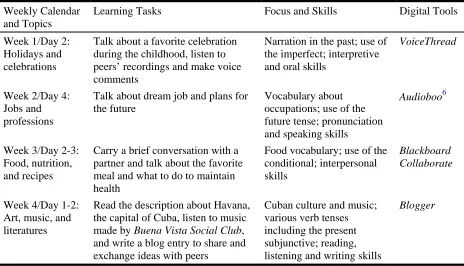
The course was designed based on task-based activities supported by Chapelle’s (2001) six criteria for CALL task appropriateness (e.g., learner fit, meaning focus, authenticity) and the major principles of language acquisition (e.g., input, interaction, output). In addition to input-based practices via an electronic platform, MySpanishLab provided by the textbook publisher, course materials focusing on output-based activities were created and housed in a private class wiki2 via Wikispaces. The class wiki contained a collection of wiki pages, which listed all of the course information, such as course description, course components, weekly calendar, tools, grading, and resources. A teacher-made video3 was used to provide students with step-by-step instructions on how to use the wiki site and digital tools along with video tutorials from YouTube. Daily learning materials with hyperlinks were listed under the weekly calendar page. Both teacher-made and YouTube videos were incorporated into daily lessons to help students learn vocabulary and grammar. All completed assignments were submitted and uploaded to various wiki pages accordingly. For example, blog links were posted on the Blogger page, whereas VoiceThread4 cultural projects were embedded into the VoiceThread presentation page.
pedagogical values. For example, Blogger allowed students to practice writing through self-expression, and further share and exchange ideas through social networking, whereas Blackboard Collaborate5 was used to conduct web conferencing sessions through which students developed interpersonal
communication skills.
Table 1. Four-Skill-Integrated Tasks and Digital Tools
Weekly Calendar and Topics
Learning Tasks Focus and Skills Digital Tools
Week 1/Day 2: Holidays and celebrations
Talk about a favorite celebration during the childhood, listen to peers’ recordings and make voice comments
Narration in the past; use of the imperfect; interpretive and oral skills
VoiceThread
Week 2/Day 4: Jobs and professions
Talk about dream job and plans for the future
Vocabulary about occupations; use of the future tense; pronunciation and speaking skills
Audioboo6
Week 3/Day 2-3: Food, nutrition, and recipes
Carry a brief conversation with a partner and talk about the favorite meal and what to do to maintain health
Food vocabulary; use of the conditional; interpersonal skills
Blackboard Collaborate
Week 4/Day 1-2: Art, music, and literatures
Read the description about Havana, the capital of Cuba, listen to music made by Buena Vista Social Club, and write a blog entry to share and exchange ideas with peers
Cuban culture and music; various verb tenses including the present subjunctive; reading, listening and writing skills
Blogger
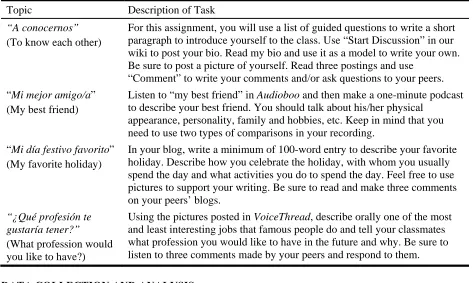
Based on major themes of chapters, various types of tasks were created to develop student language skills and cultural knowledge (see Table 2).
Table 2. Sample Topics and Tasks for Online Assignments
Topic Description of Task
“A conocernos” (To know each other)
For this assignment, you will use a list of guided questions to write a short paragraph to introduce yourself to the class. Use “Start Discussion” in our wiki to post your bio. Read my bio and use it as a model to write your own. Be sure to post a picture of yourself. Read three postings and use
“Comment” to write your comments and/or ask questions to your peers.
“Mi mejor amigo/a” (My best friend)
Listen to “my best friend” in Audioboo and then make a one-minute podcast to describe your best friend. You should talk about his/her physical
appearance, personality, family and hobbies, etc. Keep in mind that you need to use two types of comparisons in your recording.
“Mi día festivo favorito” (My favorite holiday)
In your blog, write a minimum of 100-word entry to describe your favorite holiday. Describe how you celebrate the holiday, with whom you usually spend the day and what activities you do to spend the day. Feel free to use pictures to support your writing. Be sure to read and make three comments on your peers’ blogs.
“¿Qué profesión te gustaría tener?” (What profession would you like to have?)
Using the pictures posted in VoiceThread, describe orally one of the most and least interesting jobs that famous people do and tell your classmates what profession you would like to have in the future and why. Be sure to listen to three comments made by your peers and respond to them.
DATA COLLECTION AND ANALYSIS Midterm Reflections
At the midterm of the course, open-ended questions were used to allow students to reflect upon (1) the usefulness of the course wiki and CMC tasks, (2) the practicality of digital tools, and (3) the effectiveness of teacher scaffolding in relation to autonomous learning. Open-ended questions allowed students to freely express their viewpoints using the retrospective method (Cohen, Manion, & Morrison, 2007). 73% of the students (n = 35) posted their answers anonymously via SurveyMonkey.
Post-Surveys
The post-surveywas designed to capture learners’ viewpoints of the affordances of online courses on autonomous learning processes and their L2 development. It should be noted that the post survey was designed based on Lee’s (2011a) questionnaire concerning four aspects of online autonomous learning in relation to the use of online TBI (see Table 1). 79% of the students (n = 38) voluntarily completed the survey via SurveyMonkey. The survey consisted of 12 statements that elicited responses in relation to learner autonomy. To find out students’ reactions to teacher scaffolding, an additional five statements were employed as part of the post-survey. The survey used a 5-point Likert scale ranging from Strongly Disagree to Strongly Agree to gauge different viewpoints. Students indicated their level of satisfaction by ranking the questions from 1 to 5 (5 being the highest score) along with an explanation of each rating. Students also rated the effectiveness of different types of tasks and the usefulness of digital tools. Final Interviews
A conceptual content analysis of student reflective reports and final interviews was used to identify factors that challenged students and afforded them the opportunity to carry out the online course. Reflective reports were read and analyzed using open coding procedure to identify the recurring themes that emerged in the reports (Saldaña, 2009). The common themes were subsequently sorted into three major categories: autonomous learning (e.g., making plans, taking initiative, level of commitment, motivation), benefits from using online tasks and digital tools (e.g., social interaction, reflective thinking, teacher scaffolding), and challenges associated with online courses (e.g., lack of time, social presence, language proficiency). Qualitative data from readily available blog posts and oral recordings together with comments provided additional evidence to illustrate and support the findings.
RESULTS AND DISCUSSION
Student Reactions to TBI Regarding Autonomous Learning
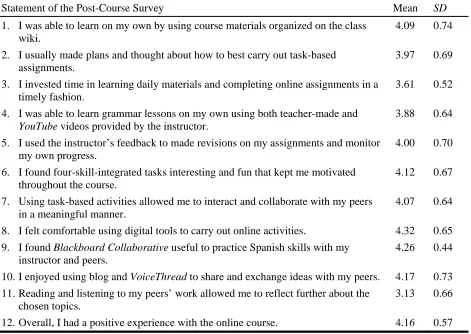
Table 3 reports student views on the use of TBI in relation to autonomous learning. The high rating of Statement 12 (Mean = 4.16) indicates that most students reacted very favorably to the online course. Most students agreed that using TBI was an effective way to develop their language skills and learn about the target culture.
Table 3. Students’ Reactions to Online TBI Regarding Autonomous Learning
Statement of the Post-Course Survey Mean SD
1. I was able to learn on my own by using course materials organized on the class wiki.
4.09 0.74
2. I usually made plans and thought about how to best carry out task-based assignments.
3.97 0.69
3. I invested time in learning daily materials and completing online assignments in a timely fashion.
3.61 0.52
4. I was able to learn grammar lessons on my own using both teacher-made and YouTube videos provided by the instructor.
3.88 0.64
5. I used the instructor’s feedback to made revisions on my assignments and monitor my own progress.
4.00 0.70
6. I found four-skill-integrated tasks interesting and fun that kept me motivated throughout the course.
4.12 0.67
7. Using task-based activities allowed me to interact and collaborate with my peers in a meaningful manner.
4.07 0.64
8. I felt comfortable using digital tools to carry out online activities. 4.32 0.65
9. I found Blackboard Collaborative useful to practice Spanish skills with my instructor and peers.
4.26 0.44
10. I enjoyed using blog and VoiceThread to share and exchange ideas with my peers. 4.17 0.73
11. Reading and listening to my peers’ work allowed me to reflect further about the chosen topics.
3.13 0.66
12. Overall, I had a positive experience with the online course. 4.16 0.57
example, explained the following during the final interview:
“I think the wiki was an organized way to find assignments. Everything was laid out in a clear way within a single shared space. I got used to the wiki very quickly. Knowing what exactly was due and when ahead of time gave me more control of my own learning. It helped me think about how to go about completing all assigned activities.”
The above comment reveals that easy access to the course content and activities facilitated the learning process. Students managed to adjust their own schedules accordingly in order to complete online assignments (Statement 2). They repeatedly remarked that weekly calendars were very useful to them because they were able to make plans ahead of time. A few students, however, admitted that they had to learn quickly to be more self-efficient and not fall behind in the course schedule. As might be expected, some students were more self-determined and self-regulated than others. It is also possible that they might have had different expectations and goals for their own learning. Self-regulation is pivotal to the success of online learning. It would be particularly useful to teach online students management and self-monitoring strategies to increase learner autonomy, as suggested by Lai and Gu (2011) and Ranalli (2012).
As to time investment, more than 70% of the students reported that they spent time learning new materials and completing the coursework (Statement 3). There appeared to be a clear consensus among the students that course materials prepared by the instructor motivated them to learn on their own initiative (Statement 4). Moreover, 80% of the students noted that they took up teacher feedback to make error correction and further were able to monitor their own progress (Statement 5). One student wrote the following comment in the midterm reflection:
“The teacher’s feedback was fast and really thought out. I found teacher feedback very beneficial. It helped me understand what I was doing wrong and how to fix it. I actually enjoyed revising the blog entries. I know I became more aware of what I wrote and was able to catch some of my own mistakes before posting my assignments.”
These findings clearly demonstrate that the course wiki granted students the ability to take an active role of their own learning and stay focused on making progress in their coursework.
Despite the positive results, nearly 30% of the students (n = 11) found maintaining daily assignments demanding. One student, for example, acknowledged being unable to complete some of oral recordings and missing a few online meetings due to a busy work schedule. According to the pre-survey, 90% of the students worked either full time or part time during the summer while taking this online course. Online learning invariably requires students to have a degree of self-discipline and self-motivation. This finding suggests that the lack of time commitment on the part of the students contributed to their poor
performance. As aforementioned, the majority of the students enrolled the course to satisfy the L2 requirement for graduation. It is likely that they were not aware how much time they needed to spend to complete daily course assignments. As a result, some students were not prepared for autonomous learning. The following quotations drawn from the final interviews exemplify student attitudes toward self-directed online course:
“I had a hard time keeping up assignments. Some activities were time-consuming. I had never taken an online course before. I had no idea of how demanding the course was. I realized that the course was fast-paced and a lot of more difficult to manage than a regular semester-long course. I was overwhelmed by the amount of work I had to do each day.”
To be honest, this online course wasn’t my priority and I did not put much time and effort into it. I must admit that I tended to wait until the last minute to do the homework.”
These comments confirm the importance of increasing learner self-regulation and the readiness for autonomy toward L2 learning, which have repeatedly been addressed in the previous studies (e.g., Schunk & Zimmerman, 2008). To become autonomous, students need to develop management skills, such as deciding what, when, and how to learn and knowing how to monitor their own learning.
Effectiveness of Tasks Types and Digital Tools on Learner Autonomy
Overall, students had a positive experience with the types of tasks and digital tools used for the online course. Overwhelmingly, students reported that CMC tasks kept them motivated throughout the semester (Statement 6) and engaged them in working together with their classmates (Statement 7). A number of students observed that TBI provided them with ideal conditions to make use of the four language skills. One student expressed her approval of using four-skill-integrated tasks during the final interview:
“I really liked how most assignments focused on specific skills. I particularly enjoyed making one-minute oral recordings using real-life topics and listening prompts provided by the instructor. Making audio recordings enabled me to practice my pronunciation and speaking, which were my weakest areas. I also liked how topics were related to the vocabulary and grammatical structures that we learned from each chapter.”
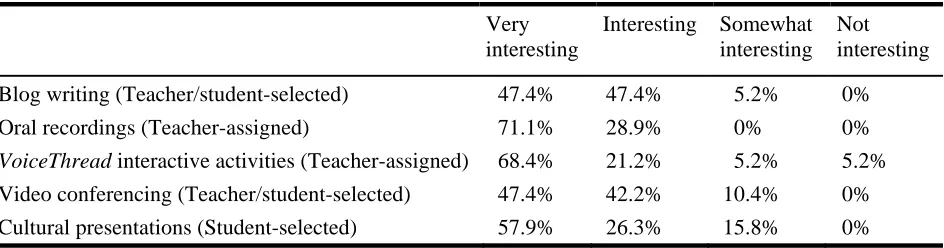
The above comment shows that the student found CMC tasks to be appealing, as they were relevant to the course content and the real-world situations. The current study used both teacher-made and student-chosen tasks. Table 4 illustrates the high ratings of various types of tasks from the students.
Table 4. Students’ Views of Different Types of Tasks
Very interesting
Interesting Somewhat interesting
Not interesting
Blog writing (Teacher/student-selected) 47.4% 47.4% 5.2% 0%
Oral recordings (Teacher-assigned) 71.1% 28.9% 0% 0%
VoiceThread interactive activities (Teacher-assigned) 68.4% 21.2% 5.2% 5.2%
Video conferencing (Teacher/student-selected) 47.4% 42.2% 10.4% 0%
Cultural presentations (Student-selected) 57.9% 26.3% 15.8% 0%
Both teacher- and student-chosen tasks for blog entries and video conferencing assignments received relatively high ratings. Students commented that structured tasks gave them clear directions to carry out the assigned activities (see Table 2 for blog and VoiceThread topics). A closer look at the data shows that 71.1 % of the students found oral recordings to be engaging, whereas 68.4% of the students were content with interactive activities via VoiceThread. Teacher-chosen topics appear to affect the amount of the work students produced, as students wrote and spoke more on the topics that the teacher assigned to them than on the free topics. It is also likely that the beginning language students had a limited L2 knowledge, and consequently felt less confident expressing their ideas using the less teacher guidance-based free topic tasks.
“I found some of the teacher-assigned topics somewhat repeated and bland. Choosing my topics based on chapter themes allowed me to use my creativity. Also it was difficult for me to make comments or ask questions when most people wrote or talked about similar topics.”
Another student who had worked in Costa Rica expressed enthusiasm about the final cultural project: “I was glad that I could choose my own topic because I love to share what I know about the Costa Rican people and culture to my classmates.” It is possible that the students felt motivatedto talk about topics related to their personal experience. The positive attitudes engendered towards the learning tasks by encouraging students to make choices and initiate attempts to share ideas with others shown in the study support autonomous learning addressed by others researchers (Lee, 2011a).
With respect to digital tools, the results showed that students not only felt comfortable using digital tools (Statement 8), but also enjoyed using them such as Blackboard Collaborate (Statement 9). According to the midterm reflections, most students (n = 22) found real-time interaction extremely beneficial for improving their interpersonal skills. For example, one student wrote the following:
“The most useful tool was the Blackboard Collaborate because I was able to ask and understand my questions in real-time meetings as if I were asking the teacher in class. I also enjoyed interacting with my classmates during the role-play activities. It was really fun.”
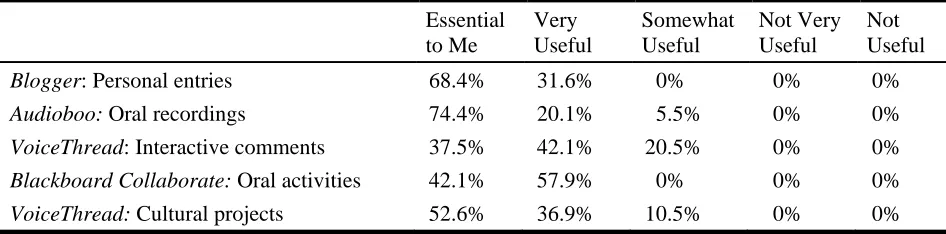
A number of students noted that Blackboard Collaborate was a practical tool for them to interact with each other online and build oral fluency (Lys, 2013; Rosell-Aguilar, 2007). As shown in Table 5, students clearly were in favor of using Blogger for writing assignments and Audioboo for speaking practice.
Table 5. Students’ Views of Usefulness of Digital Tools for Online Learning
Essential to Me
Very Useful
Somewhat Useful
Not Very Useful
Not Useful
Blogger: Personal entries 68.4% 31.6% 0% 0% 0%
Audioboo: Oral recordings 74.4% 20.1% 5.5% 0% 0%
VoiceThread: Interactive comments 37.5% 42.1% 20.5% 0% 0%
Blackboard Collaborate: Oral activities 42.1% 57.9% 0% 0% 0%
VoiceThread: Cultural projects 52.6% 36.9% 10.5% 0% 0%
Students also reported that blogging and podcasting enhanced their digital literacy and participation, including online content creation and sharing (e.g., Alameen, 2011).
More than 80% of the students enjoyed using CMC tools for both individual and collaborative tasks (Statement 10). The following example concerning the Holy Week in Spain demonstrates how students collaboratively shared and exchanged comments in VoiceThread:
Student A: Uno de los platos tradicionles *que preparan durante la Semana Santa es bacalao. (One of the traditional dishes * they prepare during the Holy Week is codfish.)
Student A: Me gusta el pescado también pero mi favorito es salmon. Como mucho salmon. Un plato típico como *bread pudding o *French toast se llama Torrijas. Aquí *es el dibujo …. (I also like fish but my favorite is salmon. I eat a lot of salmon. One typical dish like *bread pudding or *French toast is called Torrijas. Here *is the picture …)
Student C: Este festival es muy interesante. Me gustaría visitar España. ¿Sabes *cómo bailar Flamenco? Las mujeres en el dibujo son *bonito en sus *vestidas *rojas.
(This festival is very interesting. I would like to visit Spain. Do you know *how to dance Flamenco? The women in the picture are *beautiful in their *red *dresses.)
Student A: Oh, no. No *sabo bailar. No me gusta bailar. Pienso que es difícil bailar Flamenco. (Oh, no. I *cannot dance. I don’t like to dance. I think it’s hard to dance Flamenco.)
Student D: Mi mejor amiga fue a Sevilla y *veia la Semana Santa el año pasado. Ella *veía muchos desfiles. Ella compró un vestido de Flamenco. Ella *es loca…
(My best friend went to Seville and *saw the Holy Week last year. She *saw many parades. She bought a Flamenco dress. She *is crazy…)
Student E: Interesante. Me gusta ver un baile Flamenco. ¿Celebra la gente la Semana Santa en *otros partes de España?
(Interesting. I like to see a Flamenco dance. Do people celebrate the Holy Week in *other parts of Spain?)
Despite the fact that the beginning students produced simple sentences and made linguistic errors, they actively engaged in the task through social interaction via VoiceThread.
Although 80% of the students enjoyed using VoiceThread to interact with each other, they found a few drawbacks, such as the inability to edit recordings and the current lack of a timestamp in asynchronous CMC. A few students wrote in their midterm reflections that they tended to forget to log into the site to listen and respond to their peers, as they had no idea when the comments were made. These comments corroborate the findings of Lee’s (2014) CMC study regarding drawbacks to asynchronous CMC with respect to enhancing the learning experience via feedback. Due to the lack of timely and consistent peer feedback, nearly 40% of the students did not find online commenting effective and useful to promote further reflection when using VoiceThread (Statement 11). To this end, VoiceThread may not be the best option for social interaction within the constructivist-learning environment. This finding suggests that a CMC interactive task does not in itself promote social engagement and collaboration. Rather, it depends on how much initiative learners take, when working under challenging situations, such as regularly checking and making peer comments without having to rely on the instructor’s reminders. Policies and procedures for online participation and collaboration should be clearly stated in the course syllabus and graded accordingly to ensure student engagement in VoiceThread.
Teacher Scaffolding and Feedback for Self-Regulated Learning
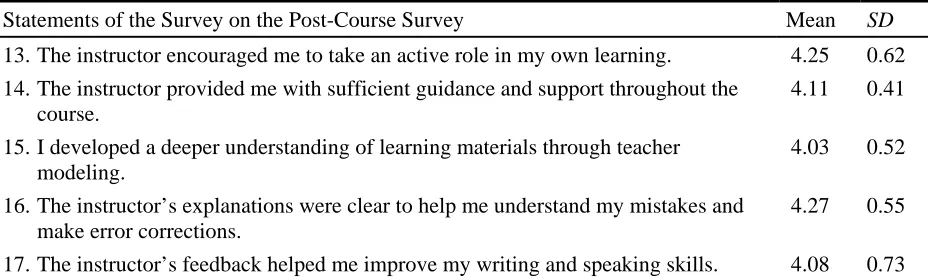
Table 6. Students’ Reactions to Teacher Scaffolding and Feedback
Statements of the Survey on the Post-Course Survey Mean SD
13. The instructor encouraged me to take an active role in my own learning. 4.25 0.62
14. The instructor provided me with sufficient guidance and support throughout the course.
4.11 0.41
15. I developed a deeper understanding of learning materials through teacher modeling.
4.03 0.52
16. The instructor’s explanations were clear to help me understand my mistakes and make error corrections.
4.27 0.55
17. The instructor’s feedback helped me improve my writing and speaking skills. 4.08 0.73
Comments gathered from the final interviews revealed that most students appreciated the affective support received from the instructor. For example, one student said that the instructor always used very positive comments to provide feedback, such as “excellent” or “good job” to offer encouragement. The study evidently shows that teacher’s guidance and support mediated through technology was an important factor, as this student observed during the final interview:
“I received a lot of help from the teacher via email. The responses were always very fast. Also the teacher was willing to meet online to go over the materials I did not understand. Being able to interact with the teacher regularly really kept me focused on the course work. I wouldn’t be able to complete this course without the instructor’s guidance.”
This finding attests to the fact that the instructor was a highly visible presence throughout the course, as one essential aspect of learner autonomy advocated by Little (2007).
In addition to creating tasks and selecting appropriate tools for students to interact with the course
material, the instructor constantly facilitated interaction among students by the intervention when needed. The following real-time exchange via Blackboard Collaborate demonstrates just how the instructor guided the student through the process of carrying out a VoiceThread task regarding buying Christmas gifts by explaining a grammar point to the student:
Student: I read the instructions and listened to your examples but I’m not sure how I should describe each picture using the double object pronouns. I’m confused.
Teacher: Not a problem. Let’s look at the first picture … Do you understand why the two pronouns are attached to the verb?
Student: Hmm… I know you put the indirect before the direct but why it is ‘darselo’ but not ‘darlelo’…
Teacher: Remember that you need to change ‘le lo’ to ‘se lo’ when using the double object pronouns. Be sure to review pp. 132-133. Let’s try another one. How about the third picture?
Student: O.K. Can I say ‘Voy a comprarselo’ (I’m going to buy it to her)? Do I use ‘se’ here?
Student: Oh, sorry! It should be ‘la’ (it = feminine) not ‘lo’ (it = masculine).
Teacher: Excellent. Now you know how to finish the rest of the activity.
The above example exhibits how the instructor used a step-by-step scaffolding to help the student understand the usage of the double object pronouns. The presence of teacher as supporting scaffolding allowed the development of autonomy. The finding corroborates the results of Lee’s (2008) CMC study showing that expert scaffolding through collaborative dialogue fosters the understanding of linguistic features by activating learners’ zone of proximal development (ZPD). Beginning learners do not necessarily know how to learn efficiently on their own. When face-to-face interaction was absent, the teacher was still able to provide useful guidance to engage students in performing both independent and collaborative tasks. The findings confirm those reported in previous studies indicating that the instructor’s presence is essential for network-based learning and further affects students’ motivation (Swan, 2001).
Another effective scaffolding is modeling, which provides task assistance by cuing, prompting, and questioning techniques. Student remarked that they gained a better understanding of learning tasks by means of using online models (Statement 15). Teacher modeling indeed increased student comfort level with oral recordings. One student described the following during the final interview:
“I found the teacher’s modeling very beneficial. I usually listened to the teacher-made recordings a few times before I recorded my own. I also found her step-to-step instructions very helpful to carry out each assignment. By the second week, I became more confident in speaking activities and relied less on teachers’ models.”
In addition, 85% of the students agreed that they understood the teacher’s explanations of their mistakes and further made error corrections (Statement 16). Teacher linguistic feedback indeed helped them improve their writing and oral skills (Statement 17). The following excerpt demonstrated how much a beginning student valued the instructor’s corrective feedback:
“For me, the teacher’s feedback guided in self-correction, which allowed me to better remember my errors. Although making error correction was time consuming, I truly believe that I benefitted from it.”
The beginning students with low language proficiency are not equipped to correct their own errors. Thus, the instructor plays a facilitative role in guiding students through the process of error correction. The findings show that teacher linguistic feedback fostered attention to form for the improvement of language accuracy (Lee, 2010). More importantly, teacher scaffolding through constant monitoring of student progress created room for learner autonomy.
LIMITATIONS AND SUGGESTIONS FOR FUTURE STUDIES
the online format. It would be necessary to include future studies comparing courses offered in hybrid and face-to-face formats to those in a fully online format in order to further provide evidence to test whether there is a significant difference in the perceived presence of learner autonomy. Also the study examined solely teacher scaffolding focusing on corrective feedback. It would be worthwhile to explore how peer feedback affects social interaction and collaborative engagement on the error revision process and focus-on-form through self-reflection. Finally, another drawback is the inherent limitations of self-report surveys. A future study using the pre- and post-surveys together with a larger qualitative sample, such as weekly self-reflections, will contribute a clearer understanding of the effectiveness of TBI in relation to online autonomous learning.
CONCLUSION
While the use of CMC tasks mediated by digital tools for a fully online course and its benefits on learner autonomy is limited in scope and depth, the findings of this study are noteworthy. The study demonstrates that learner autonomy was fostered involving the implementation various types of CMC tasks and digital tools. For example, the tasks with guided questions provided by the teacher were more appealing to beginner students than the free topic tasks that were less teacher-guided. With regard to Web 2.0 tools, it appears that Blogger for writing assignments and Audioboo for speaking practice were more effective in promoting learner autonomy in a fully online learning environment. TBI supports social, cognitive, and affective dimensions of autonomous learning by allowing students to learn independently and
collaboratively with their peers and instructor. TBI permits students to use L2 actively and meaningfully in order to carry out four-skill-integrated tasks. The findings show that CMC tasks related to real-world language use were conductive to motivating beginning learners to actively engage in the learning process. As suggested by Lee (2011a), the current study included more than one Web 2.0 tool, such as Audioboo, VoiceThread, and Blackboard Collaborate to explore the role of online learner autonomy. The combined use of web tools offered promising benefits to L2 learners, as they individually wrote the blogs, produced the audio recordings, and collaboratively exchanged ideas with their peers within a socially bounded learning environment. As a result, social presence of synchronous and asynchronous CMC increased student engagement and motivation and promoted learner autonomy. The study suggests that learners should be aware of their own learning by means of self-management and self-determination (Little, 2007). Moreover, teacher intervention allows students not only to master targeted skills, but also to gain
independence through advancing their ZPD described by Vygotsky (1978). Effective scaffolding on focus on form allows students to develop their interlanguage. Teachers should regularly provide both explicit and implicit corrective feedback (for details, see Lee, 2011b) to draw learners’ attention to linguistic forms and help them build form-meaning connections through synchronous CMC, such as
videoconferencing sessions. The study concludes that teachers need to invest a tremendous amount of time and energy to create and develop online courses that meet the needs of learners in a similar way to face-to-face instruction. Carefully designed CMC tasks in conjunction with effective strategies, such as teacher modeling and scaffolding for fully online instruction are essential to boost learner autonomy in a meaningful and productive way.
NOTES
1. Elementary Spanish language courses are offered in a traditional face-to-face classroom setting during the regular semester and are mainly taught by graduate teaching assistants.
3. All teacher-made videos were made using the Tegrity, a lecture capturing softwarepurchased by the researcher’s institution.
4. VoiceThread is a web-based application that allows users to create multimedia slide shows and share them with others through interactive comments. The author’s university owns a department license with pro accounts for students to use VoiceThread.
5. Blackboard Collaborate is a web conferencing system that is fully integrated into Blackboard,
allowing students to interact with the instructor in real time via text chats, voice calls, or collaborative tools such as screen sharing and digital white boards.
6. It should be noted that the name Audioboo has been changed to AudioBoom since 2014. It is a digital application that allows users to listen to, record and share sound files.
ACKNOWLEDGEMENTS
I would like to thank the anonymous reviewers and the editors of Language Learning & Technology for their valuable and insightful feedback on the manuscript.
ABOUT THE AUTHOR
Lina Lee (PhD, University of Texas-Austin) is Professor of Spanish at the University of New Hampshire where she teaches courses in second language acquisition, applied linguistics, and foreign language methodology. She has conducted research and published articles on language pedagogy, computer-mediated communication, and discourse analysis.
E-mail: [email protected]
REFERENCES
Alameen, G. (2011). Learner digital stories in a Web 2.0 age. TESOL Journal, 2(3), 355–369.
Benson, P. (2013). Drifting in and out of view: Autonomy and the social individual. In P. Benson & L. Cooker (Eds.), The applied linguistic individual: Sociocultural approaches to identity, agency, and autonomy (pp. 75–89). Sheffield, UK: Equinox.
Blake, R. (2011). Current trends in online language learning. Annual Review of Applied Linguistics, 31, 19–35.
Chapelle, C. A. (2001). Computer applications in second language acquisition: Foundations for teaching, testing and research. Cambridge, UK: Cambridge University Press.
Cohen, L., Manion, L., & Morrison, K. (2007). Research methods in education. London, UK: Routledge.
Dam, L. (2011). Developing learner autonomy with school kids: Principles, practices, results. In D. Gardner (Ed.), Fostering autonomy in language learning (pp. 40–52). Gaziantep, Turkey: Zirve University.
Ellis, R. (2003). Task-based language learning and teaching. Oxford, UK: Oxford University Press.
Guth, S., & Helm, F. (Eds.). (2010). Telecollaboration 2.0: Language, literacies, and intercultural learning in the 21st century. Bern, Switzerland: Peter Lang.
Hafner, C. A., & Miller, L. (2011). Fostering learner autonomy in English for science: A collaborative digital video project in a technological learning environment. Language Learning & Technology, 15(1), 68–86. Retrieved from http://llt.msu.edu/issues/october2011/hafnermiller.pdf
Hampel, R. (2010). Task design for a virtual learning environment in a distance language course. In M. Thomas & H. Reinders (Eds.), Task-based language learning and teaching with technology (pp. 131– 153). London, UK: Continuum International Publishing Group.
Holec, H. (1981). Autonomy and foreign language learning. Oxford, UK: Pergamon.
Kim, S. (2014) Developing autonomous learning for oral proficiency using digital storytelling. Language Learning & Technology, 18(2), 20–35. Retrieved from http://llt.msu.edu/issues/june2014/action1.pdf
Lai, C. (2013). A framework of developing self-directed technology use for language learning. Language
Learning & Technology, 17(2), 100–122. Retrieved from http://llt.msu.edu/issues/june2013/lai.pdf
Lai, C., & Gu, M. (2011). Self-regulated out-of-class language learning with technology. Computer
Assisted Language Learning, 24(4), 317–335.
Lai, C., Zhao, Y., & Wang, J. W. (2011). Task-based language teaching in online Ab Initio Chinese classrooms. Modern Language Journal, 95(1), 81–103.
Leaver, B. L., & Willis, J. (2005). Task-based instruction in foreign language education: Practices and programmes. Washington, DC:Georgetown University Press.
Lee, L. (2008). Focus-on-form through collaborative scaffolding in expert-to-novice online interaction. Language Learning & Technology, 12(3), 53–72. Retrieved from http://llt.msu.edu/vol12num3/lee.pdf
Lee, L. (2010). Fostering reflective writing and interactive exchange through blogging in an advanced language course. ReCALL, 22(2), 212–227.
Lee, L. (2011a). Blogging: Promoting learner autonomy and intercultural competence through study abroad. Language Learning & Technology, 15(3), 87–109. Retrieved from
http://llt.msu.edu/issues/october2011/lee.pdf
Lee, L. (2011b). Focus on form through peer feedback in a Spanish-American telecollaborative exchange. Language Awareness, 20(4), 343–357.
Lee, L. (2014). Digital news stories: Building language learners’ content knowledge and speaking skills. Foreign Language Annals, 47(2), 338–356.
Lee, L., & Markey, A. (2014). A study of learners’ perceptions of online intercultural exchange through Web 2.0 technologies. ReCALL, 26(3), 1–20.
Levy, M., & Stockwell, G. (2006). CALL dimensions: Options and issues in computer assisted language learning. Mahwah, NJ: Lawrence Erlbaum.
Little, D. (2007). Language learner autonomy: Some fundamental considerations revisited. Innovation in Language Learning and Teaching, 1(1), 1–27.
Lys, F. (2013). The development of advanced learner oral proficiency using iPads. Language Learning & Technology, 17(3), 94–116. Retrieved from http://llt.msu.edu/issues/october2013/lys.pdf
Ranalli, J. (2012). Alternative models of self-regulation and implications for L2 strategy research. Studies
Reinders, H., & Hubbard, P. (2013). CALL and learner autonomy: Affordances and constraints. In M. Thomas, H. Reinders, & M. Warschauer (Eds.), Contemporary computer assisted language learning (pp. 359–375). London, UK: Continuum Books.
Rosell-Aguilar, F. (2007). Top of the pods: In search of a podcasting ‘podagogy’ for language learning. Computer Assisted Language Learning, 20(5), 471–492.
Rubio, F., & Thomas, J. J. (Eds.). (2012). Hybrid language teaching and learning: Exploring theoretical, pedagogical, and curricular issues. Boston, MA: Cengage Learning.
Saldaña, J. (2009). The coding manual for qualitative researchers. Thousand Oaks, CA: Sage.
Schunk, D. H., & Zimmerman, B. J. (Eds.). (2008). Motivation and self-regulated Learning: Theory,
research, and applications. New York, NY: Lawrence Erlbaum.
Schwienhorst, K. (2008). Learner autonomy and CALL environments. New York, NY: Routledge.
Smith, K., & Craig, H. (2013). Enhancing the autonomous use of CALL: A new curriculum model in EFL. CALICO Journal, 30(2), 252–278.
Swan, K. (2001). Virtual interaction: Design factors affecting student satisfaction and perceived learning in asynchronous online courses. Distance Education, 22(2), 306–331.
Tassinari, M. G. (2012). Evaluating learner autonomy: A dynamic model with descriptors. Studies in Self-Access Learning Journal, 3(1), 24–40.
Thomas, M., & Reinders, H. (Eds.). (2010). Task-based language learning and teaching with technology. London, UK: Continuum.
Tuovinen, J. E. (2000). Multimedia distance education interactions. Education Media International, 37(1), 16–24.
Van den Branden, K. (Ed.). (2006). Task-based language teaching: from theory to practice. Cambridge, UK: Cambridge University Press.
Vygotsky, L. S. (1978). Mind in society. Cambridge, MA: Harvard University Press.