PRIVACY ISSUES OF SPATIAL DATA
MINING IN WEB SERVICES
D.Marlene Grace Verghese1
Associate Professor in MCA
Bhimavaram Institute of Engineering & Technology Pennada, West Godavari
Dr.A.VinayaBabu
Professor, Dept. of CSE,
JNTU College of Engineering, Hyderabad, K.Madhukar
Professor Nizam College, Osmania University, Hyderabad S.Nagaprasad
Research Scholar, Dept. of CSE, Aacharya Nagarjuna University, Guntur,
V.Mallaiah
Research Scholar, Dept. of CSE, Aacharya Nagarjuna University, Guntur,
A.Sreelatha
Student, Dept. of CSE,
JITS College of Engineering, Karimnagar, Abstract:
The Web Services paradigm promises to enable rich flexible and dynamic interoperation of highly distributed, heterogeneous network enabled services. The idea of Web Services Mining that it makes use of the findings in the field of data mining and applies them to the world of Web Services. The emerging concept of Semantic Web Services aims at more sophisticated Web Services technologies: on basis of Semantic Description Frameworks, Intelligent mechanisms are envisioned for Discovery, Composition, and contracting of Web Services. The aim of semantic web is not only to support to access information on the web but also to support its usage. Geospatial Semantic Web is an augmentation to the Semantic Web that adds geospatial abstractions, as well as related reasoning, representation and query mechanisms. Web Service Security represents a key requirement for today’s distributed interconnected digital world and for the new generations, Web 2.0 and Semantic Web. To day, the problem of security has been investigated very much in the context of standardization efforts; Personal judgments are made usually based on the sensitivity of the information and the reputation of the party to which the information is to be disclosed. On the privacy front, this means that privacy invasion would net more quality and sensitive personal information. Initially we improved privacy of Web Services Mining using P3P and integrated it with Geospatial Semantic Layer. In this paper, we had implemented a case study on integrated privacy issues of
Spatial Semantic Web Services Mining. Finally, we implemented a Location Based System and improved its digital signature capability, using advanced Digital Signature standards.
Keywords: Web Services Mining, Semantic Web, Spatial Web Mining, Privacy, Advanced Digital Standards.
1. Introduction
considerable processes. Web Services are self-contained, self-describing, modular applications that can be published, located, and dynamically invoked across the Web [1]. In order to fully explore Web Service business opportunities while ensuring a correct and reliable modeling and execution, analyzing and tracking Web Services interactions will enable them to be well understood and controlled. The Web Services paradigm promises to enable rich, flexible and dynamic interoperation of highly distributed, heterogeneous network enabled services. The idea of Web Services Mining that makes use of the findings in the field of data mining and apply them to the world of Web Services and Service Oriented Architectures.
With the advent of evolution of WWW from Web searching to Web Mining, many business applications that utilize data mining techniques are extracting useful business information on the web. The web is transforming from a web of data to a web of both semantic data and services. This trend is providing us with increasing opportunities to compose potentially interesting and useful services from existing services. Using open web API's like Google (Spatial Google Map API version 2), Amazon and eBay we can implement data mining algorithms like Apriori for various business applications like CRM (Customer Relationship Management) with ease. The emerging concept of Semantic Web Services aims at more sophisticated Web Services technologies: on basis of Semantic Description Frameworks, Intelligent mechanisms are envisioned for Discovery, Composition, and contracting of Web Services. The Semantic Web Services on basis of the Web Services Modeling Ontology (WSMO) and related initiatives. Ontology is a representation of a set of concepts within a domain and the relationships between those concepts. In other words, ontology defines the vocabulary of a domain.
A review (“Semantic Web Technologies: Ready for Adoption?” IEEE IT Pro, pp. 8-16,) of Semantic Web use in the EU shows that its related technologies are finding their way into real-world applications. Rather than being a fashionable research issue, the semantic web is slowly but surely becoming a reality. Semantic Web is an extension of the current Web in which data and information on the Web are defined and linked in a way that it can be used by computers not only for display purposes, but for automation, integration, and reuse of data across various applications. The Semantic Web allows computers to make more sense of the information on the Web with the result of facilitating better cooperation between computers and people. The semantic web is a recent initiative to take the World Wide Web much further and develop it into a knowledge representation and computing. The aim of semantic web is not only to support to access information on the web but also to support its usage. The semantic web encourages and facilitates the formulation of shared vocabularies and shared knowledge in the form of ontology’s. The construction and design of ontology’s for functions of web services is an area that is currently topic of active research: Requests to a service and the reaction of the server can be collected and learning methods, Identification of user behavioral patterns, Teaching aids etc.
The goal of Semantic Web Services research and development is to introduce semantics for service-descriptions and to enable automation for various tasks of a service integration process. Recent developments in Semantic Web services aim to introduce bottom up approach to service modeling allowing to build incremental layers on top of existing service descriptions while at the same time enhance existing SOA (Service Oriented Architecture) technologies.
Geospatial Semantic Web is an augmentation to the Semantic Web that adds geospatial abstractions, as well as related reasoning, representation and query mechanisms. Geospatial data and information that identify the geographic location (using precise scientific coordinates), and the characteristics of natural or constructed features and boundaries on the Earth. Geo-processing is the manipulation of geospatial data and the analysis of these data to derive information. Geo-processing is used to generate high-quality data, perform quality control checks on data, and undertake modeling and analysis.
guarantees about the information disclosure can be made. The emerging Semantic Web is expected to make the challenge more acute in the sense that it would provide a whole infrastructure for the automation of information processing on the Web. On the privacy front, this means that privacy invasion would more quality and sensitive personal information.
2. Web Services Mining
The main purpose of Web Services Mining is to apply some mining and conformation techniques as a feedback loop to improve the Web Services concepts in particular to abstract process and the orchestration model [2]. Generally, formal traditional approaches develop using their Web Service modeling formalisms, a set of techniques to analyze the composition model and check some properties. Figure 1(a), proposes a formal framework for modeling, specifying and analyzing the global behavior of Web Services compositions. This approach models web services by Mealy machines (finite state machines with input and output). Figure 1(b) Proposes a log based approach that starts from the execution log to mine and analyze web services behavior. This mining step will be used in future to improve the web services modeling.
Fig.1. Log based approach compared to based formalism approaches
3. Semantic Web and Semantic Web Services
The Semantic Web would be an extension of the current one, in which information is given well defined meaning, better enabling computers and people to work in cooperation. Thus the current web is basically comprised of documents, presented by computers and read by man would also include data and information that would automatically be handled by agents and utilities [3-5]. Researchers from universities and company’s about semantics divided into three groups: The first deals with Semantic Web Services; the second presents Semantic Web processes; and the third deals with the applications for the Semantic Web. Exposing functionality in the form of Web Services is generally more attractive for market participants than publishing all relevant facts directly on the web. Refer to Table-1 which provides an overview of emerging semantic web services technologies.
Table-1: An overview of emerging semantic web technologies
Technology Definition OWL-S OWL-S (formerly DAML-S) is a services ontology that enables software agents to discover,
invoke, compose, and monitor Web resources.
OWL 2 OWL 2 extends the Web Ontology Language (OWL) with a small but useful set of features (EL, QL, and RL) that enable effective reasoning.
WSMO The Web Service Modeling Ontology (WSMO) provides a conceptual framework and a formal language for semantically describing all relevant aspects of Web Services to facilitate the automation of discovering, combining, and invoking electronic services over the Web.
WSML The Web Services Markup Language (WSML) provides a formal syntax and semantics for the WSMO and consists of several variants, such as WSML-Core, WSML-DL, WSML-Flight, WSML-Rule, and WSML-Full.
SWRL The Semantic Web Rule Language aims to be the Semantic Webs standard rule language and is based on a combination of the OWL DL, OWL Lite, RuleML and so on.
RuleML RuleML constitutes a modular family of Web sublanguages including derivation rules, queries and integrity constraints as well as production and reaction rules.
4. Geospatial Semantic Web:
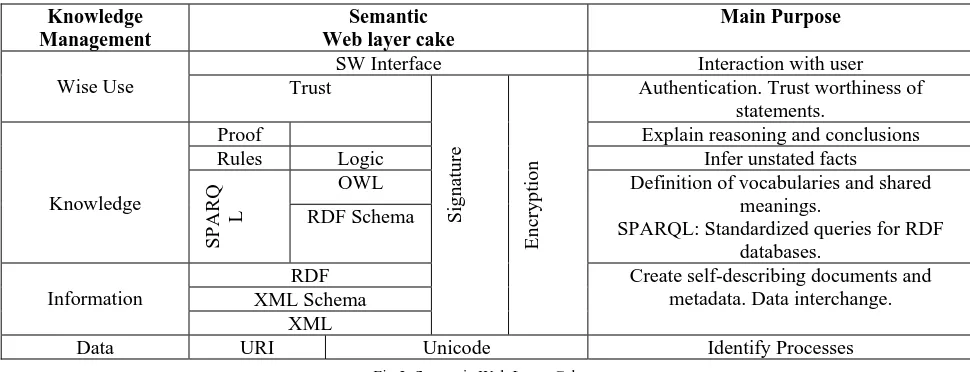
Figure 2 represents the Semantic Web Layer (SWLayer) Cake. This is a very simplified representation of the principles and technologies involved in implementing the vision of the semantic web [6-7] at the base of the cake, Unicode allows computers to consistently represent and manipulate text in most of the worlds writing systems, while URI (Uniform Resource Identifier) to identify resources on the web. XML (extensible Markup Language) Schemas are used to facilitate the sharing of structure data across different systems on the web. RDF Schema is an extensible knowledge representation language that provides basic elements for the descriptions of ontologies. SPARQL defines a standard way in which to communicate with RDF based services on the Web, and in this way creating interoperability between different RDF tools and services. “Web of Trust” will come into existence by propagating trust transitively. Finally, at the top of SWLayer cake is the issue of interfaces to interact with the semantic web. Geo Spatial semantic web can be viewed as an augmentation to the semantic web that adds Geospatial abstractions as well as related reasoning, representation and query mechanisms.
Fig.2. Semantic Web Layer Cake
5. Privacy Issues
5.1 Overview of Web Services Privacy
Privacy-Preserving Data Mining (PPDM) refers to data mining techniques developed to protect sensitive data while allowing useful information to be discovered from the Web.[8] Any solution to privacy of Web Service should support two important functions that are complementary and very crucial: How to communicate the privacy policies of an organization to interested parties, such as the individuals whose data are being collected by the organization; and How to enforce such privacy policies within the organization. The most well-known approach to the communication of privacy policies is the W3C’s Platform for Privacy Preferences Project (P3P). P3P enables Web sites to encode their data collection and data use practices in a machine-readable XML format, known as P3P Policies. In short, P3P and APPEL (A P3P Preference Exchange Language) are designed to enable users to play an active role in controlling their private information. Refer to TABLE 2. Which explains Three Layer Privacy Responsibility Framework and Engineering Issues?
Knowledge Management
Semantic Web layer cake
Main Purpose
Wise Use
SW Interface Interaction with user
Trust Si gnat u re En cryp tio n
Authentication. Trust worthiness of statements.
Knowledge
Proof Explain reasoning and conclusions
Rules Logic Infer unstated facts
SPAR
Q
L
OWL Definition of vocabularies and shared
meanings.
SPARQL: Standardized queries for RDF databases.
RDF Schema
Information
RDF Create self-describing documents and
metadata. Data interchange. XML Schema
XML
Table- 2. Three Layer Privacy Responsibility Framework and Engineering Issues
Privacy Spheres
Where data is stored
Engineer’s responsibility
Engineering Issues
User Sphere Users desktop
Personal, computers, Laptop, Mobile phones, RFID chips Give users control over access to themselves (in terms of access to data and attention)
What data is transferred from the client to a data recipient? Is the user explicitly involved in the transfer?
Is the user aware of remote/or local application storing data on his system?
Is data storage is transient or persistence?
Joint Sphere Web Service
providers,
servers and databases
Give users some control over access to themselves (in terms of access to data and attention) Minimize
users future privacy risks
Is the user fully aware of how his data is used and how he controls this? Recipient Sphere Any data recipients, servers and databases of network providers, service providers or other parties with whom data recipient shares data Minimize users future privacy risks
What data is being shared by the data recipient with other parties?
Can the user expect or anticipate a transfer of his data by the recipient?
Is personal data adequately secured? Is data storage transient or persistence?
Can the processing of personal data be foreseen by the user?
Are there secondary uses of data that may not be foreseen by the user?
Is there a way to minimize processing (e.g. by delegating some pre-processing to User Sphere)?
Each P3P policy is specified by one POLICY element that includes the following major elements: As an example, consider the following P3P Statement in Box 1:
Box 1.Example of A P3P Statement <STATEMENT>
<PURPOSE> <admin required=”opt-in”/> </PURPOSE> <RECIPIENT> <public /> </RECIPIENT?
<RETENTION> <indefinitely/> </RETENTION> <DATA-GROUP>
<DATA ref=”user.home-info.postal”> </DATA> <DATA-GROUP>
<STATEMENT>
5.2 Semantic Web Interoperation Security and Geospatial Semantic Web Privacy
quality and sensitivity personal information.
Trust
Proof Dig
ital
Si
gnat
u
res
Logic Ontology Vocabulary
RDF + RDF schema
XML + NS + XML schema
Unicode URI
Fig 3 Architecture of the Semantic Web
6. Implementations and Validations
6.1 Securing Privacy for Web Services Mining
A factor that limits the application of web mining is the need to protect privacy of users. Web Mining uses data that are available on the web anyway but the use of Data Mining makes it possible to induce general patterns that can be applied to personal data to inductively infer data that should remain private. Privacy has become a major concern because the news contains numerous stories of personal information misuse. One of the misuses of personal information is identity theft, but that’s by no means the largest misuse. Many users also feel that gathering personal information for marketing purposes without permissions and full disclosure of the requestor will use the information is also a major misuse of personal information. The proliferation of spy ware blockers shows that users are becoming aware of covert attempts by some Web sites (including pop-up advertisements) to steal data from their systems. Personal information covers a range of topics today. Most developers recognize that name, address, telephone number, and other personally identifying information is private. However, users don’t want developers to know a lot of information that some developers see as belonging to the public domain.
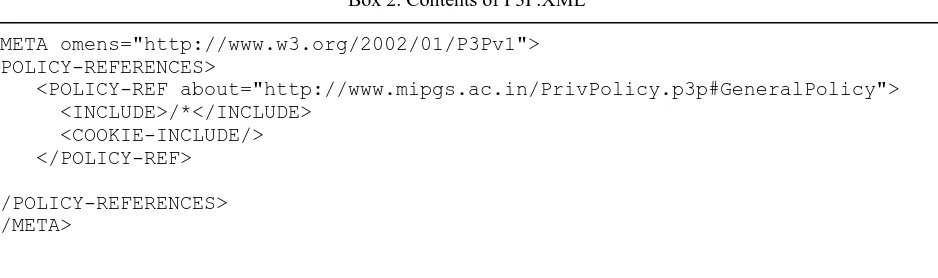
Web Services Mining using open Web Google API, can help developers and designers, and address privacy issues by providing privacy policy. Many users are beginning to request this functionality (privacy policy) and they may not visit our site more than once if we don’t provide it. In addition it’s also important to personalize the user’s experience with our site so we don’t have to ask the same questions every time the users visit the site. Personalization helps users have a better experience and improves user efficiency Refer to Box 2 which contains the Contents of P3P.xml file.
Box 2. Contents of P3P.XML <META omens="http://www.w3.org/2002/01/P3Pv1"> <POLICY-REFERENCES>
<POLICY-REF about="http://www.mipgs.ac.in/PrivPolicy.p3p#GeneralPolicy"> <INCLUDE>/*</INCLUDE>
<COOKIE-INCLUDE/> </POLICY-REF>
</POLICY-REFERENCES> </META>
Fig.4. Privacy Demonstration
Fig.5. Save Cookie option
Fig.6. Read Cookie option
6.2 Implementation of Spatial Location Based Service
Fig.7. The architecture of our location based service
Fig.8. High-level sequence diagram
Fig.9. Output of the spatial application.
Fig.10. Class diagram of advanced DSA.
Fig.12 Output screen shot of the application.
7. Conclusion
In this paper, we discussed various privacy issues, integrating web services mining, semantic web, and geospatial semantic web by implementing a case study. Further work pertaining to Privacy Preserving data mining, includes data perturbation and Secure Multiparty Computation. Privacy enforcement in web services and semantic web using decentralized models, like distributed, registry-based and peer to peer reputation models. Finally, geospatial privacy includes geoRBAC. The widespread deployment of location based services and mobile applications, as well as the increased concern for the management and sharing of geographical information in strategic applications like, environmental protection and homeland security, have resulted in strong demand for spatially aware access control systems. These application domains impose interesting requirements on access control systems. In particular, the permissions assigned to users depend on their position in a reference space; users often belong to well-defined categories; objects to which permissions must be granted are located in that space; and access control policies must grant permissions based on object locations and user positions.
8. References
[1] Hsinchun Chen, Xin Li, Michael Chau, Yi-Jen Ho and Chunju Tseng, “Using Open Web APIs in Teaching Web Mining,” IEEE
Transactions on Education, vol. 52 no. 4, pp. 482–490, November 2009.
[2] Ravi Kothuri, Albert Godfrind and Euro Beinat, Pro Oracle Spatial for Oracle Database 11g Apress publishers, 2007.
[3] Valentina Janev and Sanja Vranes, “Semantic Web Technologies: Ready for Adoption?” IEEE IT Pro, pp. 8-16, September/October 2009. [4] Tomas Vitvar, Jacek Kopecky, Jana Viskova, Adrian Mocin, Mick Kerrigan and Dieter Fensel, ”Semantic Web Services Architecture with
Lightweight Description of Services”, Advances in Computers, Vol. 76, pp. 177 – 223, Elsevier Inc. 2009
[5] Martin Hepp,”Semantic Web and Semantic Web Services: Father and Son or Indivisible Twins?” IEEE Internet Computing, pp. 85 – 88, March April 2006.
[6] Rafael Moreno-Sanchez, “The Geospatial Semantic Web: What are its Implications for Geospatial Information Users?” pp. 588- 609, IGI Global, 2009.
[7] Sarah Spiekermann and Lorrie Faith Cranor “Engineering Privacy,” IEEE Transactions on Software Engineering, vol. 35 no. 1, pp. 67—82,
January-February 2009.
[8] Lixin Fu, Hamid Nemati and Fereidoon Sadri Privacy-Preserving Data Mining and the Need for Confluence of Research and Practice IGI
Global, 2009.
[9] Bhavani Thuraisingham, Natasha Tsybulnik and Ashraful Alam Adminstering the Semantic Web: Confidentiality, Privacy and
Management. IGI Global, 2009.
[11] Shinsaku Kiyomoto, Keith M.Martin, and Kazuhide Fukushima,” Privacy-Aware Location Database Service for Granular Queries”, WISTP LNCS 5746, pp. 28—37, IFIP 2009.
[12] Rahul katarya and Dr.Satbir Jain, “Web Search with mobile incorporation Geographic information system” ; CSI Communications, Vol No 33, Issue No.8, November 2009.
[13] Neil daswari, Christoph kers and Anita kesavan, “Foundations of Security, What every Programmer needs to know” A press publishers, 2007.
D.Marlene Grace Verghese Received the Bacholar of Computer Science From D N R AUTONOMOUS COLLEGE, BHIMAVARAM AFFILIATED TO ANDHRA UNIVERSITY IN 1999, M.C.A From CH S D St.THEREASAS COLLEGE FOR WOMEN, ELURU, AFFILIATED TO ANDHRA UNIVERSITY IN 2003. Presently Pursing Ph.D in Computer Science & Engineering from Aacharya Nagarjuna University, Guntur.
Prof.A.Vinay Babu obtained his Bachelors degree in Electronics & Communication Engineering from Osmania University. Has duel Masters degree, one in Computer Science & Engg and the other one is in ECE from JNTU. He obtained his PhD from JNTU, Hyderabad. His research area is Data Mining and Image processing.
Prof. K.Madhukar received his Masters in Engineering Physics and Instrumentation from Osmania University in 1980 and PhD from Osmania University in 1989. Presently he is Professor and Head, Dept of Physics and Electronics, Nizam College, Osmania University, Hyderabad. He worked as ICT4D programme specialist in United Nations Development Programme (UNDP) for more than four years. His research area is Data mining, Knowledge Discovery and Networks. Presently eight students are working for their doctorial degree under his supervision.
S.Nagaprasad Received the Bacholar of Computer Applications (B.C.A.) From Osmania University, Hyderabad, in 2001, M.Sc (I.T.) From Sikkim Manipal University, Manipal in 2003 and M.Tech (C.S.) From Allahabad Agricultural University, Allahabad in 2005. Presently Pursing Ph.D in Computer Science & Engineering from Aacharya Nagarjuna University, Guntur.