686 | P a g e
A COMPARATIVE EVALUATION OF GA AND PSO
OPTIMISATION ALGORITHMS IN FORECASTING
THE INFLUENCE OF TURNING PARAMETERS ON
ASTM
A48 GREY CAST IRON MACHINING
D.Ramalingam*
1, Dr.M.Saravanan
2, R.RinuKaarthikeyen
3Dr.D.Palanikkumar
4*
1Associate Professor, Nehru Institute of Technology, Coimbatore ( India)
1
Principal, SSM Institute of Engineering and Technology, Dindigul (India)
2
Research Associate, Manager – Engineering, TCMPFL, Chennai (India)
3
Professor, CSE, Nehru Institute of Technology, Coimbatore (India)
ABSTRACT
ASTM 48 Grey cast iron is being used to produce casting parts with low or middle duty or load, such as various
stove parts, gas burners, boiler parts, protective cover, hand wheel, brackets, base plate, crane balls, counter
weight, handle, machine base, cases, bearing support, workbench, belt pulley, pump body, valve body, pipe
fittings, flywheel etc. The material removal rates in the machining operations are one of the major deciding
factors addressing to the volume production. To meet out the demand maximizing the MRR is essential. This
investigation involves in optimising the MRR of turning operations on ASTM 48 Grey cast iron with the
application of two optimization algorithms Genetic Algorithm and Particle Swarm optimisation. Based on the
assessment of performance of the algorithms the outcome of the second best algorithm is taken as a input (feed)
to the better performed algorithm as a hybridization approach. Machining speed, feed, depth of cut and material
removal rate are chosen as the process parameters. Regression equation modeling, analysis and optimization
algorithms are used to recognize the parametric influence and optimization.
Key words-
ASTM 48 Grey cast iron, Turning, Regression, Genetic Algorithm, Particle swarm
optimisation, hybridization, Optimisation, Minitab, MATLAB.
I. INTRODUCTION
687 | P a g e
available in plenty and the application part of optimisation techniques is carefully done in order to identify the algorithms which support to reach the optimum solutions to the issues by taking care of all related attributes. This study mainly focused towards the maximization of MRR during machining operations. Genetic algorithm and Particle swarm optimisation algorithms are chosen to apply in this aspect and the convergence of each algorithm is observed. Thereby hybridization of algorithms is effected to get the most tuned results. Machining speed, feed, depth of cut are the input parameters considered and material removal rate is chosen as the outcome process parameters.Kaymakci et al [1] developed one unique cutting mechanics model to access and forecast the cutting forces in milling, boring, turning and drilling operations towards ensuring the product end quality. That particular operation models join all the material properties, tool geometry, cutting mechanics, process kinematics and structural dynamics together and are applied to envisage force, torque, power in metal cutting operations. Abou-El-Hossein et al [2] have industrialized about the impact of speed; feed rate; radial and axial depth of cut on the cutting force which in turn reflects on the quality by developing first and second order models to predict the cutting force created in the end milling operation of the material AISI P20 tool steel. Srikanth and Kamala [3] have suggested and applied a unique real coded genetic algorithm (RCGA) to sentence the optimal machining parameters through the explanations about the various issues of RCGA along with its advantages over the existing model of binary coded genetic algorithm (BCGA). Maciej Grzenda et al [4] have conducted experiment and finally suggested a roughness prediction model through a hybrid algorithm which was the combination of Genetic Algorithm and Neural Networks in high-torque face milling operations. Azlan Mohd Zain et al [5] have applied the Genetic Algorithm (GA) to optimize the machining conditions in view of minimizing the surface roughness in end milling operation. The optimal consequence of the tool radial rake angle in combination with speed and feed rate cutting conditions over the influence on the surface roughness was the main objective of the study. With reference to the real machining data, the authors developed a best regression model to devise the fitness function of the GA. The outcome of the analysis was that the GA technique is capable of estimating the optimal machining conditions that converges with the minimum surface roughness value.
688 | P a g e
In this study the analysis and forecasting on the optimized parametric combination is carried out through the designated Genetic Algorithm and particle swarm optimization coded in MATLAB programming. Referring to the performance in computation as a new move feeding the outcome value of the second ranked algorithm as the input values to the first ranked algorithm by direct hybridization and the optimised parameters combinations are identified with the tuned results through the simulation.II. EXPERIMENTAL PLAN AND OBSERVED DATA
For the investigation of the material removal rate on the material ASTM 48 Grey cast iron while machining in a conventional lathe machine with the high speed steel as the cutting tool material the experiments was performed by [9] Md. Maksudul Islam et al. The basic chemical composition of the specimen material is specified in Table 2.1 followed by the important mechanical properties
Table 2.1 Basic chemical composition of ASTM 48 Grey cast iron Component Quantity
Carbon 3.2 to 3.5 %
Silicon 1.8 to 2.4 %
Magnesium 0.5 to 0.9 %
Fe Balanced
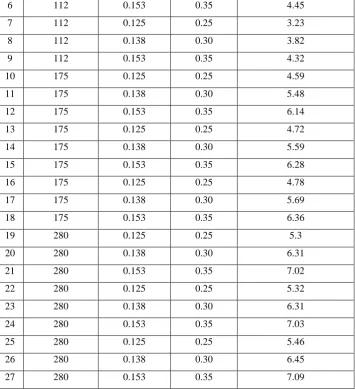
The tensile strength of class 20 is Min. 150 Mpa; the hardness range is 150 to 200 HB which has good casting property, shock absorption, wear-resisting property and machining performance. The machining input cutting variables are cutting speed, feed rate and depth of cut with three levels as mentioned in Table 2.2. L27 array was taken for the experiment conducted and the Material removal rate was considered as outcome variables. The machining processes were carried out as dry machining process and subsequently the responses with reference to each observation were arranged in Table 2.2. Then arrived observed experimental data [9] are mentioned in the Table 2.3
Table 2.2 Input machining parameters level selection
Turning parameters Units Level 1 Level 2 Level 3
Cutting Speed (rpm) 112 0.125 0.25
Feed (mm / rev) 175 0.138 0.30
Depth of cut (mm) 280 0.153 0.35
Table 2.3 Experimental observed data set
Ex. No.
Cutting Speed ( rpm)
Feed Rate ( mm/ rev)
Depth of Cut ( mm)
Material removal rate (mm3 / sec)
1 112 0.125 0.25 3.38
2 112 0.138 0.30 4.01
3 112 0.153 0.35 4.55
4 112 0.125 0.25 3.31
689 | P a g e
6 112 0.153 0.35 4.45
7 112 0.125 0.25 3.23
8 112 0.138 0.30 3.82
9 112 0.153 0.35 4.32
10 175 0.125 0.25 4.59
11 175 0.138 0.30 5.48
12 175 0.153 0.35 6.14
13 175 0.125 0.25 4.72
14 175 0.138 0.30 5.59
15 175 0.153 0.35 6.28
16 175 0.125 0.25 4.78
17 175 0.138 0.30 5.69
18 175 0.153 0.35 6.36
19 280 0.125 0.25 5.3
20 280 0.138 0.30 6.31
21 280 0.153 0.35 7.02
22 280 0.125 0.25 5.32
23 280 0.138 0.30 6.31
24 280 0.153 0.35 7.03
25 280 0.125 0.25 5.46
26 280 0.138 0.30 6.45
27 280 0.153 0.35 7.09
IV. MATHEMATICAL MODELLING
With the Minitab17 software, the influences of the input machining parameters (speed, feed and depth of cut) on the output parameter (material removal rate) are analysed by statistical regression relationship. The second order regression relationship between the variables shows higher level significance than the first order regression through the values of the R – sq. Both the first and second order statistical values of R-sq can be viewed from the Table 4.1.
Table 3.1 Regression model comparison for surface roughness
Parameter Regression S R-sq R-sq(adj) R-sq(pred) Durbin - Watson
MRR First order 0.39688 90.06% 88.76% 86.76% 0.62616
Second order 0.100509 99.45% 99.28% 99.03% 0.66992
The second order regression equations through the Minitab17 for the material removal rate in terms of input parameter combination are
MRR = - (4.55) + (0.0822*Speed) + (13*feed) + (5.1*Doc) – (0.000112*Speed^2) – (0.614*Speed*feed)
+ (0.203*Speed*Doc)
690 | P a g e
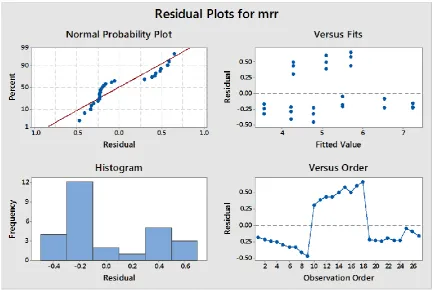
Figure 3.1 Residual plots of material removal rate
The residual plots through Minitab analysis for the surface roughness are depicted in Figure 3.1. The best subset regression analysis reveals that the speed is the major influencing factor which contributes 63.5 % ; the parameter depth of cut registered next level influence with 26.4 % whereas the feed rate exhibits very little amount of influence on the MRR.
IV. PARAMETRIC OPTIMISATION
Sentencing a choice with a good number of cost effective or uppermost attainable presentations under the given constraints is by maximizing preferred factors and minimizing undesired ones. Process optimization is the order of adjusting a process so as to optimize a number of particular groups of parameters devoid of violating some constraint. The most common goals are minimizing cost and maximizing throughput and effectiveness. This is one of the major quantitative gears in industrial decision making.
691 | P a g e
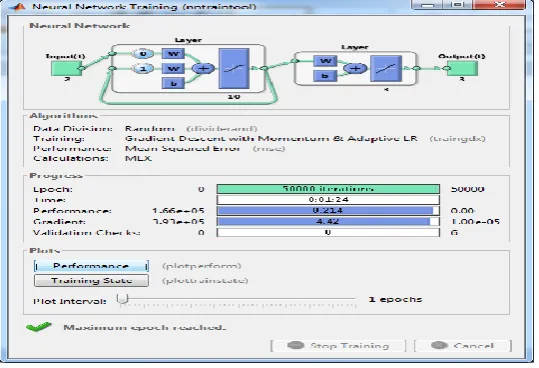
through the accuracy level in computation which is in the form mean squared error occurred rate as the indicator. Figure 4.1 shows the progress of the training data in MATLAB. The accuracy level of the computation is mentioned in the Table 4.1.Figure 4.1 Data training progress of 50000 iterations Table 4.1 Mean squared error value comparison Algorithm Mean squared error Ranking
GA
0.01138
1PSO 0.02635 2
Genetic algorithm converges with the minimum value of mean squared error than the PSO algorithm in this case. As the novel attempt is made by feeding the values off the PSO outcome as the input reference values to GA and the performance of the simulation is evaluated. The value of the mean squared error was noticed as 0.00849, i.e. around 23.4 % improvement is noticed. The new approach of hybridization with regression equations as condition for simulation and regression calculated values replacing the experimental values are shown in the Fig. 4.2
Input parameters Cutting Speed, Feed,
Depth of cut
Optimization through GA and PSO
Regression equation formulation and compiling output parameter values Ranking the two optimization method based on MSE Confirming for improved performance of the hybrid method Hybridization of Regression equations in the Programme and evaluate performance Simulatio n of results with the hybrid method Optimized results on Output parameters Allotting the second ranked PSO output as input to the first
692 | P a g e
Figure 4.2 Block diagram of Hybridization
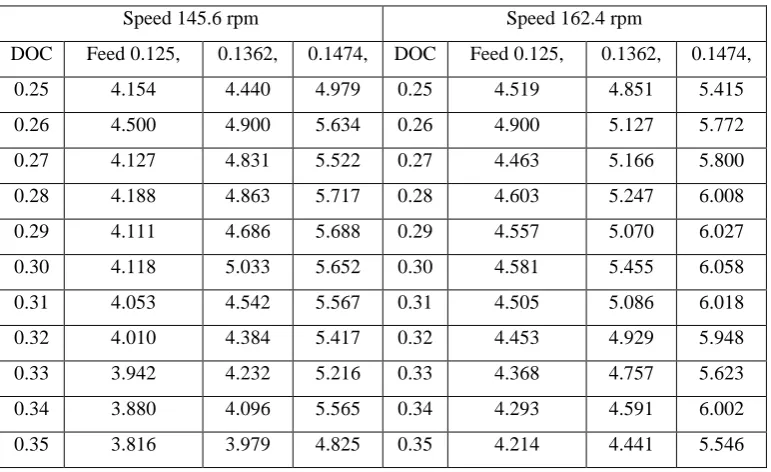
In order to pave a smooth curve with closer interval values of the process outcomes, the parameters selected was sub divided with the step value 16.8 rpm in speed, 0.0112 step value in feed and 0.01 mm step value in depth of cut. The computed results of the MRR through this PSO feed GA approach for all combination of the parameter input given to the programme are listed in the Table 4.2 to Table 4.4.
Table 4.2 MRR for the speed 112, 128.8 rpm Vs all combination of feed and depth of cut
Speed 112 rpm Speed 128.8 rpm
DOC Feed 0.125, 0.1362, 0.1474, DOC Feed 0.125, 0.1362, 0.1474,
0.25 3.239 3.468 3.960 0.25 3.729 3.972 4.485
0.26 3.885 4.087 5.128 0.26 4.040 4.560 5.428
0.27 3.792 3.703 4.470 0.27 3.655 4.334 5.084
0.28 3.202 3.447 4.729 0.28 3.662 4.328 5.282
0.29 3.092 3.726 4.524 0.29 3.586 4.238 5.174
0.30 3.100 3.491 4.349 0.30 3.603 4.082 5.047
0.31 3.106 3.410 4.262 0.31 3.572 3.955 4.936
0.32 3.117 3.348 3.934 0.32 3.551 3.836 4.434
0.33 3.109 3.290 4.217 0.33 3.512 3.730 4.748
0.34 3.096 3.242 3.800 0.34 3.472 3.636 4.335
0.35 3.077 3.202 3.703 0.35 3.429 3.557 4.157
Table 4.3 MRR for the speed 145.6, 162.4 rpm Vs all combination of feed and depth of cut
Speed 145.6 rpm Speed 162.4 rpm
DOC Feed 0.125, 0.1362, 0.1474, DOC Feed 0.125, 0.1362, 0.1474,
0.25 4.154 4.440 4.979 0.25 4.519 4.851 5.415
0.26 4.500 4.900 5.634 0.26 4.900 5.127 5.772
0.27 4.127 4.831 5.522 0.27 4.463 5.166 5.800
0.28 4.188 4.863 5.717 0.28 4.603 5.247 6.008
0.29 4.111 4.686 5.688 0.29 4.557 5.070 6.027
0.30 4.118 5.033 5.652 0.30 4.581 5.455 6.058
0.31 4.053 4.542 5.567 0.31 4.505 5.086 6.018
0.32 4.010 4.384 5.417 0.32 4.453 4.929 5.948
0.33 3.942 4.232 5.216 0.33 4.368 4.757 5.623
0.34 3.880 4.096 5.565 0.34 4.293 4.591 6.002
0.35 3.816 3.979 4.825 0.35 4.214 4.441 5.546
Table 4.4 MRR for the speed 112, 128.8 rpm Vs all combination of feed and depth of cut
Speed 179.2 rpm Speed 196 rpm
DOC Feed 0.125, 0.1362, 0.1474, DOC Feed 0.125, 0.1362, 0.1474,
0.25 4.820 5.196 5.778 0.25 5.061 5.468 6.055
0.26 5.239 5.279 5.864 0.26 5.511 5.387 5.925
693 | P a g e
0.28 4.894 5.493 6.187 0.28 5.102 5.206 6.296
0.29 4.874 5.394 6.230 0.29 5.086 5.654 6.351
0.30 4.934 5.807 6.296 0.30 5.169 6.101 6.433
0.31 4.872 5.494 6.288 0.31 5.124 5.756 6.443
0.32 4.833 5.377 6.268 0.32 5.112 5.680 6.451
0.33 4.747 5.230 5.965 0.33 5.041 5.583 6.247
0.34 4.672 5.065 6.383 0.34 4.980 5.450 6.694
0.35 4.588 4.902 6.049 0.35 4.905 5.305 6.333
The scatter plots generated through the Minitab for the above results are shown in the following Figures 4.3 to 4.
Figure 4.3 MRR plots of speed 112 rpm & feed 0.125, 0.1362, 0.1474 mm / rev
694 | P a g e
Figure 4.5 MRR plots of speed 145.6 rpm & feed 0.125, 0.1362, 0.1474 mm / rev
Figure 4.6 MRR plots of speed 162.4 rpm & feed 0.125, 0.1362, 0.1474 mm / rev
695 | P a g e
Figure 4.8 MRR plots of speed 196 rpm & feed 0.125, 0.1362, 0.1474 mm / rev
V. RESULTS AND CONCLUSIONS
For the set of experimental parameters with the selected level, 2nd order regression relationship between the input, output variables is significant statistically.
Genetic Algorithm converges with minimum mean squared error value towards optimising than the Particle Swarm Optimisation.
On replacing with the random process with regression relationship, feeding the regression computed values as input the accuracy level in computation is tuned to the finest level for the set of values.
Speed is the major influencing factor which contributes 63.5 %; the parameter depth of cut registered next level influence with 26.4 % whereas the feed rate exhibits very little amount of influence on the MRR.
The optimum value of MRR is 7.319 mm3 / sec for the speed 263.2 rpm, 0.1474 mm / rev feed, 0.34 mm depth of cut combination.
Manufacturers may use the derived method of optimisation technique for simulating the outcome values and reference can be done at time of manufacturing products with the ASTM 48 Grey cast iron material.
REFERENCES
[1] Kaymakci M, Kilic ZM & Altintas Y, 2012, “Unified cutting force model for turning, boring, drilling and milling operations”, International Journal of Machine Tools and Manufacture, vol. 54-55, pp. 34-45. [2] Abou-El-Hossein, KA, Kadirgama, K, Hamdi, M & Benyounis, KY, 2007, “Prediction of cutting force in
end-milling operation of modified AISI P20 tool steel”, Journal of Materials Processing Technology, vol. 182, pp. 241-247.
[3] Srikanth T & Kamala V, 2008, “A Real Coded Genetic Algorithm for Optimization of Cutting Parameters in Turning”, IJCSNS, Int. J. Comput. Sci. Netw. Secur. vol. 8, no. 6, pp. 189-193.
696 | P a g e
[5] Azlan Mohd Zain , Habibollah Haron & Safian Sharif, 2010, “Application of GA to optimize cuttingconditions for minimizing surface roughness in end milling machining process”, Expert Systems with Applications, vol. 37, pp. 4650-4659.
[6] Babu K. (2004), „Optimization of grinding parameters using Adaptive Genetic Algorithm and Simulated Annealing Algorithm‟, M.Tech. Thesis, SASTRA Deemed University, Thanjavur, Tamilnadu, India, 1-7. [7] Saravanan R., Sivasankar R., Asokan P., Vijayakumar K. and Prabhaharan G. (2005), „Optimization of
cutting conditions during continuous finished profile machining using non-traditional techniques‟, International Journal of Advanced Manufacturing Technology, Vol. 26, No. 9, pp. 1123-1128.
[8] Noorul Haq A., Sivakumar K., Saravanan R. and Karthikeyan K. (2006), „Particle Swarm Optimization (PSO) algorithm for optimal machining allocation of clutch assembly‟, International Journal of Advanced Manufacturing Technology, Vol. 27, pp. 865-869.