Volume No.02, Issue No. 11, November 2014 ISSN (online): 2348 – 7550
AN OPTIMIZED TECHNIQUE FOR DUPLICATE
DETECTION IN XML DATA
Suvarna B. Kale
1, Basha Vankudothu
21, 2
Department of Computer Engineering, Pune University, GSMCOE, Balewadi, Pune, (India)
ABSTRACT
Duplicate detection means detecting multiple representations of a same object and also for every object
represented in a dataset. Duplicate detection is important in data cleaning and data integration applications
and has studied extensively for relational data describing a single type of object in a single table. Presently data
is being stored in more complex and semi structured or hierarchical structure and the problem arose is how to
detect duplicate objects on XML data. Also due to differences between various data models we cannot apply
same algorithms which are use for single relation on XML data. So main aim of our project is duplicate object
detection in XML data. In this paper we considering detection of duplicates in multiple types of objects related
to each other and devise methods adapted to semi-structured XML data. Our method called XMLDup uses a
Bayesian network which is used to determine the probability of two XML elements which are duplicates and
considering not only the information within the elements, but also considers the way that information is
structured in it. And to improve the efficiency of the network evaluation we are using a novel pruning strategy
which is capable of significant gains over the unoptimized version of the algorithm is presented.
Keywords: Duplicate Detection, XML Data, Pruning Strategy, Hierarchical Structure
I. INTRODUCTION
XML is mostly used in most of the business applications to exchange data within the network and it also used for
publishing the data on web. Most of the times XML data comes with errors and inconsistencies inherent in the
real world data. It is necessary to ensure that the quality of data published on web as it is created from distributed
and heterogeneous datasets. Data quality however can be compromised by different types of errors as it can have
various origins. Identifying and eliminating duplicate objects has become one of the challenging tasks as the data
may not look exactly similar. Presently data’s are given different representation as a result identifying different
representation of the same entity turn out to be a problem in the field of duplicate detection in xml. So it is
essential to use a correct matching strategy for identifying if they refer to the same real world entity or not. What
makes duplicate detection an important task is the fact that duplicates are not exactly equal and often due to
errors in the xml data. Consequently, we cannot use previous comparison algorithms that detect exact duplicates.
Instead of that, we have to compare all object representations, using a possibly complex matching strategy, to
decide if they refer to the same object or not. Due to the numerous applications in various fields, duplicate
detection has been studied profoundly for data stored in relational datasources. In detecting duplicates in
Volume No.02, Issue No. 11, November 2014 ISSN (online): 2348 – 7550
In most of the cases, it deletes some of the data’s as foreign keys are used to connect tables. Various algorithmspresented for detecting duplicates in hierarchical and semistructured data, most notably, on XML data [1][2].
II. PROBLEM STATEMENT
Duplicates detection and resolution in xml is an important task of data cleaning process which we aim at
identifying multiple representation of the same real world entity. Duplicate detection in the world of XML is not
easy and it suffers from many problems as object definition which refers to the problem of defining which data
values actually describe an object (i.e. which values to consider when comparing two objects). Structural
diversity which discusses the problem of multiple structures of the same XML elements unlike relational tupples
that makes detecting duplicates in XML more complex process than any other data store, also element
dependency which means that XML elements relate to their ancestors and descendants. So these relationships
can be considered to improve duplicate detection. For example, two <city> elements with text Los Angeles are
nested under different <country> elements with text USA and Chile. However the city names are identical, we can
detect that they are not the same city in the real-world, because they are in different countries.
III. LITERATURE SURVEY
In this section we have explained various duplicate detection algorithms and techniques.
Delphi is used to identify duplicates in data warehouse which is hierarchically organized in a table. In this work
it doesn’t compare all pairs of tuples in the hierarchy as it evaluates the outermost layer first and then proceeds
to the innermost layer [4].
D. Milano et.al, suggested a method for measuring the distance of each XML data with one another which is
known as structure aware XML distance. Using this edit distance measure and similarity measure can be
evaluated. This method compares only a portion of XML data tree whose structure is similar in nature [5].
M. Weis et.al proposed Dogmatix framework which consists of three main steps: candidate definition, duplicate
definition and duplicate detection. The method Dogmatix compares XML elements based on the similarity of
their parents, children and structure. It also takes into account difference of the compared elements [6].
S. Puhlmann proposed SXNM (Sorted XML Neighborhood Method) is a duplicate detection method that adapts
the relational sorted neighborhood approach (SNM) to XML data. Similar to the original SNM, the idea is to
avoid performing useless comparisons between objects by grouping together those that are more likely to be
similar [7].
Detecting the duplicates between XML entities involves detecting similarity between entities, which is measured
using their edit distance as in [8].
But researches in [9] develop an efficient algorithm for detecting duplicates in complex XML using MD5
algorithm. As well presents a novel method for XML duplicate detection, called XMLDup which uses a
Bayesian network to determine the probability of two XML elements being duplicates, considering not only the
information within the elements, but also the way that information is structured.
Oktie Hassanzadeh [10] Evaluate and compares several unconstrained clustering algorithms for duplicate
detection by extensive experiments over various sets of string data with different characteristics. As well provide
Volume No.02, Issue No. 11, November 2014 ISSN (online): 2348 – 7550
The XMLDup system first proposed in [11] uses a Bayesian Network model (BN) for XML duplicate detection.
Approach presented in this is the basis for the algorithms proposed in this paper.
IV. METHODOLOGY
The main aim of duplicate detection in XML data is to identify the XML element which represents the same real
world object. XML document is considered as duplicates not only based on their structure but also on the way in
which contents are represented n XML. Two methods we have presented described as follows.
4.1 A Bayesian Network Model for Duplicate Detection
Method for detecting duplicate data detection is to construct the Bayesian network then compute the similarity
between XML objects and using this similarity we can classify two XML objects as duplicates if it falls above a
threshold.
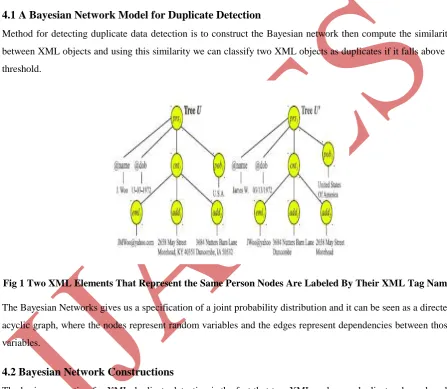
Fig 1 Two XML Elements That Represent the Same Person Nodes Are Labeled By Their XML Tag Name
The Bayesian Networks gives us a specification of a joint probability distribution and it can be seen as a directed
acyclic graph, where the nodes represent random variables and the edges represent dependencies between those
variables.
4.2 Bayesian Network Constructions
The basic assumption for XML duplicate detection is the fact that two XML nodes are duplicates depends only
on the fact that their values are duplicates and their children nodes are duplicates. So two XML trees are
duplicates if their root nodes are duplicates. An XML tree is defined as a triple U = (t, V, C)
Where,
t is a root tag label, e.g., for tree U
V is a set of (attribute, value) pairs. If the node itself has a value then we can consider it as a special (attribute,
value) pair.
C is a set of XML trees that is the sub-trees of U. These subtrees are again each described by a triple.
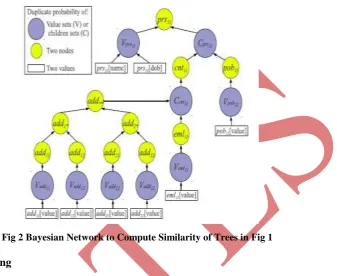
First consider the XML nodes tagged prs. As illustrated in Following figure, the BN will have a node labeled
Volume No.02, Issue No. 11, November 2014 ISSN (online): 2348 – 7550
tree U0. Node prs11 is assigned a binary random variable and this variable takes the value 1 (active) to representthe fact that the XML prs nodes in trees U and U’ are duplicates and It takes the value 0 (inactive) to represent
the fact that the nodes are not duplicates. Then compute prior probability, conditional probability and final
probability
Fig 2 Bayesian Network to Compute Similarity of Trees in Fig 1
4.3 Network Pruning
To increase Bayesian network evaluation time a lossless pruning strategy is used. We can say that this strategy is
lossless in the sense that no duplicate objects are lost. Only the object pairs incapable of reaching a given
duplicate probability threshold value are discarded. A network evaluation is performed by doing a propagation
of the prior probabilities, in a bottom up fashion, until reaching the topmost node of tree. The prior probabilities
are obtained by applying a similarity measure to the pair of values represented by the content of the leaf nodes
and computing such similarities is the mostexpensive operation in the network evaluation and in the duplicate
detection process in general. Therefore, the idea behind our pruning proposal lies in avoiding the calculation of
prior probabilities, unless they are strictly necessary and the strategy is that before comparing two objects, all the
similarities are assumed to be 1 (i.e., the maximum possible score). At every step of the process, maintain an
upper bound on the final probability value. At each step, whenever a new similarity is computed, the final
probability is estimated taking into consideration the already known similarities and the unknown similarities
that assume to be 1. When verify that the network root node probability can no longer achieve a score higher
than the defined duplicate threshold, the object pair is discarded and, thus, the remaining calculations are
avoided. The algorithm takes input as node N from the BN and a threshold T. It starts by gathering a list of all
the parent nodes of N and assuming the duplicate probability score is 1. It then proceeds compute the actual
probability value. If a parent node n is a value node then its probability score is simply the similarity of the
value. If n also has parent node then its probability score depends on its own parent.
Algorithm 1. Network Pruning (N, T)
Require: The node N, for which we intend to compute the probability score; threshold value T, below which the
Volume No.02, Issue No. 11, November 2014 ISSN (online): 2348 – 7550
Ensure: Duplicate probability of the XMLnodes represented by N
1: L ← getParentNodes(N) {Get the ordered list of parents}
2: parentScore[n] ← n L {Maximum probability of each parent node} 3: currentScore ← 0
4: for each node n in L do {Compute the duplicate probability}
5: if n is a value node then
6: score ← getSimilarityScore(n) {For value nodes, compute the similarities}
7: else
8: newThreshold ← getNewThreshold(T, parentScore) 9: score ← NetworkPruning(n, newThreshold)
10: end if
11: parentScore[n] ← score
12: currentScore
←computeProbability(parentScore)
13: if currentScore < T then
14: End network evaluation
15: end if
16: end for
17: return currentScore
Fig.3.Network Pruning Algorithm
V. CONCLUSION
Duplicate detection is defined as the identification of different representations of a same real-world object called
as duplicates and these duplicates are due to errors and inconsistencies in the data, like typos and misspellings,
missing information, or outdated data. The consequence of this, duplicates are not exactly equal, which makes
duplicate detection a challenging task in data cleaning and data integration processes. In this paper, we have
presented a method for XML duplicate detection called XMLDup. Our method uses a Bayesian Network to
determine the probability of two XML objects being duplicates. Bayesian Network model is construct from the
structure of the objects being compared and also all probabilities are computed considering not only the
information the objects contain, but also the way such information is structured in it. To improve the runtime
efficiency of our method called XMLDup we propose a network pruning algorithm is used. We can say that this
strategy is lossless in the sense that no duplicate objects are lost only object pairs incapable of reaching a given
threshold are discarded. Every node should have the duplicate probability value as 1 before evaluation, this is
called as pruning factor. Slightly lowering the pruning factor the system achieves high performance. The
XMLDup does not consider different structure representation and the conditional probability is derived
manually. So, in proposed the machine learning algorithm with support vector machine is used to extend the BN
Volume No.02, Issue No. 11, November 2014 ISSN (online): 2348 – 7550
objects with different structures and conditional probability is obtained automatically with the help of Supportvector machine.
VI. ACKNOWLEDGEMENT
We thank the anonymous reviewers for their very useful comments and suggestions.
REFERENCES
[1] M. Weis “Dogmatix Tracks Down Duplicates in XML,” Proc. ACM SIGMOD Conf. Management of Data,
pp. 431 442, 2005.
[2] L. Leita˜o and M. Weis, “Structure-Based Inference of XML Similarity for Fuzzy Duplicate Detection,”
Proc. 16th ACM Int’l Conf. Information and Knowledge Management, pp. 293-302, 2007.
[3] Melanie Weis,"Fuzzy Duplicate Detection on XML Data”, Humboldt-University at zu Berlin Unter den
Linden 6, Berlin, Germany, 2005.
[4] R .Ananthakrishna, S. Chaudhuri “Eliminating fuzzy duplicates in data warehouses” In International
Conference on Very Large Databases, Hong Kong, China, 2002.
[5] D. Milano, M. Scannapieco “Structure Aware XML Object Identification” Proc. VLDB Workshop Clean
Databases (CleanDB), 2006.
[6] M. Weis and F. Naumann, “Dogmatix Tracks Down Duplicates in XML” Proc. ACM SIGMOD Conf.
Management of Data, 2005.
[7] S. Puhlmann, M. Weis “XML Duplicate Detection Using Sorted Neighborhoods” Proc. Conf. Extending
Database Technology (EDBT), pp. 773-791, 2006.
[8] Melanie Weis and Felix "Detecting duplicate objects in XML documents" Humboldt-Universität zu Berlin,
germany,Workshop on Information Quality in Information Systems, 2004
[9] Lwin, T, "An efficient Duplicate detection system for XML document” Computer Engineering and
Applications (ICCEA) Second International Conference in 2010.
[10]Oktie Hassanzadeh, Fei Chiang, Hyun Chul Lee and Ren´ee J. Miller, University of Toronto, "Framework
for Evaluating Clustering Algorithms in Duplicate Detection",2009.
[11]P. Calado “Structure-Based Inference of XML Similarity for Fuzzy Duplicate Detection,” Proc. 16th