University of Pennsylvania
ScholarlyCommons
Publicly Accessible Penn Dissertations
2018
Statistical Methods For Truncated Survival Data
Lior Rennert
University of Pennsylvania, [email protected]
Follow this and additional works at:
https://repository.upenn.edu/edissertations
Part of the
Biostatistics Commons
This paper is posted at ScholarlyCommons.https://repository.upenn.edu/edissertations/2729 For more information, please [email protected].
Recommended Citation
Rennert, Lior, "Statistical Methods For Truncated Survival Data" (2018).Publicly Accessible Penn Dissertations. 2729.
Statistical Methods For Truncated Survival Data
Abstract
{Truncation is a well-known phenomenon that may be present in observational studies of time-to-event data.
For example, autopsy-confirmed survival studies of neurodegenerative diseases are subject to selection bias
due to the simultaneous presence of left and right truncation, also known as double truncation. While many
methods exist to adjust for either left or right truncation, there are very few methods that adjust for double
truncation. When time-to-event data is doubly truncated, the regression coefficient estimators from the
standard Cox regression model will be biased. In this dissertation, we develop two novel methods to adjust for
double truncation when fitting the Cox regression model. The first method uses a weighted estimating
equation approach. This method assumes the survival and truncation times are independent. The second
method relaxes this independence assumption to an assumption of conditional independence between the
survival and truncation times. As opposed to methods that ignore truncation, we show that both proposed
methods result in consistent and asymptotically normal regression coefficient estimators and have little bias in
small samples. We use these proposed methods to assess the effect of cognitive reserve on survival in
individuals with autopsy-confirmed Alzheimer’s disease. We also conduct an extensive simulation study to
compare survival distribution function estimators in the presence of double truncation and conduct a case
study to compare the survival times of individuals with autopsy-confirmed Alzheimer’s disease and
frontotemporal lobar degeneration. Furthermore, we introduce an R-package for the above methods to adjust
for double truncation when fitting the Cox model and estimating the survival distribution function.
Degree Type
Dissertation
Degree Name
Doctor of Philosophy (PhD)
Graduate Group
Epidemiology & Biostatistics
First Advisor
Sharon X. Xie
Subject Categories
STATISTICAL METHODS FOR TRUNCATED SURVIVAL DATA
Lior Rennert
A DISSERTATION
in
Epidemiology and Biostatistics
Presented to the Faculties of the University of Pennsylvania
in
Partial Fulfillment of the Requirements for the
Degree of Doctor of Philosophy
2018
Supervisor of Dissertation
Sharon X. Xie, Professor of Biostatistics
Graduate Group Chairperson
Nandita Mitra, Professor of Biostatistics
Dissertation Committee
Warren B. Bilker, Professor of Biostatistics
Kevin G. Lynch, Associate Professor of Psychiatry
STATISTICAL METHODS FOR TRUNCATED SURVIVAL DATA
c
COPYRIGHT
2018
Lior Rennert
This work is licensed under the
Creative Commons Attribution
NonCommercial-ShareAlike 3.0
License
To view a copy of this license, visit
ACKNOWLEDGEMENT
I would like to thank my dissertation advisor, Dr. Sharon X. Xie, for all of her support and
encour-agement during my time as a PhD student. I would also like to thank my committee member and
former supervisor Dr. Kevin G. Lynch for his mentorship over the years. The professors, students,
and staff in the Biostatistics Department here at Penn have provided an amazing environment to
be in, and I am very grateful for my experience here. Finally, I would like to thank my family. Among
many things, I would not be here if it were not for the love and motivation instilled in me from my
mother. My father and brothers have also provided me with great love and encouragement and
have believed in me throughout the years. Finally, I would like to thank all of my friends. While I
probably would have graduated much sooner if it weren’t for you, I would not trade the experiences
ABSTRACT
STATISTICAL METHODS FOR TRUNCATED SURVIVAL DATA
Lior Rennert
Sharon X. Xie
Truncation is a well-known phenomenon that may be present in observational studies of
time-to-event data. For example, autopsy-confirmed survival studies of neurodegenerative diseases are
subject to selection bias due to the simultaneous presence of left and right truncation, also known
as double truncation. While many methods exist to adjust for either left or right truncation, there are
very few methods that adjust for double truncation. When time-to-event data is doubly truncated,
the regression coefficient estimators from the standard Cox regression model will be biased. In
this dissertation, we develop two novel methods to adjust for double truncation when fitting the
Cox regression model. The first method uses a weighted estimating equation approach. This
method assumes the survival and truncation times are independent. The second method relaxes
this independence assumption to an assumption of conditional independence between the survival
and truncation times. As opposed to methods that ignore truncation, we show that both proposed
methods result in consistent and asymptotically normal regression coefficient estimators and have
little bias in small samples. We use these proposed methods to assess the effect of cognitive
reserve on survival in individuals with autopsy-confirmed Alzheimers disease. We also conduct
an extensive simulation study to compare survival distribution function estimators in the presence
of double truncation and conduct a case study to compare the survival times of individuals with
autopsy-confirmed Alzheimers disease and frontotemporal lobar degeneration. Furthermore, we
introduce an R-package for the above methods to adjust for double truncation when fitting the Cox
TABLE OF CONTENTS
ACKNOWLEDGEMENT . . . iii
ABSTRACT . . . iv
LIST OF TABLES . . . vii
LIST OF ILLUSTRATIONS . . . viii
CHAPTER 1 : INTRODUCTION . . . 1
CHAPTER 2 : COX REGRESSION MODEL WITH DOUBLY TRUNCATED DATA . . . 3
2.1 Introduction . . . 3
2.2 Proposed Parametric and Nonparametric Weighted Estimators . . . 6
2.3 Asymptotic Properties of Proposed Estimators . . . 11
2.4 Simulations . . . 18
2.5 Application to Alzheimer’s Disease Study . . . 22
2.6 Discussion . . . 26
CHAPTER 3 : COX REGRESSION MODEL UNDER DEPENDENT TRUNCATION . . . 29
3.1 Introduction . . . 29
3.2 Methods . . . 32
3.3 Simulations . . . 39
3.4 Application to Alzheimer’s Disease . . . 42
3.5 Discussion . . . 45
CHAPTER 4 : BIAS IN THE SURVIVAL DISTRIBUTION FUNCTION ESTIMATOR UNDER DOUBLE TRUNCATION: ACASE STUDY OF NEURODEGENERATIVE DISEASES . . . 51
4.1 Introduction . . . 51
4.2 Existing methods to adjust for double truncation . . . 54
4.4 Example: Autopsy-confirmed Alzheimer’s disease and frontotemporal lobar
degen-eration . . . 62
4.5 Discussion and Recommendations . . . 67
CHAPTER 5 : A PACKAGE FOR ANALYZINGTRUNCATEDDATA INR . . . 70
5.1 Introduction . . . 70
5.2 Statistical methodology . . . 71
5.3 Overview of the package SurvTruncation . . . 73
5.4 Conclusions . . . 81
CHAPTER 6 : DISCUSSION. . . 83
APPENDICES . . . 87
LIST OF TABLES
TABLE 2.1 : Simulation results . . . 20
TABLE 2.2 : Simulation results under misspecification of the truncation distribution . . . 21
TABLE 2.3 : Simulation results under dependent truncation structureV =U+d0. . . 22
TABLE 2.4 : Comparing low education (<16 years) and high education (≥16 years) groups 23 TABLE 2.5 : Application: Education on survival in AD . . . 24
TABLE 3.1 : Simulation results . . . 41
TABLE 3.2 : Application: Occupational attainment on survival in AD. . . 45
TABLE 4.1 : Simulation results . . . 59
TABLE 4.2 : Simulation results under misspecification of the truncation distribution . . . 62
TABLE 4.3 : Simulation results under violation of the independence assumption . . . 64
TABLE 4.4 : Testing equality of survival probabilities between AD and FTLD . . . 67
TABLE 5.1 : Summary of the arguments of the functioncdfDT. . . 75
LIST OF ILLUSTRATIONS
FIGURE 2.1 : Hypothetical example of double truncation . . . 4
FIGURE 2.2 : Normal Q-Q plot ofT = βbwnp−β0
b
σ from 1000 simulations under the
trunca-tion scenario for the second model described in Table 2.1 . . . 18 FIGURE 2.3 : Comparing bias and MSE (mean-squared error) of estimators . . . 21
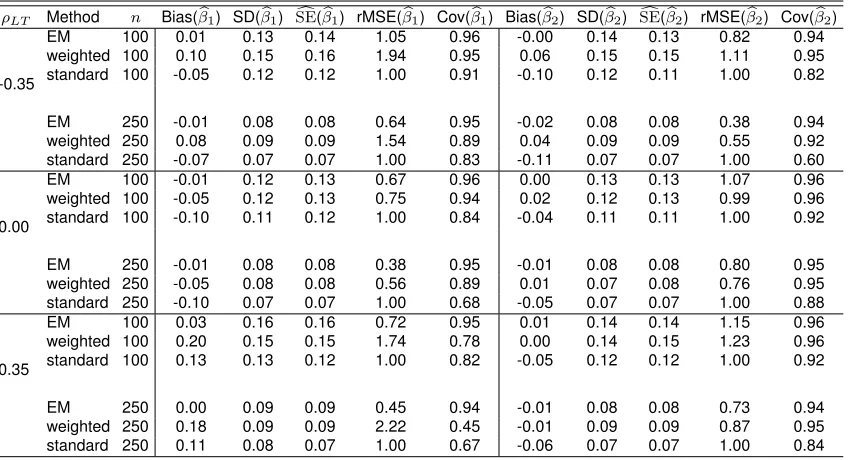
FIGURE 3.1 : Comparing bias and MSE (mean-squared error) of estimators across dif-ferent left and right truncation proportions, underdependent survival and truncation times. . . 48 FIGURE 3.2 : Comparing bias and MSE (mean-squared error) of estimators across
dif-ferent left and right truncation proportions, underindependentsurvival and truncation times. . . 49 FIGURE 3.3 : Comparing bias and MSE (mean-squared error) of estimators under
de-pendent left truncation. . . 50
FIGURE 4.1 : Schematic depiction of doubly truncated neurodegenerative disease data . 52 FIGURE 4.2 : Bias of distribution function estimators. . . 58 FIGURE 4.3 : Bias of distribution function estimators under misspecification of truncation
distribution. . . 60 FIGURE 4.4 : Bias of distribution function estimators under violation of independence
as-sumption . . . 63 FIGURE 4.5 : Estimated distribution functions for AD and FTLD . . . 66
FIGURE 5.1 : NPMLE of the cumulative distribution function and survival function of the AIDS induction times. . . 78 FIGURE 5.2 : NPMLE of the marginal cumulative distribution function of left truncation
time (left) and right truncation time (right). . . 79 FIGURE 5.3 : NPMLE of the joint cumulative distribution function of left and right
CHAPTER 1
I
NTRODUCTIONTruncation is a statistical phenomenon that has been shown to occur in a wide range of applications,
including survival analysis, epidemiology, economics, and astronomy. Individuals who are subject
to truncation provide no information to the investigator. Left truncation occurs when data is only
recorded for individuals whose survival time exceeds a random time (i.e. left truncation time).Right
truncationoccurs when data is only recorded for individuals whose survival time proceeds a random
time (i.e. right truncation time). When both left and right truncation are present, this is known as
double truncation.
Double truncation is inherent in retrospective autopsy-confirmed studies of neurodegenerative
dis-eases. Due to the inaccuracy of clinical diagnosis (Beach et al., 2012), autopsy confirmation is
needed for a definitive diagnosis (Grossman and Irwin, 2016) of a particular neurodegenerative
disease. The right truncation occurs because information is only obtained from a subject when they
receive an autopsy. Subjects who survive past the end of the study are not diagnosed and therefore
not included in the study sample, resulting in a sample that is biased towards subjects with smaller
survival times. Furthermore, the retrospective sample is also left truncated because subjects who
succumb to the disease before they enter the study are unobserved, resulting in a sample that is
biased towards subjects with larger survival times. We note that right censoring is not possible in
this setting, since any subject who has an autopsy performed will also have a known survival time.
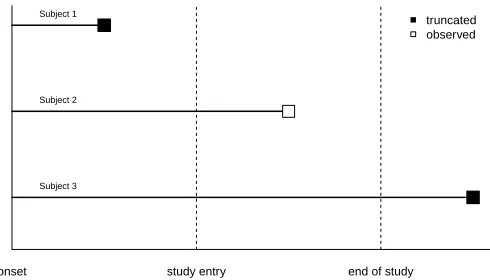
A diagram showing how double truncation occurs is provided in Figure 2.1.
The aim of our data analysis is to get accurate estimates of the effect of risk factors on survival
from disease symptom onset in subjects with autopsy-confirmed neurodegenerative diseases. The
default application for analysis in this setting is the Cox regression model (Cox, 1972). However,
regression techniques which do account for truncation will result in biased regression coefficient
estimators. This is because under left truncation, individuals with smaller event times are less
likely to be observed, resulting in a study sample that is biased towards larger event times and
risk factors associated with larger event times. Similarly, under right truncation, individuals with
smaller event times and risk factors associated with smaller event times. If double truncation is
not accounted for, then the regression coefficient estimators from the Cox regression model will be
biased.
In Chapter 2, we introduce a weighted estimating equation approach to adjust the Cox regression
model in the presence of double truncation, under the assumption that the survival times and
trun-cation times are independent. In chapter 3, we use a conditional likelihood approach to relax this
independence assumption to an assumption of conditional independence between the survival and
truncation times. Here we estimate the regression coefficient estimators for the Cox regression
model using an expectation-maximization (E-M) algorithm. In Chapter 4, we conduct a case study
to compare estimators of the survival distribution function under double truncation. In Chapter 5, we
introduce an R-package to adjust both the Cox regression model and the survival time distribution
function in the presence of double truncation. The R-package is intended for the situation where
the survival and truncation times are independent. Concluding remarks are given in Chapter 6. The
code for the Cox regression coefficient estimators using the EM algorithm introduced in Chapter 3 is
provided in Appendix D. The code for the functions contained in the R package described in
Chap-ter 5, which use a nonparametric weighting approach to adjust the Cox regression model (ChapChap-ter
CHAPTER 2
C
OX REGRESSION MODEL WITH DOUBLY TRUNCATED DATA2.1. Introduction
Accurate regression coefficient estimation in survival analysis is crucial for studying factors that
affect disease progression. However in some survival studies the outcome of interest may be
subject to either left or right truncation. When both left and right truncation are present, this is known
as double truncation. For example, double truncation is inherent in retrospective autopsy-confirmed
studies of Alzheimer’s disease (AD), where autopsy confirmation is the gold standard for diagnosing
AD due to the inaccuracy of clinical diagnosis (Beach et al., 2012). The right truncation occurs
because information is only obtained from a subject when they receive an autopsy. Subjects who
survive past the end of the study are not diagnosed and therefore not included in the study sample,
resulting in a sample that is biased towards subjects with smaller survival times. Furthermore, the
retrospective sample is also left truncated because subjects who succumb to the disease before
they enter the study are unobserved, resulting in a sample that is biased towards subjects with
larger survival times. We note that right censoring is not possible in this setting, since any subject
who has an autopsy performed will also have a known survival time.
A diagram showing how double truncation occurs is provided in Figure 2.1. In this hypothetical
example, we assume subjects 1, 2, and 3 all have similar times of disease symptom onset. For
illustrative purposes, we also assume that subjects 1, 2, and 3 have the same study entry time,
however this need not be the case. Here the x-axis represents time, and the squares represent the
terminating events. Subject 1 is left truncated because they die before they enter the study. Subject
2 enters the study and dies before the end of the study, and is therefore observed. Subject 3 is
right truncated because they live past the end of the study, and therefore do not have an autopsy
performed.
If the left and right truncation are not accounted for then the observed sample will be biased,
which may lead to biased estimators of regression coefficients and hazard ratios. In this paper, we
examine the relationship between education and survival from AD symptom onset in a retrospective
Figure 2.1: Hypothetical example of double truncation
onset study entry end of study
Subject 1
Subject 2
Subject 3
truncated observed
In this hypothetical example, we assume subjects 1, 2, and 3 all have similar times of disease symptom onset. For illustrative purposes, we also assume that subjects 1, 2, and 3 have the same study entry time, however this need not be the case. Here the x-axis represents time, and the squares represent the terminating events. Subject 1 is left truncated because they die before they enter the study. Subject 2 enters the study and dies before the end of the study, and is therefore observed. Subject 3 is right truncated because they live past the end of the study, and therefore do not have an autopsy performed.
regression model (Cox, 1972). However, to obtain consistent regression coefficient estimators,
we must adjust for truncation. Regression techniques already exist under left truncation (Lai and
Ying, 1991), right truncation (Kalbfleisch and Lawless, 1991), and length-biased data (Wang, 1996).
In this paper, we propose a Cox regression model to adjust for double truncation using a weighted
estimating equation approach, where the hazard rate for the failure times follows that of the standard
Cox regression model.
Although double truncation may appear in many studies in which data is only recorded for subjects
whose event times fall in an observable time interval, the amount of literature on methods to handle
double truncation is small. Most of the literature deals with the estimation of the survival distribution
rather than regression. Efron and Petrosian (1999) introduced the nonparametric maximum
likeli-hood estimator (NPMLE) for the survival distribution function under double truncation. Shen (2010)
investigated the asymptotic properties of the NPMLE and introduced a nonparametric estimator of
the truncation distribution function. Shen (2010) and Moreira and de ˜Una- ´Alvarez (2010) introduced
a semiparametric maximum likelihood estimator (SPMLE) for the survival distribution function under
and doubly truncated data using linear transformation models, but these models only allow discrete
covariates and the asymptotic properties of the resulting estimators are not established. Moreira,
de ˜Una- ´Alvarez, and Meira-Machado (2016) introduced nonparametric kernel regression for doubly
truncated data, where a mean function conditional on a single covariate is estimated, rather than a
hazard ratio. Furthermore, the resulting estimator is asymptotically biased. Since right censoring is
rare under double truncation, the current literature assumes no censoring or interval censoring.
The concept of adjusting the Cox regression model for biased samples using a weighted estimating
equation approach was first introduced by Binder (1992) for survey data. In this setting, the weights
were knowna priori and a biased study sample was selected directly from the target population
(i.e. the population we wish to study). Lin (2000) proved the asymptotic normality of the regression
coefficient estimator introduced by Binder, and extended the model to settings where the biased
study sample is selected from a representative sample of the underlying target population. Pan
and Schaubel (2008) introduced a Cox regression model with estimated weights, using logistic
regression to estimate each subject’s probability of selection into the study. In their setting, they
assumed that baseline information was available from both subjects with observed and missing
survival times. Due to truncation, we do not have any information on subjects with missing survival
times. Therefore previous methods are unable to address the unique challenges present in our AD
study.
There are several new contributions of this paper to the literature. We propose a Cox regression
model using a weighted estimating equation approach to obtain a hazard ratio estimator under
dou-ble truncation, where the weights are inversely proportional to the probability that a subject isnot
truncated. These selection probabilities are estimated both parametrically and nonparametrically
using methods introduced by Shen (2010a, 2010b) and Moreira and de ˜Una- ´Alvarez (2010). As
opposed to using data from missing subjects, the selection probabilities here are estimated using
survival and truncation times from observed subjects only. The parametric selection probabilities
make distributional assumptions about the truncation times, while the nonparametric selection
prob-abilities do not. We show that the proposed regression coefficient estimators are consistent, and
greatly reduce the bias in finite samples compared to the standard Cox regression estimator which
ignores double truncation. We prove the asymptotic normality of the regression coefficient
use the bootstrap technique (Efron and Tibshirani, 1993) to estimate the variance and confidence
intervals of the regression coefficient estimator under nonparametric weights.
The remainder of this paper is organized as follows. In Section 2.2 we introduce the weighted
esti-mating equation and the proposed estimators, as well as the estimation procedure for the weights.
The asymptotic properties of the proposed estimators are provided in Section 2.3. In Section 2.4
we conduct a simulation study to assess the finite sample performance of the proposed estimators.
The proposed method is then applied to the AD data in Section 2.5. Discussion and concluding
remarks are given in Section 2.6.
2.2. Proposed Parametric and Nonparametric Weighted Estimators
Throughout this paper, we refer topopulation random variablesas random variables from the target
population and denote them without subscripts. We refer tosampling random variablesas random
variables from the observed sample and denote them with subscripts. These two sets of variables
may have different distributions due to double truncation, which is why standard methodology may
be inappropriate.
LetTi denote the observed survival times for subjecti = 1, ..., n ≤N, wherenis the size of the
observed sample andN is the size of thetarget sample. Here we use the term target sample to
denote a representative sample from the underlying target population. In our setting, this consists
of all subjects that would have been included in the observed sample had truncation not occurred.
For a given timet, defineYi(t) = 1{Ti≥t}andNi(t) = 1{Ti≤t}. Letτ be a constant set to the end of
study time. The Cox regression model assumes that for a given subject withp×1covariate vector
Zi(t), the hazard function at timetis given byλi(t) =λ0(t)eβ
0
0Zi(t), whereλ
0(t)is the true baseline
hazard function and is unspecified. The truep×1regression coefficient vector,β0, is estimated by
b
β, the solution to
U(β) = n
X
i=1
Z τ
0
Zi(t)−
Pn
j=1Yj(t)eβ
0Z j(t)Z
j(t)
Pn
j=1Yj(t)eβ
0Z j(t)
dNi(t) =0, (2.1)
wheredNi(t) =Ni(t)−Ni(t−). Since right censoring is not possible under our sampling scheme,
we do not include it in the estimation procedures. Therefore dNi(Ti)= 1 in this setting, since all
When subjects have unequal probabilities of selection, then the study sample will not be a
repre-sentative sample of the underlying target population. To adjust for biased samples, Binder (1992)
proposed weighting each subject in the score equation 2.1 by the inverse probability of their
inclu-sion in the sample. The true regresinclu-sion coefficientβ0is then estimated byβbw, the solution to the
weighted score equation
Uw(β,π) =
n
X
i=1
Z τ
0
wi
Zi(t)−
Pn
j=1wjYj(t)eβ
0Z j(t)Z
j(t)
Pn
j=1wjYj(t)eβ
0Z j(t)
dNi(t) =0. (2.2)
Here π = (π1, ..., πn) and wi = π−i 1, where πi is the selection probability for subject i, and is
conditional on subject specific characteristics. The method described above assumes that the
selection probabilitiesπiare knowna priori. When these probabilities are not known, they must be
estimated.
In our setting, we can estimate the probability that a subject was selected in our sample (i.e. not
truncated), conditional on their observed survival time. Thus a natural solution to adjust for double
truncation is to use these estimated selection probabilities in (2). These selection probabilities are
estimated using the survival and truncation times from observed subjects only. The estimation
procedure is given in Section 2.2.1.
In our data example, the left truncation time is taken to be the time from AD symptom onset to
entry into the study. The right truncation time is set to the time from AD symptom onset to the end
of the study. LetU and V denote the left and right truncation times, respectively. Due to double
truncation, we observe{T, U, V,Z(t)}if and only ifU ≤T ≤V.
Conditional onTi, subjecti is observed with probabilityπi =P(U ≤ T ≤ V|T =Ti). Hereπi is
the probability that a subject from the target sample with survival timeT =Ti is observed, and is
called the selection bias function (Bilker and Wang, 1996). For an intuition as to why this weighting
scheme works, we consider the following. Ifxindividuals with survival timeTiare observed in the
sample, then by the definition ofπi, there must bex/πiindividuals in the target sample with survival
timeTi. Without loss of generality, supposex= 1, so that there are 1/πi individuals with survival
time Ti in the target sample. Of these, (1/πi)×πi = 1will be observed and the other 1/πi −1
individuals are referred to as ghosts (Turnbull, 1976) and are unobserved. In this case, eachTi
adjust for the biased sample by weighting each observation in the estimating equation 2.1 by1/πi.
To give another intuitive view as to how the weighting works, it can be shown thatπiis proportional
to the probability of observing a survival timeTiin the observed sample relative to the probability of
observing a survival timeTiin the target sample. That is,πi∝P(T =Ti|U ≤T ≤V)/P(T =Ti).
Using these selection probabilities in (2) works because observations with survival times which are
oversampled in the observed sample relative to the target sample are downweighted and those
which are undersampled are upweighted, yielding a score function consisting of survival times (and
corresponding covariates) that are distributed according to those of the target population. We show
in Section 2.3 that if these selection probabilities are estimated consistently and plugged into the
score equation 2.2, then this score function is asymptotically equivalent to the unweighted score
function using all observations from the target sample, and is therefore asymptotically unbiased.
This results in the consistency of the proposed regression coefficient estimators presented below.
2.2.1. Estimation of selection probabilities
The methods used to estimate the selection probabilities assume that the survival and truncation
times are independent in the observable region U ≤ T ≤ V. This independence assumption is
needed to estimateπ using the estimation procedures below. We note that under independence,
πi is simplyP(U ≤ Ti ≤ V). Situations where the independence assumption can be relaxed by
covariate adjustment are discussed in Section 2.6.
Before we describe the parametric and nonparametric procedures for estimating the selection
prob-abilities, we introduce additional notation and assumptions. Letf(t)andF(t)denote the density
and cumulative distribution functions of T. Let k(u, v) and K(u, v) denote the joint density and
cumulative distribution functions of (U, V). For any cumulative distribution function H, define the
left endpoint of its support by aH = inf{x : H(x) > 0} and the right endpoint of its support by
bH = inf{x : H(x) = 1}. Let HU(u) = K(u,∞) and HV(v) = K(∞, v) denote the marginal
cumulative distribution functions ofU andV, respectively. For the following methods, we assume
thataHU < aF ≤aHV andbHU ≤bF < bHV. These conditions are needed for identifiability of the
selection probability estimators presented below (Shen, 2010a,b; Woodroofe, 1985).
Lettingπ(t) =P(U ≤t≤V), our methods rest on the assumption thatπ(t)>0for allt∈[aF, bF].
of this positivity assumption can lead to aπi that is very small and thus gives undue influence to
theithobservation in the score equation 2.2. We discuss a remedy to this situation at the end of
Section 2.6. We note that this positivity assumption is generally implied through the identifiability
constraintsaHU < aF ≤aHV andbHU ≤bF < bHV. Justification of these constraints and positivity
assumption for our data example, and a discussion on when these may be violated, are given in
Web Appendix D.
Nonparametric estimation
We now present the nonparametric estimation of the selection probabilitiesπi. As shown in Shen
(2010a, p. 837), the distribution of the observed survival times, F˜(t), can be written as F˜(t) =
P(Ti≤t) =P(T ≤t|U ≤T ≤V) =p−1P(T ≤t, U ≤T ≤V) =p−1
Rt
0[K(s, bHV)−K(s, s)]F(ds),
wherep=P(U ≤T ≤V)is the probability of observing a random subject from the target sample.
The last equality follows from the independence ofT and(U, V)in the observable regionU ≤T ≤
V. In this case, the density of the observed survival times is given byf˜(t) =p−1×π(t)f(t), where
π(t) = K(t, bHV)−K(t, t) = P(U ≤t ≤V). It can also be shown that under this independence
assumption, the joint density of the observed truncation times can be written ask˜(u, v) = p−1×
ϕ(u, v)k(u, v), whereϕ(u, v) =F(v)−F(u−) =P(u≤T ≤v).
Letϕ= (ϕ1, ..., ϕn), whereϕi =ϕ(Ui, Vi). Sincek(u, v) =p×k˜(u, v)/ϕ(u, v), we have that when
ϕ andpare known, K(u, v) can be estimated byn−1pPn
j=1
1{Uj≤u,Vj≤v}
ϕj . Settinguand v to ∞,
we can estimate p by n Pn j=11/ϕj
−1
. Therefore when ϕ is known, we can estimate K(u, v)
by Pn j=11/ϕj
−1Pn
j=1
1{Uj≤u,Vj≤v}
ϕj and thus πi = K(Ti, bHV)−K(Ti, Ti) can be estimated by
Pn j=11/ϕj
−1Pn
j=1
1{Uj≤Ti≤Vj}
ϕj . Similarly, sincef(t) = p× ˜
f(t)/π(t), we have that when π is
known,F(t)can be estimated by Pn j=11/πj
−1Pn
j=1 1{Tj≤t}
πj and thusϕi=F(Vi)−F(Ui−)can
be estimated by Pn j=11/πj
−1Pn
j=1
1{Ui≤Tj≤Vi}
πj .
Shen (2010) proved that the NPMLE’s of ϕi andπi, denoted byϕbi andπbi, respectively, can be
found using the following iterative algorithm:
Step 0) Setϕb(0)i =n−1Pn
j=11{Ui≤Tj≤Vi}, fori= 1, ..., n.
Step 1) Setbπi(1)=Pn
j=1 1
b
ϕ(0)j
−1 Pn
j=1
1{Uj≤Ti≤Vj}
b
Step 2) Setϕb(1)i =Pn
j=1 1
b
π(1)j
−1 Pn
j=1
1{Ui≤Tj≤Vi}
b
πj(1) , fori= 1, ..., n.
Step 3) For a prespecified errore, repeat steps 1 and 2 untilPn
i=1|bπ
(s) i −πb
(s−1) i |< e.
The NPMLE of π is given by πbnp = (bπ1(s), ...,πb(s)n ), with estimated weights wnp = 1/πb
np
. The
corresponding estimator ofβ0is denoted byβbw
np, the solution toUw(β,πb
np ) =0.
Because we do not need estimates of the survival and truncation time distributions, the algorithm
to estimateπpresented here is a simplified version of the algorithm given in Shen (2010). We note
that both algorithms result in the same estimatorπbnp.
Parametric estimation
We can also estimate the selection probabilities parametrically using the methods introduced by
Shen (2010) and Moreira and de ˜Una- ´Alvarez (2010). In this setting, we assume that the truncation
timesU andV have a parametric joint density functionkθ(u, v). Here θ ∈ Θ is aq×1vector of
parameters andΘis the parametric space.
Under the assumption of independence in the region U ≤ T ≤ V, the conditional likelihood of
the(Ui, Vi)given Ti is given byLc(θ) = Qni=1kθ(Ui, Vi)/πiθ, whereπθi =
R
u≤Ti≤vkθ(u, v)dudv =
Pθ(U ≤Ti≤V). Here the subscriptθdenotes that the probability depends onθ. In this setting, we
estimateπi byπbθi =
R
u≤Ti≤vkθb(u, v)dudv. The conditional likelihood estimator,θb, is the solution to
Uc(θ) = ∂∂θlogLc(θ) =0.
The MLE ofπis given byπbθ= (πbθ
1, ..., πθnb). The weightswiare then estimated bywi(bθ) =p(bθ)/πbθi,
wherep(bθ) =P b
θ(U ≤T ≤V) = n
−1Pn
j=11/π
b θ
j
−1
. The corresponding estimator ofβ0is denoted
by βbw
b
θ, the solution to Uw(β,π b
θ) =0. Here the estimated parametric weightsw
i(bθ)scale1/πbθi
byp(bθ)so that they sum up to the original sample sizen, which is needed for the derivation of the
asymptotic variance ofβbw
b
θ.
2.2.2. Estimating the regression coefficients
The estimated parametric and nonparametric selection probabilities,πbθ andπb
np
, can be computed
using the code provided in the online supplementary materials. The regression coefficient
estima-torsβbw
b
R (coxph) with weights p(bθ)/πbθ and1/πb
np
. More details, including standard error estimates and
confidence intervals ofβbw
b
θ andβbwnp, as well as sample data, are provided in our code.
2.3. Asymptotic Properties of Proposed Estimators
In this section, we describe the asymptotic properties of our proposed estimatorsβbwnp andβbw
b
θ. The asymptotic properties of the proposed estimators refer to the situation when the total number
of observed (non-truncated) subjectsn → ∞. The following theorems assume that the regularity
conditions listed below hold.
The regularity conditions listed here are adapted from Andersen and Gill (1982), Pan and Schaubel
(2008), and Shen (2010ab). For ap×1vectora, we denotea⊗0= 1,a⊗1=a, anda⊗2as thep×p
matrixaa0. Conditions (a)-(f) below are needed for the consistency ofβbw
np:
(a){Ti, Ui, Vi,Zi}are independent and identically distributed fori= 1, ..., N,
(b)Rτ
0 dΛ0(t)<∞, whereΛ0(t)is the baseline cumulative hazard function,
(c) ForSw(j)(β,π;t) =n−1Pni=1π−i1Yi(t)eβ
0Z i(t)Z
i(t)⊗j,j= 0,1,2, we assume the existence of a
neighborhoodB0ofβ0andΠ0ofπ0such thatsupt∈[0,τ],β∈B0,π∈Π0kSw (j)
(β,π;t)−sw(j)(β,π;t)k
p
−→0asn→ ∞, forj= 0,1,2, wheresw(j)(β,π;t)=E{Sw(j)(β,π;t)}ands
(0)
w (β,π;t)>0,
(d) There exists aδ >0such thatπ(t) =P(U ≤t≤V)> δalmost surely for everyt∈[aF, bF],
(e)Rτ
0 |Zik(t)|dt <∞almost surely, whereZik(t)is thek
thcovariate value for subjectiat timet,
(f) The Cox model assumptionλ(t) = λ0(t)eβ
0
0Z(t)holds for both observed and unobserved
sub-jects.
Condition (a) is used when applying the central limit theorem, and this assumption is reasonable
in practice assuming the subjects are independent. Condition (b) is used to ensure that several
terms in the proofs of Theorems 2.1 and 2.2 are bounded. Condition (c) ensures thatSw(j)(β,π;t)
converges in probability, and thate(β,π;t) = sw(1)(β,π;t) s(0)w(β,π;t)
is bounded. This assumption is applied
several times throughout the proofs below. Condition (d) states that the probability of observing
any survival timetin[0, τ]is non-zero, which leads to the boundedness of several quantities in the
proofs below and ensures thatN andngo to∞at the same rate. Condition (e) is a boundedness
condition of the covariateZik(t). While it is not required, it is applicable in most situations and is
used to simplify the proofs of Theorems 2.1 and 2.2. For a fixed covariate vectorZ(t)and fixed time
Cox model) regardless of whether a subject was observed or truncated. This assumption is used
implicitly in the proof of Theorem 2.1 when concluding N−1U
w(β,πb)andN
−1U∗(β)
(defined in
the proof of Theorem 2.1) converge to the same limit.
For the consistency ofβbw
b
θ, we need the following three conditions in addition to (a)-(f): (g)Gθ(t) =Pθ(U ≤t≤V) =R
u≤t≤vkθ(u, v)dudvis continuous intfor everyθ∈Θ,
(h)θbn p −
→θimpliesG b θn(t)
p
−→Gθ(t)for everyt∈[0, τ],
(i) Existence of a neighborhoodB0ofβ0andΘ0ofθ0such thatsupt∈[0,τ],β∈B0,θ∈Θ0kSw (j)
(β,θ;t)
−sw(j)(β,θ;t)k
p
−→0asn→ ∞, forj = 0,1,2, wheresw(j)(β,θ;t)=E{Sw(j)(β,θ;t)}and
s(0)w (β,θ;t)>0. The quantitySw(j)(β,θ;t)is defined in the proof of Theorem 2.2.
Conditions (g) and (h) are used for the uniform consistency ofπbθ
i toπ
θ0
i across all possible values of
Tiin[0, τ]. Note thatπiθ=Gθ(Ti). Condition (i) ensures thatSw(j)(β,θ;t)converges in probability,
and thate(β,θ;t) = sw(1)(β,θ;t)
s(0)w (β,θ;t)
is bounded.
The regularity conditions (j) and (k) below are needed in addition to (a)-(i) for the asymptotic
nor-mality ofβbw
b
θ:
(j) For everyt∈[0, τ]andθin a neighborhoodΘ0ofθ0,Gθ(t)is continuously differentiable inθ,
(k) Positive-definiteness of the matricesAw(β,θ)andI(θ)(defined in proof of Theorem 2.2).
Condition (j) is used to ensure the existence of Q(β0,bθ) defined in the proof of Theorem 2.2,
along with its convergence toQ(β0,θ0). Condition (k) ensures the existence of the inverses of the
matricesAw(β,θ)andI(θ).
Theorem 2.1:βbw
npandβbwθb
are consistent estimators ofβ0asn→ ∞.
Proof of Theorem 2.1: The following proof holds for bothwb = wnpand wb = wbθ. We therefore
denoteπbnpandπbθby b
π to simplify notation in this setting. The score equation 2.2 can be written
as
Uw(β,π) =
N X i=1 Z τ 0 ξi πi
{Zi(t)−Ew(β,π;t)}dNi(t), (2.3)
whereEw(β,π;t) = PNj=1ξπj
jYj(t)e
β0Zj(t)Z
j(t) /PNj=1ξπj
jYj(t)e
β0Zj(t) , andξ
i is an indicator
from both truncated and observed subjects, withξi= 0 for truncated subjects.
Letβb b
wbe the solution toUw(β,πb) =0. We will show thatN
−1U
w(β,πb)andN
−1U∗(β)
converge
to the same limit, where U∗(β) = PN
i=1
Rτ
0{Zi(t)−E(β;t)}dNi(t) is the complete case score
function which includes all observations from both truncated and observed subjects, andE(β;t) =
PN
j=1{Yj(t)e
β0Zj(t)Z
j(t)}/Pj=1N {Yj(t)eβ
0Z
j(t)}. We then apply results from Lin (2000) and convex
function theory to conclude thatβb b
w p −→β0.
Forπ(t) =P(U ≤t≤V), Shen (2010a,2010b) proved thatbπ(t)converges uniformly in probability
(with respect to t) to π0(t). Here πb(t) denotes the estimator of π(t) under both parametric and
nonparametric assumptions, andπ0(t) is the true probability of observing a subject with survival
timet. We will denoteπbiandπ0,ias the estimated and true probability of observing a subject with
survival timeTi, respectively. Note thatπbi=bπ(Ti)andπ0,i=π0(Ti).
We can re-expressN−1U
w(β,πb)as
N−1Uw(β,πb) =N
−1 N X i=1 Z τ 0
π0,i−1ξi{Zi(t)−Ew(β,πb;t)}dNi(t) (2.4)
+N−1
N
X
i=1
Z τ
0
{πb−i1−π0,i−1}ξi{Zi(t)−Ew(β,πb;t)}dNi(t). (2.5)
We will now state and prove a lemma used throughout the proof of Theorem 2.1.
Lemma:N−1PN
i=1(bπ
−1
i −π
−1
0,i)g(·) p
−→0for any stochastically bounded functiong.
Proof: LetHN(πb;·) =N
−1PN
i=1(bπ
−1
i −π
−1
0,i)g(·). We need to show that∀ >0,∃N ≥Nsuch that
P(|HN(πb;·)|> )< .
By the uniform consistency ofbπ(t)int fort ∈ [aF, bF]and the continuous mapping theorem, we
have thatπb−1(t)is also uniformly consistent int fort ∈ [a
F, bF]. That is, ∀ > 0,∃N1 such that
N ≥N1 =⇒ P( sup t∈[aF,bF]
|πb−1(t)−π−01(t)| > )< . Sincegis stochastically bounded,∃M <∞
andN2 such that∀ >0, N > N2 =⇒ P(|g(·)|> M)< .
P(|HN(πb;·)|> ) =P(N −1 | N X i=1
(πbi−1−π0,i−1)g(·)|> )
≤P(N−1
N
X
i=1
|(bπ−i1−π0,i−1)g(·)|> )≤P(N−1
N
X
i=1
|bπi−1−π0,i−1|> /M)
≤P( max
i=1,..,N|bπ
−1
i −π
−1
0,i|> /M)≤P( sup t∈[aF,bF]
|πb−1(t)−π0−1(t)|> /M)< .
Forj= 0,1, we can write
Sw(j)(β,πb;t) =N
−1
N
X
i=1
π−0,i1ξiYi(t)eβ
0Z i(t)Z
i(t)⊗j+N−1 N
X
i=1
(bπi−1−π0,i−1)ξiYi(t)eβ
0Z i(t)Z
i(t)⊗j
SinceZi(t)is stochastically bounded by regularity assumption (e), the termξiYi(t)eβ
0Z i(t)Z
i(t)⊗j
is also stochastically bounded. Application of the lemma therefore yieldsSw(j)(β,πb;t) =
Sw(j)(β,π0;t) +op(1). SinceEw(β,πb;t) =
Sw(1)(β,πb;t) Sw(0)(β,
b
π;t), application of Slutsky’s theorem yields
Ew(β,πb;t) =Ew(β,π0;t) +op(1).
We therefore have that 2.4 is equivalent toN−1PN
i=1
Rτ
0 π
−1
0,iξi{Zi(t)−Ew(β,π0;t) +op(1)}dNi(t).
Equation 2.5 is equivalent toN−1PN
i=1
Rτ
0{bπ
−1
i −π
−1
0,i}ξi{Zi(t)−Ew(β,π0;t) +op(1)}dNi(t), which
converges in probability to0by the lemma.
Finally, another application of Slutsky’s theorem yields
N−1Uw(β,πb) =N
−1 N X i=1 Z τ 0
π0,i−1ξi{Zi(t)−Ew(β,π0;t)}dNi(t) +op(1) =N−1Uw(β,π0) +op(1).
Thus N−1Uw(β,πb) and N
−1U
w(β,π0) converge to the same limit. Since N−1Uw(β, π0) and
N−1U∗(β)
converge to the same limit (Lin 2000), N−1U
w(β,πb) andN
−1U∗(β)
must also
con-verge to the same limit. Therefore our proposed estimating equation,Uw(β,πb), is asymptotically
equivalent to the standard Cox estimating equation containing all of the observations from the target
sample,U∗(β). SinceU∗(β)is maximized atβ0(Andersen and Gill 1982), it follows from convex
function theory thatβb b w
p
−→β0(Lin 2000).
Theorem 2.2Under correct specification of the truncation distribution,√n(βbw
b
asymptoti-cally normal asn→ ∞with mean zero and covariance matrix
Σ(β0,θ0) =Aw(β0,θ0)−1Vw(β0,θ0)Aw(β0,θ0)−1.
To estimate the asymptotic variance of βbw
ˆ
θ, we need some additional definitions. Let wi(θ) = p(θ)/πθ
i, wherep(θ) =Pθ(U ≤T ≤V). Denoteθ0as the true value ofθ. For ap×1vectora,a⊗0
= 1,a⊗1=a, anda⊗2denotes thep×pmatrixaa0. Let
dMi(β;t) =dNi(t)−Yi(t)eβ
0Z i(t)dΛ
0(t),wheredΛ0(t)is the hazard function,
Sw(j)(β,θ;t) =n−1
n
X
i=1
wi(θ)Yi(t)eβ
0Z i(t)Z
i(t)⊗j, j= 0,1,2,
Ew(β,θ;t) =Sw(1)(β,θ;t)/Sw(0)(β,θ;t),
Q(β,θ) =Eh Z τ
0
∂
∂θ˜wi(˜θ){Zi(t)−Ew(β,θ;t)}dMi(β;t)
i
|˜θ=θ,
Uc(θ) = n
X
i=1
Uci(θ),whereUci(θ) =
∂
∂θlog(kθ(Ui, Vi)/π θ
i),
I(θ) =−Enn−1∂Uc(˜θ) ∂θ˜
o
|˜θ=θ,
φi(β,θ) = Z τ
0
wi(θ){Zi(t)−Ew(β,θ;t)}dMi(β;t) +Q(β,θ)I(θ)−1Uci(θ),
Vw(β,θ) =E{φi(β,θ)
⊗2},
Aw(β,θ) =E h
−
Z τ
0
wi(θ)
nSw(2)(β,θ;t)
Sw(0)(β,θ;t) −Sw
(1)(β,θ;t)⊗2
Sw(0)(β,θ;t)2
o dNi(t)
i ,
Σ(β,θ) =Aw(β,θ)−1Vw(β,θ)Aw(β,θ)−1.
The asymptotic variance of βbwˆ
θ is given by Σ(β0,θ0) = Aw(β0,θ0)
−1V
w(β0,θ0)Aw(β0,θ0)−1.
We can estimatedΛ0(t)by dΛb0(βbw
ˆ
θ,bθ;t) =n
−1Pn
j=1wj(bθ)dNj(t)/S (0) w βbw
ˆ
θ,θb;t
, anddMi(β;t)
by dMci(βbw
ˆ
θ,bθ;t) = dNi(t)−Yi(t)e b β0w
ˆ
θ Zi(t)
dΛb0(βbw
ˆ
θ,bθ;t). It can be shown that the remaining matrices defined above can be consistently estimated by their empirical counterparts, where β0
andθ0are replaced by their corresponding estimatorsβbw
ˆ
θ andθb, respectively. It follows that the estimator of the asymptotic variance ofβbw
ˆ
θ,Σ βbwˆθ,bθ
, is consistent forΣ(β0,θ0). The derivatives
∂
∂θwi(θ),Uc(θ), and
∂Uc(θ)
∂θ can be computed directly (when possible) or numerically.
Proof of Theorem 2.2: The proof proceeds by multiple applications of Taylor’s theorem, results from
empirical processes, the multivariate central limit theorem, and Slutsky’s theorem. It can easily
counterparts using the strong law of large numbers and Slutsky’s theorem.
Using simple algebra, we rewrite the score function given in equation 2.2 in Section 2.2, with
para-metric weights, as
Uw(β,θb) =
n X i=1 Z τ 0 1
πbθ
i
{Zi(t)−Ew(β,θb;t)}dMci(β,bθ;t).
Taylor expansion ofUw(βbw
ˆ
θ,bθ)aroundβ=β0yields
√
n(βbwˆ
θ−β0) =
n−1∂Uw(β,bθ) ∂β
−1
|β=β∗
n−12Uw(β 0,bθ),
whereβ∗ lies betweenβbw
ˆ
θ andβ0 inR
p. The uniform convergence in probability of πbθ to πθ0,
the consistency ofβbw
ˆ
θ, and the continuous mapping theorem implies the uniform convergence of S(j)w (βbw
ˆ
θ,bθ;t)tos
(j)
w (β0,θ0;t)int, forj = 0,1,2. Application of the strong law of large numbers
yields
n−1∂Uw(β,bθ) ∂β |β=bβw
ˆ
θ
p −
→Aw(β0,θ0).
Applying the mean value theorem yields
√
n(βbw
ˆ
θ−β0) =Aw(β0,θ0)
−1n−1
2Uw(β
0,θb) +op(1).
Following similar arguments to Pan and Schuabal (2008), we set
Uw(β0,θb)=Uw1(β0,bθ) +Uw2(β0,bθ), where
Uw1(β0,bθ) =
n X i=1 Z τ 0 1
πθ0 i
{Zi(t)−Ew(β0,θb;t)}dMci(β0,θb;t),
Uw2(β0,bθ) =
n X i=1 Z τ 0 1
πbθ
i
− 1
πθ0 i
{Zi(t)−Ew(β0,θb;t)}dMci(β0,θb;t).
Using results from empirical process theory, it can be shown that
n−12Uw
1(β0,θb) =n−
1 2 n X i=1 Z τ 0 1
πθ0 i
Applying Taylor expansion ofUw2(β0,bθ)aroundθ=θ0yields
n−12Uw
2(β0,bθ) =n−
1
2∂Uw2(β0,θ)
∂θ |θ=θ∗(bθ−θ0),
whereθ∗ lies betweenbθ andθ0 inRq. Applying Taylor expansion onUc(bθ)aroundθ =θ0 yields
b
θ−θ0=Ic(θ∗)−1Uc(θ0), whereIc(θ) =−n−1∂U∂cθ(θ).
Since n−1∂Uw2(β0,θ) ∂θ |θ=θ∗
p
−→ Q(β0,θ0)andIc(θ∗) p −
→ −E
n−1∂Uc(θ)
∂θ θ=θ0 = I(θ0), we can
re-expressn−12Uw
2(β0,bθ)as
n−12Uw
2(β0,bθ) =n
−1
2Q(β
0,θ0)I(θ0)−1 n
X
i=1
Uci(θ0) +op(1).
Combining the terms above, we now have the expression
n−12Uw(β
0,bθ) =n−
1 2
n
X
i=1
φi(β0,θ0) +op(1),
which is asymptotically equivalent to a sum of independent and identically distributed random
vec-tors. Using the multivariate central limit theorem (van der Vaart 2000) yields n−12Uw(β0,bθ)
D −→
N{0,Vw(β0,θ0)}. Finally, we apply the result thatn−1
∂Uw(β,θb)
∂β |β=βbw
ˆ
θ
p −
→ Aw(β0,θ0)along with
Slutsky’s theorem to conclude√n(βbw
ˆ
θ−β0)
D
−→N{0,Σ(β0,θ0)}, where
Σ(β0,θ0) =Aw(β0,θ0)−1Vw(β0,θ0)Aw(β0,θ0)−1. The covariance matrixΣ(β0,θ0)can be
con-sistently estimated byΣ βbw
b
θ,θb
. .
The nature of πbnp (e.g. no closed form) complicates the establishment of asymptotic normality
forβbw
np. Thus we apply the bootstrap technique to get estimates of the standard error for βbwnp
and corresponding confidence intervals. While asymptotic normality and the theoretical validity of
the bootstrap are not formally established in this paper, our empirical evidence suggests thatβbw
np
is asymptotically normal and that the bootstrap estimators are valid. The evidence for asymptotic
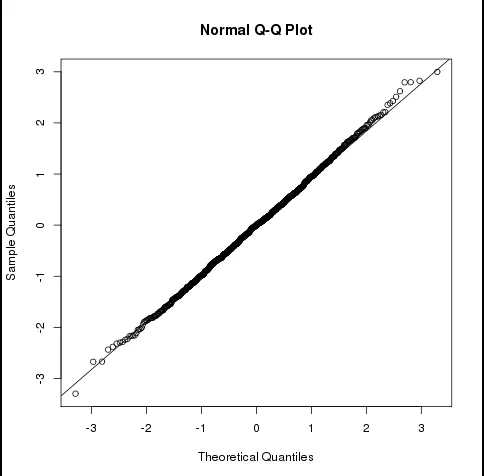
normality is based on the Q-Q plot ofβbw
npfrom our simulation studies, shown in 2.2. Furthermore,
these simulation studies show that the bootstrap standard errors ofβbwnp are close to the observed
sample standard deviations, and that the 95% confidence intervals based on the (bootstrap)
per-centile method result in coverage probabilities that are close to the nominal level of 0.95 (Table 2.1).
on assuming normality.
Figure 2.2: Normal Q-Q plot ofT = βbwnp−β0
b
σ from 1000 simulations under the truncation scenario
for the second model described in Table 2.1 .
Here θ1 = 0.40 andθ2 = 0.25, and n=100. Here bσis the standard error estimate of βbwnp, and is
estimated using the simple bootstrap method.
2.4. Simulations
In this section we examine the performance of the proposed weighted estimators and compare
them to the na¨ıve unweighted estimator which ignores truncation. In all simulations, the survival
times were generated from a proportional hazards model with hazard functionλ(t|Z) =λ0(t)eβ0Z,
and follow a Weibull distribution with scale parameterρ= 0.1and shape parameterκ= 1.2. We set
β0= 1, and generated the explanatory variableZfrom a Unif[0,1] distribution. We simulated the left
truncation time from ac1Beta(θ1,1) distribution and the right truncation time from ac2Beta(1, θ2)
distribution, with c1 = c2 = 30. We chose these distributions based on our data example. The
assumption of the beta distribution for the truncation times in our data example was validated by a
goodness-of-fit test (Section 2.5).
We conducted 1000 simulation repetitions with sample sizes ofn= 50, 100, and 250. To obtain
nobservations after truncation, we simulatedN = n
truncated data. For each simulation, we estimated the hazard ratio using the na¨ıve unweighted
es-timator which ignores truncation(βbuw), the parametric weighted estimator(βbw
b
θ), the nonparametric
weighted estimator(βbwnp), and the complete case estimator(βbcc)based on the full (truncated and
non-truncated) sample. For these estimators, we calculated the estimated bias (βb−β0), observed
sample standard deviations (SD), estimated standard errors (SEc), and the average empirical
cov-erage probability of the 95% confidence intervals (Cov). We used 2000 bootstrap resamples to
estimate the standard error and confidence interval ofβbwnp.
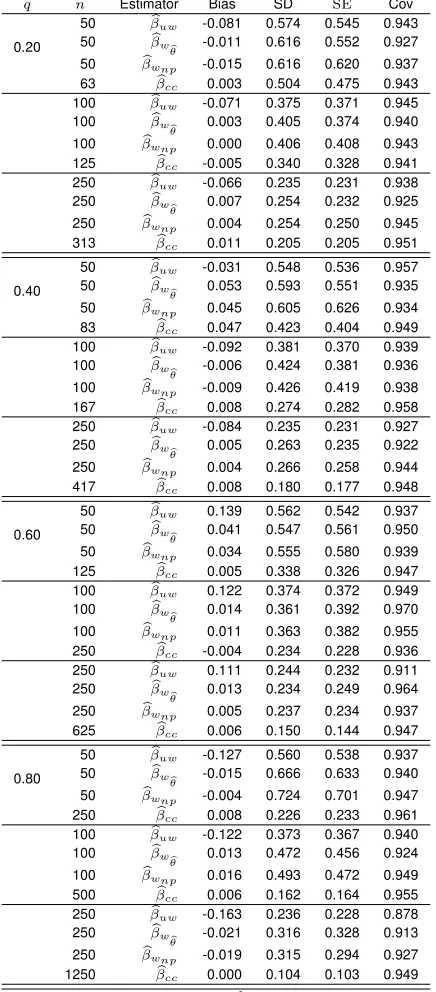
Table 2.1 shows the results of the simulations described above. In the first model we setθ1= 0.06
andθ2= 0.60, which produced mild left and right truncation and a total of 20% of the observations
truncated. In the second model we setθ1= 0.15andθ2= 1, which produced moderate truncation
from the left and right and a total of 40% of the observations truncated. In the third model we set
θ1= 0.40andθ2= 0.25, which produced heavy left truncation and mild right truncation and a total
of 60% of the observations truncated. In the fourth model we setθ1 = 0.50 andθ2 = 2.5, which
produced both heavy left and right truncation and a total of 80% of the observations truncated.
In all models, the weighted estimatorsβbw
b
θ andβbwnp had little bias, while the unweighted estimator
b
βuw was biased. The observed sample standard deviations of βbw
b
θ corresponded well with the
standard error estimates based on asymptotic theory. The observed sample standard deviations of
b
βwnp were accurately estimated by the bootstrap technique, and were slightly greater than those of
b βw
b
θ. Both weighted estimators had coverage probabilities that were close to the nominal level of
0.95. All of these results held for both smaller (n=50) and larger (n=250) sample sizes. We note
that the high coverage probabilities ofβbuw are an artifact of its large standard error relative to its
bias, which led to wider confidence intervals forβbuw. In simulations where the standard error ofβbuw
was small relative to its bias, the coverage probabilities ofβbuw did not come close to the nominal
level (e.g. Table 2.2).
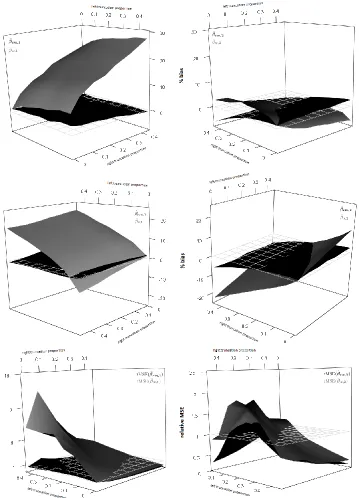
We now examine the bias of βbwnp and βbuw as a function of left and right truncation proportion
(Figure 2.3). For the purpose of clarity we do not includeβbw
b
θ in Figure 2.3, but note that its bias
was nearly identical to that ofβbwnp. Even under mild truncation, βbuw was biased, and this bias
increased drastically as the proportion of right truncation increased. Here βbwnp had little bias,
Table 2.1: Simulation results
q n Estimator Bias SD SEc Cov
0.20
50 βbuw -0.081 0.574 0.545 0.943
50 βbw
b
θ -0.011 0.616 0.552 0.927
50 βbwnp -0.015 0.616 0.620 0.937
63 βbcc 0.003 0.504 0.475 0.943
100 βbuw -0.071 0.375 0.371 0.945
100 βbw
b
θ 0.003 0.405 0.374 0.940
100 βbwnp 0.000 0.406 0.408 0.943
125 βbcc -0.005 0.340 0.328 0.941
250 βbuw -0.066 0.235 0.231 0.938
250 βbw
b
θ 0.007 0.254 0.232 0.925
250 βbwnp 0.004 0.254 0.250 0.945
313 βbcc 0.011 0.205 0.205 0.951
0.40
50 βbuw -0.031 0.548 0.536 0.957
50 βbw
b
θ 0.053 0.593 0.551 0.935
50 βbwnp 0.045 0.605 0.626 0.934
83 βbcc 0.047 0.423 0.404 0.949
100 βbuw -0.092 0.381 0.370 0.939
100 βbw
b
θ -0.006 0.424 0.381 0.936
100 βbwnp -0.009 0.426 0.419 0.938
167 βbcc 0.008 0.274 0.282 0.958
250 βbuw -0.084 0.235 0.231 0.927
250 βbw
b
θ 0.005 0.263 0.235 0.922
250 βbwnp 0.004 0.266 0.258 0.944
417 βbcc 0.008 0.180 0.177 0.948
0.60
50 βbuw 0.139 0.562 0.542 0.937
50 βbw
b
θ 0.041 0.547 0.561 0.950
50 βbwnp 0.034 0.555 0.580 0.939
125 βbcc 0.005 0.338 0.326 0.947
100 βbuw 0.122 0.374 0.372 0.949
100 βbw
b
θ 0.014 0.361 0.392 0.970
100 βbwnp 0.011 0.363 0.382 0.955
250 βbcc -0.004 0.234 0.228 0.936
250 βbuw 0.111 0.244 0.232 0.911
250 βbw
b
θ 0.013 0.234 0.249 0.964
250 βbwnp 0.005 0.237 0.234 0.937
625 βbcc 0.006 0.150 0.144 0.947
0.80
50 βbuw -0.127 0.560 0.538 0.937
50 βbw
b
θ -0.015 0.666 0.633 0.940
50 βbwnp -0.004 0.724 0.701 0.947
250 βbcc 0.008 0.226 0.233 0.961
100 βbuw -0.122 0.373 0.367 0.940
100 βbw
b
θ 0.013 0.472 0.456 0.924
100 βbwnp 0.016 0.493 0.472 0.949
500 βbcc 0.006 0.162 0.164 0.955
250 βbuw -0.163 0.236 0.228 0.878
250 βbw
b
θ -0.021 0.316 0.328 0.913
250 βbwnp -0.019 0.315 0.294 0.927
1250 βbcc 0.000 0.104 0.103 0.949
qis proportion of truncated observations,nis size of observed sample.βbuwdenotes na¨ıve unweighted estimator,βbw
b
θdenotes proposed
parametric weighted estimator,βbwnpdenotes proposed nonparametric weighted estimator,βbccdenotes unattainable complete case
estimator based on both truncated and non-truncated observations. SD is empirical standard deviation of estimates across simulations,SEc is average of estimated standard errors, Cov is coverage of 95% confidence intervals. True value ofβis 1.
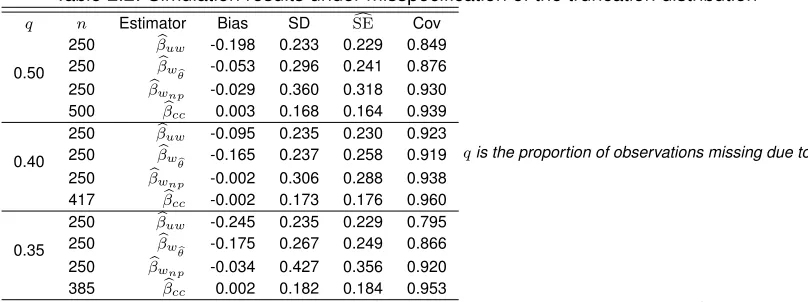
We also examined the robustness ofβbw
b
θ under misspecification of the truncation distribution in
Ta-ble 2.2. In this setting,βbw
b
Figure 2.3: Comparing bias and MSE (mean-squared error) of estimators
Bias of the unweighted estimator βbuw (black) and nonparametric weighted estimator βbwnp (gray).
Left truncation time simulated from ac1Beta(θ1,1)distribution, right truncation time simulated from
ac2Beta(1, θ2)distribution, withc1=c2= 30. Hereθ1ranges from 0.025 to 0.50 which results in a
range of 5% to 65% truncation from the left, andθ2 ranges from 0.25 to 5 which results in a range
of 5% to 45% truncation from the right. The remaining settings are kept the same as in Table 2.1, withn= 250.
assumptions for the truncation times.
Table 2.2: Simulation results under misspecification of the truncation distribution
q n Estimator Bias SD SEc Cov
0.50
250 βbuw -0.198 0.233 0.229 0.849 250 βbw
b
θ -0.053 0.296 0.241 0.876 250 βbwnp -0.029 0.360 0.318 0.930 500 βbcc 0.003 0.168 0.164 0.939
0.40
250 βbuw -0.095 0.235 0.230 0.923 250 βbw
b
θ -0.165 0.237 0.258 0.919 250 βbwnp -0.002 0.306 0.288 0.938 417 βbcc -0.002 0.173 0.176 0.960
0.35
250 βbuw -0.245 0.235 0.229 0.795 250 βbw
b
θ -0.175 0.267 0.249 0.866 250 βbwnp -0.034 0.427 0.356 0.920 385 βbcc 0.002 0.182 0.184 0.953
qis the proportion of observations missing due to
truncation andnis the size of the observed sample.βbuwdenotes the na¨ıve unweighted estimator,βbw
b
θdenotes the
proposed parametric weighted estimator,βbwnpdenotes the proposed nonparametric weighted estimator, andβbccdenotes
the unattainable complete case estimator based on both truncated and non-truncated observations. SD is the empirical standard deviation of estimates across simulations,SEcis the average of the estimated standard errors, Cov is the
coverage of 95% confidence intervals. The true value ofβis 1.
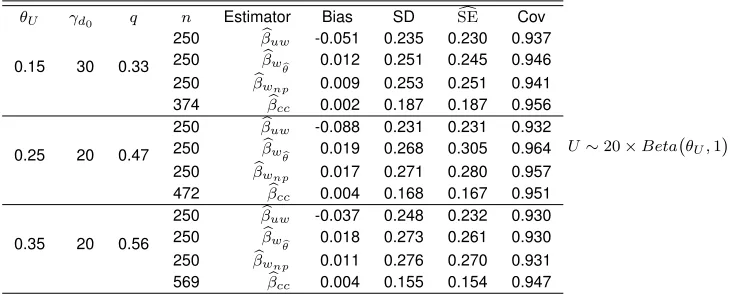
asV =U+d0, whered0can be random or constant. To assess the performance of our proposed
estimators under this dependent truncation structure, we conducted a simulation study in Table 2.3.
The results are similar to those presented in Table 2.1.
Table 2.3: Simulation results under dependent truncation structureV =U+d0.
θU γd0 q n Estimator Bias SD SEc Cov
0.15 30 0.33
250 βbuw -0.051 0.235 0.230 0.937 250 βbw
b
θ 0.012 0.251 0.245 0.946 250 βbwnp 0.009 0.253 0.251 0.941 374 βbcc 0.002 0.187 0.187 0.956
0.25 20 0.47
250 βbuw -0.088 0.231 0.231 0.932 250 βbw
b
θ 0.019 0.268 0.305 0.964 250 βbwnp 0.017 0.271 0.280 0.957 472 βbcc 0.004 0.168 0.167 0.951
0.35 20 0.56
250 βbuw -0.037 0.248 0.232 0.930 250 βbw
b
θ 0.018 0.273 0.261 0.930 250 βbwnp 0.011 0.276 0.270 0.931 569 βbcc 0.004 0.155 0.154 0.947
U∼20×Beta θU,1
,
d0∼U nif0, γd0
. The remaining settings were kept the same as in the simulations in Section 2.4 of the paper.qis the proportion of observations missing due to truncation andnis the size of the observed sample.βbuwdenotes the na¨ıve
unweighted estimator,βbw
b
θdenotes the proposed parametric weighted estimator,βbwnpdenotes the proposed
nonparametric weighted estimator, andβbccdenotes the unattainable complete case estimator based on both truncated and
non-truncated observations. SD is the empirical standard deviation of estimates across simulations,SEcis the average of
the estimated standard errors, Cov is the coverage of 95% confidence intervals. The true value ofβis 1.
2.5. Application to Alzheimer’s Disease Study
We illustrate our method by considering an autopsy-confirmed AD study conducted by the Center
for Neurodegenerative Disease Research at the University of Pennsylvania. The target population
for the research purposes of this study consists of all subjects with AD symptom onset before
2012 that met the study criteria and therefore would have been eligible to enter the center. Our
observed sample contains all subjects who entered the center between 1995 and 2012, and had
an autopsy performed before 2012. Thus one criterion for a subject to be included in our sample
is that they did not succumb to AD before they entered the study, yielding left truncated data. In
addition, our sample only contains subjects who had an autopsy-confirmed diagnosis of AD, and
therefore we have no knowledge of subjects who live past the end of the study. Thus our data is
also right truncated. Our data consists of n=47 subjects, all of whom have event times. The event
time of interest is the survival time (T) from AD symptom onset. The left truncation time (U) is the
time between the onset of AD symptoms and entry into the study (i.e. initial clinic visit). The right
truncation time (V) is the time between the onset of AD symptoms and the end of the study, which
Our motivation for studying the effect of education on survival in AD is that education serves as
a proxy for cognitive reserve (CR). CR theorizes that individuals develop cognitive strategies and
neuronal connections throughout their lives through experiences such as education and other forms
of mental engagement (Valenzuela and Sachdev, 2007). For example, CR may have a protective
role in the brain, and therefore lengthen survival during the course of the disease (Ientile et al.,
2013). Paradise et al. (2009) and Meng and D’Arcy (2012) failed to detect an effect of education
on survival from AD symptom onset. However the studies included in their meta-analyses did not
consist of populations with autopsy-confirmed AD.
Here we assess the effect of education on survival time in our autopsy-confirmed cohort, where
education is measured by years of schooling. The median years of education in this cohort is 16
years. Comparing the low education group (<16 years) and high education group (≥16 years) on
the variables of interest revealed no significant differences (Table 2.4).
Table 2.4: Comparing low education (<16 years) and high education (≥16 years) groups Low education (n=15) High education (n=32)
Variable mean (sd) mean (sd) Test statistic p-value
Age Onset 61.8 (10.5) 63.2 (12.9) t45=−0.37 0.712
Survival time 8.7 (3.4) 7.9 (3.2) t45= 0.80 0.430
Time to study entry 3.4 (1.71) 2.7 (1.5) t45= 1.37 0.177
Time to end of study 13.3 (2.8) 12.6 (4.7) t45= 0.58 0.563
Male (%) 53 72 χ21= 1.56 0.211
Survival time, time to study entry, and time to end of study are measured in years from AD symptom onset.
Since our data is doubly truncated, we apply the Cox regression model using the proposed weighted
estimating equation approach. We check the assumption of independence between the truncation
and survival times in the observable region U ≤ T ≤ V using the conditional Kendall’s tau
pro-posed by Martin and Betensky (2005). The resulting p-value is 0.10, and therefore we do not have
enough evidence to reject the null hypothesis that the observed survival and truncation times are
independent. We justify the identifiability constraints, aHU < aF ≤aHV andbHU ≤bF < bHV, in
Section 2.4.1 below.
We adjust for double truncation using both parametric and nonparametric weights. The parametric
weights are estimated under the assumption that U ∼ c1Beta(α1, β1) and V ∼ c2Beta(α2, β2),
b
α2= 3.0,βb2= 9.7. To check our assumption of the beta distribution, we test the null hypothesisH0:
K(u, v) = Kθ(u, v), whereθ = (α1, β1, α2, β2). Here the parametric joint cumulative distribution
functionKθ(u, v)=Iu/c1(α1, β1)×Iv/c2(α2, β2), whereIx(a, b) =
Rx
0 t
a−1(1−t)b−1dt. As described
by Moreira, de ˜Una- ´Alvarez, and Van Keilegom (2014), we can testH0using a Kolmogorov-Smirnov
type test statistic Dn = supu,v∈R|Kn(u, v)−Kbθ(u, v)|, where Kn(u, v)is the NPMLE of K(u, v)
(Shen, 2010a). This yields a p-value of 0.60, and therefore we do not have enough evidence
against the beta distribution assumption for the truncation times.
Table 2.5 displays the results from the Cox regression model using no weights, parametric weights,
and nonparametric weights. The effects of age at AD symptom onset and male on survival are
nearly twice as large in the weighted models relative to the unweighted model, but these effects
are only significant under parametric assumptions. When we do not account for double truncation,
there is no effect of education on survival (βbuw = 0; 95% CI: [-0.11,0.12]). When we account for
double truncation, higher education is associated with increased survival under parametric weights
(βwb
b
θ= -0.07; 95% CI: [-0.20,0.06]) and nonparametric weights (βwb np = -0.06; 95% CI: [-0.29,0.19]).
However the confidence intervals for bothβwb
b
θ andβwb np contain 0.
Table 2.5: Application: Education on survival in AD
Unweighted Parametric weights Nonparametric weights
Predictor βbuw(SEc) 95% CI βbw
b
θ(SEc) 95% CI βbwnp (SEc) 95%CI
Age Onset 0.03 (0.03) (-0.01, 0.06) 0.05 (0.02) (0.00, 0.09) 0.05 (0.03) (-0.02, 0.12)
Male 0.45 (0.34) (-0.21, 1.11) 1.01 (0.49) (0.06, 1.97) 0.95 (0.61) (-0.36, 2.18)
Education 0.00 (0.06) (-0.11, 0.12) -0.07 (0.07) (-0.20, 0.06) -0.06 (0.11) (-0.29, 0.19)
2.5.1. Justification of identifiability constraints
Here we justify that the identifiability constraints given in Section 2.2.1, aHU < aF ≤ aHV and
bHU ≤bF < bHV, hold in our data example. First we introduce some notation. Denoteτas the end
of study date,τE as the study entry date, andτAas the date of symptom onset. Note thatτ is the
same for all subjects, whileτEandτAcan differ among subjects. The left truncation time is defined
asU =τE−τA, and the right truncation time is defined asV =τ−τA.
Subjects can theoretically enter the center at the time of AD symptom onset, but not before.
There-fore the smallest possible left truncation time is U=0, and thus aHU = 0. Since recruitment of
subjects into the center stops one week prior to the end of the study, the smallest possible right