869 |
P a g e
SELECTION AND RANKING OF MULTIFACETED
CRITERIA FOR THE PRIORITIZATION OF MOST
APPROPRIATE CONVERSION TECHNOLOGY FOR
BIOMASS TO BIOFUEL IN INDIAN PERSPECTIVE
USING ANALYTIC HIERARCHY PROCESS
Sudeep Yadav
1, Amitabh K. Srivatava
2, R.S.Singh
31
Assistant Professor, Department of Chemical Engineering,
2Associate Professor, Department of Civil Engineering,
Bundelkhand Institute of Engineering and Technology, Jhansi-284128 , (U.P.)
3Associate Professor, Department of Chemical Engineering, Indian Institute of Technology-BHU,
Varanasi-221005, (U.P.)
ABSTRACT
In present Indian scenario, global warming, decrement of fossil fuel and other international issues have led to the decision to exploit renewable energy for the sustainable development. One of those Renewable sources is biomass energy which can provide a good quality Energy. Conversion of biomass to energy is undertaken using three main conversion technologies named as Thermo-chemical, Bio-chemical and Chemical. Each type of Biomass Conversion Process has its limitations, and thus choosing the most appropriate amongst them as per the requirement is very important to gain the optimal benefits. To deal with such complex decision making problems, The Analytic Hierarchy Process (AHP) a Multi criteria Decision Model introduced by Thomas Saaty, is an effective tool for dealing such situation .It may support the decision maker to set priorities and make the finest decision. The AHP helps to capture both subjective and objective aspects of a decision by sinking complex decisions to a series of pairwise comparisons and then combine the results. In this methodology selection and ranking of criteria is the most crucial step.
In this research, we have selected and ranked seven multifaceted criteria Technology Maturity, Conversion Efficiency, Availability of Technology Provider, Initial Cost, Operational Cost, Emissions and Land Requirement by using AHP (Super Decision Software) to determine the most appropriate Conversion Technology for Biomass to Biofuel in Indian Perspective.
870 |
P a g e
I.
INTRODUCTION
In India increasing electricity demand had been planned to be met mostly by fossil-fuel based generation while
ignoring the native renewable resources. It is clear from the potential of biomass in India that various feed stocks are
available for conversion to the bio-fuels as well as for power generation applications. The biofuels produced from
the renewable resources could help to minimize the fossil fuel consumption. Biofuels produced from biomass such
as plants or organic waste could help to reduce the India’s dependence on fossil fuel and it would mitigate global
warming. This may due to the CO2 released in burning equals the CO2 tied up by the plant during photosynthesis
and thus does not increase the net CO2 in the atmosphere [1]. In Indian context, Biomass is mainly obtained from as
Agriculture Residue, Animal Excreta, Energy Farming, Sewage Waste, Tannery Waste, Brewery Waste, Slaughter
House Waste and food &Vegetable Waste.
Conversion of biomass to Biofuel can be done by means of three main conversion technologies named as
thermo-chemical, bio-chemical and Chemical. In Thermo chemical conversion Technology, the biomass is converted in
biofuel by the process of combustion, gasification and pyrolysis. In Bio Chemical conversion Technology two main
processes are used, fermentation and an-aerobic digestion while in Chemical conversion technology
Transesterification Process is used [2].
Each type of Biomass Conversion technology has its advantages and disadvantages. Due to difficulty in selecting the
optimal option amongst various Biomass Conversion Technology, a powerful multi-criteria decision analysis model
is needed. It is necessary that such a model can analytically break a complex decision problem into smaller but
related sub problems; a model that can incorporate qualitative and quantitative information on conversion
Technology.
Therefore, Analytical Heirchical Process (AHP) introduced by Thomas Saaty is considered to be an appropriate
methodology to be employed for developing the required model. The AHP model formulated in this study consists
of three levels. At the top level is the goal of the model followed by the criteria at level two while conversion
Technologies are at the Third level, named, alternatives. In this methodology selection and ranking of criteria is the
most important step.
In this study seven multifaceted criteria Technology Maturity (Reliability of Technology in present time), Conversion Efficiency (Biomass to Energy conversion efficiency), Availability (Number of Available Technology providers), Initial Cost (Initial Installation Cost), Operational Cost (Recurring Cost ,Excluding cost of Biomass), Emissions (Air, Water & Land) in Conversion processand Land Requirement (Land Requirement for Plant Setup)are selected from the literature review and discussion with experts from different sectors that are related
to the problem. A selection methodology based on AHP (Super Decision Software) is used to rank these criteria.
871 |
P a g e
The vast stores of biomass available in India have the potential to displace significant amounts of fuels that are
currently derived from fossil fuels. Energy security, energy flexibility, and rural development are other drivers that
support the use of biomass to produce fuels, chemicals, and other products. There are various conversion
technologies that can convert biomass resources into power, heat, and fuels for potential use. Figure 1 summarizes
the various bio energy conversion processes.
Biomass
Feedstock Processing
Thermo chemical Conversion
Biochemical Conversion
Transesterification Fermentation
Anaerobic Digestion Gasification
Pyrolysis Combustion
Chemical Conversion
Fig-1: Various methods of Conversion Technology for Biomass to Bio Fuel
As shown in fig-1, Conversion technologies of biomass to Biofuel can be categorized into three main conversion
technologies named as thermo-chemical, bio-chemical and Chemical. A Brief discussion of above mentioned
Conversion Technologies for Biomass to Biofuel is given below.
2.1. Combustion
The world fuel consumption is continuously increased in past and will strongly increase in the future.Combustion
systems for electricity and heat production are similar to most fossil-fuel fired power plants. With the help of this
process the chemical energy stored in biomass is converted into heat energy, mechanical power and also in
electricity by different process. The biomass fuel is burned in a boiler to produce high-pressure steam. The steam
produced is introduced into a steam turbine, which cause causes the turbine blades to rotate. The turbine is
connected to an electric generator. It is possible to burn any type of biomass but in practice combustion is reasonable
only for biomass with moisture content less than 50%. Biomass with high moisture content is better suited to
biological conversion processes [3].This process is a extensively available and viable technology. Combustion
boilers are available in diverse designs, depending on relevance and biomass characteristics.
872 |
P a g e
In Gasification Process biomass is converted into a combustible gas mixture by the partial oxidation of biomass at
high temperatures. The low calorific value gas produced with this process can be burnt directly or used as a fuel for
gas engines and gas turbines. The gases produced by this process can be used as a feed stock for the production of
chemicals[4].There are a large number of different biomass feedstock types for use in a gasifier, each with diverse
characteristics, including dimension, shape, bulk density, moisture content, energy content, chemical composition,
ash fusion characteristics. Feedstock with higher moisture contents result in a lower gasification thermal efficiency,
as energy is needed to evaporate the water, with the resulting steam also affecting the gas composition. Ash is the
inorganic material (or mineral content) in biomass which cannot be gasified. Besides feedstock moisture and ash
properties, the size of the biomass fed into the gasifier can have a large influence on the gasification reaction – the
required sizing is mainly a function of feeding rate, residence time, tar production, temperature and gasifier
efficiency, which need evaluation for each individual gasifier and feedstock. Preparation of biomass, such as drying
and/or sizing is needed to some extent for most combinations of feedstock and gasifier type. Gasification produces
almost zero emissions and its non-hazardous by-products (nitrogen, argon, sulphur and slag) are very marketable.
Gasification plants use significantly less water than traditional coal-based plants and, using commercially proven tec
hnology [5].
2.3. Pyrolysis
Pyrolysis is one of a number of possible paths by which we can convert biomass to higher value products. Pyrolysis
of biomass is obtained from primary products like char, gases and vapors. At ambient temperature the vapors
condensed into a dark brown viscous liquid. The practice of charcoal manufacture from biomass is generally
referred to as a slow pyrolysis process based on the rate in which heat is imparted to the biomass. Whereas under
―fast pyrolysis‖ conditions the product distribution is noticeably altered and shifts the distribution primarily to a
liquid bio-oil product. To achieve the high bio-oil yields of fast pyrolysis it is also necessary to prepare the solid
biomass feedstock in such a manner that it can facilitate the required heat transfer rates. There are three primary heat
transfer mechanisms available in designing reaction vessels: convection, conduction, and radiation. To adequately
exploit one or more of these heat transfer mechanisms as applied to biomass fast pyrolysis requirements, it is
necessary to have a relatively small particle for introduction to the reaction vessel. This ensures a high surface area
per unit volume of particle. Because of small linear dimensions the whole particle achieves the desired temperature
in a very short residence time. Preparation of biomass is important for better performance of this process. [6].
2.4. Fermentation
Fermentation processes from any Biomass that contains sugar could derive Bioethanol. The various raw materials
used in the production of ethanol via fermentation are suitably classified into three main types of raw materials:
sugars, starches, and cellulose materials. Sugars (from sugarcane, sugar beets, molasses, and fruits) can be converted
into ethanol directly. Starches (from corn, potatoes, and root crops etc.) must first be hydrolyzed to fermentable
873 |
P a g e
waste) must similarly be converted into sugars. Once simple sugars are formed, enzymes from microorganisms can
voluntarily ferment them to ethanol. The most widely used sugar for ethanol fermentation is molasses which
contains about 50 wt. % of sugar and about 50 wt. % of organic and inorganic compounds, including water. Since
molasses contains microorganisms which can disturb the fermentation, the molasses is taken initially to the sterilizer
and then to the fermenter [7]. Most agricultural biomass containing starch can be used as a potential substrate for the
ethanol fermentation by microbial processes.
2.5. Anaerobic Digestion
In Anaerobic digestion (AD) organic material is directly converted to a Biogas which is a mixture of mainly
methane and carbon dioxide with small quantities of other gases such as hydrogen sulphide. The biomass is
converted in anaerobic environment by bacteria, which produces a gas with energy of about 20–40% of the lower
heating value of the feedstock [8]. It is a series of processes in which microorganisms break down biodegradable
material in the absence of oxygen to manage waste and/or to produce energy. The digestion process starts with
bacterial hydrolysis of the input materials in order to break down insoluble organic polymers and make them
available for supplementary bacteria. Then sugars and amino acids are converted into carbon dioxide, hydrogen,
ammonia, and organic acids by Acidogenic bacteria .These resulting organic acids are converted into acetic acid,
along with additional ammonia, hydrogen, and carbon dioxide with the help of Acetogenic bacteria. As a final point,
methanogens convert these products to methane and carbon dioxide.
Anaerobic Digestion is a commercially proven technology and is widely used for treating high moisture content
organic wastes, i.e.80-90% moisture. Biogas can be used directly in spark ignition gas engine and gas turbines and
can be upgraded to higher quality i.e. natural gas quality, by the removal of CO2. The overall conversion efficiency
can be21% [9]. As with any power generation system using an internal combustion engine as the prime mover,
waste heat from the engine oil and water-cooling systems and the exhaust could be recovered using a combined heat
and power system.
Almost any biomass except lignin (a major component of wood) can be converted to biogas including animal and
human wastes, sewage sludge, crop residues, industrial processing byproducts, and landfill material.
2.6 Transesterification
Biodiesel, which refers to fatty acid alkyl esters, has attracted considerable attention as an environmentally friendly
alternative fuel for diesel engines. Since the oil produced from biomass resources have high viscosity, it is necessary
to reduce the viscosity in order to use them in a common diesel engine. There are various methods used to solve this
problem, amongst these methods the transesterification reaction produce the products commonly known as
biodiesel. Biodiesel can be synthesized by the transesterification reaction of a triglyceride with a primary alcohol in
the presence of catalysts. Amongst primary alcohols, methanol is favored for the transesterification due to its high
874 |
P a g e
from the glycerol phase is easily recovered after phase separation. The choice of a catalyst for the transesterification
mainly depends on the amount of Free Fatty Acid (FFA) and of raw materials. Biodiesel has several advantages as a
renewable, biodegradable, and nontoxic fuel.
III. SELECTION OF MULTIFACETED CRITERIA AND METHODOLOGY
There is a big variety of Multi criteria Decision Making methods, but all have the same goal, to estimate the best
alternative among several options, based on predefined criteria. One of possible methods is AHP method, which
offers a frame of effective tools in complex decision situations, and helps to simplify and speed up natural process of
decision making. AHP method is based on breakdown of a complex situation into simple components, where
hierarchical system of the problem and pairwise comparisons are made in order to ensure the quantification of
qualitative judgments.
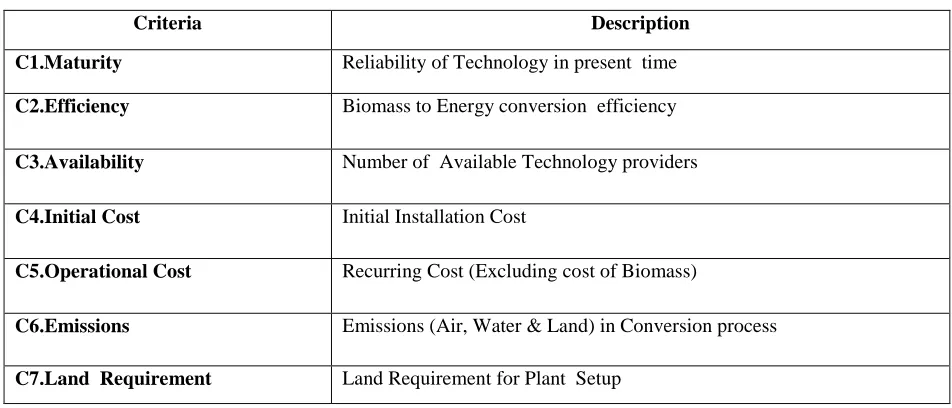
The Selection of multifaceted criterion is very crucial step of this process. Various criteria like Technology Maturity, Conversion Efficiency, Availability of Technology Provider, Initial Cost, Operational Cost, Emissions and Land Requirement are selected from the literature review and discussion with experts from different sectors that are related to the problem improves the effectiveness and correctness of the decision as shown
in Table no.1.
Table No.1- Multifaceted Criteria and Its Description
Criteria Description
C1.Maturity Reliability of Technology in present time
C2.Efficiency Biomass to Energy conversion efficiency
C3.Availability Number of Available Technology providers
C4.Initial Cost Initial Installation Cost
C5.Operational Cost Recurring Cost (Excluding cost of Biomass)
C6.Emissions Emissions (Air, Water & Land) in Conversion process
C7.Land Requirement Land Requirement for Plant Setup
The benefit of the proposed model is that it increases the effectiveness of the decision by allowing participation of
different experts. Multiple decision makers are often preferred rather than a single decision maker, to avoid bias and
minimize partiality in the decision process. Since decisions made in the energy sector affect all society and sectors,
875 |
P a g e
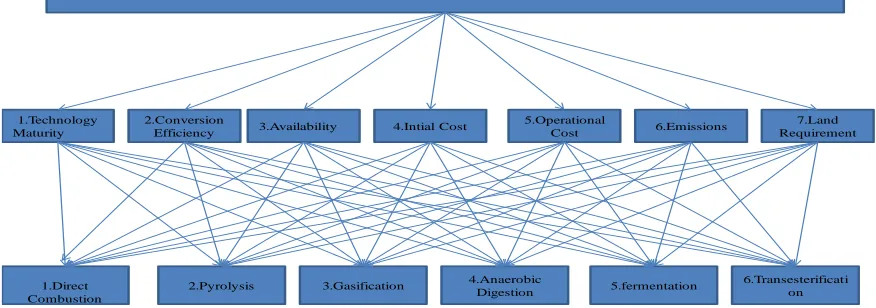
compared for importance to establish their priorities with respect to the goal. The Conversion Technologies will be
pairwise compared for preference to establish their priorities with respect to each criterion. The results of all these
comparisons will be combined to give the best alternative with the highest priority. The goal and criteria are one
comparison group with the goal as the parent and the criteria as the children. The criteria will be pairwise compared
with respect to the Goal for importance. Each criterion connected to the alternatives forms a comparison group with
that criterion as the parent and the alternative as children [11, 12, 13]. The alternatives will be pairwise compared
with respect to the criterion for preference as shown in Fig.2 given below.
Prioritization of Biomass to BioFuel Conversion Technology in Indian Context
6.Emissions
6.Transesterificati on 5.fermentation
4.Anaerobic Digestion 3.Gasification
2.Pyrolysis 1.Direct
Combustion
7.Land Requirement 5.Operational
Cost 4.Intial Cost
3.Availability 2.Conversion
Efficiency 1.Technology
Maturity
Fig 2:
The hierarchy of biomass priority
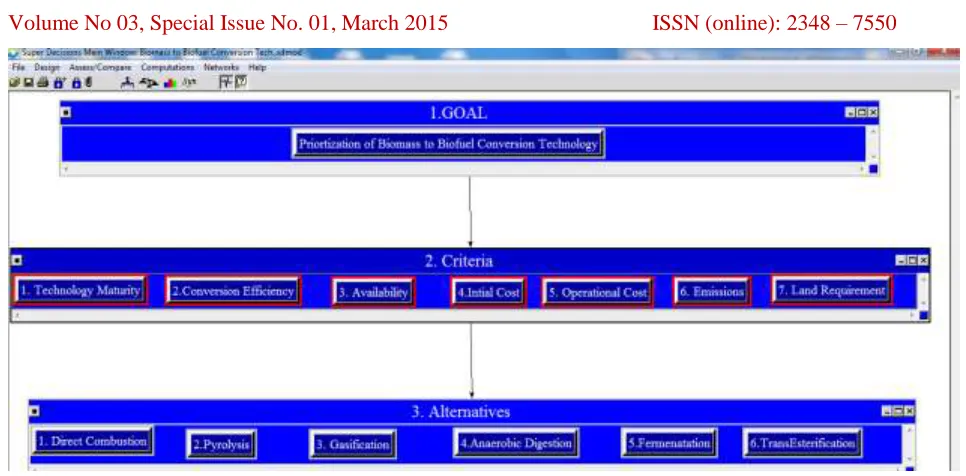
In this research SuperDecisionssoftware designed by William J. Adams is used for the implementation for decision making. It decomposes a problem systematically and incorporates judgments on intangible factors alongside
tangible factors. In the SuperDecisionssoftware a decision model is made up of clusters, nodes and links. Clusters
are groupings of nodes which are logically related factors of the decision. Connections are made among nodes to
establish comparison groups. In a hierarchy the links go only downward: from the goal node to the criterion nodes
and from each Criterion node to the alternative nodes. Below is a screenshot of the Biomass Conversion
876 |
P a g e
Fig 3:
The hierarchy of links in Super Decision SoftwareThe pairwise comparison judgments are made using the Fundamental Scale of the AHP and the judgments are
arranged in the pairwise comparison matrix. The pairwise comparison judgments used in the AHP pairwise
comparison matrix are defined as shown in the Fundamental Scale of the AHP given by Thomas Satty below in
Table 2.
Table .2: The Fundamental Scale of the AHP
Intensity of importance Definition Explanation
1 Equal importance Two elements contribute equally to the objective
3 Moderate importance Experience and judgment slightly favor one element over another
5 Strong importance Experience and judgment strongly favor one
element over another
7 Very strong importance An activity is favored very strongly over another
9 Absolute importance The evidence favoring one activity over another is of the highest possible order of affirmation
2,4,6,8 Used to express intermediate values
Decimals 1.1, 1.2, 1.3, …1.9 For comparing elements that are very close
In AHP, the numbers in the cells in a matrix, by convention, indicate the dominance of the row element over the
column element; a cell is named by its position (Row, Column) with the row element first then the column element.
While using AHP with the help of Super Decision Software only the judgments in the unshaded area need to be
made and entered because the inverse of a judgment automatically entered in its transpose cell. The diagonal
877 |
P a g e
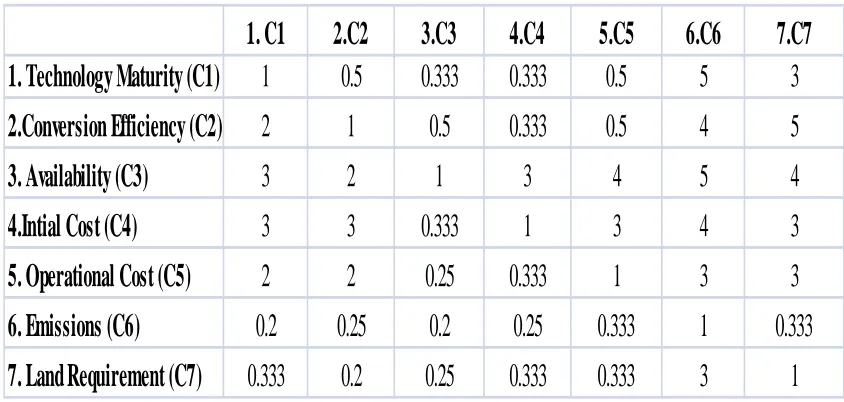
judgments is n (n-1)/2 to do the complete set of judgments. As per discussion with experts from different sectors that are related to the problem Intensity of importance are provided for Pairwise Comparison as shown in Table-3.
Table 3: Matrix showing Pairwise Comparison
Goal 1. C1 2. C2 3. C3 4. C4 5. C5 6. C6 7. C7
1.Technology Maturity (C1)
1 1/2 1/3 1/3 1/2 5 3
2.Conversion Efficiency (C2)
1 1/2 1/3 1/2 4 5
3.Availability (C3) 1 3 4 5 4
4.Initial Cost (C4) 1 3 4 3
5.Operational Cost (C5) 1 3 3
6.Emissions (C6) 1 1/3
7. Land Requirement (C7) 1
As per above discussion, in Super Decision software, the rest of the judgments are filled automatically as shown in table-4
Table-4: Complete Matrix showing Pairwise Comparison in Super Decision Software
1. C1
2.C2
3.C3
4.C4
5.C5
6.C6
7.C7
1. Technology Maturity (C1)
1
0.5
0.333
0.333
0.5
5
3
2.Conversion Efficiency (C2)
2
1
0.5
0.333
0.5
4
5
3. Availability (C3)
3
2
1
3
4
5
4
4.Intial Cost (C4)
3
3
0.333
1
3
4
3
5. Operational Cost (C5)
2
2
0.25
0.333
1
3
3
6. Emissions (C6)
0.2
0.25
0.2
0.25
0.333
1
0.333
7. Land Requirement (C7)
0.333
0.2
0.25
0.333
0.333
3
1
The priorities of an AHP pairwise comparison matrix are obtained by solving for the principal eigenvector of the
matrix. The mathematical equation for the principal eigenvector w and principal eigenvalue λmax of a matrix A is given below. Matrices have had more than one eigenvector; the principal eigenvector which is associated with the
878 |
P a g e
comparison matrix. Aw = λmax w. The priorities for the criteria in the goal column, when normalized, are the original priorities derived by pairwise comparison [14].
IV.RESULTS AND DISCUSSION
As per literature review and discussion with experts from different sectors that are related to the problem seven
multifaceted criteria Technology Maturity (Reliability of Technology in present time), Conversion Efficiency
(Biomass to Energy conversion efficiency), Availability (Number of Available Technology providers), Initial Cost (Initial Installation Cost), Operational Cost (Recurring Cost ,Excluding cost of Biomass), Emissions (Air, Water & Land) in Conversion processand Land Requirement (Land Requirement for Plant Setup) are selected.
A selection methodology based on AHP (Super Decision Software) is used to rank these criteria. This methodology
involves a procedure for the aggregation of expert opinion using the seven selection criteria related to conversion
Technology of Biomass to Biofuel ,that are appropriate for India.
Experts involved in the assessment found that the Availability of Technology providers is the most important criteria having the priority of 0.3213, followed by Initial Cost , Conversion Efficiency andOperational Cost, with the priorities of 0.2242, 0.1352 and 0.1323 respectively. While other criteria Technology Maturity, Land Requirement and Emissions have lower scores 0.0974, 0.0542 and 0.0351 respectively. The Results above mentioned is shown below in the screenshot from super decision software in Fig.4.
879 |
P a g e
The results of the above decision can also be shown as below in Table 5.
Table 5: Priorities of Different Criteria
Inconsistency
0.08809
Name
Normalized
Idealized
1. Technology Maturity
0.097417579
0.303139053
2.Conversion Efficiency
0.135267202
0.420917581
3. Availability
0.32136268
1
4.Intial Cost
0.224239283
0.697776366
5. Operational Cost
0.1323508
0.411842471
6. Emissions
0.035127162
0.10930691
7. Land Requirement
0.054235294
0.168766621
It is very clear from the above results that the criteria related to Availability of Technology Provider is more important than any other criteria followed by Initial Cost , Conversion Efficiency andOperational Cost . While
Technology Maturity, Land Requirement and Emissions are given least Priority. The benefit of the proposed model is that it increases the effectiveness of the decision by allowing participation of different experts. Since
decisions made in the energy sector affect all society and sectors, these decisions should not be made by the
initiative of individual or through one sector.
V. CONCLUSION
It is predictable that electricity demand in India is going to rise in future. To develop a sustainable electricity
generation system country has to incorporate renewable resources for electricity generation. Sustainable
development balances the energy production and consumption with minimal negative impact on the environment
Renewable energy systems as a part of sustainable development bring environmental, energetic and economic
benefits such as reduction of GHG, reliable energy supply ,economic saving by using natural resources and wastes
as feedstock. Production of biofuels from organic material is one of the alternative renewable energy systems.
Biofuels can be produced and converted to energy in different kinds of conversion plants with different scales that
use various conversion technologies. Biofuels can be used for generating centralized as well as decentralized heat,
electricity and energy [15].
In this study, an overview of various Conversion Technologies of Biomass to Biofuel in Indian Context is given. It
was found that there are sufficient conversion Technologies are available but each option has its own limitations. In
this type of situation Multi criteria Decision Making (MCDM) methodologies increasingly popular in decision
making for sustainable energy systems because of their ability to integrate the multi-criteria and complex nature of
880 |
P a g e
situations, and helps to simplify and speed up natural process of decision making. In AHP method Selection and
ranking of Criteria is most critical and important step.
In this study Selection and ranking of Criteria for Prioritizing Conversion Technology of Biomass to Biofuel in
Indian Context has been done. The criteria identified are such that a holistic evaluation of a particular Conversion
Technology is provided to a decision-maker. An AHP (Super Decision Software) model is developed to meet out the
purpose..
The model framework consisted selection and ranking of criteria and on which each Conversion Technologies of
Biomass to Biofuel was appraised. The study classified these criteria as Technology Maturity, Conversion Efficiency, Availability of Technology Provider, Initial Cost, Operational Cost, Emissions and Land Requirement. The Priorities of Biomass to Biofuel are shown below in screenshot from super decision software in fig-5.
The model results showed criteria related to Availability of Technology Provider is most important than any other criteria followed by Initial Cost, Conversion Efficiency and Operational Cost. While Technology Maturity, Land Requirement and Emissions are given least Priority. The emphasis on these criteria demonstrates that availability of Technology provider,financial and Conversion efficiency are vital in Biomass to Biofuel Conversion
in Indian Scenario.
Fig.5: The screenshot from super decision software showing priorities in unweigthed Matrix
It should be noted that the model’s application is country-specific, since the strategic criteria depend on the countries
881 |
P a g e
of Criteria involved in this study is useful to Energy Planners in determining investment priorities in the field of
Biomass Energy. The method used and the results obtained from this study can be used in the further research.
REFERENCES
[1]. S.N. NaikVaibhav, V.,Goud,Prasant., K. Rout .,Ajay K. Dalai 2010 Production of first and second generation
bio fuels: A comprehensive review, Renewable and Sustainable Energy Reviews 14 578–597
[2]. Anil Kumar.,Nitin Kumar. , Prashant Baredar., Ashish Shukla,, 2015 A Review on biomass energy resources
,potential, conversion and policy in India, RenewableandSustainableEnergyReviews45. 530–539
[3]. Sharma A, Unni BG, Singh HD. A novel fed batch system for bio methanation of plant
biomasses.JBiosciBioeng1999; 87(5):678–82.
[4]. Ganesh A Banerjee R. Biomass pyrolysis for power generation—a potential technology.
RenewableEnergy2001;22:9–14.
[5]. Review of Technologies for Gasification of Biomass and Wastes Final report NNFCC project 09/008 ,A
project funded by DECC, project managed by NNFCC and conducted by E4Tech
[6]. Mohan D, Pittman Jr CU, Steele PH. Pyrolysis of wood/biomass for biooil: a critical
review.EnergyFuels2006;20:848–89.
[7]. Das, C, R., GhatnekarP.1979 Replacement of Cow Dung by Fermentation of Aquatic and Terrestrial Plants for
use as Fuel, Fertilizer and Biogas Plant Feed.
[8]. McKendryP. (2002): Energy Production from Biomass Overview of Biomass. Bio Resources Technology,
83(1):3746.
[9]. Souza, Samuel Nelson M, Werncke Ivan, Marques Cleber Aimoni, Bariccatti
ReinaldoA,SantosReginaldoF,etal.Electricenergymicro-productionina rural property using biogas as primary
source Renewable Sustainable Energy Rev2013;28:385–91.
[10].McKendry P. Energy production from biomass (Part 2): overview of biomass. Bio resource Technology
2001;83 2002(1):47 54.
[11].Mehmet, K., Metin, D., 2014 Prioritization of renewable energy sources for Turkey by using a hybrid MCDM
methodology. Energy Conversion and Management 79, 25–33
[12].Adek, T., Susilawati, A., 2014. Selection among Renewable Energy Alternatives Based on a Fuzzy Analytic
Hierarchy Process in Indonesia. Sustainable Energy Technologies and Assessments 7, 34–44.
[13].Yılmaz,S., Selim,H.,2013. A Review on the Methods for Biomass to Energy Conversion Systems Design.
Renewable and Sustainable Energy Reviews 25, 20–430.
[14].The Fundamentals of Decision Making and Priority Theory with the Analytic Hierarchy Process By Thomas L.
Saaty, 478 RWS Publications, Pittsburgh, PA, 2011 revision, ISBN 0-9620317-6-3
[15].SebnemYılmaz n, Hasan Selim, A Review on the Methods for Biomass to Energy Conversion Systems Design