707 |
P a g e
DRIVER BEHAVIOR ANALYSIS USING
NON-INVASIVE SENSORS
1
L. Nikitha ,
2J.Kiranmai,
3B.Vidhyalakshmi
1,2,3Department of Electronics and Communication, SCSVMV University, Kanchipuram , (India)
ABSTRACT
Detecting driver distraction has been an important research topic over the past few years. While there are many common reasons for vehicle crashes, driver distraction and inattention are very prominent causes. Previous studies have shown the impact that inattentions can have on driving behavior, which can lead to many crashes and fatalities. The study reported by The National Highway Traffic Safety Administration (NHTSA) indicated that over 25% of police-reported crashes involved inattentive drivers. The 100-car Naturalistic Study concluded that over 65% of near crashes and 78% of crashes included inattention. These high percentages are not surprising, since 30% of the time drivers are in a moving vehicle, they are engaged in secondary tasks that are potentially distracting. These numbers are estimated to increase as the usage of in-vehicle technologies for navigation, communication and infotainment, and the number of cars on the roads is expected to exponentially increase in the next years. A driver monitoring system that is able to sense inattentive drivers can play an important role in reducing the number of accidents, preventing fatalities and increasing the safety on roads. In this paper Monitoring driving habits of a person is presented, which is based on CAN network. The CAN bus is used as a communication of a distributed control network. This paper mainly introduces the design of the hardware and the software in detail. This device track speed, Engine temperature and Alcohol consumption status.
I INTRODUCTION
There has always been a rapid development of technology in every field. In past few years with the
implementation and fast development of the in-vehicle technologies especially in the cars had lead to the vast increase in the unintentional accidents. These accidents are caused by the distraction in the driver’s attention
due to the involvement in the secondary tasks like operating the radio, GPS, and other in-vehicle technologies.
The driver distractions are detected using the various non-invasive sensors. The driver is made to involve in the
secondary tasks like operating on the radio, navigation systems like GPS( Global Positioning System) and
mobile phones, etc. The changes in the driver’s behavior is detected by comparing the values obtained by the
sensors when the driver is involved in secondary tasks and when he is not involved in the secondary tasks.
When any abnormality is detected in any of the sensors then the safety measures like indication by the side
708 |
P a g e
The paper is organized as follows: Section 2 presents the open challenges currently existing in the real time and
the related works done in this field of analyzing the driver’s behavior. Section 3 describes the methodology of
the data collection and the working procedure of the system. Section 4 studies the effects in driver behavior
induced by the secondary tasks, including the statistical analysis of multimodal features and discriminative
analysis between normal and task driven conditions. Section 5 concludes the paper with final remarks,
limitations of the study and the further research directions.
II RELATED STUDIES
Secondary tasks deviate the driver’s attention from the primary driving task [1]. Various activities have been
proposed to induce cognitive and/or visual distractions. For cognitive distractions, common approaches include
solving math problems [2], [3], [4], [5], talking to another passenger [1], [6], and focusing on other activities
such as following the stock market [5]. Common secondary tasks for visual distraction are “look and find” tasks
[7], [3], [8], operating devices such as a touchscreen [1], or a cellphone [9], and reading sequences of numbers
[2]. While these cognitive and visual tasks clearly affect the driver, some of them may not represent the
common distractions observed in real scenarios.
While most of the studies on driver behaviors rely on simulators [10], [11], [3], [1], [8], some studies have
considered recordings in cars equipped with multiple sensors [2], [12], [13], [14], [6], [15]. Perez et al. [12]
presented the “Argos” system for data collection. Murphy-Chutorian and Trivedi [13] reported results on data
recorded in the LISA-P experimental testbed. The car has video and motion cameras with near- IR illuminator[.
They have used computer visual algorithms to automatically extract visual information, achieving promising
results towards detecting driver distraction. Another data collection vehicle was designed by Takeda et al. [16].
The car is equipped with cameras and microphones, laser scanners (front, back), pedal pressure and
physiological sensors. A similar car was designed by Abut et al. [17] called UYANIK. The UTDrive is another
car platform,[18], [19]. These cars provide more realistic data to study driver behaviors.
Frontal cameras can be useful to assess the distraction level of the driver [13], [20]. Relevant visual features
include head pose, gaze range and eyelid movements [2], [7], [8],[21], [22]. Liang et al. [7] showed that eye
movements and driving performance measures were useful for detecting cognitive distraction. Su et al. [21]
presented an approach to monitor visual distractions using a low cost camera. The study relied on eyelid
movements and face orientation to predict driver’s fatigue and distraction. Azman et al. [22] used eye and lip
movements to predict cognitive distractions in simulated environment. Kutila et al. [2], [4] extracted gaze angle,
head rotation and lane position for cognitive distraction detection. Bergasa et al. [14] proposed to predict fatigue
with percent eye closure (PERCLOS), eye closure duration, blink frequency, face position, fixed gaze and
nodding frequency. They used IR illuminator to mitigate the changes in illumination. A similar approach was
presented by Zhu and Ji[23]. Other studies have considered cameras for capturing and modeling foot gestures
709 |
P a g e
CAN BUS
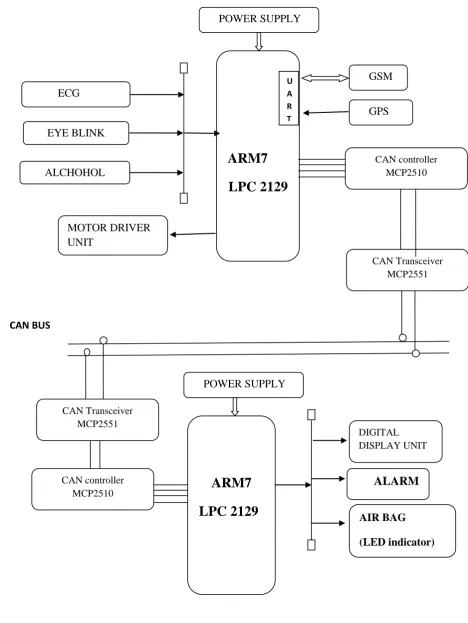
Fig 1: Working Modality of the Module
ARM7
LPC 2129
ALCHOHOL
SENSOR
ECG
SENSOR
EYE BLINK
SENSOR
CAN controller MCP2510
CAN Transceiver MCP2551
CAN Transceiver MCP2551
CAN controller
MCP2510
ARM7
LPC 2129
MOTOR DRIVER
UNIT
DIGITAL DISPLAY UNIT
ALARM
AIR BAG
(LED indicator)
U A R T
T
GSM
GPS
GPS
POWER SUPPLY
710 |
P a g e
III METHODOLOGY AND WORKING MODALITY
A real-world driving study inherently involves numerous uncontrollable variables such as traffic, weather and
traffic lights which are not easily replicated in a simulated environment. This analysis aims to identify relevant
features that are directly affected by the driver’s behaviors, and to use these features to quantify the distraction
level of the drivers.
Before the motor can start the driver has to give the alcohol test. If any alcohol content is detected then the
valve of the fuel tank will be closed. When no alcohol content is detected then the motor starts. While driving
the sensors like eye blink and pulse sensors will monitor the eye blink and heart beat continously. If any
abnormalaties are detected then the accident preventive measures like the opening of the air bag, sounding the
alarm system and indication using the side lights are taken. The vibration due to the crash by the other vehicle
can be detected using the vibration sensor and if any vibration due to the crashes is detected, then the accident
preventive measures are taken.
With the help of the CAN(Controller Area Network Bus the signals from a controller which monitors the
driver’s behavior and to which the sensors are interfaced is communicated to the other controller to which the
external features are connected. In case the accident occurs then the message about the accident is given through
the GSM technique. The position of the car is tracked using GPS (GLOBAL POSITIONING SYSTEM).
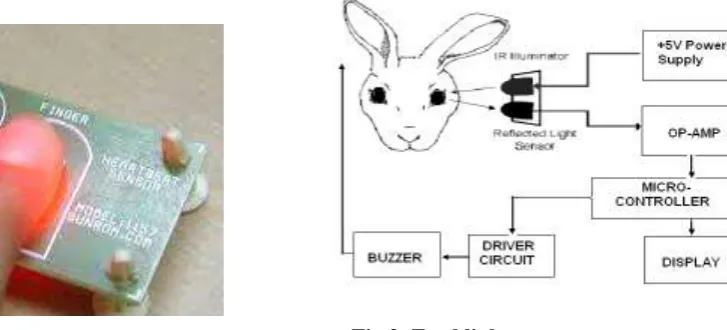
The output of the heart beat sensor is active high for each and every heartbeat and this can be given to the
microprocessor. LED flashes for each heartbeat whenever sensor starts working. The sensor works on the basis
of light modulation by blood flow through finger for each pulse.
Fig 2: ECG Sensor Fig 3: Eye blink sensor
The EBM ( Eye Blink Monitoring) system works on the principle of monitoring eyelid movements of the
person inside the vehicle continuously by the use of an IR sensor. Whenever the driver falls asleep, then the
buzzer will rang to wake him up.
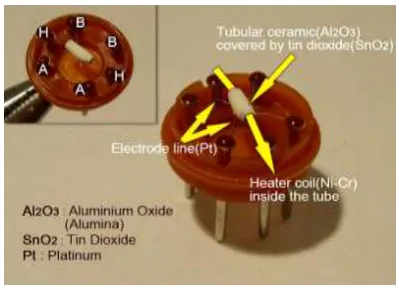
The Alcohol breathalyzer estimates the Blood Alcohol Concentration by detecting and measuring the presence
711 |
P a g e
parts and the coils in the picture. If the coil is heated up SnO2 will become the semi conductor further we can
find more movable electrons, which indicates the current flow is ready. Whenever the alcohol gas molecules
meet the electrode which is present in the air, then gradually ethanol in the air burns into acetic acid which
further produces more current.
Fig 4: Gas sensor
IV EFFECTS IN DRIVER BEHAVIOR
The secondary tasks force the driver to be distracted from the primary task which is driving. These distractions
in the driver behavior can be detected by using a series of sensors.
The normal pulse rate of the human being is about 72 heart beats per second. In case of any stroke or any other
problems related to the heart beat then the count of the heart beat varies from the normal value. The range from
65 to 80 heart beats is considered to normal. If the pulse rate is not in this range then the driver’s behavoir
changes due to the abnormalities.
The normal eye blink rate is about 15 to 20 blinks or lesser. When the driver is in drowsy state the number of
blinks may increase than the normal level as the driver tries to come out of the drowsy state or the eye lids
remain closed for a longer period than it is required for the normal eye blink.
The breath of the person who is not drunk does not contain any alcohol content or very minute traces of the
alcohol. If the breath contains more than the allowed level of the alcohol content then it is concluded that the
person is in drunken state.
V CONCLUSION
The system proposed in the paper is a fully functional automatic mentoring system which is a step ahead of
presently available in terms efficiency, accuracy and simplicity. The system is designed with an objective of
minimizing road accidents that occur due to over speeding. The algorithm used for position matching and
subsequent speed limit extraction is the first of its kind relying on both GSM and GPS input signals,
712 |
P a g e
This system can be implemented in the larger vehicles like trucks and buses and further more vehicles like
passenger and cargo trains. This proposed system can be used as the warning system to avoid collisions in the
National Highways.
This system can be further developed using the image processing technique to analyze the driver’s facial
expressions to understand the different situations that can arise while driving.
REFERENCES
Proceeding papers
[1] T. Ersal, H. Fuller, O. Tsimhoni, J. Stein, and H. Fathy, “Model-based analysis and classification of driver
distraction under secondary tasks,” IEEE Transactions on Intelligent Transportation Systems, vol. 11, no. 3, pp.
692-701, September 2010.
[2] M. Kutila, M. Jokela, G. Markkula, and M. Rue, “Driver distraction detection with a camera vision system,”
in IEEE International Conference on Image Processing (ICIP 2007), vol. 6, San Antonio, Texas, USA,
September 2007, pp. 201-204.
[3] F. Putze, J.-P. Jarvis, and T. Schultz, “Multimodal recognition of cognitive workload for multitasking in the
car,” in International Conference on Pattern Recognition (ICPR 2010), Istanbul, Turkey, August 2010.
[4] M. Kutila, M. Jokela, T. Makinen, J. Viitanen, G. Markkula, and T. Victor, “Driver cognitive distraction
detection: Feature estimation and implementation,” Proceedings of the Institution of Mechanical Engineers, Part
D: Journal of Automobile Engineering, vol. 221, no. 9, pp. 1027-1040, September 2007.
[5] J. Harbluk, Y. Noy, P. Trbovich, and M. Eizenman, “An on-road assessment of cognitive distraction:
Impacts on drivers’ visual behavior and braking performance,”Accident Analysis and Prevention, vol. 39, no. 2,
pp. 372-379, March 2007.
[6] A.Sathyanarayana, P. Boyraz, Z. Purohit, R. Lubag, and J. Hansen, “Driver adaptive and context aware
active safety systems using CANbus signals,” in IEEE Intelligent Vehicles Symposium (IV 2010), San Diego,
CA, USA, June 2010.
[7] Y. Liang, M. Reyes, and J. Lee, “Real-time detection of driver cognitive distraction using support vector
machines,” IEEE Transactions on Intelligent Transportation Systems, vol. 8, no. 2, pp. 340-350, June 2007.
[8] F. Tango and M. Botta, “Evaluation of distraction in a driver-vehicleenvironment framework: An
application of different data-mining techniques,” in Advances in Data Mining. Applications and Theoretical
Aspects, ser. Lecture Notes in Computer Science, P. Perner, Ed. Berlin, Germany: Springer Berlin / Heidelberg,
2009, vol. 5633, pp. 176-190.
713 |
P a g e
CAN-Bus information,” in IEEE International Conference on Multimedia and Expo (ICME 2011), Barcelona,
Spain, July 2011.
[10] “EEG-based drowsiness estimation for safety driving using independent component analysis,” IEEE
Transactions on Circuits and Systems I:Regular Papers, vol. 52, no. 12, pp. 2726-2738, December 2005.
[11] I. Damousis and D. Tzovaras, “Fuzzy fusion of eyelid activity indicators for hypovigilance-related accident prediction,” IEEE Transactions on Intelligent Transportation Systems, vol. 9, no. 3, pp. 491-500, September
2008.
[12] J. Zamorano, “Argos: An advanced in-vehicle data recorder on a massively sensorized vehicle for car
driver behavior experimentation,” IEEE Transactions on Intelligent Transportation Systems, vol. 11, no. 2, pp.
463–473, June 2010.
[13] E. Murphy-Chutorian and M. Trivedi, “Head pose estimation and augmented reality tracking: An
integrated system and evaluation for monitoring driver awareness,” IEEE Transactions on Intelligent
Transportation Systems, vol. 11, no. 2, pp. 300-311, June 2010.
[14] L. Bergasa, J. Nuevo, M. Sotelo, R. Barea, and M. Lopez, “Realtime system for monitoring driver
vigilance,” IEEE Transactions on iIntelligent Transportation Systems, vol. 7, no. 1, pp. 63-77, March 2006.
[15] A. Sathyanarayana, S. Nageswaren, H. Ghasemzadeh, R. Jafari, and J.H.L.Hansen, “Body sensor networks
for driver distraction identification,” in IEEE International Conference on Vehicular Electronics and Safety
(ICVES 2008), Columbus, OH, USA, September 2008.
[16] K. Takeda, J. Hansen, P. Boyraz, L. Malta, C. Miyajima, and H. Abut, “International large-scale vehicle
corpora for research on driver behavior on the road,” IEEE Transactions on Intelligent Transportation Systems,
vol. 12, no. 4, pp. 1609-1623, December 2011.
[17] H. Abut, H. Erdo˘gan, A. Ercil, B. Curuklu, H. Koman, F. Tas A. Arguns¸ah, S. Cos¸ar, B. Akan, H.
Karabalkan et al., “Real-world data collection with “UYANIK”,” in In-Vehicle Corpus and Signal Processing
for Driver Behavior, K. Takeda, H. Erdo˘gan, J. Hansen, and H. Abut, Eds. New York, NY, USA: Springer,
2009, pp. 23-43.
[18] P. Angkititrakul, M. Petracca, A. Sathyanarayana, and J. Hansen, “UTDrive: Driver behavior and speech
interactive systems for in-vehicle environments,” in IEEE Intelligent Vehicles Symposium, Istanbul, Turkey,
June 2007, pp. 566-569.
[19] P. Angkititrakul, D. Kwak, S. Choi, J. Kim, A. Phucphan, A. Sathyanarayana, and J. Hansen, “Getting start
with UTDrive: Driver-behavior modeling and assessment of distraction for in-vehicle speech systems,” in
Interspeech 2007, Antwerp, Belgium, August 2007, pp. 1334-1337.
714 |
P a g e
enhanced vehicle safety,” IEEE Transactions on Intelligent Transportation Systems, vol. 8, no. 1, pp. 108-120,
March 2007.
[21] M. Su, C. Hsiung, and D. Huang, “A simple approach to implementing a system for monitoring driver
inattention,” in IEEE International Conference on Systems, Man and Cybernetics ( SMC 2006), vol. 1, Taipei,
Taiwan, October 2006, pp. 429-433.
[22] A. Azman, Q. Meng, and E. Edirisinghe, “Non intrusive physiological measurement for driver cognitive
distraction detection: Eye and mouth movements,” in International Conference on Advanced Computer Theory
and Engineering (ICACTE 2010), vol. 3, Chengdu, China, August 2010.
[23] Z. Zhu and Q. Ji, “Real time and non-intrusive driver fatigue monitoring,” in IEEE International
Conference on Intelligent Transportation Systems, Washington, DC, October 2004, pp. 657-662. IEEE
TRANSACTIONS ON MULTIMEDIA, VOL. X, NO. X, APRIL 2012 13
[24] J. McCall and M. Trivedi, “Driver behavior and situation aware brake assistance for intelligent vehicles,”
Proceedings of the IEEE, vol. 95, no. 2, pp. 374-387, February 2007.
[25] C. Tran, A. Doshi, and M. Trivedi, “Modeling and prediction of driver behavior by foot gesture analysis,”
Computer Vision and Image Understanding, vol. 116, no. 3, pp. 435-445, March 2012.
[26] C. Berka, D. Levendowski, M. Lumicao, A. Yau, G. Davis, V. Zivkovic, R. Olmstead, P. Tremoulet, and
P. Craven, “EEG correlates of task engagement and mental workload in vigilance, learning, and memory tasks,”
Aviation, Space, and Environmental Medicine, vol. 78, no. 5, pp. 231-244, May 2007.
[27] Detection of Intoxicated Drivers Using Online System Identification of Steering Behavior Mehran M.
Shirazi, and Ahmad B. Rad, IEEE TRANSACTIONS ON INTELLIGENT TRANSPORTATION SYSTEMS,
VOL. 15, NO. 4, AUGUST 2014.
Journal papers:
[28]
Driver fatigue and drowsiness monitoring system with embedded electrocardiogram sensor on steeringwheel Sang-Joong Jung, Heung-Sub Shin, Wan-Young Chung, Published in IET Intelligent Transport Systems ,
Received on 20th February 2012 , Revised on 16th July 2012 ,Accepted on 18th July 2012, doi: