UNIVERSIDAD CARLOS III DE MADRID
TESIS DOCTORAL
ACHIEVING
RELIABILITY AND
FAIRNESS IN
ONLINE
TASK
COMPUTING
ENVIRONMENTS
Autor
Evgenia Christoforou
IMDEA Networks Institute & Universidad Carlos III de Madrid
Co-Director Antonio Fern´andez Anta IMDEA Networks Institute
Co-Director & Tutor Angel S´anchez
Universidad Carlos III de Madrid
DOCTORADO EN INGENIER´IA MATEM ´ATICA DEPARTAMENTO DE MATEM ´ATICAS
UNIVERSIDAD CARLOS III DE MADRID
PH.D. THESIS
ACHIEVING
RELIABILITY AND
FAIRNESS IN
ONLINE
TASK
COMPUTING
ENVIRONMENTS
Author
Evgenia Christoforou
IMDEA Networks Institute & Universidad Carlos III de Madrid
Co-Director Antonio Fern´andez Anta IMDEA Networks Institute
Co-Director & Tutor Angel S´anchez
Universidad Carlos III de Madrid
DOCTORATE IN MATHEMATICAL ENGINEERING DEPARTMENT OF MATHEMATICS
Achieving Reliability and Fairness in Online Task Computing Environments
A dissertation submitted in partial fulfillment of the requirements for the degree of Doctor of Philosophy
Prepared by
Evgenia Christoforou, IMDEA Networks Institute & Universidad Carlos III de Madrid
Under the advice of
Antonio Fern´andez Anta, IMDEA Networks Institute Angel S´anchez, Universidad Carlos III de Madrid
Departamento de Matem´aticas, Universidad Carlos III de Madrid
Date: Junio, 2017
Web/contact: [email protected]
TESIS DOCTORAL
ACHIEVINGRELIABILITY ANDFAIRNESS IN ONLINETASK COMPUTING ENVIRONMENTS
Autor
Evgenia Christoforou, IMDEA Networks Institute & Universidad Carlos III de Madrid Co-Director
Antonio Fern´andez Anta, IMDEA Networks Institute Co-Director & Tutor
Angel S´anchez, Universidad Carlos III de Madrid
Firma del tribunal calificador:
Presidente: Alberto Tarable
Vocal: Juan Juli´an Merelo Guerv´os
Secretario: Jos´e A. Cuesta
Calificaci´on:
To my father, a great man and a great scientist...
Θάρρος
Στα δύσκολα εις την ζωήν, να μεν λιποτακτήσεις, ούτε τζιαι την προσπάθειαν, στην μέση να αφήσεις. Μες τη ζωήν την δύσκολην, ποττέ μεν σταματήσεις, τζι’ αν κάμεις τζιαι διακοπήν, πάλαι να ξεκινήσεις.
Αφού εγεννηθήκαμεν, μπροστά μας να θωρούμεν, ούτε με σιόννια τζιαι βροσιές, πρέπει να σταματούμεν. Τζι’ αν αιστανθείς τον κίντυνον, εσού να μεν κολόσεις, ούτε τζιαι τα πιστεύω σου, ποττέ σου να προδώσεις.
Acknowledgements
Before presenting this work, I would like to take a moment of the reader’s time to thank the people who have supported and guided me through this process. First and foremost I would like to thank my parents, without them nothing of this would have been possible. They gave me a great opportunity in life by giving me an education, which is my “fortune” as they keep saying, and for that I am forever grateful. I would like to thank my mother, one of the strongest women I have ever met in my life, for her endless support, her endless careering and her endless love. Words are not enough to describe my father’s support and guidance throughout my life. He is the kindest person I ever met and losing him was the hardest moment of my life. Dedicating this thesis to him is the least I can do for the person that taught me how to have courage in life. Moreover, I would like to thank my brother and my sister for being there and sharing every step of our life together.
Moving on, I would like to acknowledge my thesis directors. It is not an exaggeration to say that without them this work would not have been possible. They have helped mature as a scientist in every aspect, but one of the greatest lessons that Antonio gave me was to think out of the box, while Angel (Anxo) taught to have right-thinking. I would like to give a special thanks to Chryssis Georgiou, for being my first supervisor and showing me how to be a researcher. Moreover, I would like to thank my co-authors Miguel Mosteiro for the excellent collaboration all these years; Agustin S´antos for the amazing energy that he brings into the work; Kishori Konwar for sharing his amazing ideas and last but not least Nicolas Nicolaou for amount of time we spent working together and for the endless brainstorming.
A especial thanks goes out to four very dear friends of mine that are always there when I need them to support me and take my tension away. Voula with her infinite passion for life being always an optimist; Nuri always being a realist; Kalia with her absolute kindness; and Andri always there to listen and support. I would also like to thank Dario, Alessia, Gaia, Maurizio and Paolo for the great dinner company, enjoying together the Madrid tapas experience and Miguel for joining us to the adventurous salsa classes. I could not help but saying a great thanks to all my IMDEA current and former colleagues for sharing a coffee break and having a great team attitude. A particular thanks goes out to Pablo that although he is far he never stopped caring.
I would like to take a final moment to thank my partner in life Christian, that has been my pillar of strength. He has supported me through out this process not only by being my best friend but also by being my most sever critic. He has been encouraging me to continue through my toughest moments with every possible mean, without him this work would have never been completed.
Abstract
We consider online task computing environments such as volunteer computing platforms run-ning on BOINC (e.g., SETI@home) and crowdsourcing platforms such as Amazon Mechanical Turk. We model the computations as an Internet-based task computing system under the master-worker paradigm. A master entity sends tasks across the Internet, to master-worker entities willing to perform a computational task. Workers execute the tasks, and report back the results, completing the computational round. Unfortunately, workers are untrustworthy and might report an incorrect result. Thus, the first research question we answer in this work is how to design a reliable master-worker task computing system. We capture the master-workers’ behavior through two realistic models: (1) the “error probability model” which assumes the presence of altruistic workers willing to provide correct results and the presence of troll workers aiming at providing random incorrect results. Both types of workers suffer from an error probability altering their intended response. (2) The “rationality model” which assumes the presence of altruistic workers, always reporting a correct result, the presence of malicious workers always reporting an incorrect result, and the presence of rational workers following a strategy that will maximize their utility (benefit). The rational workers can choose among two strategies: either be honest and report a correct result, or cheat and report an incorrect result. Our two modeling assumptions on the workers’ behavior are supported by an experimental evaluation we have performed on Amazon Mechanical Turk. Given the error probability model, we evaluate two reliability techniques: (1) “voting” and (2) “auditing” in terms of task assignments required and time invested for computing correctly a set of tasks with high probability. Considering the rationality model, we take an evolutionary game theoretic approach and we design mechanisms that eventually achieve a reliable computational platform where the master receives the correct task result with probability one and with minimal auditing cost. The designed mechanisms provide incentives to the rational workers, reinforcing their strategy to a correct behavior, while they are complemented by four reputation schemes that cope with malice. Finally, we also design a mechanism that deals with unresponsive workers by keeping a reputation related to the workers’ response rate. The designed mechanism selects the most reliable and active workers in each computational round. Simulations, among other, de-pict the trade-off between the master’s cost and the time the system needs to reach a state where the master always receives the correct task result. The second research question we answer in this work concerns the fair and efficient distribution of workers among the masters over multiple
Table of Contents
Acknowledgements XI
Abstract XIII
List of Tables XVII
List of Figures XXI
List of Acronyms 1
1. Introduction 3
2. Background and Related Work 11
2.1. Background . . . 11
2.2. Related Work . . . 16
3. Evaluation of Reliability Techniques 25 3.1. Introduction . . . 25
3.2. Model . . . 27
3.3. Exact Worker Behavior (= 0) . . . 30
3.4. Probabilistic Worker Behavior ( >0) . . . 32
3.4.1. AlgorithmMWMIX: Auditing and Voting . . . 33
3.4.2. AlgorithmMWVOTE: Use Voting Alone . . . 36
3.5. AlgorithmE1: Tightly Estimatingfaand . . . 38
4. A Reinforcement Learning Approach 43 4.1. Introduction . . . 43
4.2. General Model . . . 45
4.3. Presence of Rational Workers . . . 48
4.3.1. Introduction . . . 48
4.3.2. Algorithmic Mechanism . . . 49
4.3.3. Analysis . . . 51
4.3.4. General Simulations . . . 57
4.3.5. Large Scale Simulations . . . 63
4.4. Presence of Malicious, Altruistic and Rational Workers . . . 68
4.4.1. Introduction . . . 68
4.4.2. Model . . . 69
4.4.3. Reputation-based Mechanism . . . 72
4.4.4. Analysis . . . 74
4.4.5. Simulations . . . 81
4.5. Selecting from a Pool of Workers . . . 94
4.5.1. Introduction . . . 94
4.5.2. Model . . . 95
4.5.3. Reputation-based Mechanism . . . 98
4.5.4. Analysis . . . 100
4.5.5. Simulations . . . 103
5. Worker Characterization: An Experimental Evaluation 109 5.1. Introduction . . . 109
5.2. Experiments on Amazon Mechanical Turk . . . 110
5.2.1. Experimental Set-Up . . . 112
5.2.2. Observations . . . 115
5.3. Categorizing the workers’ behavior . . . 124
5.4. Conclusions . . . 127
6. Fair and Efficient Distribution of Resources 131 6.1. Introduction . . . 131
6.2. Model . . . 134
6.3. The Fair and Efficient Distribution of Resources (FEDoR) Mechanism . . . 136
6.4. Formal Analysis . . . 137
6.5. Simulation Results . . . 142
6.6. Discussion . . . 148
List of Tables
1.1. Summary of task computations via worker’s attributes . . . 5 4.1. Payoffs. The parameters are non-negative. . . 47 5.1. Correlation coefficient of the workers’ response time with the accuracy of
the workers (ratio of worker’s correct subtask responses over all subtasks in the Human Intelligence Task (HIT). ) . . . 118 5.2. The number of workers belonging to each accuracy group in all three HITs. 121 5.3. The correlation coefficient of the worker’s correct response ratio (in the four
subtasks) with the response time in each graph.. . . 124
List of Figures
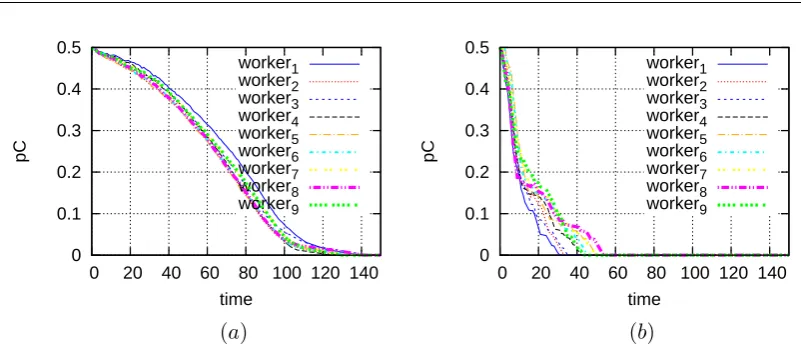
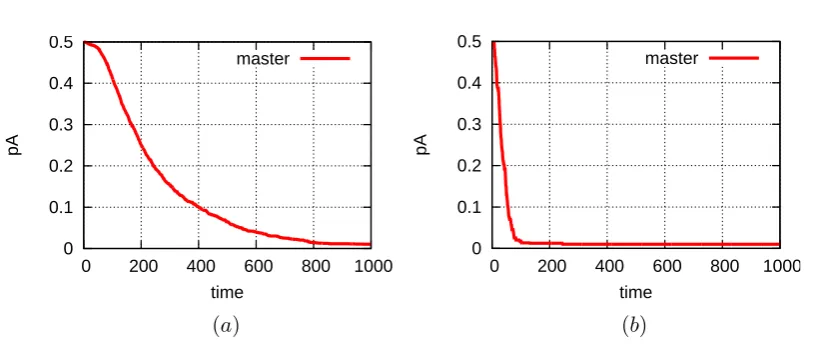
1.1. System model and research problems . . . 4 4.1. Cheating probability for each worker as a function of time (number of rounds) 58 4.2. Auditing probability for the master as a function of time (number of rounds) 59 4.3. Cheating probability for each worker as a function of time (number of rounds) 60 4.4. Top panel, master’s cost as a function of time. Middle panel, master’s
au-diting probability as a function of time. Bottom panel, worker’s cheating probability as a function of time. . . 62 4.5. Convergence percentage of 50 realizations in 1000 rounds. . . 64 4.6. Convergence percentage of 50 realizations in 1000 rounds as a function of the
number of workers . . . 66 4.7. Reputation types. . . 70 4.8. Rational workers. Auditing probability of the master as a function of time
(number of rounds) . . . 82 4.9. Rational workers, for an individual realization . . . 83 4.10.Correct reply rate as a function of time in the presence of only rational
work-ers. . . 85 4.11.One covered worker. . . 86 4.12.Five covered workers. . . 87 4.13.Master’s auditing probability as a function of time in the presence of rational
and malicious workers. . . 88 4.14.Master’s auditing probability as a function of time in the presence of
altruis-tic and malicious workers. . . 89 4.15.Presence of 4 malicious and 5 rational workers, only 1 rational worker is
covered. . . 90 4.16.Correct reply rate as a function of time. Presence of 5 malicious workers on
the 500th round. . . 91 4.17.Presence of 5 malicious workers on the 500th round. Workers’ reputation as a
function of time, audit occurrences as a function of time and reputation ratio as a function of time, for an individual realization. . . 92
4.18.Presence of 5 malicious workers on the 500th round. Audit probability as a
function of time and correct reply percentage as a function of time. . . 93
4.19.Simulation results with full availability. . . 107
4.20.Simulation results with partial availability: (a1)-(a2) initial pA = 0.5, (b1)-(b2) initialpA= 1. . . 108
5.1. Graphs used in the tasks given to the workers. . . 111
5.2. HIT preview, for the task variation color, as seen by the worker. . . 112
5.3. HIT preview, for the task variation majority, as seen by the worker. . . 114
5.4. HIT preview, for the task variation count, as seen by the worker. . . 115
5.5. Number of workers’ correct and incorrect replies in all four subtasks for HIT color. . . 116
5.6. Number of workers’ correct and incorrect replies in all four subtasks for HIT majority. . . 117
5.7. Number of workers’ correct and incorrect replies in all four subtasks for HIT count. . . 117
5.8. The Empirical Cumulative Distribution Function (ECDF) of the total re-sponse time for HIT majority. . . 119
5.9. The ECDF of the total response time for HIT color for the five accuracy groups.120 5.10.The ECDF of the total response time for HIT count for the five accuracy groups. . . 120
5.11.Histogram of the density of reported number of black nodes in graph G1 for HIT majority. . . 122
5.12.Histogram of the density of reported number of black nodes in graph G2 for HIT majority. . . 122
5.13.Histogram of the density of reported number of nodes in graph G1 for HIT count. . . 123
5.14.Histogram of the density of reported number of nodes in graph G2 for HIT count. . . 123
5.15.Scatter plot of the workers’ response time against workers accuracy group for all four HIT color subtasks. . . 126
5.16.Scatter plot of the workers’ response time against workers accuracy group for all four HIT majority subtasks. . . 127
5.17.Scatter plot of the workers’ response time against workers accuracy group for all four HIT majority subtasks. . . 128
5.18.The reported age of participating workers in all three HITs . . . 129
5.19.The reported education of participating workers in all three HITs . . . 129
LIST OF FIGURES XXI
6.1. Comparing FEDoR with Vickrey-Clark-Groves (VCG) and Generalized Sec-ond Price (GSP) in the mean utility of seller (computational platform) and player (master) per auction. . . 143 6.2. The percentage of positives with the KS test as a function of the history length
of the KS test. . . 144 6.3. Different strategies, modelled as aβ= 0.7probability distribution. . . 146 6.4. Different strategies, modelled as aβ= 0.9probability distribution. . . 147 6.5. The utility of an honest master compared to a cheating master in different
List of Acronyms
AMT Amazon Mechanical Turk
FEDoR Fair and Efficient Distribution of Resources
BOINC Berkeley Open-source software for volunteer computing SETI Search for Extraterrestrial Intelligence
WCG World Community Grid HIT Human Intelligence Task EGT Evolutionary Game Theory GT Game Theory
NE Nash Equilibrium MD Mechanism Design P2P Peer to Peer
CPU Central Processing Unit QPQ Quid Pro Quo
whp with high probability
ECDF Empirical Cumulative Distribution Function VCG Vickrey-Clark-Groves
GSP Generalized Second Price GoF Goodness of Fit
PIT Probability Integral Transformation
Chapter 1
Introduction
The Internet is turning into a massive source of inexpensive computational power. Ev-ery entity connected over the Internet is a potential source not only of machine computational power but also of human intelligence. For this reason, numerous task computing environ-ments [8, 23, 56, 102] have been designed to harvest this computational power. One of the most representative examples is volunteer computing initiatives, like the Search for Extraterrestrial Intelligence (SETI)@home [79] project, that is supported by the Berkeley Open-source soft-ware for volunteer computing (BOINC) [8]. Other representative examples are profit-seeking platforms, such as Amazon Mechanical Turk (AMT) [102]. The advantage of these online task computing platforms is the easy access and inexpensive computational power they provide.
We refer to the computation taking place in these environments asInternet-based task comput-ing, and we model its components by means of a master-worker approach. A “master” entity has a set of tasks to perform, and instead of computing them locally, she sends these tasks across the Internet to “worker” entities that execute and report back some task result. A real computational environment may have multiple master entities with distinct set of tasks to perform.
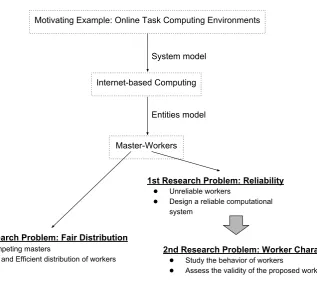
Unfortunately, two crucial and challenging research problems prevent Internet-based task computing from reaching its full potential. First of all, computations carried out over the In-ternet can not be trusted due to the fact that workers can hide behind their anonymity or simply make mistakes. Moreover, whoever is requesting the computation may be lacking tools to ver-ify the validity of the results. Thus, the results received from a worker can not be considered reliable, and the whole computational environment suffers from “unreliability” issues. From this first research challenge a complementary problem emerges, that is characterizing the nature of the workers. Being able to understand and model the workers behavior is an essential component to any designed solution. A second challenge arises from the fact that multiple masters may be competing at the same time for the same workers, and thus might experience issues arising from the inefficient allocation of the workers. This work provides a number of solutions addressing the problem of unreliability and inefficient resource allocation in Internet-based task computing setting. Figure 1.1 describes the two main research problems addressed in this work and how they
Motivating Example: Online Task Computing Environments
Internet-based Computing
Entities model
Master-Workers System model
3rd Research Problem: Fair Distribution
● Competing masters
● Fair and Efficient distribution of workers
1st Research Problem: Reliability
● Unreliable workers
● Design a reliable computational system
2nd Research Problem: Worker Characterization
● Study the behavior of workers
● Assess the validity of the proposed worker models
Figure 1.1:System model and research problems
arise from the task computing environment we consider.
Online Task Computing Platforms
This work focuses on computations taking place over the internet. By computations we refer to the processing of tasks run by machines or the processing of tasks performed through human intelligence. Thus, we classify computations based on the mean used for performing the task. Further more, we sub-classify these computation with respect to the payment received. Workers in online task computing might or might not receive monetary payments. We continue by de-scribing four principal settings according to the above classification where online task computing platforms are present. In Table 1.1 we summarize the features of four types of task computations via the workers’ attributes.
5
Worker Monetary
Reward
Contribution Motivation
Yes No Machine Power
Human Intelligence
Power
Payment Altruism Enjoyment Reputation
Task
Volunteer computing
X X X X
Crowdsourcing X X X X X X X
Virtual citizen science
X X X X X
Bitcoin mining X X X
Table 1.1:Summary of task computations via worker’s attributes
might also be attracted by the prestige and the reputation gain of having her contribution an-nounced [9]. This last reason for joining the computation together with the fact that a user might actually want to harm the project are enough to jeopardize the reliability of volunteer computing. Several studies [8, 9, 12, 63, 77] have found evidence that reliable task results is not an a-priory property of volunteer computing and there is a need for establishing it.
In addition to users volunteering computational resources, humans themselves connected to the Internet are a source of computational power. The word crowdsourcing was introduced by Howe [67] to describe the situation where human intelligence tasks are executed over the In-ternet by humans that are given monetary, social or other kind of incentives. A profit-seeking computation platform has been developed by Amazon, called Amazon’s Mechanical Turk [102] (AMT). Users sign in to the platform and choose to perform a Human Intelligence Task (HIT) in return for a monetary reward. The most common tasks encountered in AMT are closed class questions (following the categorization in [47]), meaning that the range of answers is a limited predefined set. The word crowdsourcing is vastly used to describe any contribution that can be produced by a human-technology collaboration by having participant volunteer or being paid. In this work we consider micro-task crowdsourcing as it was described above and by convention we refer to it simply as crowdsourcing. Like volunteer computing, crowdsourcing systems can not be considered reliable [47, 68], especially now that participants expect a monetary gain.
and Bitcoin payments (proof of work) to guarantee trustworthiness [20].
Finally, another example of Internet-based task computing we could consider is virtual citizen science [41,76]. We could say that this type of computation is a hybrid among what we call volun-teer computing and crowdsourcing. Volunvolun-teers over the Internet willing to help scientists accept to participate in tasks that need human intelligence to be solved. One of the most characteristic project is Galaxy Zoo [41, 56], engaging volunteers to classify galaxies into categories, doing so in many occasions in the form of a “fun” game. It was through the work of Von Ahn [131], that pioneeredgames with a purpose, where we first saw this type of scheme for creating a more pleas-ant experience for the volunteers. As pointed out by Kloetzer et al. [76] volunteers will gradually learn to perform a task through these “task-game mechanisms” as they call them. Thus, this type of volunteers actually become reliable over time and given the right incentives.
The Nature of the Workers
All of the aforementioned examples in essence follow a master-worker model. A master process sends tasks, across the Internet, to available worker processes, which execute them and report back the task results. Moreover, it is clear from the nature of Internet-based task computing that workers can not be trusted. A number of works present evidence that workers might actually misreport values in online task computing platforms [8, 9, 47, 63, 68, 75, 77]. The most trivial reason for workers misreporting values is due to hardware or software failures happening during the computation of the task that was not detected. Other explanations are the workers might have ulterior motives for misreporting results or might have limited capabilities of computing a correct result. In order to be able to provide solutions that establish reliability we need first to be able to correctly model the worker’s behavior.
A number of attempts have been made in the past to classify these workers. In Distributed Computing a classical approach is to model the malfunctioning (due to a hardware or a software error) or cheating (intentional wrongdoer) asmaliciousByzantine workers that wish to hamper the computation, and thus always return an incorrect result. The non-faulty workers are viewed asaltruisticones [122] that always return the correct result. On the other hand, a game-theoretic approach assumes that workers are rational [4, 58, 124], that is, a worker decides whether to truthfully compute and return the correct result or return a bogus result, based on the strategy that best serves her self-interest (increases its benefit).
7
Given the above, we can safely assume that in an Internet-based task computing system, a number of workers will be reporting always correct task results, a number of workers will be reporting always incorrect results, and a number of workers will be reporting both correct and incorrect results. In order to be able to give solutions to the problem of unreliability of the workers, we need to model their behavior under a general framework. This work looks into two different models of the workers’ behavior.
Error probability model: We assume the presence of two type of workers. Altruisticworkers that are positive towards executing the task, and willing to provide the correct result. In the case of a BOINC system, a “positive” worker will let its machine execute the task and report back the result, while in the case of crowdsourcing she will aim at computing the correct task result.Trollworkers are negative towards executing a task, and want to convey an incorrect result to the master. Hence, a troll worker can miscalculate a task on purpose by reporting a random incorrect result. Altuistic and troll workers are subject to errors, and thus it is possible that an altruistic worker will report an incorrect result while a troll worker might report a correct result. Notice that in this model we do not assume that workers have an intelligent strategy to fool the system, nor that a troll worker has any information on the actions taken by the master or the other workers.
Rationality model: We assume the presence of three types of workers. Rational workers are selfish in a game-theoretic sense and their aim is to maximize their utility (benefit). Thus, they will report a correct or incorrect result based on the strategy that maximizes their benefit.Altruisticandmaliciousworkers have a predefined behavior, to always be honest and cheat, respectively.
Notice that the concepts of trolls and malicious workers, in the two models mentioned above, are very similar. The main difference among the malicious and the troll workers is that malicious workers have an intention of harming the computation and thus they form even collusions to achieve their goal. On the other hand, troll workers are simply not interested in providing the correct reply.
The Nature of the Masters
Besides workers exhibiting a strategic behavior (aiming at reporting a task result that will maximize their benefit) also the masters profiting from in the computational environment might exhibit strategic behavior. Rationality on the master’s side has been also considered in the past [134].
is aiming at workers with the same skills, while their budget varies in the order of thousands of dollars. Thus, competitive behavior might arise among requesters, especially ones that are aiming at popular task types such as content generation or object classification, for example. The way AMT is designed allows requesters having a strategic behavior to increase the reward for a completed task and attract more workers participation. Another feature of AMT is that it gives the possibility to a requester to declare a task result incorrect and refuse payment to the worker. Thus, given the fact that requesters are limited by a budget, they might exhibit a strategic behavior to increase their benefit by posting tasks with high payments and not rewarding the worker after receiving the answer. This strategic behavior does not only affect the workers but also the rest of the requesters competing for workers with the same set of skills. Thus, it is essential in Internet-based task computing to have fair and efficient (when the workers are needed the most) allocation of the workers among the competing masters.
Contributions & Document Organization
We address the issues of reliability and fairness in online task computing environments, proposing solutions intended to alleviate the presence of malicious entities and incentivize the good behavior of strategic entities, in an attempt to exploit the full potentials of this computing environments. In particular, in this work we have three research goals:
Reliability: Achieve a reliable online task computing platform, in the presence of untrustworthy workers, where the master receives with high probability the correct answer.
Worker Characterization: Study the behavior of workers participating in micro-task crowd-sourcing and assess the validity of our proposed worker models. In parallel, provide key information to design reliable crowdsourcing platforms.
Fair Distribution: Achieve a fair and efficient distribution of workers among the set of strategic masters. That is, a worker must be executing a task for the master that has the highest valuation for her work, at any time.
To this respect our general contributions can be summarized in the following:
We provide a comprehensive study on online task computing environments paving the way to a broad adaptation of this easy and inexpensive source of computational power. We abstract online task computing environments to the Internet-based task computing system model and we model the computational entities under the master-worker paradigm. We model the workers’ unreliable behavior under two general models, the error prob-ability model and the rationality model.
9
solutions, thus the problem complexity increases. For this reason, we provide a study of the two main reliability techniques: (1) auditing and (2) voting given the above assumptions. To do so, we design algorithms using the above techniques that decide with high probabil-ity the correct task solution for a set of tasks. We analyze and compare the computational complexity of the algorithms in terms of time and required work from the workers. For a detailed analysis of these contributions we refer the reader to the Contribution paragraph of Chapter 3.
We model the workers behavior according to the rationality model and we assume a repeated interaction with the workers. The computation is modelled using evolution-ary dynamics and we study the conditions under which the master can reliably obtain task results. In particular, we develop and analyze algorithmic mechanisms based on reinforce-ment learning to provide rational workers with the necessary incentives to eventually be-come truthful, while we use reputation to deal with malice and unresponsive workers. Our analysis identifies the conditions under which truthful behavior can be ensured. The anal-ysis is complemented with illustrative simulations. Detailed contributions are provided in Chapter 4 in Sections 4.3, 4.4 and 4.5.
We provide an experimental evaluation of the workers behavior on AMT where we identify workers with different levels of accuracy in their responses. We verify a relation-ship among reliability and task difficulty and also the relationrelation-ship among reliability and worker’s response time. Most importantly though, we are able to conjecture that validity of our two models characterizing the workers’ behavior.
We design a mechanism for fair and efficient distribution of the workers without the use of monetary incentives in an Internet-based computing system, in the presence of strate-gic masters aiming at increasing their own benefit by declaring a higher than their actual valuation on a workers’ contribution. Analysis shows the good properties of our mechanism while simulations compare the designed mechanism with renown auction mechanisms that use monetary incentives. For more details on these contributions we refer the reader to the Contribution paragraph of Chapter 6.
Chapter 2
Background and Related Work
There is a great amount of literature related to what we describe in this work as the master-worker Internet-based task computing problem. In this chapter we aim at reviewing the most closely related works giving particular emphasis to how the problem of reliability and fairness is addressed in volunteer computing and crowdsourcing. Moreover, we provide some back-ground on the concepts appearing in this work and we refer the reader to works that exten-sively describe the concepts of Game Theory (GT), Mechanism Design (MD), Evolutionary Game Theory (EGT), reinforcement learning, reputation and so forth.
2.1
Background
Before reviewing the related work, we briefly introduce some concepts relevant to with this work.
Mechanism Design & Auction Mechanisms
The concept of GT [61, 100, 103] is used in economics, computer science, biology, political science, etc., and tries to capture and study strategic interaction among rational agents driven by their self-interest, beliefs and preferences. In an abstract way we can describe a game a the set of available actions the agents have and a mapping of the agents strategies to an outcome. The utility of an agent, determines her preferences over the possible strategies she can follow and the strategies of the other agents. Generally an agent is considered rational when it tries to maximize its utility. To this respect, solution concepts try to compute the outcome of a game with rational agents. The most famous solution concept is the Nash Equilibrium (NE) [98]. The concept of rationality [61] is used to model the human behavior and formally define the outcome of a game with self-interested agents. A complementary approach to GT is MD [100, 103] where given a targeted outcome, a game is designed to incentivize the rational agents in behaving in such a way such that the desired outcome is achieved.
The concepts of Algorithmic Game Theory [100], MD [103] and Algorithmic Mechanism Design [100] have a large applicability in computer science, in the fields of distributed systems and networks since agents interacting on the Internet are considered strategic [100]. Examples of popular problems addressed through these fields are network routing problems, scheduling problems, task allocation problems, etc,. In MD a designer of a game aims at choosing game structures, called mechanisms that will result in desirable outcomes. In a game we have a system with a number of strategic agents and a possible set of outcomes. Each agent has a type, which is a private information of the agent, determining the agents utility over different outcomes. Thus, an outcome is preferred by an agents if it strictly provides her with a larger utility. The problem addressed is to compute a social choice function that selects an optimal outcome given all the agents types. The most common social choice function is to maximize the total utility of the agents. In order for the mechanism to achieve the desirable outcomes, a set of rules and incentives are designed to influence the rational agents preferences.
The most straightforward mechanisms for resource allocation are auctions [97], where agents submit bids based on their preference on the auctioned good and the outcome is to assign the good to the agent that, for example, maximizes the revenue given the bids. An auction can be categorized in many ways [80]; open or sealed bid, first price auctions or second price auctions. It can be a single object auction or a multi-unit auction. If it is a multi-unit auction, objects can be identical or not and can be sold in a single round or over sequential rounds and objects can be complements (i.e. the value of a second object obtained that is complement of the first one obtained increases). Multi-unit auctions can be classified as uniform price auctions or discrimi-natory price auctions. In uniform price auctions there is a fix amount ofkhighest bids that win the auction and winners pay the same amount; bidder also declare the units of good they desire. In the work presented in Chapter 6 we are assuming a multi-unit, sealed, sequential (with many objects auctioned at each round) auction where auctioned goods are not complements. When the agents (bidders) in an auction know how much they value a good, and this information is only known to them, this describes a situation ofprivate values[80], which is the case in this work. One of the most celebrated auction mechanisms are the ones belonging to the Vickrey-Clark-Groves (VCG) [16, 100, 103] family of mechanisms, where an agent’s dominant strategy is to be truthfully revealing its preferences, independently of the other agents actions. A mechanism that has this property is called strategy-proof.
Evolutionary dynamics & Evolutionary Game Theory
2.1 Background 13
The dynamics of evolution have been studied under the principles of EGT. Maynard-Smith and Price [125, 126] introduced the concept of EGT in an effort to apply game theoretical ideas to understand evolving populations of lifeforms. This made Maynard-Smith [126] adjust the traditional concept of strategy, equilibrium, and the nature of a player’s interaction, so that a player would learn how to optimize its behavior and maximize its return. However, while in traditional GT players choose a strategy from their strategy sets, EGT in biology is dealing with species inheriting possibly mutated strategies. When referring to social entities such as humans, evolution is understood as a learning process akin to “cultural evolution” [64]. Cultural evolution implies an analogy between learning and biological evolution. For the existing analogies between learning, at the individual level, and biological evolution, we refer the reader to a paper by Borgers and Sarin [26].
In EGT, instead of the NE [98] , Maynard-Smith and Price used the Evolutionarily Stable Strategy (ESS) concept [45, 57, 115, 132]. A strategy is called evolutionarily stable if, when the whole population is using this strategy, any group of invaders (mutants) using a different strategy will eventually die away over multiple generations (evolutionary rounds). All ESS are NE but the reverse is not true. Our work is driven by the concept of ESS and we wish to have a similar stable strategy among workers that would guarantee reliability. Even if a mutant worker decides to change its strategy to cheating, it will be soon brought back to an honest strategy. Instead of the one-shot and repeated games of classical GT, EGT assumes that the game is played repeatedly by players randomly drawn from large populations, uninformed of the preferences of opponents. In our work we do not wish to change the set of players as evolutionary rounds progress, but we rather talk about “cultural evolution”, where workers change their strategies as a process of learning, rather than being replaced themselves.
Reinforcement Learning & Aspiration Level
While evolution operates on the global distribution of strategies within a given population, re-inforcement learning [128] operates on the individual level of each member of the population. A well-known model of reinforcement learning is Bush and Mosteller’s model [28]. In this model, the players have limited information and they play in discrete time repeatedly the same normal-form game. At each point in time, the players are characterized by a probability distribution over their strategy sets. Players’ choices are random, since they are affected by some unpredictable “psychological” factor. This probability distribution is adjusted over time in response to expe-rience. This experience is gained through repeated interactions of the players with the system, based on their strategies and the received payoffs. Positive payoffs reinforce the strategy just chosen, and negative payoffs discourage the use of that strategy.
workers and does not change during the evolutionary process (as in [22]). For more information on the different reinforcement learning models and comparisons between them we refer the reader to a paper by Laslier et al. [85] and a study by Izquierdo and Izquierdo [70].
A survey by Phelps et al. [108] and an article by Conitzer and Sandholm [42] take a new approach on MD by introducing the concept of evolutionary mechanism design. Evolutionary mechanism design assumes an engineering approach, based on an incremental process that creates a partly automated mechanism design. The evolutionary mechanism has a continuous interaction and feedback from the current mechanism, as opposed to classical mechanism design, which after the mechanism is introduced in the system, remains in the same NE forever. Looking at it from a different perspective, evolutionary mechanism design is analogous to EGT. Just as players may be forced to gradually adjust their strategies, in an analogous manner mechanisms are gradually making adjustments in their rules with respect to what strategies are currently in play. In some way, our mechanism can be seen as an evolutionary mechanism, since the probability of auditing of the master and the probability of cheating of the workers change, which is similar to changing the mechanism.
Distributed computation in the presence of selfishness was studied within the scope of com-binatorial agencies in Economics [17–19, 48]. The basic model considered is a comcom-binatorial variant of the classical principal-agent problem [92]: A master (principal) must motivate a col-lection of workers (agents) to exert costly effort on the master’s behalf, but the workers’ actions are hidden from the master. Instead of focusing on each worker’s actions, the focus is on complex combinations of the efforts of the workers that influence the outcome. The principal-agent ap-proach deals in general with designing contracts between the principal and the workers that allow the principal to get the most out of the workers without knowing a priori what their actual capa-bilities are. One difference with respect to our master-worker model is that, the worker’s actions cannot really be viewed ashiddenin our setting. Another important difference is that our scheme considers worker punishment, as opposed to the schemes in combinatorial agency where workers cannot be fined (limited liability constraint); this is possible in our framework as worker’s actions are contractible (either a worker truthfully performs a task or not).
In the work of Rose and Willemain [112] the principal-agent problem is extended to evolu-tionary learning, and bounded rationality of the agents is assumed. Players’ learning is simulated with a genetic algorithm that roughly mimics selection and mutations in biological evolution. Changes in the system are externally induced through the use of incentives. The agents’ learning is aided by the principal’s incentives that are used to adjust the learning, according to the output the principal desires. The principal is also able to use an artificial selection procedure to identify high performing agents for its own benefit.
2.1 Background 15
the players may change over time and players can experience mutations. In both works incentives are used to impose a desired behavior over time. But in [112] bounded rationality has been used, while in our work no cognitive limitation of the workers is assumed.
Reputation
In Chapter 4 we use reputation to deal with malice. The master reinforces its strategy as a function of the reputation calculated for each worker. Reputation has been widely considered in on-line communities that deal with untrustworthy entities, such as online auctions (e.g., eBay) or Peer to Peer (P2P) file sharing sites (e.g., BitTorrent); it provides a mean of evaluating the degree of trust of an entity [72]. Reputation measures can be characterized in many ways, for example, as objective or subjective, centralized or decentralized. An objective measure comes from an objective assessment process while a subjective measure comes from the subjective belief that each evaluating entity has. In a centralized reputation scheme a central authority evaluates the entities by calculating the ratings received from each participating entity. In a decentralized system entities share their experience with other entities in a distributed manner. In our work, we use the master as a central authority that objectively calculates the reputation of each worker, based on its interaction with it; this centralized approach is also used by BOINC.
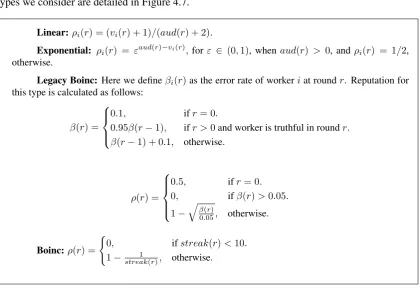
The Berkeley Open-source software for volunteer computing (BOINC) system itself uses a form of reputation [11] for an optional policy called adaptive replication. This policy avoids repli-cation in the event that a job has been sent to a highly reliable worker. The philosophy of this reputation scheme is to be intolerant to cheaters by instantly minimizing their reputation. Our mechanism differs significantly from the one that is used in BOINC. One important difference is that we use auditing to check the validity of the worker’s answers while BOINC uses only replication; in this respect, we have a more generic mechanism that also guarantees reliability of the system. Notwithstanding inspired by the way BOINC handles reputation we have designed a BOINC-like reputation type in our mechanism (called Boinc). The adaptive replication policy currently used by BOINC has changed relatively recently. BOINC used to have a different pol-icy [10], where a long time was required for the worker to gain a good reputation but a short time to lose it. In this work we evaluate the two policies used by BOINC, adapted of course to our mechanism. We call the old policy Legacy Boinc and we seek to understand the quantitative and qualitative improvements among the two schemes.
2.2
Related Work
In this section we review the most relevant works addressing the issue of reliability in Internet-based task computing systems and fair resource allocation without the use of monetary incentives. Related to the topic of reliability we review a number of works considering the presence of mali-cious, altruistic and rational workers.
Presence of Malicious & Altruistic Workers
Sarmenta [118] was among the first that introduced the problem on reliability in volunteer computing. In his work he assumed the presence of malicious and altruistic workers, with only the malicious workers having a constant probability of submitting an erroneous result and binary set of response. Based on these assumptions he introduced sabotage-tolerance mechanisms that used voting and a spot checking technique (similar to auditing in our work). Given the assumption that altruistic workers will always reply with the correct task result, the mechanisms combine voting with challenges to create a reputation for each worker and increase the systems’ reliability while trying to keep redundancy low.
In the work of Kondo et al. [77], the error detection mechanisms presented in the work of Sar-menta are evaluated with real data gathered from the XtreamLab project that uses the BOINC [8] infrastructure. Through this work the errors generated in desktop grid applications are character-ized. They conclude that a large fraction of errors is coming from a very small portion of workers. Also they show that little correlation between simultaneous malicious workers exist. Addition-ally, there is a large variability of the set of malicious workers over time, with the exception of a few frequent offenders. Also care has to be taken if blacklisting or credibility is used. They derive the conclusion that a large number of tasks and time are required to achieve low error rates with spot-checking and that, in general, to achieve low error rates it is better to use majority voting.
In the work of Fern´andez et al. [51], an asynchronous distributed system is considered where the master processor sends tasks to a collection of n workers and a worker may deliberately return an incorrect result in an effort to harm the master. Hence, they consider workers to have a predefined behavior: either they are malicious or correct. The authors model with an explicit parameterdthe probability that the master will receive a reply from a worker on time. The master employs majority voting in accepting the correct result of a task. In order to analyze a worst case scenario the assumption that malicious workers reply and return the same incorrect result is made (thus a form of collusion is assumed). For each task assigned to a worker the master is charged with one work unit. The goal of the master is to accept the correct task result with high probability of success1−ε,ε 1, and with the smallest possible amount of work. A probabilistic bound on the number of malicious workers is considered, with a probability p < 1/2of any worker processor being faulty. Lower bounds on the minimum amount of (expected) work required are given, so that any algorithm accepts the correct reply with probability of success1−ε.
cor-2.2 Related Work 17
rect reply by the end of the round. Two algorithms for the master using different decision strate-gies are developed: a majority-based and a threshold-based algorithm. The authors show that both algorithms obtain the same probability of success1−εand derive similar upper bounds on the (expected) work required in doing so. Also they show that under certain conditions, these upper bounds are asymptotically optimal with respect to the shown lower bounds. This work shows that it is possible to devise mechanisms for executing tasks reliably with high probability and low cost in the presence of malicious worker processors and unreliable communication, and do so with provable analytical guarantees. The work proposed by Fern´andez et al. [51] takes into account the conclusions derived by the work of Kondo et al. [77], that in general achieving low errors it is better to use majority. Also considers the unreliability of the network and unavailability of the workers something that is not considered in the work of Sarmenta.
In their work Konwar et al. [78] remove the assumption that the probability of a worker being malicious is known and new algorithms are proposed to approximate this probability. The lower bounds on the amount of work necessary, when the set of responses is binary, are comparable to the work complexity of our proposed algorithms. These works assume that all workers might fail in every round with a certain probability. In our work we take a more realistic assumption, considering that workers might reply incorrectly with a different probability related to their nature (that is, we assume two types of workers’ failures).
The work in [81] proposes a distributed verification mechanism in which workers can verify each other’s tasks. This approach can potentially aid the master, especially in multi-round compu-tations, from performing the verification by itself. The authors have incorporated their distributed checking mechanism in the BOINC server software. The goal of their mechanism is to give re-wards only to altruist workers and prevent the system with being flooded with incorrect results. Here the malicious workers are assumed to form a single coalition. The focus in our work is not to design a verification mechanism, but instead to limit the use of auditing to the minimum (in such a case, the master does not suffer a prohibitively large overhead for auditing). Also, the verifica-tion mechanism developed in [81] assumes that no more than 20% of the workers are malicious; otherwise their mechanism fails to verify the correctness of a result. This bound is significantly smaller than the one assumed in [51] (50%). Our work, is not subject to any such limitations (due to the central auditing employed by the master), but it does trade cost with reliability (more auditing is needed if the number of malicious workers is large).
In their work Zhao and Lo [135] compare voting to challenges (called Quiz) under two as-sumptions: that all malicious workers return the same incorrect result or that malicious workers return distinct results. They use as performance metrics the accuracy and overhead, and through simulations they show the trade-off among these performance metrics and the two reliability techniques. Their work is mostly experimental and does not provide any complexity analysis. Additionally they do not assume a density of solutions nor an error probability on the altruistic workers.
for each task while achieves an aimed total reliability of the tasks on a one-shot assignment. Their proposed algorithm assigns tasks to workers based on a bipartite graph and based on that graph their inference algorithm decides upon the correct task result of the task after a number of iterations. They conclude that if they have a certain information on the quality of the crowd their algorithm performs better than using majority to infer the correct solution. Like in our work a kind of malicious and altruistic workers are assumed, named spammers and hammers. Unlike in our work here spammers will submit a correct answer with probability 1/2 and hammers will always submit a correct answer. More over tasks with binary solutions are assumed. Like us thought they assume that tasks have the same difficulty and the probability of replying incorrectly does not depend on the particular task.
Finally the work of Laredo et al. [84] takes a different approach designing scalable evolution-ary algorithms resilient to failures, that is to errors arriving from potentially malicious workers, and analyzes experimentally the speed by which the system converges. In their experiments they considered two paradigms of evolutionary computation: genetic algorithms and genetic program-ming. Their model assumes the presence of workers that join and leave the computation for a limited period of time, an assumption that we explore as well in Section 4.5.
Presence of Rational Workers
Under the classical game-theoretic view, workers act on their own self-interest and they do not have an a priori established behavior (malicious or altruistic). They are assumed to be rational [4, 58]. In other words, the workers decide on whether they will be honest and report the correct task result, or cheat and report a bogus result, depending on which strategy increases their benefit or utility. Under this view, Algorithmic Mechanisms [4, 99] are employed, where games are designed to provide the necessary incentives so that processors’ interests are best served by acting “correctly.” In particular, the master provides some reward (resp. penalty) should a worker be honest (resp. cheat). The design objective is for the master to force a desired unique NE [98], i.e., a strategy choice by each worker such that none of them has an incentive to change it. That NE is the one in which the master achieves a desired probability of obtaining the correct task result.
work-2.2 Related Work 19
ers, announces the probability by which it will audit and sends the task to the workers. If the master audits then it rewards honest workers and penalizes cheaters. If it does not audit and there is a strong majority of workers (more than 50%) that return the same result, then it rewards the members of the majority and penalizes the rest. If there is no strong majority, then no reward/pun-ishment takes place, the master chooses again randomly a set of workers and re-initiates the same process with the same task (but no knowledge is used from the previous round). That is, not always a single-round protocol is followed for a specific task, whereas our frameworks consider a single-round interaction per task. As indicated experimentally by Kondo et al. [77], a task may take more than one day of Central Processing Unit (CPU) time to complete. Hence, repeating the computation of a task seems to waste useful computation time.
The master in [133] has a fixed budget for computing a task, that includes the auditing cost and the rewards to the workers cost. The goal of the master is to guarantee that it will get the correct reply without exceeding its budget. Bounds for the auditing probability are computed to guarantee that workers have incentives to be honest in three scenarios: redundant allocation with and without collusion, and single-worker allocation. The authors conclude that single-worker allocation is a cost-effective mechanism, especially in the presence of collusions. In our work we do not restrict the budget of the master, but instead, we show trade-offs between reliability and cost (hence considering budgets implicitly).
A later work by Fern´andez et al. [52] considers Internet-based master-worker computations from a game-theoretic point of view. These computations are modeled as games where each worker is assumed to be rational and can choose to cheat (i.e., fabricate a reply and return it to the master), or be honest (i.e., compute and return the correct result). A general single-round protocol is presented where the master assigns the task tonworkers. Each worker cheats with a probability and the master verifies the answer with some probability. If the master verifies, then it rewards and punishes workers appropriately. If the master does not verify, then it rewards the workers according to one of three reward models: (a) “majority” reward model, where the majority of workers is rewarded, (b) “all” reward model the master rewards all workers and (c) “none” reward model the master does not reward at all. Cost-sensitive mechanisms that provide the necessary incentives for the workers to truthfully compute and return the correct result are designed. The objective is to maximize the probability that the master will obtain the correct task result while minimizing its cost. For this purpose the authors consider a set of realistic payoff parameters that can model the environment considered in a game-theoretic sense. Four different games are considered: (a) a game between the master and a single worker (1 : 1game), (b) a game between the master and a workers played ntimes, each with a different worker (1 : 1n
goal. Finally they have identified and proposed specific mechanisms for two realistic scenarios, a volunteer computing scenario (like Search for Extraterrestrial Intelligence (SETI)@home [79]) and a profit-seeking company that buys computational cycles from Internet computers and sells them to customers in the form of a task-computation service (like Amazon Mechanical Turk (AMT) [102]).
The authors in [52] consider a weak form of collusion, where all cheaters return the same incorrect result (we make the same assumption in our work as well). This leads to a worst case analysis, covering all other scenarios with weaker types or no worker collusions. Also they make the assumption that if a worker does not perform the task, then it is almost impossible to guess the correct answer (in other words, guessing the correct result is very unlikely); we make this assumption in our work as well (see Chapter 4). Also, in [52] a verification mechanism is assumed where the master can verify which workers have truthfully performed the task, without computing the task. Hence, the master by verifying does not necessarily obtain the correct result, for example when all workers cheat.
Compared with the work of Yurkewych et al., the work of Fern´andez et al. [52] studies more algorithms and games, considers richer payoffs, probabilistic cheating and shows reacher trade-offs between reliability and cost. However they share a common conclusion: under certain con-ditions non-redundant task allocation is best. This motivates the need for better mechanisms that would make redundant allocation more effective. Considering knowledge gained in previous interactions for future task computations is a promising direction, as we observe in this work.
Also in the work of Fern´andez et al. [53] workers are considered rational behavior on the side of the workers in a game-theoretic sense. The authors considered that rational workers might col-lude and they analytically present parameter conditions where a unique NE exist and the master obtains the correct answer. Finally, in [134] the authors consider a crowdsourcing setting and present a game-theoretic model based on repeated games, where workers and masters are con-sidered selfish. They propose a class of incentive protocols that are based on social norms and analyze the social welfare of the platform proving that it can operate close to Pareto efficiency.
Presence of Altruistic, Malicious & Rational Workers
Eliaz [49] seems to be the first to formally study the co-existence of Byzantine (malicious) and rational players. He introduces the notion ofk-fault-tolerant NEas a state in which no player benefits from unilaterally deviating despite up tokplayers acting maliciously. He demonstrates this concept by designing simple mechanisms that implement the constrained Walrasian function and a choice rule for the efficient allocation of an indivisible good (e.g., in auctions). Abraham et al [4] extend Eliaz’s concept to accommodate colluding rational players. In particular they design a secret sharing protocol and prove that it is (k, t)-robust, that is, it is correct despite up to k
colluding rational players andtByzantine ones.
BAR-2.2 Related Work 21
tolerant, that is, the protocol is resilient to both Byzantine faults and rational manipulation. (In this respect, one might say that our aim is to design mechanisms that are BAR-tolerant.) As an application, they designed a cooperative backup service for P2P systems, based on a BAR-tolerant replicated state machine. Li et al [90] also considered the BAR model to design a P2P live streaming application based on a BAR-tolerant gossip protocol. Both works employ incentive-based game theoretic techniques (to remove the selfish behavior), but the emphasis is on building a reasonably practical system (hence, formal analysis is traded for practicality). Moreover, Li et al [89] developed a P2P streaming application, called FlightPath, that provides a highly reliable data stream to a dynamic set of peers. FlightPath, as opposed to the above-mentioned BAR-based works, is based on mechanisms for approximate equilibria[30], rather than strict equilibria. In particular,-Nash equilibria are considered, in which rational players deviate if and only if they expect to benefit by more than a factor of . As the authors claim, the less restrictive nature of these equilibria enables the design of incentives to limit selfish behavior rigorously, while it provides sufficient flexibility to build practical systems.
Gairing [55] introduced and studied malicious Bayesian congestion games. These games extend congestion games [113] by allowing players to act in a malicious way. In particular, each player can either be rational or, with a certain probability, be malicious (with the sole goal of disturbing the other players). As in our work, players are not aware of each other’s type, and this uncertainty is described by a probability distribution. Among other results, Gairing shows that, unlike congestion games, these games do not in general possess a NE in pure strategies. Also he studies the impact of malicious types on the social cost (the overall performance of the system) by measuring the so-calledPrice of Malice. This measure was first introduced by Moscibroda et al [96] to measure the influence of malicious behavior for a virus inoculation game involving both rational (selfish) and malicious nodes.
In an article by Alon et al. [7] the notion of Bayesian ignorance is presented. Bayesian ig-norance is quantified by comparing the social cost obtained by players that have local views in a Bayesian game to the expected social cost of players with global views. The authors assume the existence of both altruistic and rational players and present their derived results on a specific congestion game. The main result reached is that having rational agents bear a local view is best for the social cost. Relating to our model all workers and the master have the same view of the system, having workers with different views is something that can not be applied to our framework.
Besides investigating the co-existence of malicious and rational players, also the co-existence of altruistic and rational players has been considered. Hoefer and Skopalik [65] study congestion games with altruist players, assuming a level of altruismβifor each playeri:βi = 0being a pure
selfish andβi = 1being a pure altruist player. The work of Kuznetsov and Schmid [83] describes
(I.e., malicious players aim at reducing the utility of the rest of players, while altruistic players aim at increasing these utilities.) Instead, in the context of master-worker task computing, we assume that maliciousness and altruism is with respect to the master.
In an earlier work [31], we considered the presence of malicious, altruistic and rational work-ers in the presence of an unreliable communication mean and unavailable workwork-ers. Two algorith-mic mechanisms were designed providing incentives to the rational workers to act correctly, while alleviating the malicious workers’ actions and coping with the unreliability of the network. The designed solutions considered a one-shot (or stateless) interaction of the master with the work-ers, in the sense that the master decides about the outcome of an interaction with the workers involving a specific task, without using any knowledge gained by prior interactions. Each of the designed mechanisms implements an instance of a Bayesian game. Assuming that the stochastic distribution of the workers over the three types is known, analysis provides the probability of the master obtaining the correct result and the master’s utility, while identifies the conditions under which the game has a unique NE.
Resource Allocation & Mechanisms without Monetary Incentives
The concept of mechanisms without money has been studied before by Schummer and Vohra [120] and Procaccia and Tennenholtz [110]. We are focusing on mechanisms for resource allo-cation/distribution. To this respect, a related work is the one by Guo et al. [60]. They study the problem of allocating a single item over multiple competing agents in a repeated setting, without the involvement of money. To do this, they introduce an artificial payment system; they propose a number of repeated Bayes-Nash incentive compatible mechanisms and analyze how competitive they are with mechanisms using money. In their setting they assume, like we do, that agents learn their private values before each interaction, and also that preferences are i.i.d according to a dis-tribution that does not change over time. In a later work, Guo and Conitzer [59] design a strategy proof mechanism for allocating multiple heterogeneous goods among two agents, in a single shot, prior-free and payments-free setting. Our designed mechanism which we call Fair and Efficient Distribution of Resources (FEDoR) promotes a truthful declaration of values, since telling the truth increases the agents benefit (assuming the possibility of the agents being more than two) independently of the other agents strategy. Our mechanism considers a setting of multi-round in-teractions among the agents, for allocating a set of heterogeneous goods to them. We assume that all agents distributions can be transformed into a uniform [0,1] distribution, but besides that we have no information about the distribution of the agents. So, FEDoR is payment-free mechanism that achieves fairness and efficiency.
2.2 Related Work 23
the use of mechanism without payments. In contrast to the kind of mechanisms they consider, in FEDoR there is no need of a trusted entity. Due to the infeasibility of using money incentives in many computer science oriented problems, new techniques developed to substitute monetary incentives, such as thetit-for-tatin BitTorrent [91,109] and money-burning mechanisms [62]. Un-fortunately, these techniques can not be easily generalized to other problems. In particular, in [88] interdomain routing is analyzed from a game theoretic perspective and incentive-compatible dis-tributed mechanisms without payments are designed in a repeated setting.
Rahman et al. [111] considers the fairness constraint focusing on P2P systems, and propose an alternative approach to resource allocation that achieves fairness and efficiency on effort-based incentives, as opposed to contribution or output-based incentives. This work is somehow related to ours by the fact that we also consider that fairness is not proportional to the valuations of the agents, but in our work no incentives are necessary to achieve efficiency. In addition, we give analytical proofs of the properties of our mechanism, unlike the work by Rahman et al. [111].
Chapter 3
Evaluation of Reliability Techniques
3.1
Introduction
We consider a distributed system that carries out computational tasks, as we have seen in the introductory section. A master entity has a set of computational tasks to resolve that is unable or unwilling to compute locally. Hence, she assigns these tasks over the Internet to worker entities willing to perform the task and reply back to the master with a result. The inherent limitation of this load distribution scheme is the unreliable nature of the workers. We assume that there is no mean of verifying an answer provided by a worker unless we know the set of solutions for the particular task.
Evidence exist that workers might actually misreport values [8, 9, 47, 63, 68, 77]. The most straight forward explanation is that workers might have ulterior motives for misreporting a result. Another reason might be that actually a hardware or software failures happened during the com-putation of the task that was not detected. Another possibility is, in the crowdsourcing example, that workers intend to convey a correct result but they miscalculate.
Drawing from the above examples and the work of Kondo et al. [77], where they have charac-terized errors in Berkeley Open-source software for volunteer computing (BOINC) systems, we can infer the existence of two type of workers and we characterize them based on what we call theerror probability model, where we have(i) altruistic1workers: This type of worker is posi-tive towards executing the task, and willing to provide the correct result. In the case of volunteer computing systems, a “positive” worker will let its machine execute the task and report back the result. While in the case of crowsourcing, workers will intend to compute the correct result. (ii) Troll2workers:This type of worker is negative towards executing a task and wants to convey an incorrect result to the master. Hence, it can miscalculate a task on purpose and tries to report an incorrect result. In this work we do not assume any type of intelligent strategy to fool the system,
1
For historical reasons, to match with original work in the field of master-worker task computing.
2
Historically they are called malicious workers, but since we are not assuming any intelligent behavior to harm the system here we call them troll workers. For more information see Chapter 2.
nor that a troll has any information on the actions taken by the master or the other workers. We can safely assume that both types of workers can be susceptible to a small error probability
that is related to hardware or software failures or limited capabilities (in the case of humans computing the task) or to any other factor that would force them to deviate from their intended behavior. Thus an altruistic worker, will have a high probability of reporting a correct result, while a troll will have a low probability of reporting a correct result. Although this work was initially motivated by the volunteer computing example based on the existing literature, our experimental work, presented in Chapter 5, shows that even in a crowdsourcing setting where humans act in a more “selfish” way, the above modelling can also capture the crowdsourcing setting. Altruistic workers, will aim at reporting a correct task result, by trying to calculate a correct result to the extend of their cognitive capabilities. On the hand trolls, want to provide an incorre