conservative care of TMJ dysfunction in a
competitive swimmer
Erik Yuill,
BPHE, BSc, MSc*Scott D. Howitt,
BA, CK, CSCS, DC, FCCSS(C), FCCRS(C)**Objective: To detail the progress of a patient with TMJ dysfunction and headaches due to swimming, who underwent a conservative treatment plan featuring soft tissue therapy, spinal manipulative therapy, and rehabilitation.
Clinical Features: The most important features were initial bilateral temporal headaches and persistent left sided TMJ pain brought about by bilateral breathing while swimming. Conventional treatment aimed at decreasing hypertonic muscles, increasing hyoid mobility, improving TMJ mobility, resolving cervical restrictions, and improving digastric facilitation.
Intervention and Outcome: The conservative treatment approach utilized in this case involved soft tissue therapy, hyoid mobility treatment, TMJ mobilization, spinal manipulative therapy, and digastric facilitation. Outcome measures included subjective pain ratings, range of motion, and motion palpation of the cervical spine.
Conclusion: A patient with bilateral temporal
headaches and TMJ pain due to bilateral breathing while swimming appeared to be relieved of his pain after three treatments of soft tissue therapy, hyoid mobility
treatment, spinal manipulative therapy, and digastric facilitation.
(JCCA 2009; 53(3):165–172)
Objectif : Expliquer en détail les progrès d’un patient souffrant du dysfonctionnement d’une articulation temporomandibulaire (ATM) et de maux de tête reliés à la natation, à qui l’on a prescrit un traitement
conservateur comprenant un travail des tissus mous, une manipulation rachidienne et une réadaptation.
Caractéristiques cliniques : La plus importante manifestation du dysfonctionnement se présentait d’abord sous forme de céphalées temporales bilatérales et de douleur persistante ATM du côté gauche, causée par la respiration bilatérale pendant la natation. Le traitement conventionnel visait à adoucir les muscles hypertoniques, accroître la mobilité hyoïdienne, améliorer la mobilité ATM, éliminer les contraintes cervicales et améliorer le fonctionnement du muscle digastrique.
Intervention et résultat : La méthode de traitement conservateur utilisé dans le présent cas a consisté à centrer le traitement sur les tissus mous, la mobilité hyoïdienne, la mobilité ATM, la manipulation rachidienne et le travail du muscle digastrique.
L’indicateur des résultats a inclus des cotes subjectives de classification de la douleur, la portée du mouvement et la palpation du mouvement de la colonne cervicale.
Conclusion : Un patient souffrant de céphalées temporales bilatérales et de douleurs ATM attribuables à la respiration bilatérale pendant la natation semble être soulagé de sa douleur après trois traitements d’une thérapie des tissus mous, d’un traitement de la mobilité hyoïdienne, d’une manipulation rachidienne et d’un
* Clinic Intern, CMCC
** Assistant Professor, Clinical Education, Canadian Memorial Chiropractic College, 6100 Leslie St., Toronto, Ontario, M2H 3J1. Phone: (416) 226-6780 x7233. Fax: (416) 488-0470. Email: [email protected]
k e y w o r d s: temporomandibular, joint, headache, manipulation
Introduction
The temporomandibular joint (TMJ) is a complex junc-tion in the human skull incorporating disk, masticatory muscles, and cervicocranial innervation. The prevalence of TMJ pain in the general population is reported to be 25%.1 Common signs associated with TMJ discomfort
include popping, clicking, muscle tenderness, joint ten-derness, and decreased opening of the jaw.1 This joint has
also been suggested to be a key propagating factor in oral and cervical disorders as well as headaches. TMJ pain commonly occurs with capsulitis, synovitis, meniscal derangement, tendonitis, degenerative joint disease, and infection.2 The main movements which the TMJ is
re-sponsible for are the opening and closing of the mouth. Proper opening mechanics involves both mandible de-pression and chin retrusion. Alternatively mouth closing includes mandible elevation and chin protrusion.2
The National Board of Chiropractic Examiners (NBCE) 2005 survey of 2574 chiropractors in the USA confirms that TMJ pain or Temporal Mandibular Disor-der (TMD) is a condition that is commonly seen. Their data rated TMD complaints as being a condition that ‘sometimes’ (26–50%) presents to a chiropractors office. In fact, the 2003 paper by Raphael et al reported that in their survey of women with TMD, that 22% of them chose complementary alternative therapies, which in-cluded chiropractic.3
Early signs of TMJ dysfunction vary from one patient to another, however commonly reported findings include: headache and facial pain, impaired jaw mobility, clicking or crepitus, pain in the TMJ and ears, masticatory muscle pain, “stuffy” sensation in the ears, eustachian tube dys-function, and dizzy spells.4
Other predisposing factors can include joint specific is-sues such as joint laxity, anatomical variation, capsular or muscular inflammation, repetitive motion, and static ar-ticular stress.
An aquatic sport which can lead to TMJ pain is swim-ming. To date there have not been any investigations to assess the prevalence of TMJ dysfunction in swimmers. The majority of reported swimming injuries include shoulder, neck, and back injuries due to repetitive over-use and microtrauma brought on by poor technique and biomechanics.5–9 In order to maximize force production
while in the water swimmers must position themselves in uncommon anatomical positions that subject the athletes to repetitive strain of numerous structures and tissues in the upper limb and spine.5,9 In fact, the neck can be
sub-jected to sustained and repetitive movements which can lead to overuse injury. Fifty-five (55%) of total cervical movement (most prominently rotation) is provided by the atlanto-axial joint (C1-C2), which houses the trigeminal spinal tract subnucleus and C1-C2 dorsal horns.5 It is not
surprising that the neck and its related structures can cause radiating pain to the shoulder and facial structures. In the older swimmer, disc dysfunction and spondylosis may also impinge on nerve roots at these levels as well as C4, C5 and C6 resulting in radiating pain to the shoulder joint and beyond. Such an injury would make it difficult to swim due to the additional load placed on the cervi-cocranial structures.5
The number of strokes a freestyle swimmer takes in a practice is considered to be approximately 2500. Assum-ing they are takAssum-ing a breath every three strokes, this translates into the swimmer turning their head over 800 times per workout.5 This is further complicated if the
ma-jority of the swimmers breaths are unilaterally (only ro-tating the head in one direction for breathing in a front crawl) as it could lead to muscle imbalances. Such dys-functions can be further irritated by postural alterations such as forward head carriage. Repetitively turning the head from the axis of rotation at C1-C2, into a stressed position while breathing, can cause the neck to adopt a hyperextended and rotated position. It has been suggested traitement facilitant le fonctionnement du muscle digastrique.
(JACC 2009; 53(3):165–172)
that the overuse of a hyperextended cervical spine can predispose the swimmer to cervicogenic headaches.5
Thus bilateral breathing (breathing to the left when the right arm is extended overhead and to the right when the left arm is extended overhead) during the front crawl is promoted in swimmers from an early age to enhance muscle balance.
The term for a headache occurring during physical ac-tivity is called “benign exertional headache.” Although swimming headaches are rare, they are often described as sudden, severe, exploding, and pulsating.10,11 It has been
suggested that vascular factors are involved in the patho-genesis of swimming headaches.10 Increased levels of
CO2 in the blood, due to insufficient ventilation while swimming, could possibly give rise to cerebral vasodila-tation, resulting in increased intracranial pressure leading to an exertional headache.10 Another possible explanation
for swimming induced headaches could be neuronal irri-tation. Cervicogenic headaches while swimming may also be the result of nerve entrapments in hypertonic cer-vical muscles brought on by the repetitive rotation and hyperextension of the neck. Such a mechanism could also be used to explain a TMJ dysfunction brought on by swimming via relay through the previously mentioned trigeminal spinal tract subnucleus and C1-C2 dorsal horn transitional zone.
The purpose of this case report was to describe a pa-tient who experienced TMJ pain and headaches during swimming while training for a triathlon. The patient un-derwent a successful, simple, non-invasive chiropractic treatment plan using manual procedures and rehabilita-tive training for the TMJ musculature as well as undergo-ing technique and postural education for their swimmundergo-ing stroke.
Case Report
This case report involves a 31 year old male recreational triathlete who developed headaches and TMJ pain while attempting to incorporate bilateral breathing into his free-style swimming training regime. Initially the patient was breathing every 2 or 4 strokes only rotating his head to the left side. Breathing bilaterally every 3 strokes intro-duced an additional right sided rotation breathing. On his first day of initially attempting to bilaterally breathe the patient experienced a bilateral temporal headache after his swim which was relieved by AdvilTM. Two days later
while attempting to bilaterally breathe for the second time, the patient experienced another bilateral temporal headache (again relieved by AdvilTM) and left sided jaw
pain while in the pool. The next day while attempting to bilaterally breathe for the third time the patient experi-enced a mild headache, extreme jaw pain, and an inability to open his mouth more than 50% which prompted the patient to present for treatment.
The patient was a physically fit health care professional who reported to work-out daily (either swimming, biking, running, or weightlifting, each 2–3 times per week). He denied any previous incidences of TMJ pain or dental is-sues, but did report previous cervicogenic headaches as a student, that resolved with postural exercises. No previous motor vehicle accidents were reported however the patient acknowledge that he suffered several concussions in his youth playing minor sports. Occasional knee discomfort associated with his run training was noted however the pri-mary complaint was his jaw pain and dysfunction which was aggravated by his swim training.
endurance test in which the patient could only maintain a chin tucked position for 10 seconds and reported the sen-sation of a headache “coming on” at the conclusion of the test.
Treatment
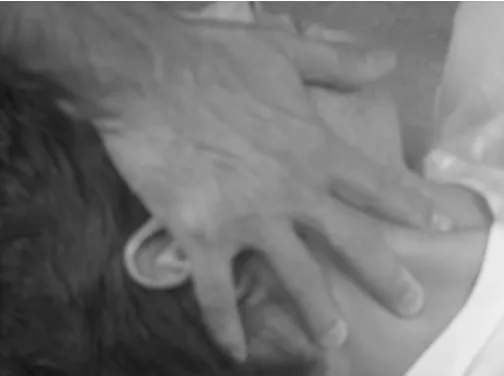
The patient was treated with 3 sessions of soft tissue ther-apy consisting of Active Release Technique® (ART®) to the SCM, upper trapezius, levator scapula, superior and inferior oblique, and rectus capitis minor muscles (see Figure 1); hyoid mobility treatment done passively with the patient lying supine and the slack taken out on the hy-oid bone by pushing lateral to medial in both directions until resistance was encountered (see Figure 2); TMJ mo-bilization done passively taking out the joint slack and ro-tating the joint in a figure eight like motion (see Figure 3); spinal manipulative therapy was performed by rotary adjustment to C1-C2 (see Figure 4); and digastric exer-cises were accomplished by an isometric facilitation, eve-ry other day over the course of 1 week. Additionally the patient was instructed to continue digastric facilitation exercises by placing the tongue on the roof of his mouth while opening his jaw (see Figure 5) and deep neck flexor exercises (chin tucks) at home 2 to 3 times daily (see Fig-ure 6). The patient returned to the pool 1 week later with a swimming coach for stroke assessment and reported no pain. These interventions combined with 1 week of rest resulted in relief from headaches and TMJ pain as the pa-tient resumed his biweekly swim training with a VAS of zero out of 10. At follow up one month later the patient reported no reoccurrence of headache or TMJ pain, ex-hibited an improved mouth opening pattern and full range of TMJ and cervical spine motion. He also demonstrated an improved deep neck flexor endurance test to 45 sec-onds, and VAS remained zero out of 10.
Discussion
The three main categories of TMJ disorders are myofas-cial pain, internal derangement, and degenerative destruc-tion.2The myofascial category is the most common and
often involves pain not only in the muscles of mastication but also muscles of the neck and shoulders.2 A number of
muscles can be involved with movement of the TMJ, how-ever it has been suggested that the most important are the digastricus, masseter, and lateral pterygoid.2 (see Figure
7) The primary action of the digastricus is to aid in
open-ing of the mouth, whereas the masseter muscle is chiefly responsible for closing the mouth. The masseter is assisted in this task by the medial pterygoid and temporalis mus-cles. The lateral pterygoids bilaterally stabilize the TMJ and contribute to protrusion of the chin during mouth opening.2 Manual treatments for relaxation, facilitation,
and mobilization of these muscles have been shown to be successful in dealing with TMJ pain.2
Figure 1 Active release technique for the SCM.
Postural alterations have also been associated with TMJ disorders as individuals with an anterior head car-riage typically display protrusion of the chin and hyper-extension of the cervicocranial junction.2 Prolonged
static maintenance of this posture can cause lengthening of the deep neck flexors and coupled shortening of the suboccipital muscles. Furthermore, the masseter muscles can become hypertonic due to the increased gravitational challenge, whereas the antagonistic digastricus muscles
are often found to be inhibited in people with this pos-ture. Strength and performance of the TMJ and cervi-cocranial junction are thus compromised making this region less stable and prone to injury.2
The upper cervical spine (C1 and C2 spinal segments) is also implicated in TMJ disorders. The dorsal horns of this level of the spinal column represent a transition zone be-tween the trigeminal spinal tract subnucleus (cranial nerve V) of the brainstem and the rest of the spinal cord.12
Figure 3 Mobilization of Hypomobile TMJ.
Figure 4 Spinal manipulation therapy.
Figure 5 Digastric facilitation exercise.
Cranial nerve V contains 3 divisions: ophthalmic, maxil-lary, and mandibular. The mandibular division innervates the lower lip, cheek, teeth, and anterior two-thirds of the tongue, plus the skin of the lower jaw and the side of the head.12 The TMJ is specifically innervated by the
masse-teric and auriculotemporal branches of the mandibular nerve.13 It has been reported by Morch et al. that the C1
and C2 dorsal horns receive extensive primary afferent in-puts from the lateral aspect of the face and from nerves of the craniofacial muscles such as those of the mandibular division of cranial nerve V supplying the masseter, tempo-ralis, and anterior digastric muscles.13,14 Afferent
conver-gence patterns have been implicated as an important process underlying pain referral in conditions such as TMJ disorders.13,14 It has also been documented that upper
cer-vical dorsal horns receive nociceptive inputs from deep craniofacial tissues and act as a critical relay center in craniofacial nociceptive reflexes.12,13 Previous studies
have shown the involvement of the trigeminal spinal tract subnucleus and C1 dorsal horn to be an important relay site of deep and cutaneous nociceptive craniofacial infor-mation to higher brain centers.14 These two structures also
act as a significant interneuronal relay site for jaw reflex responses to deep noxious stimuli. These features suggest that the trigeminal spinal tract subnucleus and C1-C2 dor-sal horns may act as one integrative functional unit to process nociceptive information from craniofacial struc-tures such as the TMJ.12
Patients with TMJ disorders often have histories that reveal predisposing and complicating factors that can sig-nificantly contribute to their condition, such as muscle imbalance and upper cervical spine joint dysfunction.15
One predisposing factor to consider in every TMJ patient is hypertonic sternocleidomastiod (SCM) muscles. In fact, trigger points in the SCM muscle can be used as an objective indicator for orofacial and cervicocranial disor-ders.15 Chronic over activity of the neck flexors such as
the SCM will cause an inhibitory weakening of the deep neck flexors and lead to a forward head posture seen with cervicocranial disorders. Tight SCM muscles can also lead to heterotopic pain in the form of temporal head-aches, which is another common finding with TMJ pain. If left untreated this can lead to not only TMJ dysfunction but also compromise such functions as speech, swallow-ing, chewswallow-ing, and respiration.15
When considering a swimmer with TMJ pain, stroke mechanics are recommended to be investigated with the assistance of a coach in order to avoid relapses and to ensure the athlete is performing with optimal biomechan-ical advantage. It is important to note that common swim-ming drills such as kicking with a flutter board can cause the neck to be put into a position of hyperextension for prolonged periods of time and thus should be avoided in athletes who have cervical pain. Improving or maintain-ing ideal posture and technique durmaintain-ing practice may have long term benefits for the athlete.5 Athletes with neck
pain and decreased range of motion with tight cervical muscles will often experience relief of their symptoms from mobilizations or manipulation to the cervical spine.5 Despite bilateral breathing causing the complaint
in this patient, bilateral breathing during swim practices should be encouraged as breathing only to the favored side leads to muscular imbalances within the neck (espe-cially with rotation). These muscular imbalances can be aggravated by forward head carriage, as the axis of rota-tion changes, resulting in greater extension and side bending of the cervical spine to compensate for the de-creased rotation. Alternatively, breathing to the unfa-Figure 7 Important muscles of mastication. Lateral
vored side may not rotate the body enough, potentially contributing to over-rotation of the neck and subsequent discomfort.11 While often overlooked, scapula stability is
also important in neck function and postural education. Even more important however is the role of the deep neck flexors, longus colli and longus capitis. Rehabilita-tive treatment for these muscles should focus on endur-ance exercises to improve the ability to contract over time.5
The 2000 publication by Skaggs and Liebenson de-scribes 4 clinically useful tests for diagnosing and treating TMJ dysfunction which were used in this case.2 The first
test, Centric Relation Protraction Test, is a structural as-sessment test. It is designed to place the disc-condyle com-plex in the most stable position. A positive test indicates malposition of the disc-condyle complex and suggests a structural pathology with poor prognosis to conservative care. Possible causes of pain include disc dislocation, osteoarthritis, and capsulitis.2 The remaining 3 tests are
functional assessment tests. The second test, Mouth Open-ing Pattern Test, involves observOpen-ing the patients chin while they open their mouth, paying special attention to the ini-tiation of movement. A positive test is protrusion of the chin during the initiation of opening or limited opening range of motion, and indicates over-activity and tension of the masseter or lateral pterygoid muscles. Treatment (pos-tisometric relaxation) focused on lateral pterygoids and involves passively opening the patients mouth and resist-ing their gentle attempt to poke the chin out. On relaxa-tion, the clinician takes out slack in a posterior direction of chin retrusion to lengthen the muscle. Treatment (postiso-metric relaxation) focused on masseter muscles involves passively opening the patients mouth (down and back) while resisting the patients gentle attempt to close the mouth. On relaxation, the patient is asked to simulate a yawn, during which time, the clinician follows the mandi-ble to the next barrier of resistance and the procedure is then repeated.2 The third test, Hyoid Mobility Test, is done
passively with the patient lying supine. The practitioner takes out the slack on the hyoid bone by pushing lateral to medial in both directions until resistance is encountered. A positive test is little or no springing of the bone or a dis-tinct asymmetry of palpable tension and indicates in-creased tension in the digastric muscle on the ipsilateral side. Treatment (postisometric relaxation) focuses on the digastric muscle. The clinician prepositions the patient’s
mouth open with the chin in retrusion, contacting the hy-oid on the blocked side. The clinician then attempts to close the patient’s mouth and instruct the patient to resist closure. On relaxation the clinician follows the release of hyoid to next barrier and then repeats.2 The fourth and
fi-nal test, TMJ Mobility Test, is an active test done with light palpation of the disc-condyle complex just anterior to the tragus of the ear. This test assesses for symmetry in the translation of the condyles while the patient slowly opens and closes their mouth several times. Subjectively the cli-nician can appreciate either hypo or hypermobility of the TMJ. Treatment to a hypermobile joint involves connec-tive tissue release techniques such as Acconnec-tive Release Tech-nique, whereas a hypomobile joint is recommended to be treated via mobilizations. This is done by contacting the molars of the affected side with the thumb. Joint slack is taken out with long axis distraction and the practitioner gently rotates (clockwise or counterclockwise) the TMJ in a figure eight like motion for up to 20 seconds.2
Conclusion
Headaches in swimmers have been previously document-ed, however to our knowledge this is the first case were a TMJ dysfunction has been reported and treated in a swim-mer.10,11 The causes of TMJ complaints are believed to be
multi-factorial and include postural alterations that can lead to hypo/hypertonic muscles and cervical spine re-strictions, visceral insufficiency, and neuronal irritation. Conventional treatment aims at decreasing hypertonic muscles, increasing hyoid mobility, resolving cervical fix-ations, and improving digastric facilitation to enhance mouth opening patterns. Furthermore, the 2004 Cochrane review concluded there was weak evidence for the use of stabilisation splint therapy for reducing pain severity and was neither worse nor better than other active interven-tions.16 More recently, the conservative care paper by
Vin-jamury et al. found the effectiveness of manual treatment for TMD to be both safe and effective.17 In this case, a
References
1 George J, Fennema J, Maddox A, Nessler M, Skaggs C. The effect of cervical spine manual therapy on normal mouth opening in asymptomatic subjects. J Chiropractic Medicine. 2007; 6:141–145.
2 Skaggs C, Liebenson C. Orofacial Pain. Top Clinical Chiropractic. 2000; 7(20):43–50.
3 Raphael KG, Lausner JJ, Nayak S, Marbach JJ. Complementary and alternative therapy use by patients with myofascial temporomandibular disorders. J Orofac Pain. 2003; 17(1):36–41.
4 Balestra C, Germonpre P, Marroni A, Snoeck T. Scuba diving can induce stress of the temporomandibular joint leading to headache. Br J Sports Medicine. 2004; 38:102–104.
5 Pollard H, Fernandez M. Spinal musculoskeletal injuries associated with swimming: a discussion of technique. Australasia Chiropractic and Osteopathy. 2004; 12(2):72–80.
6 Pollard H, Crocker D. Shoulder pain in elite swimmers. Australasia Chiropractic and Osteopathy. 1999; 8(3):91–95.
7 McMaster W. Swimming injuries: An overview. Sports Medicine. 1996; 22(5):332–336.
8 Kenal K, Knapp L. Rehabilitation of injuries in competitive swimmers. J Sports Medicine. 1996; 22(5):337–347. 9 Troup J. The physiology and biomechanics of competitive
swimming. Clinics in Sports Medicine. 1999; 18(2):267–283.
10 Kim J. Swimming headache followed by exertional and coital headache. J Korean Medical Science. 1992; 7(3):276–279.
11 Indo T, Takashashi A. Swimmer’s migraine. Headache. 1990; 30:485–487.
12 Hua J, Suna K, Vernon H, Sesslea B. Craniofacial inputs to upper cervical dorsal horn: implications for somatosensory information processing. Brain Research. 2005; 1044: 93–106.
13 Morch C, Hu J, Arendt-Nielsen L, Sessle B. Convergence of cutaneous, musculoskeletal, dural and visceral afferents onto nociceptive neurons in the first cervical dorsal horn. European J Neuroscience. 2007; 26:142–154.
14 Bronton J, Hu J, Sessle B. Effects of temporomandibular joint stimulation on nociceptive and nonnociceptive neurons of the cat’s trigeminal subnucleus caudalis (medullary dorsal horn). J Neurophysiology. 1988; 59(5):1575–1589.
15 Skaggs C. Temporomandibular dysfunction: chiropractic rehabilitation. J Bodywork and Movement Therapies. 1997; 1(4):208–213.
16 Al-Ani MZ, Davies SJ, Gray RJ, Sloan P, Glenny AM. Stabilisation splint therapy for temporomandibular pain dysfunction syndrome. Cochrane Database of Systematic Reviews. 2004. 1.