Table of Contents
1. Introduction...5
2. The process of conducting Content Analysis - Two approaches...5
3. The Method ………..3
4. Deductive or inductive approach...6
5. The process...7
6. Coding...8
Fig 1 : The Abstraction Process...9
7. Intercoder analysis...10
Table 1. Amendments made to the categories after intercoder analysis for comparison purposes... 11
8. Results of Analysis – interpretation...11
9. Evaluation and conclusion...12
Reference List...14
Appendices... 16
Appendix A: Research Questions...17
Appendix B : Identification of Labels...18
Appendix C : Frequencies / Categories...34
1. Introduction
This paper critically reviews content analysis as a research approach. It discusses its immense flexibility making it beneficial for a variety of research. Conversely it provides a critical review and appraisal of this approach, questioning its validity as a research tool given that it lacks firm definition or procedure. It does this by conducting qualitative content data analysis on three transcripts focusing on children’s aspirations. The merits and shortcomings of the content analysis and intercoding process are discussed. Finally it concludes by saying that although it is a complex technique, the outcomes can provide for a critical appreciation of the contents.
2. The process of conducting Content Analysis - Two
approaches
Hsieh and Shannon (2005) identify the goal of content analysis is to ‘provide knowledge and understanding of phenomenon under study’. As an approach it provides immense flexibility encompassing a family of analytical approaches ranging from to strict systematic textual analysis to intuitive; manifesting itself in the forms of descriptive, contextual, comparative and particularistic content analysis (intention of the message)(Sarantakos 2005). This flexibility makes it useful for a variety of research (Punch 2005).
On close scrutiny as a research method content analysis is an analytical technique dating back to the 18th century (Hsieh and Shannon 2005). Initially it was used as both a
quantitative and qualitative approach (Berg 2007). The earlier quantitative research
approach going beyond merely counting words to examining language intensively for the purposes of identifying meaningful categories; it questions whether statistical information can provide an ontology representation (Bryman 2004; Oakley, 2000). It attempts to provide a subjective interpretation of the text through the process of coding and identifying themes in order to discover realities of individuals (Hsieh and Shannon 2005). There is no clarity whether content analysis should be conducted either as quantitative or qualitative approach or intertwined, as some researchers acknowledge that interpretation of the data depends on statistical comparison of frequencies (Sarantakos 2013).
3. The method
To increase the validity of the coding process Hsieh and Shannon( 2005) suggest that the first step of coding requires the researcher to read all the transcripts several times in order to achieve immersion and a sense of the whole.
During the process of reading the three transcripts, I opted to use the subjective qualitative method. This required analysis of individual quotes to understand the intent of the message; which in turn lends itself to a thematic approach enabling the generation of codes from the data (Sarantakos 2013; Elo and Kyngäs 2008). Later the frequencies of the
categories/subcategories; the counting of key words and comparing frequencies of
categories were conducted to provide an understanding of their experiences (Twycross and Shields 2008). This thematic approach was taken in order to provide meaning to what is otherwise meaningless transcripts.
4. Deductive or inductive approach
fragmented knowledge which needs to be explored. This directed itself more to an inductive approach which requires us to move from specific to general. Instances within the transcripts were identified and were are combined into a larger abstract groups (Elo and Kyngäs 2008).
5. The process
The first process of content analysis is to select an appropriate sample size that is representative of the population from which it is drawn (Cohen et al. 2000). For this assignment the sample had already been selected, so no sampling approach could be adopted, however the unit of analysis needed to be carefully identified as it leads to the generations of codes. Deciding on what to analyse and in what detail are important factors when selecting the unit of analysis (Sarantakos 2013). Controversy exists as to what should be selected as the unit of analysis, some authors suggest that researchers should note down their first impressions (Hsieh and Shannon 2005). Others suggest a more concrete approach by suggesting that the researcher should focus on words, sentences, meanings or the whole document (Sarantakos 2013; Graaf and Vossen 2013; Bryman 2004) to gain insight into the feelings and ideas of those being interviewed.
It is not unreasonable to suggest that a unit of analysis that is too big, such as the whole document, will mean the analysis process will become difficult and challenging (Elo and Kyngäs 2008); one that is too small e.g. one word may result in fragmentation (Payne and Payne 2004). Such polarisation of the two approaches lends itself to a varied depth of understanding consequently resulting in differing conclusions.
particular parts of the sentences offering meaning. Sarantakos (2013) suggests that such an approach allows for flexibility and refinements while the topic is studied.
6. Coding
During the coding process the data was read word by word and exact words that appear to capture the thoughts or concepts were highlighted, in order to derive codes (Hsieh and Shannon 2005).
There can be no certainty that a true reality is being created during the content analysis process, not least due to the researcher’s interpretations and understanding. The flexibility of content qualitative analysis enables the data to be analysed either by Manifest or Latent approaches. Latent content (Elo and Kyngäs 2008) attempts to identify the hidden meaning (Sarantakos 2013). Conversely Manifest coding required identification of visible text
elements such as words or sentences, dealing with concrete units avoiding involvement of personal judgement (Sarantakos 2013). I attempted to use both approaches, to help gain a better understanding given that the transcripts were produced by a third party and no further analysis or feedback could be made. For each unit of meaning I identified, I attached a label in the column next to the text preparing it for counting (Appendix B: Labels ). Later the frequencies of the units or labels identified were analysed (Appendix C: Categories / Frequencies) so an analysis of the children’s experiences can be made.
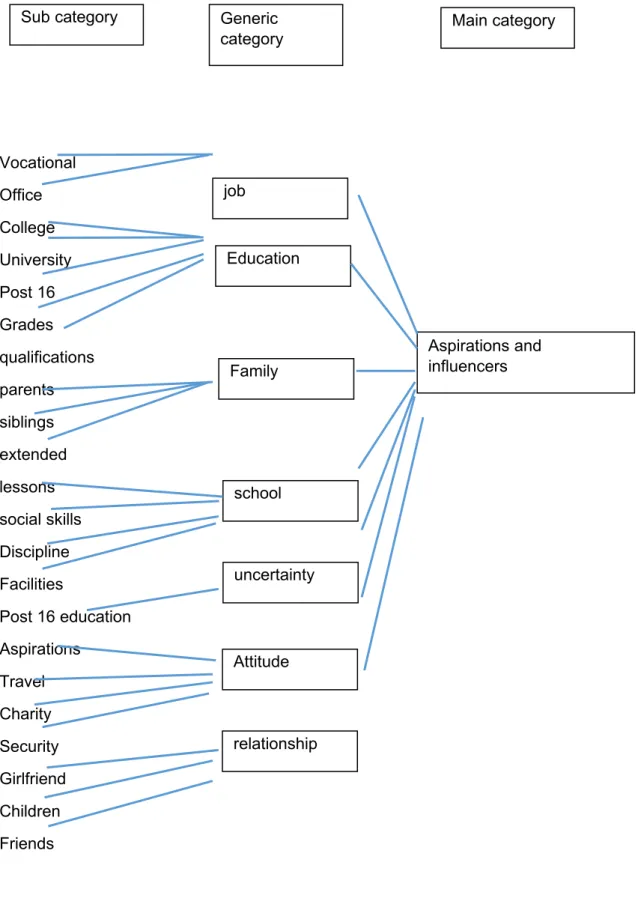
Finally the abstraction process was followed where codes were then sorted into main category, generic categories and subcategories. This was an iterative process (Appendix C : Categories / Frequencies) (Dey, 1993). A diagram (Fig 1.) and a table (Appendix C :
Fig 1 : The Abstraction Process
depicted below : The inductive process moves from specific to general creating categories which group similar things together into broader higher level categories in order to establish meaningful realities of experiences.Vocational Office College University Post 16 Grades qualifications parents siblings extended lessons social skills Discipline Facilities
Post 16 education Aspirations
Travel Charity Security Girlfriend Children Friends
Education job
Main category Generic
category Sub category
Aspirations and influencers Family
school
uncertainty
Attitude
7. Intercoder analysis
To avoid bias and minimise risk the strategy of intercoding was adopted. An approach that is widely used to increase objectivity by having a second person coding and analysing the text (Twycross and Shields 2008). The process involves comparing the themes I produced with the second person’s analysis. High levels of agreement above 80 per cent between the two researchers indicate increased validity in the approach (Twycross and Shields 2008),
During the intercoder process of comparing themes and sub themes it became apparent that there were considerable discrepancies between coder two and myself both in the approach and the findings. The second coder focused her coding process on the research questions in an abstract approach, where as I conducted the study in a concrete approach. This may be due to my scientific background and my natural process of focusing on finite aspects.
It was evident that there were differences in the ranking of the generic categories. My process revealed six finite generic categories: Job, Education, Family, School, Uncertainty, Attitude, and Relationship. The second coder had three high level abstract themes:
Goals/Ambition, Influencers, and Self/Motivation. Interestingly these discrepancies did not transpire down to the subcategory level. We noticed the second coders sub categories and mine were very similar (Appendix C - in bold), however often higher level words such as extended family was used by the second coder whereas I used Dad, Mum, Uncle, Aunty.
Table 1. Amendments made to the categories after
inter-coder analysis for comparison purposes
Coder 1
combined labels after inter-coder analysis
Coder 2 frequencies
Coder category label
Job and Education
Ambition 33 : 11 Family and
relationships
influencers 65 : 46 Attitude Self motivation 27 : 44
8. Results of Analysis – interpretation
It is evident that even when I tried to map similar categories I had, to the broader categories of the second researcher we see that the frequencies of the codes have significant
differences. Twycross and Shields (2008) would question the validity of these results. Trying to obtain an objective truth (Bryman 2004) is difficult as content analysis required us to make interpretations of the scripts, infusing an element of unreliability when codes were formulated (Krippendorff 1983).
Interpretivist researchers would argue that the researchers own background and upbringing will have biased or tainted the way the frameworks of the codes were developed. Conversely Silverman (1997) would argue that the discrepancies do not invalidate the findings rather they identify different perspectives or truths.
“I would want to stay with my family as they help me with a lot of things ….”.
Money is also important to all three children; one equates it with security saying: “I will be more secure if I have money.” Another emphasises his mother’s guidance by saying:
“She just wants me to get a really good job to earn some money”.
Here we see that parents are influential in instilling the importance of money for their child’s livelihood at a young age.
Education also seems important to all of them but there is some confusion as to what qualifications are needed to progress to college or university. This lack of knowledge may account for the uncertainty in their lives. The concept of uncertainty is prevalent in all transcripts and may be due to their young age. Lastly school also appeared an important element in their lives with facilities and discipline being issues of concern for them.
9. Evaluation and conclusion
The process of content analysis has provided an interesting insight to the validity of the approach. There is general consensus that content analysis is complex, difficult and less standardised (Berg 2007; Hsieh and Shannon 2005; Bryman 2004). We have seen that it offers great flexibility in its approach and interpretations for categories of coding.
However there are no simple guidelines for analysis and as I found the results can vary significantly. Each inquiry is distinctive and the results depend on the skills and insights of the researcher (Elo and Kyngäs 2008). It is a challenging technique as there is no correct way to do it. As the constructionist ontology representation, based on interpretivist
epistemology, claim that the reality presented in content analysis is not objective but
analysis adopted different approach to mine, making judgements on what variations to produce based on their insights and formulation of her research questions.
Throughout the content analysis process I felt a sense of uncertainty. Elo and Kyngäs (2008) states that tolerance of the feeling of uncertainty during the process is required and this situation can be overcome by intercoding, which helps with checking the reliability of the categories. However I was left even more unsettled after the intercoding process as the categories varied significantly. The second coder had chosen to abstract the data to a higher level. I chose not to compress the codes to a finite level in order to maintain the integrity and richness of the narrative data. This is in accordance with Pilot and Beck (2004) thought processes. However Bryman(2004) warns that during content analysis researchers unwittingly put emphasis on measurement resulting in over compressed codes, as I did. However equally valid is the Dey (1993) discussion that a lack of sufficient compressed codes results in inability to categorise the data.
A further drawback of content analysis is that often third party transcripts are unclear. Clearly content analysis is only as good as the subscriber (Bryman 2004). In this assignment the transcripts did not appear to be linear, interview transcripts contained unclear phrases, further clarifications was needed, however as the interview was conducted by a third party, this refinements was not possible (Dey 1993). Thus I was left attempting to create the reality of the world according to my own cultural and historical upbringings (Hammersley 2005; Eisner, 1992;).
fragmented. It is debatable whether these categories reveal a ‘truth’ as clearly my
interpretations were different from the second coder. Arguably tainted by my own historical upbringing.
Reference List
Berg, B. (2007)
Research Methods for the Social Sciences.
6th ed. Boston: Pearsons
Education.
Bryman, A. (2004)
Social Reserach Methods.
New York: Oxford University Press.
Cohen, L., Manion, L. & Morrison, K. (2000)
'reserach Methods in Education.
5th ed.
London: RoutledgeFalmer.
Dey, I (1993) Qualitative Data analysis. Auser friendly guide for Social Scientists. Routledge,
London.
Eisner, E.W. (1983) Anastasia Might Still Be Alive, But the Monarchy Is Dead.
Educational
Researcher,
12(5), p.13-14.
Elo, S. & Kyngäs, H. (2008) The Qualitative content abalysis process.
Journal of Advanced
Nursing,
62(1), p.107-115.
Eto, S. & Kyngäs, H. (2008) The qualitative content analysis process.
Journal of Advanced
Nursing,
62(1), p.107-115.
Graaf, R. & Vossen, R. (2013) Bits versus brains in content analysis. Comparing the
advantages and disadvantages of manual and automated methods of content analysis.
Communications,
38(4), p.433-443.
Hsieh, H. & Shannon, S. (2005) Three Approaches to Qualitative Content Analysis.
Qualitative Health Reserach,
15(9), p.1277-1288.
Krippendorff, K. (1980) Content Analysis : An introduction to its Methodology. California:
Sage Publications.
Oakley, A. (2000)
Experiments in knowing: gender and method in social sciences.
UK: Polity
Press.
Payne, G. & Payne, J. (2004)
Key concepts in social research. Summon
[Online]. Available
at:
http://uwl.summon.serialssolutions.com/2.0.0/link/0/eLvHCXMwY2AwNtIz0EUrEyzSjE3M
DJNTUhLTUlKTUpKNk1KNk9MSk4G9C2CDKRl8N4ybRWSgcSSwz49UwLsJMTCl5ok
ySLq5hjh76JaW58RDhzXiTcyMQa13MQYWYD85VYJBIS0tCShinmyeZJhqAuxLW6QlJ5
mZWRqmJZmmGSWmpUoyCGHqBwBBry3X
.
Punch, K. (2005)
Introduction to Social Reserach.
2nd ed. London: Sage Publications.
Sarantakos, S. (2013)
Social reserach.
4th ed. Hampshire: Palgrave MacMillan.
Silverman, D. (1997)
Qualitative Reserach.
London: Sage Pubications.
Appendix A: Research Questions
1) What are the students aspirations regarding post-16 studies?
2) What are the students understandings of the process and the qualifications needed to go to university?
3) What are the views on whether university and qualifications means a better job? 4) What are the most influential people in their lives?
5) What are their experiences in school?
Appendix B : Identification of Labels.
Childrens’ Future Aspirations
Note: in total 30 interviews were carried out with year 7 children across
England. Interviews followed up on the survey responses of 829 interviews
and explored the aspirations of 10 children who planned to stay on post-16;
10 children who planned to leave at 16 and 10 children who were undecided.
The transcripts included here were carried out by the same interviewer - a
female
Transcript 1 (T1)
Male
“If I get a job before I leave school then I will leave at 16, but if I don’t get
one then I’ll stay on”
So is that your preferred option?
“yeah”
Is that for the money?
“No not really, I prefer doing stuff kinda physically”
So what might make you stay on - if anything - if you did get a job?
“If I didn’t have a good set of qualifications
What do you consider to be a good set?
“Well I’m not sure really, I am not really clever so I don’t expect to get A’s,
but I hope to do OK”
So do you think you will go to university at all?
“Probably. I would like to do what my brother does, he goes to college two
days and he works three days with an employer, so I would like to do
something like that”
So does he work in construction?
“yeah sort of he is a plumber”
Choice at 16 Job School
Money
Physical activity
Qualifications
So would you like to be a plumber?
“An electrician”
You are looking to go to college. Do you think you will look to go to
university as well?
“Umm, not sure”
Do you know what the difference is?
“No not really, but I think university is higher, I will probably go to college”
You have said that you think you will be able to get a job as an electrician.
“yeah, well my uncle is an electrician, but he is not fully qualified anymore,
but he knows a few people that might be able to help me get qualified. He is
who my brother got a job off, cause he has a mate who is a plumber and
works with him”
So you should be really hopeful of getting a job before you leave school
.
“yeah. And in year 11 don’t you get to go and work for a day or
something?”
Mm hmm and sometimes it is for a week
“yeah I’ll probably do that and see how I get on see if I like it and take it
from there.
So have you done any electrics already
“yeah, I help my dad around the house a lot and I do a few bits with my
uncle”
So is your dad an electrician or similar?
No he works as RCM – the concrete people.
Oh OK, what does he do there?
“HE works in the office. He used to work with my Granddad and help him,
he used to have 5 shops but he doesn’t have them anymore so dad went to
wok for RCM
Does your mum work?
“yeah she works at B&Q just to get some extra money”
So do you think any of your friends will go to university?
“when we was filling out the questionnaire they all said they would leave at
16
“I guess it depends on whether they get their qualifiers (sic) they might stay
on at post 16 but when I asked them in year seven they all said they don’t
Plumber vocational Electrician
Unsure about university
University / college
Uncle electrician
Brother
Work experience
Help dad / uncle with electrics
Dad - concrete
Granddad / dad
Mum work
Leave school Work office or
footballer
want to do office work what to be footballers but that is hard to get into so
they’ll probably work in an office. I know three people that might go to
university cause they are clever”
when you say at post 16 do mean at school?
“Yeah there is a little area out there {nods out of the window} where you
can go and do what ever you want”
What about your mum and dad?
“They are happy for me to do what I want. They agree that electrician is
quite good and they let me pick what job I want and they agreed with it”
So they are happy that you don’t stay on at school?
“”yeah they are happy with what my brother has done and if I can get a job
like my brother then I don’t have to stay on but if I can get a job like that
and qualifications then they will probably send me back to post 16 to get
better grades”
They have a clear idea then
“yeah they started with my brother in year nine and my mum says it was too
late, they had to run around and find out about the qualifiers {sic}. So she
made me find out now what I want ‘cause she said she found out I could go
down a sport route or physical and I said I wanted to be an electrician, so she
said that is the physical route”
So do you think you will ever have your own company?
“I think I will go and work with my uncle and if I don’t I will work with
another company”
So if you have the choice you wouldn’t look at doing business studies next
year?
“no I don’t think I will ever have my own company”
So you wouldn’t look at doing it anyway?
“I would need to see what grades I get to know whether I am good at it first”
And do you get your grades before you have to make your choice?
“I am not sure, because they haven’t told us yet, but I hope so, they did with
my brother”
Qualifications
Mum/dad Electrician
Job like Brother but prefer post
16 if get Qualifications
Physical route / electrician
Uncle/work
Not interested in own company
Qualifications
Moving on with the questionnaire
“If you muck around at school then you won’t be very clever and you won’t
get the grades you want to get a job you want, where as if you work hard at
school and concentrate then you might get cleverer and you might get the
job the want”
“If you try hard enough you might get the job that you want. Not everything
that you want – but the job”
He talked about if you were lucky you might be able to get a good job.
In answer to the question ‘If I don’t do well at school I might regret it
later:
“depends on how your life is really. If you do well at your job you probably
won’t but if you get sacked for not paying attention or listening then you
might regret not getting your education or qualifiers {sic}”
Getting good qualifications was most important to him because he felt
that that would lead to a good job which would earn good money which
would then enable you to have/do everything else. Though he would
never move away from England to go abroad:
“I would want to stay with my family because they help me a lot with things
- and if they moved away I would get a job near where they were”
“I like doing PE and tech, Tech is very good because it is physical. All the
lessons are good, even though I don’t like them, they are good. I don’t like
maths and english but they are still good – I think - . I like science because
it is physical, PE is physical”
Do you play on any of the sports team?
“I play Rugby on Saturday Tuesday Wednesday and Thursday. So I don’t
have alot of time for much else. Though I play the electric guitar but I was
late filling in the form this year so I didn’t get to do it but next year I am
going to fill in the form early, cause how good I am at the moemnt I can’t
really play anything, I need more lessons so I can play whole songs rather
than learning stuff like I had got to”
So you said all the lessons are good so what do you think makes them so
good?
“Well like in science it is because it is physical you are always doing
something and just sat there writing. Music is physical cause you are
playing instruments. PE is physical. French we do learning games and that
keeps it good init {sic} and the same in Spanish and some people do Italian.
So we do games most lessons”
So what don’t you like
“Well, not much. I don’t like English much, but you have to do it, so I just
get on with it and learn, there’s not much that bothers”
Work hard at school get grades get good
job
Job
Job education
Family
Physical activity
Sports
Guitar
Physical Games Interactive
lessons
“I really want to do well and learn stuff now but last year I wasn’t very good
so this year I have got to start working. Last year I wasn’t very good I have
got to start learning. Last year I did the work but mucked around between
the lessons, but this year I am learning because I want good qualifications”
So you have decided not muck around anymore?
“Yeah becasue I want to get good grades for a job”
Is it important to your parents that you do well?
“Yeah they are behind me and support me. They want me to get good
qualifications so I can get a job”
Do your parents help you with homework?
“they will leave me to do it, but if I am stuck they will help me. They won’t
give me the answer but they will tell me how to do it and they will make a
question up and tell be how to do it and then make another one up and I have
to work through it and then write the answer for the homework. So they
help to figure it out for myself. I do it on scrap paper first before putting it
on the sheet.”
If you want to go to college you will need to do well in maths and English
won’t you.
“well you need maths and English everyday so I will need to do well in it
anyway”
Do you think you will do well in your exams?
“I hope I will but I will have to work a lot harder if I want to do well in my
grades”
“I don’t really like coming to school, I don’t like having to get up early but it
is something you have to do to have a good life. I have to do it. In the
morning I am not awake, so I wouldn’t like doing PE in the morning, but it
is OK last lesson. I don’t mind doing science in the morning casue its just
abit of writing and a bit of thinking, but I get better during the day and I can
concentrate more in the afternoon”
“I am concentrating more this year, last year I was really just mucking about
but this year I am concentrating more”
Do you think there is a lot of bullying at this school?
“No not really. There is some bullying, but it is mainly year 11s. They take
your ball, they don’t steal it they just take it from you and chase it. They
will give it back to you at the end of break, but sometimes a teacher has to
come and take it for you. That’s it really they just take your ball”
Does school have much to offer you?
“school offers me education for life and they have clubs and stuff but that’s
it really
“All teachers try their best to give us a good education but if you get a reaaly
Qualifications Focused
Grades / job
Parents
Parents Homework
Maths / English
Work hard Focus Grades
Concentration Improves during
the day
Bullying
School
naughty person in their class they cant control them because they won’t
listen to you, so all you can do is send them outside before the bell goes”
“The teachers try and keep you educated as they can, they try and make you
really brainy and clever, but some people don’t really listen”
“If you respect them, they will respect you back”
Do you agree with the rules?
“yeah the school has to have rules to help you learn. If there were no rules
then no teaching would happen and we wouldn’t learn anything”
“School give you the education to deal with the outside world, like get a
job”
Do you think it teaches you social skills?
“yeah it teaches you how to cook and what to do to keep fit outside and they
teach you stuff about yourself in science”
“we have a book – oyur organiser that has out timetable and stuff in it and if
you get 25 good remarks then you get a certificate and if you get a hundred
you get a prize – I think – yeah you get a prize”
“I did OK {at primary school} my grades weren’t low, but they weren’t
high, but I have started improving now”
“There’s one teacher that I don’t {talks about a specific incident} but I just
went- to the head teacher and told him about it”
That is good that you can do that.
“Yeah I just goes to the head and tells him stuff and he listens to me and if
he doesn’t I just keep going until he does”
When asked if there was anything he would like to change about the
school:
“I think we should do more English, I don’t like but you need it. I think we
should do more of it than other subjects. Like Spanish. You don’t really
need Spanish – unless you go to Spain – but there is nothing major you need
Spanish for, English and Maths you need to get on in life. But I guess they
need to teach us Spanish and French, but it seems to teach us for nothing
really
Transcript 2 (T2)
Boy
Very shy boy was very quiet when first entered room, kept looking around
to door to see if anyone was looking/listening (door would not shut properly)
even though there was never anyone there.
Interview notes:
Respect for teacher
School rules
School job
social skills cook keep fit
Persistent Goes to head to
resolve problems
English
He says he wants he wants to stay on at school, but on further
questioning what he means is stay on in education post 16. On his
questionnaire he states that he wants to go to university and he knows
that at universities you take degrees and he knows he needs to go to
university to be a lawyer, but ‘how’ he will get to university is a bit
vague – ie he is not really aware of GCSEs and A levels etc.
“I want to stay on, but I don’t really know yet what I want to do, I haven’t
worked it out”
So when you stay on because there is no sixth form you mean go to college?
“Yeah either college or university”
Do you know about GCSEs and A levels?
“I have heard of them but I don’t really know what they mean or entail. But
I think I would like to do A levels”
Do you think that you need A levels to go to university?
“I would think so. University is for clever people and stuff where you can
get degrees and the like”
I not that you said that your parents/carers want you to stay on
“Yeah they have said that it would benefit me in life to stay on and that has
kinda influenced me a bit (…)They think I will have a better life and won’t
need to work for 50 years out in the rain”
The main thing that is important to him and this comes across quite
clearly on the questionnaire and during the interview is money, but he
sees money as providing security. He also app
ears to rate being at home when children are young quite highly as well.
You don’t want to follow in your dads footsteps and be a joiner?
“no not really”
“they just want me to have a good job, with a lot of money and a good life”
“I have been abroad once before with my family but I would like the kind of
job that would allow me to do that more often”
“I am being edged on by parents but I want to do it because like I say I don’t
want to end up working 14 hours a day”
Do you think the hours will be shorter if you go to university?
“that is what I am hoping for”
“people say I am good at lots of subjects so I don’t really know what I will
do I just want to do there”
Committed to university but
Unclear
Committed to post 16 study university or
college
Uncertain about A levels
University
Parental influence
Dad Vocational
Joiner
job travel
parents influence
It says you want to be a solicitor or a lawyer?
“that is what I were thinking of. A friend of my dads is a lawyer, but he is
the gaffer on a job – on a construction site – and he is a multi millionaire so
that has influenced me a bit. He says he can work the hours he likes and he
gives money to charity. I’d like to be like that.”
Have you spoken to him yourself or is that what your father has said?
“One of my friends, who lives next door, his parents are solicitors and their
house is really posh and that. They are always at home caring for him and
looking after him.”
He seems to delineate between his friends at school and his friends at
home, as an interviewer I found it difficult to follow which ‘friends he
was talking about’.
“I would try and make my friends stay on at school, because even though
they are not that bright I would like them to stay on to hang around with.”
“Non of my best friends will go to university. I have got about 3 or 4 here
but I don’t think they want to go to university. They might stay on at
school.”
Talking about wanting to have enough money to give some to charity
and the comments about his mum giving up teaching because she didn’t
want to have to critise pupils, implies he has an idea of social
responsibility.
“my dad went to college and my mum could have been an art teacher, but
she thought that everyone’s work was good and it was all equal, so she took
a waitressing job instead. She found it very difficult to say someone was
bad”
“I don’t believe in luck, I haven’t had a lot of it. I have had a bit, but I am
not a lucky person like some of my friends”
“I will be more secure if I have money”
So you want security?
“yep”
Do you parents have security?
“Not really. I would like to have more”
A family has moved house recently from Rotherham to ##### as being
close to family was important to his parents. Since moving to the school
he hasn’t made many friends and it is three busses to go back to #####
to see his friends. He is bullied at school and because of this he doesn’t
like coming to school. He has spoken to his parents about it and his
mum would come to the school if he wanted them to, but no one has
Charity Flexibility Working hours High aspirations
Flexible working Care for children
Friends
Friends
Parents
Friends
Money brings Security
Security
actually hurt him so he doesn’t want her to yet. He doesn’t feel that he
has many friends at the school those he does have he calls just ‘messing
about friends’.
“we moved because my dad wanted be closer to his side of the family. On
the 4
thit is my sisters birthday and we are going up to my Aunties and all the
family will be there even people I don’t know. ”
“I like the teachers. I liked my old geography teacher he knew what he was
talking about. He lived in the lakedistict when he was a kid and he was
always talking about it”
“I don’t like some of the kids here, they walk around thinking their hard”
“they just make comments because I am in the top set and that”
He plays on the school football and rugby teams
“the team is sort of good. The teachers say we are good, but we don’t win a
lot of matches. We are playing a team tonight and I am scared about it,
because everyone says they are bigger than us and they win all their
matches…they say “make sure you put your gum shield in”
Although the school is a sports college, he feels there is not as much
sport at the school as there was at primary school, he used to play a lot
of football and tennis and he doesn’t get as much chance to play them
now especially tennis, he has to play them out of school.
He feels that if he wasn’t at school he would be walking the streets so he
comes to school to keep him occupied. He doesn’t like coming to school
but he knows he has to come if he wants to get a good job.
“My dad tells me college is different it is not like school. I think University
would be interesting because you get to study stuff rather than lots of tests
and fire drills and things like that”
Do you not like tests?
“I don’t mind tests because I get to find out hw I am doing. If I don’t do as
well as I think I should I get upset and try harder. I look at them as an
incentive. They are an incentive to try harder. If I get something wrong I get
upset. We got a maths test back yesterday and I got four wrong and I am
upset about that. I got a calculator test and I got 8 wrong out of 24 and it has
put me down a bit I want to be able to do the test again”
Batteries go flat at this point and I have to go to notes:
At school he is more strict with himself and doesn’t talk much but at
home he is freer and relaxes more. Ie he talks about at school he won’t
eat chocolate because it is unhealthy but at home he “scoffs” as much as
he likes. He feels he doesn’t really fit in people at school. He feels that
Extended family Aunty
Dad family
teachers
bullying
Sport Rugby
University college
tests affect his mood
School Strict More Disciplined
everyone knows him but not best friends with him.
When talking about the school he says it used to be a primary school
and it still feels a bit like one – physically with narrow corridors and all
on one level. He talks about how nice the school he should have gone to
in Rotherham would have been it would have been bigger and he has
friends there and the sports stuff is better. It is too far to travel to from
his new house.
He likes most of the teachers but feels that some are unfair, he talks
about one that will let the class talk for five minutes without saying
anything and then just sends them outside for talking. On return they
were told where to sit. He said it was like the teacher wanted to put
them in a certain palce but couldn’t just say. He wanted to make it look
like it was them being naughty that meant they couldn’t it next to their
friends.
His mum and dad would like it if he had more homework and have said
they are going to phone the and ask for him to be given more but he
doesn’t want that. In this sense he feels pushed to learn.
He doesn’t like the area the school is in and his parents don’t like him
coming to it – it is a rough area, but he has to because it was the only
school that had a place for him
“my granddad came with me to look around the school and he said it
reminded him of a prison and not a nice place to be”
He goes on to talk more about how much nicer the school he should
have to would have been, describing the facilities and what his friends
say about it that go there
When talking about things he would like to change about the school he
talks about how there isn’t a lot old sports equipment although it is a
sports college and there are no cricket or football nets. He describes it
as
“very low tech”
He also wishes that they are streamed for all classes not just the
‘important ones’
“We are still in forms for history and religion so people still mess around. I
do just as well, but I don’t really like it as much. I just keep my head down
and keep quiet in those classes”
wishes he was in old school friends better
sports
teachers unfair
Parents More homework
Feels pushed to learn
Rough area school in
School prison
Wished for other school Missed friends Better facilities
This school no sports Low tech
School streaming
Transcript
3 (T3)
BoyFor every question he said he hadn’t decided or hadn’t thought about it.
Needed a lot of prompting and felt like I was leading him. He always
seemed to agree with what I was saying.
“My first choice would be footballer, but really a good job would be a
doctor. I picked footballer because I love the game.”
So do you play football?
“I used to but I stopped because I wasn’t being picked for the team...there
were people better than me”
If you can’t get to be a football player do you know what you do?
“no not really”
Do you think you will be a footballer?
“no not really it depends, you need to be good to be a footballer”
Would you consider staying in the field of football like a physio or a coach?
“yeah”
do you think you need qualifications to do this?
“yeah”
Do you think you need qualifications to be a footballer?
“yeah”
Do you know which ones?
“You just need qualifications. Like PE. You can’t be a good footballer
without qualifications”
Really - why?
“If you don’t have qualifications you won’t be able to play it properly
So you mean football qualifiactions?
“Yeah”
What are football qualifications? I am not sure myself.
“I don’t know either, I just know you need them”
When asked about what his parents thought about going to university,
again he said he didn’t know and he didn’t know if his parents had been
to university or have any qualifications it has never been discussed:
Unclear
Footballer Job
Football People better
than me
Uncertain of future
Football
qualifications
qualifications
qualifications
“She just wants me to get a really good job to earn some money”
Has she said what she thinks a good job is?
“no just one that earns lots of money”
So she hasn’t said what she thinks she would like you to do to earn money?
“No”
Do you mind that?
“No, I like it – no pressure”
When asked about how he felt about the next set of questions he just
said he couldn’t remember why he answered what he did (on most of
the answers it was not sure) on pushing he responded:
“If you didn’t go to school then you wouldn’t be very smart”
“If you do try hard and you don’t get like a good level, your parents might
think you didn’t try hard”
“If am going to stay on I would do the subjects that I like, like maths, but I
don’t think I would regret it if I don’t stay on”
“luck doesn’t really have anything to do with it”
When asked about things he would like to do when he was older:
“I don’t want to leave Derby – I like Derby”
Have you been anywhere else?
“Yeah I have been all around the world.”
Wow that’s great – where have you been?
“Spain, France and I think I have been to Italy – not sure, can’t remember?
“I have been to Spain about 12 times”
Where in Spain have you been?
“Not sure, next Easter we are going to some where in the North near Devon
and later we are going to Spain”
I go to a place near Malaga a lot.
“We go to Los Amigos, ‘cause we know this person that works in the
Chinese restaurant there and when we go there they know what we are going
to order and everything so they already know when to get it ready”
Would you not want to live in Spain sounds like you like it there?
“yeah I could do”
what job would you do?
“one that pays good”
You want children?
“yeah to keep my name, I’d like that”
When do you think you will have have them?
money
money
parents no pressure
School makes you smart
Parents expectations
Uncertain about staying on
Doesn’t want to move
Travelled
Spain, France, Italy
Spain
familiarity
Live in Spain
Job money
Children
“when I am 19”
Wow, that is as soon as you leave school then!
“yeah”
so do you have a girlfriend?
“yeah”
How long have you been with her?
“six years”
A long time then already, since you were at primary school!
“yeah”
Is she at this school as well
“No she is at Da Vinci but she comes up once a week”
So do you think you will have kids with her?
“yeah probably”
I can see why you are not sure about staying on at school, you will need a
good job to support them!
He nods!! “That’s why I need qualifications to get a good job to earn
money”
We go on to talk about what he likes and dislikes about school, he talks
about not liking people that misbehave in class “because they stop you
from learning”. He says he can talk to teachers if he wants to:
“I know where they go at lunchtime so I could talk to them if I wanted to,
but I don’t need to because I don’t have any worries really”
It is important to you that you do well at school – why it is important?
“cause if I do well at school I’ll get qualifications and I’ll get a good job and
earn lots of money”
So we are back to wanting to earn lots of money again!
“yeah”
Is it important to your mum that you do well at school?
“yeah, she wants me to get a good job and earn lots of money”
Does she help you with your homework?
“yeah”
“you can get a good job with out school, but you can get a better job if you
go to school”
When asked about why he is not sure if there is bullying at the school:
“I have not been bullied, but I have friends that say they have been but when
I have hanged around with them they have not been bullied so I am not so
sure if they lied or if it didn’t happen”
Do you think it did happen but the teachers dealt with it?
school girlfriend long relationship Children with current girlfriend Qualifications to get good job
earn money Discipline in school Teachers approachable Qualifications Good job Money Money Parents Job money
Better job if schooling
Unsure about bullying
“yeah”
Or do you think it didn’t happen in the first place
“yeah”
“when I am at school I act more mature because I don’t want to get a
detention but when I am at home I am more relaxed.”
So are you more yourself at home?
“yeah can behave more like myself”
Laughs: misbehave more at home?
Smiles for the first time ”yeah a bit”
So does she shout at you?
“No not really she goes to work in the afternoons so it is just me, me dad and
me baby brother at home”
This is the first time he has mentioned his dad throughout the whole
interview!
So your dad lives at home?
“yeah”
On the question about what your dad does you didn’t put an answer so I am
sorry I just assumed he didn’t live at home. Do you just not know what he
does?
“Yeah I do know, but it is sort of classified information”
Is it! That sounds exciting – does he work for the government?
“No”
No! Wow I am going to think about who he works for now!
He looks at his shoes and makes it clear he isn’t going to say anymore
So did your dad go to university?
“No he left school at 16 and says he regrets it”
So would he like you to go to university?
“Don’t know we don’t talk about”
When asked about noise in the school and whether he is hassled in
school:
“If school was too quiet, you wouldn’t learn so much”
How come?
“cause if you couldn’t ask questions because you weren’t allowed to talk
you wouldn’t be able to learn or if the teacher couldn’t talk to you”
OK so you are talking about noise in class?
“Yeah”
So if people ask a lot of questions in class does that make it too noisy?
“sometimes”
Uncertainty
Home relaxed School mature
Relaxed home
Mum dad baby brother
Dad
Secretive About Dad job
University
School
Learning -Asking questions in
class
So you don’t like it if people ask a lot of questions?
“it depends, sometimes they ask too much, but if you really don’t know then
you should be able to ask questions”
After explaining about what hassling means:
“yeah then I get hassled – mainly by my friends that want to go to the ICT
block”
What would you rather do then?
“Do clubs”
Is this at lunchtime?
“yeah”
What do they do on the computers?
“they just search out stuff on the web and stuff”
When talking about how he got on at primary school he really opens up
and looks animated:
“yeah when I was in year seven my mum and dad said they would give me a
present if I did well”
And did you?
“yeah and it was amazing what I got!”
What did you get?
“A PET CAT”
A pet cat?
“yeah – little kitten - ginger”
Is that what you have called it?
“No Krillin it is just named after a TV programme - Dragon Ball Z. I have
got three cats now ones off Pokemon called Onyx ones off Discworld called
{Dewflower? – not sure of name}.
Wow what will they get you if you do well this year!
“I can’t really top what I did last year”
“what did you get?
“I can’t remember”
When asked if he could change anything:
“We learn a little bit of French and I like that, but we were told last year that
if we were really good we could learn a second language and I would really
like that. When we go to Spain it would be really good if I could speak that
– it would really help me out to know about Spanish culture. But I didn’t
get it. So my mum wrote a letter and now I am going to have to have an
interview to see if I can do and if I can cope with doing another language.”
So if you did really well and got a cat, why do think they didn’t let you do
Spanish
“I don’t know...I could also do German because my friends dad is German
and he could help me, he lives near by”
“you know when you asked me if I did well at school it would help me get
Friends prefer ICT
He likes school clubs
ICT
Parents
Gift cat present
Cat
3 cats
parents
Wants to learn second language
Unclear why not given parents
what I want. I have decided I disagree with that now”
Is that because you did well and you still didn’t get to do Spanish?
“yeah”
Thats OK I can make sure that answer gets changed for you. I have just
noticed as well that you say you don’t really feel like you fit in at school?
“yeah when I was at primary I school I was the brainiest of the bunch and
there was a lot more like brainier kids and that”
Are you the brainiest now?
“No”
How does it make you feel not to be the brainiest?
“Well I didn’t really mind not being the brainiest”
Is that what makes you think you don’t fit in as well?
“yeah a little bit”
In what way?
“I’m not so sure”
disagreement Doing well
doesn’t necessary get you what you
want
Brainiest
Brainiest
Fit in class
Appendix C : Frequencies / Categories
.A table demonstrating the abstraction process : depicting the formulation of the
Generic Category, Sub categories and Further Sub-Divisions. In addition the
frequencies of the words within the transcripts T1, T2, and T3 are summerised.
(Words in bold are the same ones on both second coder and mine)
Generic Category
Sub-category Further subdivision Transcripts
T1 T2 T3
job Vocational
Office
o electrician o plumber
o Physical activity o Work experience o footballer
o Not interested in own company o joiner
o Doctor
5 0 0
1 0 0
3 0 0
1 0 0
1 0 3
1 0 0
0 1 0
1 0 0
Subtotal 12 1 3
Frequency Total : 16 Education College University Post 16 Grades qualification s 2 1 0
1 2 1
0 0 0
2 0 0
2 0 6
Sub total 7 3 7
Frequency Total : 17 Family Parents o dad o mum 2 2 3
Siblings Extended o parents o brother o granddad o uncle o aunty
2 4 7
3 0 1
1 0 0
3 0 0
Subtotal 13 3 22
Frequency Total : 38 School Lessons Social skills Discipline facilities o sports o guitar o physical games o maths o English o Spanish o ICT o Homework o Streaming o Cook o Keep fit o Unpopular / fit in class o Respect for teacher o Bullying o School rules o Strict o Less relaxed o Teachers unfair o Disruptive classes o Teachers approachable o Noisy o Prison o Rough area o Low facilities 1 3 0
1 0 0
0 0 0
1 0 0
2 0 0
1 0 0
0 0 0
1 1 0
0 2 0
1 0 0
1 0 0
0 1 0
0 0 1
1 1 1
1 0 1
0 1 1
0 0 1
0 1 0
0 1 0
0 0 2
0 0 1
0 1 0
0 1 0
0 1 0
Sub total 11 14 8
Frequency Total : 33 Uncertainty Post 16 education o Job o work o Committed to university but unclear of process : get better job 6 1 4
2 0 0
o Grades needed Sub total
10 3 10
Frequency Total : 23 Attitude Relationshi ps Aspirations Travel Charity security girlfriend Children Friends o Ambitious o Focused o Concentration improves along day o Tests affect mood o Money o Persistent goes to head to sort out o Work hard o start family 1 0 0
1 0 0
1 0 0
0 0 0
1 2 5
1 0 0
0 0 0
1 1
1 0
3 0
0 0 2
0 1 2
0 3 1
Appendix D : Mapping the frequency of the Generic
Categories within transcripts T1,T2,T3 to the Research
questions
RQ T1 T2 T3 Frequency
Totals
Categories addressing RQ
1 12 1 3 16 Job
2 7 3 7 17 Education
3 10 3 10 23 Uncertainty
4 13 3 22 38 Family
5 11 14 8 33 School
6 5 11 11 27 Attitude
RQ1) What are the students aspirations regarding post-16 studies?
RQ2) What are the students understandings of the process and the qualifications needed to go to university?
RQ3) What are the views on whether university and qualifications means a better job? would they stay on
RQ4) What are the most influential people in their lives? RQ5) What are their experiences in school?