Researcher conduct determines data reliability
1
Mark N. Wass1*, Larry Ray2, Martin Michaelis1*
2 3
1 Industrial Biotechnology Centre and School of Biosciences, University of Kent,
4
Canterbury, UK 5
2 School of Social Policy, Sociology and Social Research, University of Kent,
6
Canterbury, UK 7
8
E-mail addresses: Mark N. Wass, [email protected]; Larry Ray, 9
[email protected]; Martin Michaelis, [email protected] 10
11
*Correspondence to: Mark N. Wass, [email protected]; Martin Michaelis, 12
14
Abstract 15
A lack of data reproducibility (“reproducibility crisis”) is debated across many scientific 16
and medical disciplines. A systematic analysis of the available evidence on the 17
reliability of scientific data revealed that, although the existence of a reproducibility 18
crisis is widely perceived, conclusive data on the scale of the problem are lacking. 19
Most importantly we found that, although the debate is largely focused on 20
methodological issues, researcher conduct defines research standards and in turn 21
data reliability. The availability of reliable methods itself does not guarantee good 22
practice. Moreover, research is typically characterised by a lack of established 23
methods due to its immanent novelty. Despite the crucial importance of researcher 24
conduct, research and conclusive data on the determinants of researcher behaviour 25
are missing. In conclusion, meta-research is urgently needed that establishes an 26
understanding of the factors that determine researcher behaviour. This knowledge can 27
then be used to implement and iteratively improve measures, which incentivise 28
researchers to apply the highest standards resulting in high quality data. 29
30
Key words: reproducibility crisis, replication crisis, data reliability, bias, publication 31
Background 33
A lack of data reproducibility (“reproducibility crisis”) is debated across many medical 34
and scientific disciplines [1-12]. It seems to receive increasing attention as 35
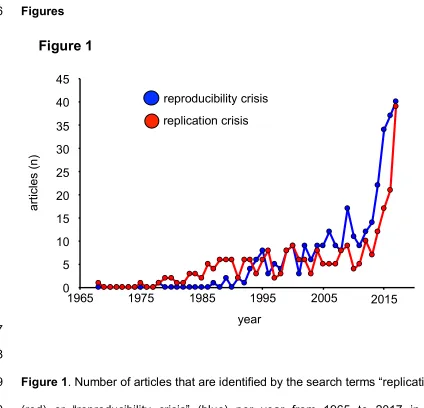
demonstrated by the rise in articles indexed in PubMed [13] related to the terms 36
"reproducibility crisis" and "replication crisis" (Figure 1). This finding is in accordance 37
with another recent analysis that indicated a rapidly increasing number of scientific 38
articles within a “crisis narrative” [14]. Factors suggested to affect reproducibility 39
include (a lack of) methodological standards, (unconscious) bias, pressure related to 40
the need to attract grants and publish in high impact journals, and publication bias 41
favouring the publication of novel (“positive”) findings and discouraging the publication 42
of confirmatory findings and “negative” results [3,11,15-22]. Some authors argue that 43
a high proportion (up to 90%) of research money is wasted [2-7], although this very 44
pessimistic view is not unambiguously shared [14]. Nevertheless, the perception of a 45
reproducibility crisis seems to be common among researchers. In a Nature survey, 46
52% of the 1576 respondents from all science areas agreed that a reproducibility crisis 47
exists [23]. 48
Method 49
To determine what is known about the extent and causes of the reproducibility crisis 50
and how the scientific community deal with it, we performed a systematic analysis of 51
the available literature on the reproducibility of research findings. Literature searches 52
were performed using PubMed on 3rd November 2017 using the search terms
53
“replication crisis” (resulting in 260 hits) and “reproducibility crisis” (306 hits). Cell line 54
misidentification has been discussed as a significant cause of unreliable results since 55
first mammalian cell lines were established [24,25]. Thus, we also used the search 56
term “cell line authentication” (17th November 2017, 147 hits). We identified a further
104 relevant articles from the analysed articles. After removing the overlaps, 791 58
articles were analysed resulting in 280 relevant articles in English (Suppl. Table 1; 59
Suppl. Figure 1). 60
Results 61
Scale of crisis remains unclear 62
Despite the high visibility of the issue, systematic research and in turn conclusive 63
evidence on the scale of a potential reproducibility crisis is lacking. In a survey among 64
faculty and trainees at the MD Anderson Cancer Center, about 50% of the participants 65
reported that they had failed to reproduce published data at least once [26]. Similarly, 66
in a Nature survey >70% of the 1576 respondents stated that they had been unable 67
to reproduce data at least once [23]. However, systematic data that would enable the 68
reliable quantification of the issue was not identified. We found 17 direct replication 69
attempts among the articles that focused on methodology (Suppl. Table 1). This 70
included nine sciences, six psychology studies, one public health study, and one 71
economics study. 72
The scientific studies were part of the “Reproducibility Project: Cancer Biology” by the 73
Center for Open Science [27] and Science Exchange [28]. In this project, findings from 74
29 high-profile scientific publications will be independently replicated [29,30,31]. So 75
far, the results of nine replication studies have been reported. Important parts of the 76
original paper could be reproduced in four studies [32-35]. The results from two 77
replication studies could not be interpreted [36,37], and one study failed to replicate 78
the original findings [38]. In the two most recent reports, parts of the original studies 79
were reproduced while other parts were not [39,40] (Suppl. Table 1). 80
Psychological studies reported varying levels of successful replication. Two 81
by the Open Science Collaboration reported the successful replication of 39 of 100 83
psychological studies [9]. However, further studies replicated a majority of the 84
analysed effects [43] or confirmed previous findings [44,45]. Finally, there were a 85
successful confirmation study from the public health area [46] and a partially 86
successfully economics replication study [47] (Suppl. Table 1). 87
In the clinical research field, an analysis of follow-up publications of 49 original clinical 88
research studies, which had been published between 1990-2003 and had each 89
acquired more than 1000 citations, revealed that seven (16%) were not confirmed by 90
subsequent studies, seven (16%) had reported stronger effects than those found in 91
subsequent studies, 20 (44%) were successfully replicated, and for 11 (24%) follow-92
up data was not available [1]. 93
Reproducibility data was also provided in articles other than original research articles. 94
Researchers from drug companies reported that only six out of 53 studies (11%) [5] 95
or 16 out of 67 studies (24%) [3] had been successfully reproduced. However, these 96
data were published as a Comment [5] and a Correspondence [3] without presentation 97
of detailed data. Hence, the exact nature of the investigations and the criteria for 98
reproducibility remain elusive. 99
Taken together these findings show that despite anecdotal reports of data 100
irreproducibility, the scale of the issue remains unclear. Most replication attempts 101
focus on highly cited early-stage studies. This may not adequately reflect the general 102
reproducibility of research findings. A meta-assessment of bias in the sciences 103
observed a significant risk of small, early, and highly cited studies to overestimate 104
effects [48]. Further, failed and successful replication attempts would need to be 105
studies are not available. A psychology study estimated that only about 1% of studies 107
are subject to replication attempts [49]. 108
The determination of the scale of the problem may be further complicated by the 109
absence of clear criteria that define the successful or unsuccessful repetition of a 110
study. Ten articles represented a dispute on the consistency of data from two large 111
pharmacogenomics screens in cancer cell lines [50,51]. Six of these articles reported 112
discrepancies between the datasets, while four reported consistency. All six articles 113
that reported discrepancies were published by the same research group, whereas the 114
articles reporting consistency were published by four different research groups (Suppl. 115
Table 1). However, the dispute does not appear to have been resolved. In this context, 116
a modelling study from the psychology field suggests that the criteria for reproducibility 117
may sometimes be interpreted in an unrealistically strict fashion [52]. 118
Researcher conduct defines data quality 119
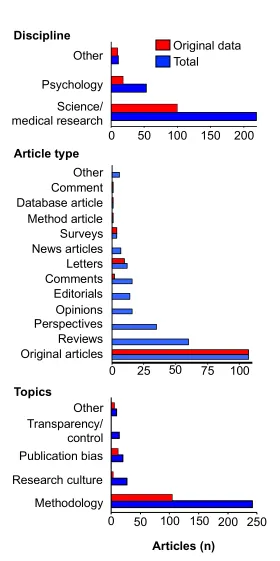
242 of the 280 relevant articles considered methodological shortcomings. Other 120
potential issues were less commonly addressed and included research culture and 121
incentives (27 times), publication bias (20), and transparency/ availability of raw data 122
(14) (Figure 2, Suppl. Table 1). 123
126 of the 280 articles contained original data directly related to reproducibility (Figure 124
2, Suppl. Table 1). Again, the vast majority reported on methodological issues (105 125
articles). A few (12) reported on publication bias (Figure 2, Suppl. Table 1). Together, 126
these data indicate a strong focus on methodological issues in the debate about data 127
reproducibility. 128
The issue of transparency/ availability of raw data was mentioned in total 14 times 129
(Figure 2, Suppl. Table 1) and has been recognised by research funders and scientific 130
Medical Sciences, Wellcome Trust, and Biotechnology and Biological Sciences 132
Research Council published a common report on data reproducibility [54] and the 133
World Economic Forum set up a “Code of Ethics for Researchers” [55]. Journals from 134
publishers including the Nature Publishing group and EMBO Press introduced 135
'publication checklists' [see e.g. 56,57]. Nature also published a special collection on 136
reproducibility in 2013 [58]. However, data on the effects of increased transparency 137
are lacking. A survey reported psychologists to be open to changes to data collection, 138
reporting, and publication practices, but to be less positive about mandatory conditions 139
of publication [59]. One preprint posted on bioRxiv suggested that the introduction of 140
a checklist by Nature had indeed improved study design and the transparency of data 141
[60], but data indicating whether this translated into improved reproducibility is not yet 142
available. 143
Despite the focus of the debate on research methodology, it remains unclear whether 144
(and if yes, to which extent) a lack of reproducibility may be caused by a lack of 145
(knowledge of) appropriate methods and to which extent the significance of data can 146
be improved by standardisation. In animal experiments, batch-to-batch variation was 147
described even under highly standardised conditions in the same lab [61]. Experiment 148
heterogenisation and multi-laboratory design was suggested to produce more reliable 149
data [61-65]. In the area of drug discovery, clear requirements for the generation of 150
reproducible data have been suggested [see e.g. 19,21,22,66]. However, data on the 151
implementation of such measures and their efficacy with regard to improved 152
reproducibility are not available. 153
With regard to the use of appropriate methodologies, cell line misidentification has 154
been an area of concern since the first cell lines were established [24,25]. 49 of the 155
line authentication (Figure 2, Suppl. Table 1). Although short tandem repeat (STR) 157
analysis has been available and promoted as a reliable authentication method since 158
at least 2001 [67], very recent articles still demonstrate that the use of misidentified 159
cell lines remains an issue [68,69]. Similarly, a meta-analysis considering 60-years of 160
articles indicated that the statistical power of behavioural sciences studies has not 161
increased, although the need to increase the statistical power was repeatedly 162
discussed and demonstrated [70]. Hence, the availability of suitable and reliable 163
methods is not sufficient to guarantee their appropriate and consequent use. 164
Additionally, it is a characteristic of research that experiments are performed and 165
methodologies are used for the first time. Consequently, researcher conduct and the 166
research culture are critical to ensure the highest possible reliability of data. Hence, 167
more focus and effort needs to be invested to understand how researchers report and 168
present their data. 169
Researcher careers are driven by publications in as highly prestigious research 170
journals as possible to gain visibility and attract research funding [19,71]. This requires 171
the presentation of novel, significant findings, which incentivises the publication of 172
'positive' findings and discourages the publication of 'negative' findings. This may also 173
incentivise smaller (potentially underpowered) studies, because they are more likely 174
to produce significant results than larger studies [19,71]. A modelling study indicated 175
that the best strategy to produce significant findings and optimise research output is 176
to perform small studies that only have 10-40% statistical power, which would result 177
in half of the studies reporting false-positive findings [72]. Further modelling studies 178
suggested that a focus on novel findings and positive results undermines the 179
rigorousness of science [70,73]. Accordingly, early, highly-cited studies seem to be 180
Contribution of publication bias 182
A focus on 'positive' results also favours 'publication bias', i.e. 'positive' results are 183
more likely to be published than 'negative' findings. Hence, the available literature 184
does not appropriately represent the totality of experiments that have been performed, 185
because many ‘negative’ results remain unpublished (“file drawer problem”). 186
Additionally, 'positive' findings are more likely to be published in prestigious journals 187
than 'negative’ findings [18,19,74]. 188
We identified twelve articles that provided data on publication bias (Suppl. Table 1). 189
One study reported the overestimation of the importance of anticipated prognostic 190
factors in various types of cancer due to publication bias [75]. A follow-up study, which 191
investigated 1,915 research articles on prognostic markers in cancer, found that >90% 192
of studies reported positive prognostic correlations [76]. Less than 1.5% of the 193
investigated articles provided purely ‘negative’ data. If ‘negative’ findings were 194
presented, this typically happened in the context of other significant correlations 195
(‘positive’ findings), or the authors followed up on non-significant trends and tried to 196
defend the importance of the investigated markers despite the lack of significance [76]. 197
This illustrates that negative results are not commonly published. The evaluation of 198
meta-analyses on cancer biomarkers and the analysis of animal studies on stroke and 199
neurological diseases also suggested a bias towards the publication of ‘positive 200
results’ [77-79]. 201
Further, a similar publication bias was reported for both clinical trials [80] and 202
psychological studies [81,82]. Accordingly, a large analysis using US data concluded 203
that there is a general publication bias towards the publication of ‘positive’ results 204
across the academic disciplines [83]. This bias seems to be more pronounced, the 205
becomes complicated by findings that suggest that meta-research on publication bias 207
may itself be subject to publication bias [85]. Taken together, there is convincing 208
evidence that a bias favouring the publication of 'positive' findings exists and that it 209
can affect the reliability of publicly available data, although the scale of the impact is 210
not clear. 211
Determinants of researcher conduct are unclear 212
Researcher conduct defines the reliability of findings also beyond publication bias. 213
This is highly relevant as original research is typically defined by a significant level of 214
novelty in the absence of established standards. Findings are often made using novel 215
(combinations of) approaches together with (novel) model systems and/ or (novel) 216
data for the first time, i.e. before tested and standardised approaches are available. It 217
is fair to assume that the incentives provided in a research environment substantially 218
influence researcher behaviour. One substantial meta-analysis based on data from 18 219
surveys concluded that a pooled weighted estimate of 1.97% (crude unweighted 220
mean: 2.59%) of the respondents admitted to have fabricated, falsified or modified 221
data or results at least once. 14.12% (crude unweighted mean: 16.66%) reported to 222
personally know of a colleague who had done so [86]. Hence, there is evidence of 223
questionable research practices, but the actual extent, the influence of the research 224
environment and its incentives, and the concrete effect on data reliability remain 225
elusive. 226
To identify studies that investigated researcher (mis)conduct in response to the 227
pressures and incentives of the research environment, we performed an additional 228
literature search using the term “misconduct” (although not all forms of scientific 229
misconduct affect data reproducibility, e.g. plagiarism, gift authorship, and 230
circumventing animal-subjects research requirements) in PubMed (18th January
2018). This search resulted in 9394 hits (Suppl. Table 2). We identified three relevant 232
articles and based on these articles three additional ones (Suppl. Table 2). These 233
articles supported the idea that the pressure to publish contributes to questionable 234
research practices that may affect the reproducibility of findings. 235
A survey analysing the answers of 3247 early- and mid-career scientists suggested 236
that a feeling of injustice may contribute to questionable research practices, which 237
may affect reproducibility [87,88]. Focus group discussions involving 51 scientists from 238
research universities revealed that the pressure to produce outputs also promotes 239
questionable research practices [89], which may affect reproducibility. In a survey 240
among 315 Flemish biomedical scientists, 15% of the respondents admitted that they 241
had fabricated, falsified, plagiarised, or manipulated data in the past 3 years. 72% 242
rated the publication pressure as "too high" [90]. A follow-up qualitative focus group 243
interview study among Dutch biomedical researchers suggested that the current 244
publication culture leads to questionable research practices among junior and senior 245
biomedical scientists [91]. Hence, there is some initial evidence that the pressure 246
associated with a highly competitive environment affects researcher conduct, which in 247
turn affects the reliability and reproducibility of data. Again, however, the actual scale 248
Conclusions 250
Our findings demonstrate the need for systematic meta-research on the issue of data 251
reproducibility. A reproducibility crisis is widely recognised among researchers from 252
many different fields. There is no shortage of suggestions on how data reproducibility 253
could be improved, but quantitative data on the subject (including the scale of the 254
problem) are largely missing. Currently, there is a strong focus on methodology. 255
However, ongoing issues with the use of misidentified cell lines illustrate that problems 256
may persist, even despite effective standards being available. Further, it is in the 257
nature of research to do things for the first time before established methods become 258
available. Hence, research standards are primarily defined by the conduct of 259
researchers and their rigour in the acquisition, analysis, and interpretation of data. 260
There are some indications that the high pressure associated with a competitive 261
environment increases the preparedness of researchers to lower their ethical 262
standards, but the available information remains scarce. Consequently, a major focus 263
of meta-research on data reproducibility will need to be put on researcher behaviour, 264
especially in relation to “boundary work”, that is, the ways researchers draw the 265
boundaries between the permissible and the non-permissible [92]. Only measures that 266
are based on a detailed understanding of researcher behaviour and that are closely 267
monitored for efficacy (and iteratively improved) will make it possible to amend our 268
research system in a way that it provides the right incentives to ensure that 269
References 271
1) Ioannidis JP. Contradicted and initially stronger effects in highly cited clinical 272
research. JAMA. 2005;294:218-28. 273
2) Young SS, Bang H, Oktay K. Cereal-induced gender selection? Most likely a 274
multiple testing false positive. Proc Biol Sci. 2009;276:1211–2; discussion 1213. 275
3) Prinz F, Schlange T, Asadullah K. Believe it or not: how much can we rely on 276
published data on potential drug targets? Nat Rev Drug Discov. 2011;10:712. 277
4) Young SS, Karr A. Deming, data and observational studies: a process out of control 278
and needing fixing. Significance. 2011;9:122-6. 279
5) Begley CG, Ellis LM. Drug development: Raise standards for preclinical cancer 280
research. Nature. 2012;483:531-3. 281
6) Peers IS, Ceuppens PR, Harbron C. In search of preclinical robustness. Nat Rev 282
Drug Discov. 2012;11:733–4. 283
7) Young SS, Miller HI. Are medical articles true on health, disease? Sadly, not as 284
often as you might think. Genetic Engineering and Biotechnology News 2014;34:7-9. 285
8) Begley CG, Buchan AM, Dirnagl U. Robust research: Institutions must do their part 286
for reproducibility. Nature. 2015;525:25-7. 287
9) Open Science Collaboration. Estimating the reproducibility of psychological 288
science. Science. 2015;349:aac4716. 289
10) Kousta S, Ferguson C, Ganley E. Meta-Research: Broadening the Scope of PLOS 290
Biology. PLoS Biol. 2016;14:e1002334. 291
11) Lilienfeld SO. Psychology's Replication Crisis and the Grant Culture: Righting the 292
Ship. Perspect Psychol Sci. 2017;12:660-4. 293
12) Hutson M. Artificial intelligence faces reproducibility crisis. Science. 2018;359:725-294
13) https://www.ncbi.nlm.nih.gov/pubmed. Accessed 12 January 2018. 296
14) Fanelli D. Opinion: Is science really facing a reproducibility crisis, and do we need 297
it to? Proc Natl Acad Sci U S A. 2018;115:2628-2631. 298
15) Casadevall A, Fang FC. Reforming science: methodological and cultural reforms. 299
Infect Immun. 2012;80:891-6. 300
16) Fang FC, Casadevall A. Reforming science: structural reforms. Infect Immun. 301
2012;80:897-901. 302
17) Ioannidis JP. How to make more published research true. PLoS Med. 303
2014;11:e1001747. 304
18) Ioannidis JP, Greenland S, Hlatky MA, Khoury MJ, Macleod MR, Moher D, Schulz 305
KF, Tibshirani R. Increasing value and reducing waste in research design, conduct, 306
and analysis. Lancet. 2014;383:166-75. 307
19) Begley CG, Ioannidis JP. Reproducibility in science: improving the standard for 308
basic and preclinical research. Circ Res. 2015;116:116-26. 309
20) Jarvis MF, Williams M. Irreproducibility in Preclinical Biomedical Research: 310
Perceptions, Uncertainties, and Knowledge Gaps. Trends Pharmacol Sci. 311
2016;37:290-302. 312
21) Kaelin WG Jr. Publish houses of brick, not mansions of straw. Nature. 313
2017;545:387. 314
22) Kaelin WG Jr. Common pitfalls in preclinical cancer target validation. Nat Rev 315
Cancer. 2017;17:425-40. 316
23) Baker M. 1,500 scientists lift the lid on reproducibility. Nature. 2016;533:452-4. 317
24) American Type Culture Collection Standards Development Organization 318
Workgroup ASN-0002. Cell line misidentification: the beginning of the end. Nat Rev 319
25) Capes-Davis A, Neve RM. Authentication: A Standard Problem or a Problem of 321
Standards? PLoS Biol. 2016;14:e1002477. 322
26) Mobley A, Linder SK, Braeuer R, Ellis LM, Zwelling L. A survey on data 323
reproducibility in cancer research provides insights into our limited ability to translate 324
findings from the laboratory to the clinic. PLoS One. 2013;8(5):e63221. 325
27) https://cos.io. Accessed on 7 March 2018. 326
28) https://www.scienceexchange.com. Accessed on 7 March 2018. 327
29) Errington TM, Iorns E, Gunn W, Tan FE, Lomax J, Nosek BA. An open 328
investigation of the reproducibility of cancer biology research. Elife. 2014 Dec 10;3. 329
doi: 10.7554/eLife.04333. 330
30) Baker M, Dolgin E. Cancer reproducibility project releases first results. Nature. 331
2017;541:269-270. 332
31) https://elifesciences.org/collections/9b1e83d1/reproducibility-project-cancer-333
biology. Accessed on 7 March 2018. 334
32) Aird F, Kandela I, Mantis C; Reproducibility Project: Cancer Biology. Replication 335
Study: BET bromodomain inhibition as a therapeutic strategy to target c-Myc. Elife. 336
2017;6. pii: e21253. 337
33) Kandela I, Aird F; Reproducibility Project: Cancer Biology. Replication Study: 338
Discovery and preclinical validation of drug indications using compendia of public gene 339
expression data. Elife. 2017;6. pii: e17044. 340
34) Shan X, Fung JJ, Kosaka A, Danet-Desnoyers G; Reproducibility Project: Cancer 341
Biology. Replication Study: Inhibition of BET recruitment to chromatin as an effective 342
treatment for MLL-fusion leukaemia. Elife. 2017;6. pii: e25306. 343
35) Showalter MR, Hatakeyama J, Cajka T, VanderVorst K, Carraway KL, Fiehn O; 344
leukemia-associated IDH1 and IDH2 mutations is a neomorphic enzyme activity 346
converting alpha-ketoglutarate to 2-hydroxyglutarate. Elife. 2017 Jun 27;6. pii: 347
e26030. 348
36) Horrigan SK; Reproducibility Project: Cancer Biology. Replication Study: The 349
CD47-signal regulatory protein alpha (SIRPa) interaction is a therapeutic target for 350
human solid tumors. Elife. 2017;6. pii: e18173. 351
37) Horrigan SK, Courville P, Sampey D, Zhou F, Cai S; Reproducibility Project: 352
Cancer Biology. Replication Study: Melanoma genome sequencing reveals frequent 353
PREX2 mutations. Elife. 2017;6. pii: e21634. doi: 10.7554/eLife.21634. 354
38) Mantis C, Kandela I, Aird F; Reproducibility Project: Cancer Biology. Replication 355
Study: Coadministration of a tumor-penetrating peptide enhances the efficacy of 356
cancer drugs. Elife. 2017;6. pii: e17584. doi: 10.7554/eLife.17584. 357
39) Lewis LM, Edwards MC, Meyers ZR, Talbot CC, Hao H, Blum D, et al. Replication 358
Study: Transcriptional amplification in tumor cells with elevated c-Myc. Elife. 2018;7. 359
pii: e30274. 360
40) Vanden Heuvel JP, Maddox E, Maalouf SW; Reproducibility Project: Cancer 361
Biology, Iorns E, et al. Replication Study: Systematic identification of genomic markers 362
of drug sensitivity in cancer cells. Elife. 2018;7. pii: e29747. 363
41) Boekel W, Wagenmakers EJ, Belay L, Verhagen J, Brown S, Forstmann BU. A 364
purely confirmatory replication study of structural brain-behavior correlations. Cortex. 365
2015;66:115-33. 366
42) Emmerling F, Martijn C, Alberts HJ, Thomson AC, David B, Kessler D, et al. The 367
()replicability of regulatory resource depletion: A field report employing non-368
43) Klein RA, Ratliff KA, Vianello M, Adams RB Jr Bahník Š, Bernstein MJ, et al. 370
Investigating variation in replicability: A “many labs” replication project. Soc Psychol. 371
2014;45:142–52. 372
44) Ahmad MM. Psychometric evaluation of the Cognitive Appraisal of Health Scale 373
with patients with prostate cancer. J Adv Nurs. 2005;49:78-86. 374
45) Zwaan RA, Pecher D, Paolacci G, Bouwmeester S, Verkoeijen P, Dijkstra K, et al. 375
Participant Nonnaiveté and the reproducibility of cognitive psychology. Psychon Bull 376
Rev. 2017 Jul 25. doi: 10.3758/s13423-017-1348-y. 377
46) Firn M, Alonso-Vicente M, Hubbeling D, Holley J, White SJ, Jones B. The 378
replacement of assertive outreach services by reinforcing local community teams: a 379
replication study reporting comparative outcomes and patient reported experience. J 380
Ment Health. 2017;27:1-7. 381
47) Camerer CF, Dreber A, Forsell E, Ho TH, Huber J, Johannesson M, et al. 382
Evaluating replicability of laboratory experiments in economics. Science. 383
2016;351:1433-6. 384
48) Fanelli D, Costas R, Ioannidis JP. Meta-assessment of bias in science. Proc Natl 385
Acad Sci U S A. 2017;114:3714-9. 386
49) Makel MC, Plucker JA, Hegarty B. Replications in Psychology Research: How 387
Often Do They Really Occur? Perspect Psychol Sci. 2012;7:537-42. 388
50) Barretina J, Caponigro G, Stransky N, Venkatesan K, Margolin AA, Kim S, et al. 389
The Cancer Cell Line Encyclopedia enables predictive modelling of anticancer drug 390
sensitivity. Nature. 2012;483:603-7. 391
51) Garnett MJ, Edelman EJ, Heidorn SJ, Greenman CD, Dastur A, Lau KW, et al. 392
Systematic identification of genomic markers of drug sensitivity in cancer cells. Nature. 393
52) Stanley DJ, Spence JR. Expectations for Replications: Are Yours Realistic? 395
Perspect Psychol Sci. 2014;9:305-18. 396
53) Nature Editorial. A code of ethics to get scientists talking. Nature. 2018;555:5. 397
54) https://acmedsci.ac.uk/download?f=file&i=32558. Accessed on 7 March 2018. 398
55) http://widgets.weforum.org/coe/. Accessed on 7 March 2018. 399
56) Nature Announcement. Reducing our irreproducibility. Nature. 2013;496:398. 400
57) Nature Editorial. Steps towards transparency in research publishing. Nature. 401
2017;549:431. 402
58) https://www.nature.com/collections/prbfkwmwvz/. Accessed on 7 March 2018. 403
59) Fuchs HM, Jenny M, Fiedler S. Psychologists Are Open to Change, yet Wary of 404
Rules. Perspect Psychol Sci. 2012;7:639-42. 405
60) Macleod MR, The NPQIP Collaborative group. Findings of a retrospective, 406
controlled cohort study of the impact of a change in Nature journals' editorial policy for 407
life sciences research on the completeness of reporting study design and execution. 408
bioRxiv 2017. doi: https://doi.org/10.1101/187245 409
61) Karp NA. Reproducible preclinical research-Is embracing variability the answer? 410
PLoS Biol. 2018;16:e2005413. 411
62) Karp NA, Speak AO, White JK, Adams DJ, Hrabé de Angelis M, Hérault Y, et al. 412
Impact of temporal variation on design and analysis of mouse knockout phenotyping 413
studies. PLoS One. 2014;9:e111239. 414
63) Kafkafi N, Golani I, Jaljuli I, Morgan H, Sarig T, Würbel H, et al. Addressing 415
reproducibility in single-laboratory phenotyping experiments. Nat Methods. 416
2017;14:462-4. 417
64) Voelkl B, Vogt L, Sena ES, Würbel H. Reproducibility of preclinical animal research 418
65) Milcu A, Puga-Freitas R, Ellison AM, Blouin M, Scheu S, Freschet GT, et al. 420
Genotypic variability enhances the reproducibility of an ecological study. Nat Ecol 421
Evol. 2018;2:279-2. 422
66) Begley CG. Six red flags for suspect work. Nature 2013;497:433-4. 423
67) Masters JR, Thomson JA, Daly-Burns B, Reid YA, Dirks WG, Packer P, et al. Short 424
tandem repeat profiling provides an international reference standard for human cell 425
lines. Proc Natl Acad Sci U S A. 2001;98:8012-7. 426
68) Vaughan L, Glänzel W, Korch C, Capes-Davis A. Widespread Use of Misidentified 427
Cell Line KB (HeLa): Incorrect Attribution and Its Impact Revealed through Mining the 428
Scientific Literature. Cancer Res. 2017;77:2784-8. 429
69) Wang M, Yang M, Liu Y, Huang Y, Ye F, Zheng C, Shen C. Investigation of cross-430
contamination among human cell lines used in China. Int J Cancer. 2017 Aug 10. doi: 431
10.1002/ijc.30923. 432
70) Smaldino PE, McElreath R. The natural selection of bad science. R Soc Open Sci. 433
2016;3:160384. 434
71) Brembs B. Prestigious Science Journals Struggle to Reach Even Average 435
Reliability. Front Hum Neurosci. 2018;12:37. 436
72) Higginson AD, Munafò MR. Current Incentives for Scientists Lead to 437
Underpowered Studies with Erroneous Conclusions. PLoS Biol. 2016;14:e2000995. 438
73) Grimes DR, Bauch CT, Ioannidis JPA. Modelling science trustworthiness under 439
publish or perish pressure. R Soc Open Sci. 2018;5:171511. 440
74) Nissen SB, Magidson T, Gross K, Bergstrom CT. Publication bias and the 441
canonization of false facts. Elife. 2016;5. pii: e21451. 442
75) Kyzas PA, Loizou KT, Ioannidis JP. Selective reporting biases in cancer prognostic 443
76) Kyzas PA, Denaxa-Kyza D, Ioannidis JP. Almost all articles on cancer prognostic 445
markers report statistically significant results. Eur J Cancer. 2007;43:2559-79. 446
77) Tsilidis KK, Papatheodorou SI, Evangelou E, Ioannidis JP. Evaluation of excess 447
statistical significance in meta-analyses of 98 biomarker associations with cancer risk. 448
J Natl Cancer Inst. 2012;104:1867-78. 449
78) Sena ES, van der Worp HB, Bath PM, Howells DW, Macleod MR. Publication bias 450
in reports of animal stroke studies leads to major overstatement of efficacy. PLoS Biol. 451
2010;8:e1000344. 452
79) Tsilidis KK, Panagiotou OA, Sena ES, Aretouli E, Evangelou E, Howells DW, et 453
al. Evaluation of excess significance bias in animal studies of neurological diseases. 454
PLoS Biol. 2013;11:e1001609. 455
80) Hall R, de Antueno C, Webber A; Canadian Research Ethics Board. Publication 456
bias in the medical literature: a review by a Canadian Research Ethics Board. Can J 457
Anaesth. 2007;54:380-8. 458
81) Bakker M, van Dijk A, Wicherts JM. The Rules of the Game Called Psychological 459
Science. Perspect Psychol Sci. 2012;7:543-54. 460
82) Ferguson CJ, Heene M. A Vast Graveyard of Undead Theories: Publication Bias 461
and Psychological Science's Aversion to the Null. Perspect Psychol Sci. 2012;7:555-462
61. 463
83) Fanelli D. Do pressures to publish increase scientists' bias? An empirical support 464
from US States Data. PLoS One. 2010;5:e10271. 465
84) Fanelli D. "Positive" results increase down the Hierarchy of the Sciences. PLoS 466
One. 2010;5:e10068. 467
85) Dubben HH, Beck-Bornholdt HP. Systematic review of publication bias in studies 468
86) Fanelli D. How many scientists fabricate and falsify research? A systematic review 470
and meta-analysis of survey data. PLoS One. 2009;4:e5738. 471
87) Martinson BC, Anderson MS, de Vries R. Scientists behaving badly. Nature. 472
2005;435:737-8. 473
88) Martinson BC, Anderson MS, Crain AL, de Vries R. Scientists' perceptions of 474
organizational justice and self-reported misbehaviors. J Empir Res Hum Res Ethics. 475
2006;1:51-66. 476
89) de Vries R, Anderson MS, Martinson BC. Normal Misbehavior: Scientists Talk 477
about the Ethics of Research. J Empir Res Hum Res Ethics. 2006;1:43-50. 478
90) Tijdink JK, Verbeke R, Smulders YM. Publication pressure and scientific 479
misconduct in medical scientists. J Empir Res Hum Res Ethics. 2014;9:64-71. 480
91) Tijdink JK, Schipper K, Bouter LM, Maclaine Pont P, de Jonge J, Smulders YM. 481
How do scientists perceive the current publication culture? A qualitative focus group 482
interview study among Dutch biomedical researchers. BMJ Open. 2016;6:e008681. 483
92) Hesselmann F, Wienefoet V, Reinhart M. Measuring Scientific Misconduct— 484
Figures 486
487 488
Figure 1. Number of articles that are identified by the search terms “replication crisis” 489
(red) or “reproducibility crisis” (blue) per year from 1965 to 2017 in PubMed 490
(www.ncbi.nlm.nih.gov/pubmed, data accessed on 12th January 2018).
491 492
Figure 1
0 10 20 30 40
year 1975
1965 1985 1995 2005 2015
5 15 25 35 45
a
rt
ic
le
s
(
n
)
493
Figure 2. Number of articles that are relevant to the reproducibility crisis and data 494
reproducibility by discipline, article type, and topic. Blue bars indicate the total number 495
of articles. Red bars indicate the number of articles that contain original data. 496
Figure 2
Other Psychology Science/ medical research
Discipline
Articles (n)
0 50 100 150 200
Original articles Reviews Perspectives Opinions Editorials Comments Letters News articles Surveys Method article Database article Comment Other Article type
0 25 50 75 100
Topics
Methodology Research culture Publication bias Transparency/
control Other
498
499
Suppl. Figure 1
Records after duplicates removed
(n = 791)
Full-text articles assessed for eligibility
(n = 791)
Studies included in analysis (n = 280)
Records identified through database searching (n = 713):
“reproducibility crisis” (n = 306) “replication crisis” (n = 260) “cell line authentication” (n = 147)
Additional records identified through other sources
(n = 104)
Full-text articles excluded, with
reasons (n = 511)
Suppl. Figure 1. Summary of the literature search using the search terms
“reproducibility crisis”, “replication crisis” (data accessed on 3rd November 2017)