ISSN: 2231-5381
http://www.ijettjournal.org
Page 2447The Comparative Study of Adaptive Channel Equalizer Based
on Fixed and Variable Step-Size LMS Algorithm & its Variants
for Non Stationery Wireless Channel
Darshna Kundu(M. Tech Scholar)1 and M.K.Jain(Associate Professor)2 ECE Department Lingayas University Faridabad, Haryana, India
Abstract-the performance of modern communication system can be reduced by non ideal characteristic of the channel, which is known as inter-symbol interference (ISI).The equalization technique is an efficient method to overcome ISI and improve the characteristics of the system. Adaptive linear filter and various categories of training algorithms are used to imitate different equalizer models. . Here we have simulated a digital communication model having quadrature amplitude modulation technique and additive white Gaussian noise channel implemented in MATLAB where Equalizer plays major role in this model. This paper presents the comparison of performance of linear & non linear adaptive channel equalizer trained by using gradient decent algorithm LMS & its variants such as NLMS, FBLMS, and SRLMS with fixed & variable step size in terms of Bit Error Rate (BER). Inspite of much prior work on this subject we reveal surprising analytical results in terms of well known BER
Keywords—LMS, NLMS, FBLMS, BER Algorithm, Channel Equalization, DFE, VSSLMS
I. Introduction
In any wireless communication system, the channel
induced distortion results in Inter-symbol
Interference (ISI), if it is not compensated, causes higher error rates. The solution of this ISI problem is to design a receiver that employs a means for reducing the channel distortion which arises due to non linear characteristic of the channel, in the received signal. An adaptive equalizer is the best compensator for the ISI problem.
Channel Equalizers are widely used in digital communication systems to mitigate the effects of ISI caused by channel distortion. Linear equalizers are most popularly used for high speed modems that transmit data over telephone channels but some channels like radio channels require a very
powerful non linear adaptive channel equalizer to combat the severe ISI such as DFE adaptive channel equalizer track such variations in the channel response & adapt it’s coefficients to reduce the ISI.
Fig (1) A simplified Block Diagram of a digital communication system using adaptive channel equalizer at the receiver [10]
Types Structures & Algorithms
ISSN: 2231-5381
http://www.ijettjournal.org
Page 2448i. Linear Equalizer (Transversal FIR
adaptive filter)
A linear equalizer can be implemented as FIR filter also called as transversal filter. In such an equalizer the current and past values of the received signal are linearly weighted by the filter coefficient and summed to produce the output. It is very effective on channels, such as wire line telephone channels, where the ISI is not severe. The basic limitation of a linear equalizer is that it performs poorly on channels having spectral nulls.
ii. Non-linear (Decision feedback)
Equalizer
It arguments a linear equalizer by adding a filtered version of previous symbol estimates to the original filter output.
Fig (3) Simple Block Diagram of DFE[9]
Non linear Equalizer (DFE):-
The Decision feedback equalizer consists of two filters, the first filter is called a feed forward filter & it is generally a fractionally spaced FIR filter with adjustable tap coefficients. The second is a feedback filter, its input is the set of previously detected symbols, and the output of the feedback filter is subtracted from the output of the feed forward filter to form the input to the detector. The taps coefficients of the feed forward & feedback filters are selected to optimize some desired performance measure, for mathematical simplicity the MSE criteria is usually employed,& a various
adaptive filtering algorithms are used to implement an adaptive DFE.
iii. Description of Adaptive Algorithms
The most prominent family of the adaptive filtering algorithm is least mean square (LMS).
Various categories of LMS Algorithm are used: 1. Normalized LMS
2. Signum LMS
3. Signum-signum LMS 4. Signum repressor LMS
Fig (4).Basic Block diagram of Adaptive Channel Equalizer Based on gradient decent algorithms [1]
u (n)= Input signal
h (n) = system response e (n) = Error signal d (n)= desired signal.
(n)=Transversal FIR filter output
= weight vector of Transversal FIR filter ξ (n) = E [e (n)] ……….(1) The error estimation e (n) is
e (n) = d(n) – (n) ………...(2) (n)=w (n)*u (n) ……… (3)
iv. Least mean square (LMS) with fixed
step size
Least mean square filter is designed using a transversal (tapped delay line) structure. It has two practical features:
ISSN: 2231-5381
http://www.ijettjournal.org
Page 2449The least-mean square (LMS) algorithm updates the linear filter coefficients such that the mean square error (MSE) cost function to be minimized .it perform the following operation to update coefficients of the adaptive filter.
Calculates the error signal e (n) by using the equation (2).Coefficient updating equation is W (n+1) = w (n) + µ u (n) e (n)………. (4) [8] Where µ is the fixed step size of the adaptive filter (n) is weight vector and u (n) is the input signal vector.
v. Least mean square (LMS) algorithm
with variable step size (VSSLMS)
VSSLMS algorithm was introduced in which the step size was adapted that each iteration using the instantaneous power of the error. Here µ can respond to time varying channel parameters thus leading to high performance (low MSE).
VSSLMS algorithm uses the following variable step size adjustment scheme:
Let d(n) be the desired signal of the adaptive filter ………..….(5) Where h(n) denote coefficient vector of the unknown system with length M.
x (n) is the input vector (n) is the (AWGN)system noise that is independent of x(n)we express a prediction error e(n) as
………... (6)[5] Where w(n) denoting coefficient vector of the adaptive filter at iteration n as w(n)
By using squared instantaneous prediction error & constant parameters to update the step size as
………... (7)[5] Where 0<α<1,γ>0 & µ(n+1) is restricted to some predefined values
Filter coefficient vector update recursion is given by
……… (8)[5]
II. Structure of the Proposed Model
Fig (5) Structure of the proposed model [1]
The structure employed in this paper consists of random integer generator, QAM modulator, AWGN fading channel, equalizer and QAM demodulator & is implemented using MATLAB as shown in Figure (5). It follows the topology suggested in base paper [1].Simulation is being carried out by varying Eb /No ratio of AWGN
fading channel for the linear & non linear equalizers based on fixed and variable step size LMS algorithm and its variants. The output is observed in the form of bit error rate (BER), number of errors and the number of bits processed.
III. Simulation Results and Analysis
ISSN: 2231-5381
http://www.ijettjournal.org
Page 2450 Fig (6): Linear & DFE Equalizer based on LMS algorithm for fixed µ=0.01 &variable step size.
It may be inferred from above that linear LMS (variable step size) gives most optimum results
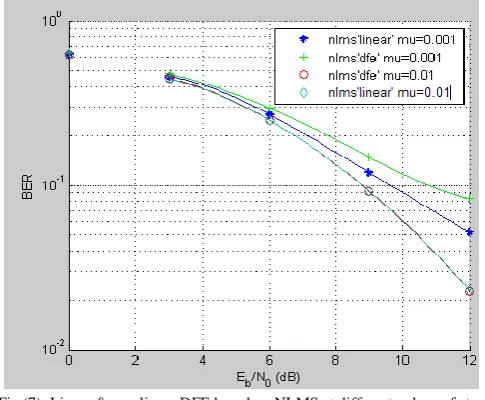
Fig (7): Linear & non linear DFE based on NLMS at different values of step size.
From above fig. it is shown that NLMS at µ=0.01 gives lowest BER amongst the four.
Fig (8) LMS variants (step size µ=0.01)
From above we may conclude that NLMS performs much better than others.
ISSN: 2231-5381
http://www.ijettjournal.org
Page 2451 Fig (10): Linear & DFE Equalizer based on LMS, NLMS & SLMS withAWGN channel (µ=.001)
From above plot it can be concluded that SLMS linear equalizer have lowest BER over all others.
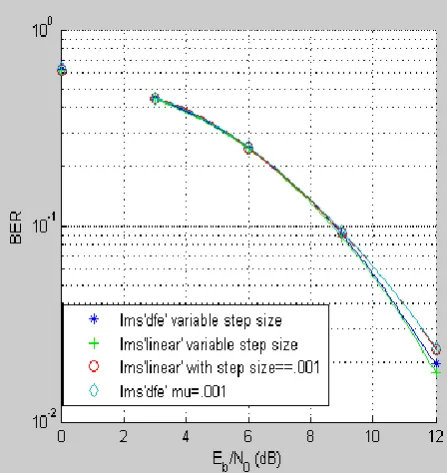
Fig (11): Linear & DFE Equalizer based on SLMS, LMS (fixed step size µ=0.001 & variable step size) algorithm
Fig (12): Linear & DFE Equalizer based on LMS algorithm for fixed step size µ=0.001 & variable step size
From above plots, it is thus clear that performance of variable step size LMS is better.
Simulation Results in Tabular Form:
Name
Of Algorit hm
Type of Equali zer
Step Size
( µ)
Bit Error Rate(BER) values for different Eb /No
Eb/No
0DB
3 dB 6 dB 9 dB 12 dB
LMS Linear (VSS) 0.62 0.446 0.247 0.087 0.017
DFE VSS 0.630 0.451 0.250 0.090 0.019
SRLMS Linear µ=0.001 0.622 0.468 0.289 0.127 0.058
DFE µ=0.001 0.623 0.467 0.287 0.127 0.059
SLMS DFE µ=0.001 0.626 0.454 0.255 0.091 0.020
Linear µ=0.001 0.623 0.449 0.248 0.087 0.018
SSLMS DFE µ=0.001 0.622 0.472 0.297 0.141 0.064
Linear µ=0.001 0.618 0.466 0.290 0.130 0.046
NLMS Linear µ=0.001 0.629 0.459 0.270 0.119 0.051
ISSN: 2231-5381
http://www.ijettjournal.org
Page 2452IV. Conclusion & Further Work
Many adaptive algorithms have been proposed to achieve fast convergence rate, rapid tracking, & low BER in past two decades. This paper summarized several promising algorithms & presented a performance comparison by means of extensive simulation. Here we implemented the system identification problem using the linear and non linear (DFE) equalizer based on various adaptive filtering algorithms such as LMS & its variants with fixed step size and variable step size (VSSLMS). From the simulation results plots & table it is
concluded that VSSLMS linear equalizer
outperform other types of adaptive algorithms in terms of Bit Error Rate. The work done in this paper will be further optimized by some derivative free training algorithms on adaptive filters & also with neural network.
References
[1] M.F.Mosleh,A.H.ALNakkash‖Combination of LMS and RLS Adaptive Equalizer for Selective Fading Channel‖European Journal of Scientific Research ISSN 1450-216X Vol.43 No.1(2010),pp.127-137
[2] O.P.Sharma,V.Janyani and S.Sancheti‖Recursive Least Squares Adaptive Filter a better ISI compensator‖world academy of science,engineering and technology52 2009
[3] Hardeep Singh,S.S.Gill‖Approches to Channel Equalization‖second international conference on Advanced Computing & Communication Technology 2012
[4] Ying Liu,Wasfy B. Mikhael‖A Fast-converging Adaptive FIR Technique for Channel Equalization‖IEEE 2012
[5] Zhao Shengkui, Khoo Suiyang―A Fast Variable Step-Size LMS A lgorithm with System Identification‖IEEE-2007
[6] M.O.BinSaeed,A.Zzedine,S.A.Zummo‖Variable Step-Size Least Mean Square Algorithms over Adaptive Networks‖10th international conference on information science, signal processing and their application 2010.
[7] Proakis, J.2001 ―Digital Communication, Mc 8.Graw-Hill,NY,4th edition
[8] Monson H. Hayes ―Statistical Digital Signal Processing and Modeling‖ Wiley-India Edition
[9] TheodoreS.Rappaport―Wireless Communications‖PHI-Secondedition Farhang- Chichester, England, John Wiley & Sons
[10] Havkin.S.1996``AdaptiveFilter Theory, Third Ed., Upper Saddle Riven, N.J., Prentice-Hall.
![Fig (1) A simplified Block Diagram of a digital communication system using adaptive channel equalizer at the receiver [10] Types Structures & Algorithms](https://thumb-us.123doks.com/thumbv2/123dok_us/8604333.1725085/1.595.303.548.524.641/simplified-diagram-communication-adaptive-equalizer-receiver-structures-algorithms.webp)
![Fig (4).Basic Block diagram of Adaptive Channel Equalizer Based on gradient decent algorithms [1]](https://thumb-us.123doks.com/thumbv2/123dok_us/8604333.1725085/2.595.48.282.335.470/basic-block-diagram-adaptive-channel-equalizer-gradient-algorithms.webp)
![Fig (5) Structure of the proposed model [1]](https://thumb-us.123doks.com/thumbv2/123dok_us/8604333.1725085/3.595.305.534.116.325/fig-structure-proposed-model.webp)