ISSN: 2231-5381
http://www.internationaljournalssrg.org
Page 246
A Review: Optimization of Energy in
Wireless Sensor Networks
Anjali
1, Navpreet Kaur
21 Department of Electronics & Communication, M.Tech Scholar, Lovely Professional University, Punjab, India 2Department of Electronics & Communication, Faculty of Electronics & Communication Engineering, Punjab, India
*Corresponding Author: Anjali
Abstract- Wireless Sensor Networks have become an important research topic in last year. WSN is a collection of tiny, large number of densely deployed sensor node; these sensor nodes are smart, effective which is very powerful and versatile networking
where traditional wired and wireless networking is unable to deploy. These sensor nodes have limited transmission range,
processing and storage capabilities as well as their energy resources. Routing protocols for wireless sensor networks are
responsible for maintaining the energy efficient paths in the network and have to ensure extended network lifetime. In this paper,
we propose a new approach to provide multiple routing paths using an Ant Colony Optimization (ACO) algorithm. Ant Colony
Optimization based routing algorithms have been proposed to solve the routing problem trying to deal with these constrains. This
paper will find an energy efficiency path in the WSNs using a method is based on Ant Colony Optimization (ACO) algorithms,
aiming to minimize the consumption of power, improve fault tolerance, and length the network lifetime. We conclude that the
proposed protocol effectively extends the network lifetime with less consumption of energy in the network.
Keywords-Wireless sensor network, Ant colony optimization, Routing, Network lifetime
I. INTRODUCTION
The popularity of Wireless Sensor Networks (WSN) are
increasing day-by-day in recent years due to the advances in
low power wireless communications, information
technologies and electronics field. The wireless sensor
networks are based on the cooperation of a number of tiny
sensors and which are depending upon four parts: sensor
(motes), processor, transceiver, and battery. The Sensor get
information from surrounding area and processor change the
analog information into digital information. These sensors
sense and detect various environmental parameters such as
temperature, pressure, air pollution etc. They are also
deployed in monitoring of agriculture, smart homes,
structures, passive localization, tracking etc. Then transceiver
transmits the converted data to the base- station directly, or
through neighboring sensor. The development of low-cost,
low-power, a multifunctional sensor has received increasing
attention from various industries. Sensor nodes or motes in
WSNs are small in size and are sensing capability,
connecting and processing data while communicating with
other nodes connected in the network, via radio frequency
(RF) channel.
Routing is a challenging issue in WSNs due to the inherent
characteristics that distinguish these networks from other
Wireless networks like mobile ad hoc networks or cellular
networks. The large amount of sensor nodes and Constraints
in terms of energy, processing, and storage capacities
requires careful management of resources. Due to such
differences, many algorithms have been proposed for the
ISSN: 2231-5381
http://www.internationaljournalssrg.org
Page 247
These routing mechanisms have taken into consideration theinherent features of WSNs along with the application and
architecture requirements. The task of finding and
maintaining routes in WSNs is nontrivial since energy
restrictions and sudden changes in node status (e.g., failure)
cause frequent and unpredictable topological changes.
In this paper an adaptation of Ant Colony Optimization (ACO)
technique is demonstrated for network routing. This approach
belongs to the class of routing algorithms inspired by nature’s
complex adaptive systems. Ant Colony Optimization (ACO) is a
combinatorial optimization framework that reverse-engineers
and formalizes the basic mechanisms at work in a shortest-path
behavior observed in ant colonies. Ants in a colony are able to
converge on the shortest among multiple paths connecting their
nest and a food source. The driving force behind this behavior is
the use of a volatile chemical substance called pheromone.
While locating food, ants lay pheromone on the ground, and they
also go in the direction where the concentration of pheromone is
higher. This mechanism allows them to mark paths and
subsequently guide other ants, and let good paths arise from the
overall behavior of the colony.
II. WIRELESS SENSOR NETWORK ARCHITECTURE
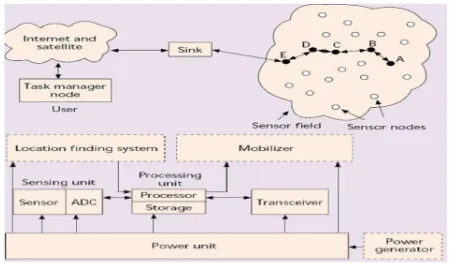
The Number of sensor nodes are form sensor network to
produce high-quality information about their environment.
The functionalities like sensing, processing, transmission,
location finding, power consumption etc. are available in
each of the nodes. Their main objectives are making discrete,
local measurement about phenomenon surrounding these
sensors, forming a wireless network by communicating over
a wireless medium, and collect date and rout data back to the
user via sink (Base Station). The sink (Base Station)
communicates with the user via internet or satellite
communication. It is located near the sensor field or
well-equipped nodes of the sensor network. Collected data from
the sensor field routed back to the sink by a multi-hop
infrastructure less architecture through the sink. Phenomenon
is an entity of interest to the user to collect measurements
about. This phenomenon sensed and analyzed by the sensor
nodes. The user is interested to gathered information about
specific phenomenon to measure/monitor its behavior.
Figure 1 shows the architecture of a typical Wireless Sensor
Network with the components of a sensor node.
Figure 1. Sensor node and WSN Architecture
III.ANT COLONY OPTIMIZATION (ACO)
Ant Colony Optimization is one kind of algorithm which is
inspired by swarm intelligence (Dorigo & Stützle, 2004). An
ant will leave pheromones for other ants when finding the
food. Some ants will follow the pheromone to find the food,
but some other ants will find a shorter path and also deposit
their pheromone. Eventually, the shortest path from nest to
food source will be found. Inspired by the activity of ants in
nature, the prototype of the ACO System was built by Dorigo
to solve intelligence optimization problems. Since then,
Dorigo and other researchers have been working on ACO
system and extending the system. They have already proposed
Ant Colony System (ACS) and MAX-MIN Ant System
(MMAS) which both are metaheuristic algorithms (Dorigo &
Socha, 2007). ACO algorithms focus on global search, but
their local search is not so efficient. This inefficiency may
cause increased consumption of power if there are a large
ISSN: 2231-5381
http://www.internationaljournalssrg.org
Page 248
other algorithms, single ACO may have a poor performancewhen the number of nodes is large. Lim, Jain and Dehuri
(2009) have already found that ACO with local search can
perform well on some complex problems. Therefore, an
improved Ant Colony Optimization which combined with
local search is proposed for solving this complex optimization
problem. There are two general methods of local search:
genetic local search and simulated annealing. The results of
two hybrid Ant Colony Optimization algorithms will be
compared to the original ACO algorithm and other routing
results, to determine whether ACO combined with local search
is more effective or not.
A) AS (Ant system algorithm):
Ant System (AS) was the first (1991) ACO algorithm. Its
importance resides mainly in being the prototype of a number
of ant algorithms which have found many interesting and
successful applications. Three AS algorithms have been
defined, which differ by the way pheromone trails are
updated. These algorithms are called density,
ant-quantity, and ant-cycle. In ant-density and ant-quantity ants
deposit pheromone while building a solution, while in
ant-cycle ants deposit pheromone after they have built a complete
tour.
B) ACS (Ant Colony System):
ACS was the first algorithm inspired by real ant’s behavior.
The merit to introduce the ACO algorithms and to show the
potentiality of using artificial pheromone and artificial ants to
drive the search of always better solutions for complex
optimization problems. In ACS once all ants have computed
their tour (i.e. at the end of each iteration) AS updates the
pheromone trail using all the solutions produced by the ant
colony. Each edge belonging to one of the computed
solutions is modified by an amount of pheromone
proportional to its solution value. At the end of this phase the
pheromone of the entire system evaporates and the process of
construction and update is iterated. On the contrary, in ACS
only the best solution computed since the beginning of the
computation is used to globally update the pheromone. As
was the case in AS, global updating is intended to increase
the attractiveness of promising route but ACS mechanism is
more effective since it avoids long convergence time by
directly concentrate the search in a neighborhoods of the best
tour found up to the current iteration of the algorithm.
ANTS algorithm within the ACO frame-work has two
mechanisms:
i. Attractiveness
ii.Trail update
The attractiveness of a move can be effectively
estimated by means of lower bounds (upper bounds
in the case of maximization problems) on the cost
of the completion of a partial solution. In fact, if a
state ι corresponds to a partial problem solution it is
possible to compute a lower bound on the cost of a
complete solution containing ι.
A good trail updating mechanism avoids stagnation,
the undesirable situation in which all ants
repeatedly construct the same solutions making any
further exploration in the search process
impossible. Stagnation derives from an excessive
trail level on the moves of one solution, and can be
observed in advanced phases of the search process,
if parameters are not well tuned to the problem. The
trail updating procedure evaluates each solution
against the last k solutions globally constructed by
ANTS. As soon as k solutions are available, their
moving average z is computed; each new solution z
is compared with z (and then used to compute the
new moving average value). If z is lower than z, the trail
level of the last solution's moves is increased, otherwise it
ISSN: 2231-5381
http://www.internationaljournalssrg.org
Page 249
Δτi,j = τ0 . (1 - z curr – LB/z – LB)Where z is the average of the last k solutions and LB is a
lower bound on the optimal problem solution cost.
IV ROUTING ALGORITHM IN WSNS
Suppose the ant is randomly placed on node i , the probability of an ant k choosing the next adjacent node j is as depictedin Equation 6. And the pheromone table helps to choose the next neighbor in the process.
Pij=
(i,j)] a .
(j)]b
(i,j)] a .
(j)]bIf j=Mk
0 otherwise
where
Pij = probability of packet going from node i to j,
(i,j) = pheromone level in the table of node i for node j,
(j) = energy level of node j,Mk = identifier of every visited node,
a = parameter that denotes pheromone level,
b = parameter that denotes energy level heuristics.
Two categories of ants are in use, they are termed as forward ants
and backward ants. We adopted this concept from the relating work
of ant algorithm routing such as T-ant, antNet and EEABR. We
further develop the definitions as used in the literature. The forward
ants are defined as the ants that are sent from the source. The
forward ants will carry the information such as (1) the required
sensor type, (2) the sensor region of interest, (3) the data rate and (4)
the time period of the interest. More details can be seen in table I
where both categories of ants are described in functions. Parameters
and variables formatted in the packet of the experiment are
described here in Table I. The header and data are carried by each
packet. The packet is sent from source node, taking the form as
backward and forward ants.
Match specific sensor data required
Data information embedded
Discovery request of interested sensor data area from
Acknowledge
Sink ants check self-availability of their carried sensor data
Response ant is to sent if there are any matching on
intermediate ants or sink ants)
Sensor Connection Built
Source ants stop sending scout nts
Data communication starts between Sensor Connection Built
Source ants stop sending scout ants
Start
(Neighbour Node discovery )
Sensor Data Communication
Source nodes keep sending ants carrying sensor data
Ants likely follow up the pheromone trace with strongest pheromone density
Pheromone density updated every data ant trace
Termination of Data Communication
Data communication continues until the subscription of source node expired.
Pheromone density decreased by every data ant trace
A termination ant to be sent to stop the communication process
Response ants reaching threshold?
Respond
Keep sending source ants
Connection confirmation ants (CCA) are to be
ISSN: 2231-5381
http://www.internationaljournalssrg.org
Page 250
Figure 2. Flowchart of the proposed algorithms for therouting scheme of WSNs
V. CONCLUSIONS
In this paper, Ant routing algorithm performs well for
symmetric networks with good success rates and energy
efficiency. However, for denser networks the loss rate
becomes high with the decrease in success rate and energy
efficiency. Furthermore, if the network does not have a
symmetric path, the algorithms do not work well as the ant
wanders wastefully for searching the destination. In the near
future, improvisations in ant routing algorithm will be
implemented along with comparisons with other learning
based algorithms.
ACKNOWLEDGEMENT
The authors also would like to thank the anonymous reviewers
for their comments and suggestions to improve this paper. The
authors also would like to thanks friends Navpreet Kaur,
Savita.