_____________________________________________________________________________________________________
*Corresponding author: E-mail: [email protected];
Modulatory Effect of Ascorbic Acid Administration
on Rectal Temperature, Percentage of Excitability
and Body Weight Changes of West African Dwarf
Goats Transported by Road
E. O. Agwu
1*, O. Byanet
2, C. Ezihe
3, H. A. Abu
3and A. Y. Adenkola
31Department of Animal Health, Federal College of Animal Health and Production Technology, N.V.R.I, P.M.B. 01, Vom, Plateau State, Nigeria. 2
Department of Veterinary Anatomy, College of Veterinary Medicine, Federal University of Agriculture, P.M.B. 2373, Makurdi, Benue State, Nigeria. 3Department of Veterinary Physiology and Biochemistry, College of Veterinary Medicine, University of Agriculture, P.M.B. 2373, Makurdi, Benue State, Nigeria.
Authors’ contributions
This work was carried out in collaboration among all authors. All authors read and approved the final manuscript.
Article Information
Editor(s):
(1)Dr. Fabio Da Costa Henry, Associate Professor, Technology of Animal Products, State University of Northern of Rio de Janeiro, UENF, Brasil.
Reviewers:
(1) Wafaa Abd Gl-Ghany, Cairo University, Egypt. (2)Grace O. Tona, Ladoke Akintola University of Technology, Nigeria. (3)Pravin Ramdas Rathod, Maharashtra Animal and Fishery Sciences University, India. Complete Peer review History:http://www.sdiarticle3.com/review-history/49913
Received 26 April 2019 Accepted 01 July 2019 Published 09 July 2019
ABSTRACT
This study was conducted with the aim of evaluating the modulatory effect of ascorbic acid supplementation on rectal temperature, body weight changes and percentage excitation of West African Dwarf (WAD) goats transported by road for eight hours. A total of twenty eight (28) male West African dwarf goats of eight months to one year old were used for this study. The animals were divided into four groups of seven animals each. Animal in groups A and C were given ascorbic acid at the dosage of 250 mg/kg body weight while groups B and D were only given 10ml of sterile water each. Animals in groups A and B were transported while those in groups C and D were inside the pen on the day of transportation. The rectal temperature obtained at the experimental site before
and after transportation in all the groups were not significantly (p>0.05) different. On the day of journey, rectal temperature of animals rise from 38.25±0.19°C to 39.44±0.12 in group B, from 38.58±0.13 to 39.42±0.11°C in group D while it fluctuate between 38.38±0.15 and 38.00±0.15°C in group A eight hour into the journey. At the end of the journey, there was significant (p<0.05) difference between the ascorbic acid supplemented groups and non-ascorbic acid supplemented groups. The average live weight of WAD goats in kg before the transportation were 9.14±0.52, 8.85±0.58, 8.87±0.37 and 8.93±0.59 kg in groups A, B, C and D respectively. Although there was no significant (p>0.05) difference in the live weight of goats in the various groups pre and post transportation but a percentage difference of 3.06, 5.53, 3.38 and 4.45 was obtained in group A, B, C and D respectively. Weight of animals in group A (9.83±0.45 kg) and group C (9.32±o.34 kg) were higher than the weight recorded in group B (9.00±0.95 kg) and D (8.80±0.69 kg) seven days post transportation. The percentages of excitation recorded immediately after transportation in ascorbic acid supplemented groups were significantly (p<0.05) higher than the non-ascorbic acid supplemented groups.
In conclusion, transportation of WAD goats constitute stress which could have adverse effect on rectal temperature, live weight and excitability scores, thus it is recommended that ascorbic acid should be administered to goats prior to transportation to ameliorate the stress.
Keywords: Road transportation; ascorbic acid administration; WAD goats; rectal temperature; percentage of excitation; live weight changes.
1. INTRODUCTION
Goat production is increasingly becoming a major source of animal protein in Nigeria, contributing over 30 percent to the total meat consumption in the country [1]. Goat population has witnessed a positive growth rate in the last twenty [2] years [3] and the goats are inevitably subjected to transportation for the purpose of marketing and slaughter outside places where
they are produced [4]. Handling, loading, food deprivation, vibrations, centrifugal forces,
confinement, poor air quality and mixing of unfamiliar groups are some of the potential sources of stress during transportation [5]. Adverse climatic conditions such as high or low temperatures and high relative humidity are also additional stress sources to animals during transportation [6]. Transportation stress has
remarkable physiological effects such as
increased adrenal cortical activity, decreased immunity, increased morbidity and mortality due to infectious diseases and weight loss [7,5]. As a result, transportation stress has both economic (productivity) and welfare concerns [8]. Live weight loss during transportation and handling is of particular economic importance in small ruminants since the digestive tract comprises a greater proportion of live weight than in cattle and swine [9].
Anti-oxidants such as vitamin C and E are free radical scavengers, which protect the body defense system against excessive produced free radicals during transportation stress and stabilize health status of the animals [10]. Vitamin C has
2-fold importance: (i) it spares vitamin E [11] and (ii) it helps in reduction of tocopheroxyl radicals back to its active vitamin E [12]. Although ruminants can synthesize vitamin C [13], a large reduction in plasma vitamin C concentration was reported in calves stressed by housing conditions [14] and heat stressed cows [15]. Oral supple-mentation of vitamin C effectively alleviated stress in sheep [16] and goats [17,18].
Several studies have evaluated the responses of small ruminants to transportation stress in different geographical parts of Nigeria [18,17,4]. There is paucity of information in the available literature on the excitability score and live weight of WAD goats to stress due to road transportation in the middle belt area of Nigeria considering the fact that this animals are indigenous to this area, and the main mode of transportation is by road which has been documented by various authors to be stressful [19]. Hence, this experiment was designed to evaluate the effect of road transportation stress on rectal temperature, excitability score and weight loss on this group of animals and the possible role of ascorbic acid.
2. METHODOLOGY
2.1 Study Area
and a maximum temperature range of 26.5 - 42°C with annual rainfall of 1,317 – 1,323 mm which spans between 6 – 7 months [20] while the relative humidity is between 47- 85% [2].
2.2 Experimental Animals and Management
Twenty eight (28) West African Dwarf male goats, eight months to one year old served as the subjects of this study. The goats were sourced from Makurdi metropolis. They were reared under the semi intensive management system and were kept in four of the pens in the building meant for small ruminant in the farm. The building has a long corridor of about 1m long with each pen measuring 285 x 285 cm for animals on both sides of the corridor. The pen has a large wide windows measuring 180 x 126 cm with a wire mesh for natural ventilation. The goats were not restrained inside the pen and were stocked at a rate of 1m2/goat. Two weeks before transportation, the goats were screened for common diseases and prophylactic treatment against ecto- and endoparasites was given.
Thereafter, the goats were individually
vaccinated with NVRI PPR vaccine against PPR and were ear-tagged to enable identification.
2.3 Experimental protocol/ Design
Twenty eight (28) selected animals were randomly allotted into four groups of seven each (Group A– D). Animals belonging to each group were identified and numbered with plastic ear-tag during the study.
The grouping of the animals was done as follows:
Group A (n=7): animals in this group were subjected to ascorbic acid administration prior to transportation.
Group B (n=7): animals in this group did not receive ascorbic acid but were transported together with those in group A.
Group C (n=7): ascorbic acid was administered to this group but they were not transported.
Group D (n=7): animals in this group acted as the negative control group (they were given only distilled water and were not transported).
2.3 Measurement of Rectal Temperature
The rectal temperature was measured using a standard thermometer (Divine care®, Nigerian
Ltd) at 7:00, 13:00 and 18:00 h for three consecutive days before and after transportation. The thermometer was inserted through the anus into the rectum of each goat and was left there for five minutes after which the value was read as correspond to the level of the rising mercury in the thermometer indicating the end of the reading [21].
2.4 Weight Measurement and Percentage Excitation Estimation
The live weight of each WAD goat was measured using a standard weighing scale (Sunbeam Coy, USA) in the morning on the day of transportation, immediately after transportation and seven days post transportation. Percentage of excitations were recorded during weighing of each goat as described by Kannan et al. [9] and Adenkola and Alilu, [21].
2.5 Transportation of Animals
On the day of transportation, the goats in group A (n = 7) and group C (n = 7) were orally and individually administered with Ascorbic Acid (Juhel® Nigeria Ltd) at 200 mg/kg [22] dissolved in 10 ml of water, while 7 goats in groups B and D were given 10 ml of sterile water. The administrations was made between 15 to 30 minutes before loading the goats into the vehicle. Food and water were withdrawn 12 h before the journey and throughout the journey period. The vehicle travelled along Makurdi - Otukpa road from University of Agriculture Makurdi Teaching and Research Farm on tarred smooth and rough road for 8hrs at the speed of 40-50 km/h covering a total of 400 km and back to the starting point. After completing the journey, the goats were unloaded at the spot where they were originally loaded and given feed and water.
2.6 Vehicle Design
A standard Peugeot bus (J5), popularly used in
the middle belt region of Nigeria for
transportation of livestock was used to transport the rams. The inner compartment of the vehicle measured 3.63 x 1.35 x 1.7 m high. The side walls of the vehicle 'from the floor to the roof
were completely covered with corrugated
aluminum sheets, which were smooth with no
protrusion of sharp edge and 'with a window, which provided for adequate ventilation. Each
window measured 1.02by 0.51 m on both sides
vehicle. Other transportation procedures were carried out in accordance with the standard guidelines governing the welfare of livestock
during road transportation[23]. They were made
to stand inside the vehicle in rows without any form of restraint. The journey commenced at 9:00 am on the day of transportation.
3. RESULTS
3.1 Effects of Ascorbic Acid Administra-tion, Loading and Eight hours of Road Transportation on Rectal Temperature of the Goats
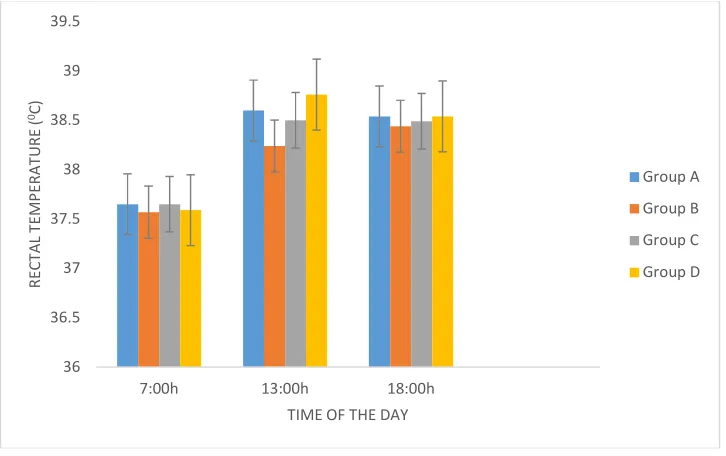
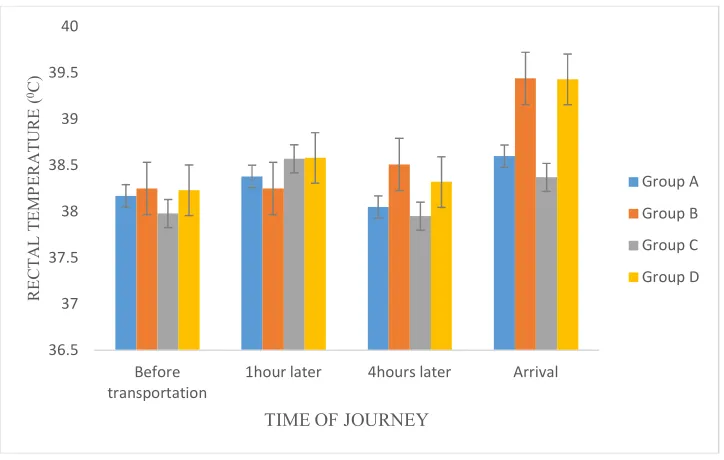
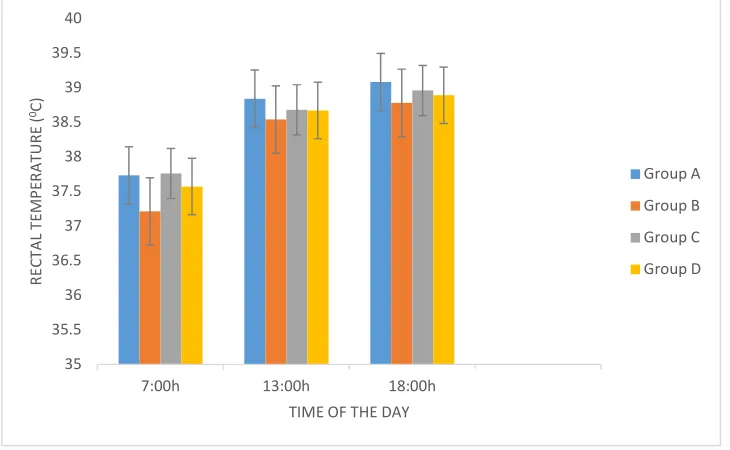
Rectal temperature (RT) of the goats at the experimental site before transportation, during and after transportation are shown in Fig 1-3.
The RT value was lowest at 7:00 h in all the groups with the values of 37.61±0.19°C, 36.97 ±0.30°C, 37.67±0.24°C and 37.28±0.20°C in groups A, B, C and D respectively on the first day. The value of rectal temperature obtained at 7:00h on the second and third day before transportation was not statistically significant (p>0.05) in all the groups.
On the first day at 13: 00 h, the values of RT obtained in group B with the values of 38.08±0.15°C was significantly (p<0.05) lower than the values of RT in group D with a value of
38.74±0.13°C. On the second day at the same time, values of 38.91±0.14°C and 39.00±0.18°C was obtained in groups A and D. this value were significantly (p<0.05) higher than the value of 38.23±0.26°C obtained in group B. however, there was no significant (p>0.05) difference in the value obtained on the third day pre transportation at 13: h in all the groups. The value of RT obtained at 18: h, was not statistically significant in all the groups on the first, second and third day of rectal temperature determination.
On the day of journey, the RT values obtained before the commencement of the journey was 38.38 ±0.15°C, 38.25±0.19°C, 38.57±0.26°C and 38.58±0.13°C in groups A, B, C, and D respectively. These values were not significantly (p>0.05) different in all the groups. The RT value obtained in group A decreased from initial values
of 38.38±0.15°C before the journey to
38.00±0.15°C in the eighth hour of the journey. Similar observation was seen in group C with initial value of 38.57±0.26°C and final value of38.37±0.20°C. The RT value obtained in group C was not significantly (p>0.05) different from the values obtained in group A. The RT value in groups B and D during the journey increased from 38.25±0.19°C to 39.44±0.12°C in group B
and 38.58±0.13°C to 39.42±0.11°C in group D at the eighth hour of journey. At the fourth hour into the journey and at the end of the journey, there
Fig. 1. Rectal temperature of goats at the experimental site before transportations
36 36.5 37 37.5 38 38.5 39 39.5
7:00h 13:00h 18:00h
R
EC
TA
L
TE
M
P
ER
A
TU
R
E
(
0C
)
TIME OF THE DAY
Group A
Group B
Group C
was significant (p<0.05) difference between the ascorbic acid treated groups (A and C) and the non-ascorbic acid treated groups (B and D).
The overall RT value three days after the journey at 7:00h was 37.46±0.42°C,
37.00±0.27°C, 37.37±0.23°C and 37.15±0.09°C which rose to 38.96±0.32°C, 39.08±0.07°C, 38.93±0.11°C and 39.11±0.09°C by 18:00 h in group A, B, C, and D respectively. These values were not significantly (p>0.05) different from each other statistically.
3.2 Effects of Ascorbic Acid Administration and Eight Hours of Road Transportation on Body Weight of the Goats
The average body weight of the West African dwarf (WAD) goats in kg pre- transportation were 9.14±0.52 kg, 8.85±0.58 kg, 8.87±0.37 kg, and 8.93±0.59 kg in Groups A, B, C, and D respectively as shown in Fig. 4 and Table 1. There was no statistically significant (p>0.05) difference in the live weights recorded in all the group pre- transportation. Also there was no significant (p>0.05) difference between the live weight of the goats’ pre-transportation and post transportation; however, a percentage difference of 3.06, 5.53, 3.38 and 4.45 was obtained in group A, B, C and D respectively. Weight of the
animals in group A (9.83±0.45 kg), and group C (9.32±0.34 kg) were higher than the weight recorded in group B (9.00±0.95 kg) and
group D (8.80±0.69 kg) 7 days post
transportation.
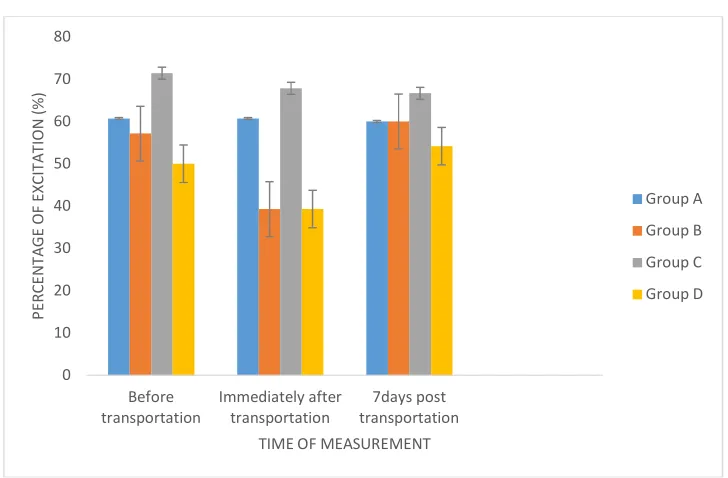
3.3 Effects of Ascorbic Acid Administra-tion and Road TransportaAdministra-tion on Percentage Excitation of the Goats
The results of the percentage of excitation in all the treatment groups are shown in Fig 5. Percentage of excitation recorded in group A had the values of 60.71±5.05% and group C with the value of 71.43±6.52%, while groups B and D had the percentage of excitation with the values of 57.14±4.61% and 50.00±0.00% respectively. There was significant (p<0.05) difference when group C was compared with groups B and D pre- transportation. Immediately after transportation, the highest excitability score of three was recorded in groups A and C with the values of 60.71±5.05% and 67.85±4.61% while the lowest values of 39.29±5.05% was recorded in groups B
and D respectively. These values were
significantly (p<0.05) higher in the ascorbic acid treated groups than the non-ascorbic acid treated groups. However, there was no significant (p>0.05) difference in the obtained values for the
percentage of excitation 7 days post
transportation.
Fig 2. Effects of ascorbic acid administration and eight hours of road transportation on rectal temperature of goats on the day of transportation
36.5 37 37.5 38 38.5 39 39.5 40
Before transportation
1hour later 4hours later Arrival
R
E
C
T
A
L
T
E
M
P
E
R
A
T
U
R
E
(
0C
)
TIME OF JOURNEY
Group A
Group B
Group C
4. DISCUSSION
Rectal temperature (RT) is a true reflection of internal body temperature and a reliable index of thermal balance [24]. The RT values recorded in all the goats were within the established normal range value (38 – 40°C) documented for goat in the tropic [10]. This implied that the goats were healthy and fit for the journey. The result obtained in this study indicate variations in RT of goats at different hours of recordings as evidenced by gradual increase in RT from 7:00 h to 18:00h in all the groups especially in the values recorded before and after the journey. The fluctuations in RT values in this present study agrees with the findings of [25] and [26] who reported that RT values vary with the hour of the day and ambient temperature which could be above or below the zone of comfort. In this study, we observed that the RT values recorded at 13:00h were not significantly (p>0.05) different from the values of RT recorded at 18:00h. This finding does not agree with the report of [10],
who recorded a highest RT value at 13:00h in the same study location. This difference could be due to variation in meteorological parameter, season of research, specie and age of the animal used. The non-significant (p>0.05) difference observed in the RT of all the animals before the journey, could be due to the fact that more time was needed for the effect of ascorbic acid to be manifested in groups A and C following the administration. This is in agreement with the result of [27] and [17] in goats; [28] in pigs and [29] in chicken who reported that ascorbic acid administration did not exert any significant effect on the RT during loading.
However, the RT values obtained 1 hour into the
journey increased even to the 8th hour
significantly (P < 0.05) and this effect is more in the group which was not administered any antioxidants. The effect seen could be attributed to the high concentration of free radicals generated as this free radical generation increases with the hour of journey and the effect
Fig. 3. Average rectal temperature of goats at the experimental site after transportation
Table 1. Body weight changes of West African dwarf goats
Groups Before
transportation
Immediately after transportation
7 days post transportation
Percentage difference between before and after transportation
Group A 9.14±0.52 8.86±0.49 9.83±0.45 3.06
Group B 8.85±0.58 8.36±0.51 9.00±0.95 5.53
Group C 8.87±0.37 8.57±0.34 9.32±0.34 3.38
Group D 8.93±0.59 8.53±0.59 8.80±0.69 4.45
The mean ±SEM body weights of WAD goats in Kg of different groups at different time of weight taking 35
35.5 36 36.5 37 37.5 38 38.5 39 39.5 40
7:00h 13:00h 18:00h
R
EC
TA
L
TE
M
P
ER
A
TU
R
E
(
0C
)
TIME OF THE DAY
Group A
Group B
Group C
Fig. 4. Body weight changes of WAD goats in kilo grams (Kg) at different time of weight measurement
Fig. 5. Percentage excitation of WAD goats following administration of ascorbic acid before loading, immediately after transportation and seven days post transportation respectively
is more in the groups B and D in which an antioxidant was not administered, while the effect was less in the groups in which the antioxidants was administered. Free radical generation has
been known to inhibit the hypothalamic
thermostat [30] in modulating the RT in animal
subjected to environmental stress, and this environmental stress has been demonstrated to cause oxidative stress and impairs antioxidants
in vivo [31] and therefore antioxidants
supplementation has been shown to be beneficial in reducing the adverse effect of 0
2 4 6 8 10 12
before transportation
immediately after transportation
7days post transportation
B
O
D
Y
W
EI
G
H
T
IN
K
G
DIFFERENT TIMES OF BODY WEIGHT MEASUREMENT
Group A
Group B
Group C
Group D
0 10 20 30 40 50 60 70 80
Before transportation
Immediately after transportation
7days post transportation
P
ER
C
EN
TA
G
E
O
F
EX
C
IT
A
TI
O
N
(
%
)
TIME OF MEASUREMENT
Group A
Group B
Group C
environmental stress [32] and stress induced tissue damage. The finding in this study agrees with the earlier work of [28] and [4] who
administered vitamin C to pigs and rams
and transported them for eight hours
respectively. Antioxidants vitamins have been shown to prevent or reduce considerably
the free radicals induced damages to body cells [33].
The little decrease in the live weight of the control animals (B and D)seen immediately after transportation in this present study demonstrate
that road transportation of WAD goat was a bit stressful and has adverse effect on the
wellbeing of this animals. This finding is in concordance with the report of [6,34]. Loss of live weight during transportation is mostly due to loss of water (dehydration) and deprivation of food. High ambient temperature may also cause weight loss through loss of moisture from the respiratory tract. According to [6], animals can
lose when they are subjected to greater energy demands, such as those required to
maintain balance or for thermoregulation in transport.
Unlike the control goats, the live weight of goats treated with ascorbic acid did not change significantly after the journey, which implied that ascorbic acid apparently reduced the negative effects of transportation in goats. This result agrees with those of [17] in goats; [28], in pigs; [35] in rabbits. The increase in live weight of the experimental goats 7 days post transport
observed in this study is in line with the report of [36], who reported that ascorbic acid
supplementation enhance full weight gain and better feed utilization in piglets.
Therefore administration of ascorbic acid
pretransportation in goats may reduce decrease
in live weight often encountered during
transportation thereby enhancing the
productivity and profitability of goats in the study area.
The results obtained on the percentage of excitation demonstrated that transportation of goats, apparently, has adverse effects on the nervous system of the animals as evidenced by a decrease in the values of percentage of excitation in groups B and D. This progressive decrease in percentage of excitation in this group of animals (control animals) reflected the state of physical and mental alertness of the animals, indicating sensorimotor reflex and neuromuscular
coordination. This decrease may be due to generation of free radical which possibly induced lipid per oxidative damage to the brain [37] and impairs the activity of the cerebral cortex, because brain is highly vulnerable to oxidative damage due to high utilization of inspired oxygen and the large amount of easily oxidized polyunsaturated fatty acid [38]. Free radicals play an important role in neurodegenerative disorders by oxidizing the macromolecules like protein, deoxyribonucleic acid and lipids leading to the common final pathways for cell death [39]. The increased excitability scores recorded in the treatment groups administered with AA is in line with the findings of [10] who demonstrated that ascorbic acid protects the cholinergic receptors from free radical induced oxidative damage. This finding is also in agreement with the result obtained by [30] which showed the pre treatment with antioxidant continuously reversed stress-
induced neurobehavioral changes in rat.
Percentages of excitation recorded in all treat-ment groups seven [8] days post transportation were not significantly (p>0.05) different from the values obtained pre-transportation. This finding shows that ascorbic acid facilitated the rapid transition of the state of depression that followed
excitation (occurring during transportation)
immediately after the journey, indicating a reactivation of the nervous system. This study has also demonstrated that ascorbic acid improves brain function and mood as observed by [9].
5. CONCLUSION AND RECOMMENDA-TION
Road transportation of livestock is very stressful;
the impaired homeostatic mechanisms
associated with road transportation can be
modulated by antioxidant administration
(ascorbic acid) and thus reduced economic losses incurred due to road transportation of livestock.
CONSENT
It is not applicable.
ETHICAL APPROVAL
ACKNOWLEDGEMENT
The authors are grateful to the department of Veterinary Physiology and Anatomy, University of Agriculture Makurdi for their technical support during the course of this work.
COMPETING INTERESTS
Authors have declared that no competing interests exist.
REFERENCES
1. Anaeto M, Adeyeye JA, Chioma GO,
Olarinmoye AO, Tayo GO. Goat products: Meeting the challenges of human health and nutrition. Agriculture and Biology Journal of North America. 2010;6:1231-1236.
2. Nigeria Meteorological Agency (NMA).
Makurdi weather element records. Nigeria Meteorological Agency Makurdi, Nigeria; 2004.
3. Morand-Fehr P. Strategy for goat farming in the 21st Century. Small Ruminant Research. 2003;51(2):175-183.
4. Adenkola AY, Adah AS, Ambali SF. The
effects of vitamins C and E on erythrocyte osmotic fragility, serum malondialdehyde concentrations and surface erythrocyte
sialic acid in rams following road
transportation. Alexandria Journal of
Veterinary Sciences. 2016;48(2):9-17. 5. Tajik J, Nazifi S, Eshtraki R. The influence
of transportation stress on serum cortisol, thyroid hormones, and some serum bio-chemical parameters in Iranian cashmere (Raini) goat. Veterinary Arhivers. 2016;86: 795-804.
6. Kadim I, Mahgoub IT, AlKindi O,
Al-Marzooqi AY, Al-Saqri W, Almaney NM,
Mahmoud IY. Effect of transportation
at high ambient temperatures on
physiological responses, carcass and meat quality characteristics in two age groups of omani sheep. Asian-Australian Journal of Animal Science. 2007;20(3): 424–431.
7. Saeb MA, Baghshani H, Nazifi S, Saeb S.
Physiological response of dromedary camels to road transportation in relation to circulating levels of cortisol, thyroid hormones and some serum biochemical parameters. Tropical Animal Health and production. 2010;42:55-63.
8. Adenkola AY, Ayo JO. Physiological and
behavioural responses of livestock to road transportation stress: A review. African Journal of Biotechnology. 2010;9(31): 4845-4856.
9. Kannan G, Terrill TH, Konakou B, Gazal OS, Gelaye S, Amoah EA, Samake S.
Transportation of goats: Effects on
physiological stress responses and live weight loss. Journal of Animal Science. 2000;78:1450-1457.
10. Adenkola AY, Okoro LI. Serum
malondialdehyde concentration, rectal
temperature and excitability score in road
transported rams administered with
vitamins C + E Combination and Vitamin C. Nigerian Veterinary Journal. 2014;35(2): 995-1006.
11. Frei B, Forte TM, Ames B, Cross CE. Gas
phase oxidants of cigarette smoke induce
lipid peroxidation and changes in
lipoprotein properties in human blood plasma. Protective effects of ascorbic acid. Journal of Biochemistry. 1991;277:133-138.
12. Parker AJ, Dobson GP, Fitzpatrick LA.
Physiological and metabolic effects of prophylactic treatment with the osmolytes glycerol and betaine on Bos indicus steers during long duration transportation. Journal of Animal Science. 2007;85:2916-2923.
13. McDowell LR. Vitamins in animal’s
nutrition: Vitamin C, folacin. In Mcdowell LR. (Ed.), Comparative aspects to Human nutrition. Academic Press, London, UK. 1989;298-387.
14. Cummins KA, Brunner CJ. Effect of calf housing on plasma ascorbate and
endocrine and immune function.
Journal of Dairy Science. 1991;74:1582-1588.
15. Padilla L, Matsui T, Kamiya Y, Kamiya M, Tanaka M, Yano H. Heat stress decreases plasma vitamin C concentration in lactating cows. Livestock Science. 2006;101:300-304.
16. Ghanem AM, Jabel LS, Abi SM, Barbour
EK, Hamadeh SK. Physiological and chemical responses in water deprived Awassi ewes treated with vitamin C. Journal of Arid Environment. 2007;72:141-149.
17. Ayo JO, Minka NS, Mamman M.
hot-dry conditions. Journal of Veterinary Science. 2006;7:127-131.
18. Minka NS, Ayo JO. Physiological
responses of erythrocytes of Goats to Transportation and the modulatory role of ascorbic acid. Journal of Veterinary Medical Science. 2010;72(7):875-881.
19. Adenkola AY, Onyeberechi AS.
Co-administration of ascorbic acid and alpha-tecopherol ameliorates oxidative stress parameters of rams transported by road for eight hours. The Journal of Free Radicals and Antioxidants. 2015;142:399-406.
20. Adenkola AY, Kaankuka F, Oyedokun TT.
Effect of ascorbic acid on some physio-logical and haematophysio-logical parameters of
West African dwarf sheep during
confinement in early rainy season. Journal of Agricultural Science and Technology. 2004;14(1-2):8-12.
21. Adenkola AY, Alilu EI. Modulatory effect of ascorbic acid supplementation of physio-logical and behavioural parameters on West African Dwarf goats confined during the rainy season. Nigerian Veterinary Journal. 2014;33(4):655-665.
22. Chervyakov DK, Yevdokimov PD, Vishker
AS. Drugs in veterinary medicine. Kolos Publishing House, Moscow. 1977;496. (in Russian).
23. Warris PD. The welfare of animals during transport. Veterinary Annual Report. 1996; 36:73-85.
24. Zhao Z, Cao J, Meng X, Li Y. Seasonal variation in metabolism and thermore-gulation in the stripped hamster (Cricetulus barabensis). Journal of Thermal Biology. 2010;35(1):52-57·
25. Ozkan SY, Akbas O, Altan A, Altan V, Ayhan K. The effect of short-term fasting
on performance traits and rectal
temperature of broilers during the summer season. British Poultry Science. 2003;44: 88-95·
26. Minka NS, Ayo JO. Physiological
responses of food animals to road
transportation stress. African Journal
of Biotechnology. 2009;9(40):6601-
6613.
27. Minka NS. Effects of ascorbic acid on some physiological parameters of Red
Sokoto goats transported by road during the hot-dry season. M. Sc. Thesis. Department of Physiology and
Pharmacology. Ahmadu Bello University Zaria; 2005.
28. Adenkola AY, Ayo JO, Sackey AKB,
Adelaye AB. Ameliorative effect of
ascorbic acid on rectal temperature of pigs trans-ported by road for eight hours du ring the hamattan season. Agricultural and Bio-logical Journal of North America. 2011;25: 734 -741.
29. Ajakaiye JJ. Effects of vitamin C and E on
some physiological parameters of Shika brown layer chickens transported by road during the hot-dry season. M.Sc. Thesis. Department of Physiology and Pharmacology. Ahmadu Bello University Zaria; 2006.
30. Charkraborti A, Gulati K, Ray A.
Age-related differences in stress-induced
neurobehavioral responses in rats:
Modulation by antioxidants and nitrergic agents. Behavioural Brain Research. 2008; 3:186.
31. Sahin K, Sahin N, Onderei M, Yaraglu S. Kucuk O. Protective role of supplemental vitamin E on lipid peroxidation of broiler reared under heat stress. Veterinary Medicine (Czech). 2001;46:140-144.
32. Kafri I, Cherry JA. Supplemental
ascorbic acid and heat stress in broiler chicks. Poultry Science. 1984;63(Suppl.): 125.
33. Minka NS, Ayo JO. Effect of antioxidants,
vitamin E and C on erythrocyte fragility,
haemoglobin index and colonic
temperature of transported Japanese quails (Coturnix coturnix japonica). Journal of Veterinary Science and Technology. 2013;4:149.
34. Asala OO, Ayo JO, Adenkola AY, Minka
NS. Effects of road transportation on excitability scores of pigs administered with ascorbic acid during the hot- dry season. African Journal of Biotechnology. 2011; 9(6):906-911.
35. Ayo JO, Minka NS, Idoga ES. Ameliorative
effects of ascorbic acid on rectal tempera-ture, excitability score and live weight of rabbits transported by road. African Journal of Biotechnology. 2011;10(48): 9978-9984.
36. Adenkola AY, Anugwa FOI. Effect of
37. Brocardo PS, Assni F, Franco JL, Pandolfo P, Muller YM, Takahashi RN. Zinc attenuates malathion-induced depressant-like behavior and confers neuroprotection in the rat brain. Toxicological Science. 2007;97:140-48.
38. Balu M, Sangeetha P, Haripiya D,
Paneerselvan C. Rejuvenation of
anti-oxidants system in central nervous system of aged rats by grape extract. Neuro-science Letters. 2005;383:295-300.
39. Sohal RS, Agvarwal S, Sohali RH.
Oxidative stress and aging in the Mongolian gerbil (Merinos unguiculatus). Mechanism. Ageing Develop. 1995;81:15- 25.
_________________________________________________________________________________ © 2019 Agwu et al.; This is an Open Access article distributed under the terms of the Creative Commons Attribution License
(http://creativecommons.org/licenses/by/4.0), which permits unrestricted use, distribution, and reproduction in any medium,
provided the original work is properly cited.
Peer-review history: