https://doi.org/10.5194/npg-25-713-2018 © Author(s) 2018. This work is distributed under the Creative Commons Attribution 4.0 License.
Nonlinear effects in 4D-Var
Massimo Bonavita, Peter Lean, and Elias Holm
European Centre for Medium-Range Weather Forecasts, Shinfield Park, Reading, RG2 9AX, UK Correspondence:Massimo Bonavita ([email protected])
Received: 14 March 2018 – Discussion started: 6 April 2018
Revised: 10 August 2018 – Accepted: 21 August 2018 – Published: 19 September 2018
Abstract. The ability of a data assimilation system to deal effectively with nonlinearities arising from the prognostic model or the relationship between the control variables and the available observations has received a lot of attention in theoretical studies based on very simplified test models. Less work has been done to quantify the importance of nonlin-earities in operational, state-of-the-art global data assimila-tion systems. In this paper we analyse the nonlinear effects present in ECMWF 4D-Var and evaluate the ability of the incremental formulation to solve the nonlinear assimilation problem in a realistic NWP environment. We find that non-linearities have increased over the years due to a combination of increased model resolution and the ever-growing impor-tance of observations that are nonlinearly related to the state. Incremental 4D-Var is well suited for dealing with these non-linear effects, but at the cost of increasing the number of outer loop relinearisations. We then discuss strategies for accom-modating the increasing number of sequential outer loops in the tight schedules of operational global NWP.
1 Introduction
The importance of nonlinear effects has been recognised since the early days of the development of 4D-Var (e.g. Gau-thier, 1992; Rabier and Courtier, 1992; Miller et al., 1994; Pires et al., 1996). The presence of nonlinearities in either the model or the observations can potentially cause signifi-cant deviations from the usual Gaussian distribution assumed to describe observation and background errors in the defini-tion of the 4D-Var cost funcdefini-tion. This in turn translates into a more complex topology of the cost function and the potential for multiple minima (e.g. Pires et al., 1996; Hoteit, 2008). In these conditions, finding the global minimum of the 4D-Var cost function for realistic numerical weather prediction
(NWP) applications becomes computationally unaffordable and, even if it were possible, the interpretation and usefulness of the result in the case of multi-modal error distributions be-come unclear in a deterministic analysis context (Lorenc and Payne, 2007).
vided answers to some of these questions in the context of the ECMWF operational system of the time. These studies emphasised the importance of the consistency between the nonlinear and linearised evolution of the analysis increments during the assimilation window for the global convergence of the incremental 4D-Var. This, in turn, was shown to re-quire the availability of accurate linearised models, and the need to run inner and outer loops with not too large discrep-ancies in terms of spatial resolution and time step (a ratio of three between the outer and inner loop resolutions was found to give satisfactory results). As there is no guarantee of global convergence of the incremental 4D-Var algorithm, the aforementioned studies also stressed the importance of regularly re-evaluating the nonlinearity issues in future oper-ational systems.
From the time of these investigations, the operational ECMWF IFS has changed considerably. From the perspec-tive of the validity of the linearity assumptions in the incre-mental formulation, two changes are particularly relevant: (a) the increase in resolution at both outer loop and inner loop level and (b) the introduction of a very large number of humidity, cloud and precipitation-sensitive satellite observa-tions in the analysis system (Geer et al., 2017). In terms of spatial resolution, the effective grid spacing has gone from approx. 40 km (TL511, i.e. spectral triangular truncation 511 with a linear grid) to approx. 9 km (TCo1279, spectral trian-gular truncation 1279 with a cubic grid; see Malardel et al., 2016, for more details), for the 4D-Var outer loops, and from approx. 130 km (TL159) to approx. 50 km (TL399) for the inner loops. Thus, nonlinearities are expected to play a larger role in the current IFS, also in view of the fact that the ratio between the resolutions of the outer and inner loops of the minimisation has increased from approx. 3.2 to 5.5. In terms of observation usage, the increase in the number and influ-ence of humidity, cloud and precipitation-sensitive observa-tions can also be expected to expose nonlinear effects con-nected to the way their observation operators respond to fore-casted humidity and precipitation structures. Some of these issues were already described at the time of the introduction of the “all-sky” framework for the assimilation of microwave imagers sensitive to humidity and precipitation (Bauer et al., 2010), but at that time the number and influence of these ob-servation types on the 4D-Var analysis was relatively small. Currently, however, all-sky observations are one of the most
In Sect. 4, we evaluate how effective incremental 4D-Var is in dealing with both observation and model nonlinearities. Section 5 addresses the question of how important the ability to run outer loops is in the current ECMWF data assimilation system, in terms of both analysis and forecast skill. These re-sults and their implication for data assimilation strategy at ECMWF and elsewhere are discussed in Sect. 6.
2 Algorithmic aspects
The aim of variational data assimilation is to determine the model trajectory that best fits in a least square sense the ob-servations available during a given time window. This con-cept naturally leads to the formulation of the standard strong constraint 4D-Var cost function:
J (x0)=
1
2(x0−xb) TB−1(x
0−xb)
+1
2 K X
k=0
yk−Gk(x0)
T
R−k1 yk−Gk(x0)
=JB(x0)+JO(x0) . (1)
In Eq. (1)x0is the control vector at the start of the
assimila-tion window;xbandBare the background and its expected
error covariance matrix;ykandRkare the set of observations presented to the analysis in thek sub-window and their ex-pected error covariances; andGkis a generalised observation operator (or forward model) that produces the model equiva-lents of the observationsykby first integrating the prognostic model fromt0totk and then applying the standard observa-tion operatorHkto the propagated fields, i.e.:
Gk=Hk◦Mt0→tk. (2)
The formulation (1) represents the general nonlinear weighted least square solution of the assimilation problem using the forecast model as a strong constraint. Problem (1) cannot however be solved efficiently by standard optimal control methods for realistic numerical weather prediction (NWP) data assimilation systems, given the size of the con-trol vectorx0(O(109)). A possible solution, first proposed in
et al., 2005; Gratton et al., 2007). This consists of approxi-mating the minimisation of the nonlinear cost function (1) as a sequence of minimisations of linear, quadratic cost func-tions defined in terms of perturbafunc-tions around a sequence of progressively more accurate trajectories (i.e. nonlinear model integrations). The cost function linearised around a guess tra-jectoryxgcan be expressed as an exact quadratic problem in terms of the increment at the initial timeδx0:
J (δx0)=
1
2 δx0+x
g 0−xb
T
B−1 δx0+xg0−xb
+1
2 K X
k=0
(dk−Gk(δx0))TRk−1(dk−Gk(δx0))
=JB(δx0)+JO(δx0) . (3)
In Eq. (3)dk=yk−Gk x g 0
are the observation departures around the latest model trajectory andGk=HkMt0→tkis the
linearisation of the generalised observation operator around the defined trajectory.
In the observation part of the cost function, the so-called “tangent linear (TL) approximation” has been made in going from Eq. (1) to Eq. (3):
yk−Gk(x0)=yk−Gk x g 0+δx0
=
=yk−Gk x g 0
−Gk(δx0)−
1 2(δx0)
T ∂G k ∂x xg (δx0)
−Okδx0k3
≈yk−Gk x g 0
−Gk(δx0) . (4)
In the Taylor expansion in Eq. (4), terms of O kδx0k2
and higher are neglected (note that if Eq. 4 is exactly satis-fied, then Eq. 3 is equivalent to Eq. 1). This approximation, as first noted in Lawless et al. (2005), is equivalent to the standard approximation used in the Gauss–Newton optimi-sation algorithm, i.e. neglecting the second-order derivatives ofGkin the Hessian of the cost function:
∇2J =B−1+ K X
k=0
(Gk)TR−k1(Gk)− XK
k=0
∂G k
∂x
xg
R−k1 yk−Gk xg0≈
B−1+ K X
k=0
(Gk)TR−k1(Gk) . (5)
The validity of the tangent linear approximation is thus based on whether either the increments δx0 are in some sense
small or the dependence of the linearisation ofGk(i.e.Gk= HkMt0→tk) on the reference trajectory is negligible.
Con-cerning the first aspect, we only note here that the size of analysis increments is, to first order, a linear function of ob-servation departures. Thus, the sizes of departures need to be small with respect to the observation and background er-rors used in the analysis update for the TL approximation to hold (the interested reader can find further details in Bonavita
et al., 2017b). The other aspect affecting the validity of the TL approximation relies on an implicit linearity assumption of both the forecast model and the observation operator in a neighbourhood of the reference trajectory. Experience at ECMWF indicates that there is a clear sensitivity of both the linearised observation operator and the linearised model to the linearisation state (e.g. Bauer et al., 2010; Janisková and Lopez, 2013). It is thus relevant to revisit the roles of model and observation nonlinearities in the current opera-tional ECMWF 4D-Var implementation and to validate the effectiveness of the incremental 4D-Var method in dealing with these nonlinearities.
Other, possibly less well-known, sources of nonlinearities in the ECMWF incremental 4D-Var formulation stem from the variational quality control (VarQC) of the observations and the nonlinear change of variable used for the humidity analysis. The VarQC algorithm is based on the Huber norm (Tavolato and Isaksen, 2015) and has the effect of making the observation error matrixRa function of the current depar-turedkand thus of the reference state. However, as it is cur-rently applied to conventional observation only, its impact on the linearity of the minimisation is limited. The other source of nonlinearity arises from the nonlinear change of variable used in the humidity analysis (Hólm et al., 2002), which im-plies that also theJBpart of the cost function in Eq. (3) is not a purely quadratic function of the initial incrementδx0and,
consequently, the gradient ofJB with respect to the initial increment is not linear inδx0. Consistently with the
incre-mental 4D-Var philosophy, this is handled by a linear update of the humidity control variable in the quadratic cost func-tion (3), followed by a nonlinear update of the humidity field at the outer loop level to provide the initial state for the new reference trajectory. The nonlinear effects connected with the humidity control variable are intimately linked with the us-age of the all-sky observations, which provide the vast major-ity of humidmajor-ity sensitive observations, and will be discussed in that context.
3 Evidence of nonlinear effects in 4D-Var 3.1 The role of the model
Figure 1.Globally averaged profiles of historical ECMWF 4D-Var differencesM
xn−1+δxn−
M
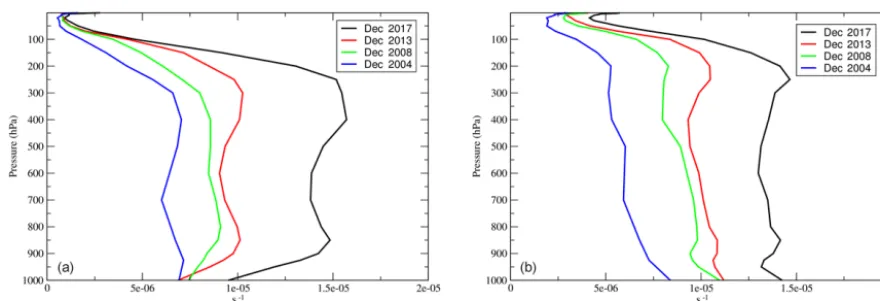
xn−1+Mδxnin the last minimi-sation 9 h into the 12 h assimilation window for vorticity(a)and divergence(b)in 2004, 2008, 2013 and 2017. Over the years, the resolution and number of inner and outer loops have increased from 60-level TL511/TL95-TL159 in 2004 to 137-level TCo1279/TL255-TL319-TL399 in 2017.
Mxn−1+δxn−Mxn−1+Mδxn, (6) and the globally averaged profile of the standard deviation of this quantity is shown in Fig. 1 for selected years from 2004 to 2017. Over the years, there has been an increase in the res-olution of the trajectory and the inner loops and the gap in resolution between the two has increased. This has resulted in increased differences, which we interpret as increased non-linearity due to the combination of increased model resolu-tion and resoluresolu-tion differences between the inner loop and the trajectory. One way to counteract the nonlinearity that comes with resolution increases is to shorten the length of the as-similation window. This can be achieved either by very short windows or by the use of overlapping assimilation windows. In this second case the reduction in nonlinearity is realised by reducing the size of the analysis incrementsδxn as each new window will start from a first guess trajectory that has already seen the observations in the overlapped part of the window.
3.2 The role of the observations
The significance of nonlinearities in the observation opera-tors can be estimated using statistics from the Ensemble of Data Assimilations (EDA, Isaksen et al., 2010) system which is run operationally at ECMWF. Each ensemble member is initialised using a perturbed model state with perturbations drawn from a distribution with zero mean. For linear obser-vation operators and Gaussian perturbations, the ensemble mean of the model equivalents provided by the observation operators is expected to be close to the unperturbed control member (in fact, it should match it exactly in the limit of infinite ensemble size):
1 N
XN
i=0Gk(x0+δxi)=
1 N
XN
i=0Gk(x0) + 1
N XN
i=0Gk(δxi)=Gk(x0)+Gk
XN i=0δxi
∼
=Gk(x0) . (7)
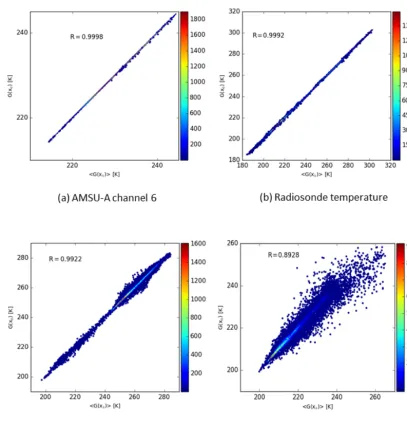
Figure 2a–d show the relationship between the ensemble mean model equivalent value and the model equivalent val-ues in the unperturbed control member for different obser-vation types. For obserobser-vations sensitive to tropospheric tem-perature, such as the Advanced Microwave Sounding Unit A (AMSU-A) channel 6 (Fig. 2a) and radiosonde temperature observations (Fig. 2b), a strong linear relationship holds, in-dicating that nonlinear effects in the observation operators are negligible. However, operators associated with observa-tions sensitive to humidity and cloud show more significant nonlinear behaviour. For example, the Advanced Technology Microwave Sounder (ATMS) channel 20 (Fig. 2c) is sensi-tive to humidity and the Advanced Microwave Scanning Ra-diometer 2 (AMSR-2) channel 11 (Fig. 2d) is sensitive to cloud liquid water.
4 Dealing with nonlinearities through the incremental approach
Figure 2.Ensemble meanG(x)(xaxis) against control memberG(x)for(a)AMSU-A channel 6 in clear-sky locations,(b)radiosonde temperature,(c)ATMS channel 20 (clear-sky) and(d)ASMR-2 channel 11 observations (all-sky).
is repeated for all minimisations, which can be at different resolutions, starting with the lowest resolution to capture the larger scales and increasing the resolution in later minimisa-tions to extract more detailed information from the observa-tions (Veerse and Thépaut, 1998).
4.1 Impact diagnostics in observation space
Bauer et al. (2010) discussed how the difference in departures at the end of each minimisation step, and those in the subse-quent nonlinear trajectory step (i.e.δdk=dknon-linear−dklinear), indicate the presence of nonlinearities in the system. Fig-ure 3 shows the standard deviation of the guess departFig-ures at each stage of the operational 4D-Var for AMSR-2 chan-nel 10, which is sensitive to water vapour (see Sect. 5 for
details of the operational 4D-Var set-up). It can be seen that each minimisation improves the fit between the model trajec-tory and the observations. However, the standard deviation in each nonlinear trajectory step is consistently higher than that at the end of the previous minimisation. This is to be ex-pected because of the resolution difference between ear and linearised models and also due to the fact that nonlin-ear processes cannot be represented by the linnonlin-ear model and operators used in the minimisations.
Figure 3. Standard deviation of departures for AMSR-2 channel 10 in the nonlinear trajectories (circles) and at the end of the min-imisation of the linearised cost function (triangles) for each outer loop of 4D-Var. Note how the nonlinear and linearised departure standard deviations should coincide in the linear case. The average background error standard deviation in observation space for this type of observation is 3.4 K. Results from a single cycle from the ECMWF operational assimilation system.
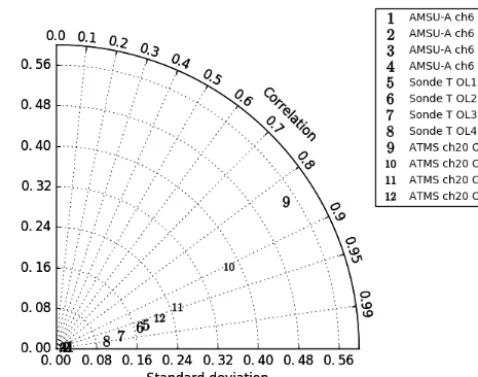
significant than for ATMS channel 20 (which is sensitive to humidity).
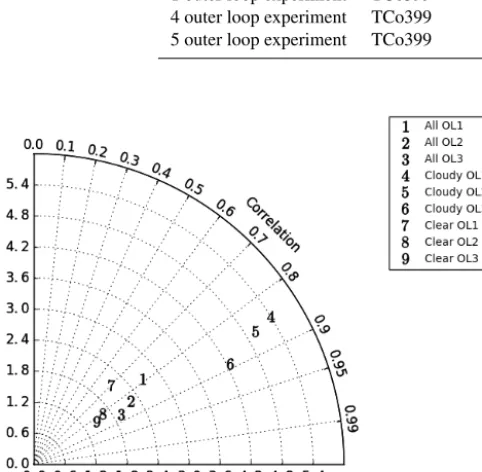
As expected, the departures for observations sensitive to cloud and humidity show increased nonlinear impacts. Fig-ure 5 shows results from AMSR-2 channel 11 categorised using estimates of cloudiness from both the observations and the model fields (Geer and Bauer, 2011). It can be seen that the linear assumption holds less well for observations in cloudy regions compared to those in areas of clear sky. 4.2 Impact diagnostics in model space
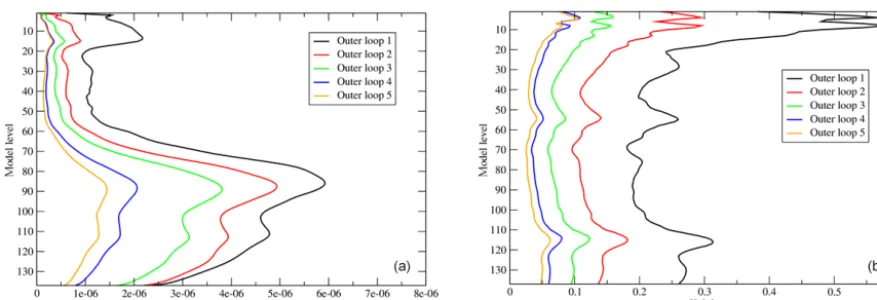
A clear indicator of the success or otherwise of the incre-mental strategy is the size of the analysis increments pro-duced by the linearised cost function (3) during successive outer loop iterations. For a well-behaved incremental 4D-Var converging towards the solution of the nonlinear cost function (1), successive analysis increments are expected to become smaller, reflecting the hypothesis that successive first guess trajectories provide increasingly accurate descrip-tions of the flow. This hypothesis is supported by the ex-perimental results shown in Fig. 6, where we present the vertical profiles of the standard deviations of the analysis increments of vorticity (left panel) and temperature (right panel) from a multi-incremental 4D-Var experiment with five outer loops (in this experiment the outer loop resolution is TCo399, approx. 30 km, and the inner loop resolutions are TL95/TL159/TL255/TL255/TL255, approx. 210, 125, and 80 km; more details in Table 1). The magnitude of the
analy-Figure 4.Taylor diagram showing the correlation (azimuthal an-gle) and standard deviation (distance from the origin) of the dif-ferences in the departures (K) between the nonlinear trajectory and linear minimisation steps for each outer loop. Results are shown for satellite brightness temperature observations (ASMU-A channel 6, ATMS channel 20) and radiosonde temperature observations.
sis increments is seen to gradually decrease for successive outer loop iterations, more rapidly in the stratosphere for vorticity. After five outer loop iterations, the magnitude of the analysis increments appears to asymptote to a relatively small value for temperature throughout the atmospheric col-umn (1Ta≈0.05 K), and for vorticity in the stratosphere
and mesosphere (1voa≈10−7s−1for model levels greater
Table 1.Resolution and number of outer loop iterations for the sensitivity experiments discussed in Sect. 5. TCo399 means IFS model integrations with spectral triangular truncation 399 and a cubic octahedral reduced Gaussian grid. TLXXX mean IFS model integrations carried out at spectral triangular truncation XXX on a linear reduced Gaussian grid. All minimisations are performed using the full physics tangent linear and adjoint models.
Experiment Resolution of Number of Resolution of outer loop outer loops minimisations
Reference TCo399 3 TL95/TL159/TL255 1 outer loop experiment TCo399 1 TL255
4 outer loop experiment TCo399 4 TL95/TL159/TL255/TL255 5 outer loop experiment TCo399 5 TL95/TL159/TL255/TL255/TL255
Figure 5.As Fig. 4 but showing results from AMSR-2 channel 11 categorising observations by those in clear-sky regions and those impacted by cloud.
4.3 A test case
An informative example of the effectiveness of incremental 4D-Var in dealing with nonlinear error evolution in active weather systems is described in the following test case of organised convection in the southern United States. These high-impact weather phenomena are particularly interesting from a data assimilation perspective because: (1) they have been shown to be potential precursors of significant forecast “busts” in downstream regions, Europe in particular (Rod-well et al., 2013); and (2) they occur in probably the most densely observed region of the world, thus allowing a more in-depth look into the ability of the assimilation system to make effective use of the observations.
In the case described here, large-scale organised convec-tion with the satellite signature of a mesoscale convective complex (Fig. 8, left panel), was forming in the southern US coastal plains in the local evening hours of 3 May 2017, continuing for most of the night. The synoptic situation, as depicted by the ECMWF operational analysis (Fig. 8, right
panel) is characteristic of this type of event (Maddox, 1980): a strong warm, moist southerly flow from the Gulf of Mex-ico is taking place in the lower troposphere, in the region ahead of an upper level trough. The combination of strong warm and moist air advection in the lower levels with vortic-ity advection aloft leads to a situation conducive to intense organised convection in a region along the Texas–Louisiana coast, starting at around 13:00 UTC on the 3 May 2017 and lasting until approx. 06:00 UTC on 4 May 2017. Forecasting the intensity and location of convection is notoriously diffi-cult and the ECMWF analysis increments (Fig. 9) show that the operational 4D-Var makes significant changes to the first guess fields throughout the atmospheric column. In particu-lar, the analysis appears to adjust the strength of the convec-tive system through a significant cooling at the top of the tro-posphere and associated enhancement of the divergent wind field (Fig. 9, left panel). In the boundary layer (Fig. 9, right panel), the analysis increments show more spatial variability, but the main signal of localised warming and convergence of the wind field in the direction of movement of the convective system are apparent.
Figure 6.Vertical profiles of the globally averaged standard deviation of the analysis increments produced by successive outer loop iterations for vorticity(a)and temperature(b). Values have been averaged over a 1-month period. The assimilation experiment has been run with an outer loop resolution corresponding to a cubic octahedral reduced Gaussian grid with spectral truncation 399 (TCo399, approx. 30 km grid spacing), and inner loop resolutions corresponding to linear reduced resolution Gaussian grids at spectral truncations TL95/159/255/255/255, corresponding to approx. 210/120/80 km grid spacing.
and/or model errors; or missing representativeness errors in the specified observation errors. We note that the wind ob-servations whose departures are shown in the plots in Fig. 10 come from the US radiosonde network and from aircraft ob-servations, which implies that linear observation operators are used. Thus, the nonlinear effects seen in the plots arise exclusively from nonlinearities in the evolution of model per-turbations in the assimilation window.
5 Results from cycling data assimilation experiments
The diagnostics presented in Sect. 4 showed that increasing the number of outer loop iterations in the ECMWF 4D-Var helps to reduce the magnitude of nonlinearities in the analy-sis and suggests that it can lead to a better use of available ob-servations, in particular those that are nonlinearly related to the model state. The next step is then to verify that these find-ings are confirmed in a cycled data assimilation environment as close as is computationally affordable to the operational ECMWF assimilation system. To this end a series of data as-similation experiments has been run with a recent ECMWF IFS cycle (cycle 43R3, operational from July 2017), in which only the horizontal spatial resolution has been changed for both outer loops and inner loop minimisations. The opera-tional 4D-Var runs three outer loops at TCo 1279 resolution (approx. 9 km) and performs three inner loop minimisations at TL255/TL319/TL399 resolution (approx. 80/60/50 km). In the experiments described here the outer loop resolution has been reduced to TCo399 (approx. 30 km) and the inner loop resolutions vary from TL95 to TL159 to TL255 (ap-prox. 210, 125, and 80 km; more details in Table 1). The number of outer loop updates varies from one to five. In the following, we present results for the one, three, four and five outer loop experiments. In these experiments, the full
obser-vational dataset used in operations at ECMWF has been as-similated. The number of inner loop iterations in the minimi-sations is not prescribed, because minimiminimi-sations stop when a convergence criterion based on the information content of the minimisation is reached (Fisher, 2003). Convergence is usually reached in approx. 30 iterations, and this number has been found not to be sensitive to resolution and number of outer loop relinearisations. A hard stopping criterion of 50 it-erations is also present, but in all the experiments reported here it was never reached. An additional point to note is that all the experiments have at least one minimisation performed at the highest resolution (i.e. TL255). Thus, differences in analysis and forecast performance cannot be attributed to ei-ther insufficient resolution in the minimisation or incomplete convergence.
5.1 Analysis skill – full observing system
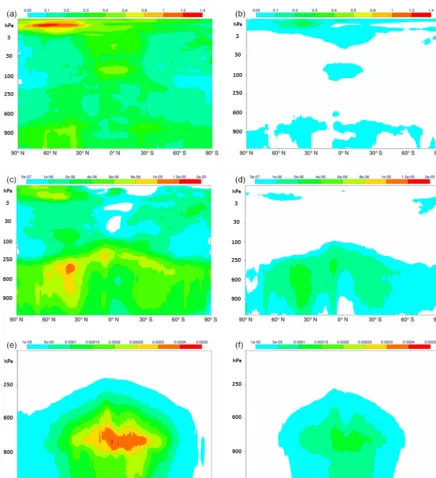
Figure 7.Vertical profiles of the longitudinally averaged standard deviation of the analysis increments produced at the end of the first outer loop minimisation(a, c, e)and the fifth outer loop minimisation(b, d, f)for temperature(a, b), vorticity(c, d)and humidity(e, f). Details of the assimilation experiments as described in text.
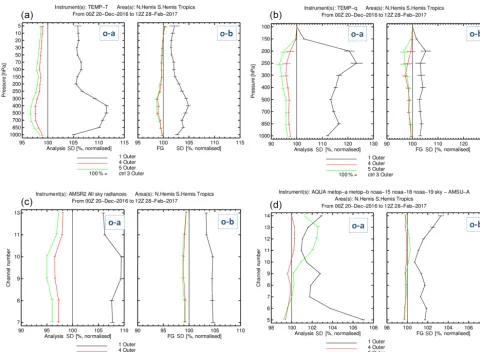
A representative sample ofo−a ando−b departures is shown in Fig. 11. In these plots the observation departures for a standard three outer loop 4D-Var assimilation cycle are used as a baseline against which the departures for one, four and five outer loop experiments are compared. The first thing to note is the significant degradation in botho−aando−b statistics of the one outer loop experiment. This degradation is visible for all observation types (not shown) and indicates that a linear analysis update is inadequate in the context of a 12 h assimilation window. The other significant result is that
increasing the number of outer loops to four, and to a smaller extent five, can bring additional benefits in the tropospheric analysis, in particular for observations sensitive to humid-ity and clouds and for wind observations (not shown). This confirms the diagnostics of Figs. 6 and 7, i.e. that the wind and humidity analysis increments in the troposphere are still relatively large in the fourth and fifth outer loop updates, in-dicating that the minimisation has not fully converged.
Figure 8. (a)Infrared image of the continental US from the GOES-13 geostationary satellite, valid on 3 May 2017, 17:45 UTC (credits: National Centers for Environmental Information, NOAA).(b)ECMWF operational analysis of geopotential at 200 hPa (continuous isolines), temperature at 200 hPa (dashed isolines) and equivalent potential temperature at 850 hPa (shaded, units Kelvin), valid on 3 May 2017, 18:00 UTC.
Figure 9. (a)ECMWF operational analysis of geopotential at 200 hPa (continuous isolines), temperature analysis increments at 150 hPa (colour shaded, units Kelvin) and wind vector analysis increments at 150 hPa (arrows, units m s−1), valid on 3 May 2017, 12:00 UTC.(b)as left, all quantities at 850 hPa.
stratospheric-peaking channels of the microwave (Fig. 11, bottom right, channels 10 to 14) and infrared hyperspectral instruments (not shown). This is particularly visible in the five outer loop experiment, whereo−astatistics are clearly degraded for channels 10 to 14 (approx. peaking from 50 to 2 hPa) while the degradation in the fit to the short-range forecast(o−b)is only marginal. This result can be partially explained by the diagnostic shown in Fig. 1, where it was shown that the magnitude of nonlinear effects in the ECMWF analysis system is relatively small in the stratosphere. Thus, the incremental minimisation can be expected to converge more rapidly in the stratosphere and additional outer loops beyond the standard three cannot be expected to significantly improve o−a ando−b fits. On the other hand, the reason why these fits are actually degraded is the subject of
cur-rent investigations. Preliminary results indicate that the main cause of this behaviour can be traced to the different time steps used in the inner and outer loops. This difference in time steps leads to different speeds of propagation of grav-ity waves in the stratosphere, which then leads to oscillating behaviour in the minimisation. This is ongoing work and we defer a more complete treatment of this interesting effect to a future publication.
5.2 Forecast skill – full observing system
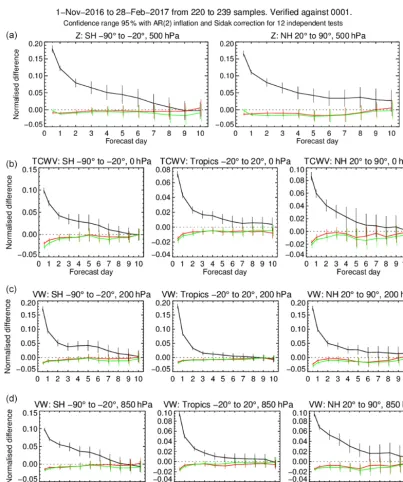
geopo-Figure 10.Standard deviation of wind vector observation minus model departures over the 09:00 to 21:00 UTC assimilation window of 3 May 2017 in the 100–400 hPa layer for a pre-operational version of the IFS 43R3 cycle: first guess departures(a); a one outer loop analysis departures(b); a three outer loop analysis departures(c); a five outer loop analysis departures(d).
tential rms forecast error, top row), the water cycle (total col-umn water vapour rms error, second row) and the wind field (200 and 850 hPa wind vector rms errors, third and bottom row). All the diagnostics confirm the significant degradation in performance for the one outer loop experiment and the small but statistically significant improvement of the four and five outer loop experiments with respect to the baseline three outer loop experiment. In the stratosphere (not shown) fore-cast skill scores again show degraded performance for the one outer loop experiment, while results are mostly neutral or slightly positive for the four and five outer loop exper-iments. One notable exception is the tropical stratospheric layer from 5 to 1 hPa, where the five outer loop experiment shows a statistically significant degradation, again confirm-ing the analysis skill diagnostic results.
5.3 Analysis and forecast skill – linear observation operators
In Sect. 2 of this paper we have shown how nonlinear effects in 4D-Var arise from two different sources: nonlinearities
Figure 11.Normalised standard deviations of analysis(o−a)and first guess(o−b)departures for radiosonde temperature observations(a); radiosonde humidity observations(b); the microwave imager AMSR-2(c); the combined observations from the AMSU-A microwave sounder instrument onboard the AQUA, METOP-A/B, and NOAA-15/18/19 satellites (d). The 100 % baseline refers to the three outer loop ex-periment, the black/red/green lines to the one/four/five outer loop experiments, respectively. Values smaller/larger than 100 indicated a tighter/looser fit of the analysis/first guess to the observations relative to the three outer loop baseline experiment. Values are averaged over the 20 December 2016 to 28 February 2017 period. Error bars represent 95 % confidence levels.
cloud and precipitation) that is responsible for the additional benefit of running more than the current three outer loops.
6 Discussion and conclusions
In modern atmospheric data assimilation (and, arguably, in most of the other Earth system components as well) nonlin-earities play an ever more important role. This is due to the ever-increasing resolution and complexity of the prognostic models, which exhibit instabilities at smaller scales and thus present faster nonlinear error growth during the assimilation window, and to the emergence of an array of observations that are nonlinearly related to the control vector variables used in the variational analyses. Both these trends are ex-pected to continue in the near future, which makes the
ca-pacity of the assimilation algorithms to deal effectively with nonlinear effects an increasingly important benchmark.
Figure 12.Normalised root mean square forecast errors for geopotential at 500 hPa(a); total column water vapour(b); wind vector at 200 hPa(c); wind vector at 850 hPa(d). The black/red/green lines refer to the one/four/five outer loop experiments, respectively. Errors are normalised with respect to the three outer loop experiments and are computed using the operational ECMWF analysis as verification. Error bars represent 95 % confidence levels.
loop updates, appear beneficial both in terms of analysis quality and in terms of general forecast skill. Results from limited additional experimentation (not shown) also indicate that more than five outer loops do not appear to bring further benefits, at least in the experimental configuration we have used.
One interesting question is about the limits of applicabil-ity of the multi-incremental approach in the ECMWF data
analy-Figure 13.Normalised root mean square forecast errors for geopotential at 500 hPa(a); total column water vapour(b); wind vector at 200 hPa(c); wind vector at 850 hPa(d)for the assimilation experiments using the linear observations subset. The black/red lines refer to the one/four outer loop experiments, respectively. Errors are normalised with respect to the three outer loop experiment and are computed using the operational ECMWF analysis as verification. Error bars represent 95 % confidence levels.
sis introduced by the assimilation of nonlinear observations (mainly humidity and cloud and precipitation sensitive ra-diances) affect the stratospheric analysis either through the shape of the background error spatial correlations or by the generation of gravity wave structures in the initial conditions. Remarkably, the stratospheric degradation of the multi-outer loop experiments also disappeared in tests run with the full observing system with matching time steps for the outer and inner loop integrations. This result gives further support to
the hypothesis that the representation in the 4D-Var analysis of stratospheric gravity waves excited by the assimilation of all-sky observations could be one of the main drivers of these effects. These interactions are currently being investigated.
where the first guess departures are at least 1 order of mag-nitude larger than the assumed observation errors. In most cases, use of more realistic values of the observation errors, which better take into account the representativity and obser-vation operator components, are sufficient to regularise the minimisation.
While the advantages of being able to run an increased number of outer loop linearisations are clear, the question remains on how to fit them inside the typically tight opera-tional schedules of operaopera-tional weather centres. Taking the ECMWF data assimilation system as an example, the three outer loops 4D-Var analysis has about 45 min to complete. Given the sequential nature of the 4D-Var minimisation, each additional outer loop would increase this time by approx. 15 min. This implies that, in the current set-up, the obser-vation cut-off time would have to be pushed back by a simi-lar time interval, quickly negating any advantage that the in-creased number of outer loops might bring. One possible way to overcome this problem would be to allow late arriving ob-servations to enter the assimilation at successive outer loop updates. This would effectively push the observation cut-off time forward to the beginning of the last minimisation, thus allowing to start the 4D-Var analysis earlier and consequently accommodate additional outer loop updates. This assimila-tion framework, which we call “continuous DA”, is currently being tested at ECMWF and results will be documented in a forthcoming paper. Note that in the continuous DA the prob-lem being solved is conceptually different from that of incre-mental 4D-Var. In increincre-mental 4D-Var we solve a nonlinear problem through repeated linearisations. In the continuous DA we solve a sequence of slightly different nonlinear min-imisation problems, taking advantage of increasingly accu-rate first guess trajectories.
Another possible approach to increase the number of outer loops within the operational time constraints is to adopt an “overlapping” assimilation window framework, for exam-ple along the lines discussed in Bonavita et al. (2017a). In this configuration, observations that have been assimilated in both successive overlapping windows will have effectively be seen by twice the number of guess trajectories as in a stan-dard non-overlapping configuration. This idea, similar to the quasi-static variational DA approach of Pires et al. (1996) and Jarvinen et al. (1996), is also being actively investigated.
Data availability. The datasets used in this work are avail-able from ECMWF under the terms and conditions specified at https://www.ecmwf.int/en/forecasts/accessing-forecasts/ order-historical-datasets (last access: 1 September 2018).
Author contributions. All the authors have equally contributed to all parts of the paper and the work described in it.
Competing interests. The authors declare that they have no conflict of interest.
Special issue statement. This article is part of the special is-sue “Numerical modeling, predictability and data assimilation in weather, ocean and climate: A special issue honoring the legacy of Anna Trevisan (1946–2016)”. It is a result of a Symposium Honor-ing the Legacy of Anna Trevisan – Bologna, Italy, 17–20 October 2017.
Acknowledgements. One of the authors (Massimo Bonavita) would like to express his gratitude to the organisers of the Anna Trevisan Symposium, and to Alberto Carrassi in particular, for setting up a very successful and interesting meeting and for being such attentive and considerate hosts.
The authors would also like to thank the reviewers and the editor for their careful examination of our manuscript and the many constructive proposals for its improvement.
Edited by: Michael Ghil
Reviewed by: four anonymous referees
References
Andersson, E., Fisher, M., Holm, E., Isaksen, L., Radnòti, G., and Trémolet, Y.: Will the 4D-Var approach be de-feated by nonlinearity? ECMWF Tech. Memo. 479, avail-able at: https://www.ecmwf.int/sites/default/files/elibrary/2005/ 7768-will-4d-var-approach-be-defeated-nonlinearity (last ac-cess: 1 September 2018), 2005.
Bauer, P., Geer, A. J., Lopez, P., and Salmond, D.: Direct 4D-Var as-similation of all-sky radiances. Part I: Implementation, Q. J. Roy. Meteor. Soc., 136, 1868–1885. https://doi.org/10.1002/qj.659, 2010.
Björck, A.: Numerical methods for least squares problems, SIAM, Philadelphia, ISBN 0-89871-360-9, 1996.
Bonavita, M., Trémolet, Y., Holm, E., Lang, S. T. K., Chrust, M., Janisková, M., Lopez, P., Laloyaux, P., De Rosnay, P., Fisher, M., Hamrud, M., and English, S.: A Strategy for Data Assimilation, ECMWF Technical Memorandum n. 800, available at: https: //www.ecmwf.int/en/elibrary/17179-strategy-data-assimilation (last access: 1 September 2018), 2017a.
Bonavita, M., Dahoui, M., Lopez, P., Prates, F., Hólm, E., De Chiara, G., Geer, A., Isaksen, L., and Ingleby, B.: On the ini-tialization of Tropical Cyclones. ECMWF Technical Memo-randum n. 810, available at https://www.ecmwf.int/en/elibrary/ 17677-initialization-tropical-cyclones (last access: 1 Septem-ber 2018), 2017b.
Carrassi, A., Ghil, M., Trevisan, A., and Uboldi, F.: Data assim-ilation as a nonlinear dynamical system problem: Stability and convergence of the prediction-assimilation system, Chaos, 18, 023112, https://doi.org/10.1063/1.2909862, 2008.
Gauthier, P.: Chaos and quadri-dimensional data assimilation: a study based on the Lorenz model, Tellus A, 44, 2–17, https://doi.org/10.1034/j.1600-0870.1992.00002.x, 1992. Gauthier, P., Tanguay, M., Laroche, S., Pellerin, S., and Morneau, J.:
Extension of 3DVAR to 4DVAR: implementation of 4DVAR at the meteorological service of Canada, Mon. Weather Rev., 135, 2339–2354, https://doi.org/10.1175/MWR3394.1, 2007. Geer, A. J. and Bauer, P.: Observation errors in all-sky
data assimilation, Q. J. R. Meteor. Soc., 137, 2024–2037, https://doi.org/10.1002/qj.830, 2011.
Geer, A. J., Baordo, F., Bormann, N., Chambon, P., English, S. J., Kazumori, M., Lawrence, H., Lean, P., Lonitz, K., and Lupu, C.: The growing impact of satellite observations sensitive to humid-ity, cloud and precipitation, Q. J. Roy. Meteor. Soc., 143, 3189– 3206, https://doi.org/10.1002/qj.3172, 2017.
Gratton, S., Lawless, A., and Nichols, N. K.: Approximate Gauss– Newton methods for nonlinear least squares problems, SIAM J. Optimiz., 18, 106–132, https://doi.org/10.1137/050624935, 2007.
Hólm, E. V., Andersson, E., Beljaars, A. C. M., Lopez, P., Mahfouf, J.-F., Simmons, A., and Thépaut, J.-J.: Assimila-tion and Modelling of the Hydrological Cycle: ECMWF’s Status and Plans. ECMWF Tech. Memo. 383, available at: https://www.ecmwf.int/sites/default/files/elibrary/2002/9996- assimilation-and-modelling-hydrological-cycle-ecmwfs-status-and-plans.pdf (last access: 1 September 2018), 2002.
Hoteit, I.: A reduced-order simulated annealing approach for four-dimensional variational data assimilation in meteorology and oceanography, Int. J. Numer. Meth. Fl., 58, 1181–1199, https://doi.org/10.1002/fld.1794, 2008.
Isaksen, L., Bonavita, M., Buizza, R., Fisher, M., Haseler, J., Leutbecher, M., and Raynaud, L.: Ensemble of data assimilations at ECMWF. ECMWF Tech. Memo. 636, available at: https://www.ecmwf.int/en/elibrary/ 10125-ensemble-data-assimilations-ecmwf (last access: 1 September 2018), 2010.
Janisková, M. and Lopez, P.: Linearized physics for data assimila-tion at ECMWF, in: Data assimilaassimila-tion for Atmospheric, Oceanic and Hydrological Applications (Vol. II), edited by: Park, S. K. and Xu, L., Springer-Verlag Berlin Heidelberg, 251–286, https://doi.org/10.1007/978-3-642-35088-7, 2013.
Jarvinen, H., Thépaut, J. N., and Courtier, P.: Quasi-continuous vari-ational data assimilation, Q. J. Roy. Meteor. Soc., 122, 515–534, 1996.
Kadowaki, T.: A 4-Dimensional Variational Assimilation System for the JMA Global Spectrum Model, CAS/JAC WGNE
Re-https://doi.org/10.1002/qj.36, 2007.
Maddox, R. A.: Mesoscale Convective Complexes, B. Am. Meteorol. Soc., 61, 1374–1387, https://doi.org/10.1175/1520-0477(1980)061<1374:MCC>2.0.CO;2, 1980.
Malardel, S., Wedi, N., Deconinck, W., Diamantakis, M., Kühn-lein, C., Mozdzynsky, G., Hamrud, M., and Smolarkiewicz, P.: A new grid for the IFS. ECMWF Newsletter No. 146, Winter 2015/16, available at: https://www.ecmwf.int/sites/default/files/ elibrary/2016/17262-new-grid-ifs.pdf (last access: 1 Septem-ber 2018), 2016.
Miller, R. N., Ghil, M., and Gauthiez, F.: Advanced Data Assimilation in Strongly Nonlinear Dynamical Systems, J. Atmos. Sci., 51, 1037–1056, https://doi.org/10.1175/1520-0469(1994)051<1037:ADAISN>2.0.CO;2, 1994.
Pires, C., Vautard, R., and Talagrand, O.: On extending the limits of variational assimilation in nonlinear chaotic systems, Tellus A, 48, 96–121, 1996.
Rabier, F. and Courtier, P.: Four-Dimensional Assimilation in the Presence of Baroclinic Instability, Q. J. Roy. Meteor. Soc., 118, 649–672, https://doi.org/10.1002/qj.49711850604, 1992. Rabier, F., Järvinen, H., Klinker, E., Mahfouf, J.-F., and
Sim-mons, A.: The ECMWF operational implementation of four-dimensional variational assimilation. Part I: Experimental results with simplified physics, Q. J. Roy. Meteor. Soc., 126, 1143– 1170, https://doi.org/10.1002/qj.49712656415, 2000.
Radnòti, G., Trémolet, Y., Andersson, E., Isaksen, L., Hólm, E. V., and Janiskova, M.: Diagnostics of linear and in-cremental approximations in 4D-Var revisited for higher resolution analysis, ECMWF Tech Memo 479, available at: https://www.ecmwf.int/en/elibrary/11816-diagnostics-linear-and-incremental-approximations-4d-var-revisited-higher (last access: 1 September 2018), 2005.
Rawlins, F., Ballard, S. P., Bovis, K. J., Clayton, A. M., Li, D., Inverarity, G. W., Lorenc, A. C., and Payne, T. J.: The Met Office global four-dimensional variational data as-similation scheme, Q. J. Roy. Meteor. Soc., 133, 347–362, https://doi.org/10.1002/qj.32, 2007.
Rodwell, M. J., Magnusson, L., Bauer, P., Bechtold, P., Bonavita, M., Cardinali, C., and Diamantakis, M.: Characteristics of occa-sional poor medium-range weather forecasts for Europe, B. Am. Meteorol. Soc., 94, 1393–1405, https://doi.org/10.1175/BAMS-D-12-00099.1, 2013.
Tanguay, M., Bartello, P., and Gauthier, P.: Four-dimensional data assimilation with a wide range of scales, Tellus A, 47, 974–997, https://doi.org/10.1034/j.1600-0870.1995.00204.x, 1995. Tavolato, C. and Isaksen, L.: On the use of a Huber norm for
obser-vation quality control in the ECMWF 4D-Var, Q. J. Roy. Meteor. Soc., 141, 1514–1527, https://doi.org/10.1002/qj.2440, 2015. Trémolet, Y.: Diagnostics of linear and incremental
approxima-tions in 4D-Var, Q. J. Roy. Meteor. Soc., 130, 2233–2251, https://doi.org/10.1256/qj.03.33, 2004.
Trémolet, Y.: Incremental 4D-Var convergence study, Tellus A, 59, 706–718, https://doi.org/10.1111/j.1600-0870.2007.00271.x, 2007.
Trevisan, A. and Uboldi, F.: Assimilation of standard and targeted observations within the unstable subspace of the observation – analysis –forecast cycle system, J. Atmos. Sci., 61, 103–113, 2004.
Trevisan, A., D’Isidoro, M., and Talagrand, O.: Four-dimensional variational assimilation in the unstable subspace and the opti-mal subspace dimension, Q. J. Roy. Meteor. Soc., 136, 487–496, 2010.