MICROBIAL COMMUNITIES REGULATE NITROGEN USE EFFICIENCY BY BALANCING TRADEOFF BETWEEN RESOURCE ACQUISITION AND GROWTH RATE
BY
BENNETT EDWARD THOMPSON B.A., Biology, Swarthmore College, 2016
THESIS
Submitted to the University of New Hampshire in Partial Fulfillment of
the Requirements for the Degree of
Master of Science in
Natural Resources: Soil and Water Resource Management
This thesis/dissertation was examined and approved in partial fulfillment of the requirements for the degree of Master of Science in Natural Resources: Soil and Water Resource Management by:
Thesis Director, Dr. A. Stuart Grandy, Associate Professor of Natural Resources and the Environment Dr. Serita Frey, Professor of Natural Resources and the Environment
Dr. Alexandra Contosta, Research Assistant Professor, Earth Systems Research Center
On August 6, 2019
ACKNOWLEDGEMENTS
This work would not have been possible without extensive support from my family, friends, and colleagues. Thank you to all members of the Grandy, Frey, and Ernakovich labs for help with lab work and conceptual development. I would like to especially note Scott Greenwood, Lauren Breza, and Kevin Geyer for instructing me in laboratory techniques; Mel Knorr and Amber Kittle for performing PLFA analyses; and Karen Morán-Rivera, Bethany Balstad, Diane
DeVries, Taylor Hennas, Marilu Shepardson, Lee Hildebrand, Brian Bartlett, and Aiyana Brough for lab assistance that kept me sane and on schedule. I owe a large part of my intellectual growth here to conversations with my committee: Stuart Grandy, Serita Frey, and Alix Contosta; and graduate members of the Grandy lab: Amanda Daly, Andrea Jilling, Emily Kyker-Snowman, and again Lauren Breza. I am especially grateful for the tight-knit Natural Resources and the
Environment community, spearheaded by Wendy Rose, Janice Mutschler, and Josephine Anes, without which New Hampshire would not have become home. Finally, I would like to
TABLE OF CONTENTS
ACKNOWLEDGEMENTS ... III LIST OF TABLES ... V LIST OF FIGURES ... VI ABSTRACT ... VII
INTRODUCTION ... 1
MATERIALS AND METHODS ... 9
RESULTS ... 19
DISCUSSION ... 22
CONCLUSION ... 29
LIST OF REFERENCES ... 30
TABLES AND FIGURES ... 38
LIST OF TABLES
Table 1: Effects of agricultural treatment, incubation sampling day, and their interaction ... 38
Table 2: Soil chemical properties of mesocosms ... 38
Table 3: Soil microbial processes and properties...39
Table 4: Spearman correlations of soil and microbial variables with CUE and NUE ... 40
LIST OF FIGURES
ABSTRACT
MICROBIAL COMMUNITIES REGULATE NITROGEN USE EFFICIENCY BY BALANCING TRADEOFF BETWEEN RESOURCE ACQUISITION AND GROWTH RATE
by
Bennett Thompson
University of New Hampshire, September 2019
Microbial nitrogen use efficiency (NUE) is the portion of N uptake that microbes allocate to growth versus mineralize as ammonium and is thus a critical parameter governing the
transformation of organic to inorganic nitrogen. Microbial NUE is sensitive to changes in the soil environment, but its microbial controls remain untested. I performed an incubation where
identical mesocosms were inoculated with three distinct microbial communities derived from agricultural land management (conventional, organic, and deciduous forest). Through this
incubation, I explored three scales at which communities may exercise control over NUE: in how microbes alter their soil environment through system-level processes; through their
stoichiometric and community composition; and through community physiology. My results indicate that microbial activity and physiology are most strongly related to NUE in this
controlled environment. Specifically, I show that NUE is positively related to microbial growth rate and not resource acquisition. I also empirically demonstrate for the first time that CUE and NUE are positively related. From these results I conclude that microbes may be important
Introduction
Attempts to model the soil nitrogen (N) cycle have been hampered for years by our lack of understanding of the microbes that mediate it. Soil microbes are responsible for transforming N across nine different forms, spanning enormous polymeric organic N molecules to tiny dinitrogen gas (Robertson and Groffman, 2015). These microbial N transformations are particularly important to soil fertility in both unmanaged and agricultural systems. Even fertilized crops derive the majority of their N from the soil, and microbes help regulate the availability of N (Gardner and Drinkwater, 2009; Jilling et al., 2018). However, the contribution of N to fertility goes hand in hand with its potential to contribute to pollution. In excess,
inorganic nitrate (NO3-) harms drinking water and causes coastal dead zones, while oxides of
nitrogen (NOx) contribute to ozone depletion, acid rain, and climate change (Robertson and
Vitousek, 2009). The two-sided nature of N challenges farmers to manage soil and fertilizer N efficiently, optimizing its contributions to crop yield while minimizing its losses to the
environment (Bowles et al., 2018). In response to this challenge farmers have sought guidance for fertilizer applications that is holistic and responsive to variation in soil N availability (Reimer et al., 2017). While over a century of research has described the pathways by which microbes transform soil N and make it available to plants, we still struggle to predict the magnitude of these transformations. Better understanding the microbes that perform them, however, is a promising step in that direction.
then uptake these N-rich monomers. Microbes metabolize N monomers to grow biomass and maintain cellular function; any N they uptake in excess of their demand, however, they mineralize and excrete as ammonium (Mooshammer et al., 2014a). These two microbial processes—depolymerization and the allocation of N to biomass versus mineralization—
constitute critical junctures in the N cycle, and yet remain under-studied. Recent methodological advances have enabled us begin studying the controls on gross depolymerization through the breakdown of proteins to amino acids (Noll et al., 2019; Wanek et al., 2010). However, research on microbial N allocation to biomass versus mineralization has been much more limited.
Microbial allocation of N to biomass versus mineralization has been formalized into the concept of nitrogen use efficiency (NUE; Mooshammer et al., 2014a). Because NUE demarcates the proportion of depolymerized organic N that actually becomes ammonium, it serves as a fundamental regulator of the total transformation of organic to inorganic N. Only a handful of papers have empirically examined NUE (Mooshammer et al., 2014a; Wild et al., 2018; S. Zhang et al., 2019), and its theoretical development to date has relied heavily on research on microbial carbon use efficiency (CUE). Similar to NUE, CUE denotes the portion of C uptake that
microbes allocate to biomass growth versus respire as carbon dioxide (CO2). Microbial CUE has
been demonstrated to be a major physiological control over C cycling, influencing SOM
dynamics and C sequestration (Bradford et al., 2013; Frey et al., 2013; Kallenbach et al., 2015). Controls on CUE are varied; it integrates, and thus responds to, resource availability,
environmental conditions, microbial stoichiometric demand, metabolic activity, and community dynamics (Geyer et al., 2016; Manzoni et al., 2012). NUE likely has distinct controls from CUE, though the two are linked through metabolic stoichiometry (Mooshammer et al., 2014a;
the elemental imbalance between microbial communities and their resource (Sterner and Elser, 2002). Microbes have a relatively fixed biomass C:N averaging 8:1; comparatively, the SOM which they metabolize can range anywhere from 4-185:1 (Sinsabaugh et al., 2016). In order to maintain a consistent biomass C:N, stoichiometric theory predicts microbes can alter their CUE and/or NUE in order to offload whichever element is available in excess of microbial demand (Zechmeister-Boltenstern et al., 2015). By indicating changing rates of C or N mineralization from the soil, together variation in microbial CUE and NUE partially determine the fate of energy and nutrients in the soil environment.
Though research on microbial NUE is in its infancy, we have several lines of empirical evidence for how microbial NUE responds to environmental variables. Mooshammer et al. (2014a) used gross rates of amino acid uptake and N mineralization to calculate NUE,
demonstrating that NUE responds to the imbalance between microbial biomass C:N and SOM C:N. Using similar methodology, Wild et al. (2018) demonstrated that long term warming and drought moderately decreased microbial NUE, perhaps by releasing the microbial community from N-limitation. In an exciting advancement, S. Zhang et al. (2019) measured 18O-H2O
Indirect influence of system-level microbial processes on NUE
Soil microbes may indirectly affect NUE through system-level processes by which microbes alter their chemical environment (Figure 1a). Though NUE is sensitive to the C:N imbalance between SOM and microbial biomass, soil microbes are able to alleviate this imbalance through enzyme production. Microbes produce extracellular enzymes which
depolymerize SOM into dissolved organic matter (DOM), which microbes then directly uptake. Microbes are able to modulate enzyme production in order to target C- or N-rich compounds within the SOM pool, thereby forming a DOM pool with a reduced imbalance from microbial biomass C:N (Mooshammer et al., 2014b). These shifts in enzyme production to manage DOM C:N independent of SOMC:N may insulate NUE from needing to shift. Furthermore, the process of cell death deposits microbial necromass into the SOM pool, influencing SOMC:N over time. Heterotrophic microbial necromass is enriched in N compared to other sources of SOM, which would reduce NUE in the long term (Kaiser et al., 2014). Through these system-level processes, microbes may indirectly modulate NUE (Figure 1a).
Influence of the microbial community composition on NUE
Microbes may directly influence NUE through the stoichiometry of their biomass, which can vary with changes in community composition (Figure 1b). Though microbial biomass C:N is relatively constrained, it does vary, and largely by the composition of the community. For
driven primarily by shifts in microbial community structure (Fanin et al., 2013; Mooshammer et al., 2014b). Thus, microbial biomass C:N is likely an important control on NUE, and shifts in community structure may directly alter the C:N imbalance between microbial biomass and SOM.
Community composition may also drive differences in microbial processes (Figure 1a), thereby indirectly influencing NUE. Microbial communities can vary in their capacity to produce extracellular enzymes depending on community composition (Trivedi et al., 2016), which would influence their capacity to regulate DOM C:N. Microbial physiology may also directly vary due to community composition (Figure 1c). For example, CUE can vary widely among fungi, but is phylogenetically constrained (Morrison, 2017). It is possible that NUE may be similarly
phylogenetically dependent. It is, however, an ongoing project in the field of soil ecology to assess how variation in microbial community composition relates to community-scale
characteristics and ecosystem functioning (Graham et al., 2016; Reed and Martiny, 2007; Widder et al., 2016). While microbial biomass C:N presents a clear control on NUE, it is as of yet
unclear whether community composition may provide direct or indirect influence on NUE.
Role of microbial physiology as regulator of NUE
I have already discussed how microbial community composition may constrain NUE as it does CUE; however, elements of microbial physiology may serve as strong, direct regulators of NUE, even independent of community composition (Figure 1c). Physiology refers to the
functional properties of the microbial community at the cellular scale, such as the rate and efficiency with which microbes metabolize resources. Because of the outsized role soil microbes play in the transformation of energy and nutrients, their underlying physiology carries
historically understood there to be a tradeoff between growth rate and efficiency, based on an evolutionary perspective of fitness between oligotrophic and copiotrophic microbes. Copiotrophs are defined as fast-growing microbes that thrive in resource-rich environments; whereas,
oligotrophs grow more slowly, invest heavily in extracellular enzymes, and are more competitive in resource-limited environments (Fierer et al., 2007; Koch, 2001). Roller and Schmidt (2015) argued that oligotrophs must efficiently convert substrate to biomass in order to survive in a resource-limited environment. Without similar resource constraints, copiotrophs have less need to grow efficiently. The tradeoff between microbial growth rate and efficiency has been
demonstrated in both single strain cell cultures and whole soils, with the tradeoff generally attributed to less efficient fermentation metabolism employed by fast-growing microbes in glucose-rich environments (Anderson and Domsch, 1986; Lipson et al., 2009; MacLean and Gudelj, 2006; Pfeiffer et al., 2001; Shen and Bartha, 1996). However, the negative relationship between growth and efficiency conflicts with recent theory and research concerning community-scale growth efficiency in soils.
Formalizations in CUE theory suggest that oligotrophs that invest heavily in resource acquisition and cell maintenance may not be more efficient. From a mass-balance perspective, microbial growth is the total microbial C uptake less respiration and exudate production, where exudates are enzymes and metabolites that are not part of biomass and have faster turnover (Geyer et al., 2016; Manzoni et al., 2012). By this equation, microbes (such as oligotrophs) that produce more enzymes are allocating less C to growth, and thus have lower efficiency—with the same relationship holding true for N as well. This revised view of growth and efficiency has received support in recent models and studies. Kaiser et al. (2014) demonstrated that the
not) into an individual-based model increased CUE when resources became limiting, compared to a community composed only of degraders. This is accomplished by the decoupling of resource uptake from enzyme production. In other words, the individual microbes investing in enzyme production do not necessarily uptake the products of their enzymatic depolymerization. When cheaters uptake DOM instead of degraders, they are able to allocate more C to biomass, increasing the community’s overall CUE while decreasing enzyme production relative to the total community’s biomass. This inverse relationship between growth efficiency and investment in resource acquisition, as opposed to growth rate, has also held up in recent whole-soil
incubations (Kallenbach et al., 2015; Malik et al., 2019; Soares and Rousk, 2019). Though the relationship between growth rate and efficiency thus far has focused on CUE, I would expect the same relationship to hold for NUE as well. Because microbial biomass has a relatively
constrained C:N of 5-20 depending on the taxa present, C allocation to biomass is accompanied by a predictable allocation of N (Cleveland and Liptzin, 2007; Sinsabaugh et al., 2016). It stands to reason that fast-growing, efficient microbes that allocate more C to biomass must also allocate more N to biomass growth to maintain biomass C:N. Given the conflict in our understanding of the relationship between growth rate and efficiency, further exploring the contexts that modulate this relationship is essential to understanding how microbes may dynamically alter the
transformation of both C and N in soil.
for cellular maintenance depends on the taxon. For example, many soil fungi produce trehalose in response to heat stress, which is an extremely C-intensive compound to produce (Treseder and Lennon, 2015). Conversely, soil bacteria produce N-intensive amino acids to resist desiccation (Schimel et al., 2007). CUE and NUE may therefore respond differently to investments in
cellular maintenance, depending on the source of stress and the stoichiometry of dominant taxa’s stress response.
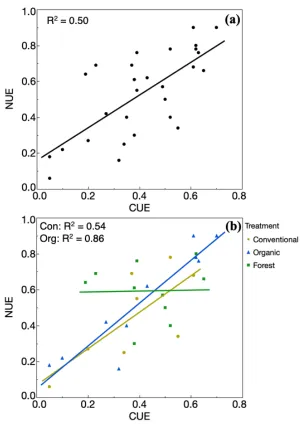
Finally, to my knowledge, no study has empirically demonstrated the relationship between CUE and NUE. Because CUE and NUE are expected to respond inversely to resource C:N, theory predicts that CUE and NUE must also be inversely related (Sinsabaugh et al., 2016; Zechmeister-Boltenstern et al., 2015). However, the fact that both CUE and NUE may be positively related to growth rate suggests that CUE and NUE may not always be at odds. For example, in a high growth rate, resource unlimited scenario, microbes that demand more C for biomass will simultaneously demand more N. It seems possible that fast-growing microbes would benefit from exploiting both C and N efficiently. Providing an empirical link between CUE and NUE is an important step to understanding the dynamic role microbes play in C and N cycling.
To test whether microbial communities themselves exert control over NUE, I performed incubations in identical mesocosms inoculated with microbial communities from three long-term land use treatments observed to have developed physiologically distinct communities
are all selection pressures for the soil microbial community size and composition. Organic management, which eschews synthetic fertilizer and pesticide usage, appears to boost soil microbial biomass over conventional management (Esperschütz et al., 2007; Kallenbach et al., 2015). However, this difference appears to be due less to the plant protection or tillage regime, and more a consequence of the type and quality of substrate addition to the soil (Hartmann et al., 2015; Jangid et al., 2008). In order to maintain soil fertility without the aid of synthetic
fertilizers, organic farmers rely on crop rotation, compost, and manure applications that increase the input of organic substrates to the soil microbial community. In some cases, this enhanced substrate availability increases the diversity of the soil microbial community (Lupatini et al., 2017; Tiemann et al., 2015). In others, the composition of the microbial community does not shift in response to organic management, but the physiology of the community does (Kallenbach et al., 2015). Whether due to shifts in microbial physiology or community composition,
agricultural management practices carry high potential to alter intrinsic microbial NUE. By introducing these agricultural microbes to an identical environment independent of differences in soil quality, I aim to test for the first time whether differences in NUE can emerge between microbial communities 1) indirectly, through microbial transformation of the soil environment over time, 2) directly, through microbial stoichiometric and community composition, or 3) directly due to intrinsic differences in physiology between communities.
Materials and methods Experimental site
(https://lter.kbs.msu.edu/research/long-term-experiments/main-cropping-system-experiment/). The site is located in Hickory Corners, Michigan (42°240 N, 85°240 W), with mean annual total precipitation of 1005 mm and mean annual temperature of 10.1 °C. The soils are fine-loamy Kalamazoo and coarse-loamy Oshtemo, which are both Typic Hapludalfs formed on glacial till (Hamilton and Robertson, 2015). Both agricultural treatments are tilled and are on a corn-soybean-wheat rotation. The conventional fields receive chemical fertilizer and pesticide treatment, while organic fields are planted with a post-harvest, fall red clover cover crop. Organic fields are cultivated for weed control, neither organic nor conventional fields receive compost or manure, and both were planted with soybean when sampled. The deciduous forest plots, which are limited to three replicates, are late-successional hardwood forests that have never been cleared for agriculture. In August 2018 ten 2.5 cm diameter by 10 cm depth cores were collected and composited within each replicate. Four field replicates each were sampled from the conventional and organic treatments, and three replicates from the deciduous forest treatment. Soils were transported on ice to the University of New Hampshire (UNH, Durham, NH), where they were sieved (< 2 mm) and refrigerated at 4 °C. Subsets of soil from each replicate were flash-frozen in liquid nitrogen and stored at -20 °C for measurement of microbial biomass.
Incubation experiment
environment, or due to intrinsic differences in microbial community composition and physiology (Figure 1). Cereal rye (Secale cereale) was harvested prior to anthesis from UNH Woodman Horticultural Research Farm in May 2018 and dried for 48 hours at 60 °C. Shoots and leaves were ground in a ball grinder and sieved (< 250 µm). Mesocosms were composed of 98.5 g sand (53 µm – 2 mm) and 1.5 g ground rye litter (C:N = 20) combined in polypropylene sample cups (Schnecker et al., 2019). For simplicity I will refer to this sand-litter mixture as soil, though it has no secondary mineral component. To sterilize the mesocosms, they were wetted with Milli-Q water, covered with foil, and autoclaved for 20 minutes (121°C, 15 psi), then incubated
overnight at 25 °C. This was repeated twice more; for the final autoclave the polypropylene cups were inserted into quart-sized canning jars and covered with foil (van Diepen et al., 2016).
Soil inocula were derived by blending 1 g fresh soil in 100 mL Milli-Q water (Kallenbach et al., 2016). A fourth pseudoreplicate was created for the forest treatment by combining 5 g soil from each forest replicate, and similarly blending 1 g of this mixture as inoculum. This pseudoreplicate was excluded from all analyses of land use treatment effects. 1 mL of inoculum was added to a subset of mesocosms three days after soil sampling (n = 6 for each incubation sampling day). This “pre-track” subset was destructively harvested at days 3, 13, 48, and 91 of incubation and background concentrations of free amino acids (FAA) and NH4+
was added when WHC < 50%. Inoculations and water additions were performed under a laminar flow hood using sterile techniques, and a subset of non-inoculated mesocosms were incubated to detect contamination.
Respiration measurements were taken on each mesocosm every 12 hours for the first four days of incubation, daily until the tenth day, and then twice weekly thereafter. Mesocosm
headspace was purged of CO2 using ultra-zero grade air (Airgas) passed through a 2 µm
Whatman GMF filter, and then incubated at 25 °C for 30 minutes to 2 hours depending on the rate of microbial activity. Headspace gas samples were injected into an infrared gas analyzer (Li-COR LI 820, LI-(Li-COR, Lincoln, Nebraska, USA), and respiration rates calculated from the increase of CO2 in the headspace over time. In addition to tracking respiration rates over the
course of the incubation, frequently purging the headspace of CO2 ensured that the mesocosms
remained aerobic.
Experimental mesocosms remained sealed and incubated at 25 °C until they were
destructively sampled on day 3, 13, 48, or 91 of the incubation. These dates were selected based on a preliminary incubation, which showed these dates corresponded to maximum respiration at day 3, and progressively lower respiration rates thereafter. As such, they were intended to
capture the microbial community at different stages of resource availability and growth. On each sampling day soil was weighed out, and each assay performed within three days of soil
weighing. Soil aliquots destined for enzyme, DOM, and pH analysis on the third day of sampling were refrigerated at 4 °C to slow changes in the soil and microbial community.
Initial total C and N were determined for the litter mixture and measured on each sampling day thereafter. Samples for total C and N analysis were dried at 60 °C for 24 hours, packed in tin capsules, and measured on an elemental analyzer (Costech Instruments ECS 4010, Costech Analytical Technologies, Valencia, California, USA). Day 3 measurements are missing for total C and N only. pH was determined in a 1:5 (w/w) fresh soil to Milli-Q water mixture using a Mettler Toledo Seveneasy pH Meter 20 (Mettler Toledo, Columbus, Ohio, USA). Dissolved C and N pools were extracted using a 1:10 (w/w) fresh soil to Milli-Q water mixture, which was shaken for 30 minutes and extracted through a 0.7 µm filter. Though < 0.45 µm is the standard operational definition for DOM, filtration through a 0.7 µm is common practice, with faster particle loading capabilities with no noticeable differences in DOM (Kawahigashi Masayuki et al., 2006; Sanderman et al., 2008). Total dissolved nitrogen (TDN) and dissolved organic C (DOC) were measured using a TOC-L CPH/CPN analyzer (Shimadzu, Kyoto, Japan). NH4+ and NO3- concentrations were determined colorimetrically (Hood-Nowotny et al., 2010;
Kandeler and Gerber, 1988; Miranda et al., 2001). DON was then calculated as TDN – (NH4+ +
NO3-).
Mesocosm microbial community characterization
Microbial biomass C and N were determined by chloroform fumigation (Vance et al., 1987). 15 g of each soil was fumigated in an evacuated dessicator under chloroform for 24 hours, and then extracted with 30 mL 0.05 M K2SO4 that was shaken and filtered through Whatman #40
in DOC or TDN between fumigated and unfumigated samples, corrected by 0.45 for extraction efficiency.
Microbial community biomass and composition was assayed using phospholipid-derived fatty acids (PLFAs) extracted from 4 g of freeze-dried soil (Bligh and Dyer, 1959; Guckert et al., 1985; White et al., 1979). A single-phase chloroform solvent with phosphate buffer was used to extract PLFA only from viable microbes. Lipid extracts were fractionated on silicic acid columns into neutral, glycol-, and polar lipids. Polar lipids were collected and methylated with 0.2 M methanolic KOH to form fatty acid methyl esters (FAMEs), which were brought to volume with hexane and injected onto a Varian 3800 FID GC. Bacterial markers included saturated Gram-positive fatty acids (i15:0, a15:0, i16:0, i17:0, and a17:0), monoenoic and cyclopropane unsaturated Gram-negative fatty acids (18:1ω7c and cy19:0), and general bacterial markers (15:0, 16:1ω7c, and 16:1ω7t), actinomycetes (10Me16), and fungal markers included non-arbuscular mycorrhizal fungi (18:2ω6,9 and 18:1ω9) and non-arbuscular mycorrhizal fungi (AMF) (16:1ω5) (Ekelund et al., 2003; Leckie et al., 2004).
Microbial processes
Potential enzyme activities were assayed for b-1,4-glucosidase (BG), b -1,4-N-acetylglucosaminidase (NAG), and L-leucine aminopeptidase (LAP) (German et al., 2011; Saiya-Cork et al., 2002). Soils were suspended and homogenized in 100 mM sodium acetate buffer adjusted to a pH of 5.5. This slurry was transfered to black microtiter plates and amended with MUF (4-methylumbelliferyl) labeled substrates for BG and NAG, and
(excitation 365 nm and emission 450 nm; Biotek Synergy HT, Biotek Instruments, Winooski, Vermont, USA).
Gross nitrogen mineralization was assayed on days 3, 13, and 91 of incubation using pool dilution of a 15N-NH
4+ label (Hart et al., 1994). Duplicate 6 g soil samples were labeled with 15
N-NH4Cl solution to reach 15N as 20 at% of the background NH4+ concentration and bring the soil
sample to 65% of WHC. Samples were incubated at 25 °C for 4 and 24 hours, then extracted with 30 mL 1 M KCl and shaken before filtering through #40 Whatman filter papers. NH4+ was
brought to solid phase through microdiffusion and capture on a PTFE acid trap (Sørensen and Jensen, 1991). Dried acid traps were packed into tin capsules and run on a Thermo Delta V IRMS interfaced to a NC2500 elemental analyzer (Cornell Isotope Laboratory, NY).
Gross protein depolymerization was assayed similarly by the pool dilution of 15N-labeled
amino acids (Wanek et al., 2010). Duplicate 4 g soil samples were labeled with a mixture of 18
15N-labeled amino acids to reach 15N as 20 at% of the background free amino acid (FAA)
concentration, and bring the soil sample to 65% of WHC. The incubation was terminated after 10 minutes (t1) and 30 minutes (t2) using a 10 mM CaSO4 and formaldehyde mixture which kills
microbes without lysing their cells. Amino acids were separated by filtering the slurry through cation exchange cartridges, eluted, and derivatized using methyl-chloroformate (Chen et al., 2010). 14N- and 15N-amino acids were quantified using gas chromatograph-mass spectrometry
(Thermo Fisher: Trace 1300 GC/ISQ-LT single quadrupole MS).
Microbial physiology
Microbial growth rate (MGR), CUE, and NUE were all calculated based on the
al., 2019; Spohn et al., 2016). Due to cost, microbial physiology was only assayed on days 3, 13, and 91 of incubation. Duplicate 0.3 g soil samples were prepared; one received an 18O-labeled
water amendment to reach 18O as 20 at% of water content and bring the soil sample to 65% of
WHC. The other received unlabeled water to reach 65% of WHC. The soil samples were placed in glass vials sealed with rubber septa, and the headspace purged of CO2 using ultra-zero grade
air. After 24 hours of incubation at 25 °C, headspace gas samples were injected into an infrared gas analyzer (LI-COR 6252, Lincoln, NE USA) to estimate respiration rate. The duplicate samples were then flash-frozen with liquid nitrogen and stored at -80 °C. DNA extraction was performed using Qiagen DNeasy PowerSoil Kit (Venlo, Netherlands) with modifications to maximize soil DNA yield (Geyer et al., 2019). DNA extracts were pipetted into silver tins, amended with salmon sperm solution to bring oxygen mass within detection limits, dried, and analyzed on a Thermo Delta V IRMS interfaced to a temperature conversion elemental analyzer (Cornell Isotope Laboratory, NY).
Calculations
FAA pool size and gross depolymerization rates were calculated using the sum of pool and rate values for each amino acid observed within detection limits and that exhibited positive depolymerization rates for each sampling date. Due to a small at% of 15N label and low isotopic
dilution rates, only 5 of the 18 amino acids assayed met these qualifications: valine, leucine, isoleucine, proline, and serine. Gross rates of production and consumption were calculated for both depolymerization and mineralization according to Kirkham and Bartholomew (1954):
𝐺𝑃 =(𝑁&'− 𝑁&))
(𝑡'− 𝑡)) × 60 × 24 ×
ln[(𝑎𝑡%)6𝑁
𝐺𝐶 =(𝑁&)− 𝑁&')
(𝑡'− 𝑡)) × 60 × 24 × ;1 +
ln[(𝑎𝑡%)6𝑁
&'− 𝑎𝑡%)6𝑁7)/(𝑎𝑡%)6𝑁&)− 𝑎𝑡%)6𝑁7)]
ln(𝑁&'/𝑁&)) >
where Nt1,Nt2, at%15Nt1, and at%15Nt2 are the concentration of N and 15N (in µg N g-1 d.w.) in
FAA or NH4+ at t1 and t2, and 𝑎𝑡%)6𝑁7 is the background 15N abundance (0.00366). Mean residence time (MRT) of both FAA and NH4+ was calculated by dividing the pool size by gross
production.
Microbial growth was calculated from the atom % excess (APE) of 18O-DNA mass
observed in the labeled sample compared to the control, and by scaling growth in DNA to growth in biomass C or N (Geyer et al., 2019; Spohn et al., 2016; S. Zhang et al., 2019). Microbial growth was then used to calculate both CUE and NUE as:
𝑋𝑈𝐸 = 𝐺𝑟𝑜𝑤𝑡ℎ
(𝐺𝑟𝑜𝑤𝑡ℎ + 𝑀𝑖𝑛𝑒𝑟𝑎𝑙𝑖𝑧𝑎𝑡𝑖𝑜𝑛)
where Growth is either growth of biomass C or N, and Mineralization is either the cumulative C respired or N mineralized (calculated from the gross mineralization rate). Microbial growth rate (MGR) was also calculated by dividing C growth by time from the 18O-labeling to flash-freezing,
and microbial turnover calculated by dividing biomass C by growth rate.
Additionally, biomass specific rates were calculated for respiration (qCO2),
Statistical analysis
All statistical analyses were performed in JMP Pro 14.3.0 (SAS Institute Inc., 2018) unless otherwise noted. Normal distribution and homoscedasticity were tested with Shapiro-Wilk test and Levene test. Data were log transformed if necessary. Two-way ANOVA was conducted on a subset of values for which assumptions were met to test the effects of land use treatment and incubation day followed by Tukey’s HSD post-hoc test. However, because a number of variables were not normally distributed even after transformation, nonparametric approaches were selected for subsequent analyses. One-way differences by day were tested with Kruskal-Wallis, and pairwise comparisons made with Steel-Dwass all pairs test. Spearman correlation analysis was performed on non-transformed data to assess the relationship between soil and microbial variables with CUE and NUE. A linear regression was performed on CUE and NUE since both were normally distributed. All P-values less than 0.05 were considered significant.
PERMANOVA was performed in R 3.5.2 (R Core Team, 2018) using the vegan package in order to test the effects of land use treatment and incubation day on four multivariate
groupings: mesocosm soil chemistry, microbial community composition, microbial processes, and microbial physiology. A partial least squares (PLS) model was also constructed in JMP to test the multivariate relationship between soil and microbial variables on CUE and NUE. PLS is an appropriate approach to test the relationship between multiple predictor and response
variables with low sample size and high collinearity among predictors (Boulesteix and Strimmer, 2007; Nash and Chaloud, 2011). Given the small number of response variables, NIPALS
Results
Day and treatment effects on soil and microbial properties
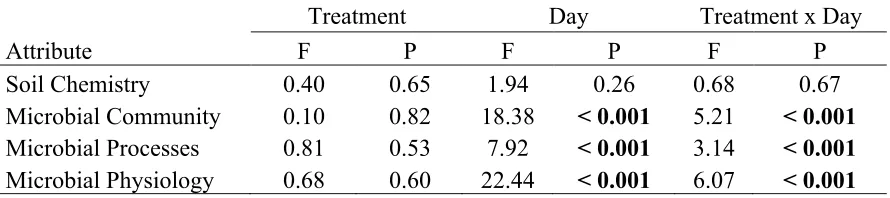
Land use treatment did not significantly impact either litter chemistry or the microbial community (Table 1). Though microbial PLFA biomass did significantly differ by land use in native soils (Kruskal-Wallis, P = 0.007), the process of extraction and inoculation diluted the microbial community, resulting in inoculum of similar biomass size and composition. Combined with the selection pressure from the homogenous litter substrate, microbial biomass and
composition did not significantly differ by treatment for the remainder of the incubation (PERMANOVA, P = 0.82). However, microbial community properties, processes, and physiology did change over the course of the incubation, and significantly interacted with treatment (Table 1). Two-way ANOVA performed on a subset of variables for which
assumptions were met similarly showed that day was a significant effect, but that the interaction effect was predominately non-significant for individual variables (Table S1). For this reason, further analysis will focus solely on the one-way effect of incubation day by lumping together land use treatments.
Percent C loss from mesocosms was calculated from the difference over time in soil C from the initial C content. Total soil C decreased markedly over the course of the incubation, with an average 57% of initial soil C lost after 91 days (Table 2, Figure c). SoilC:N declined to half its initial level as soil N only marginally decreased (Figure a). However, DOMC:N
change over time (Table 3). CUE and NUE tracked closely over the course of the incubation (Figure g-h). CUE remained at approximately 0.50 and NUE at 0.60 for the first two sampling dates. By day 91, CUE dropped by half to 0.24, while NUE did not significantly decline (Table 3).
Relationship between soil and microbial properties and NUE
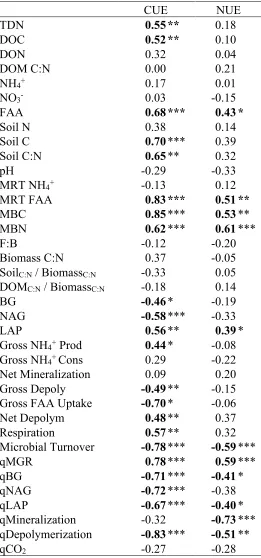
NUE was overall less related to soil chemical variables and microbial activity than CUE (Table 4). CUE was strongly positively related to DOC, soil C, and soil C:N, indicating its positive relationship to C availability overall. NUE was positively related to free amino acid (FAA) concentrations, but unrelated to all other soil variables. NUE was also positively related to the mean residence time of the FAA pool, indicating that NUE was higher when competition for FAA decreased.
NUE was similarly unrelated to variability in most microbial processes, unlike CUE (Table 4). While CUE was significantly related to raw enzyme activities, mineralization, depolymerization, and respiration, NUE was only positively related to LAP activity.
Interestingly, NUE was unrelated to gross mineralization rates, despite gross mineralization being used to calculate NUE. Both CUE and NUE were unrelated to biomass C:N, as well as the stoichiometric imbalance (i.e. ratio) between microbial biomass C:N and both soil C:N and DOM C:N.
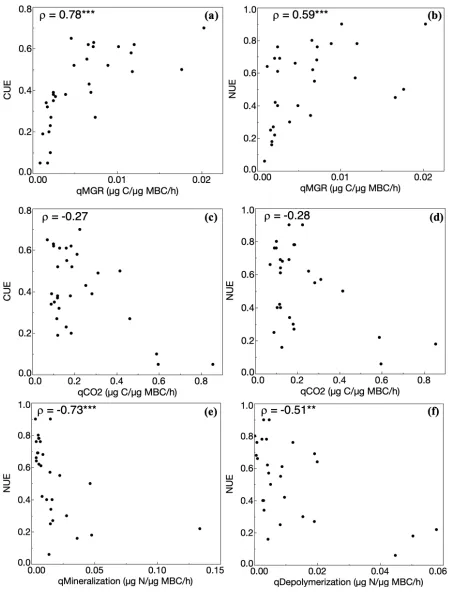
NUE had a more moderately negative relationship with qBG, qLAP, and was marginally related to qNAG (P = 0.057). Neither CUE nor NUE had a significant relationship with qCO2 (Figure
3c-d), though NUE was negatively related to qMineralization and qDepolymerization (Figure 3e-f).
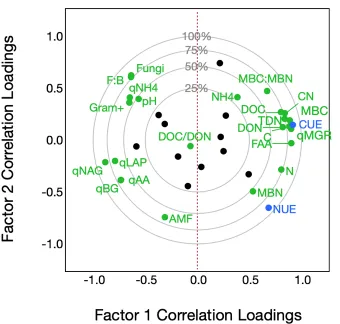
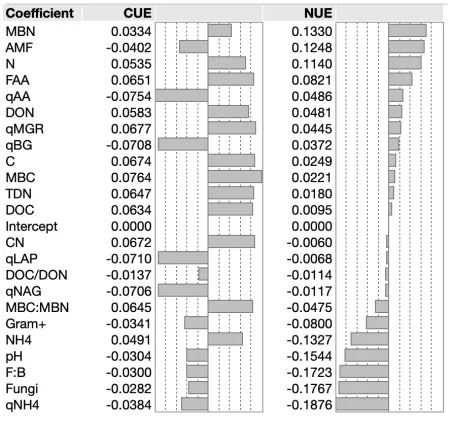
Two PLS models were constructed to explore the relationship between soil and microbial variables with both CUE and NUE in multivariate space. All non-redundant soil and microbial variables were used to construct the first, in which six factors minimized predictive residual sum of squares (PRESS). Variables with VIP > 0.8 were selected to construct a second refined model. In the refined model, two factors explained 66% of variability in predictor variables and 89% of variability in CUE and NUE (Figure 4), where the majority of variation in all predictor and response variables can be explained by Factor 1 (R2X = 0.53, R2Y = 0.66). CUE and NUE had
clearly distinct patterns in their relationship to soil and microbial variables (Figure 4). While CUE was clustered (and thus similarly related to model factors) with indicators of resource availability and microbial growth, NUE was comparatively independent of soil and microbial variables. Though NUE was not as closely related to soil and microbial variables as CUE, NUE was positively related to MBN, AMF, soil N, and FAA, and most negatively related to
qMineralization, fungi, F:B, and pH. CUE was most negatively related to qDepolymerization and specific enzyme activities (Table S2).
Relationship between CUE and NUE
NUE were strongly related in mesocosms inoculated with conventional and organic microbial communities but had no relationship in forest mesocosms.
Discussion
Microbial NUE governs the proportion of organic N microbes transform to inorganic N and is thus a fundamental parameter of the nitrogen cycle. Despite its importance, microbial relationships to NUE have thus far remained largely unexplored (Mooshammer et al., 2014a; Wild et al., 2018; S. Zhang et al., 2019). My results show that NUE is tightly linked to microbial activity and physiology. Specifically, I show that NUE is positively related to microbial growth as opposed to resource acquisition, as estimated by specific enzyme activities. These
relationships help explain variation in NUE that cannot be predicted by stoichiometric theory alone, and indicate that microbes may themselves be important regulators of NUE.
Indirect influence of system-level microbial processes on NUE
In this incubation, microbes altered their environment significantly while NUE did not vary over time. The initial mesocosm soil C:N was 20, or approximately the threshold elemental ratio at which microbial communities switch between C- or N-limitation (Mooshammer et al., 2014a; Sterner and Elser, 2002). As C was lost from the mesocosms through microbial
to N-acquiring qLAP likely helped constrain DOM C:N to a narrow range independent of soil C:N. Interestingly, significant increases in qBG were accompanied by increased qNAG activity. While qNAG is generally classified as an N-acquiring enzyme, it can also facilitate microbial access to both C and N through the degradation of fungal-derived chitin (Sinsabaugh et al., 2008). Given that qNAG increased concurrently with C-limitation suggests both that microbes may have been using it primarily to acquire C, and that fungal necromass was an increasingly large portion of available substrate over time (Geisseler and Horwath, 2009; Schnecker et al., 2019). Though NUE is one in the suite of tools microbial communities have to overcome stoichiometric imbalance, these patterns in enzyme activity suggest that microbes targeted enzyme production as their dominant strategy in response to C-limitation, rather than alter NUE.
I observed that NUE is unrelated to most soil chemical variables, suggesting that it might be difficult to predict from common parameters of resource availability (Table 4). This is in contrast to past results showing NUE is sensitive to soil C and C:N (Mooshammer et al., 2014a; S. Zhang et al., 2019). However, it is important to note that N was likely not limiting at any point in this experimental setup, given that soil C:N was always at or below the threshold elemental ratio of 20. As such, it is likely that we may observe distinct patterns of microbial NUE response to environments where N, or another nutrient, is limiting. While I have shown that NUE is less sensitive to stoichiometric imbalances than enzyme production in an N-unlimited environment, expanding these findings to other stoichiometric scenarios is important to better understanding the plasticity of NUE across the range of microbial environments.
Through PLS modeling of soil and microbial variable relationships to CUE and NUE, I found that non-mycorrhizal fungal PLFAs were strongly and negatively associated with NUE (Table S2, Figure 4). While bacterial PLFAs had mostly negligible impacts on the model, fungi were the second most important variable (VIP = 1.2), and had the second strongest negative relationship to NUE, preceded only by qMineralization. We have historically considered fungi to be slow-growing, efficient microbes that dominate in soils with poor C-quality. However, these assumptions have been increasingly challenged in the past two decades, as F:B biomass ratio has been shown to have no relationship to growth efficiency (Six et al., 2006; Thiet et al., 2006). Fungi as a whole vary widely in CUE, though this variation is phylogenetically constrained (Morrison, 2017). But in whole communities, fungal dominance has in fact been associated with higher C and N mineralization rates than bacterial dominance, and recent growth-based measures of F:B have shown that CUE declines with increasing F:B (Rousk and Frey, 2015; Soares and Rousk, 2019). The negative relationship between fungi and both CUE and NUE that I observe may be mediated by their increased allocation of C and N to enzyme production, since fungi and specific enzyme activity are similarly correlated with Factor 1 (Figure 4; Boer et al., 2005; Manzoni et al., 2012). My results are in line with recent revisions to our paradigm that soil fungi are associated with efficient growth.
Surprisingly, arbuscular mycorrhizal fungi (AMF) had the most abundant of all fatty acid biomarkers over the course of the incubation, and was the only microbial taxon positively related to NUE in the PLS model (Table 3, Figure 4). AMF are obligate symbionts, and lack the
experiment, which excluded roots (Pepe et al., 2018). While PLFA biomarkers used for AMF can also be bacterial indicators, I used the neutral lipid fatty acid 16:1w5c, which is specific to AMF (Olsson, 1999). The two most likely explanations for the high abundance of AMF in this incubation is due to either the persistence of AMF fatty acids after cell death, or a high biomass of metabolically inactive AMF spores. PLFAs have been shown to rapidly degrade in soil incubations, leaving AMF spore biomass as the most likely explanation (Egan et al., 2014; Y. Zhang et al., 2019). Consequently, while this experiment indicates that NUE is negatively associated with non-mycorrhizal fungi, the positive relationship observed between NUE and AMF is likely an artifact of high AMF spore biomass with low metabolic activity.
Relationship between microbial physiology and NUE
Microbial physiology emerged as the strongest correlate to NUE, as NUE was tightly linked to specific growth rate (qMGR) and CUE. These results stand in contrast to our historical view that microbes exhibit a clear tradeoff between growth rate and efficiency (Roller and Schmidt, 2015). Instead, I found that both CUE and NUE had a positive, saturating relationship with qMGR (Figure 3a-b). Recent experiments also utilizing substrate-independent, growth-based assays for CUE and NUE not only found growth rate strongly correlated with efficiency, but identified it as an important mediator of environmental effects on growth efficiency (S. Zhang et al., 2019; Zheng et al., 2019). Growth also appears to mediate NUE response to
As discussed earlier, shifts in enzyme production appears to have enabled NUE to remain steady over the course of the incubation by maintaining a consistent DOM C:N. However, microbial communities’ increased allocation of resources to enzyme production still came at a metabolic cost. CUE was strongly negatively related to all three enzymes, while NUE had a weaker negative relationship (Table 4). qDepolymerization and specific enzyme activities were also the most significant variables negatively correlated with CUE in the PLS model (Table S2). It is difficult to determine whether the negative relationship between CUE, NUE and enzyme activity is due to the metabolic cost of producing these enzymes, or that increased
qDepolymerication released the microbial community from resource limitation. The overall decrease in DOM and CUE over time, however, suggests that specific enzyme activity increased in response to resource limitation, which potentially drove the decrease in CUE.
fitness in a resource-limited environment, it does not mean that oligotrophic life history traits (slow growth, investment in enzymes and maintenance) are associated with growth efficiency writ large. Instead, the most proximate drivers of microbial CUE and NUE appear to be the opportunity to grow quickly without sacrificing resources to enzyme or metabolite production (Allison, 2014; Kaiser et al., 2014; Malik et al., 2019; S. Zhang et al., 2019; Zheng et al., 2019). Efficient growth may be less an intrinsic trait of the microbial community, but rather an
emergent property of the microbial community’s response to its environment.
Conclusion
Microbial physiology plays a significant role in biogeochemical cycles, and our assumptions of how it varies can have significant impacts on how we model C and N
List of References
Allison, S.D., 2014. Modeling adaptation of carbon use efficiency in microbial communities. Frontiers in Microbiology 5. doi:10.3389/fmicb.2014.00571
Anderson, T.-H., Domsch, K.H., 1986. Carbon assimilation and microbial activity in soil. Zeitschrift Für Pflanzenernährung Und Bodenkunde 149, 457–468.
doi:10.1002/jpln.19861490409
Azcón-Aguilar, C., Bago, B., Barea, J.M., 1999. Saprophytic Growth of Arbuscular Mycorrhizal Fungi, in: Varma, A., Hock, B. (Eds.), Mycorrhiza: Structure, Function, Molecular Biology and Biotechnology. Springer Berlin Heidelberg, Berlin, Heidelberg, pp. 391– 408. doi:10.1007/978-3-662-03779-9_16
Blazewicz, S.J., Schwartz, E., 2011. Dynamics of <Superscript>18</Superscript>O
Incorporation from H <Subscript>2</Subscript><Superscript>18</Superscript>O into Soil Microbial DNA. Microbial Ecology 61, 911–916. doi:10.1007/s00248-011-9826-7 Bligh, E.G., Dyer, W.J., 1959. A rapid method of total lipid extraction and purification. Canadian
Journal of Biochemistry and Physiology 37, 911–917. doi:10.1139/o59-099
Boer, W. de, Folman, L.B., Summerbell, R.C., Boddy, L., 2005. Living in a fungal world: impact of fungi on soil bacterial niche development. FEMS Microbiology Reviews 29, 795–811. doi:10.1016/j.femsre.2004.11.005
Boulesteix, A.-L., Strimmer, K., 2007. Partial least squares: a versatile tool for the analysis of high-dimensional genomic data. Briefings in Bioinformatics 8, 32–44.
doi:10.1093/bib/bbl016
Bowles, T.M., Atallah, S.S., Campbell, E.E., Gaudin, A.C.M., Wieder, W.R., Grandy, A.S., 2018. Addressing agricultural nitrogen losses in a changing climate. Nature Sustainability 1, 399. doi:10.1038/s41893-018-0106-0
Bradford, M.A., Keiser, A.D., Davies, C.A., Mersmann, C.A., Strickland, M.S., 2013. Empirical evidence that soil carbon formation from plant inputs is positively related to microbial growth. Biogeochemistry 113, 271–281. doi:10.1007/s10533-012-9822-0
Chen, W.-P., Yang, X.-Y., Hegeman, A.D., Gray, W.M., Cohen, J.D., 2010. Microscale analysis of amino acids using gas chromatography–mass spectrometry after methyl chloroformate derivatization. Journal of Chromatography B 878, 2199–2208.
doi:10.1016/j.jchromb.2010.06.027
Egan, C., Li, D.-W., Klironomos, J., 2014. Detection of arbuscular mycorrhizal fungal spores in the air across different biomes and ecoregions. Fungal Ecology, Fungal ecology beyond boundaries: from communities to the globe 12, 26–31. doi:10.1016/j.funeco.2014.06.004 Ekelund, F., Olsson, S., Johansen, A., 2003. Changes in the succession and diversity of
protozoan and microbial populations in soil spiked with a range of copper concentrations. Soil Biology and Biochemistry 35, 1507–1516. doi:10.1016/S0038-0717(03)00249-9 Esperschütz, J., Gattinger, A., Mäder, P., Schloter, M., Fließbach, A., 2007. Response of soil
microbial biomass and community structures to conventional and organic farming systems under identical crop rotations. FEMS Microbiology Ecology 61, 26–37. doi:10.1111/j.1574-6941.2007.00318.x
Fanin, N., Fromin, N., Buatois, B., Hättenschwiler, S., 2013. An experimental test of the
hypothesis of non-homeostatic consumer stoichiometry in a plant litter–microbe system. Ecology Letters 16, 764–772. doi:10.1111/ele.12108
Fierer, N., Bradford, M.A., Jackson, R.B., 2007. Toward an Ecological Classification of Soil Bacteria. Ecology 88, 1354–1364.
Frey, S.D., Lee, J., Melillo, J.M., Six, J., 2013. The temperature response of soil microbial efficiency and its feedback to climate. Nature Climate Change 3, 395–398.
doi:10.1038/nclimate1796
Gardner, J.B., Drinkwater, L.E., 2009. The Fate of Nitrogen in Grain Cropping Systems: A Meta-Analysis of 15N Field Experiments. Ecological Applications 19, 2167–2184.
Geisseler, D., Horwath, W.R., 2009. Relationship between carbon and nitrogen availability and extracellular enzyme activities in soil. Pedobiologia 53, 87–98.
doi:10.1016/j.pedobi.2009.06.002
German, D.P., Weintraub, M.N., Grandy, A.S., Lauber, C.L., Rinkes, Z.L., Allison, S.D., 2011. Optimization of hydrolytic and oxidative enzyme methods for ecosystem studies. Soil Biology and Biochemistry 43, 1387–1397. doi:10.1016/j.soilbio.2011.03.017
Geyer, K.M., Dijkstra, P., Sinsabaugh, R., Frey, S.D., 2019. Clarifying the interpretation of carbon use efficiency in soil through methods comparison. Soil Biology and
Biochemistry 128, 79–88. doi:10.1016/j.soilbio.2018.09.036
Geyer, K.M., Kyker-Snowman, E., Grandy, A.S., Frey, S.D., 2016. Microbial carbon use
efficiency: accounting for population, community, and ecosystem-scale controls over the fate of metabolized organic matter. Biogeochemistry 127, 173–188. doi:10.1007/s10533-016-0191-y
Banerjee, S., Yu, R.-Q., Nogaro, G., Richter, A., Koranda, M., Castle, S.C., Goberna, M., Song, B., Chatterjee, A., Nunes, O.C., Lopes, A.R., Cao, Y., Kaisermann, A., Hallin, S., Strickland, M.S., Garcia-Pausas, J., Barba, J., Kang, H., Isobe, K., Papaspyrou, S., Pastorelli, R., Lagomarsino, A., Lindström, E.S., Basiliko, N., Nemergut, D.R., 2016. Microbes as Engines of Ecosystem Function: When Does Community Structure Enhance Predictions of Ecosystem Processes? Frontiers in Microbiology 7.
doi:10.3389/fmicb.2016.00214
Guckert, J.B., Antworth, C.P., Nichols, P.D., White, D.C., 1985. Phospholipid, ester-linked fatty acid profiles as reproducible assays for changes in prokaryotic community structure of estuarine sediments. FEMS Microbiology Letters 31, 147–158. doi:10.1016/0378-1097(85)90016-3
Hamilton, S.K., Robertson, G.P., 2015. The Ecology of Agricultural Landscapes: Long-term Research on the Path to Sustainability. Oxford University Press.
Hart, S.C., Stark, J.M., Davidson, E.A., Firestone, M.K., 1994. Nitrogen Mineralization, Immobilization, and Nitrification. Methods of Soil Analysis: Part 2—Microbiological and Biochemical Properties sssabookseries, 985–1018. doi:10.2136/sssabookser5.2.c42 Hartmann, M., Frey, B., Mayer, J., Mäder, P., Widmer, F., 2015. Distinct soil microbial diversity
under long-term organic and conventional farming. The ISME Journal 9, 1177. doi:10.1038/ismej.2014.210
Hood-Nowotny, R., Umana, N.H.-N., Inselbacher, E., Oswald- Lachouani, P., Wanek, W., 2010. Alternative Methods for Measuring Inorganic, Organic, and Total Dissolved Nitrogen in Soil. Soil Science Society of America Journal 74, 1018–1027.
doi:10.2136/sssaj2009.0389
Jangid, K., Williams, M.A., Franzluebbers, A.J., Sanderlin, J.S., Reeves, J.H., Jenkins, M.B., Endale, D.M., Coleman, D.C., Whitman, W.B., 2008. Relative impacts of land-use , management intensity and fertilization upon soil microbial community structure in agricultural systems. Soil Biology and Biochemistry 40, 2843–2853.
doi:10.1016/j.soilbio.2008.07.030
Jilling, A., Keiluweit, M., Contosta, A.R., Frey, S., Schimel, J., Schnecker, J., Smith, R.G., Tiemann, L., Grandy, A.S., 2018. Minerals in the rhizosphere: overlooked mediators of soil nitrogen availability to plants and microbes. Biogeochemistry 1–20.
doi:10.1007/s10533-018-0459-5
Kaiser, C., Franklin, O., Dieckmann, U., Richter, A., 2014. Microbial community dynamics alleviate stoichiometric constraints during litter decay. Ecology Letters 17, 680–690. doi:10.1111/ele.12269
Kallenbach, C.M., Grandy, A.S., Frey, S.D., Diefendorf, A.F., 2015. Microbial physiology and necromass regulate agricultural soil carbon accumulation. Soil Biology and Biochemistry 91, 279–290. doi:10.1016/j.soilbio.2015.09.005
Kandeler, E., Gerber, H., 1988. Short-term assay of soil urease activity using colorimetric determination of ammonium. Biology and Fertility of Soils 6, 68–72.
doi:10.1007/BF00257924
Kawahigashi Masayuki, Kaiser Klaus, Rodionov Andrej, Guggenberger Georg, 2006. Sorption of dissolved organic matter by mineral soils of the Siberian forest tundra. Global Change Biology 12, 1868–1877. doi:10.1111/j.1365-2486.2006.01203.x
Kingsbury, J.M., Goldstein, A.L., McCusker, J.H., 2006. Role of Nitrogen and Carbon
Transport, Regulation, and Metabolism Genes for Saccharomyces cerevisiae Survival In Vivo. Eukaryotic Cell 5, 816–824. doi:10.1128/EC.5.5.816-824.2006
Kirkham, D., Bartholomew, W.V., 1954. Equations for Following Nutrient Transformations in Soil, Utilizing Tracer Data1. Soil Science Society of America Journal 18, 33.
doi:10.2136/sssaj1954.03615995001800010009x
Koch, A.L., 2001. Oligotrophs versus copiotrophs. BioEssays 23, 657–661. doi:10.1002/bies.1091
Leckie, S.E., Prescott, C.E., Grayston, S.J., Neufeld, J.D., Mohn, W.W., 2004. Comparison of chloroform fumigation-extraction, phospholipid fatty acid, and DNA methods to determine microbial biomass in forest humus. Soil Biology and Biochemistry 36, 529– 532. doi:10.1016/j.soilbio.2003.10.014
Lipson, D.A., Monson, R.K., Schmidt, S.K., Weintraub, M.N., 2009. The trade-off between growth rate and yield in microbial communities and the consequences for under-snow soil respiration in a high elevation coniferous forest. Biogeochemistry 95, 23–35. doi:10.1007/s10533-008-9252-1
Lupatini, M., Korthals, G.W., de Hollander, M., Janssens, T.K.S., Kuramae, E.E., 2017. Soil Microbiome Is More Heterogeneous in Organic Than in Conventional Farming System. Frontiers in Microbiology 7. doi:10.3389/fmicb.2016.02064
MacLean, R.C., Gudelj, I., 2006. Resource competition and social conflict in experimental populations of yeast. Nature 441, 498. doi:10.1038/nature04624
Malik, A.A., Puissant, J., Goodall, T., Allison, S.D., Griffiths, R.I., 2019. Soil microbial communities with greater investment in resource acquisition have lower growth yield. Soil Biology and Biochemistry 132, 36–39. doi:10.1016/j.soilbio.2019.01.025
Manzoni, S., Taylor, P., Richter, A., Porporato, A., Ågren, G.I., 2012. Environmental and
Miranda, K.M., Espey, M.G., Wink, D.A., 2001. A Rapid, Simple Spectrophotometric Method for Simultaneous Detection of Nitrate and Nitrite. Nitric Oxide 5, 62–71.
doi:10.1006/niox.2000.0319
Mooshammer, M., Wanek, W., Hämmerle, I., Fuchslueger, L., Hofhansl, F., Knoltsch, A., Schnecker, J., Takriti, M., Watzka, M., Wild, B., Keiblinger, K.M., Zechmeister-Boltenstern, S., Richter, A., 2014a. Adjustment of microbial nitrogen use efficiency to carbon:nitrogen imbalances regulates soil nitrogen cycling. Nature Communications 5, 1– 7. doi:10.1038/ncomms4694
Mooshammer, M., Wanek, W., Zechmeister-Boltenstern, S., Richter, A., 2014b. Stoichiometric imbalances between terrestrial decomposer communities and their resources: mechanisms and implications of microbial adaptations to their resources. Frontiers in Microbiology 5. doi:10.3389/fmicb.2014.00022
Morrison, E.W., 2017. Fungi as Drivers of Ecosystem Response to Global Change (Ph.D.). University of New Hampshire, United States -- New Hampshire.
Nash, M.S., Chaloud, D.J., 2011. Partial Least Square Analyses of Landscape and Surface Water Biota Associations in the Savannah River Basin. ISRN Ecology 1–11.
doi:10.5402/2011/571749
Noll, L., Zhang, S., Wanek, W., 2019. Novel high-throughput approach to determine key
processes of soil organic nitrogen cycling: Gross protein depolymerization and microbial amino acid uptake. Soil Biology and Biochemistry 130, 73–81.
doi:10.1016/j.soilbio.2018.12.005
Olsson, P.A., 1999. Signature fatty acids provide tools for determination of the distribution and interactions of mycorrhizal fungi in soil. FEMS Microbiology Ecology 29, 303–310. doi:10.1111/j.1574-6941.1999.tb00621.x
Pepe, A., Giovannetti, M., Sbrana, C., 2018. Lifespan and functionality of mycorrhizal fungal mycelium are uncoupled from host plant lifespan. Scientific Reports 8, 10235.
doi:10.1038/s41598-018-28354-5
Pfeiffer, T., Schuster, S., Bonhoeffer, S., 2001. Cooperation and Competition in the Evolution of ATP-Producing Pathways. Science 292, 504–507. doi:10.1126/science.1058079
Reed, H.E., Martiny, J.B.H., 2007. Testing the functional significance of microbial composition in natural communities. FEMS Microbiology Ecology 62, 161–170. doi:10.1111/j.1574-6941.2007.00386.x
Robertson, G.P., Groffman, P.M., 2015. Robertson & Groffman 2015.pdf, in: Paul, E.A. (Ed.), Soil Microbiology, Ecology, and Biochemistry. Elsevier Inc., Waltham, MA, pp. 421– 446.
Robertson, G.P., Vitousek, P.M., 2009. Nitrogen in Agriculture: Balancing the Cost of an Essential Resource. Annual Review of Environment and Resources 34, 97–125. doi:10.1146/annurev.environ.032108.105046
Roller, B.R., Schmidt, T.M., 2015. The physiology and ecological implications of efficient growth. The ISME Journal 9, 1481–1487. doi:10.1038/ismej.2014.235
Rousk, J., Frey, S.D., 2015. Revisiting the hypothesis that fungal-to-bacterial dominance characterizes turnover of soil organic matter and nutrients. Ecological Monographs 85, 457–472. doi:10.1890/14-1796.1
Saiya-Cork, K.R., Sinsabaugh, R.L., Zak, D.R., 2002. The effects of long term nitrogen deposition on extracellular enzyme activity in an Acer saccharum forest soil. Soil Biology and Biochemistry 34, 1309–1315. doi:10.1016/S0038-0717(02)00074-3 Sanderman, J., Baldock, J.A., Amundson, R., 2008. Dissolved organic carbon chemistry and
dynamics in contrasting forest and grassland soils. Biogeochemistry 89, 181–198. doi:10.1007/s10533-008-9211-x
Schimel, J., Balser, T.C., Wallenstein, M., 2007. Microbial Stress-Response Physiology and Its Implications for Ecosystem Function. Ecology 88, 1386–1394.
Schimel, J.P., Bennett, J., 2004. Nitrogen mineralization: challenges of a changing paradigm. Ecology 85, 591–602.
Schnecker, J., Bowles, T., Hobbie, E.A., Smith, R.G., Grandy, A.S., 2019. Substrate quality and concentration control decomposition and microbial strategies in a model soil system. Biogeochemistry 144, 47–59. doi:10.1007/s10533-019-00571-8
Shen, J., Bartha, R., 1996. Metabolic efficiency and turnover of soil microbial communities in biodegradation tests. Applied and Environmental Microbiology 62, 2411–2415.
Shimizu, K., 2013. Metabolic regulation of a bacterial cell system with emphasis on Escherichia coli metabolism. ISRN Biochemistry 2013, 47. doi:10.1155/2013/645983
Sinsabaugh, R.L., Lauber, C.L., Weintraub, M.N., Ahmed, B., Allison, S.D., Crenshaw, C., Contosta, A.R., Cusack, D., Frey, S., Gallo, M.E., Gartner, T.B., Hobbie, S.E., Holland, K., Keeler, B.L., Powers, J.S., Stursova, M., Takacs‐Vesbach, C., Waldrop, M.P., Wallenstein, M.D., Zak, D.R., Zeglin, L.H., 2008. Stoichiometry of soil enzyme activity at global scale. Ecology Letters 11, 1252–1264. doi:10.1111/j.1461-0248.2008.01245.x Sinsabaugh, R.L., Turner, B.L., Talbot, J.M., Waring, B.G., Powers, J., Kuske, C., Moorhead,
Six, J., Frey, S.D., Thiet, R.K., Batten, K.M., 2006. Bacterial and Fungal Contributions to Carbon Sequestration in Agroecosystems. Soil Science Society of America Journal 70, 555–569. doi:10.2136/sssaj2004.0347
Soares, M., Rousk, J., 2019. Microbial growth and carbon use efficiency in soil: Links to fungal-bacterial dominance, SOC-quality and stoichiometry. Soil Biology and Biochemistry 131, 195–205. doi:10.1016/j.soilbio.2019.01.010
Sørensen, P., Jensen, E.S., 1991. Sequential diffusion of ammonium and nitrate from soil
extracts to a polytetrafluoroethylene trap for 15N determination. Analytica Chimica Acta 252, 201–203. doi:10.1016/0003-2670(91)87215-S
Spohn, M., Klaus, K., Wanek, W., Richter, A., 2016. Microbial carbon use efficiency and biomass turnover times depending on soil depth – Implications for carbon cycling. Soil Biology and Biochemistry 96, 74–81. doi:10.1016/j.soilbio.2016.01.016
Sterner, R.W., Elser, J.J., 2002. Ecological Stoichiometry. Princeton University Press. Tang, N., San Clemente, H., Roy, S., Bécard, G., Zhao, B., Roux, C., 2016. A Survey of the
Gene Repertoire of Gigaspora rosea Unravels Conserved Features among Glomeromycota for Obligate Biotrophy. Frontiers in Microbiology 7. doi:10.3389/fmicb.2016.00233
Thiet, R.K., Frey, S.D., Six, J., 2006. Do growth yield efficiencies differ between soil microbial communities differing in fungal:bacterial ratios? Reality check and methodological issues. Soil Biology and Biochemistry 38, 837–844. doi:10.1016/j.soilbio.2005.07.010 Tiemann, L., Grandy, A., Atkinson, E., Marin-Spiotta, E., McDaniel, M., 2015. Crop rotational
diversity enhances belowground communities and functions in an agroecosystem. Ecology Letters 18, 761–771. doi:10.1111/ele.12453
Treseder, K.K., Lennon, J.T., 2015. Fungal Traits That Drive Ecosystem Dynamics on Land. Microbiology and Molecular Biology Reviews 79, 243–262. doi:10.1128/MMBR.00001-15
Trivedi, P., Delgado-Baquerizo, M., Trivedi, C., Hu, H., Anderson, I.C., Jeffries, T.C., Zhou, J., Singh, B.K., 2016. Microbial regulation of the soil carbon cycle: evidence from gene– enzyme relationships. The ISME Journal 10, 2593–2604. doi:10.1038/ismej.2016.65 van Diepen, L.T.A., Frey Serita D., Landis Elizabeth A., Morrison Eric W., Pringle Anne, 2016.
Fungi exposed to chronic nitrogen enrichment are less able to decay leaf litter. Ecology 98, 5–11. doi:10.1002/ecy.1635
Wanek, W., Mooshammer, M., Blöchl, A., Hanreich, A., Richter, A., 2010. Determination of gross rates of amino acid production and immobilization in decomposing leaf litter by a novel 15N isotope pool dilution technique. Soil Biology and Biochemistry 42, 1293– 1302. doi:10.1016/j.soilbio.2010.04.001
White, D.C., Davis, W.M., Nickels, J.S., King, J.D., Bobbie, R.J., 1979. Determination of the sedimentary microbial biomass by extractible lipid phosphate. Oecologia 40, 51–62. doi:10.1007/BF00388810
Widder, S., Allen, R.J., Pfeiffer, T., Curtis, T.P., Wiuf, C., Sloan, W.T., Cordero, O.X., Brown, S.P., Momeni, B., Shou, W., Kettle, H., Flint, H.J., Haas, A.F., Laroche, B., Kreft, J.-U., Rainey, P.B., Freilich, S., Schuster, S., Milferstedt, K., van der Meer, J.R., Groβkopf, T., Huisman, J., Free, A., Picioreanu, C., Quince, C., Klapper, I., Labarthe, S., Smets, B.F., Wang, H., Isaac Newton Institute Fellows, Soyer, O.S., 2016. Challenges in microbial ecology: building predictive understanding of community function and dynamics. The ISME Journal 10, 2557–2568. doi:10.1038/ismej.2016.45
Wieder, W.R., Grandy, A.S., Kallenbach, C.M., Bonan, G.B., 2014. Integrating microbial physiology and physio-chemical principles in soils with the MIcrobial-MIneral Carbon Stabilization (MIMICS) model. Biogeosciences 11, 3899–3917. doi:10.5194/bg-11-3899-2014
Wild, B., Ambus, P., Reinsch, S., Richter, A., 2018. Resistance of soil protein depolymerization rates to eight years of elevated CO2, warming, and summer drought in a temperate heathland. Biogeochemistry. doi:10.1007/s10533-018-0487-1
Xue, K., Wu, L., Deng, Y., He, Z., Nostrand, J.V., Robertson, P.G., Schmidt, T.M., Zhou, J., 2013. Functional Gene Differences in Soil Microbial Communities from Conventional, Low-Input, and Organic Farmlands. Applied and Environmental Microbiology 79, 1284– 1292. doi:10.1128/AEM.03393-12
Zechmeister-Boltenstern, S., Keiblinger, K.M., Mooshammer, M., Peñuelas, J., Richter, A., Sardans, J., Wanek, W., 2015. The application of ecological stoichiometry to plant– microbial–soil organic matter transformations. Ecological Monographs 85, 133–155. doi:10.1890/14-0777.1
Zhang, S., Zheng, Q., Noll, L., Hu, Y., Wanek, W., 2019. Environmental effects on soil microbial nitrogen use efficiency are controlled by allocation of organic nitrogen to microbial growth and regulate gross N mineralization. Soil Biology and Biochemistry 135, 304–315. doi:10.1016/j.soilbio.2019.05.019
Zhang, Y., Zheng, N., Wang, J., Yao, H., Qiu, Q., Chapman, S.J., 2019. High turnover rate of free phospholipids in soil confirms the classic hypothesis of PLFA methodology. Soil Biology and Biochemistry 135, 323–330. doi:10.1016/j.soilbio.2019.05.023
TABLES AND FIGURES
Table 1: Effects of agricultural treatment, incubation sampling day, and their interaction on attributes of the soil chemical environment and microbial community according to
PERMANOVA. Significant effects are in bold.
Table 2: Soil chemical properties of mesocosms across each day of incubation. Total soil C and N were failed to be collected on Day 3. Results of Kruskal-Wallis test of difference between days denoted by asterisks (*P < 0.05, **P < 0.01, ***P < 0.001). Values are mean ± SE.
Variable Day 3 Day 13 Day 48 Day 91 P
TDN (µg N g-1) 40.5 ± 5.0 28.2 ± 2.1 20.5 ± 1.2 16.0 ± 1.1 ***
DOC (µg C g-1) 435 ± 36 366 ± 22 248 ± 16 214 ± 22 ***
NH4+ (µg N g-1) 14.0 ± 2.5 3.2 ± 0.9 2.3 ± 0.9 3.0 ± 0.6 ***
NO3- (µg N g-1) 0.86 ± 0.10 0.68 ± 0.05 0.60 ± 0.08 0.66 ± 0.13
DON (µg N g-1) 25.6 ± 3.9 24.3 ± 1.6 17.6 ± 0.7 13.0 ± 1.0 ***
DOM C:N 20.3 ± 2.5 15.2 ± 0.3 14.1 ± 0.6 16.9 ± 1.0 Soil N (µg N g-1)
253 ± 10 250 ± 8 225 ± 7 *
Soil C (µg C g-1)
3574 ± 197 2537 ± 85 2084 ± 65 ***
Soil C:N 14.1 ± 0.4 10.2 ± 0.2 9.3 ± 0.2 ***
pH 8.76 ± 0.09 9.09 ± 0.05 9.31 ± 0.02 9.14 ± 0.02 *** FAA (µg N g-1) 0.13 ± 0.01 0.13 ± 0.01 0.08 ± 0.01 0.04 ± 0.00 ***
MRT NH4+ (h) 35 ± 6 21 ± 6 81 ± 26 *
MRT FAA (h) 3.2 ± 0.6 3.3 ± 1.0 0.6 ± 0.1 0.6 ± 0.1 ***
Treatment Day Treatment x Day
Attribute F P F P F P
Soil Chemistry 0.40 0.65 1.94 0.26 0.68 0.67
Table 4: Spearman correlation analysis of soil and microbial variables with CUE and NUE. Values are Spearman r; significance of relationship denoted by asterisks (*P < 0.05, **P < 0.01, ***P < 0.001).
CUE NUE
TDN 0.55 ** 0.18
DOC 0.52 ** 0.10
DON 0.32 0.04
DOM C:N 0.00 0.21
NH4+ 0.17 0.01
NO3- 0.03 -0.15
FAA 0.68 *** 0.43 *
Soil N 0.38 0.14
Soil C 0.70 *** 0.39
Soil C:N 0.65 ** 0.32
pH -0.29 -0.33
MRT NH4+ -0.13 0.12
MRT FAA 0.83 *** 0.51 **
MBC 0.85 *** 0.53 **
MBN 0.62 *** 0.61 ***
F:B -0.12 -0.20
Biomass C:N 0.37 -0.05
SoilC:N / BiomassC:N -0.33 0.05
DOMC:N / BiomassC:N -0.18 0.14
BG -0.46 * -0.19
NAG -0.58 *** -0.33
LAP 0.56 ** 0.39 *
Gross NH4+ Prod 0.44 * -0.08
Gross NH4+ Cons 0.29 -0.22
Net Mineralization 0.09 0.20
Gross Depoly -0.49 ** -0.15
Gross FAA Uptake -0.70 * -0.06
Net Depolym 0.48 ** 0.37
Respiration 0.57 ** 0.32
Microbial Turnover -0.78 *** -0.59 ***
qMGR 0.78 *** 0.59 ***
qBG -0.71 *** -0.41 *
qNAG -0.72 *** -0.38
qLAP -0.67 *** -0.40 *
qMineralization -0.32 -0.73 *** qDepolymerization -0.83 *** -0.51 **
Figure 2: Shifts in resource availability (a-c), enzyme activity (d-f), and physiology (g-h) over the course of the incubation. (c) Soil C loss was calculated as the percent difference in soil C content at each day from the initial mesocosm C content. Letters denote groups that are
Figure 5: Regression between CUE and NUE for (a) all values and (b) divided by treatment. R2