https://doi.org/10.5194/amt-12-2019-2019 © Author(s) 2019. This work is distributed under the Creative Commons Attribution 4.0 License.
Cloud products from the Earth Polychromatic Imaging Camera
(EPIC): algorithms and initial evaluation
Yuekui Yang1, Kerry Meyer1, Galina Wind2,1, Yaping Zhou3,1, Alexander Marshak1, Steven Platnick1, Qilong Min4, Anthony B. Davis5, Joanna Joiner1, Alexander Vasilkov2, David Duda2,6, and Wenying Su6
1NASA Goddard Space Flight Center, Greenbelt, MD, USA 2Science Systems and Applications Inc., Lanham, MD, USA
3Goddard Earth Sciences Technology and Research, Morgan State University, Baltimore, MD, USA 4Atmospheric Sciences Research Center, State University of New York at Albany, Albany, NY, USA 5Jet Propulsion Laboratory, California Institute of Technology, Pasadena, CA, USA
6NASA Langley Research Center, Hampton, VA, USA Correspondence:Yuekui Yang ([email protected])
Received: 18 September 2018 – Discussion started: 13 November 2018
Revised: 10 February 2019 – Accepted: 11 March 2019 – Published: 29 March 2019
Abstract.This paper presents the physical basis of the Earth Polychromatic Imaging Camera (EPIC) cloud product algo-rithms and an initial evaluation of their performance. Since June 2015, EPIC has been providing observations of the sun-lit side of the Earth with its 10 spectral channels ranging from the UV to the near-infrared. A suite of algorithms has been developed to generate the standard EPIC Level 2 cloud prod-ucts that include cloud mask, cloud effective pressure/height, and cloud optical thickness. The EPIC cloud mask adopts the threshold method and utilizes multichannel observations and ratios as tests. Cloud effective pressure/height is derived with observations from the O2 A-band (780 and 764 nm) and B-band (680 and 688 nm) pairs. The EPIC cloud opti-cal thickness retrieval adopts a single-channel approach in which the 780 and 680 nm channels are used for retrievals over ocean and over land, respectively. Comparison with co-located cloud retrievals from geosynchronous earth orbit (GEO) and low earth orbit (LEO) satellites shows that the EPIC cloud product algorithms are performing well and are consistent with theoretical expectations. These products are publicly available at the Atmospheric Science Data Center at the NASA Langley Research Center for climate studies and for generating other geophysical products that require cloud properties as input.
1 Introduction
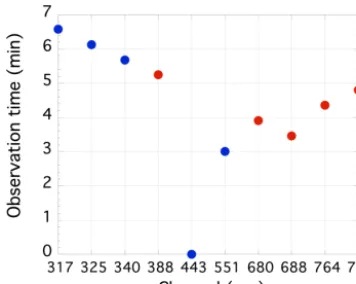
Figure 1.Observation time from the start of acquisition for each EPIC channel starting from 443 nm. Red dots are the channels used for cloud retrievals. It takes about 7 min to complete the 10-channel image set.
The focal plane of the EPIC system is a 2048 pixel×2048 pixel CCD array. The point spread function of the CCD array has a full width at half maximum (FWHM) of ∼1.34 pixels. Images for the 10 spectral channels are obtained using a 10-color filter wheel assembly and shutter, the operation of which takes about 7 min to acquire a complete set of observations. As shown in Fig. 1, the observation starts with the 443 nm channel, followed by the 551, 688, 680, 764, 780, 388, 340, 325, and 317 nm channels. The time difference between one channel and the next consists of readout, exposure, and filter rotation time. Limited by data transmission capability, only the 443 nm channel image is downlinked at its original size; the rest are all reduced to 1024 pixels×1024 pixels through onboard processing and then interpolated back to the full size of 2048 pixels×2048 pixels after being downlinked. As can be seen from Fig. 1, the observation time difference between one channel and the next is usually half a minute, except between the 443 and 551 nm, which is ∼3 min. At full resolution, the pixel size of EPIC observations is ∼8 km at nadir. For view zenith angle (VZA) > 0, the EPIC pixels become elliptical, whereby the longer axis increases by a factor of about 1/cos(VZA) and the shorter axis remains
∼8 km.
Due to the latency between imaging different wavelengths and the rotation of the Earth, the regions covered by the im-ages of the 10 EPIC spectral channels are not exactly the same. For algorithm development and research, all 10 spec-tral channels are projected to a common grid in the Level-1B (L1B) radiance product. The projection procedure includes (see details in Marshak et al., 2018) (1) mapping the images to a 3-D model of the Earth in order to calculate the geolo-cation of each pixel and (2) projecting and regridding each image onto the common reference grid.
A suite of algorithms has been developed for generating the standard EPIC Level 2 cloud products that include cloud
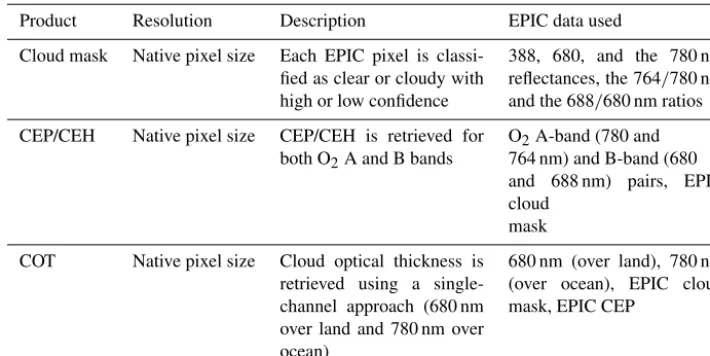
gives a summary of the EPIC L2 cloud products. These prod-ucts, which are publicly available at the Atmospheric Science Data Centre at the NASA Langley Research Center, provide cloud properties of the sunlit side of Earth and are being used in applications such as cloud screening for aerosol property retrievals, ocean color studies, and trace gas retrieval correc-tions.
The remainder of the paper is organized as follows: Sect. 2 presents the algorithm theoretical basis for the standard EPIC L2 cloud products; Sect. 3 presents an initial assessment of the performance of these products through comparison with results from co-located geosynchronous earth orbit (GEO) and low earth orbit (LEO) observations; a summary and dis-cussions are presented in Sect. 4.
2 EPIC cloud product algorithms
The three components of the EPIC cloud product system, cloud mask, CEP/CEH retrieval, and COT retrieval are run independently. The EPIC cloud mask serves as input to both the CEP/CEH and COT retrievals, for which only pixels clas-sified as cloudy are processed.
2.1 EPIC cloud mask algorithm
Table 1.List of current EPIC cloud products and required EPIC observations. The native EPIC pixel size is roughly 8 km at nadir.
Product Resolution Description EPIC data used
Cloud mask Native pixel size Each EPIC pixel is classi-fied as clear or cloudy with high or low confidence
388, 680, and the 780 nm reflectances, the 764/780 nm and the 688/680 nm ratios
CEP/CEH Native pixel size CEP/CEH is retrieved for both O2A and B bands
O2A-band (780 and 764 nm) and B-band (680 and 688 nm) pairs, EPIC cloud
mask
COT Native pixel size Cloud optical thickness is retrieved using a single-channel approach (680 nm over land and 780 nm over ocean)
680 nm (over land), 780 nm (over ocean), EPIC cloud mask, EPIC CEP
The two tests used in the EPIC cloud mask over snow-/ice-free land are the 388 nm BRF and the EPIC O2A-band ratio, i.e.,R764/R780, whereR764is the 764 nm absorption channel BRF andR780the 780 nm reference channel BRF.
The utility of the 388 nm channel for cloud detection is due to the fact that surface reflectance in this channel is usually small, while clouds are relatively bright over snow-/ice-free land (Herman et al., 2001). To accommodate a wide range of sun-view geometries, the contribution from Rayleigh scatter-ing is first removed from the observed BRF. A truly accu-rate Rayleigh correction requires knowledge of the reflecting layer height and its microphysical properties. However, for the more qualitative purposes of cloud detection, we can ap-ply a simple Rayleigh correction based on the assumption that the observed reflectance comes from the interaction of a Lambertian surface and a Rayleigh layer above. Then the derived Lambertian-equivalent reflectivity (LER) (e.g., Her-man and Celarier, 1997) can be compared with the surface albedo to decide if clouds are present. The EPIC observed BRF at the top of atmosphere (TOA)RTOAcan be expressed as
RTOA=RR+
TRRLER 1−SRRLER
, (1)
whereRLER is the Lambertian-equivalent reflectivity to be derived; RR,TR, andSR are the Rayleigh path reflectance, two-way transmittance, and spherical albedo, respectively, which are calculated with the analytical solutions described in Vermote and Tanre (1997). Thresholds for the 388 nm test are based on the monthly surface reflectance climatol-ogy derived from the Global Ozone Monitoring Experiment-2 (GOME-Experiment-2) and the SCanning Imaging Absorption Spec-troMeter for Atmospheric CHartographY (SCIAMACHY) missions (Tilstra et al., 2017). In practice, if the Rayleigh cor-rected LER is larger than the surface albedo, then the scene is labeled as cloudy; otherwise, it is clear. The uncertainty
in the surface albedo provided by the dataset (Tilstra et al., 2017) is used to decide the confidence level.
The selection of the O2A-band ratio as a cloud mask test is based on the fact that everything being equal, the ratio is higher with the presence of clouds compared to clear sky cases because O2absorption is proportional to the air mass above the reflecting layer. Thresholds for this test are a func-tion of surface elevafunc-tion, which is based on the Global Grid-ded Elevation and Bathymetric (ETOPO5) dataset (Edwards, 1989). While the O2 B-band ratio is also useful for cloud detection for the same reason (and is used over snow/ice as discussed below), the A-band ratio is selected for use over land because it provides better skill than that of the B band due to its higher sensitivity to the photon path length change (Y. Yang et al., 2013).
Over ocean, the BRFs of the 680 and the 780 nm chan-nels are used for cloud detection because clouds and the sea surface contrast well in both channels. Although the obser-vations are highly correlated, the two channels complement each other over coastal and shallow water regions due to dif-ferences in surface reflectance. Similar to the 388 nm test over land, a Rayleigh correction is also applied to both the 680 and 780 nm BRFs. Thresholds are derived empirically. BRF values RT680=0.11 and RT780=0.10 are used to sep-arate low confidence clear and low confidence cloudy scenes for the 680 and 780 nm channels, respectively. RT680±0.03 and RT780±0.03 are used as the high confidence thresholds for the two channels, respectively.
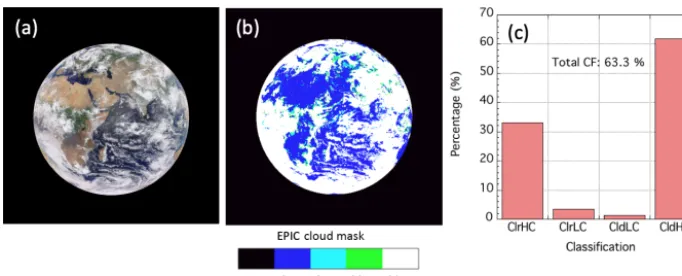
atmo-Figure 2.Sample EPIC L2 cloud products for the observations at 08:00 UTC on 18 August 2016:(a)EPIC RGB image and(b)EPIC cloud mask. Spc: space pixels, ClrHC: clear with high confidence, ClrLC: clear with low confidence, CldLC: cloudy with low confidence, and CldHC: cloudy with high confidence.(c)Percentage of each scene type derived from the cloud mask.
Figure 3. (a)Derivative of the clear sky two-way transmittance (dT /dz) for the EPIC A- and B-band absorption channels normalized byT, whereT is the two-way transmittance andzis the height. The plot shows how muchT changes (%) if the altitude of the reflecting layer changes by 1 km.(b)The two types of photon paths considered in the MLER method. The picture shows one partially cloudy EPIC pixel.
Table 2.Cloud masking tests for different surface types.
Test Ocean Land Snow/ice
388 nm Y
680 nm Y
780 nm Y
Ratio: 688/680 nm Y
Ratio: 764/780 nm Y Y
sphere at the A and B band used in this paper are calculated with the Line-By-Line Radiative Transfer Model (LBLRTM) (Clough et al., 2005) using the 1976 U.S. Standard Atmo-sphere, and monochromatic radiative transfer results were convolved with the filter functions. Detailed properties of the EPIC A- and B-band channels are described in Y. Yang et al. (2013).
The procedure of generating the EPIC cloud mask includes two steps. First, for a given surface type, each of the two tests leads to an independent cloud mask represented with an integer value:
cloudmaski=1,2= {1:clear with high confidence; 2:clear with low confidence;
3:cloudy with low confidence;
4:cloudy with high confidence}. (2) Second, the final cloud mask is assigned based on the sum of the individual tests, such that
2 X
i=1
cloudmaski={≤3:clear with high confidence; 4:clear with low confidence;
clear with low confidence (ClrLC), cloudy with low confi-dence (CldLC), and cloudy with high conficonfi-dence (CldHC), are 33.1 %, 3.6 %, 1.4 %, and 61.9 %, respectively. From the cloud mask, it is straightforward to derive Earth’s daytime cloud coverage (Fig. 2c); for this granule, the total cloud coverage, including cloudy with low and high confidence, is 63.3 %.
2.2 EPIC CEP/CEH algorithm
The EPIC CEP/CEH is derived from observations in the O2 A-band (780 and 764 nm) and B-band (680 and 688 nm) pairs. The idea of using O2 absorption for cloud height re-trieval has been investigated extensively and has been imple-mented in several operational algorithms (e.g., Loyola et al., 2018; Schüssler et al., 2014; Ferlay et al., 2010; Davis et al., 2009; Vasilkov et al., 2008; Wang et al., 2008; Lindstrot et al., 2006; Kokhanovsky et al., 2005; Min et al., 2004; Van-bauce et al., 2003; Daniel et al., 2003; Koelemeijer et al., 2001; Stephens and Heidinger, 2000; Buriez et al., 1997). With the O2A- and B-band observations, EPIC provides an unprecedented opportunity to monitor cloud height from the L1 point. An information content analysis on EPIC A- and B-band observations is provided in Davis et al. (2018a, b).
Figure 3a shows the sensitivity of the EPIC A and B bands to the reflecting layer height change, represented here by the derivative of the above-cloud two-way transmittance (T) with respect to height (z). While the A band has stronger ab-sorption than the B band, the sensitivity to cloud height is clear for both channels. For example, perturbing by 1 km the altitude of a reflecting layer at 5 km changes the atmosphere two-way transmittance by∼8 % for the A band and∼4 % for the B band.
Since oxygen is a well-mixed gas, it would be easy to de-rive cloud top height from radiance measurements in the ab-sorption band if the cloud behaved optically like a hard tar-get. However, multiple scattering along the photon path in-side and outin-side the cloud complicates the situation. Due to photon penetration into the cloud, for given optical thickness and particle properties, the radiance measured by the EPIC A- and B-band sensors is not only a function of cloud top height, but also a function of cloud extinction coefficient pro-file. Except under special situations, e.g., for optically thick clouds over dark surfaces with vertically uniform extinction coefficient (Y. Yang et al., 2013), the EPIC measurements generally do not provide enough information content to re-trieve the actual cloud top, but they are sufficient for retriev-ing another important cloud location information – namely CEP/CEH, as well as the effective cloud fraction (ECF).
CEP is equivalent to the mean pressure from which light is scattered and ECF is the derived radiometrically equivalent cloud fraction assuming an a priori cloud albedo (Stammes et al., 2008). CEP and ECF are important information, and both have been widely applied to trace gas retrievals and climate studies (e.g., Joiner et al., 2012; Wang et al., 2011; Vasilkov
et al., 2008; Stammes et al., 2008; Sneep et al., 2008). CEP and ECF are retrieved using the Mixed Lambertian-Equivalent Reflectivity (MLER) concept, which has been ex-tensively studied and applied to operational settings (e.g., Joiner et al., 2012; Y. Yang et al., 2013; Koelemeijer et al., 2001). The MLER model assumes that the pixel contains two Lambertian reflectors, the surface and the cloud. Figure 3b illustrates the concept. The cloud is assumed to be opaque; hence photon transmission is neglected. The reflectance ob-served at the sensor can be expressed as
Rabs(θ, θ0)=(1−Ac) αsTabs(Ps, θ, θ0)
+AcαcTabs(Pc, θ, θ0) (4)
Rref(θ, θ0)=(1−Ac) αsTref(Ps, θ, θ0)
+AcαcTref(Pc, θ, θ0) , (5)
whereRabsandRrefare the observed reflectances for the ab-sorption and the reference channels, respectively,Ac is the ECF,αsis the surface albedo,αcis the a priori cloud albedo, TabsandTrefare the two-way atmospheric transmittances for the absorption and the reference channels, respectively,Pc andPsare the CEP and the surface pressure, respectively, and θandθ0are the view zenith and solar zenith angles, respec-tively. Generally,αcis assumed to be 0.8, which corresponds to an optically thick cloud. This value is selected to justify the no transmission assumption of the MLER model. It has been demonstrated that although the selection of the a priori cloud albedo does affect the results of the ECF, its effect on the retrieved CEP is relatively small (Stammes et al., 2008; Koelemeijer et al., 2001).
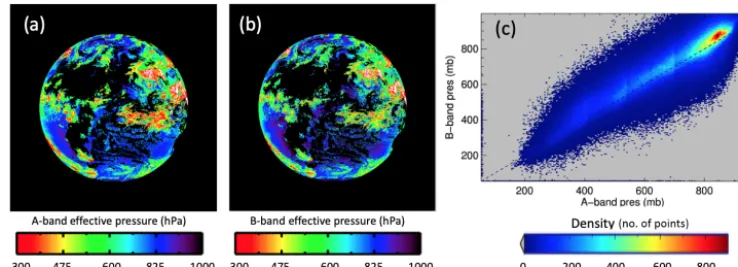
Figure 4.Sample EPIC L2 cloud effective pressure (CEP) products. Same granule as Fig. 3, but for(a)O2A-band CEP,(b)O2B-band CEP, and(c)scatterplot for A- vs. B-band CEP.
simulations, the differences between the two CEPs resulting from penetration depth difference should be small (Y. Yang et al., 2013; Davis et al., 2018a, b). In addition, potential in-strument instability, surface albedo differences, calibration accuracy, and changes resulting from the differences in ob-servation time (see Fig. 1) can also cause differences in the two CEPs.
2.3 EPIC COT algorithm
Simultaneously retrieving COT and cloud effective radius (CER) using a combination of absorbing and non-absorbing spectral channels has been common practice (e.g., Platnick et al., 2017; Nakajima and King, 1990). However, due to the lack of a particle-size-sensitive absorbing shortwave/mid-wave infrared channel, the EPIC COT retrieval adopts a single-channel approach similar to what has been used by the International Satellite Cloud Climatology Project (ISCCP) (Rossow and Schiffer, 1999), the Multi-angle Imaging Spec-troRadiometer (MISR) mission (Marchand et al., 2010), and the Geoscience Laser Altimeter System (GLAS) solar back-ground application project (Yang et al., 2008). The 780 and 680 nm channels are used for retrievals over ocean and over land, respectively. Fixed particle sizes are assumed based on the MODIS global cloud effective radius modes derived from the Collection 6 (C6) MODIS cloud products (14 µm for liq-uid clouds and 30 µm for ice clouds). Using MODIS data, it has been shown that the uncertainties for a single-channel retrieval due to assuming a fixed cloud effective radius are roughly 10 % for liquid clouds and 2 % for ice clouds (Meyer et al., 2016).
The EPIC COT algorithm shares the same code base, for-ward model assumptions, and, to the extent possible, an-cillary usage as the current C6/C6.1 MODIS cloud opti-cal/microphysical property retrievals (MOD06) (Platnick et al., 2017). Since EPIC does not provide enough information to confidently determine cloud thermodynamic phase, two COT values are retrieved and reported for each cloudy pixel by assuming liquid and ice phases, respectively. A similar
approach has been used by Chiu et al. (2010). Nevertheless, by combining the A- and B-band CEPs and GEOS-5 atmo-spheric profiles, the EPIC cloud product also provides A-and B-bA-and cloud effective temperatures as well as a most likely cloud thermodynamic phase derived from thresholds applied to the A-band CEP and temperature. Providing two COT values is useful to the community for further synergistic research, when more information on cloud phase is available from other sources. An example of EPIC COT and the most likely cloud phase product is shown in Fig. 5 for the same granule as in Fig. 2.
3 Performance assessment with co-located GEO–LEO results
Figure 5.Sample EPIC L2 cloud optical thickness (CODT) products. Same granule as Fig. 3, but for(a)COT retrieval assuming liquid thermodynamic phase,(b)COT retrieval assuming ice thermodynamic phase, and(c)the most likely cloud phase based on cloud effective temperature derived from the A-band CEP.
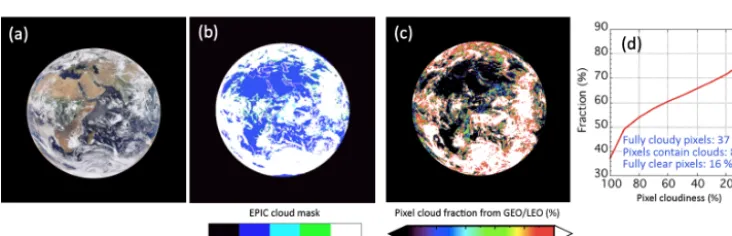
Figure 6.Comparison of the EPIC cloud mask with the co-located GEO–LEO satellite results.(a)The EPIC RGB image for 08:00 UTC on 15 September 2015,(b)the corresponding EPIC cloud mask,(c)the corresponding GEO–LEO composite for the sub-pixel cloud fraction of each EPIC pixel, and(d)the cumulative distribution of pixels from 100 % cloudy to fully clear for this granule based on the GEO–LEO composite in(c).
The LEO sensors used include MODIS on NASA’s Terra and Aqua and AVHRR on NOAA’s satellites. The retrieval and projection methods used are described in Minnis et al. (2011) and Khlopenkov et al. (2017). We note that the retrievals from the GEO–LEO platforms have uncertainties as well, but this dataset serves as an independent source for the as-sessment and consistency check of the EPIC cloud products. With the performance assessment, we also attempt to pro-vide an uncertainty estimate for the EPIC cloud products. Retrieval uncertainty can come from many sources, includ-ing the assumptions and simplifications in the retrieval al-gorithm, instrument calibration, geolocation inaccuracy, and cloud evolution within the latency between imaging differ-ent wavelengths. Note that pixel-level uncertainties of the COT retrievals, accounting for known and quantifiable error sources including radiometry, ancillary atmospheric profile, surface spectral reflectance, cloud forward model, and cloud effective radius assumptions, are provided in the current ver-sion of the operational products (Meyer et al., 2016; Platnick et al., 2017); uncertainty for other products will be included in the next version.
3.1 Performance of EPIC cloud mask
Figure 7.Comparison between EPIC global cloud coverage and co-located (spatially co-located and time difference within 5 min) GEO– LEO results. Four weeks of data from 2016 are utilized with 1 week from each season (6–12 March, 20–26 June, 21–27 September, and 20–26 December).(a)Average EPIC cloud coverage and(b)average cloud coverage from the GEO–LEO composites.
Figure 8. Comparison of EPIC A-band CEP with the co-located GEO–LEO retrievals for the same granule as Fig. 6. The compari-son is done along the red arrow shown on the cloud mask thumbnail at top.
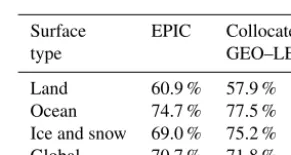
Figure 7 compares the global average cloud fraction from EPIC and from the GEO–LEO composites from 4 weeks of data, one from each season, in 2016 (6–12 March, 20– 26 June, 21–27 September, and 20–26 December). Cloud fractions are calculated for each 1◦×1◦ latitude–longitude grid box. For this study, the global statistics are done with a customized version of the composites that uses only GEO– LEO data within ±5 min of the EPIC observation time to minimize the temporal differences between the EPIC and GEO–LEO data. As shown in the figure, the two datasets vi-sually match each other well. The total global cloud fractions are 70.7 % and 71.8 % for EPIC and the GEO–LEO compos-ites, respectively (Table 3). Over land it is 60.9 % for EPIC and 57.9 % for GEO–LEO; over ocean it is 74.7 % for EPIC and 77.5 % for GEO–LEO. Discrepancies exist between the two datasets; the most obvious one is over snow- and ice-covered regions. For example, EPIC misses a large portion of clouds over West Antarctica, where cloud detection uses
Table 3.Comparison between EPIC cloud fraction and collocated GEO–LEO results. Data used are the same as in Fig. 7.
Surface EPIC Collocated
type GEO–LEO
Land 60.9 % 57.9 % Ocean 74.7 % 77.5 % Ice and snow 69.0 % 75.2 % Global 70.7 % 71.8 %
the O2A- and B-band ratios. Ongoing efforts are taking place to improve cloud masking performance over these regions.
To further quantify the uncertainty in the cloud mask, we use the GEO–LEO composites as the reference and calculate the accuracy, the percentage of correct detection (POCD), and the percentage of false detection (POFD):
accuracy=(α+β)/(α+β+χ+γ ) (6)
POCD=(α)/(α+χ ) (7)
POFD=(γ )/(β+γ ), (8)
Figure 9.EPIC A- and B-band CEP and the comparison with cloud pressure from GEO–LEO composites. Data used are the same as in Fig. 7. Scatterplots(a)for EPIC A- vs. B-band CEP,(b)the GEO–LEO composites cloud pressure vs. EPIC A-band CEP, and(c)the GEO–LEO composites cloud pressure vs. EPIC B-band CEP.
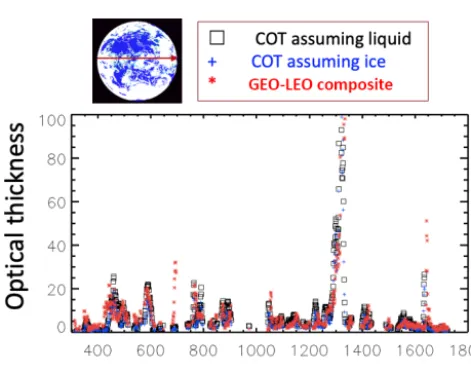
Figure 10.Comparison of EPIC COT with the collocated GEO– LEO retrievals for the same granule as in Fig. 6. The comparison is done along the red arrow shown on the cloud mask thumbnail at top.
3.2 Performance of EPIC CEP/CEH
As discussed above, the retrieved CEPs are generally higher (lower altitude) than the physical cloud top pressure due to the photon penetration into clouds that is ignored in the adopted MLER concept. However, at the most oblique solar zenith and view zenith angles, CEPs can be lower (higher al-titude) than the physical cloud top due to the contribution of Rayleigh scattering (e.g., Y. Yang et al., 2013; Ferlay et al., 2010; Vanbauce et al., 2003).
Figure 8 compares the EPIC A-band CEP with the GEO– LEO composites. Cloud pressures in the GEO–LEO com-posite are derived from infrared channels, which are radia-tive pressures but are closer to the physical cloud top. As shown in the Figure, the EPIC A-band CEPs are generally higher (lower altitude) than those of the GEO–LEO com-posites (note that the vertical axis is reversed), except at the
edges of the image where the solar and view zenith angles are both large. The mean cloud pressures along this line are 658 mb for the EPIC A-band and 645 mb for the GEO–LEO composite. As discussed in Sect. 2.2, the EPIC cloud pres-sure is essentially the centroid of the reflected photons reg-istered at the satellite sensor. Photons penetrating into and through clouds have longer path lengths compared to pho-tons reflected at the cloud top. Since the LER model does not take these factors into account, it is expected that the EPIC CEP is lower in altitude than the physical cloud top (higher in pressure); hence the results shown here are consistent with previous studies and theoretical predictions.
Figure 9a compares the EPIC A- and B-band CEP re-trievals using the same 4 weeks of data as in Fig. 7. Re-sults are similar to the single granule case shown in Fig. 4c. The A- and B-band CEPs are generally close to each other with the B-band CEP higher (lower altitude). The spread of the scatterplot can come from spectral surface albedo differ-ences, changes resulting from the differences in observation time, and calibration accuracy, etc. Figure 9b and c show the comparison between EPIC A- and B-band CEP and cloud pressure from GEO–LEO composites. In general, the GEO– LEO cloud pressure is lower (higher in altitude) than the CEPs, as their sensitivity lies closer to the physical cloud top. The mean differences between the EPIC A-band and B-band CEPs and the GEO–LEO cloud pressure are 92.7 and 147.5 hPa, respectively. Again, the results are consistent with existing studies and theoretical expectations.
3.3 Performance of EPIC COT retrieval
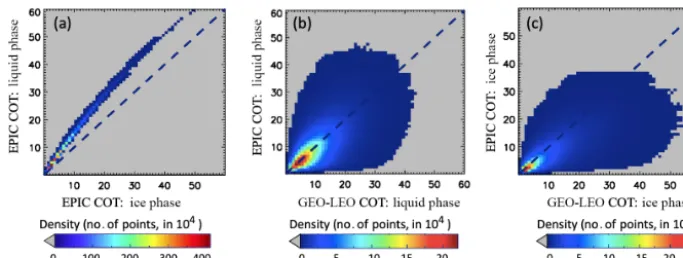
al-Figure 11. (a)Scatterplot for EPIC COT assuming liquid vs. ice phase;(b)EPIC COT vs. GEO–LEO composites: liquid clouds only as identified by the GEO–LEO algorithms; and (c)EPIC COT vs. GEO–LEO composites: ice clouds only as identified by the GEO–LEO algorithms. Data used are the same as in Fig. 7.
gorithm (Meyer et al., 2016). The study showed that for ice clouds, uncertainties are mostly less than 2 % because even though a fixed particle size is assumed (30 µm), the ice crys-tal model used in the retrieval (i.e., severely roughened ag-gregate of hexagonal columns) (P. Yang et al., 2013; Holz et al., 2016) is not sensitive to the particle size; for liquid clouds the uncertainty is larger, roughly 10 %, although for thin clouds (COT < 2) the error can be higher.
Figure 10 shows a comparison of the two EPIC COT re-trievals (liquid and ice phase) with the GEO–LEO compos-ites. In general, there is good correlation between the EPIC and GEO–LEO composite COTs. For reference, the mean EPIC COT along the selected line is 8.9 for liquid phase, 7.4 for ice phase, and 9.5 for the GEO–LEO composite. Using the same 4 weeks of data as in Fig. 7, Fig. 11a shows the re-lationship between the two EPIC COT retrievals by assuming ice and liquid phase, respectively. As expected, for the same reflectance, liquid clouds have higher COT than ice clouds (King et al., 2004). Figure 11b and c compare the EPIC COT with the GEO–LEO COT for liquid and ice phase clouds, as identified by the GEO–LEO retrieval algorithm (Minnis et al., 2011). In general, the two products match each other well. We emphasize again that the COT retrievals used in the GEO–LEO composites are generated by the CERES Cloud team with a different set of assumptions and cloud models (Minnis et al., 2011) than are used in the EPIC COT re-trievals. Other factors that can contribute to the spread in-clude the differences in observation time and the instrument spatial resolution.
4 Summary and discussion
From the Earth–Sun system L1 Lagrangian point, EPIC has been providing a continuous view of the sunlit side of the Earth since June 2015. Observations from the 10 EPIC spec-tral channels are a unique dataset for cloud system monitor-ing and cloud product development. A suite of algorithms has been developed to generate the standard EPIC Level 2
cloud products that include cloud mask, CEP/CEH, and COT. These products are archived at the Atmospheric Science Data Center at the NASA Langley Research Center.
The EPIC cloud product algorithms are presented. The EPIC cloud mask adopts the threshold method and utilizes the BRFs of the 388, 680, and 780 nm channels, the 764 and 780 nm (A-band) ratio, and the 688 and 680 nm (B-band) ra-tio as tests. The Earth’s surface is separated into three types: land, ocean, and snow/ice; two tests are applied to each sur-face type, and the results from each test are combined to gen-erate the final cloud mask, which classifies a pixel as clear or cloudy with confidence levels. The EPIC CEPs are derived with observations from the O2A-band (780 and 764 nm) and B-band (680 and 688 nm) pairs based on the MLER model. Both A-band CEP and B-band CEP are reported in the cloud product. CEPs are converted to cloud heights using the co-located atmospheric profiles provided by the GEOS-5 model. Due to the lack of particle size sensitive channels, the EPIC COT retrieval adopts a single-channel approach in which a fixed particle size is assumed. Observations from the 780 and 680 nm channels are used for retrievals over ocean and over land, respectively. In addition, since the EPIC channels do not contain enough information to confidently determine cloud thermodynamic phase, the EPIC COT product pro-vides two independent retrievals for each cloudy pixel, one assuming liquid phase and one assuming ice phase, respec-tively. A most likely cloud thermodynamic phase is also pro-vided based on thresholds applied to the CEP and the cloud effective temperature derived from the EPIC O2A band.
theo-retical expectations. The EPIC COT retrieval shares the same code base, forward model assumptions, and ancillary usage as the current C6/C6.1 MODIS cloud optical/microphysical property retrievals (MOD06).
The EPIC cloud products provide cloud properties of the sunlit side of Earth for climate studies and for generating other geophysical products that require cloud properties as input. Known issues include the cloud detection problems over ice and snow, which lead to errors in CEP/CEH and COT retrievals. Ongoing efforts are taking place to improve the EPIC cloud products in these regions.
Data availability. The DSCOVR level-1 and level-2 data used in this paper are publicly available from the NASA Langley Atmo-spheric Sciences Data Center (ASDC).
Author contributions. All authors contributed to planning and writ-ing of the paper. YY initiated and led the EPIC Level 2 cloud product project, designed and implemented the cloud mask and ef-fective pressure/height algorithms, and drafted the paper. KM and GW implemented the EPIC cloud phase and COT retrieval algo-rithm and conducted cloud product system integration; KM also conducted the EPIC COT retrieval algorithm uncertainty study and contributed to the cloud mask algorithm design. YZ conducted the cloud product assessment, AM initiated and conducted the EPIC cloud height study and provided guidance for the initial design of the cloud height retrieval algorithm, and SP provided access to the MODIS cloud product retrieval infrastructure and provided guid-ance for modifications to suit the EPIC product needs. QM investi-gated the derivation of cloud top height from EPIC cloud effective pressure/height retrievals, ABD conducted a two-pronged informa-tion content analysis of the EPIC O2A and B band, and JJ and AV provided critical contributions to the design of the cloud effective pressure/height algorithm. DD and WS generated the GEO–LEO composites for the EPIC cloud product assessment.
Competing interests. The authors declare that they have no conflict of interest.
Acknowledgements. The authors thank the two anonymous review-ers and Diego Loyola for reviewing this paper and for their insight-ful comments. This research was supported by the NASA DSCOVR Earth Science Algorithms program managed by Richard Eckman. The authors also thank Alexander Cede, Karin Blank, and Alexei Lyapustin for helpful discussions.
Review statement. This paper was edited by Jun Wang and re-viewed by three anonymous referees.
References
Ackerman, S., Strabala, K., Menzel, P., Frey, R., Moeller, C., and Gumley, L.: Discriminating clear-sky from cloud with MODIS algorithm theoretical basis document (MOD35), MODIS Cloud Mask Team, Cooperative Institute for Meteorological Satellite Studies, University of Wisconsin, 2010.
Boucher, O., Randall, D., Artaxo, P., Bretherton, C., Feingold, G., Forster, P., Kerminen, V.-M., Kondo, Y., Liao, H., Lohmann, U., Rasch, P., Satheesh, S.K., Sherwood, S., Stevens, B., and Zhang, X.Y.: Clouds and Aerosols, in: Climate Change 2013: The Physical Science Basis. Contribution of Working Group I to the Fifth Assessment Report of the Intergovernmental Panel on Climate Change, Stocker, T. F., Qin, D., Plattner, G.-K., Tig-nor, M., Allen, S. K., Boschung, J., Nauels, A., Xia, Y., Bex, V., and Midgley, P. M., Cambridge University Press, Cambridge, UK and New York, NY, USA, 2013.
Buriez, J.-C., Vanbauce, C., Parol, F., Goloub, P., Herman, M., Bon-nel, B., Fouquart, Y., Couvert, P., and Sèze, G.: Cloud detection and derivation of cloud properties from POLDER, Int. J. Remote Sens., 18, 2785–2813, 1997.
Chiu, J. C., Huang, C.-H., Marshak, A., Slutsker, I., Giles, D. M., Holben, B. N., Knyazikhin, Y., and Wiscombe, W. J.: Cloud optical depth retrievals from the Aerosol Robotic Network (AERONET) cloud mode observations, J. Geophys. Res., 115, D14202, https://doi.org/10.1029/2009JD013121, 2010. Clough, S. A., Shephard, M. W., Mlawer, E. J., Delamere, J. S.,
Iacono, M. J., Cady-Pereira, K., Boukabara, S., and Brown, P. D.: Atmospheric radiative transfer modelling: a summary of the AER codes, Short Communication, J. Quant. Spectrosc. Ra., 91, 233–244, 2005.
Daniel, J. S., Solomon, S., Miller, H. L., Langford, A. O., Port-mann, R. W., and Eubank, C. S.: Retrieving cloud informa-tion from passive measurements of solar radiainforma-tion absorbed by molecular oxygen and O2-O2, J. Geophys. Res., 108, 4515, https://doi.org/10.1029/2002JD002994, 2003.
Davis, A. B., Polonsky, I. N., and Marshak, A.,: Space-time Green functions for diffusive radiation transport, in application to active and passive cloud probing, in: Light Scattering Reviews, Vol. 4, edited by: Kokhanovsky, A. A., 169–292, Springer-Praxis, Hei-delberg (Germany), 2009.
Davis, A. B., Merlin, G., Cornet, C., C.-Labonnote, L., Riédi, J, Fer-lay, N., Dubuisson, P., Min, Q., Yang, Y., and Marshak, A.: Cloud information content in EPIC/DSCOVR’s oxygen A- and B-band channels: An optimal estimation approach, J. Quant. Spectrosc. Ra., 216, 6–16, https://doi.org/10.1016/j.jqsrt.2018.05.007, 2018a.
Davis, A. B., Ferlay, N., Libois, Q., Marshak, A., Yang, Y., and Min, Q.: Cloud information content in EPIC/DSCOVR’s oxygen A- and B-band channels: A physics-based approach, J. Quant. Spectrosc. Ra., 220, 84– 96, https://doi.org/10.1016/j.jqsrt.2018.09.006, 2018b.
Edwards, M.: Global Gridded Elevation and Bathymetric (ETOPO5), Digital Raster Data on a 5-Minute Geographic Grid, Boulder CO: National Oceanic and Atmospheric Ad-ministration (NOAA) National Geophysical Data Center, 1989.
Middle-pling Frequency on DSCOVR Observations Using the GEOS-5 Nature Run Results (Part II): Cloud Coverage, Remote Sens., 8, 431, https://doi.org/10.3390/rs8050431, 2016a.
Holdaway, D. and Yang, Y.: Study of the Effect of Temporal Sam-pling Frequency on DSCOVR Observations Using the GEOS-5 Nature Run Results (Part I): Earth’s Radiation Budget, Remote Sens., 8, 98, https://doi.org/10.3390/rs8020098, 2016b. Holz, R. E., Platnick, S., Meyer, K., Vaughan, M., Heidinger, A.,
Yang, P., Wind, G., Dutcher, S., Ackerman, S., Amarasinghe, N., Nagle, F., and Wang, C.: Resolving ice cloud optical thickness bi-ases between CALIOP and MODIS using infrared retrievals, At-mos. Chem. Phys., 16, 5075–5090, https://doi.org/10.5194/acp-16-5075-2016, 2016.
Joiner, J., Vasilkov, A. P., Gupta, P., Bhartia, P. K., Veefkind, P., Sneep, M., de Haan, J., Polonsky, I., and Spurr, R.: Fast simula-tors for satellite cloud optical centroid pressure retrievals; evalu-ation of OMI cloud retrievals, Atmos. Meas. Tech., 5, 529–545, https://doi.org/10.5194/amt-5-529-2012, 2012.
Khlopenkov, K., Duda, D., Thieman, M., Minnis, P., Su, W., and Bedka, K.: Development of multi-sensor global cloud and ra-diance composites for earth radiation budget monitoring from DSCOVR, Proc. SPIE 10424, Remote Sens., 104240K, Warsaw, 2 October 2017, https://doi.org/10.1117/12.2278645, 2017. King, M. D., Platnick, S., Yang, P., Arnold, G. T., Gray, M. A.,
Riedi, J. C., Ackerman, S. A., and Liou, K. N.: Remote sensing of liquid water and ice cloud optical thickness and effective radius in the Arctic: Application of airborne multispectral MAS data, J. Atmos. Ocean. Tech., 21, 857–875, 2004.
Koelemeijer, R. B. A., Stammes, P., Hovenier, J. W., and de Haan, J. F.: A fast method for retrieval of cloud parameters using oxy-gen A band measurements from the Global Ozone Monitoring Experiment, J. Geophys. Res., 106, 3475–3490, 2001.
Kokhanovsky, A. A., Rozanov, V. V., Burrows, J. P., Eichmann, K.-U., Lotz, W., and Vountas, M.: The SCIAMACHY cloud prod-ucts: Algorithms and examples from ENVISAT, Adv. Space Res., 36, 789–799, https://doi.org/10.1016/j.asr.2005.03.026, 2005. Lindstrot, R., Preusker, R., Ruhtz, T., Heese, B., Wiegner, M.,
Lin-demann, C., and Fischer, J.: Validation of MERIS cloud top pres-sure using airborne lidar meapres-surements, J. Appl. Meteor. Clima-tol., 45, 1612–1621, 2006.
Loyola, D. G., Gimeno García, S., Lutz, R., Argyrouli, A., Rom-ahn, F., Spurr, R. J. D., Pedergnana, M., Doicu, A., Molina Gar-cía, V., and Schüssler, O.: The operational cloud retrieval algo-rithms from TROPOMI on board Sentinel-5 Precursor, Atmos. Meas. Tech., 11, 409–427, https://doi.org/10.5194/amt-11-409-2018, 2018.
Lucchesi, R.: File Specification for GEOS-5 FP-IT, GMAO Of-fice Note No. 2 (Version 1.4), 63 pp., available at: https:
DSCOVR/EPIC instrument, B. Am. Meteor. Soc., 99, 1829– 1850, https://doi.org/10.1175/BAMS-D-17-0223.1, 2018. Meyer, K., Yang, Y., and Platnick, S.: Uncertainties in cloud phase
and optical thickness retrievals from the Earth Polychromatic Imaging Camera (EPIC), Atmos. Meas. Tech., 9, 1785–1797, https://doi.org/10.5194/amt-9-1785-2016, 2016.
Min, Q. L., Harrison, L. C., Kiedron, P., Berndt, J., and Joseph, E.: A high-resolution oxygen A-band and water vapor band spectrometer, J. Geophys. Res., 109, D02202, https://doi.org/10.1029/2003JD003540, 2004.
Minnis, P., Sun-Mack, S., Chen, Y., Khaiyer, M. M., Yi, Y., Ayers, J. K., Brown, R. R., Dong, X., Gibson, S. C., Heck, P. W., Lin, B., Nordeen, M.L., Nguyen, L., Palikonda, R., Smith Jr., W. L., Spangenberg, D. A., Trepte, Q. Z., and Xi, B.: CERES Edition-2 cloud property retrievals using TRMM VIRS and Terra and Aqua MODIS data, Part II: Examples of average results and compar-isons with other data, IEEE T. Geosci. Remote, 49, 4401–4430, https://doi.org/10.1109/TGRS.2011.2144602, 2011.
Nakajima, T. and King, M. D.: Determination of the optical thick-ness and effective particle radius of clouds from reflected solar radiation measurements, Part I: Theory, J. Atmos. Sci., 47, 1878– 1893, 1990.
National Academies of Sciences, Engineering, and Medicine: Thriving on Our Changing Planet: A Decadal Strategy for Earth Observation from Space, https://doi.org/10.17226/24938, The National Academies Press, Washington, DC, 2018.
Platnick, S., Meyer, K., King, M. D., Wind, G., Amarasinghe, N., Marchant, B., Arnold, G. T., Zhang, Z., Hubanks, P. A., Holz, R. E., Yang, P., Ridgway, W. L., and Riedi, J.: The MODIS cloud optical and microphysical products: Collection 6 updates and ex-amples from Terra and Aqua, IEEE T. Geosci. Remote, 55, 502– 525, https://doi.org/10.1109/TGRS.2016.2610522, 2017. Rossow, W. B. and Garder, L. C.: Cloud Detection Using Satellite
Measurements of Infrared and Visible Radiances for ISCCP, J. Climate, 6, 2341–2369, 1993.
Rossow, W. B. and Schiffer, R. A.: Advances in un-derstanding clouds from ISCCP, B. Am. Meteor. Soc., 80, 2261–2287, https://doi.org/10.1175/1520-0477(1999)080<2261:AIUCFI>2.0.CO;2, 1999.
Schüssler, O., Loyola, D., Doicu, A., and Spurr, R.: Information Content in the Oxygen A-band for the Retrieval of Macrophysi-cal Cloud Parameters, IEEE T. Geosci. Remote, 52, 3246–3255, 2014.
Stammes, P., Sneep, M., de Haan, J. F., Veefkind, J. P., Wang, P., and Levelt, P. F.: Effective cloud fractions from the Ozone Monitoring Instrument: Theoretical frame-work and validation, J. Geophys. Res., 113, D16S38, https://doi.org/10.1029/2007JD008820, 2008.
Stamnes, K., Tsay, S.-C., Wiscombe, W. J., and Jayaweera, K.: Nu-merically stable algorithm for discrete-ordinate-method radiative transfer in multiple scattering and emitting layered media, Appl. Opt., 27, 2502–2512, 1988.
Stephens, G. L. and Heidinger, A. K.: Molecular line absorption in a scattering atmosphere: Part I, Theory, J. Atmos. Sci., 57, 1599– 1614, 2000.
Tilstra, L. G., Tuinder, O. N. E., Wang, P., and Stammes, P.: Surface reflectivity climatologies from UV to NIR determined from Earth observations by GOME-2 and SCIAMACHY, J. Geophys. Res.-Atmos., 122, 4084–4111, 2017.
Vanbauce, C., Cadet, B., and Marchand, R. T.: Compari-son of POLDER apparent and corrected oxygen pressure to ARM/MMCR cloud boundary pressures, Geophys. Res. Lett., 30, 1212, https://doi.org/10.1029/2002GL016449, 2003. Vasilkov, A., Joiner, J., Spurr, R., Bhartia, P. K., Levelt, P., and
Stephens, G.: Evaluation of the OMI cloud pressures derived from rotational Raman scattering by comparisons with other satellite data and radiative transfer simulations, J. Geophys. Res., 113, D15S19, https://doi.org/10.1029/2007JD008689, 2008. Vermote, E. F. and Tanre, D.: Analytical expressions for radiative
properties of planar Rayleigh scattering media including polar-ization contribution, J. Quant. Spectrosc. Ra., 47, 305–314, 1992. Wang, P., Stammes, P., van der A, R., Pinardi, G., and van Roozen-dael, M.: FRESCO+: an improved O2 A-band cloud retrieval algorithm for tropospheric trace gas retrievals, Atmos. Chem. Phys., 8, 6565–6576, https://doi.org/10.5194/acp-8-6565-2008, 2008.
Wang, P., Stammes, P., and Mueller, R.: Surface solar irradiance from SCIAMACHY measurements: algorithm and validation, Atmos. Meas. Tech., 4, 875–891, https://doi.org/10.5194/amt-4-875-2011, 2011.
Yang, P., Bi, L., Baum, B. A., Liou, K.-N., Kattawar, G. W., Mishchenko, M. I., and Cole, B.: Spectrally Consistent Scatter-ing, Absorption, and Polarization Properties of Atmospheric Ice Crystals at Wavelengths from 0.2 to 100 µm, J. Atmos. Sci., 70, 330–347, https://doi.org/10.1175/JAS-D-12-039.1, 2013. Yang, Y., Di Girolamo, L., and Mazzoni, D.: Selection of
the automated thresholding algorithm for Multi-angle Imag-ing SpectroRadiometer Radiometric Camera-by-Camera Cloud Mask over land, Remote Sens. Environ., 107, 159–171, https://doi.org/10.1016/j.rse.2006.05.020, 2007.
Yang, Y., Marshak, A., Chiu, J. C., Wiscombe, W. J., Palm, S. P., Davis, A. B., Spangenberg, D. A., Nguyen, L., Spinhirne, J. D., and Minnis, P.: Retrievals of Thick Cloud Optical Depth from the Geoscience Laser Altimeter System (GLAS) by Cali-bration of Solar Background Signal, J. Atmos. Sci., 65, 3513– 3526, https://doi.org/10.1175/2008JAS2744.1, 2008.