https://doi.org/10.5194/amt-12-1219-2019 © Author(s) 2019. This work is distributed under the Creative Commons Attribution 4.0 License.
Revisiting the differential freezing nucleus spectra
derived from drop-freezing experiments: methods
of calculation, applications, and confidence limits
Gabor Vali
Department of Atmospheric Science, University of Wyoming, Laramie, Wyoming, USA Correspondence:Gabor Vali ([email protected])
Received: 13 September 2018 – Discussion started: 14 November 2018
Revised: 3 February 2019 – Accepted: 6 February 2019 – Published: 26 February 2019
Abstract. The differential nucleus concentration defined in Vali (1971) is re-examined and methods are given for its ap-plication. The purpose of this document is to facilitate the use of differential spectra in describing the results of drop freezing, or similar, experiments and to thereby provide ad-ditional insights into the significance of the measurements. The additive nature of differential concentrations is used to show how the background contribution can be accounted for in the measurements. A method is presented to evaluate the confidence limits of the spectra derived from given sets of measurements.
1 Introduction
Ice nucleation, more specifically freezing nucleation, re-mains a topic of interest in a variety of disciplines. Exper-iments with multiple externally identical sample units have demonstrated the range of activities present in most sam-ples, for both known materials added to the water and wa-ter derived from precipitation, lakes, rivers, or other sources. Freezing experiments are important sources of information about ice-nucleating particles (INPs) and hence are in fairly widespread use. This paper addresses the calculation and uti-lization of the differential nucleus spectrum1 derived from data obtained in drop-freezing experiments and denoted as k(T ). The closely related cumulative spectrum has been 1Strictly speaking the quantity of interest is the differential nu-cleus concentration. The differential spectrum is the graphical rep-resentation of the concentration. However, it is convenient to refer to both as spectra.
widely used already because of its direct connection to the readily obtained frozen fraction. These functions were orig-inally defined in Vali (1971; V71) and their link to different forms, namely the differential and integral site density func-tions, is described in Vali (2014; V14). All these different forms represent quantitative descriptions of the abundance and activity of INPs present in water samples as functions of temperature. The abundance (concentration) is defined with respect to either the volume of water in which the INPs are suspended or the mass or total surface area of the INPs them-selves. These functions are empirical results that represent the most relevant characteristics (activity described in terms of the characteristic temperature) of the INPs based on the singular model of freezing nucleation. This model is time-independent and is justified by the much greater influence of temperature than of time in the activity of INPs. Justifi-cation for this manner of describing INP activity, as well as the degree to which time dependence may alter the singular description, is presented in more detail in V14.
rel-evant to the impact being studied2. Perhaps most important is the fundamental perspective that motivates these studies. We would like to have a clearer understanding of the surface and kinetic factors that determine ice nucleation activity and of the temperature dependence of those factors. The abun-dance of nucleating sites of different activities (characteris-tic temperatures) for given substances is the key information which needs to be explained in terms of structural and com-positional features of the surfaces. This is the empirical input needed to formulate theories of ice nucleation.
There are many analogs in physics to the differential con-centration information discussed here. The most prominent is perhaps the spectral intensity of light. More mundane is the population distribution by age group. In these examples, each segment of the spectrum or age group can be directly observed and quantified. However, this is not the case in freezing experiments because freezing of a drop at some tem-perature forecloses obtaining information about other poten-tial INPs active at colder temperatures. These INPs not di-rectly detectable have to be accounted for in order to acquire a meaningful result. Thus, it is necessary to obtain data with many drops in order to arrive at measures of the population at all temperatures. This problem is treated in the derivation ofk(T )in V71.
From an experimental perspective, quantitation of ice-nucleating ability depends on a successful choice of the drop sizes and of the number of suspended INPs. Because ice-nucleating ability in general is a strong function of tem-perature, small drop volumes and low amounts of particle content result in freezing temperatures at low temperatures. Conversely, with large drop volumes and high particle load-ing, most drops will freeze at roughly the same temperature. The range of usable drop volumes is often defined by the design of the apparatus, but, for laboratory preparations, par-ticle concentration is controlled by the experimenter. For wa-ter samples obtained with indigenous INPs (rain, river wawa-ter, etc.) particle concentrations can be altered by dilution and partial evaporation. The functions defined in the following section are useful only when the data to be analyzed describe a substantial spread of observed freezing temperatures.
2The dominant role of temperature in determining activity is dimmed somewhat by the fact that gradual cooling from above 0◦C is usually involved before reaching the specific temperature of ac-tivity. This introduces a combination of influences from the whole sequence of temperatures. Gradual cooling is the case for laboratory experiments with previously prepared samples and also in clouds if the majority of INPs are incorporated into cloud droplets before cooling to sub-zero temperatures. In some experiments and in some cloud situations, INPs enter into the water droplets (samples) at the supercooled temperature of interest, but in these cases observed freezing events may include effects often referred to as contact nu-cleation. This complication is set aside in this paper, so the nucleus spectra have to be viewed with that caveat in mind. The simplifica-tion is of relatively minor magnitude, as argued in Vali (2008) and in references quoted there.
Because the differential spectra are additive, i.e., repre-sent the sum at each temperature of the contributions from all sources of the INPs in a given water sample, the differ-ential spectra provide a way to correct for background noise in drop-freezing experiments. This correction is detailed in Vali (2018) and in Sect. 6 of this paper. Another advantage of the differential spectrum is that confidence limits can be cal-culated for each point of the spectrum over the temperatures covered by the measurements. This is detailed in Sect. 7.
2 Definitions
The INP3 spectra are derived from drop-freezing experi-ments. The term drop-freezing experiment is used here to represent the class of experiments in which freezing is ob-served with multiple subunits drawn from a sample of water containing dispersed INPs. The experiments involve steady cooling of a number,No, of drops and the freezing temper-ature of each drop,Ti, is recorded. In practice, several runs with the same sample may be combined to accumulate a suf-ficiently large sample sizeNofor useful statistical validity of the results. Such a step, practically all that is treated in this paper, assumes that the sample is stable, that is, unaltered in any way during the time the measurements are performed.
The differential nucleus concentration,k(T ), is defined in Eq. (11) of V71 as
k(T )= − 1
X·1T ·ln
1− 1N N (T )
, (1)
whereT stands for temperature in degrees Celsius,N is the number of drops not frozen,1N is the number of freezing events observed between T and (T −1T), i.e., drops for which(T−1T ) < Ti< T, andXis the normalization to unit volume of water, unit mass, or surface of INPs, or else, of the INPs. It is to be remembered that this expression is the re-sult of considering that a freezing event in the interval1T is the result of a drop containingat leastone INP active in that temperature interval (see V71). For relatively small1T values and for largeN values this approximation to having asingleINP per drop responsible for the observed freezing event is very good (and can be quantified from the properties of the Poisson distribution).
For experiments with an adequate number of drops, the value of1N/N (T )is going to be small, so that an approx-imate expression is valid with negligible error, except for the lowest temperatures observed, whenN (T )also becomes small. The error in k(T ) (deviation from the exact value obtained from Eq. 1) reaches 10 % when 1N/N (T ) ex-ceeds 0.2. This estimate is based on the fact that for a Poisson distribution the standard deviation is equal to the square root of the mean (see chap. 9 in Blank, 1980). The approximate relationship is
k(T )= 1 X·N (T )·
1N 1T; for
1N
N (T )→0. (2)
The cumulative concentration, the integral of k(T ) over temperature, is given by Eq. (13) in V71 as
K(T )= 1
X·[lnNo−lnN (T )], (3)
which can be rewritten in terms of the fraction of drops frozenf (T )as
K(T )= −1
X·ln[1−f (T )]. (4)
Because f (T ) is readily obtained in most experiments, this direct link toK(T )is used in a number of publications (e.g., DeMott et al., 2017; Hader et al., 2014; Häusler et al., 2018; Harrison et al., 2018; Kumar et al., 2018; Paramonov et al., 2018; Tarn et al., 2018; Whale et al., 2015) to represent the results in terms ofK(T ).
A third alternative to obtainingK(T )is to perform a nu-merical integration ofk(T ), remembering that thek(T ) val-ues here are at discreetT values, not a function:
K(T )=
T X
0
k(T )·1T . (5)
For normalization ofk(T )andK(T )to unit volume of wa-ter, we setX=V, whereV is the volume of the drops (as-suming drops of uniform sizes). For normalization to unit surface area of material dispersed in the dropsX=A, with Adenoting the average surface area of particles in each drop. In this case, many authors replaceK(T )withns(T ), where nsstands for the site density. See Sect. 8 for further discus-sion of the determination of active site density.
Mention has been made already that sample stability is as-sumed for valid representations of nucleating activity in any quantitative way. Since most INPs are insoluble solid mate-rials, they can be considered stable. Many different potential site configurations, such as crystal steps, dislocations, cracks, voids, inclusions, and adsorbed substances, are likely to be stable. However, since ice nucleation takes place on the sub-strate surface, stability of the surface is required and that is much more difficult to be assured of. The stability require-ment is clearly not fulfilled by samples such as cellulose be-cause they undergo changes when introduced into water. In general, the applicability of active site density may not be known a priori but can be assessed by testing for consistency with different particle loadings, treatments, or other methods. A great advantage of quantifying ice-nucleating ability in terms of the spectra defined here is the simplicity of these quantities. No assumptions are needed about intrinsic parti-cle properties, as for example contact angle, and neither are the results interpreted in terms of quantities not readily de-termined independently. While presentation of empirical re-sults as counts of INPs may seem overly simple, the spectra
are good measures of expected ice nucleation in the water samples tested and, for prepared suspensions of known ma-terials,k(T )andK(T )can readily be used as the basis of refinements in terms of different models of material proper-ties and site configurations. The first step in that direction is the active site density description discussed in Sect. 8.
3 Sample data
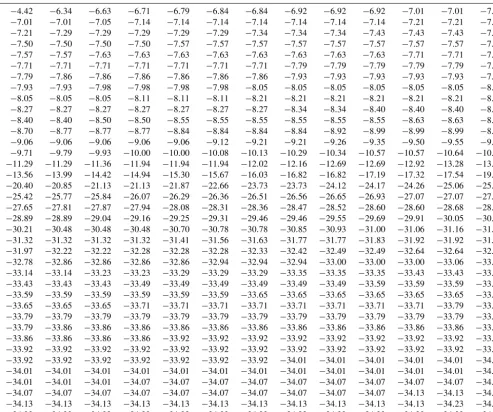
Data from an experiment with a SnomaxTM sample is used here4 for demonstrating the manner of calculating the dif-ferential concentration. Observed freezing temperatures for 507 drops are listed in Table 1. The observations were made with steady cooling of the drops. Freezing events spread over the temperature range from near−4◦C to near−35◦C. Freezing events are most frequent in two temperature re-gions, one near−8◦C and the other at the lowest tempera-tures. As can be seen, some temperature values occur more than once due to the finite resolution of the detection and recording system used. These characteristics of these data make it useful to demonstrate various points about the cal-culations.
4 Choice of temperature interval
The main decision in applying either Eq. (1) or Eq. (2) to experimental results is what numerical values to use for1T, taking into account constraints arising from the resolution of the temperature measurements and from finite sample sizes. While all other quantities in Eqs. (1) to (3) are directly mea-sured, 1T is not an empirical value but is one chosen in analysis for desirable representation of the observations. For the assumptions involved in the derivation ofk(T ), as de-scribed in V71, infinitesimally small intervalsδT should be applied, but this would necessitate infinite, or very large, sample sizesNoin order to avoid a large number of intervals without any events. Thus a finite1T is required. It will be argued that a uniform1T over the entire temperature range of an experiment is the simplest and most effective choice. The choice is made, principally, on the basis of sample size (number of drops in the experiment) and not based on instru-mental variables, such as the recording interval of freezing events.
Table 1.Observed freezing temperatures for 507 drops of a sample of SnomaxTMdispersed in purified water. Freezing temperatures are listed in decreasing order. Multiple values are due to time steps of the detection system used. These data are from work described in Polen et al. (2018).
−4.42 −6.34 −6.63 −6.71 −6.79 −6.84 −6.84 −6.92 −6.92 −6.92 −7.01 −7.01 −7.01 −7.01 −7.01 −7.05 −7.14 −7.14 −7.14 −7.14 −7.14 −7.14 −7.14 −7.21 −7.21 −7.21 −7.21 −7.29 −7.29 −7.29 −7.29 −7.29 −7.34 −7.34 −7.34 −7.43 −7.43 −7.43 −7.43 −7.50 −7.50 −7.50 −7.50 −7.57 −7.57 −7.57 −7.57 −7.57 −7.57 −7.57 −7.57 −7.57 −7.57 −7.57 −7.63 −7.63 −7.63 −7.63 −7.63 −7.63 −7.63 −7.63 −7.71 −7.71 −7.71 −7.71 −7.71 −7.71 −7.71 −7.71 −7.71 −7.71 −7.79 −7.79 −7.79 −7.79 −7.79 −7.79 −7.79 −7.86 −7.86 −7.86 −7.86 −7.86 −7.86 −7.93 −7.93 −7.93 −7.93 −7.93 −7.93 −7.93 −7.93 −7.98 −7.98 −7.98 −7.98 −8.05 −8.05 −8.05 −8.05 −8.05 −8.05 −8.05 −8.05 −8.05 −8.05 −8.11 −8.11 −8.11 −8.21 −8.21 −8.21 −8.21 −8.21 −8.21 −8.21 −8.27 −8.27 −8.27 −8.27 −8.27 −8.27 −8.27 −8.34 −8.34 −8.40 −8.40 −8.40 −8.40 −8.40 −8.40 −8.50 −8.50 −8.55 −8.55 −8.55 −8.55 −8.55 −8.55 −8.63 −8.63 −8.70 −8.70 −8.77 −8.77 −8.77 −8.84 −8.84 −8.84 −8.84 −8.92 −8.99 −8.99 −8.99 −8.99 −9.06 −9.06 −9.06 −9.06 −9.06 −9.12 −9.21 −9.21 −9.26 −9.35 −9.50 −9.55 −9.55 −9.71 −9.79 −9.93 −10.00 −10.00 −10.08 −10.13 −10.29 −10.34 −10.57 −10.57 −10.64 −10.71 −11.29 −11.29 −11.36 −11.94 −11.94 −11.94 −12.02 −12.16 −12.69 −12.69 −12.92 −13.28 −13.48 −13.56 −13.99 −14.42 −14.94 −15.30 −15.67 −16.03 −16.82 −16.82 −17.19 −17.32 −17.54 −19.30 −20.40 −20.85 −21.13 −21.13 −21.87 −22.66 −23.73 −23.73 −24.12 −24.17 −24.26 −25.06 −25.34 −25.42 −25.77 −25.84 −26.07 −26.29 −26.36 −26.51 −26.56 −26.65 −26.93 −27.07 −27.07 −27.30 −27.65 −27.81 −27.87 −27.94 −28.08 −28.31 −28.36 −28.47 −28.52 −28.60 −28.60 −28.68 −28.80 −28.89 −28.89 −29.04 −29.16 −29.25 −29.31 −29.46 −29.46 −29.55 −29.69 −29.91 −30.05 −30.05 −30.21 −30.48 −30.48 −30.48 −30.70 −30.78 −30.78 −30.85 −30.93 −31.00 −31.06 −31.16 −31.16 −31.32 −31.32 −31.32 −31.32 −31.41 −31.56 −31.63 −31.77 −31.77 −31.83 −31.92 −31.92 −31.92 −31.97 −32.22 −32.22 −32.28 −32.28 −32.28 −32.33 −32.42 −32.49 −32.49 −32.64 −32.64 −32.70 −32.78 −32.86 −32.86 −32.86 −32.86 −32.94 −32.94 −32.94 −33.00 −33.00 −33.00 −33.06 −33.06 −33.14 −33.14 −33.23 −33.23 −33.29 −33.29 −33.29 −33.35 −33.35 −33.35 −33.43 −33.43 −33.43 −33.43 −33.43 −33.43 −33.49 −33.49 −33.49 −33.49 −33.49 −33.49 −33.59 −33.59 −33.59 −33.59 −33.59 −33.59 −33.59 −33.59 −33.59 −33.59 −33.65 −33.65 −33.65 −33.65 −33.65 −33.65 −33.65 −33.65 −33.65 −33.65 −33.71 −33.71 −33.71 −33.71 −33.71 −33.71 −33.71 −33.71 −33.79 −33.79 −33.79 −33.79 −33.79 −33.79 −33.79 −33.79 −33.79 −33.79 −33.79 −33.79 −33.79 −33.79 −33.79 −33.79 −33.86 −33.86 −33.86 −33.86 −33.86 −33.86 −33.86 −33.86 −33.86 −33.86 −33.86 −33.86 −33.86 −33.86 −33.86 −33.86 −33.92 −33.92 −33.92 −33.92 −33.92 −33.92 −33.92 −33.92 −33.92 −33.92 −33.92 −33.92 −33.92 −33.92 −33.92 −33.92 −33.92 −33.92 −33.92 −33.92 −33.92 −33.92 −33.92 −33.92 −33.92 −33.92 −33.92 −33.92 −33.92 −34.01 −34.01 −34.01 −34.01 −34.01 −34.01 −34.01 −34.01 −34.01 −34.01 −34.01 −34.01 −34.01 −34.01 −34.01 −34.01 −34.01 −34.01 −34.01 −34.01 −34.01 −34.01 −34.07 −34.07 −34.07 −34.07 −34.07 −34.07 −34.07 −34.07 −34.07 −34.07 −34.07 −34.07 −34.07 −34.07 −34.07 −34.07 −34.07 −34.07 −34.07 −34.07 −34.13 −34.13 −34.13 −34.13 −34.13 −34.13 −34.13 −34.13 −34.13 −34.13 −34.13 −34.13 −34.13 −34.13 −34.23 −34.23 −34.23 −34.23 −34.23 −34.23 −34.23 −34.23 −34.23 −34.23 −34.23 −34.23 −34.23 −34.23 −34.23
pend on the temperature interval between successive freez-ing events. A given freezfreez-ing event would correspond to a
k(T )value whose magnitude is changed depending on the
previous freezing event in the sample. In effect, the quanti-tive significance of the results would be negated. To see this for the SnomaxTMdata, the temperature gaps, the differences between the freezing temperatures for successive events, are shown in Fig. 1. Each point corresponds to one drop and is plotted at the freezing temperature of that drop. The large number of points at zero gap size indicates coincidences in the recorded temperatures for several drops due to the fi-nite resolution of the recording system. Another grouping of points just below 0.1 is due to the temperature change during the time intervals with which the number of frozen drops was
recorded. Both the zeros and these minimum nonzero val-ues are most numerous near−8◦C and near−33◦C where there are high numbers of freezing occurrences. Larger gaps become more frequent in the temperature range between the two groups due to the sparsity of freezing events. These large and irregular gaps would scramble thek(T )values.
Figure 1.Temperature gaps between successive freezing events in the data given in Table 1. Fewer events in the middle range of tem-peratures produce fewer and larger gaps.
In the majority of experiments,Tiis irregularly distributed over the range of all freezing events for a given sample. Thus, if1T is chosen too small there will be intervals with zeros and ones only. That would result in an almost meaningless representation of the results ask(T )would also consist of ze-ros and a uniform small value. The density of points along the T axis would show some pattern but only in a qualitative way. The value chosen for1T is a compromise between what is ideal and what is practical. The latter perspective of course involves judgements over several factors. Most importantly, these factors are the sample size and associated statistical va-lidity, the precision with whichTi values are determined, and the detail in the final spectrum that is believed to hold mean-ingful information. In view of these conflicting influences, there is no single recipe for setting 1T, but the variations that result in the specific choice do not diminish the objec-tive value of the derivedk(T )spectrum if normalized to unit temperature interval.
For the sake of simplicity and generality, equal drop vol-umes are assumed in the calculations here,Xis set to unity, and the differential concentrations are presented with units of ◦C−1. Depending on the choice for X, (drop volume, particle surface area per drop, mass of particles per drop) the units ofk(T )will be different, for example◦C−1cm−3,
◦C−1µm−2, or◦C−1g−1.
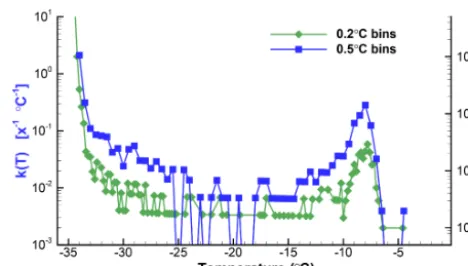
To illustrate the impacts of the choice of 1T, Fig. 2 shows the spectra for the SnomaxTM sample with two dif-ferent values. The data shown in Table 1 were binned us-ing1T =0.2◦C and1T =0.5◦C. For1T =0.2◦C there
are 51 empty bins (zeros) between −6 and −34◦C. For
1T =0.5◦C there are only eight zeros in the same tempera-ture range. Equation (2) was then used to obtaink(T ). Plots of k(T )shown in Fig. 2 differ, principally, in the degree of noisiness of the data points. Because of the large range of val-ues covered, plots of k(T )almost always use a logarithmic ordinate scale. This eliminates the possibility of including zero values, and special steps need to be taken for the plots
Figure 2.Plots ofk(T )for 0.2 and 0.5◦C bin sizes for the data from Table 1. The right-hand scale is shifted down slightly to allow the two plots to be clearly seen. Zero values are indicated for the 0.5◦C graph with values below the range covered by the ordinate. The ordinate values are forX=1 of unspecified dimension, and thus the units are given as [x−1◦C−1].
to show these values. For one of the plots in Fig. 2 the zeros were replaced by a low value well below the range covered by actual data in order to indicate the presence of the zero values. Without this, the presence of zeros, or empty bins, is seen as gaps between points, and as horizontal lines. This matters in judging the significance of the points surrounding the zeros. Clearly, the dip ink(T )between−26 and−17◦C is perceived to be much deeper when the zeros are indicated.
5 Calculation ofk(T )andK(T )
Once the interval width has been decided, calculation of the differential concentration is a straightforward matter, result-ing in a value ofk(T )for each temperature interval. The cu-mulative concentration is then also calculated for the same temperatures if it is performed by summation of the differ-ential values. This is not a requirement; the cumulative spec-trum can also be calculated without binning of the data and for as many temperatures as wanted.
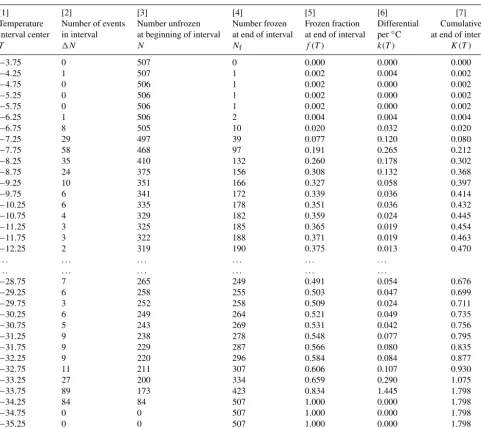
Based on the comparison presented in Fig. 2 and on the text associated with it, calculations for the SnomaxTMsample are processed here with1T =0.5◦C. The result of that bin-ning ofTivalues is shown in Fig. 3 as a histogram. After bin-ning, values ofN (T )were calculated by stepwise addition of the1Nvalues from the lowest to the highest temperature, ending up withNo for the first interval with nonzero 1N. Performing the accumulation of1N from lowest to high-est temperature producesNvalues at the upper end (warmer temperature) of each interval. The frozen fraction expressed with respect to the lower end (colder temperature) of the in-terval is obtained as
f (T )=1−N (T )−1N No
Table 2.Differential and cumulative spectra for the SnomaxTMsample with 0.5◦C intervals, as discussed in Sect. 5. Ellipses indicate the range in which not all temperatures are included, for brevity.
[1] [2] [3] [4] [5] [6] [7]
Temperature Number of events Number unfrozen Number frozen Frozen fraction Differential Cumulative interval center in interval at beginning of interval at end of interval at end of interval per◦C at end of interval
T 1N N Nf f (T ) k(T ) K(T )
−3.75 0 507 0 0.000 0.000 0.000
−4.25 1 507 1 0.002 0.004 0.002
−4.75 0 506 1 0.002 0.000 0.002
−5.25 0 506 1 0.002 0.000 0.002
−5.75 0 506 1 0.002 0.000 0.002
−6.25 1 506 2 0.004 0.004 0.004
−6.75 8 505 10 0.020 0.032 0.020
−7.25 29 497 39 0.077 0.120 0.080
−7.75 58 468 97 0.191 0.265 0.212
−8.25 35 410 132 0.260 0.178 0.302
−8.75 24 375 156 0.308 0.132 0.368
−9.25 10 351 166 0.327 0.058 0.397
−9.75 6 341 172 0.339 0.036 0.414
−10.25 6 335 178 0.351 0.036 0.432
−10.75 4 329 182 0.359 0.024 0.445
−11.25 3 325 185 0.365 0.019 0.454
−11.75 3 322 188 0.371 0.019 0.463
−12.25 2 319 190 0.375 0.013 0.470
. . . .
. . . .
−28.75 7 265 249 0.491 0.054 0.676
−29.25 6 258 255 0.503 0.047 0.699
−29.75 3 252 258 0.509 0.024 0.711
−30.25 6 249 264 0.521 0.049 0.735
−30.75 5 243 269 0.531 0.042 0.756
−31.25 9 238 278 0.548 0.077 0.795
−31.75 9 229 287 0.566 0.080 0.835
−32.25 9 220 296 0.584 0.084 0.877
−32.75 11 211 307 0.606 0.107 0.930
−33.25 27 200 334 0.659 0.290 1.075
−33.75 89 173 423 0.834 1.445 1.798
−34.25 84 84 507 1.000 0.000 1.798
−34.75 0 0 507 1.000 0.000 1.798
−35.25 0 0 507 1.000 0.000 1.798
−35.75 0 0 507 1.000 0.000 1.798
The differential concentration was calculated from Eq. (1) and the cumulative from Eq. (3). Results are given in Table 2. The table is given from highest to lowest temperature to make it match the way the data are obtained in the experiment with gradual cooling. The temperature in the first column is the midpoint of the interval over which the data were evaluated. As indicated in the preceding paragraph, columns [4], [5], and [7] are shifted by one line with respect to the others in order that they refer to the low end of the temperature inter-val. These distinctions of interval midpoint and high and low ends are somewhat unnecessary considering the magnitude of the interval width but are included here to avoid misin-terpretation of the tabulated data. It is also worth noting that at the initial part of the table, the cumulative concentration
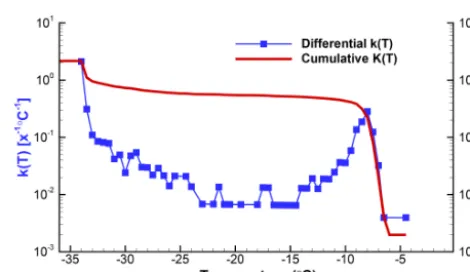
is smaller in magnitude than the differential because the dif-ferential is normalized to degrees Celsius intervals, making the values, for1T =0.5◦C used in this example, double the value without that normalization.
Figure 3.Histogram of freezing temperatures and a plot of the frac-tion of drops frozen for the data from Table 1 (SnomaxTM suspen-sion).
cases, it might be desirable to fit algebraic equations to the data.
The effectiveness of transmitting the results of analyses such as this, as mentioned, depends on the numerous fac-tors already discussed. From a purely data-processing per-spective, the spectrum with lower resolution is better be-cause it has fewer zero values. No claim is made that the 1T =0.5◦C choice is optimal. The resultingk(T )spectrum still has considerable fluctuations in the middle portion of the temperature range. Conversely, the main peak is well re-solved, as is its asymmetric shape. There are many additional steps that can be considered for smoothing the data, either at the1N level or ink(T ).
From the point of view of showing what kind of INPs were contained in the sample, all the graphs clearly indicate peaks in activity near−8◦C and near−33◦C. The first peak is of greater interest because it is due to the INPs added to the sample, while the low-temperature activity is due to the background related to the supporting surface of the drops and to impurities in the water used to suspend the active INPs. As a minor detail, it may be noted that the−8◦C peak has a broader tail toward colder temperatures. This feature is clearly seen in both of the graphs. Even finer details of the peak can be seen if the data are processed at higher resolu-tion, but very little significance can be attached to such de-tails in light of the sample size, the temperature precision of the measurements, and other instrumental factors. Nonethe-less, it is important to note that the differential spectra can resolve distinct peaks and thus can provide the type of acute description of INP activity that is needed in many studies.
6 Background correction
The differential concentration in a sample with various sources of INPs can be assumed to be the sum of the concen-trations due to each of the sources. This assumption of addi-tive behavior is likely to hold for many cases and would be
Figure 4.Differential and cumulative spectra for data discussed in Sect. 5 and displayed in different forms in Figs. 2 and 3. Zeros in the differential spectrum are seen in these plots by larger gaps between adjacent points. The left and right ordinate scales are identical. As mentioned in the text, the cumulative curve starts at a lower value than the differential because the differential is expressed with refer-ence to full degree intervals.
incorrect only if, for some reason, interactions are expected among INPs from the different sources. The most relevant example of additive behavior, applicable to essentially all ex-periments with laboratory preparations, is the addition of the background activity to that of the material to be tested. The water used to prepare suspensions of INPs is never totally free of INPs, and there is potential for further contributions to the “background” by the components of the apparatus used in the experiment. While extreme care is taken in most cases to minimize the background, it is always present to greater or lesser extent. Determination of the background is accom-plished with control experiments.
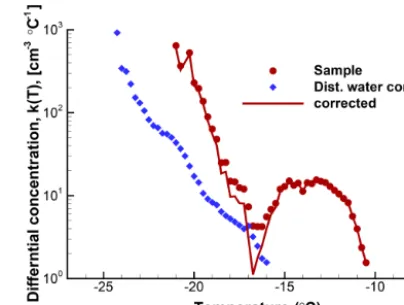
The usefulness of a quantitative assessment of the back-ground activity is demonstrated with the following example5. A suspension of soil particles in distilled water, and con-trol measurements of the distilled water, yielded the frozen fraction curves in Fig. 5. From these graphs it would ap-pear that the soil sample data are not reliable much below about−18◦C because of the appreciable level of activity in the control. When the differential spectra are computed and the control is subtracted from thek(T )values for the sample, the resulting plot shown in Fig. 6 reveals that only in a nar-row region near−17◦C is the contribution from the distilled water comparable to the INP activity in the soil. Thus, the INP activity in the soil sample below−18◦C can be judged
in a more objective fashion. Just considering this result, it would not be baseless to conclude that the soil sample con-tained two types of INPs, those producing the peak centered at−13◦C and those giving rise to high numbers of INPs be-low−18◦C. In practice, further tests with different amounts of soil in suspension would be useful to judge that conclu-sion.
Figure 5.Observed fractions of droplets frozen for the soil sample and for the distilled water control, as described in Sect. 6. Data are from a single run with 103 drops of 0.01 cm3volume.
7 Confidence intervals
Several sources of error contribute to determining the con-fidence limits or uncertainty ranges of results derived from drop-freezing experiments. Temperature accuracy is a minor contribution in most cases. Acuity of the detection of freez-ing is a larger concern. These and other error sources need to be evaluated specifically for each experimental setup. A gen-eral and demanding problem is the evaluation of the statisti-cal validity of results. That uncertainty, arising from sample sizes, is of special concern because of the usually large tem-perature range of the observations and the consequent small number of freezing events at each temperature. Uncertainty ranges specific to each temperature can be evaluated using thek(T )spectra, as described in the following.
Even with identical drop volumes and with all drops pro-duced from the same bulk suspension, considerable spreads in freezing temperatures are usually observed. As discussed earlier, variations in freezing temperatures are associated with specific differences in INPs so that the variations in freezing temperatures indicate a nonrandom distribution of the INPs of different activities in the drops. Hence, basic sta-tistical methods are not applicable to estimating the confi-dence interval of thek(T )orK(T )spectra derived to charac-terize the INP content. In the absence of many repetitions of the experiments to determine variability, Monte Carlo simu-lations provide a possible solution. In V71, such simusimu-lations were applied to show how the spread ink(T )spectra is re-duced by increasing sample size. Monte Carlo methods of slightly different configurations were also used in Wright and Petters (2013) and in Harrison et al. (2018).
The differential concentration provides a convenient basis for simulations because values of k(T ) for given tempera-tures are independent of the values at other temperatempera-tures. Use of the cumulative concentration derived from the frozen frac-tion would be less transparent. The simplest basis for sim-ulations is the number of freezing events observed in each temperature interval,1N (T ). Random variability expected
Figure 6.Differential spectra for the same data as shown in Fig. 5. Circle symbols are for the soil sample; diamond symbols are for the control (blue). The spectrum for the soil sample after correction for the distilled water background is shown with a line. The magni-tude of the correction is relatively minor in this case except in the temperature region between about−14 and−18◦C.
about those values is the measure sought in the simulation. This can be viewed as if a new set of drops were taken each time from the same bulk sample, or a new set of particles were dispersed into the volume each time, and then a freez-ing run performed. Simulation allows as many of these runs to be carried out as needed to reach a good estimate of the variability.
The simulation is relatively simple. The number of events in any given temperature interval can be expected to follow a Poisson distribution on repeated testing. This probability distribution fits the situation because the number of events per interval is discrete and independent of other intervals, and the observed numbers can serve as the assumed true val-ues. Hence, taking the observed values of1N (T )as the ex-pectation valuesλ(T )and generating a large number, sayp, of Poisson-distributed numbers for each temperature interval provides independent virtual realizations of the experiment. The mean value of the1Ni. . .1Npnumbers in each inter-val will equalλfor that interval, and the standard deviation will beλ0.5. However, the Poisson distributions include ze-ros even for mean values greater than zero. The chance of this reduces as the mean increases; the number of zero val-ues ise−λ.
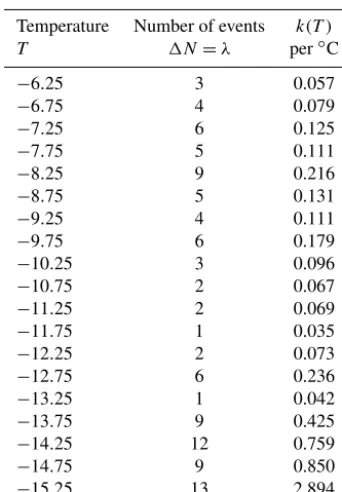
For a first demonstration of the simulation, a data set with a modest number of 106 drops is used here. Measured num-bers of freezing events for1T =0.5◦C intervals and the
cal-Table 3.Observed freezing data used as input to the Monte Carlo simulation described in Sect. 7.
Temperature Number of events k(T )
T 1N=λ per◦C
−6.25 3 0.057 −6.75 4 0.079 −7.25 6 0.125 −7.75 5 0.111 −8.25 9 0.216 −8.75 5 0.131 −9.25 4 0.111 −9.75 6 0.179 −10.25 3 0.096 −10.75 2 0.067 −11.25 2 0.069 −11.75 1 0.035 −12.25 2 0.073 −12.75 6 0.236 −13.25 1 0.042 −13.75 9 0.425 −14.25 12 0.759 −14.75 9 0.850 −15.25 13 2.894
culated using Eq. (1). The simulation results can be used in many different ways to represent the resulting uncertainties in the presentations of the empirical results. The scatter in k(T ) values is an immediate way to show the results. Cu-mulative spectraK(T )can also be obtained, as can standard deviations, or other measures.
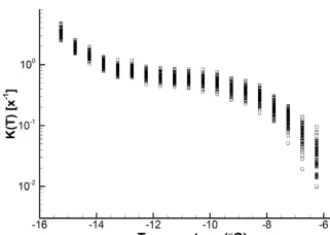
Simulated results in terms of k(T )are shown in Fig. 7. At a few places above the temperature axis, the number of zero values that occurred in the simulation for that inter-val are indicated. In this approach, the total numberNofor any given run is not constrained toP
λ; the actual number among the 100 simulated sets varied by 10 %. This variation alters the simulatedk(T )values at the low end of the tem-perature range to some degree but is insignificant at the high end. There seems to be little reason to go to that extent or re-finement, but the problem could be eliminated by adjustingλ for lower temperatures for each choice of1Ni in successive steps. One point of assurance on this score is that the 50th percentile of the simulatedk(T )points is only 3 % off from those shown in Table 3.
The spread of 10 % to 90 % of values at each interval is shown in Fig. 8. This example shows roughly a factor of 4 spread ink(T )over the whole range of temperatures, worse for those points with lowk(T )and hence also having zero values potentially expected in repetitions. As can be seen for this example, it clearly is not justified to attach too much sig-nificance to fine details of the spectrum, but there is reason-ably good definition of the broad peak of activity centered on −8◦C and of the rapid rise in numbers below −12◦C. Should the observed data have been binned in larger
tem-Figure 7.Calculatedk(T )values for 100 iterations of random as-signments of 1N from a Poisson distribution with the λ values shown in Table 3 for each interval. Numbers above the abscissa indicate the number of zero values in the simulation for selected temperatures.
Figure 8.The 10th to 90th percentile range ofk(T )for the results shown in Fig. 7. The green diamonds show the values ofk(T )from the right-hand column of Table 3 for the observed sequence of freez-ing events. Points just above the abscissa are actually zero values.
perature intervals, the confidence limits would have become narrower at the cost of lower temperature resolution. In the case presented here, this would be a reasonable choice even though the intuitive approach is to present the data with tem-perature resolution justified by measurement precision. The main limitation is from sample size.
Figure 9.Cumulative spectra for 100 simulations for which differ-ential spectra are shown in Fig. 7.
As an illustration of the influence of sample size on the confidence intervals for k(T ), the SnomaxTM sample for which data were presented in Sect. 4 was also used in a Monte Carlo simulation. The input to the simulation was extracted from Table 1 for the region near the peak, where there are 30–50 events per bin. The simulation results for 100 iterations are shown in Fig. 10 and, as can be seen, the range of variation is less than a factor of 2 at the peak. At the lowerk(T )values, the variability is similar to what is seen in Fig. 10. Here too, zero values are plotted along an ordinate value of 10−2.
The examples shown above illustrate one possible way to assess the confidence limits ofk(T ). The simulation ap-proach is a realistic and readily envisioned method. Similar results for the confidence ranges could be obtained from ta-bles of Poisson distribution using the observed number of events in some experiment as λfor each temperature inter-val. The standard deviation,λ0.5, is another way to measure variability. However, it cannot be used in the way it would be for normally distributed values because, for example, the lower limit of the 95 % range at (λ−2.14·λ0.5) can be neg-ative for smallλvalues and therefore not a physically realis-tic value for expectedδN. The main point is that confidence limits can be delineated and with that the meaning of derived k(T )spectra quantitatively assessed. The results shown here also demonstrate the need for large sample sizes in order to reduce the variability of the derived spectra.
Once sample variability has been estimated, statistical methods are available for comparisons of two samples by testing, for example, the equivalence of means (e.g., Chap. 20 in Blank, 1980). Performing that type of test interval by inter-val, as in the previous paragraphs, would test for activity in specific temperature regions. That may indeed be very useful in certain cases but will definitely require large sample sizes. More complex methods will need to be considered to make broader overall comparisons of different samples. Combin-ing data from larger temperature segments – those of greatest interest – could be helpful, but the strong temperature depen-dence of activity may be difficult to weigh adequately. Again,
Figure 10.The 10th to 90th percentile range ofk(T )in 100 simula-tions for a segment of the spectrum shown in Fig. . Points just above the abscissa stand for zero values. In contrast with other figures, a linear ordinate scale is used because of the small range of values covered. A value ofX=1 is used; actual drop volume of particle concentration is not accounted for.
sample sizes will likely pose the most serious limitation to reaching statistical significance in such tests.
8 Active site density
Site density is defined in V15 as “the number of sites causing nucleation per unit surface area of the INP, or equivalent, as functions of temperature or supersaturation; the quantitative measure of the abundance of sites of different ice nucleating effectiveness”. Frequently, for added emphasis, the term is given asactivesite density and denoted asns. This quantity has already seen extended use in the literature (e.g., Con-nolly et al., 2009; Niedermeier et al., 2015; Beydoun et al., 2016; Paramonov et al., 2018; Boose et al., 2019). As stated in Sect. 2, normalization of the cumulative spectrum by par-ticle surface area, usingX=Ain Eq. (4), leads tons, most frequently in the inverted form
f (T )=1−exp(−A·ns(T )) . (7)
No use has been made in the literature of the concept of dif-ferential active site density, although that metric has the same validity as the cumulative one, and is readily derived from Eq. (2) with the substitution ofX=A.
seems better to avoid the confusion that could result when comparing results from different publications.
The two expressions for active site density are
ks(T )= − 1 A·1T ·ln
1− 1N N (T )
, (8)
Ks(T )= − 1
A·ln[1−f (T )]. (9)
Use ofAas average INP surface area included in each drop implies some important constraint on when that use is justi-fied. First of all, it implies that the particles are stable and that the determination of Awas carried out in the suspen-sion, not in the dry state. The two determinations may differ, for example, if the particles contain some soluble material, or they take up water and change in volume. Examples of aging and other effects altering particle effectiveness in water have already been reported (e.g., Emersic et al., 2015). Calcula-tions ofksorKsfor macromolecule INPs are of questionable value; these materials are best characterized with reference to the total mass of material or the number of individual macro-molecules in suspension, not with reference to surface area. As for all of the quantitative characterizations discussed in this paper, temporal stability is assumed, at the minimum on the timescale of the experiment.
In addition to the considerations of the previous paragraph, valid use of an average surface areaAalso requires that de-viations from the mean value be reasonably small and not be the dominant source of error in the derived measures of ac-tivity. Special attention is needed with respect to the larger particles in polydisperse samples as these contribute dispro-portionate fractions of the total surface area. With sufficient knowledge of the particle size distributions, the error esti-mated can be derived for deviations from the average. Since Aappears in the pre-factor in the equations for both ks(T ) andKs(T ), the derived error estimate is valid for all values of the spectrum.
Dependent on the material constituting the INPs, total sur-face area may be an inadequate parameter to use in the cal-culation of the active site density. For example, if only a cer-tain crystal face concer-tains ice-nucleating sites, the surface area of that face is the relevant measure to include. Knowledge of such morphological factors is the goal of many studies; obtaining ks(T ) or Ks(T ) with variations in experimental parameters may provide useful insights. Conversely, with-out sufficient knowledge abwith-out particle surface characteris-tics substantial caveats need to be recognized regarding ac-tive site density spectra.
9 Summary
The differential spectrum,k(T ), is a useful representation of INP activity in heterogeneous freezing. This article examined some of the factors that need to be considered in derivations ofk(T )for experiments executed with gradual cooling of an array of sample drops taken from the same bulk sample and with the freezing of drops at different temperatures recorded. Freezing at a given temperature is taken to indicate the pres-ence of INPs active at that temperature. In Sect. 4, the im-portance of the choice of temperature interval for computing the spectra was elaborated. Methods of calculation and the relation to other derived quantities were presented in Sect. 5. Two applications were discussed: Sect. 6 presents a method for correcting empirical results for background effects. Cor-rection for background is achieved by subtraction of thek(T ) values. In Sect. 7, a method was described for determination of confidence limits fork(T )using Monte Carlo simulations. Sample size and spectral shape determine the error ranges ofk(T ). Lesser uncertainty is associated with the cumulative spectra. The background correction and the determination of error ranges can significantly augment the value of informa-tion derived from laboratory freezing experiments and can improve model predictions of ice formation in clouds.
Appendix A: Nomenclature
A Average particle surface area contained in drops; m−2 f (T ) Fraction of sample drops frozen atT
k(T ) Differential nucleus concentration;x−1◦C−1 ks(T ) Differential active site density; m−2◦C−1
K(T ) Cumulative concentration of INPs active at temperatures aboveT;x−1 Ks(T ) Cumulative site density on the INPs active at temperatures aboveT; m−2 ns(T ) Same asKs(T )
N (T ) Number of drops not frozen at temperatureT
1N Number of freezing events per temperature interval No Total number of sample drops
T Temperature;◦C
Ti Freezing temperature of a drop
X Reference quantity for normalization to unit volume of water, particle surface area, etc., as the case may be. For generality, corresponding units are indicated ink(T )andK(T )asx.
Competing interests. The authors declare that they have no conflict of interest.
Acknowledgements. Ryan Sullivan of Carnegie Mellon University is thanked for permission to use the data given in Table 1. Thanks to the associate editor Wiebke Frey for identifying errors in the original submission. Hinrich Grothe and the anonymous referee made suggestions that were helpful for rounding out some of the arguments. Their questions led to the clarification of some details.
Edited by: Wiebke Frey
Reviewed by: Hinrich Grothe and one anonymous referee
References
Beydoun, H., Polen, M., and Sullivan, R. C.: Effect of parti-cle surface area on ice active site densities retrieved from droplet freezing spectra, Atmos. Chem. Phys., 16, 13359–13378, https://doi.org/10.5194/acp-16-13359-2016, 2016.
Blank, L.: Statistical procedures for engineering, management, and science, McGraw-Hill Book Company, New York and others, ISBN 0-07-005851-2, 649 pp., 1980.
Boose, Y., Baloh, P., Plötze, M., Ofner, J., Grothe, H., Sierau, B., Lohmann, U., and Kanji, Z. A.: Heterogeneous ice nucle-ation on dust particles sourced from nine deserts worldwide – Part 2: Deposition nucleation and condensation freezing, At-mos. Chem. Phys., 19, 1059–1076, https://doi.org/10.5194/acp-19-1059-2019, 2019.
Connolly, P. J., Möhler, O., Field, P. R., Saathoff, H., Burgess, R., Choularton, T., and Gallagher, M.: Studies of heterogeneous freezing by three different desert dust samples, Atmos. Chem. Phys., 9, 2805–2824, https://doi.org/10.5194/acp-9-2805-2009, 2009.
DeMott, P. J., Hill, T. C. J., Petters, M. D., Bertram, A. K., Tobo, Y., Mason, R. H., Suski, K. J., McCluskey, C. S., Levin, E. J. T., Schill, G. P., Boose, Y., Rauker, A. M., Miller, A. J., Zaragoza, J., Rocci, K., Rothfuss, N. E., Taylor, H. P., Hader, J. D., Chou, C., Huffman, J. A., Pöschl, U., Prenni, A. J., and Kreidenweis, S. M.: Comparative measurements of ambient atmospheric concentra-tions of ice nucleating particles using multiple immersion freez-ing methods and a continuous flow diffusion chamber, Atmos. Chem. Phys., 17, 11227–11245, https://doi.org/10.5194/acp-17-11227-2017, 2017.
Emersic, C., Connolly, P. J., Boult, S., Campana, M., and Li, Z.: Investigating the discrepancy between wet-suspension-and dry-dispersion-derived ice nucleation efficiency of mineral particles, Atmos. Chem. Phys., 15, 11311–11326, https://doi.org/10.5194/acp-15-11311-2015, 2015.
Hader, J. D., Wright, T. P., and Petters, M. D.: Contribution of pollen to atmospheric ice nuclei concentrations, Atmos. Chem. Phys., 14, 5433–5449, https://doi.org/10.5194/acp-14-5433-2014, 2014.
Harrison, A. D., Whale, T. F., Rutledge, R., Lamb, S., Tarn, M. D., Porter, G. C. E., Adams, M. P., McQuaid, J. B., Morris, G. J., and Murray, B. J.: An instrument for quantifying hetero-geneous ice nucleation in multiwell plates using infrared
emis-sions to detect freezing, Atmos. Meas. Tech., 11, 5629–5641, https://doi.org/10.5194/amt-11-5629-2018, 2018.
Häusler, T., Witek, L., Felgitsch, L., Hitzenberger, R., and Grothe, H.: Freezing on a Chip – A New Approach to Determine Hetero-geneous Ice Nucleation of Micrometer-Sized Water Droplets, At-mosphere, 9, 140, https://doi.org/10.3390/atmos9040140, 2018. Kumar, A., Marcolli, C., Luo, B., and Peter, T.: Ice nucleation
activity of silicates and aluminosilicates in pure water and aqueous solutions – Part 1: The K-feldspar microcline, At-mos. Chem. Phys., 18, 7057–7079, https://doi.org/10.5194/acp-18-7057-2018, 2018.
Niedermeier, D., Augustin-Bauditz, S., Hartmann, S., Wex, H., Ignatius, K., and Stratmann, F.: Can we define an asymp-totic value for the ice active surface site density for hetero-geneous ice nucleation?, J. Geophys. Res.-Atmos., 120, 5036– 5046, https://doi.org/10.1002/2014JD022814, 2015.
Paramonov, M., David, R. O., Kretzschmar, R., and Kanji, Z. A.: A laboratory investigation of the ice nucleation efficiency of three types of mineral and soil dust, Atmos. Chem. Phys., 18, 16515– 16536, https://doi.org/10.5194/acp-18-16515-2018, 2018. Polen, M., Brubaker, T., Somers, J., and Sullivan, R. C.:
Clean-ing up our water: reducClean-ing interferences from non-homogeneous freezing of pure water in droplet freezing assays of ice nucleating particles, Atmos. Meas. Tech., 11, 5315–5334, https://doi.org/10.5194/amt-11-5315-2018, 2018.
Sullivan, R. and Vali, G.: Data used in the publication Revisiting the differential freezing nucleus spectra derived from drop freezing experiments; methods of calculation, applications and confidence limits, https://doi.org/10.15786/y5xr-pw35, 2019.
Tarn, M. D., Sikora, S. N. F., Porter, G. C. E., O’Sullivan, D., Adams, M., Whale, T. F., Harrison, A. D., Vergara-Temprado, J., Wilson, T. W., Shim, J. U., and Murray, B. J.: The study of atmospheric ice-nucleating particles via mi-crofluidically generated droplets, Microfluid. Nanofluid., 22, 52, https://doi.org/10.1007/s10404-018-2069-x, 2018.
Vali, G.: Quantitative evaluation of experimental results on the het-erogeneous freezing nucleation of supercooled liquids, J. Atmos. Sci., 28, 402–409, 1971.
Vali, G.: Repeatability and randomness in heterogeneous freezing nucleation, Atmos. Chem. Phys., 8, 5017–5031, https://doi.org/10.5194/acp-8-5017-2008, 2008.
Vali, G.: Interpretation of freezing nucleation experiments: singu-lar and stochastic; sites and surfaces, Atmos. Chem. Phys., 14, 5271–5294, https://doi.org/10.5194/acp-14-5271-2014, 2014. Vali, G., DeMott, P. J., Möhler, O., and Whale, T. F.: Technical
Note: A proposal for ice nucleation terminology, Atmos. Chem. Phys., 15, 10263–10270, https://doi.org/10.5194/acp-15-10263-2015, 2015.
Vali, G.: Comment on the quantitative evaluation of background noise in drop freezing experiments, Atmos. Meas. Tech. Dis-cuss., https://doi.org/10.5194/amt-2018-134-SC1, 2018. Whale, T. F., Murray, B. J., O’Sullivan, D., Wilson, T. W., Umo, N.
S., Baustian, K. J., Atkinson, J. D., Workneh, D. A., and Morris, G. J.: A technique for quantifying heterogeneous ice nucleation in microlitre supercooled water droplets, Atmos. Meas. Tech., 8, 2437–2447, https://doi.org/10.5194/amt-8-2437-2015, 2015. Wright, T. P. and Petters, M. D.: The role of time in heterogeneous