City University of New York (CUNY) City University of New York (CUNY)
CUNY Academic Works
CUNY Academic Works
Open Educational Resources Bronx Community College
2015
Human Anatomy and Physiology Preparatory Course
Human Anatomy and Physiology Preparatory Course
Carlos Liachovitzky
CUNY Bronx Community College
How does access to this work benefit you? Let us know!
More information about this work at: https://academicworks.cuny.edu/bx_oers/1 Discover additional works at: https://academicworks.cuny.edu
Department of Biological Sciences
Bronx Community College of the City University of New York
Human Anatomy and Physiology I
Preparatory Course without Quizzes
by C. Liachovitzky 2015
Human Anatomy and Physiology Preparatory Course by C. Liachovitzky is licensed under a Creative Commons Attribution–NonCommercial-ShareAlike 4.0 International License <<<->>> This content is available for free <<<->>> 1
Table of Contents
HUMAN ANATOMY AND PHYSIOLOGY I PREPARATORY COURSE ... 5 UNIT 1 - INTRODUCTION TO ANATOMY AND PHYSIOLOGY ... 6 MODULE 1: LEVELS OF ORGANIZATION OF THE HUMAN ORGANISM ... 6 Learning Objective 1: Describe, in order from simplest to most complex, the major levels of organization in the human organism ... 6 MODULE 2: WHAT IS HUMAN ANATOMY, WHAT IS HUMAN PHYSIOLOGY ... 8
Learning Objective 2: Define the terms anatomy and physiology, and give specific examples to show the interrelationship between anatomy and physiology ... 8 MODULE 3: HOMEOSTASIS AND CONTROL SYSTEMS ... 9
Learning Objective 3: Define homeostasis ... 9 Learning Objective 4: Define control system and describe its components ... 10 Learning Objective 5: Define negative feedback and give one example using body temperature ... 11 Learning Objective 6: Define positive feedback and give one example; also, compare and contrast positive and negative feedback in terms of the relationship between response and result ... 12
UNIT 2 – INTRODUCTION TO ANATOMY AND PHYSIOLOGY CHEMICAL
BUILDING BLOCKS ... 14
Human Anatomy and Physiology Preparatory Course by C. Liachovitzky is licensed under a Creative Commons Attribution–NonCommercial-ShareAlike 4.0 International License <<<->>> This content is available for free <<<->>> 2
Learning Objective 11: Define the terms ion, cation, anion, and electrolyte ... 22 MODULE 2: CHEMICAL BONDS ... 23
Learning Objective 12: Define chemical bonding, molecules, salts and compounds; and list three types of chemical bonds important for the study of human physiology ... 23 Learning Objective 13: Define ionic bonds and describe how they form, and define salts ... 25 Learning Objective 14: Define covalent bonds and describe how they form, and differentiate between the two types of covalent bond ... 26 MODULE 3: WATER ... 30
Learning Objective 15: Define hydrogen bonds and describe how they form ... 30 Learning Objective 16: Describe the behavior of ionic compounds when placed in water ... 31 Learning Objective 17: Differentiate between hydrophobic and hydrophilic substances ... 32 Learning Objective 18: Define the terms solution, solvent, and solute .... 33 MODULE 4: ACIDS AND BASES ... 35
Learning Objective 19: Define and differentiate the terms acid and base35 Learning Objective 20: Define the terms pH, neutral, acidic, and basic (or alkaline) ... 36 Learning Objective 21: Define the term buffer, and compare the response of a regular solution with a buffer solution to the addition of acid or base ... 38 UNIT 3 – MOLECULAR LEVEL: BIOMOLECULES, THE ORGANIC COMPOUNDS ASSOCIATED WITH LIVING ORGANISMS ... 39
MODULE 1: ORGANIC COMPOUNDS ... 39 Learning Objective 22: Define the terms organic compound and
Human Anatomy and Physiology Preparatory Course by C. Liachovitzky is licensed under a Creative Commons Attribution–NonCommercial-ShareAlike 4.0 International License <<<->>> This content is available for free <<<->>> 3
Learning Objective 23: Define functional groups and give examples ... 42 MODULE 2: CHEMICAL REACTIONS ... 43 Learning Objective 24: Differentiate between substrate and product, and define chemical equation ... 43 Learning Objective 25: Define metabolism, synthesis (anabolic),
decomposition (catabolic), and exchange reactions. ... 44 Learning Objective 26: Differentiate between reversible reactions and irreversible reactions ... 45 Learning Objective 27: Explain dehydration synthesis and hydrolysis reactions ... 46
Learning Objective 28: Explain the relationship between monomers and polymers ... 48
MODULE 3: CARBOHYDRATES ... 50 Learning Objective 29: Describe the general molecular structure of
carbohydrates, and identify their monomers and polymers; list the three subtypes of carbohydrates, and describe their structure and function .... 50 MODULE 4: LIPIDS ... 54
Learning Objective 30: Describe the general chemical structure of lipids, list three subtypes of lipids important in human functioning, and describe their structure and function ... 54 MODULE 5: PROTEINS ... 58
Learning Objective 31: Describe the general chemical structure of proteins and identify monomers and polymers; and list and explain
functions proteins perform ... 58
Learning Objective 32: Define conjugated protein, lipoprotein,
glycosylated molecule, glycoprotein, and glycolipid ... 62
Learning Objective 33: Define enzyme, enzymatic reaction, substrate, product, and active site ... 63
Human Anatomy and Physiology Preparatory Course by C. Liachovitzky is licensed under a Creative Commons Attribution–NonCommercial-ShareAlike 4.0 International License <<<->>> This content is available for free <<<->>> 4
Learning Objective 35: Describe the structure and function of ATP in the cell ... 67 UNIT 4 SMALLEST LEVEL OF COMPLEXITY ALIVE: CELLS, THEIR
STRUCTURES AND FUNCTIONS ... 69 MODULE 1: CELL STRUCTURE AND FUNCTION ... 69
Learning Objective 36: Define a cell, identify the main common
components of human cells, and differentiate between intracellular fluid and extracellular fluid ... 69 Learning Objective 37: Describe the structure and functions of the
plasma (cell) membrane. ... 70 Learning Objective 38: Describe the nucleus and its function ... 72 Learning Objective 39: Describe the components of the cytoplasm and their functions ... 73 Learning Objective 40: Identify the structure and function of cytoplasmic organelles ... 74 UNIT 5 HIGHER LEVELS OF COMPLEXITY: ORGANS AND SYSTEMS ... 79 MODULE 1: ORGANS AND SYSTEMS OF THE HUMAN ORGANISM ... 79
Learning Objective 41: Define organ and organ system, and list the organ systems in the human organism ... 79
Human Anatomy and Physiology Preparatory Course by C. Liachovitzky is licensed under a Creative Commons Attribution–NonCommercial-ShareAlike 4.0 International License <<<->>> This content is available for free <<<->>> 5
HUMAN ANATOMY AND PHYSIOLOGY I PREPARATORY COURSE
The overall purpose of this preparatory material is to help students familiarize with some terms and some basic concepts they will find later in the Human Anatomy and Physiology course.
The organization and functioning of the human organism generally is discussed in terms of different levels of increasing complexity, from the smallest building blocks to the entire body. This Anatomy and Physiology preparatory course covers the foundations on the chemical level, and a basic introduction to cellular level, organ level, and organ system levels. There is also an introduction to homeostasis at the beginning.
The material is divided into five UNITS, organized in fifteen MODULES covering a total of forty two
Learning Objectives. There is an associated assessment component at the end of each learning objective.
Learning Objectives Content
1. Learning Objectives (LO) are a derivative work of the most updated Learning Outcomes Guidelines by The Human Anatomy and Physiology Society.
2. Terms associated with each LO are shown in Arial Bold.
3. Ethymology of many new terms is shown between brackets next to the term. Sources of words ethymology are The Free Dictionary by Farlex, and The Online Ethymology Dictionary
4. Figures contain illustrations mostly from Open Learning Initiative by Carnegie Mellon University (www.oli.cmu.edu), and OpenStax CNX by Rice University (http://cnx.org/), and other open education resources, either in the public domain (free license), or licensed through
creative commons licenses (mostly licensed by attribution, some share alike and noncommercial). Illustrations throughout the book include a link to their source.
5. Tables compare terms or facts easier to visualize in a table format, or summarize information 6. Interactive Activities There are a few interactive activities and tutorials available in the digital version to exemplify certain concepts, or clarify certain descriptions in the text. Their sources are cited next to them.
Assessment Content
1. Study Questions addressing all terms, concepts and facts discussed within each learning objective. Most questions are knowledge questions (Bloom’s taxonomy first level)
2. Quizzes written in the format that students usually find in college exams (mostly multiple-choice questions, with some true/false, and some fill in the blank). Quiz questions are a mix of knowledge, comprehension and application questions (Bloom’s taxonomy first three levels)
Acknowledgments
Human Anatomy and Physiology Preparatory Course by C. Liachovitzky is licensed under a Creative Commons Attribution–NonCommercial-ShareAlike 4.0 International License <<<->>> This content is available for free <<<->>> 6
UNIT 1 - INTRODUCTION TO ANATOMY AND PHYSIOLOGY
MODULE 1: LEVELS OF ORGANIZATION OF THE HUMAN ORGANISM
Learning Objective 1: Describe, in order from simplest to most complex, the major levels of organization in the human organism
All living and non-living things are made of one or more unique substances called
elements, the smallest unit of which is the atom, (for example, the element oxygen
(O) is made of O atoms, carbon (C) is made of C atoms and hydrogen (H) is made of H atoms. Atoms combine to form molecules. Molecules can be small (for example, O2,
oxygen gas, which has 2 atoms of the element O; CO2, carbon dioxide, which has 1 atom
of C and 2 of O), medium (for example, C6H12O6, glucose, which has 6 atoms of C, 12 of
H, and 6 of O); or large (for example molecules called proteins are made of hundreds of atoms of C, H, and O with other elements such as nitrogen (N). Molecules are the building blocks to all structures in the human body.
All living structures are made of cells, which are made of many different molecules. Cells are the smallest independent living thing in the human body. The body is made of many different cell types, each with a particular function, (for example muscle cells contract to move something, and red blood cells carry oxygen). All human cells are made of a cell membrane (thin outer layer) that encloses a jelly-like cellular fluid containing tiny organ-like structures called organelles. There are many types of organelles, each with a particular function (for example, organelles called mitochondrion provides energy to a cell). Different types of cells contain different amounts and types of organelles, depending on their function, (for example muscle cells use a lot of energy and therefore have many mitochondria while skin cells do not and have few mitochondria).
As in other multicellular organisms, cells in the human body are organized into tissues. A
tissue is a group of similar cells that work together to perform a specific function. There are four main tissue types in humans (muscular, epithelial, nervous and connective). An
organ is an identifiable structure of the body composed of two or more tissues types (for
Human Anatomy and Physiology Preparatory Course by C. Liachovitzky is licensed under a Creative Commons Attribution–NonCommercial-ShareAlike 4.0 International License <<<->>> This content is available for free <<<->>> 7
composed of many organ systems that work together to perform the functions of an independent individual.
Summarizing:
The major levels of organization in the body, from the simplest to the most complex are: atoms, molecules, organelles, cells, tissues, organs, organ systems and the human organism. See below Figure 1.1.
The following modules are designed to provide students with a basic understanding of the chemical level of organization and how this is related to cell structure and function which is needed to understand how the human body functions in health and disease.
Figure 1.1
Hierarchical levels of organization of the human body from the smallest chemical level to the largest
organismal level. Read the
description, and examples for each level in the
pyramid: Chemical level, Cellular level, Tissue level, Organ level, Organ system level, and
Organismal level
Art by OpenStax College –
CC-BY
Human Anatomy and Physiology Preparatory Course by C. Liachovitzky is licensed under a Creative Commons Attribution–NonCommercial-ShareAlike 4.0 International License <<<->>> This content is available for free <<<->>> 8
Answer the study questions and take the quiz below before moving on to the next learning objective
Study Questions Write your answer in a sentence form (do not answer using loose words)
1. What is an element? 2. What is an atom? 3. What is a molecule? 4. What is a cell?
5. What is an organelle? 6. What is a tissue? 7. What is an organ?
8. What is an organ system? 9. What is an organism?
10. What are the levels of organization in the human organism (list them from the smallest to the largest)?
QUIZ
To access quiz questions like the ones you will see in BIO 23, you need to access the online version of this textbook Go here
MODULE 2: WHAT IS HUMAN ANATOMY, WHAT IS HUMAN PHYSIOLOGY
Learning Objective 2: Define the terms anatomy and physiology, and give specific examples to show the interrelationship between anatomy and physiology
Human Anatomy (ana- = “up”, tome = “to cut”) is often defined as the study of structures in the human body. Anatomy focuses on the description of form, or how body structures at different levels look. Gross anatomy studies macroscopic structures (for example, the body, organs, and organ systems), and histology studies microscopic structures (for example, tissues, cells, and organelles).
Human Physiology (physio = “nature”; -logy = “study”) studies the “nature” of the human body, nature in the sense of how structures at different levels work. Physiology focuses on function, or how structures at different levels work.
Human Anatomy and Physiology Preparatory Course by C. Liachovitzky is licensed under a Creative Commons Attribution–NonCommercial-ShareAlike 4.0 International License <<<->>> This content is available for free <<<->>> 9
muscle cells (form) determines how much and for how long a muscle can contract (function).
Body structure functions depend on their form. The way structures work depend on the way they are organized. So understanding Physiology requires an understanding of Anatomy, and vice versa.
Concepts, Terms, and Facts Check
Answer the study questions and take the quiz below before moving on to the next learning objective
Study Questions Write your answer in a sentence form (do not answer using loose words)
1. What is anatomy? 2. What is gross anatomy? 3. What is histology? 4. What is physiology?
QUIZ
To access quiz questions like the ones you will see in BIO 23, you need to access the online version of this textbook Go here
MODULE 3: HOMEOSTASIS AND CONTROL SYSTEMS
Learning Objective 3: Define homeostasis
Homeostasis (homeo- = "like, resembling, of the same kind"; stasis = “standing still”) means to maintain body functions within specific livable ranges, adjusting to internal and external changes. Temperature, nutrient concentration, acidity, water, sodium, calcium, oxygen, as well as blood pressure, heart rate, and respiratory rate are some of the internal body variables that must remain within a certain range. When the body fails to maintain internal body variables within a certain range, normal function is interrupted, and disease or illness may result.
Concepts, Terms, and Facts Check
Answer the study questions and take the quiz below before moving on to the next learning objective
Human Anatomy and Physiology Preparatory Course by C. Liachovitzky is licensed under a Creative Commons Attribution–NonCommercial-ShareAlike 4.0 International License <<<->>> This content is available for free <<<->>> 10
1. Which are some of the internal body variables that must remain within a certain range?
2. What happens when internal body variables are out of a certain range? 3. What is homeostasis?
QUIZ
To access quiz questions like the ones you will see in BIO 23, you need to access the online version of this textbook Go here
Learning Objective 4: Define control system and describe its components
Anything that must be maintained in the body within a normal range must have a control
system. A control system consists of four components:
Stimulus, or physiological variable that changes, is the item to be regulated.
Variable in the broad sense is a value that varies or changes. Two examples of variables that change are body temperature and blood glucose. Anything that can be measured and varies is a variable.
Sensor,or sensory receptor, is the cell, tissue, or organ that senses the change in
the stimulus or physiological variable. For example, sensory nerve cell endings in the skin sense a raise of body temperature, and specialized cells in the pancreas sense a drop in blood glucose. The sensory receptor or sensor provides input to the control center.
Control center is the body structure that determines the normal range of the variable,
or set point. For example, an area of the brain called the hypothalamus determines the
set point for body temperature (around 37°C, or 98.6°F), and specialized cells in the pancreas determine the set point for blood glucose (around 70-100mg/dL). To maintain homeostasis, the control center responds to the changes in the stimulus received from the sensor by sending signals to effectors.
Human Anatomy and Physiology Preparatory Course by C. Liachovitzky is licensed under a Creative Commons Attribution–NonCommercial-ShareAlike 4.0 International License <<<->>> This content is available for free <<<->>> 11
Figure 1.2 Components of a Control System:
stimulus or physiological variable that changes, sensor or sensory receptor, control center, and effector
Art derivative of OpenStax College – CC-BY
Concepts, Terms, and Facts Check
Answer the study questions and take the quiz below before moving on to the next learning objective
Study Questions Write your answer in a sentence form (do not answer using loose words)
1. What are the four components of a control system? 2. Define stimulus using two examples
3. What is a sensor (or sensory receptor)? 4. What is a control center?
5. What is a set point? 6. What is an effector?
QUIZ
To access quiz questions like the ones you will see in BIO 23, you need to access the online version of this textbook Go here
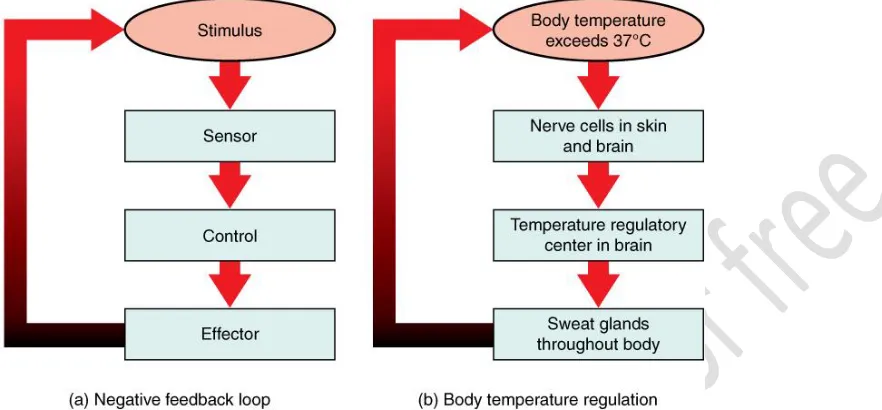
Learning Objective 5: Define negative feedback and give one example using body temperature
Human Anatomy and Physiology Preparatory Course by C. Liachovitzky is licensed under a Creative Commons Attribution–NonCommercial-ShareAlike 4.0 International License <<<->>> This content is available for free <<<->>> 12
Figure 1.3 In a negative feedback loop, a stimulus—a deviation from a
set point—is resisted through a physiological process that returns the body to homeostasis. (a) A negative feedback loop has four basic parts. (b) Body temperature is regulated by negative feedback.
Art by OpenStax College – CC-BY
Concepts, Terms, and Facts Check
Answer the study questions and take the quiz below before moving on to the next learning objective
Study Questions Write your answer in a sentence form (do not answer using loose words)
1. What is negative feedback?
QUIZ
To access quiz questions like the ones you will see in BIO 23, you need to access the online version of this textbook Go here
Learning Objective 6: Define positive feedback and give one example; also, compare and contrast positive and negative feedback in terms of the relationship between response and result
Positive feedback is a mechanism that intensifies a change in the body’s
Human Anatomy and Physiology Preparatory Course by C. Liachovitzky is licensed under a Creative Commons Attribution–NonCommercial-ShareAlike 4.0 International License <<<->>> This content is available for free <<<->>> 13
away from the normal range. Positive feedback in the body is normal only when there is a definite end point.
Childbirth is one example of a positive feedback loop that is normal but is activated only when needed. The first contractions of labor (stimulus) push the baby toward the cervix (the lowest part of the uterus). The cervix contains stretch-sensitive cells (sensors) that monitor the degree of stretching. These nerve cells send messages to the brain (control center), which in turn causes the pituitary gland at the base of the brain to release the hormone oxytocin into the bloodstream. Oxytocin causes stronger contractions of the smooth muscles (effectors) in the uterus, pushing the baby further down the birth canal. This causes even greater stretching of the cervix. The cycle of stretching, oxytocin release, and increasingly more forceful contractions stops only when the baby is born. At this point, the stretching of the cervix halts, stopping the release of oxytocin. The end result in a positive feedback loop is to reach an end point (delivery) as opposed to reach a set point as in negative feedback. See figure 1.4 below for an example, and table 1.1 for a comparison between negative feedback and positive feedback.
Figure 1.4Normal childbirth is driven by a positive feedback loop. A positive feedback loop results in a change in the body’s status, rather than a return to a set point. Art derivative of OpenStax College – CC-BY
Table 1.1Comparison between negative feedback and positive feedback.
Negative Feedback Positive Feedback
Example Regulation of body temperature or blood glucose
Normal childbirth
Response Reverses a change in a physiological condition
Intensifies a change in physiological condition Result Return to a set point Reach an end point Overall Provides stability Accelerates a process to
Human Anatomy and Physiology Preparatory Course by C. Liachovitzky is licensed under a Creative Commons Attribution–NonCommercial-ShareAlike 4.0 International License <<<->>> This content is available for free <<<->>> 14
Concepts, Terms, and Facts Check
Answer the study questions and take the quiz below before moving on to the next learning objective
Study Questions Write your answer in a sentence form (do not answer using loose words)
1. What is positive feedback?
2. How are negative and positive feedback different (Compare response, result, and overall)
QUIZ
To access quiz questions like the ones you will see in BIO 23, you need to access the online version of this textbook Go here
UNIT 2 – INTRODUCTION TO ANATOMY AND PHYSIOLOGY CHEMICAL BUILDING BLOCKS
MODULE 1: ATOMS
Learning Objective 7: Define the term atom and describe its structure in terms of location and charge of its subatomic particles
Matter is anything that has mass and takes up space. All things in the universe (i.e. living and non-living things) are considered to be matter. The smallest component of matter normally found is the atom. Then, all things in the universe (including humans) are made of atoms.
Atoms themselves are composed of even smaller subatomic particles (extremely tiny things) called neutrons, protons, and electrons. Protons
have a positive electrical
charge (+), electrons have a negative electrical charge (-), and neutrons are electrically neutral, meaning they have no charge.Human Anatomy and Physiology Preparatory Course by C. Liachovitzky is licensed under a Creative Commons Attribution–NonCommercial-ShareAlike 4.0 International License <<<->>> This content is available for free <<<->>> 15
in orbital shells. Electrons are so small that their mass is considered zero. See figure 2.1 and 2.2 below, and do activities 2.1 and 2.2 below.
Figure 2.1 Representation of an atom. This atom in particular has five electrons and five protons; it is neutral as all atoms are. Electrons’ masses are extremely small compared with protons’ and neutrons’ masses. Art by Berkeley Lab; Public Domain
The figure below shows a typical planetary representation of an atom highlighting orbital shells.
Figure 2.2 Representation of an atom as a planetary model. This atom has three protons and three electrons; then, it is neutral, as all atoms are. Electrons are represented much bigger than what they really are, only so they can be clearly seen. Art by
FastfissionCC-BY-SA
Activity 2.1 Count the number of protons and electrons in the Carbon, Hydrogen, Oxygen, and Nitrogen atoms shown below. Protons are red and neutrons are blue. Each atom should have the same number of protons as electrons.
Human Anatomy and Physiology Preparatory Course by C. Liachovitzky is licensed under a Creative Commons Attribution–NonCommercial-ShareAlike 4.0 International License <<<->>> This content is available for free <<<->>> 16
Concepts, Terms, and Facts Check
Answer the study questions and take the quiz below before moving on to the next learning objective
Study Questions Write your answer in a sentence form (do not answer using loose words)
1. What is an atom?
2. What is a subatomic particle?
3. How many different types of subatomic particles are there in an atom? 4. Where are the different subatomic particles located in an atom?
5. Which subatomic particle is positive? 6. Which subatomic particle is negative? 7. Which subatomic particle is neutral?
8. What is the overall charge of an atom (positive, negative, neutral)? 9. What is an orbital shell?
QUIZ
To access quiz questions like the ones you will see in BIO 23, you need to access the online version of this textbook Go here
Learning Objective 8: Define the term element and distinguish between atom and element
Human Anatomy and Physiology Preparatory Course by C. Liachovitzky is licensed under a Creative Commons Attribution–NonCommercial-ShareAlike 4.0 International License <<<->>> This content is available for free <<<->>> 17
colors. An atom is the smallest unit of an element that retains the properties of that element. We can also define an element as a substance that is made of a single type of atom. See figure 2.3 below
Figure 2.3 From left to right, images of the elements sodium (solid), nitrogen (liquid),
and oxygen (colorless gas bubbles in the pale blue liquid). The element sodium is made of sodium atoms, the element nitrogen is made of nitrogen atoms, and the element oxygen is made of oxygen atoms.
Art by Dnn87CC BY-SA 3.0 (Sodium), Cory DoctorowCC BY-SA 2.0 (Nitrogen), and Dr. Warwick Hillier GPL (Oxygen)
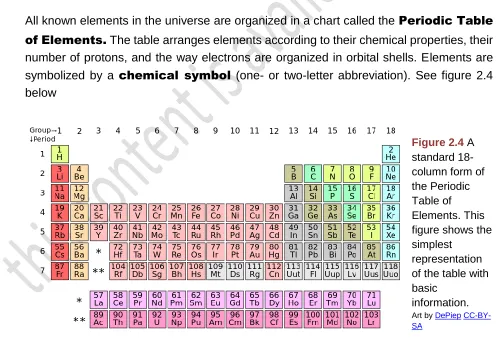
All known elements in the universe are organized in a chart called the Periodic Table
of Elements. The table arranges elements according to their chemical properties, their
number of protons, and the way electrons are organized in orbital shells. Elements are symbolized by a chemical symbol (one- or two-letter abbreviation). See figure 2.4 below
Figure 2.4 A standard 18-column form of the Periodic Table of Elements. This figure shows the simplest
representation of the table with basic
Human Anatomy and Physiology Preparatory Course by C. Liachovitzky is licensed under a Creative Commons Attribution–NonCommercial-ShareAlike 4.0 International License <<<->>> This content is available for free <<<->>> 18
The human body is composed of many different elements as shown in figure 2.5 below. For example, carbon (C), hydrogen (H), oxygen (O), nitrogen (N), phosphorous (P), and calcium (Ca), make up 98.5% of the human body weight. Other important elements are potassium (K), sulfur (S), sodium (Na), chlorine (Cl), and magnesium (Mg).
Figure 2.5 The main elements that compose the human body Art by
OpenStax College – CC-BY
Concepts, Terms, and Facts Check
Answer the study questions and take the quiz below before moving on to the next learning objective
Study Questions Write your answer in a sentence form (do not answer using loose words)
1. What is an element?
2. What is the difference between an atom and an element? 3. What is a chemical symbol?
4. What is the Periodic Table of Elements?
QUIZ
Human Anatomy and Physiology Preparatory Course by C. Liachovitzky is licensed under a Creative Commons Attribution–NonCommercial-ShareAlike 4.0 International License <<<->>> This content is available for free <<<->>> 19
Learning Objective 9: Distinguish between the terms atomic number and mass number
All elements differ in their physical and chemical properties. These properties are given by the number of subatomic particles (protons, electrons and neutrons) they carry. The number of protons an atom carries in its nucleus determines which element it is. For example, one atom of the element carbon (C) always has six protons in its nucleus; and one atom of the element oxygen (O) always has eight protons in its nucleus. In short, all atoms with a particular number of protons belong to the same element
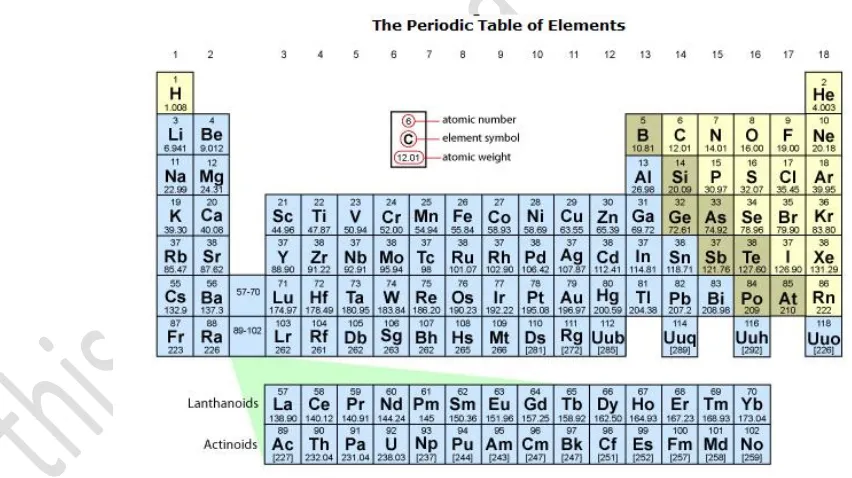
The number of protons in an atom is denoted by the atomic number, which is shown as a number in the periodic table, usually shown above the chemical symbol of the element. Then, the atomic numbers above each element in the periodic table show the number of protons of each element.
Since atoms are electrically neutral (they carry the same number of protons as electrons); then, the number of protons tells us the number of electrons an element has. For example, nitrogen (N) has an atomic number of 7 (see the periodic table below). Then, nitrogen must have seven protons, and it must also have seven electrons. Sodium (Na) has an atomic number of is 11; then, sodium must have eleven protons, and it must also have eleven electrons. The same applies to all elements in the periodic table. See figure 2.6 below.
Figure 2.6 Periodic Table of Elements showing symbols, atomic numbers and mass numbers. The actual mass of an atom is known as its weight on planet Earth. Then, we consider atomic weight and mass number as the same
Human Anatomy and Physiology Preparatory Course by C. Liachovitzky is licensed under a Creative Commons Attribution–NonCommercial-ShareAlike 4.0 International License <<<->>> This content is available for free <<<->>> 20
The atomic mass of an element is mostly the mass of its neutrons and its protons (since electrons have a negligible mass). For example, the atomic mass of carbon (C) is 12. This comes from adding the number of protons (6) plus the number of neutrons (6), each of which weighs 1 amu. The atomic mass is shown as a decimal number called the mass
number in the periodic table, usually shown below the chemical symbol of the element.
For the objectives of this course, we consider atomic weight and atomic mass to mean the same thing and ignore the decimal points in the mass number.
Summarizing:
Atomic Number = Number of protons = Number of electrons
Mass Number = Atomic Weight = Number of protons + Number of neutrons
Concepts, Terms, and Facts Check
Answer the study questions and take the quiz below before moving on to the next learning objective
Study Questions Write your answer in a sentence form (do not answer using loose words)
1. What is the atomic number of an element? 2. What is the mass number of an element?
3. How are atomic number, number of protons and number of electron related? 4. How are mass number, number of protons and number of neutrons related?
QUIZ
To access quiz questions like the ones you will see in BIO 23, you need to access the online version of this textbook Go here
Learning Objective 10: Describe the arrangement of electrons in atoms, define valence electrons, and explain the octet rule
Human Anatomy and Physiology Preparatory Course by C. Liachovitzky is licensed under a Creative Commons Attribution–NonCommercial-ShareAlike 4.0 International License <<<->>> This content is available for free <<<->>> 21
Activity 2.3 Follow this link to apply your understanding of atomic structure and
electrons distribution in orbital shells.
Art by University of Maryland University CollegeCC-BY-NC
Single atoms by themselves are unstable and chemically reactive (unless their outermost electron shell is already filled with electrons).This means that they tend to react and bond with other atoms until they become non-reactive, or stable. As it is stated by the Octet
Rule (oct- = eight), many elements become stable when they have eight electrons in their outermost orbital shell (except hydrogen, which becomes stable having two). For example, nitrogen has five electrons in its second and outermost shell, and completes eight by sharing three electrons with other atom(s). This makes nitrogen stable, which means that by completing an octet it does not need to react with any other atom. We will explore this rule further in a following learning objective.
The number of electrons in the outermost shell of atoms determines the type of bonding that occurs between atoms of the same, or different elements. The electrons found in the outermost shell, and involved in chemical bonding, are called valence electrons. Do activity 2.4 below.
Human Anatomy and Physiology Preparatory Course by C. Liachovitzky is licensed under a Creative Commons Attribution–NonCommercial-ShareAlike 4.0 International License <<<->>> This content is available for free <<<->>> 22
second shell up to eight, and the third up to eight too. Electrons in the outermost shell are valence electrons. Go here to show/hide inner orbitals.
Activity by Open Learning InitiativeCC-BY-NC-SA
Concepts, Terms, and Facts Check
Answer the study questions and take the quiz below before moving on to the next learning objective
Study Questions Write your answer in a sentence form (do not answer using loose words)
1. What does the octet rule say? 2. What are valence electrons?
QUIZ
To access quiz questions like the ones you will see in BIO 23, you need to access the online version of this textbook Go here
Learning Objective 11: Define the terms ion, cation, anion, and electrolyte
In order to follow the octet rule and end up with eight electrons in the valence shell (the outermost shell) usually atoms with one or two valence electrons tend to give them away to atoms with six or seven valence electrons that need one or two more electrons to complete eight.
For example, sodium (Na) has a total of eleven electrons: two electrons in the first shell, eight electrons in the second, and one more in the third. By giving up this last electron to an atom of another element, the second shell becomes the outermost, and sodium has eight electrons in its (new) valence shell. Initially, sodium had eleven positive charges from its eleven protons, and eleven negative charges from its eleven electrons, with an overall charge equal to zero. Now that sodium lost one negative charge (the electron), it has an extra positive charge and becomes a cation, a positively charged particle.
Human Anatomy and Physiology Preparatory Course by C. Liachovitzky is licensed under a Creative Commons Attribution–NonCommercial-ShareAlike 4.0 International License <<<->>> This content is available for free <<<->>> 23
Positively or negatively charged particles are called ions. In the two examples above, the element sodium becomes a sodium ion (Na+), a cation; and the element chlorine
becomes a chloride ion Cl-, an anion.
Cations are represented with a superscripted plus sign (+) for each electron lost, and anions are represented with a superscripted minus sign (-) for each electron gained. A single atom can form an ion like in K+, Cl-, F-; Mg2+, Al3+; and also a group of atoms, or
parts of a molecule, can form ions like in OH-, HPO
4-, NH4+, SO42-.
Electrically charged particles, such as ions, are also called electrolytes. For example, all the ions listed in the previous paragraph are electrolytes. Electrolytes usually dissolve well in water, and a mixture of water and electrolytes can conduct electrical currents.
Concepts, Terms, and Facts Check
Answer the study questions and take the quiz below before moving on to the next learning objective
Study Questions Write your answer in a sentence form (do not answer using loose words)
1. What is a cation? 2. What is an anion? 3. What is an ion?
4. What is the difference between an element and an ion? 5. What is an electrolyte?
QUIZ
To access quiz questions like the ones you will see in BIO 23, you need to access the online version of this textbook Go here
MODULE 2: CHEMICAL BONDS
Learning Objective 12: Define chemical bonding, molecules, salts and compounds; and list three types of chemical bonds important for the study of human physiology
Human Anatomy and Physiology Preparatory Course by C. Liachovitzky is licensed under a Creative Commons Attribution–NonCommercial-ShareAlike 4.0 International License <<<->>> This content is available for free <<<->>> 24
Chemical bonding is responsible for the formation of molecules and salts. Molecules are substances composed of two or more atomsheld together by a chemical bond. For example, in a molecule of carbon dioxide (CO2) the atom of carbon and the two atoms of
oxygen are held together by chemical bonds. Salts are substances composed of ions held together by a chemical bond. For example, in a crystal of NaCl, table salt, Na+ and
Cl- are held together by a chemical bond.
Salts and molecules made up of two or more atoms of different elements are called
compounds. For example CO2, H2O, and NaCl are compounds, whereas O2 or H2 are
not.
There are three types of chemical bonds important for the study of the human physiology. These are ionic bonds, covalent bonds, and hydrogen bonds.
Ionic bonds occur between ions with opposite charges (between anions and cations);
covalentbonds occur between atoms of the same molecule; and hydrogen bonds
occur between atoms in different molecules (one of them being hydrogen), or different parts of the same molecule.
Concepts, Terms, and Facts Check
Answer the study questions and take the quiz below before moving on to the next learning objective
Study Questions Write your answer in a sentence form (do not answer using loose words)
1. What is a chemical bond?
2. What subatomic particles participate in a chemical bond? 3. What is a molecule?
4. What is a salt?
5. What is a compound? 6. What is an ionic bond? 7. What is a covalent bond? 8. What is a hydrogen bond?
QUIZ
Human Anatomy and Physiology Preparatory Course by C. Liachovitzky is licensed under a Creative Commons Attribution–NonCommercial-ShareAlike 4.0 International License <<<->>> This content is available for free <<<->>> 25
Learning Objective 13: Define ionic bonds and describe how they form, and define salts
Ionic bonds are formed by the electrical attraction between ions of opposite charges.
The attraction between a cation and an anion forms an ionic bond.
Ions form when atoms take on or give up electrons following the octet rule. Do activities 2.5 and 2.6 below
Activity 2.5 Sodium atom (Na) losing one valence electron and becoming the sodium cation
(Na+) can be seen here.
Activity by University of Maryland University CollegeCC-BY-NC
Activity 2.6 Chlorine atom (Cl) taking on one electron and becoming the chlorine anion (Cl-)
can be seen here.
Activity by University of Maryland University CollegeCC-BY-NC
Figure 2.7 See here how sodium (Na) transfers one valence electron to chlorine (Cl), and the ionic attraction between the sodium cation (Na+) and the
chlorine anion (Cl-) forms an ionic bond. NaCl has
been formed.
Animation by Open Learning InitiativeCC-BY-NC-SA
Salts are a class of compounds formed by ionic bonds between ions. For example NaCl,
table salt, forms when Na+ forms an ionic bond with Cl-. See the structure of NaCl below
Human Anatomy and Physiology Preparatory Course by C. Liachovitzky is licensed under a Creative Commons Attribution–NonCommercial-ShareAlike 4.0 International License <<<->>> This content is available for free <<<->>> 26
Figure 2.8Thestructure of a NaCl crystal is given by the
interaction of its forming ions, Na+ and Cl-, which are
linked by ionic bonds
Concepts, Terms, and Facts Check
Answer the study questions and take the quiz below before moving on to the next learning objective
Study Questions Write your answer in a sentence form (do not answer using loose words)
1. What is an ionic bond? 2. What is a salt?
QUIZ
To access quiz questions like the ones you will see in BIO 23, you need to access the online version of this textbook Go here
Learning Objective 14: Define covalent bonds and describe how they form, and differentiate between the two types of covalent bond
Human Anatomy and Physiology Preparatory Course by C. Liachovitzky is licensed under a Creative Commons Attribution–NonCommercial-ShareAlike 4.0 International License <<<->>> This content is available for free <<<->>> 27
Activity 2.8 See how two hydrogen atoms (each carrying one electron in the outer shell) share electrons to
complete two in their outer shells here. Note that the pair of electrons moves around the two nuclei, and this is what keeps the two hydrogen atoms together forming a
molecule. The two electrons moving around the two nuclei is what is mean by “sharing”.
Animation by University of Maryland University CollegeCC-BY-NC
In a single covalent bond, a pair of electrons is shared between two atoms, while in
a doublecovalent bond, two pairs of electrons are shared between two atoms.
Figure 2.9 below shows in (a) that a molecule of hydrogen has two atoms of the element hydrogen. This can be represented by either a molecular formula, H2, which shows
how many atoms of each different type of element form a molecule or a structural
formula, H-H, which shows the single covalent bond involved as one line, representing
the pair of shared electrons. The oxygen molecule is formed by two atoms of the element oxygen as shown in (b). The molecular formula of the gas oxygen is O2, while the structural formula of this molecule is O=O, where the double line shows a double covalent bond indicating two pairs of shared electrons. A molecule of carbon dioxide is shown in (c) and has a molecular formula of CO2, showing that it is made of one atom of the element
Human Anatomy and Physiology Preparatory Course by C. Liachovitzky is licensed under a Creative Commons Attribution–NonCommercial-ShareAlike 4.0 International License <<<->>> This content is available for free <<<->>> 28
Figure 2.9 The examples shown above show sharing of electrons between atoms with similar a number of electrons (carbon and oxygen have six and eight, respectively). In these cases, the shared electrons spend about the same time moving around each one of the nuclei of both atoms. This type of covalent bond where electrons are equally shared is called a non-polar covalent bond. Nonpolar covalent bonds do not have a charge and are electrically neutral.
Art by OpenStax College – CC-BY
A second type of covalent bond occurs when electrons between atoms are shared in an unequal manner and is called a polar covalent bond. A polar covalent bond is common when either oxygen or nitrogen is sharing electrons with hydrogen. As shown in Figure 2.10 below, water (H2O) is a polar covalent molecule, in which one oxygen atom
Human Anatomy and Physiology Preparatory Course by C. Liachovitzky is licensed under a Creative Commons Attribution–NonCommercial-ShareAlike 4.0 International License <<<->>> This content is available for free <<<->>> 29
atom, in this example hydrogen, having a slightly positive charge density (noted as δ+). Note that we refer to charge density, as opposed to net charge, because neither oxygen nor hydrogen gains or loses electrons.
Figure 2.10 Water: a polar covalent molecule (a) shows two polar covalent bonds in the water molecule. See the explanation in the paragraph above; (b) and (c) show two other ways to represent a water molecule, other than the molecular formula, H2O, and the
structural formula, H-O-H.
Art by OpenStax College – CC-BY
Summarizing:
Covalent bonds are formed when atoms in a molecule share electrons. There are two types of covalent bonds. Molecules with non-polar covalent bonds equally share electrons between atoms and have an even arrangement of charges. Molecules with polar covalent bonds share electrons unequally between atoms and have an
uneven arrangement of changes.
Concepts, Terms, and Facts Check
Answer the study questions and take the quiz below before moving on to the next learning objective
Study Questions Write your answer in a sentence form (do not answer using loose words)
1. What is a covalent bond?
2. What is the difference between a single covalent bind and a double covalent bond? 3. What is the difference between a molecular formula and a structural formula? 4. What is a non-polar covalent bond?
What is a polar covalent bond?
Human Anatomy and Physiology Preparatory Course by C. Liachovitzky is licensed under a Creative Commons Attribution–NonCommercial-ShareAlike 4.0 International License <<<->>> This content is available for free <<<->>> 30
To access quiz questions like the ones you will see in BIO 23, you need to access the online version of this textbook Go here
MODULE 3: WATER
Learning Objective 15: Define hydrogen bonds and describe how they form
Atoms in the water molecule are held together by polar covalent bonds, as we saw in the previous LO. The unequal share of electrons in the O-H polar covalent bonds results in the oxygen atom having a slightly negative charge density (δ-) and hydrogen atom having a slightly positive charge (δ+). The slightly negative Oδ- in one water molecule is attracted
to the slightly positive Hδ+ of a neighboring water molecule as shown in figure 2.11 below. The electrical attraction between Hδ+ in one molecule and Oδ- in another molecule is called
a hydrogen bond. (Hydrogen bond can also be formed between Hδ+ in one molecule
and N in another molecule). A hydrogen bond is a weaker type of attraction, but many hydrogen bonds add up. Hydrogen bonds explain many of the properties of water. Activity 2.9 below shows how hydrogen bonds form.
Figure 2.11 Hydrogen bonds are relatively weak. They occur between atoms of different molecules and are shown as a dotted lines rather than a solid line. Covalent bonds are stronger, occur between atoms of the same molecule and are shown as solid lines
Art by OpenStax College – CC-BY
Activity 2.9 Adjust the volume on your
computer and click the play button here to see water molecule polarity and how hydrogen bonds form.
Animation by Art by Open Learning Initiative CC-BY-NC-SA
Concepts, Terms, and Facts Check
Human Anatomy and Physiology Preparatory Course by C. Liachovitzky is licensed under a Creative Commons Attribution–NonCommercial-ShareAlike 4.0 International License <<<->>> This content is available for free <<<->>> 31
Study Question Write your answer in a sentence form (do not answer using loose words)
1. What is a hydrogen bond?
QUIZ
To access quiz questions like the ones you will see in BIO 23, you need to access the online version of this textbook Go here
Learning Objective 16: Describe the behavior of ionic compounds when placed in water
When an ionic compound, or salt, (e.g. NaCl) is placed in water, its ionic components (e.g. Na+ and Cl-) dissociate (separate) and water molecules surround each ion. This
is shown in figure 2.13 below. The small positive charges on hydrogen atoms in water molecules attract the anions (Cl-), and the small negative charges on the oxygen atoms
attract the cations (Na+). Thus, because water is a polar covalent liquid, many salts and
Human Anatomy and Physiology Preparatory Course by C. Liachovitzky is licensed under a Creative Commons Attribution–NonCommercial-ShareAlike 4.0 International License <<<->>> This content is available for free <<<->>> 32
Figure 2.13 A sodium chloride crystal dissociates not into molecules of NaCl, but into Na+ cations and Cl–
anions, each completely surrounded by water molecules.
Art by OpenStax College –
CC-BY
Concepts, Terms, and Facts Check
Answer the study questions and take the quiz below before moving on to the next learning objective
Study Question Write your answer in a sentence form (do not answer using loose words)
1. What happens to an ionic compound (salt) when placed in water?
QUIZ
To access quiz questions like the ones you will see in BIO 23, you need to access the online version of this textbook Go here
Learning Objective 17: Differentiate between hydrophobic and hydrophilic substances
Human Anatomy and Physiology Preparatory Course by C. Liachovitzky is licensed under a Creative Commons Attribution–NonCommercial-ShareAlike 4.0 International License <<<->>> This content is available for free <<<->>> 33
toward). Alcohols, salts and some sugars are examples of hydrophilic substances. Nonpolar molecules do not interact with water, and they are not water soluble (they do not mix with water), so they are referred to as being hydrophobic, or “water-fearing” (phobos = fear). Oils, fats and waxes are examples of hydrophobic substances. See examples of hydrophobic and hydrophilic substances in figure 2.14 below.
Figure 2.14 Sucrose (sugar table)
molecules are hydrophilic and mix well with water, whereas
unsaturated fats (mineral oils) are hydrophobic and do not mix well with water
Art by Olli Niemitalo - Public Domain (left) and
Victor Blacus - CC BY-SA (right)
Concepts, Terms, and Facts Check
Answer the study questions and take the quiz below before moving on to the next learning objective
Study Questions Write your answer in a sentence form (do not answer using loose words)
1. What does hydrophilic mean? 2. What does hydrophobic mean?
QUIZ
To access quiz questions like the ones you will see in BIO 23, you need to access the online version of this textbook Go here
Learning Objective 18: Define the terms solution, solvent, and solute
A mixture is a combination of two or more substances, where each substance maintains
Human Anatomy and Physiology Preparatory Course by C. Liachovitzky is licensed under a Creative Commons Attribution–NonCommercial-ShareAlike 4.0 International License <<<->>> This content is available for free <<<->>> 34
A solution is a type of liquid mixture that consists of a solvent that dissolves a substance called a solute. A “sugary water” solution consists of water (solvent) that dissolves sucrose, or table sugar (solute). A drop of ink is a solution of water (solvent) and tiny colorful particles (solute). See another example in figure 2.15 below.
Most chemical reactions that happen inside and outside our body occur among compounds dissolved in water. For this is reason water is considered the “universal solvent”.
Figure 2.15 A saline water solution can be prepared by
dissolving table salt (NaCl) in water. Salt is the solute and water the solvent.
Photo by Chris 73 – CC- BY-SA
Concepts, Terms, and Facts Check
Answer the study questions and take the quiz below before moving on to the next learning objective
Study Questions Write your answer in a sentence form (do not answer using loose words)
1. What is a mixture? 2. What is a solution? 3. What is a solvent? 4. What is a solute?
QUIZ
Human Anatomy and Physiology Preparatory Course by C. Liachovitzky is licensed under a Creative Commons Attribution–NonCommercial-ShareAlike 4.0 International License <<<->>> This content is available for free <<<->>> 35
MODULE 4: ACIDS AND BASES
Learning Objective 19: Define and differentiate the terms acid and base
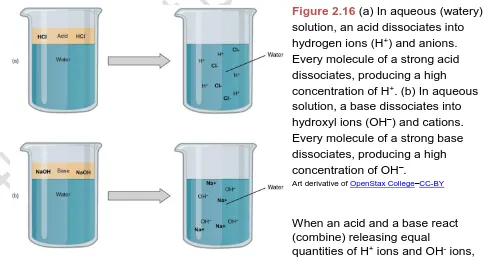
An acid is a substance or compound that releases hydrogen ions (H+) when in solution.
In a strong acid, such as hydrochloric acid (HCl), all hydrogen ions (H+), and chloride ions
(Cl-) dissociate (separate) when placed in water and these ions are no longer held
together by ionic bonding. In a weak acid, such as carbonic acid (H2CO3), only some of
the ions dissociate into hydrogen ions (H+) and bicarbonate ions (HCO
3-), while others
are still held together by ionic bonding.
A base is a substance that releases hydroxyl ions (OH-) when in solution. The hydroxyl
ions (OH-) released will combine with any hydrogen ions (H+) in the solution to form water
molecules (OH- + H+ = H
2O), so we can also define a base as a substance that takes or
accepts hydrogen ions (H+) already present in the solution.
Sodium hydroxide (NaOH) is a strong base because when placed in water, it dissociates completely into sodium ions (Na+) and hydroxyl ions (OH-), all of which are now released
and dissolved in water.
Acids, bases and salts, dissociate (separate) into electrolytes (ions) when placed in water. Acids dissociate into H+ and ananion, bases dissociate into OH- and a cation, and
salts dissociate into a cation (that is not H+) and an anion (that is not OH-).
Figure 2.16 (a) In aqueous (watery)
solution, an acid dissociates into hydrogen ions (H+) and anions.
Every molecule of a strong acid dissociates, producing a high concentration of H+. (b) In aqueous
solution, a base dissociates into hydroxyl ions (OH–) and cations. Every molecule of a strong base dissociates, producing a high concentration of OH–.
Art derivative of OpenStax College–CC-BY
When an acid and a base react (combine) releasing equal
Human Anatomy and Physiology Preparatory Course by C. Liachovitzky is licensed under a Creative Commons Attribution–NonCommercial-ShareAlike 4.0 International License <<<->>> This content is available for free <<<->>> 36
neutralization results. H+ ions and OH- ions combine (neutralize each other) to
regenerate water.
Concepts, Terms, and Facts Check
Answer the study questions and take the quiz below before moving on to the next learning objective
Study Questions Write your answer in a sentence form (do not answer using loose words)
1. What is an acid? 2. What is a base?
QUIZ
To access quiz questions like the ones you will see in BIO 23, you need to access the online version of this textbook Go here
Learning Objective 20: Define the terms pH, neutral, acidic, and basic (or alkaline)
pH is a unit of measurement of the concentration of hydrogen ions (H+) and hydroxyl ions
(OH-) in an aqueous (water) solution. Pure water is said to be neutral with a pH of 7, because there are very few H+ and OH- ions in equal concentrations (only 1 in
10,000,000 water molecules dissociate to H+ and OH-, which gives a pH of 7). Adding
equal amounts of H+ and OH- to water will also be neutral with a pH of 7, because most
of these ions combine to form water molecules and the remaining H+ and OH- ion
concentration is equal and very low.
When H+ concentration is higher than OH- concentration, the solution is acidic, and the
pH of the solution is indicated with a number below 7. Saliva, coffee, lemon juice, tomato juice, and the acid in a battery are all acidic, so in all of them the concentration of H+ is
higher than the concentration of OH-. The more H+ in a solution the more acidic and the
Human Anatomy and Physiology Preparatory Course by C. Liachovitzky is licensed under a Creative Commons Attribution–NonCommercial-ShareAlike 4.0 International License <<<->>> This content is available for free <<<->>> 37
When H+ concentration is lower than OH- concentration, the solution is basic or
alkaline, and the pH of the solution is indicated with a number above 7. Blood, baking
soda, ammonia and bleaches are all basic, so in all of them the concentration of H+ is
lower than the concentration of OH-.
Figure 2.17 pH of various solutions. The lower the pH, the more
hydrogen ions (H+) the solutions has.
The higher the pH, the less hydrogen ions the solution has.
Art derivative of OpenStax College–CC-BY
Concepts, Terms, and Facts Check
Answer the study questions and take the quiz below before moving on to the next learning objective
Study Questions Write your answer in a sentence form (do not answer using loose words)
1. What is pH?
Human Anatomy and Physiology Preparatory Course by C. Liachovitzky is licensed under a Creative Commons Attribution–NonCommercial-ShareAlike 4.0 International License <<<->>> This content is available for free <<<->>> 38
4. What is a basic (or alkaline) solution?
QUIZ
To access quiz questions like the ones you will see in BIO 23, you need to access the online version of this textbook Go here
Learning Objective 21: Define the term buffer, and compare the
response of a regular solution with a buffer solution to the addition of acid or base
Chemical reactions in the body, the food we eat, medication we take, and the effects of some diseases can add or remove hydrogen or hydroxyl ions in or from our body fluids. Levels of these ions, especially H+ since body cells are constantly producing H+ as a
waste product of cell activity, must be maintained within a normal range (slightly alkaline pH between 7.35 and 7.45,). Then, all cells in our body depend on homeostatic regulation of acid-base balance to maintain pH within optimal living conditions.
There are several homeostatic mechanisms to maintain pH within optimal conditions. It can be regulated by the internal availability of substances (chemicals), by adjusting breathing rate, and by eliminating chemicals in urine. Chemical buffers in the body are substances that can absorb extra hydrogen ions preventing a change in pH. For example, during exercise muscle cells can produce excess lactic acid, which increases hydrogen ions (acids release hydrogen ions). These hydrogen ions tend to make our body fluids more acidic, but chemical buffers in the body absorb them preventing a pH change. See below a table comparing what happens when acid or base are added to a plain solution (no buffer), or to a solution that absorbs hydrogen ions or hydroxyl ions (buffer).
Table 2.2 Comparison between a regular solution without buffering properties and a
buffer solution with buffering properties
Regular solution (without buffering properties)
Buffer solution (with buffering properties) When acid is added, it
releases hydrogen ions and …
the pH drops and the solution becomes more acidic
the pH does not drop
When base is added, it absorbs hydrogen ions (or releases hydroxyl ions) and …
the pH rises and the solution become more basic (alkaline)
Human Anatomy and Physiology Preparatory Course by C. Liachovitzky is licensed under a Creative Commons Attribution–NonCommercial-ShareAlike 4.0 International License <<<->>> This content is available for free <<<->>> 39
Bicarbonate, phosphates, and proteins work as a chemical buffer in our body fluids. They absorb extra hydrogen ions or extra hydroxyl ions released from the things we make or eat.
Concepts, Terms, and Facts Check
Answer the study questions and take the quiz below before moving on to the next learning objective
Study Question Write your answer in a sentence form (do not answer using loose words)
1. What is a buffer?
2. What happens to the pH of a plain solution when acid is added to it? 3. What happens to the pH of a buffer solution when acid is added to it?
QUIZ
To access quiz questions like the ones you will see in BIO 23, you need to access the online version of this textbook Go here
UNIT 3 – MOLECULAR LEVEL: BIOMOLECULES, THE ORGANIC COMPOUNDS ASSOCIATED WITH LIVING ORGANISMS
MODULE 1: ORGANIC COMPOUNDS
Learning Objective 22: Define the terms organic compound and
macromolecule, and list the four groups of organic compounds found in living matter
Animal tissues, plant tissues, bacteria, and fungi contain organic molecules; horns and nails, fallen leaves, eggs, fruits and vegetables contain organic compounds; wood, milk, paper, petroleum and gasoline contain organic compounds. In summary, all living matter, parts or products of living matter and remains of living matter contain organic compounds. Organic molecules associated with living organisms are also called biomolecules.
Organic compounds are molecules that contain carbon atoms covalently bonded to
Human Anatomy and Physiology Preparatory Course by C. Liachovitzky is licensed under a Creative Commons Attribution–NonCommercial-ShareAlike 4.0 International License <<<->>> This content is available for free <<<->>> 40
does not have hydrogen; then, it is not an organic compound. Water (H2O) has no carbon;
then, it is not an organic compound. Sodium chloride has neither carbon nor hydrogen; then, it is not an organic compound. Generally, gases, and mineral salts (inorganic substances found in soil, or bodies of water or watercourses) are not organic.
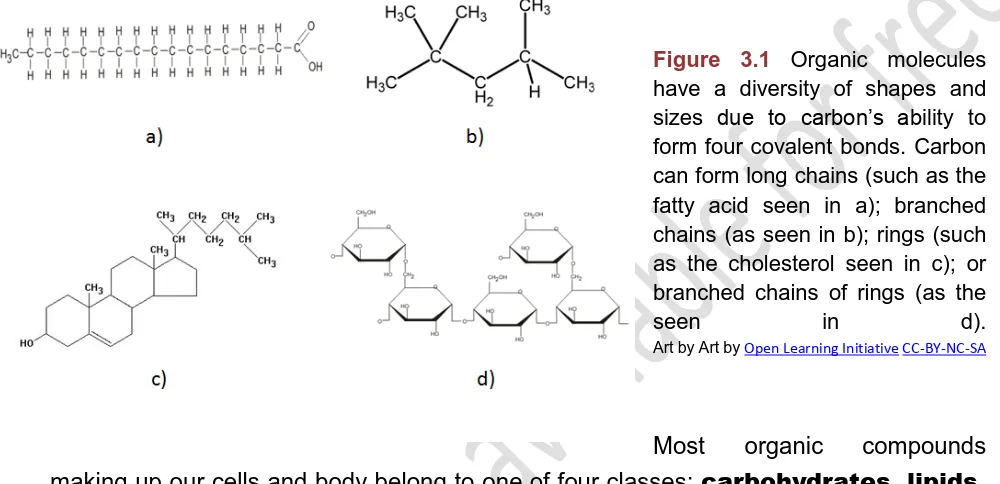
Figure 3.1 Organic molecules have a diversity of shapes and sizes due to carbon’s ability to form four covalent bonds. Carbon can form long chains (such as the fatty acid seen in a); branched chains (as seen in b); rings (such as the cholesterol seen in c); or branched chains of rings (as the
seen in d).
Art by Art by Open Learning Initiative CC-BY-NC-SA
Most organic compounds making up our cells and body belong to one of four classes: carbohydrates, lipids,
proteins, and nucleic acids. These molecules are incorporated into our bodies with
the food we eat. In general, molecules in these four classes are very large, and we often call large molecules macromolecules (macro- = “very large”, or “on a large scale”).
Human Anatomy and Physiology Preparatory Course by C. Liachovitzky is licensed under a Creative Commons Attribution–NonCommercial-ShareAlike 4.0 International License <<<->>> This content is available for free <<<->>> 41
Figure 3.3 Protein-rich food Art by ©Gooddietplan
Figure 3.4 Lipid-rich food
Art by NationalCancerInstitute – Public Domain
Figure 3.5 Two types of nucleic acids, RNA and DNA
Art by Art by Open Learning Initiative CC-BY-NC-SA