OF THE SECOND CENTURY AFTER CHRIST
(PLATES 45-46)
T HE 1985 EXCAVATION East of the Theater at Corinth produced an enormous
ll collection of animal bones, weighing over 175 kilograms when washed and sorted.' Most of the bone comes from two rooms in Building 32 on the east side of East Theater Street and mainly date to the second quarter of the 2nd century after Christ.
This is the largest bone accumulation from any period so far excavated at Corinth and the largest sample so far published from a Greek historic site. Indieed, it is one of the largest single deposits ever analyzed and published from the historic Mediterranean Basin.3
The majority of the dry-sieved (mesh size 10 mm.) bone (Bone lot [Bl] 1985-1), having a washed and sorted weight of about 146 kilograms, was found piled on the floor in the southwest quarter of the Southwest Room, considered to be an area of butchery dumping. A smaller but still substantial assemblage of dry-sieved bone (Bl 1985-22), with a washed and sorted weight of about 18 kilograms, was found scattered throughout Room 1 (previously called the Northwest Room). This room contained three tile-floored, domed cooking ovens and is considered to be a kitchen.
THE SOUTHWEST ROOM (Bl 1985-1) Goat bones
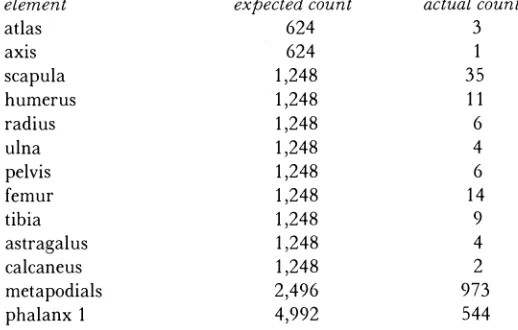
This collection includes 120.1 kgs. of goat (Capra hircus) bones4 which are broken down by weight and by actual and expected element counts in Table 1:a and b. Cranial (head) bones and teeth make up 80.9% of the collection, metapodials and phalanges 10.7%, other identifiable postcranial bones only 1.9%, and unidentifiable goat-sized bones 6.5%. Based on the proximal (P) or front end of the mandible there are 624 individuals (624 right [R], 559 left [L]) represented in the sample.5
I I thank Dr. Charles K. Williams, II for inviting me to study and publish this faunal collection. Funding
was provided by a grant from the 1984 Foundation, for which I am very grateful. The photographs were taken by Ino loannides and Lenio Bartzioti. Mark J. Rose contributed many helpful comments, as well as the fish study, and Kevin Rielly, the bird-bone study.
2 The two bone accumulations described here have been briefly discussed in the report of the 1985 excava- tion season. The present analysis supersedes the preliminary observations published in C. K. Williams, II and 0. H. Zervos, "Corinth, 1985: East of the Theater," Hesperia 55, 1986 (pp. 129-205), pp. 132, 136-137, 146, pls. 28:a, b, 29:a.
I The only other sample rioughly comparable in size is the mid- to late 5th-century (after Christ) fill from cistern 1977.1 at Carthage which included over 20,000 bones from 24 sheep/goat, 2 cattle, 20 pig, 6 rab- bit/hare, 74 chicken, 11 dove, 6 goose, 26 other birds, 43 fish, 120 marine invertebrates, etc. See D. S. Reese, with G. E. Watson and A. Wheeler, "Faunal Remains from Three Cisterns (1977.1, 1977.2 and 1977.3)," in Excavations at Carthage 1977 Conducted by the University of Michigan VI, J. H. Humphrey, ed., Ann Arbor 1981,pp.191-258.
4 See p. 260 for a discussion of the reasons for suggesting that these are goat rather than sheep bones. I For descriptions of various ways to count bones see R. E. Chaplin, The Study of Animal Bones from Archaeological Sites, London 1971, pp. 63-75; R. G. Klein and K. Cruz-Uribe, The Analysis of Animal Bones from Archaeological Sites, Chicago 1984, pp. 24-38; S. Payne, "Zoo-archaeology in Greece: A Reader's
Guide," in Contributions to Aegean Archaeology: Studies in Honor of William A. McDonald, N. C. Wilkie
American School of Classical Studies at Athens is collaborating with JSTOR to digitize, preserve, and extend access to
Hesperia
A number of horncores have been cut from the skull (P1. 45:a), and the skull has fre- quently been cut open to extract the brain. The sample includes 425 premaxilla fragments, 3 atlas, 1 axis, 66 other vertebrae, and 302 ribs (some of which could be pig), almost all of which show marks of butchery. From forelimbs there are 35 scapula fragments (only 8 are the distal [D] glenoid), 11 humerus with 1 P over 3.0-3.5 years,6 3 D (2 under 10 mos.), and 7 shaft fragments (1 from a young individual). There are 5 P radius, often butchered (P1. 45:b), and one D radius from an individual over 3 years. There are 4 ulna with 1 under 3 years and 1 over that age.
Hind limb bones include 6 pelvis remains, generally butchered (P1. 45:c), and 14 femur fragments including 9 P (3 under, 6 over 2.5-3.0 yrs.). There are 5 D with 1 just fusing (JF, 3.0-3.5 yrs.) and 7 fused (F). All femur remains are butchered (P1. 45:d). There are 1 P tibia over 3.0-3.5 years and 8 D tibia including one JF (1.5-2.0 yrs.) and 7 over this age, often butchered (P1. 45:e). There are 5 carpals, 4 astragalus, and 3 calcaneus with 2 under 2.5-3.0 years and 1 over this age.
There are a total of 318 metacarpus (mc, lower foreleg), 279 metatarsus (mt, lower rear leg), and 376 metapodial (mp, lower fore- or hind leg) fragments, weighing 9.6 kgs. Of the
145 D mc, 30 or 20.7% are unfused (UF, under 1.5-2.0 yrs.), of the 81 D mt, 17 or 21% are under 1.6-2.3 years. Of the mp, counting the complete D ends and one-half the total num- ber of fragmentary D ends, there are 138 D with 55 or 39.9% under 1.5-2.3 years.
Of the mc there are 113 L and 99 R, 106 unsideable, and of the mt, 118 L, 98 R, 63 unsideable. If we add in the unsideable bones in proportion to the sideable bones and the mp proportionally to the mc and mt, L and R, there are 201 L and 173 R mc and 192 L and 160 R mt. There are therefore as many as 201 lower forelegs and 192 lower hind legs in the sample.
There are 1,058 phalanges in the sample weighing 3.2 kgs.: 544 first phalanx with 45 (8.5%) under 13-16 months, 278 second phalanx with 11 (4%) under 13-16 months, and 236 third phalanx (1 19 R and 1 17 L). Based on the phalanges there are therefore 30 to 68 individuals present.
Cattle bones
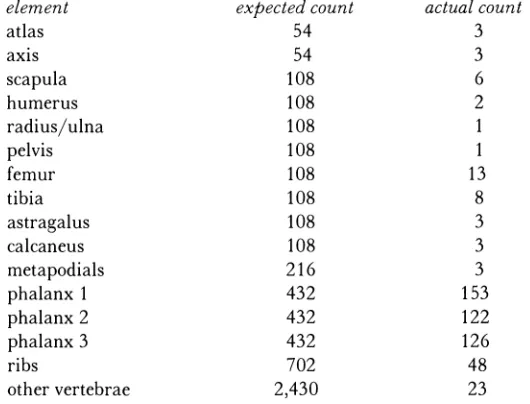
There are 24.5 kgs. of cattle (Bos taurus) bones which are recorded by weight and actual and expected element counts in Table 2:a and b. Cranial bones and teeth make up 37.1% and phalanges 38%. Based on the P mandible there are 54 individuals (54 L, 53 R).
A few of the horncores have been cut from the skull (P1. 45:a), and some of the skull bones have been cut. The sample includes 76 premaxilla fragments, 2 atlas, 3 axis, 23 other vertebrae, and 48 ribs, all butchered. Forelimb bones include 6 butchered scapula with
and W. D. E. Coulson, edd., Dubuque 1985, pp. 219-233. For diagrams of typical mammalian skeletons and illustrations of specific bones, see E. Schmid, Atlas of Animal Bones, Amsterdam/London/New York 1972.
6 The epiphyses (ends) of bones fuse to the shaft according to a set sequence for each species and can be used to determine the age of animals at death. Age can also be determined from the state of eruption and wear of the teeth.
heavy butchery around the glenoid (P1. 45:f), 2 butchered D humerus over 1.0-1.5 years (P1. 45:g), and 1 P radius/ulna over 1.0-1.5 years which has been sawn in a preliminary stage of boneworking.
Hind limbs are represented by 1 butchered pelvis, 3 P femur (2 under and 1 over 3.5 yrs., all sawn; P1. 45:h), 10 D femur (7 [some fragmentary] sawn, all 3-4 yrs.; P1. 45:i), 5 P tibia (4 under 3.5 yrs., 3 sawn), 3 D tibia (all over 2.0-2.5 yrs. and sawn), 3 astragalus, and 3 calcaneus from 3 individuals (2 under and 1 over 3.0-3.5 yrs.).
There are 3 mp including 2 mc with 1 from a young individual. Finally, there are 401 phalanges: 153 first phalanx, 122 second phalanx all over 1.5 years, and 126 third phalanx (66 L, 60 R). Based on the phalanges there are 15 to 19 individuals present.
There is no reason to suggest that any cattle are under 1.5 years old, and as many as 5 may be over 3-4 years. Since there are almost no teeth in the mandibles, fewer than 25 molars present, and so few postcranial bones, it is not possible to age the cattle remains more closely.
Pig bones
There are 0.4 kg. of pig (Sus scrofa) bones, 40% of which are cranial bones. There are 6 individuals present, with at least 2 females and 2 males based on the canines.
Bones from the forelimbs include 3 scapula with 2 butchered near the glenoid, 2 D humerus with 1 butchered (P1. 46:a), 1 butchered P radius, 1 D radius, 10 P ulna with 4 adult bones from 3 individuals with 2 butchered, and 3 younger individuals. There are 2 D ulna from 2 individuals.
From the hind limbs are 1 butchered pelvis acetabulum, 2 D tibia (both over 2 yrs.), 2 tibia shafts, 5 fibula, 2 astragalus, 13 mp III or IV (7 UF, 3 F, and 3 broken), and 10 mp II or V (5 UF, 2 F, and 3 broken). These bones fuse at 2.0-2.25 years. One mt IV is butchered through the P end and one mt V through mid-shaft. There are 7 phalanges including 3 first phalanx, with 2 younger than 2 years.
All pig represented are under 3 years old. At least 2 individuals are over 2 years, and, based on the molars, at least 2 individuals are under 17-22 months.
Dog bones
There are 0.2 kg. of dog (Canisfamiliaris) bones from at least 4 dogs. Three of the bones are butchered, and so they evidently were a food item.
There are 2 atlas, 2 axis (1 butchered; P1. 46:b), 23 other vertebrae (1 butchered; P1. 46:c), and 8 ribs. Forelimbs are represented by 4 scapula from 3 individuals (1 with an unfused glenoid and under 6-7 months), 2 humerus from 2 individuals over 1.25 years, 3 P radius from 3 individuals, and 2 D radius.
Hind limb bones include 1 D femur over 1.5 years, 2 P tibia (L, R) over 1.5 years, and 5 D tibia from 3 individuals over 13-16 months. There are also 3 calcaneus from 2 individuals over 13-16 months, 2 astragalus, 10 mp with two butchered at the P end, 1 an mc II (P1. 46:d), and 11 phalanges.
Other remains
The sample produced a number of other animal remains. There are 1 incisor and one molar fragment from a horse (Equus cabalus), 21 bones of a rabbit (Oryctolagus cuniculus) or hare (Lepus capensis) including 1 incisor, 1 scapula, 1 ulna, 1 pelvis, 16 mp remains, and
1 calcaneus. There is a small mandible fragment lacking teeth, of a member of the weasel family (Mustelidae), and an incisor fragment and a pelvis of a gray or house mouse (Mus musculus).
There are 43 bird bones weighing 0.1 kg. from 7 birds: 2 chicken, a dove, a partridge, a song thrush, a blackbird, and a raven (see Appendix A).
There are 6 bones of a frog.
There are 14 fish bones from probably 3 or 4 gilthead sea bream and 1 sea perch. Also present are 2 vertebrae (1 butchered, P1. 46:i) of large fish, 1 possibly a bluefin tunny (see Appendix B).
The marine shells from this deposit weight 0.5 kg. and come from 39 individuals. They include the following:
10 Ostrea edulis (oyster): 25 valves
9 Murex trunculus (rock murex): 3 fresh and 6 waterworn fragments 8 Murex brandaris (dye murex): all fresh
3 Cerastoderma edule glaucum (common cockle)
3 Glycymeris glycymeris (dog-cockle): 1 large shell (70 x 68 mm.) with vermetids inside (collected dead) and 2 smaller, waterworn shells, 1 with a hole at the umbo (bivalve "beak") and possibly an ornament
1 Acanthocardia tuberculata (red-nosed cockle) 1 Patella coerulea (limpet)
1 Cerithium vulgatum (horn shell): lip broken, probably during extraction of the animal
1 Tapes decussata (carpet shell) 1 Pecten sp. (scallop)
1 Tonna galea (giant tun or cask shell): 101 x 88 mm.
The Ostrea, fresh Murex, Cerastoderma, Acanthocardia, Patella, Cerithium, Tapes, and Pecten are all likely to be food debris. The Tonna may have been used as a container.
RooM 1 (Bl 1985-22) Goat bones
This assemblage weighs 10.5 kgs.: 8.3 kgs. cranial bones (79%), 0.7 kg. metapodials and phalanges (6.7%), 0.7 kg. other identifiable postcranial bones (6.7%), 0.8 kg. uniden- tifiable goat-sized bones (7.6%). Based on the P mandible there are 74 individuals (74 R, 64 L). There are also 30 bones of one fetal sheep/goat or pig.
Of the hind leg there are 3 butchered pelvis fragments, 1 P femur (under 2.5-3.0 yrs.), and 2 butchered tibia shafts (P1. 46:f). There are 61 metapodial bones including 29 mc (8 F, 21 broken; 10 L, 9 R, 10 unsided), 18 mt (3 F, 15 broken; 5 L, 7 R, 6 unsided), and 14 other mp (1 UF, 3 F, 10 broken). Nine phalanges are also present.
Cattle bones
This assemblage weighs 6.4 kgs.: 1.5 kgs. cranial bones (23.4%), 1.3 kgs. ribs and verte- brae (20.3%), 0.2 kg. phalanges (3.1%), 0.4 kg. sawn bones (6.3%), and 3 kgs. other cattle bones, frequently unidentifiable (46.9%). Based on the P mandible there are 7 individuals present (7 R, 5 L).
There are 15 premaxilla fragments, 34 vertebrae, and 34 ribs, almost all butchered. Foreleg bones recovered include 7 butchered scapula remains, 7 butchered D humerus frag- ments, 2 ulna shaft fragments (1 from a rather young individual), 1 sawn P radius (P1. 45:g), and 1 D radius under 3.25-4.0 years butchered down the side of the bone.
From hind legs are 7 pelvis fragments, all butchered, 6 P femur (1 under 3.5 yrs., 1 3.5 yrs. and butchered, 4 over 3.5 yrs. with 2 sawn), 3 D femur (1 butchered, 2 sawn; 2 under and 1 over 3.5-4.0 yrs.). There are 2 sawn D tibia over 2.0-2.5 years, 1 tibia shaft, 1 astra- galus, 4 calcaneus from 4 individuals all over 3.0-3.5 years, 1 mt under 2.25-3.0 years. Eleven phalanges were also recovered.
It is evident from the small sample of ageable postcranial bones that there are 1 indi- vidual under 2.25-3.0 years and 4 individuals over 3.0-3.5 years old.
Pig bones
There are 0.5 kg. of pig bones and, like the other assemblage, 40% of these are cranial bones. There are 6 individuals present, with at least 1 female and 2 males.
There are 10 scapula (6 R, 4 L) with at least 6 butchered through the glenoid. There are 1 butchered D humerus, 1 ulna shaft, 4 pelvis fragments (3 butchered), 1 tibia shaft, 1 calcaneus under 2.0-2.5 years, 4 mp III or IV (1 UF, 1 F, 2 broken), and 2 mp II or V (1 UF and 1 broken).
All pigs represented are under 3 years old. Based on the molars, 2 individuals are under 17-22 months. At least one of the pigs is over 2.0-2.5 yrs. based on the F mp.
Dog bones
There are 0.3 kg. of dog bones from 5 dogs. They include 2 atlas and 2 axis fragments, 13 other vertebrae, and 32 ribs. Forelimbs are represented by 5 scapula from 3 individuals, 5 humerus from 4 individuals (1 P JF from an individual 1.25 yrs.), 6 radius from 4 indi- viduals, and 4 ulna from 3 individuals.
From the hind limbs there are 1 pelvis, 5 femur from 4 individuals (1 of 1.5 yrs. and 3 over 1.5 yrs.), with one of the older bones butchered through part of the D articulation. There are also 1 P tibia, 3 complete tibia from 2 individuals (over 1.5 yrs.), 1 calcaneus, 12 mp remains, and 2 phalanges.
Other remains
The assemblage also produced 1 rabbit/hare ulna, 5 bird bones from a chicken, a dove, and a blackbird (Appendix A), and one fish bone: a gilthead sea bream dentary (Appendix B). There are 5 marine shells: 3 Ostrea individuals, 1 fresh Murex trunculus, and 1 Cha- ronia sp. (trumpet or triton shell) body fragment.
SHEEP OR GOAT?
Sheep can easily be differentiated from goat in the flesh, but this is much more difficult with the bones. Boessneck7 and his colleagues have demonstrated that this can be done with skulls and postcranial bones, but the skulls here are butchered or broken and postcranial bones rather rare. More useful here are the differences in the horncores. Also, Payne8 has recently shown that the mandibular m3 (= dP4) can be used to separate young Ovis from Capra.
In both samples the identifiable horncores indicate that we are dealing with goats, and this is also true for the 97 m3 preserved in mandibles (54 R, 43 L) and 80 isolated examples (43 L, 37 R) from Bl 1985-1 and for the smaller sample from 1985-22.
AGE OF THE GOAT SAMPLE
The UF, JF, and F postcranial remains of the goats are not particularly useful in ageing these animals since they are preserved here in such small numbers. Much more useful are the tooth eruption and wear evidence of the mandibles, particularly the D with the molars. The work of Payne9 has been used as the standard for this analysis.
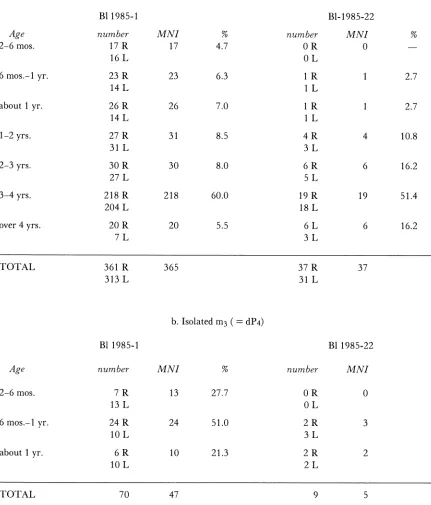
The age information derived from the mandibles is given in Table 3:a for the 674 usable mandibles (361 R, 313 L) from 365 individuals from Bl 1985-1 and for the 68 usable mandibles (37 R, 31 L) from 37 individuals from Bl 1985-22.
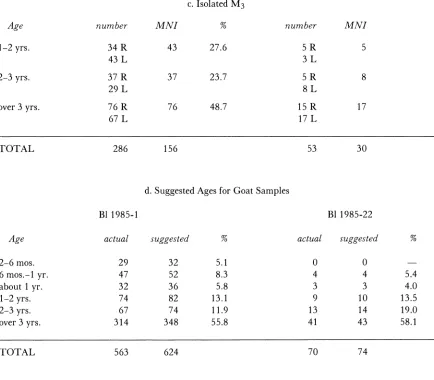
Because so many of the mandibles have lost their teeth or preserve only the P end of the tooth row, the isolated m3 ( = dP4) and M3 teeth have also been studied (Table 3:b, c). For the m3, it is considered from an individual 2-6 months old if unworn, 0.5-1.0 year if slightly worn, and about 1 year if heavily worn. For the M3, it is considered 1-2 years if unworn, 2-3 years if the last cusp is still unworn, and over 3 years if all cusps are worn.
Taking all this evidence into account, the ages for 563 goats from Bl 1985-1 and 70 from 1985-22 can be determined. If we then add in the other individuals known to be in the sample (based on the P mandible remains) in the proportions of the actual remains, we can suggest the ages of goats represented in the assemblages (Table 3:d).
This suggests that for Bl 1985-1 there are 120 individuals 1 year and younger (19.2%), 156 individuals 1-3 years (25%), and 348 individuals over 3 years old (55.7%). For Bl 1985-22 these numbers are 7 (9.4%), 24 (32.5%), and 43 (58.1%).
7J. Boessneck, J. Muller, and M. Teichert, 1964, "Osteologische Unterscheidungsmerkmale zwischen Schaf (Ovis aries Linne) und Ziege (Capra hircus Linne)," Kiuhn-Archiv 78, pp. 1-129, and J. Boessneck, "Osteological Differences between Sheep (Ovis aries Linne) and Goat (Capra hircus Linne)," in Science in Archaeology, D. Brothwell and E. S. Higgs, edd., London 1969, pp. 331-358.
8 S. Payne, "Morphological Distinctions between the Mandibular Teeth of Young Sheep, Ovis, and Goats, Capra," JAS 12, 1985, pp. 139-147.
9 S. Payne, "Kill-off Patterns in Sheep and Goats: the Mandibles from Asvan Kale," Anatolian Studies 23,
Based on Tables 3:a and d then, Bl 1985-1 produced 71 % over 2 years and 60.5% over 3 years and 1985-22, 80.5% over 2 years and 62.5% over 3 years old. The advanced age of the Corinth goats can be compared to modern Greece, where 85% are killed under 1 year. This reflects the fact that today in Greece goats are mainly raised for milk and cheese, with meat a secondary product and hair or skin relatively unimportant.10
BONEWORKING
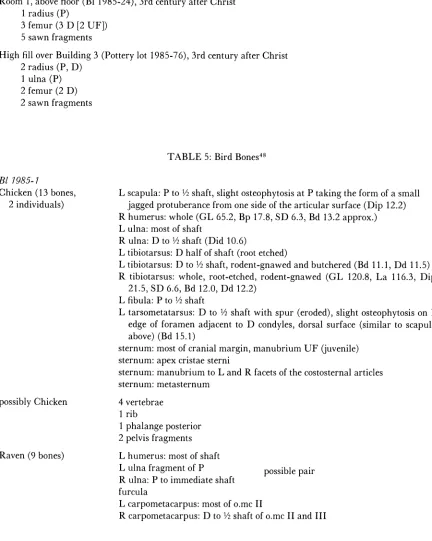
A by-product of the butchery for food of the cattle bones was the preliminary prepara- tion of the longer limb bones for boneworking. This entailed sawing off the P and D radius, ulna, or both, the femur, and the tibia, with the diaphysis (shaft) being sent on to the bone- worker. One section of such a shaft is preserved in the collection (PI. 46:h). It is possible that the horn was removed from the horncore and also sent to the boneworker. The 49 sawn cattle limb bones from Building 3 are ennumerated on Table 4.
Similar remains have been found elsewhere at Corinth. The 1969 excavation in the Gymnasium area produced evidence, originally thought to be the remains of food butchery."I The preserved bone sample from the Gymnasium includes the rear part of a deer skull with both antlers sawn through above the pedicle as well as the following cattle, horse, and possibly a smaller equid, limb bones:
Cattle 1 horncore 2 radius (2 D)
1 femur (D) 2 tibia (2 D)
6 metacarpus (2 P, 4 D) 6 metatarsus (2 P, 4 D) Equid 3 tibia (3 D)
1 metatarsus (P, small) 3 metapodials (3 D, 1 small)
Sawn cattle limb bones have been found elsewhere at Corinth, such as a D mc from the 4th-century B.C. Sacred Spring12 and a sawn fragment of a D femur of ca. 330-270 B.C.13
Probably closest to the 1985 Corinth material, since they are also associated with un- usable food butchery debris, are the sawn leg bones of cattle and equids, particularly mp, from a complex at the Athenian Agora dated to the last quarter of the 5th century and first quarter of the 4th century B.C.14 I have elsewhere'5 discussed such preliminary bonework-
ing, including Mediterranean and North European parallels. The most frequently utilized cattle bone was the mp, and it is interesting to note that it is not found sawn in the Build- ing 3 collection. Indeed, both rooms only produced 4 cattle mp, and what happened to the
10 Payne (footnote 5 above), pp. 229, 233.
1 1J. Wiseman, "The Gymnasium Area at Corinth, 1969-1970," Hesperia 41, 1972, p. 7, note 24. I thank
Professor Wiseman for permission to discuss these bones here.
12 C. K. Williams, II, "Corinth, 1969: Forum Area," Hesperia 39, 1970, pl. 12:a, second row, second from left (Bl 1969-46).
13 Bl 1969-78. In the floor fill of the racecourse.
14 T. L. Shear, Jr., "The Athenian Agora: Excavations of 1973-1974," Hesperia 46, 1975, p. 359.
other 240 mp one would expect with 61 cattle is not clear; it may be that the entire mp was generally sent to the boneworker.
DISCUSSION
The large number of cranial and lower leg bones in both rooms may be considered to be the unusable, inedible debris (except for the brain, and possibly the tongue) from food but- chery. It is the debris of the very first phase of that butchery: decapitation and removal of the lower legs. The vast majority of the edible sections are not present in the sample. This is not the first time that such bone evidence, particularly cranial remains, has been considered preliminary butchery debris.
The previously noted deposit from the Athenian Agora produced, for pig, exclusively skulls, mandibles, and scapulae. There are also relatively high numbers of pig skulls and mandibles from the Carthage cistern 1977.1, of sheep/goat and pig from a cistern at the University of Ottawa excavation at Carthage, and of pig from a Byzantine pit at Tell Kei- san in the Upper Galilee of Israel.16
Much evidence of this type has been documented from Roman and Mediaeval sites in England. A large number of pig and sheep jaws were found in a well of the 4th century after Christ at Lefevre Road, London and have been interpreted as the unsaleable debris left near a butcher's shop. 17
Grant18 has noted for the A.D. 290-360 material from Portchester Castle that "analysis
of the pig bones shows a considerable discrepancy between number of jaws, especially man- dibles, and the number of all other bones." At Roman Cirencester in Gloucestershire a midden near the center of the town produced mainly cattle mandible and skull bones.19
Excavation of a midden of the 13th century after Christ at Buckingham produced a sample of sheep bones consisting entirely of mandible, skull, and metapodial fragments.20 In contrast, the Mediaeval sheep assemblage from Okehampton Castle in Devon produced very few mandibles, skulls, metapodials, and phalanges and was dominated by the principal meat bones.21
Maltby22 has remarked that "several Romano-British towns have produced significant accumulations of primary butchery waste from cattle. Typically, these consist of large
16 Reese (footnote 3 above), pp. 196, 248.
17 D. Rixson, 'The Animal Bones,' in H. Sheldon, "Excavation at Lefevre Road, Old Fort, E3," Trans- actions of the London Middlesex Archaeological Society 23, 1976, pp. 42-77.
18 A. Grant, "The Animal Bones," in Excavation at Portchester Castle, I, Roman (Reports of the Society of Antiquaries 32), B. Cunliffe, ed., London 1975, p. 366.
19 J. M. Maltby, "Animal Bones and the Romano-British Economy," in Animals and Archaeology 4 (BAR International Series 227), C. Grigson and J. Clutton-Brock, edd., Oxford 1984, pp. 130-132 and "Patterns in Faunal Assemblage Variability," in Beyond Domestication in Prehistoric Europe, G. Barker and C. Gamble, edd., London 1985, p. 52.
20 D. J. Rackham, 'The Animal Bones,' in "An excavation at Hunter Street, Buckingham, 1974," Records of Buckinghamshire 20, 1977, R. A. Hall, ed., pp. 125-133 and Maltby, 1985 (footnote 49 above), pp. 54-55.
21 J. M. Maltby, 'The animal bones,' in "Excavations at Okehampton Castle, Devon, part 2: The Bailey," R. A. Higham et al., edd., Proceedings of the Devon Archaeological Society 40, 1982, pp. 114-135 and idem, 1985 (footnote 19 above), p. 54.
accumulations of skull, mandible and metapodial fragments. The skulls were broken to remove the brain, and the metapodials were broken to remove the marrow. Good meat bones, horncores and sometimes phalanges are grossly underrepresented ... phalanges may have been removed with the skins, and the horncores either removed in the same manner or taken away for horn-working." At Corinth, the cattle remains include mainly the horncores, skull, mandible, and phalanges but lack metapodials.
On a recent visit to the Athinas Street meat and fish market in Athens, domestic mam- mals were being sold already decapitated, and the sheep or goat had their metapodials and phalanges removed, but in most cases retained their calcaneus (and probably the astra- galus). The earlier butchery debris, not in evidence, must resemble the Corinth bone samples.
Although dog was not a normal part of the Roman diet, it was consumed at inaugural banquets and ritual meals and was eaten as a cure for various ailments. Dog has been eaten in the past, and continues to be eaten, in other parts of the world.23
To understand better these two bone samples it may be useful to consider the quantity of available (or consumable) meat provided by the bone collection. As I have stated pre- viously,24 "It is well known that animal weight depends on many factors, including breed, sex, plane of nutrition and season of death. The consumable meat weights (not the same as live weights) suggested here are intended to provide a guideline for comparison . .. and are not meant to be thought of as 'exact' weights."
The following weights are used: A goat one year or younger: 15 kgs.; 1-2 yrs.: 25 kgs.; over 2 yrs.: 30 kgs.; one cattle: 227 kgs.; a young pig: 40 kgs.; and a dog: 15 kgs.
This suggests that there are over 29,000 kgs. (almost 32 tons) of available meat repre- sented by Bl 1985-1: 56.8% goat, 42.1% cattle, 0.9% pig, and 0.2% dog. Bl 1985-22 pro- duced about 3,900 kgs. (over four tons): 52% goat, 40% cattle, 6% pig, and 2% dog.
The generally held view of Roman meat consumption has been clearly stated by Frayn:25 "Meat was not a staple article of diet for any except the rich in the Roman world. Where the peasant is depicted as consuming any meat at all, it is usually bacon or pork, smoked in the carnarium." The Roman agronomists considered lamb and kid to be im- portant food, but pork was usually considered even more important, and cattle were rarely consumed,26 at least in the Mediterranean Basin, where they mainly served as draught animals.
The modern proportions of meat eaten in Greece are not that different from what one might expect based on the Roman authors. The average annual meat production in all of Greece for 1980-1984 was 511,000 tons: 29% pork, 29% poultry, 24% mutton/lamb/goat, and 18% beef.27 For 1983 the percentages of meat consumed in Greece have been estimated
23 C. H. Greenewalt, Jr., Ritual Dinners in Early Historic Sardis (University of California Classical Stu- dies 17), Berkeley 1978, pp. 31-32, note 1. Dog was also eaten at 4th- to lst-century B.C. Kassope in Epirus. See H. Friedl, Tierknochenfunde aus Kassope/Griechenland (4.- 1. Jh. v. chr.), Munich 1984, pp. 224, 133.
24 Reese (footnote 3 above), p. 242.
25 J. M. Frayn, Subsistence Farming in Roman Italy, London 1979, p. 39.
26 K. D. White, Roman Farming, London 1970, pp. 331, 277.
at 60% pork and poultry, 24% sheep, goat, and rabbit, and 16% veal and beef.28 Both the ex- pected Roman and the modern Greek proportions are very different from the Corinth samples.
Apicius, writing in the 1st century after Christ (Artis magiricae, The Art of Cooking), devotes more space to pig than to any other domestic animal and gives very few recipes for beef or veal. He does mention hot kid or lamb stew, however, a likely product of the Build- ing 3 kitchen based on the pottery.29 The lack of skewers and the abundance of cooking wares suggest that the meat was boiled rather than cooked on a grill or spit.
As Williams has suggested,30 it is logical to assume, based on the location of the rooms with regard to the street and the Theater and on the quantity of available meat, that the butchery debris may relate to a special civil or religious feast taking place in the Theater. The large number of older goats, much cattle, presence of dog as a food, and few pigs also suggest that this is not debris from typical Roman meals but might be related to a special occasion.
It is most likely that the actual slaughtering operation took place elsewhere, but perhaps near by, and that the Southwest Room was the major debris-dumping area for preliminary food butchery. It is not possible to imagine that 700 goat, 60 cattle, 12 pig, etc. could be slaughtered in a combined area of less than 9 x 5.5 m.
It is not possible to know how long a period it took to produce the bone deposit: one day, a week, or longer. A capacity of 15,000 people has been given for the original theater at Corinth,31 and the Roman theater is likely to have had a similar capacity. If we arbitrarily provide each attendant 0.5 kg. of meat, the meat available could have fed a full crowd for four or five days. This is speculative, of course, but may help to demonstrate the magnitude of the bone assemblage.
One final note may be of some relevance to our understanding of the Corinth sample. The free issue of pork allowed by Aurelian (A.D. 270-275) forced all pork butchers of Rome to dress, cut up, and issue 20,000 lbs. (9,100 kgs. or 10 tons) of pork per day,32 only 28% of the Corinth sample. This certainly suggests that the sample was created over a longer peri- od than a single day.
DAVID S. REESE
FIELD MUSEUM OF NATURAL HISTORY Department of Anthropology Roosevelt Road at Lake Shore Drive Chicago, Illinois 60605-2496
28 M. H. Schwenk, "The Economy," in Greece: A Country Study (footnote 27 above), p. 193.
29 Williams and Zervos (footnote 2 above), p. 136, pl. 30, notes 6, 7.
30Ibid., pp. 147-148.
APPENDIX A: THE BIRD BONES
A total of 48 bird bones were recovered, 43 from Bi 1985-1 and 5 from 1985-22. Of these, 30 bones were identifiable to 6 bird types. The forms present (Table 5) include the domestic fowl or chicken (Gallus gallus), the domestic pigeon/rock dove (Columba livia),33 the raven
(Corvus corax), the chukar/rock partridge (Alectoris chukarlgraeca),34 song thrush (Tur- dus philomelos), and the blackbird (Turdus merula).
The condition of the bird bones is generally good, although there is close to 100% fresh breakage. Rodent gnawing occurred on 2 chicken and 1 partridge tibiotarsus. This condi- tion indicates that some bones were either poorly buried or else left on the surface for a while prior to burial.
Domestic fowl is the best represented species, and there is a possibility that the chicken bones account for a majority of the unidentified elements. There is a virtual or complete absence of certain primary food elements; the division line for wing and leg corresponds to the D humerus and D tibiotarsus, respectively. One tibiotarsus exhibits a knife cut to the D, possibly related to the latter division. A greater sample size is needed to clarify this question.
All the fowl bones are mature except for one UF anterior sternal fragment. This may perhaps indicate an egg-laying basis for the fowl economy. Indeed, one ulna exhibited a thick layer of medullary bone (approximately three fourths of the transverse-section dia- meter), a condition related to the egg-laying period.35 Outside this period there would be no medullary bone formation; therefore its absence does not necessarily indicate a male or capon.
The single tarsometatarsus found has a spur, which is therefore likely to belong to a male. This bone and a scapula exhibit mild exostoses, in the latter to the actual articular surface and in the former adjacent to the foramen immediately dorsal and proximal to the distal condyles. This condition may be related to age.36
The size range (Table 6) of the chicken bones closely follows that displayed at Sette- finestre, a Roman villa of the 2nd to 4th centuries after Christ in Etruria.37
The song thrush, together with the mistle thrush, are referred to by Andre as "the best feathered game in the eyes of the Romans."38 Thrushes were also eaten in Classical Greece, although Aristotle mentions only the fieldfare, mistle thrush, and possibly the redwing.39 Both the Greeks and the Romans captured blackbirds for the table.40 Varro refers to a section within his aviary set aside for songbirds, including the blackbird.41
3 Varro (de re rustica 111.7. I-2) refers to both a wild and a domestic form.
34 The partridges are of similar build and size, and they have similar habitats. Today's resident distribution, however, favors the rock partridge; H. Heinzel, R. Fitter, and J. Parolow, The Birds of Britain and Europe with North Africa and the Middle East, London 1979, p. 102.
35 J. C. Driver, "Medullary Bone as an Indicator of Sex in Bird Remains from Archaeological Sites," in Ageing and Sexing Bones from Archaeological Sites (BAR 109), B. Wilson, C. Grigson, and S. Payne, edd., Oxford 1982, pp. 251-254.
36 Baker, personal communication.
3 K. Rielly, "Gli uccelli," in Settefinestre. Una villa Schiavistica nell'Etruria romana, II, La villa e i suoi reporti, A. Carandini, ed., Modena 1985, pp. 299-303.
38 J. Andre, L'alimentation et la cuisine a Rome, Paris 1961, p. 125.
39 J. Pollard, Birds in Greek Life and Myth, London 1977, p. 104.
40 Pollard (footnote 39 above), p. 104; Andre (footnote 38 above), p. 128.
The rearing and fattening of the domestic pigeon is described in detail by both Varro and Columella,42 while the rock partridge was amongst a number of wild species which the Romans captured and then reared in aviaries.43
The 9 raven bones are possibly from one individual. This bird may have been kept as a
pet, being one of a few bird species with the power of mimicry, a virtue highly valued by the Greeks and Romans.44
KEVIN RIELLY
INSTITUTE OF ARCHAEOLOGY 31-34 Gordon Square London, WC1H OPY England
APPENDIX B: THE FISH BONES
The two Bone lots produced a total of 16 fish bones. Of these 8 come from the gilthead sea bream (Sparus aurata),45 1 from a sea perch (Family Serranidae), 1 probably from a tunny
(Family Thunnidae), and 6 are unidentifiable fragments (Tables 7, 8). None of the fish bones appear to be burnt.
The gilthead, a shallow-water mollusc-feeder, occurs throughout the Mediterranean. Its robust jaws have been found previously at Corinth.46 Measurements of the bones (Table 9) indicate that they are from perhaps five fish, which were between 250 grams and 2.0 kilograms in whole weight.
The sea perch family is represented here by a single bone, a proximal dentary fragment. It cannot be ascribed to a particular species, but the fish was in either the genus Serranus or Epinephelus. The bone size indicates that it is from an individual about 500 gr. in weight.
One anterior caudal vertebra is possibly of a tunny (PI. 46:i). The large size suggests a bluefin tunny (Thunnus thynnus), roughly 50 kilograms in live weight.
It is impossible to determine whether these fish were caught locally or were imported.47
42 Varro, de re rustica II .7. I- I; Columella, viii.8. i.
4 Andre ([footnote 38 above], p. 125) refers to Perdix graeca Brisson; Varro, de re rustica Ii. i i.4; Roman usage of aviaries for wild birds in Andre, pp.123-128.
4 Pollard (footnote 39 above), p. 135 and J. M. C. Toynbee, Animals in Roman Life and Art, London 1973, pp. 274-275.
45 Nomenclature used here follows Check-list of the Fishes of the North-eastern Atlantic and of the Mediter- ranean, J. C. Hureau and T. Monod, edd., Paris 1978.
46 Gilthead are present among the fish remains from the mid-5th-century B.C. deposits in the Punic Am- phora Building at Corinth. See C. K. Williams, II, "Corinth, 1978: Forum Southwest," Hesperia 48, 1979, pp. 117-118, esp. note 17 (fish identified as sea bream and tunny by A. Wheeler), and pl. 46. Bones of S. aurata are shown on pl. 46:a (a right premaxillary bone visible at left of the articulated group) and pl. 46:b (a right maxilla on left, inverted, with proximal end to right) and a right premaxilla (on right, proximal end to left).
Nine of the bones are from jaws and 5 are unidentifiable cranial fragments, but only 2 large vertebrae were found in these lots. This pattern could result from the way in which the fish were processed after capture, the circumstances in which the bones were deposited, the methods of excavation employed, or a combination of these factors.
MARK J. ROSE
INDIANA UNIVERSITY
Program in Classical Archaeology 408 North Indiana Avenue Bloomington, Indiana 47405
Architecture, Leiden 1978, pp. 25-35, figs. 1 iB, l 1C, for the piscinac constructed there in the 1 st century after Christ.
For imported fish at Corinth see Williams (footnote 46 above), pp. 117-118 and Y. Maniatis, R. E. Jones, I. K. Whitbread, A. Kostikas, A. Simopoulos, C. Karakalos, and C. K. Williams, II, "Punic Amphoras Found at Corinth, Greece: An Investigation of Their Origin and Technology," JFA 11, 1984, pp. 205-206, 211.
TABLE 1: GOAT
a. Weight of Goat Elements (Bi 1985-1)
element kgs.
horncores 8.6
skull bones 18.0
maxillae fragments with teeth 7.4
premaxillae 0.2
mandible fragments with and
without teeth 37.6 97.2 cranial
isolated incisors, canines,
and premolars 3.5
isolated first and second
molars 16.4
isolated third molars 5.5
metacarpus 4.7
metatarsus 4.0 9.6 metapodials
metapodial fragments 0.9
phalanx 1 2.4
phalanx 2 0.4 3.2 phalanges
phalanx 3 0.4
ribs and vertebrae 0.6
other postcranial bones 1.7
unreadable goat-sized bones 7.8
b. Actual and Expected Elements Preserved (Bl 1985-1) (624 individuals based on mandibles)
element expected count actual count
atlas 624 3
axis 624 1
scapula 1,248 35
humerus 1,248 11
radius 1,248 6
ulna 1,248 4
pelvis 1,248 6
femur 1,248 14
tibia 1,248 9
astragalus 1,248 4
calcaneus 1,248 2
metapodials 2,496 973
element expected count actual count
phalanx 2 4,992 278
phalanx 3 4,992 236
ribs 8,112 302
other vertebrae 21,216 60
TABLE 2: CATTLE
a. Weight of Cattle Elements (Bl 1985-1)
element kgs.
horncores, skull bones, and
maxillae 2.1
premaxillae 0.8
mandible fragments 4.7 9.1 cranial
isolated teeth 1.5
phalanx 1 4.1
phalanx 2 3.0 9.3 phalanges
phalanx 3 2.2
ribs and vertebrae 1.5
sawn cattle limb bones 1.1
all other cattle-sized bones 3.5
b. Actual and Expected Cattle Elements Preserved (Bl 1985-1) (54 individuals based on mandibles)
element expected count actual count
atlas 54 3
axis 54 3
scapula 108 6
humerus 108 2
radius/ulna 108 1
pelvis 108 1
femur 108 13
tibia 108 8
astragalus 108 3
calcaneus 108 3
metapodials 216 3
phalanx 1 432 153
phalanx 2 432 122
phalanx 3 432 126
ribs 702 48
TABLE 3: AGE OF GOAT
a. Mandibles
Bi 1985-1 BI-1985-22
Age number MNI % number MNI %
2-6mos. 17 R 17 4.7 OR 0
16 L 0 L
6 mos.-1 yr. 23 R 23 6.3 1 R 1 2.7
14 L 1 L
about 1 yr. 26 R 26 7.0 I R 1 2.7
14 L 1 L
1-2yrs. 27 R 31 8.5 4 R 4 10.8
31 L 3L
2-3 yrs. 30 R 30 8.0 6 R 6 16.2
27 L 5 L
3-4yrs. 218R 218 60.0 19R 19 51.4
204 L 18 L
over4yrs. 20R 20 5.5 6L 6 16.2
7L 3L
TOTAL 361 R 365 37 R 37
313 L 31 L
b. Isolated m3 ( dP4)
Bi 1985-1 Bi 1985-22
Age number MNI % number MNI
2-6mos. 7R 13 27.7 OR 0
13 L OL
6 mos.-1 yr. 24 R 24 51.0 2 R 3
10 L 3L
about 1 yr. 6 R 10 21.3 2 R 2
10 L 2 L
c. Isolated M3
Age number MNI % number MNI
1-2 yrs. 34 R 43 27.6 5 R 5
43 L 3 L
2-3 yrs. 37 R 37 23.7 5 R 8
29 L 8 L
over 3 yrs. 76 R 76 48.7 15 R 17
67 L 17 L
TOTAL 286 156 53 30
d. Suggested Ages for Goat Samples
Bi 1985-1 Bi 1985-22
Age actual suggested % actual suggested
2-6 mos. 29 32 5.1 0 0
6 mos.-1 yr. 47 52 8.3 4 4 5.4
about 1 yr. 32 36 5.8 3 3 4.0
1-2 yrs. 74 82 13.1 9 10 13.5
2-3 yrs. 67 74 11.9 13 14 19.0
over3yrs. 314 348 55.8 41 43 58.1
TOTAL 563 624 70 74
TABLE 4: Sawn Cattle Bones from Building 3
Southwest Room (Bl 1985-1) 1 radius/ulna (P)
10 femur (3 P [2 UF], 7 D-some fragmentary) (Pls. 45:h, i) 6 tibia (3 P [3 UF], 3 D)
3 sawn fragments (P1. 46:h)
Room 1 (Bl 1985-22) 1 radius (P) (P1. 46:g)
4 femur (2 P, 2D [1 UF, 1 broken]) 2 tibia (2 D)
Room 1, above floor (Bl 1985-24), 3rd century after Christ 1 radius (P)
3 femur (3 D [2 UF]) 5 sawn fragments
High fill over Building 3 (Pottery lot 1985-76), 3rd century after Christ 2 radius (P, D)
1 ulna (P) 2 femur (2 D) 2 sawn fragments
TABLE 5: Bird Bones48
Bl 1985-1
Chicken (13 bones, L scapula: P to ?/2 shaft, slight osteophytosis at P taking the form of a small 2 individuals) jagged protuberance from one side of the articular surface (Dip 12.2)
R humerus: whole (GL 65.2, Bp 17.8, SD 6.3, Bd 13.2 approx.) L ulna: most of shaft
R ulna: D to ?/2 shaft (Did 10.6)
L tibiotarsus: D half of shaft (root etched)
L tibiotarsus: D to 1/2 shaft, rodent-gnawed and butchered (Bd 11.1, Dd 11.5) R tibiotarsus: whole, root-etched, rodent-gnawed (GL 120.8, La 116.3, Dip
21.5, SD 6.6, Bd 12.0, Dd 12.2) L fibula: P to ?/2 shaft
L tarsometatarsus: D to ?/2 shaft with spur (eroded), slight osteophytosis on P edge of foramen adjacent to D condyles, dorsal surface (similar to scapula above) (Bd 15.1)
sternum: most of cranial margin, manubrium UF (juvenile) sternum: apex cristae sterni
sternum: manubrium to L and R facets of the costosternal articles sternum: metasternum
possibly Chicken 4 vertebrae
1 rib
1 phalange posterior 2 pelvis fragments
Raven (9 bones) L humerus: most of shaft
L ulna fragment of P possible pair
R ulna: P to immediate shaft furcula
L carpometacarpus: most of o.mc II
R carpometacarpus: D to ?/2 shaft of o.mc II and III
L phalanx I anterior of digit II
(last three bones all possibly one individual) sternum: R facets of the costosternal articles R femur: D and most of shaft
Dove R carpometacarpus: whole except for o.mc III
Partridge L tibiotarsus: D and most of shaft (rodent-gnawed)
Song thrush R humerus: whole
3 longbone shaft pieces and 7 indeterminate fragments
Bl 1985-22
Chicken radius: P to ?/2 shaft
sternum: apex cristae sterni and most cranial margin
Dove L carpometacarpus: whole
Blackbird L tibiotarsus: whole possible pair
R tibiotarsus: whole
TABLE 6: Size of Chicken Bones (Bl 1985-1)
element GL La Dip, Bp SD Bd, Did Dd
scapula 12.2
humerus 65.2 17.8 6.3 13.2
ulna 10.6
tibiotarsus 11.1 11.5
tibiotarsus 120.8 116.3 21.5 6.6 12.0 12.2
tarsometatarsus 15.1
TABLE 7: Identification of Fish
Bone lot S. aurata Serranidae Thunnidae Unidentified
1985-1 7 1 1 6
1985-22 1
TABLE 8: Anatomical distribution of fish bones
S. aurata Serranidae Thunnidae Unidentified
upper jaw: premaxillary 3
maxillary 1
lower jaw: dentary 3 1
articular 1
cranial/facial 5
TABLE 9: Fish Bone Measurements49 Bl-1985-1
Sparus aurata
Right premaxillary: Desse 1 37.1; Desse 2 19.5; Desse 3 19.9; Wheeler Pm h 38.0 preserved From a fish 1.5-2.0 kgs. in weight
Left premaxillary: Desse 1 40.0; Desse 2 18.8; Desse 3 19.1; Wheeler Pm h 40.0 From a fish 1.5-2.0 kgs. in weight
Left premaxillary: Desse 1 25.4; Desse 2 12.5; Desse 3 13.0; Wheeler Pm h 29.0 From a fish 500-700 gr. in weight
Right maxillary: Preserved length 46.0
Possibly from same fish as right premaxillary bone listed above
Right dentary: Wheeler D 1 32.5; greatest width across dental arcade 11.3 Left dentary: Wheeler D 1 32.9; greatest width across dental arcade 11.1
Both dentaries are from fish 1.5-2.0 kgs. in weight, possibly from the same fish
Left articular: Morales and Rosenlund art.g.l. 34.5, art.gr.b.7.7
Serranidae
Left dentary: Depth of dentary taken at notch posterior to proximal end 5.4 From a fish about 500 gr. in weight
Thunnidae
Anterior caudal vertebra: horizontal diameter 32.0; length 26.0
Unidentified
Vertebral fragment: estimated diameter of whole vertebra 22.0
Bl-1985-22
Sparus aurata
Left dentary: Greatest width across dental arcade 9.1 From a fish 250-300 gr. in weight
49 All measurements are given in millimeters. Measurements defined by other authors are noted as follows: Desse = J. Desse and G. Desse, "Analyse de l'ichtyofaune du gisement cardial de
Leucate (Aude)," Leucate-Corre'ge, Toulouse and Sete 1984, pp. 221-228 Morales and Roselund = A. Morales and K. Rosenlund, Fish Bone Measurements, Copenhagen 1979 Wheeler = A. Wheeler, "The Fish Remains," in Excavations at Carthage 1977 (footnote
A 4 c. Goat pelvis fragment, butchered; L. 72 mm. Acetabulum at right (1:1)
b. Goat proximal ra-
a. Left: goat horncore, cut at distal end; dius, butchered; W.
W. ca. 30 mm. proximal end 26 mm.
Right: cattle horncore, cut at distal end; (1:1)
max. dim. cut edge 55 mm. (1:2)
d. Goat femur tro- chanter majus,
Bn l 18-
butchered through Bone lot 1985-1
bone; W. 30 mm. (1:1)_
f. Cattle scapula, butchered e. Goat distal tibia, around glenoid; p.L. 133
butchered; distal mm., glenoid W. 52 mm. W. 24 mm. (1:1) (1:2)
g. Cattle distal humerus fragment, butch- h. Cattle proximal femur, sawn i. Cattle distal femur, sawn through; sawn edge ered down center. L. 84 mm., distal through; sawn edge 56 mm., max. 61 mm. (1:2)
W. 37 mm. (1:1) L. 66 mm. (1:2)
a. Pig distal humerus, butchered b. Dog axis, butchered (Bi 1985-1) c. Dog vertebra, butch-
through bone (Bi 1985-1) ered (Bi 1985-1)
d. Dog metacarpus 11, butchered at proxi- mal (top) end (B1 1985-1)
e. Goat scapula, butchered through glenoid on anterior side; p.L. 69 mm.,
glenoid W. 32.5 mm. (Bl 1985-22) f. Goat tibia shaft with numerous cut marks; p.L. 73 mm. (Bl 1985-22)
g. Cattle proximal radius, partly sawn h. Cattle diaphysis section, i. Tunny vertebra, butch-
through; max. W. 83.5 mm. sawn and trimmed; ered; max. diam. 32 mm.,
(Bl 1985-22) L. 68 mm., W. 32 mm. L. 26 mm.
(Bl 1985-1)
Scale 1:1