COLOPHON
Sotitlxvar(I :fromni Smvrna a gap in the hills that fringe the gulf opens to the great plain watered by the Ta?tali gay, the ancient river Astes. Thirty kilometers farther south, where foothills of the ridge of the Sivridag form the boundary of the plain, lay the Ionian citv of Colophon. In the foturth century B.C. its circu1it walls linked
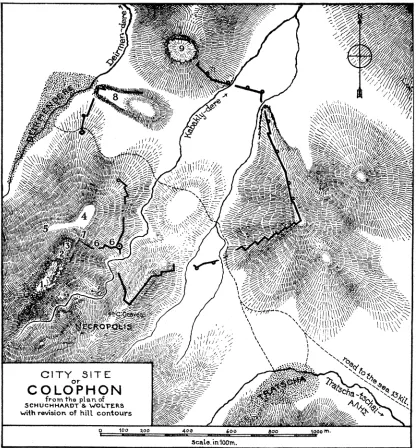
three hilltops, approximately a kilometer apart. forming roughly an equilateral triangle, with apex at the north (Figs. 1 and 3). By the northwest side runs the mill stream which gives its name to the shady modern village of De,irmendere. A second stream, the Kabakli-dere, rising to the south, flowvs through the center of the triangle and out at the northeast side. Both streams, reaching the great plain, join the Ta?tali qay and turn southwestward through the mountains to the sea near the ancient cities of Lebedos and Teos.
A road from De,irmendere throtugh the ancient city site cutting the Kabakli-dere at right angles, leads to the modern town of Traga, not far beyond the south side of the enclosed area. Though this road seems level, it actually crosses a watershed, and from Traca another stream, the ancient Ales, flows toward the southeast to reach, in thirteen kilometers, the coast at Notion, seaport of Colophon. Beside it ran the ancient highway. Nearly due eastwxard some thirty-five kilometers of another nearly level road lead fromn Colophon to Ephesos.
The site of Colophon, well watered and protected by its three hills, had niuch to
r ecommend it. It controlled not only wTide stretches of fertile land, excellent for horse raising, btut also the important highway from its colony Smyrna to Notion. On the other hand, its distance from salt water was a little too great and the harbor of Notion too unimportant for it to play a mlaritime role of any consequence. And as in the Aegean world fame was largely sea-bred, Colophon was noted only for its wealth and luxurious life and for its cavalry.
Indeed the brevity of its annals 1 reflects its fortune. The tradition of the early non-Carian settlement of the region 2 is supported by the remains of a beehive tomb,
rifled but still containing, Creto-IMycenaean potsherds.3 We are told that later it bore unwillingly the Lvdian yoke. more complacently that of the Persians, and that having finally regained independence. with Alexander's conquest of 334, it devotedly sup-
1 See the excellent historical note by J. G. Milne, Kolophon and Its Coinage, Numtismatic Notes and Monographs, No. 96 (1941), pp. 2-10.
2 Pausaniias, VII, 3.
3 Excavated by Dr. Goldman in 1922; to be published with a report on other graves at Colopholl.
Hesperici, XIII, 2
American School of Classical Studies at Athens is collaborating with JSTOR to digitize, preserve, and extend access to Hesperia
ie~~~~~~~~~~i4
win V,~
~ ~ ~ ~ ~ ~
from ol 1. Site
- flf/i'1 7 ///flhi~~~~~~~U1i/---
~~
~~j!I/u7"/ inloomCOLOP HON 93 ported his heir Antigonos against Lvsirnachos, by whose general Prepelaos it was taken in 302.' Following this disaster the inhabitants were transferred to populate, with those of ruined Lebedos. the new Ephesian suburb of Arsinoe, built by Ly- simachos.5 This terminal event is perhaps the best known in the history of Colophon, but doubt is thrown on the completeness of the finale by an inscription from Magnesia dating from later in the third century,6 which mentions KoXo4Jt)o[t ot -nv] JpXatav ro'X[V OIK]0oiVES as well as KoXoba'ctot J[7wo] OaX6aoa-o. Probably some Colophonians remained on the ancient site wvhile others migrated to Notion in such numbers that the seaport became known as NewV Colophon. Those taken to Ephesos seem to have lost the name of Colophonians altogether.
It could hardly be expected that so favorable a location would remain deserted for long. Certainly clusters of dwelling,s, like the modern villages of Degirmendere and Traca, would appear within two generations, even after total abandonment of the ancient city, but that official commemorations should be set up in such minor settle- ments seenms unlikely. What seems more probable is that certain sanctuaries, im- portant while the citv flourished, continued with diminishing reputation to keep alive the name of the dead citv of Colophon.7
After several false identifications the city site was found by Schuchhardt, Kiepert, and Wolters in 1886 (Fig. 1).8 Their brief survey traces out the circuit
walls, built of hard bltue-grey limestone (Fig. 2), cut and laid for the most part like those of Lysimachos at Ephesos. A dozen towers were located, mostly round in plan. Within the walls numerous terraces and foundations, but no standing superstructures, were seen.
On the basis of this report, the Fogg Art Museum of Harvard College in col- laboration with the American School of Classical Studies at Athens planned an extended campaign of excavation. In the spring of 1922, from late April to late June, the first expedition, directed by Dr. flettv (oldman and Dr. Carl XBlegen, attacked the site. As this campaign was primarily exploratory, trials were made in many scattered places, where building stones appeared, in the valley and on the acropolis hill, and three cemeteries were investigated. Since Schuchhardt's report was seen to be in general correct, no attempt was made to analyse the city walls or plot their lines, and indeed far more new structures were uncovered than could be surveyed in two months. Careful recording and study were planned for future campaigns.
The specific results of this expedition wvere: first, determination by the coins found that the site was indeed that of Colophon, a very large majority being from
4 Diodorus, XX, 107.
5 Pausanias, I, 9, 7. In 286 B.C. (?), C.A.H., Vol. VII, p. 91.
6 Kern, Inschr. von Magnesia, no. 53, lines 75-79.
7 According to Meritt, A.J.P., IV I, 1935, P. 381, one of the inscriptions (no. VI) found in
the lVletro6n may have been set up after 281 B.C.
Colophonian mints; second, that it was inhabited from prehistoric through classic
times, cemeteries of the Mycenaean, Geometric. and HIellenistic
periods being identified;
third, that on the acropolis, at least, there was no habitation after the fourth century,
practicallv all the coins found there being of that period, though a few coins of
Antiochus 1I (261-246) found in the Metrobn, and an inscription which may be of
similar date, indicate that the sanctuary continued its functions to the third century.
The unsettled state of the country preceding the expulsion of the Greek forces
from Anatolia in the sunmmer
of 1922 brought the campaign to a hurried close; and
Fig. 2. Exterior of Southernmost Angle of Fortification Wall, on Hilltop East of Kabakli-dere Ravine, Looking Northeast. From the Valley at the Right the Walls Mount to the First Hill Beyond, on Which, Near the Right Edge of the Picture, is the Eastern Angle of the City Enclosure. Thence the Walls Descend Northward toward the Left, along the Visible Crest
subsequent conditions prevented continuation of the full excavations which had been
planned for succeeding years.
The coins in transit to the Istanbul MNuseum,
where they now are, were taken to
Athens and studied there, but all the pottery and other minor finds left in Degirmendere,
unphotographed in the hastv departure, were lost. During Septemnber
of 1925 the
scholarly interest of the Turkish authorities made possible a second short visit to the
site under the direction of Dr. Goldnman,
at which time the lVetro6n and the bathing
establishment, discovered in the first campaign, were nmore fully excavated and
measured,9 and a few more graves explored. Since then, hope of further investigation
COLOPHON 95
has gradually faded and now it has seemed wATise to compile from the aging records of excavation notebooks and photographs, wvhere actual surveys are lacking, a pre- liminary and at the same time final report of the incomplete results of tlhe first expedi- tion, leaving unsettled many questions which only further sttudy and re-examination on the ground could resolve. The compiler of this report, occupied throughout the
campaign with general sturveying rather than with studying the remains, has tried to p)iece together and to include all significant items that could be gleaned from the notes of other members of the expedition. Obscure statements and absence of desired details have often been unavoidable, for missing information could not be supplied. An account by Dr. 1Ieritt of the inscriptions found has already appeared; 10 the ceme-
teries must wait for later publication, and so for a-time- nmtst the Metro6n and Baths. The valley (Figs. 1, 3) within the wide triangle of the city's fortifications revealed on superficial exploration traces of a numnber of large buildings, the location of none of which was recorded with sufficient accuracy for them to be placed on Fig. 1. Nearest Degirmendere, on a hillock west of the road running thence to Traca, was a structure of Roman date-as indicated by the presence of 'mortar-apparently made of re-used Greek blocks, and just to the east of the hill a large Roman building which, from the depression within its walls, suggested an Odeum. A little way to the south were remains which may have been Greek.
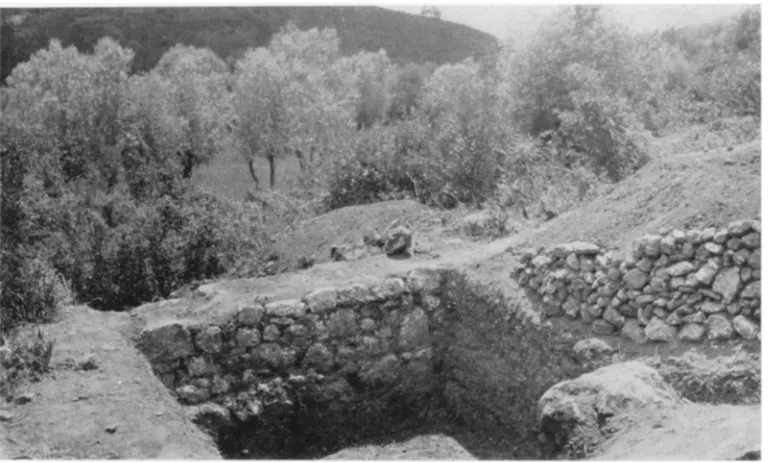
Eastward, shortly before crossing the Kabakli-dere, not far from the center of the city triangle, the Tra?a road cuts, near its northeast corner, a structure one side of which runs in a straight line for about 115 meters. Trenches in three locations here revealed parallel walls, about one meter thick and six meters apart, enclosing a great rectangle. The outer and inner walls were faced on the outside with coursed linmestone blocks (Fig.
4),
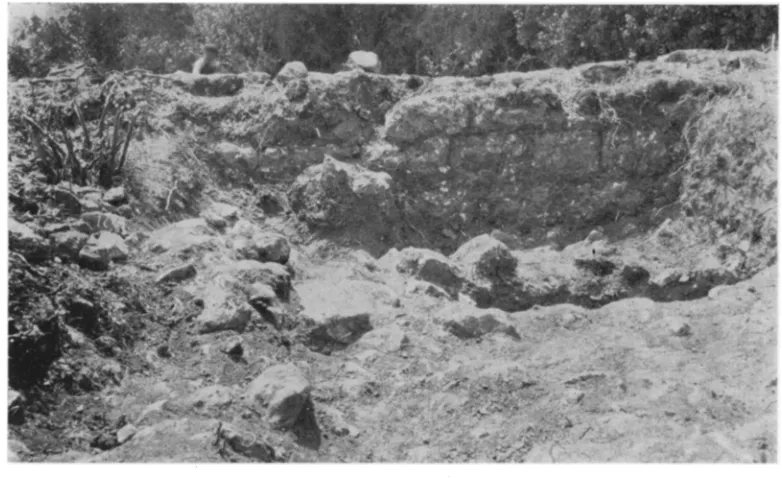
roughly bulging betwveen jointing lines, like the coursed masonry of the city walls (Fig. 2), tlhough less carefully jointed. The inner faces were unworked stones (Fig. 5). Both walls went down to stereo, on an average a meter and half below the existing grade. No floor level was found between the walls but only an unstratified fill containing many sherds, including geometric, red-figured, and fine thin black-glazed ware. No remains of the superstructure were found, nor of earlier structures on the site, barring a possible cobblestone p)avement about a meter below grade at the eastern end near the Traga road, and a few uncertain scraps of wall at the west. In the absence of coins for dating one can only say on the basis of the pottery, that the structure was not built before the fourth century, and on the basis of the stone work, that it may have been contemporary with the surrounding city walls.In the adjoining field north of the road, another rectangular structure was in- vestigated. In only a few places did the walls-about 0.80 m. thick-appear finished
10 A.J.P., LVI, 1935, pp. 358-397. For supplementary conmimenitary
as if to show above ground. Here also the face was of coursed limestone blocks with
rounded faces like the masonry of the peribolos just mentioned (Fig. 6). Stereo was
found to be only 0.40 m. below the existing grade. From east to west the north wall
measured some 20 meters. The east wall was traced 19 meters to the south, the west
wall 10 meters farther. Several short ends of interior walls, a few meters long, were
found, but not enough was uncovered to explain the arrangement. No elements of
the superstructure came to light, nor any floor, though a length of stone drain and
the bottom of a large pithos about 0.10 m. above stereo seemed to mark a floor level
either of this building or of some earlier one.
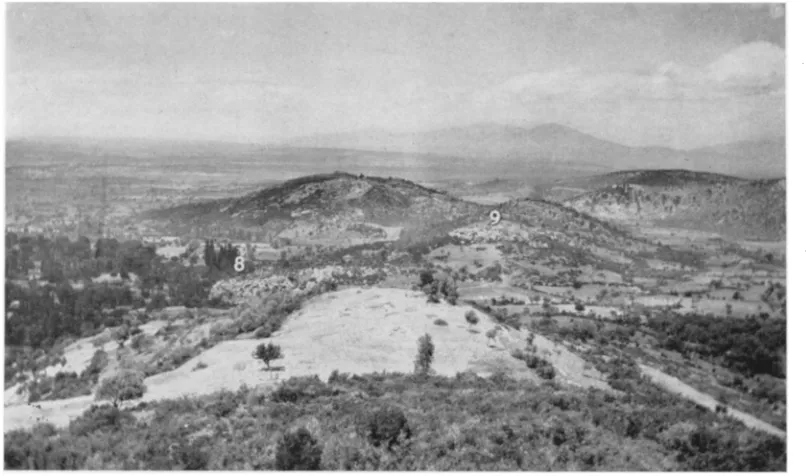
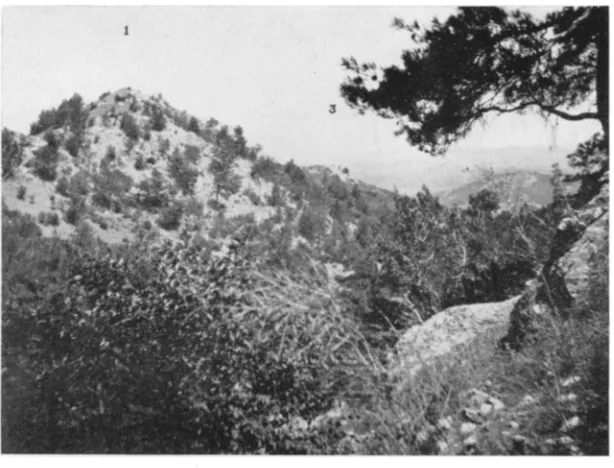
Fig. 3. View from Ledge of Rock between Peak of Acropolis and Main Terrace, Looking North. The Nearest Hill to the Right of Center (9) Forms Northern Apex of City Triangle. In the Heavy Grove of Poplars at the Left Lie the Stream and Village of De irmendere
COLOPHON 97
Fig. 4. Foundations of Peribolos in Valley, Showing Outer Face of Inner (West) Wall. Trees Just Beyond Mark Course of Kabakli-dere
for a length of
2meters, starting 0.60 m. from the west wall. Stereo was found about
0.75 m. below grade. Again no elements of the superstructure were found, nor any
floor, and it may be doubted if any of the existing remains lay above the classic
grade level.
These three buildings, of a size more suitable for public than for private struc-
tures, would seem to indicate that the heart of the municipality was near by. The
shallowness of the soil is responsible for the disappointing scantiness of the remains,
and the narrowness of the walls may explain why fragments of columns and en-
Fig. 6. Foundations
of Smaller
Rectangle
in
VTalley.Outer Face of North Wall
tablatures were not found. Yet a series of large public buildings without any use of
orders i's not what one would normally expect in an important Greek city. Possibly
these structures were the " market place, workshops, and all other necessary [rather
thban
decorative]I public buildings
" referred to in an inscription authorizing the building*
of the city walls." There can be- no doubt, 'in any case, that the stonework is Greek,
and from its appearance one wouild place it in the late fouirth century, though without
the supporting evidence of coins and sherds this cannot be stated with certainty.
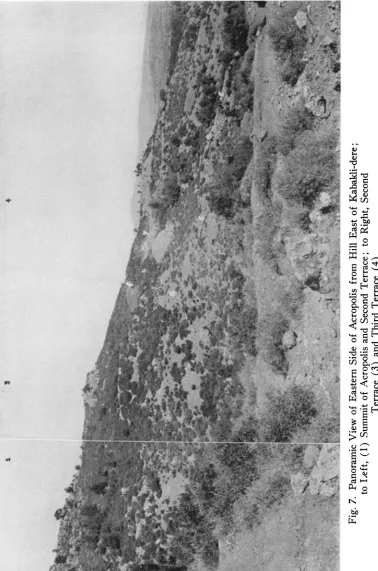
Of the, three hills which form the apices of the city, that to the souithwest Iwas
the acropolis (Figs. 1, 7, 8). In shape i't is a long ridge stretching a little east of north
from the high mnass
of the Sivrida', which rises to a peak 896 meters above the sea.
The highest point of the acropolis (1 in Fig. 7), som'e 200 m. above the plain,
.l |~~~~~~~~~~~~~~~~~~~~~~~~~~~~~~~~~~~~~~~~~~~~~~~~~~~~~~~~~~~~~~~~~~~~~~~~~r
Fig. 7. Panoramic View of Eastern Side of Acropolis from Hill East of Kabakli-dere; to ILeft, (1) Summit of Acropolis and Second Terrace; to Right, Second
is separated from the hill behind by a sharp declivity perhaps twenty meters deep.
From the peak a bare strip, little mnore
than seven meters wide, at the narrowest,
of rock fissured by progressive fragmentation, slopes gently northward for some fifty
meters to a saddle (2), rounding evenly to the eastern and western flanks of the
acropolis. This continues nearly level for some twenty-five meters more to a second
outcropping crag (3), from which the hill spreads cone-wise down to east and west
and more gently toward the north. Fifty meters lower still the northern slope becomes
a. level terrace (4), fifty meters wide by slightly over one hundred meters from south
to north. A side extension of this terrace, twenty meters wide, runs like a shelf nearly
Fig.
8.
WestSide of Acropolis
from Camp Site. Poplar Trees
(5) to Left of Center Mark Western End ofWest
T:rrace.Compare
Fig. 26
due west along the flank of the hill for a hundred and twenty meters or so until it
merges with the even westerly gradient f rom the peak of the acropolis
(5).
Ten met'ers
below the level of the main northern terrace another narrower shelf runs along the
steeper -eastern slope (Fig. 7, 7) and below these three flat areas more gradual declivi-
ties stretch north and northeast to the lower city, and east and west to the courses of
the Kabakli-dere running through the city's heart and the De'irmendere which skirted
its western
wall.
COLOPHON
101
Within this ring we may suppose the area to have been filled as solidly with
buildings and streets and public places as the topography would permit, whereas the
extent of the lower city is so great that much of the area must always have remained
unoccupied. For this reason, except for the cemeteries and trial trenches at the three
above-mentioned sites in the lower town, digging was confined to the acropolis. Un-
fortunately the geologic formation of the hill was such that preservation of remains
was extraordinarily bad. On the main peak (1) and the lower outcrop (3) of rock
Fig. 9. Acropolis from Necropolis Hill, Looking Northwest
nothing remained, if indeed anything had ever been built there. On the saddle (2)
between the two a trench four meters wide by thirty long showed scarce a half meter
of earth above the rock.12 In it were found the bottoms of many walls, which to judge
from their width and the spaces enclosed-three or four meters on the average-must
have been hotise walls; in the trench were also found fragments of cobblestone paving,
a
section of tile drain above which a wall had been built indicating a change in plan,
many pieces of roof tile, broken pithoi and fragments of smaller pottery, terracotta
figurines, etc., bits of lead, part of a hand millstone, and three bronze coins of the
fourth century
B.C.3Lacking earth to cover it, all superstructure had slid off the
saddle to one side or the other. And as the fragmentary foundations that are left
12
Not located with sufficient accuracy to be shown on the plan, but roughly 50 m. below lower left-hand limit of P1. IX.
13 J. G. Milne, Kolophon and Its Coinage, Numntismlatic Notes and Monographs, No. 96 (1941),
show diverse rebuildings, it is questionable if more extensive digging and more in-
tensive study could reveal intelligible plans. All that can be said is that this high area
was closely settled for a considerable period during the fourth century, while evidence
of inhabitation either later or earlier was not found.
From the saddle and the second ledge of rock the ground falls away rapidly; most
steeply to the east, least steeply on the ridge which spreads finally into the northern
terrace. Btut everywhere the grade is such that building could only be made possible
by heavy retaining walls, providing a series of stepped terraces from fifteen to twenty-
five meters
widle.The inevitable result of rain and earthquakes through many cen-
turies has been to smooth these steps into continuous slopes. The top of each terrace
wall and what stood upon it has been eventually tipped outward and scattered in con-
fusion down the hill. On the other hand the shelter of the terrace walls has preserved
what stood close below them for a height of a meter or twvo, buried often by the
collapsed wall itself and debris from above. And at all periods, as well when the city
was flourishing as in its long disintegration, the upper ledges of the acropolis have
loosed from time to time great boulders to plow a path of wreckage through walls and
terraces. The multiple rebuildings, indicated bv the varying techniques of sections of
the retaining walls, may have been due more often to enforced repairs than to in-
tended changes.
But the wide level terrace (4) which prolongs the ridge well to the north on the
lower part of the hill is, for most of its extent, beyond the reach of landslides; here
digging was comnmenced
with the promise of well-preserved remains. It was quickly
seen, however, that in the center of the area the surface of the modern plowed field
was only a few centimeters above bed rock, and that while the earth
wasdeeper along
the shoulders of the terrace where foundation walls had allowed it somewhat to collect,
there was rarely more than a meter of it, and even at the southwest angle w,Nhere
COLOPHON
103
THHE STOA (VII)
NORTH WING
(VII
e-i)street
r~ 1 1
1,
'T,
~
t~
4--H
r--~~ 5 7 9$ ,4 S z
Isc~~/e i' metes
-
COLOPHON 105
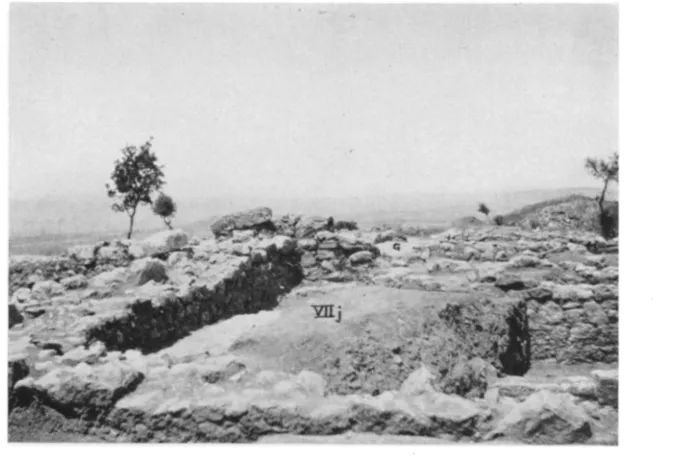
Within the main walls of the eastern section of the north wing are minor walls
(Fig. 10). Two of these,-a transverse wall ca. 0.50 m. wide in the northern half of
the southwest room (VII j), and a short spur 0.65 m. wide projecting into the large
east room (VII 1) from its south wall, 1.35 m. from the west side,-are preserved to
the height of the main walls and may belong with them, though since nothing is pre-
served above the floor level this cannot be certain. Another wall
ca.0.50 m.
wide,_
I
|
Fig. 1 1. Double Party Wall Between East and West Sections of North Wing of Stoa, Looking North, Showing Remains of Paved Street along Base of Wall, with Doorsill at Still Lower Level, at Lower Right Corner of Picture; beyond Doorsill is Interior Wall Preserved to the Heigh-t of Main Walls
paralleling the south wall of the large east room (VII
1), though s lightly lower, may
probably the same function, which contintled in use for a while after the west section
of the stoa
wasbuilt, and whlich because of its importance may have set the orientation
for the whole revision of the area.
The function of the large room and its dependencies, or of the separate building
which preceded it, can only be guessed. It seems rather too important for a commercial
structure and too closely linked to the rest of the stoa to be a religious one unless the
whole stoa was an adjunct to the neighboring sancttuary. A civic function of some
sort seems most probable. But its area is small for a bouleuterion, having hardly more
than a third of that of the Ekklesiasterion at Priene or a sixth of the bouleuterion at
Miletos. Possibly a clue is given by the finding of three square pieces of lead some
seventy-five centimeters below grade in the southwest region of the large room. One
of these was 0.07 m. on a side and 0.01 m. thick and bore in relief on one side a lvre
with the letter M beneath: a second of similar form, though less regular, was stamped
with the lyre and two indecipherable symbols in the upper corners; the third, of the
same shape, but considerably thicker and heavier, had neither lyre nor letters. A
number of similar w-eights were found elsewhere on the acropolis but always singly.
These wTeights
were below the floor level of the later building and probably above that
of the earlier one. If they indicate tlhat the official weights and measures of the city
wNTere kept in the earlier building, then it and its successor, the east section of the stoa, mnay have been a prytaneum, and the foundationls against the south wall may have been for enclosures in which the official standards were stored.
Beneath the portico of the east section p)arts of two more walls ca. 0.45 m. wide were uncovered, lying parallel to the east-west walls of the stoa and each having a stone doorsill, nearly but not quite in frolnt of one another. It is difficult to see how they could have served simultaneouslv in a building. and one may therefore suspect that they belong to successive structures or to revisions of a single structure.
Beneath thle two eastern rooms of the western section of the north wing of the stoa, foundations of other earlier structures were also found (Fig. 10, VII h, VII
i).
These are of rubble 0.40 m.-O.45 m. thick and belong to two adjacent rectangular rooms. T'lheir orientation agrees with that of the walls of a house lying just north of the stoa (XI), though not exactly with that of the structures which lay east of the street across which the stoa was built. Evidently the street broadened somewhat as it approached the plateia. In the southern piece of wall in VII h was a large poros threslhold block with hinge socket holes 1.11 m. apart on centers. fhe door opening however had been walled up, indicating a change in plan even before the house was demolished for the building of the stoa.COLOPHON
107'
forbids certainty. The north wall of the stoa, however, and the central one running
from east to west are but 0.75 m. wide, while the north-south divisions between rooms
are from 0.65 m. to 0.75 m. wide. The rear wall and doubtless the end walls were
faced with limestone blocks in courses of approximately uniform height (Fig. 27),
though the length of the blocks varied greatly; the horizontal and vertical joints were
cut with care and closely assembled. while between joints the face was dressed in a
rough convex bulge. In the eastern section the inner face of the outside wall and all
Fig. 12. Walls of Eastern Room in Western Section of North Wing of Stoa, Looking East Across Room
the interior walls were built of uncoursed rubble; in the western section the lower
part of the walls is of similar construction while the upper part, at or slightly below
floor level, is made of blocks which have been roughly dressed to rectangular form
with approximately flat faces (Fig. 1?)
'~Thesehowever are laid with such complete
disregard for their jointing and in suich irregutlar courses that it can hardly be doubted
that they are re-used materials, perhaps originally f rom the walls of some building
which the stoa replaced. If so, they show the style of dressing given to careful masonry
at a period prior to that of the stoa. However, since six of the datable coins
14found
within the -stoa area are from the first half of the fourth century, the earlier and later'
constructions cannot be far separated in time.
WEST WING
(VII a-d)
The wing of the great stoa wThich bounds the plateia on the west (P1. IX) was likewise built in sections. This is clearly indicated by the fact that the convexly cut, stone work of the rear wall, used only as a visible finish, was returned across the south face of the division wall between the third and fourth chambers, counting from the south (P1. X, VII c and VII d). and was carried around to form a finished exterior to the southeast corner of the fourth chamber (VII d). Obviously this chamber termi- nated the stoa wThen this wall was built. But as there is no similar sign of interrupted construction in the foundations of the wall wThich bore the colonnade, nor any cross wall linking colonnade to chambers at this point, it would seem that the row of chambers to the north wvas completed first, the colonnade being added when the three chambers to the souith were built. Only one of the chambers of this earlier section,- VII d,-was fully excavated. Its internal measurenments were 4.50 m. by 5.50 ni., the division walls both at front and sides were 0.65 m. thick. Presumablv four more chambers lay betTeen this one and the northern wing of the stoa; if so the space
wN"ould allow an average width of 6.06 m. from north to south, with division walls of 0.65 m. The dimensions would be approximnately those of the rooms in the north wing of the stoa, though turned with the long side toward the colonnade (P1. IX).
The row of five rooms in this western wing, antedating the colonnade, may have been built at the same time as the west section of the north wing. The foundation wall for the colonnade of the north wAing is carried at its full width of 1.00 m. at least as far as the central wall of the west wing, but whether it continued thus to the rear wall is not recorded by notebooks or photographs. At the south the north section of the west wing of the stoa was stopped by an older street (F) which entered the plat'eia diagonally from the northwest (P1. X), the principal if not indeed the only approach from the valley on the west side of the acropolis. The eventual addition of three rooms to the south involved much rebuilding'of the adjacent residential sections on the west terrace; there may have been considerable delay before this final section of the stoa could be undertaken, permitting the colonnade to be built simultaneously all along the west wing to finish wTith a solid wall across the southern end.
COLOPHON 109 high. Another scrap of wall plaster (P1. X, ,3) still in place in the angle between the south wall and the face of the central wall of the stoa, fixes the floor there as level with the stylobate or a few centimeters higher. The central wall is preserved at its extreme south end for 0.30 m. higher still, but shows no indication of the floor level of the room to the west (VII a), nor of any doorsill. However, the door nmay have been in the center or toward the northern side of the room, where the wall is not preserved above the level of the outer floor; a sill 0.30 m. high would bring the floor level of the room approximately to the highest bit of masonry preserved. Plaster
fallen from the south wall in the portico shows three distinct lavers. First is a pinkish ground coat about 0.025-0.03 m. thick made of coarse sand, lime and broken pottery; this coat was scored lightly with shallowVr depressions on the surface, and a second coat of sand and lime abotut half a centimeter thick was applied. The body of the second coat is white, but there are traces of red on the surface. On top of this is a third coat of white plaster made of coarse sand and lime about 0.02 m. thick. Probably this coat belongs to a second plastering. Fallen plaster found within the south room of the stoa wras very coarse, about 0.025 m. thick, and showed no traces of color.
The columns and entablature were presumably of poros but no fragments have been found; the spacing of the columns is purely hypothetical. Superstructure as well as stylobate blocks may have been carried from the deserted acropolis for use in con- structions in the valley in Roman or later times. The division walls and the end wall are about 0.65 m. thick, the top of the rear wall, which in its northern portion rose some six meters high to floor level, 1.00 m. thick. Exterior faces are built of coursed limestone blocks with rounded faces (Fig. 13), the rest of the walls are all of rubble. The horizontal joints are more rigidly contintuous, the vertical ones more strictly vertical than in the masonry of the fortifications (Fig. 2). At the same time, the work seems more careful, the joints closer than in that of the peribolos in the valley (Fig. 4). No re-used material was to be seen in thlis section of the stoa, except in the euthynteria, as noted above. The roof was covered with large flat terracotta imbrices and angular cover tiles. It is possible that at the northwest corner, instead of earth fill, a lower story or a stairway leading to the plateia level occupied the space below the floor.
by each of the central rows, with smaller jars against the north and south walls, and
three of 1.00 m. diameter against the east wall. These might serve to hold oil or wine
as a city reserve in case of need. Or, following the shrewd exposition of Hess
15con-
as a cFii13tout Fned. OfretWn,otaLoin otes
7_-7
cerning the method of storing civic wealth in antiquity, the foundations may have
held racks for jars or bags of coins, with space against the eastern wall for chests.
The main entrance f rom the portico wouild seem to be to the south of the wide founda-
tion against the f ront wall, with a minor door leading into the adjacent room at the
east end of the north wall. The capacity seems hardly sufficient for a city treasury,
but
itmight have served as the treasury of the sanctuary of the Great Mother, on
x~vhich
in fact the whole stoa and plateia may have been
dependent.1615"i Opisthodom als Tresor," Klio, 1935, pp. 81-84.
COLOPHON
111
Before the west wing of the stoa, on the axis of the fifth room from the south,
the foundations of a statue base were found (Pl. X) but nothing of the base itself
nor of the statue, nor any indication as to the subject. Nearly in line with the southern
end of the stoa and nearly on the axis of the level ground of the plateia terrace is a
large outcropping of native limestone that has been worked to receive some sort of
artificial superstructure (P1. IX and Fig. 14). An area ca. 2.00 m. from north to
Fig. 14. Roc-cut Base at South End of Plateia, Seen from the West
south and ca. .2.50-3.00 m. from east to west has been dressed as a bedding for cut
stone, level except at one point where a cuibe of rock has been left to form part of the
masonry core. At the eastern edge the rock is broken away, and, if this is an ancient
condition, artificial foundations may have served to extend the platform to the east.
At the west the rock is dressed to a lower step, as for a euthynteria 0.30-0.40 m. high.
The native rock immediately souith of the p)latform forms a saddle about 1.00 m. wide
f rom north to south, which slopes to east and west. Possibly this is artificially worked,
but as it is wholly below the level of the top of the supposed euthynteria, it was pre-
sumably below the ancient grade. South of the saddle. the rock rises irregularlyV
to a
maximum height of something less than a meter above the euthynteria top. This
projection has been dressed to a vertical north face parallel with the east-west axis
of the rock platform; elsewhere it is left in its natural condition. On both sides
beneath the mass of rock are natural waterworn hollows which may have served some cult purpose in antiquity, but which more probably were quite accidental and com- pletely buried beneath the earth, since virgin soil was found quite close by at the level of the " euthynteria" cutting. Previous searchers had dug beneath the rock. and the roofs of the cave-like recesses had fallen; loose shale mixed with a few large stones and a very few sherds of coarse red pottery were all that was found within. Since the level of the top of the hypothetical etuthvnteria is over two meters above the grade of the road entering arotund the southeast corner of the stoa, steps to the north of the rock platform, or a retaining wall to form a terrace at the south end of the plateia, would have been required. As the earth in this region was not excavated there is no telling whether remains of such a vall exist.
The rock-cut platform mav have served for a statue base or an altar or as a bema for public assemblies; no fragment of its superstructure nor indication of its purpose was discovered. Not far to the southwest stands a spike of native rock (P1. IX.). which, unless it was incorporated in some cvclopean constrtuction, must have projected like an unworked cone above the terrace level, and directly south of the platform are several large boulders, seemingly in a row. which may possibly have formed part of ancient developments in this region, or may be purely accidental rock fall. Still farther to the south and nearly on the axis of the plateia a trench laid bare (P1. IX. g), just beneath the surface of the earth, a roadway paved in broad low steps, running directly up the spine of the acropolis hill (Fig. 27, g, upper center). As the lower part of the road was gone, its connection with the plateia was missing, but doubtless it served as one of the main streets of the acropolis.
COLOPHON 113 rear corner was destroyed by the foundations for the stoa; at the northwest corner are a few scattered stones which may indicate a rearward continuation of the side wall or a continuation of the rear wall toward the northeast, or may be merely fortuitous tumble. Further remains might be found just west of the stoa stylobate foundations, but this area was not investigated. Along the north side of the northeast side wall remains of a terracotta drain were found running toward the northwest. Three sections of pipe, one of which had a clean-out hole in the top, wTere joined by a broken section of smaller diameter to a section of half pipe, laid as a collecting trough at the plateia end. Such drains ustuallv occur beneath streets, but a street here seems unlikely, and no traces of paving were found.
Farther south a large drain 0.35-0.45 m. wide was built through the south ex- tension of the stoa beneath the floor level (P1. X, between VII c and VII d). It was floored and covered with stone slabs, wlile the walls were of large uncut stones; the intake beneath the euthynteria of the stoa was 1nasked by a vertical slab and at the rear an outlet provide(d with a projecting lip emnptied onto a street (F). This drain to carry off rain wvater from the plateia doubtless replaced several older drains. in- cluding a well-built one of terracotta pipe beneath the surface of the street into which the new drain emptied. This older street drain was found again beneath the southern extension of the stoa in a pit in the third room from the south (VII c) and beneath the stoa portico. At its beginning it was formned of pipe of snmaller diameter, the first section of which had been displaced wrhen the stylobate was laid. At its northwest end it probably joined a similar drain, a short section of which was uncovered at the top of the northernnmost corner of the great retaining wrall, beneath a street (E) which ran along the northern edge of the western terraces. The combined drain from streets E and F probably then poured forth by a spout in the retaining wall, onto a cobbled talus at its foot, or descended beneath a road which mounted to the terrace level more or less parallel with the rear wall of the stoa. Time did not permit veri- fication of this hypothetical approach, but it seems the most reasonable way up to the acropolis from the western part of the valley, and was in fact the path usually taken by the excavators.
Behind the stoa, on the southwest side of street F, which had connected the ramp head with the plateia, were walls of houses, and on the opposite side a fragment of wall was found just at the corner wvhere the nortlhern section of the stoa stopped. Whatever structures originally stood on this side were probably entirely abandoned after the stoa was built, as the space then remaining was insufficient for a building. There wouild result a small open area, perhaps within a gatewayT at the entrance to the terrace.
might emerge as the wall at the sotuthwest corner of the first section of the west stoa. But fragmentary remains of successive rebuildings prevent the plan of the structure that stood here (P1. X, IX. and Fig. 13) from being fully intelligible. The wall itself (ca. 0.50 m. wvide and only one course high) seems to end with a definite cornerstone ca. 1.75 m. east of the stoa foundations. A group of adjacent stones may indicate a wall returning toward the north at a sharp angle, but this is far from certain. just west of the column foundations, however, there is a definite wall (ca. 0.40 m. wide) at right angles to the first, which seems clearly to belong with it; its northern part lies beneath the stoa foundations. About 2'4 m. still farther to the northwest a wall. also at right angles to the first, may be the fotindation for a threshold since in it are four stones side by side laid across the 0.30 mn. wall, while jutst beyond, to the northwest, is an area of stones wvhich stugg ests a paved strip before a building rather than a wall or chance tumble. The end of the street wall, which mav have extended as an anta beside this paved strip, has gone. The resultant arrangement appears to be an H- shaped btuilding with a room four meters or so deep on one side opening on the plateia and on the other a room of little more than half that depth opening on the uphill road from the northwest. The ftunction as well as the width of the first room is quite unknown, but in the second room against the central cross wall, on a raised step or bench of earth edged. with stones, were found remains of a pithos ca. 0.40 m. in diameter and the mark of the base of another sonmewhat larger one beside it. The width of the room as preserved wotild permnit four such pithoi upon the bench; possibly there was space originally for twice that number. It is tempting to see in this room a precursor of the second room from the south end of the great stoa (VII b) wvhich has been suggested as a municipal storehouse or a treasury. Phe older room would con- stitute by itself a very limited treasurv- but combined with the opposite half, facing the plateia, it might have offered nearly if not quite as much space as the later roon in the great stoa. Or it may have seen less diglnified services as a tavern, placed Janus- wise at a main entrance to the plateia, with welcoming refreshment on one side for those who had just climbed the hill. and on the other a place to rest and seal in good fellowship the day's transactions, before setting out for home.
COLOPHON 115 replaced them, would reach nearly to the hypothetical corner of the building (see above, p. 106) which, before the great stoa was commenced, lay to the west of the street (G) entering the north end of the plateia (Fig. 10; VII h, i). If wall y post- dates the terracotta drain tinder street F, it may be that at sometinme the line of the drain was shifted to the north approximating the line of the stone drain through the stoa, with consequent destruction of the structture between its first and second course; or the street may have forked, leaving a small, more or less triangular island between the old and the new roadway. Wall 8 is ca. 0.45 m. wide and is built directly upon wall y. It may be merely a scrap of retaining wall to hold a mass of rubble that was filled in about the stone drain, and as such is to be considered part of the foundation con- struction of the great stoa. Wall E (ca. 0.40 m. wide) is only a fragment lying in
tront of the stvlobate fotundation. It is possible that some of the stones west of the stylobate, among the conftused remains of the pithos room, may belong to a continnua- tion of this wall, and other stones in the saime region suggest a bit of wall rtunning at right angles to it, 4. If the latter be a real wall, it can hardly be contemporary
vith the wall of the pithos room, thotugh whether earlier or later is uncertain, as all walls are below floor level here. Together with wall E, 4 should belong to a building
south of the road as re-routed along wvall y. Possibly some of the previously men- tioned grotup of stones east of the soutthern corner of room IX may be 1part of another wall belonging to this system. The building of which these walls would form part would have to extend across the terracotta drain, closing this end of the southern course of the street in favor of the nmore northern route. There is also a suggestion of another line of wall crossing wall 8, in the pithos room, at a slight angle to it, and not quite parallel or at right angles to the walls of the pithos room. Perhaps there is evidence here of three successive constrtuctions, all prior to the great stoa but all fairly close in date and all belonging to rather small isolated structures of public nature, rather than to houses.
Remains of other structures probably belonging to the same pre-stoa complex were found beneath the floor level of the first stoa room to the north of the drain (VII d), but, without excavation to the sane depth beneath the adjacent portico and perhaps in other stoa rooms to the north, the natture of these earlier structures is far from clear. In the northeast part of the room a section of well-finished composition floor was laid bare.7 At the north this ends in a straight line approximatelv parallel to the side wvalls of the near-by pre-stoa room by the statue base. Along this line there had evidently been a threshold, removed when the stoa foundations were laid. The eastern edge of the floor is ctut bv the central wA7all of the stoa and the southern edge
17 No analysis of the substance of the composition floors at Colophon was made, but in
is gone. A wall (ca. 0.45 m. wide) at right angles to this line flanked the floor on
the west. It is preserved above the level of the floor only at the north and west corners
of the remaining plastered section but continues on a lower level to the southwest for
ca. 2.25 m. where it is crossed at right angles by a well-cut poros gutter (Fig. 15).
The gutter stone is cut as if to fit around a dressed anta terminating the wall it crosses,
suggesting that the composition pavement belonged to an open portico. A still earlier
floor is perhaps indicated by traces of a packed layer of whitish earth ca. 0.20 m.
Fig
15.West
Wingof Stoa, Looking South Along
Rear Wall. Room with Poros Gutter at Left, Terracotta Drain at Right Centerbeneath the composition level. Nearlyv on the line of the gutter, though completely
below it, runs a fragment of narrow wall that is approximately parallel to the terra-
cotta drain in street F and the scrap of street wall outside the southwest corner of the
stoa room VII d. This lower wall certainly antedates the composition floor, though
it may be contemporary with the pithos room and the first layout of the street of the
drain. On the other hand a group of four stones, set like the base of a- square pillar,
but separated from the floor by two centimeters of earth (P1. X), is probably without
significance, as may also be a group of stones north of the stone gutter and at about
the same level, which suggest a wall parallel to it, a-s well as a random aggregation,
like a pavement at the same level, south of the gutter. All these are probably tumbles
COLOPIHON 117
may be scarcely less in size, but the walls are thinner and above all the grouping seems an unsystematized following of the natural line of the west edge of the terrace. The great stoa substituted for this the grandiose uniformity of a formal plan, dictated doubt- less by an access of civic pride and wealth, rather than by necessity or any cultural change. The potsherds and few coins 18 found within the stoa all date before 285 B.C.
Another pre-stoa structtire lies beneath the southern end of the west wing. Here, laid in stereo about 1.10 m. below the floor level of the p)ortico, is a considerable expanse of well-made composition floor (Fig. 13, P1. X; VIII b). The west side of the rectangular roorn to which it belonged is cut by the central wall of the stoa, but the bottoms of walls on the other three sides are preserved. The lines agree more nearly with that of the near-by terracotta street drain tlhal with those of the structures further north. The wall along the southeast side is continued beyond the southwest wall to form an anta flanking a floored prostas before the floored room. Continuation of the floors of prostas (VIII a) ancd room are found beneath the south room of the great stoa, though the wall between them has disappeared. In the westernmost part of the line where the prostas floor would have met this division wall, the edge of the plaster, for a distance of about a meter, is particularly sharp and smooth, indicating contact with a cut-stone threshold. Large thresholds found elsewhere on the site measure about 1.50 m. in length. If the center of the threshold were ca. 0.25 m. from the end of the preserved floor plaster and if this point were on the axis of room and prostas, the width of these two would be ca. 7.70 m. (actually the flooring preserved assures a minimum width of ca. 5.00 m.) with a depth of 3.30 m. for the prostas and 4.70 m. for the room. The depth of the room is almost exactly that of the rooms of the later stoa, but the suggested width would exceed that of the stoa rooms by a couple of meters. The threshold may, of course, have been placed toward an end rather than in the center of the front wall, but, on the other hand, a short stretch of wall, thoroughly buried beneath the rear wall of the stoa and the subsequent structures built against it (P1. X; VI h), lies nearly parallel to the south anta of the pre-stoa prostas at a distance of approximately 7.70 m. from it. rThe prostas floor is bordered at its front, southwest, edge by a sill or curb of long stones, dressed on top and front. If there ever were columns on this line, no foundations for them have been preserved. In front of the sill, and almost at the same level, is a pavement of irregular flat stones, belonging doubtless to a street or open area. Possibly a continuation of this pavement is to be seen in a patch of irregular stones in the corner of a later room (VI g), just to the west of the stoa. Directly south of the prostas the ground rises so rapidly that a level passage past the southern corner could hardly have exceeded three meters in width, while a line of wall cut by a drain and buried beneath a new roadway. both probably contemporary with the stoa, faces the prostas on a line nearly parallel with it at a distance of ca. 3.50 m.-ca. 4.15 m. A partition in the adjacent house (between
VI
f
and VI g) continues the line of this wall to the northwest for a total length of ca. 8.50 mn., and after an interrtuption by three later rooms it seems to appear again beneath the floor of a fourth roomn (V d) wvith a turn in a right angle to the westward, at a distance of some 91.00 m. fromn its southeasternl end. Excavation beneath the floors of the intervening rooms wvould be needed to verify the continuity of the wall. By the northern angle there is a fragmnent of cobble pavement which would indicate that the street flanked by the wall turned at the same 1)oint and by a short southwest course and then a northward turn reached the street running along the north edge of the west terrace. An area of cobblestones north of the poros paving of the later street D seems to mnark the southwest stretch (P1. X, Fig. 16), and a northward- running stone drain built beneath the cobbles just inside the entrance to a later house 19may mark the final reach.
The erection of the great stoa naturally entailed a general reorganization of the area lying about its southern end. At this time the new street D (Pl. X, Fig. 16) rrmentioned above (1.615 m.-1.75 m. wide) was laid out slightly to the west of the hy- pothetical one just stiggested, not only connecting- directly with the nmain plateia across a little plateia at the south end of the stoa, but continuing in a straight line by a steep incline to the level of the terrace at the south end of the great plateia and p)erhaps beyond (Pl. IX). The section of this street from its junction with the earlier cobble pavenment at the north to the entrance to the little plateia is paved with poros blocks (P1. X, Figs. 16, 17) which are as a rule 0.40 to 0.45 m. wide by 0.65 to 0.75 m. long by about 0.16 mn. thick, but range fronm a minimum area of 0.20 X 0.30 m. to a maxi- mum of 0.50 X 1.05 mn. At the lower end of the pavement the blocks are fairly regular in shape and laid with care, but thev become progressively less rectangular and more 1andom in their arrangenment as the street rises to the south, until at the upper end the pavement is made of small uneven blocks with wide irregular joints and interstitial plugs not more than ten or fifteen centimeters on a side. A slight step all across the street, by the north janmb of the doorway into the house to the east of the street (VI e, P1. X, and Fig. 16), suggests that the street paving was not a continuous operation. In any case, the whole pavenment is evidentlv made of re-used materials, laid from north to south with the best blocks used first and with barely enough broken material to finish out the stretch. Since no clamp or dowel cuttings are apparent, the blocks could hardly be wall plinths laid on their beds, nor, in view of the use of composition floors in the structures beneath the stoa, does it seem probable that they had been paving blocks; probablv they originally served as wall facings for some of the im- portant buildings demolished when the stoa was built. At both sides of the street the blocks are laid against the bottom of the adjacent house walls. The pavement there- fore seems to have marked the conmpletion of the building operation which, with the extension of the western wing of the great stoa, necessitated the rerouting of the street and nmuch alteration if not conmplete revision of the houses on either hand.
19 House IV,
COLOPHON
119
At the south, where the street passes the little plateia. the bed rock rises so steeply
that instead of regular paving an irregular ramp was built, broken by steps made of
rubble masonry and occasional large uncut blocks (Fig. 16). After continuing in this
form between walls for a little over ten meters the street reaches a light terrace wall
which runs straight across it, and continues beyond to east and west on either side
(P1. IX). Above this wall lay a relatively level stretch over which the straight course
of the street still held, as is indicated by a short section of built-up drain and a patch
Fig. 16. Paved Street D f rom North End, Looking South
of cobblestones near by. The
souithwestboundary on this terrace is a retaining wall
of good-size blocks approximately parallel with, but a couple of meters to the west
of, the line of the side wall lower down. This retaining wall turns to the west almost
at right angles, about two and a half meters south of the light terrace wall just men-
tioned; between the two a cross street running westward along the side of the hill
is to be assumed. Since the eastern boundary of the terrace was not investigated it is
uncertain whether the first street broadened out here or simply shifted its course
slightly. If it continued for some twenty meters of slight up-grade in a straight line,
it would eventually reach the steeper stepped street (g) which ran directly up the spine
of the hill, approximately on the axis of the great plateia.
Along the south side of the little plateia stood a small building opening to the east,
apparently consisting of two rooms, one behind the other, more likely a shop than a
residence; the makeshift assemblage of re-used material that served as a doorsill
the little plateia were considerable areas of plaster (0) about one centimeter thick,
applied directly to the stone. The body was white with a red face. This plaster proba-
bly antedated the building of the great stoa and was preserved by being covered by
the earth fill which buried the remains of the wall running across the little plateia
(P1. X, Fig. 13). In front of the building is a small terrace or platform built with
roughly curved outline abutting against a natural outcropping of rock. Between this
Fig.
17.Looking
North Down Paved Street D
COLOPHON
121
between raised rims; each has a four centimeter flange at one end to fit into the next
section.
A doorway to what may well be another shop opens onto the street south of the
paved section, where it rises steeply at the southwest end of the little plateia (Plate IX).
This region lay outside the area surveyed; the walls throughout were fragmentary,
and often not preserved as high as the original floor level. But from notebook sketches
it appears that here also there were two rooms. one behind the other. Twenty centi-
meters beneath the floor level of the front room, as indicated by the doorsill (P1. X, l),
I~~~
IFig. 18. Street B on West Terrace (East of Baths), Looking South Toward Steps to UJpper Level
was found a second floor. Three stones set like a wall upon the upper floor may in-
dicate a still later construction, or. if not a fortuitous arrangement. may be some part
of the equipment of the room. Along the southern side of the room runs a built stone
drain 0.15-0.20 m. wide. It is possible that at some time this drain was an open trough
and that the whole room served as a latrine. The drain emerges through the front
wall just beside and below the threshold block (at
K).Thence it runs straight across
the line of the paved street and, curving to the north,20
was found paralleling the latter
beneath the corner room of the house northeast of it (P1. X, VI f). But oddly enough
the drain seems to come to a dead end here against a wall at right angles to it, which
lay just to the north of a wall of the house in question. It would appear that the stone
drain had been abandoned before the building of the stoa, perhaps at the time the
composition-floored structure beneath the stoa's southern end was built, and when the
20 Three of the cover blocks of the curved section are shown on PI. X (A) just south of the
terracotta drain across the little Il)ateia cut through it, the stone drain mnay have been already out of use for a score of years or more. To the west of the paved street, beneath the area of cobblestones that lies north of the poros pavement, another built- up drain, ca. 0.60 m. wide, was found (P1. X, 4,), with the top of its cover stones about 0.40 mn. belowT the surface of the cobble paving.21 It seeis to have come from the west and turned at this point sharply to the north; apparently it continued in use., at least fronm this point, in the period of the stoa and paved street, for west of it in the entrance court of the house (P1. XIS), contemporary with the stoa, is a line of six sections of terracotta drain emptying into the built drain in question. The terracotta drain is doubtless a private construction to carry water from the lowv part of the court; it is made of odd sections of
0.20
m. pipe, twvo of which have tuncovered cleanout holes, quite unnecessary in this situation. 'Perhaps in the revision antedating the stoa the stone drain (K,) to the west of the street served to replace the other stone drain which crossed the upper southern part of the street fromn the west (K, X) and ran to the eastof it, and wzas in turn replaced by the terracotta street drain in its function of carrying water fronm the upper terrace.
Another street (C), some thirty to thirty-five meters west of the paved street (D), ran froin north to south across the west terrace (P1. IX). Only the edge of this street was excavated and as a result its width is not known. Nineteen to twenty- one nmeters still farther west ran a third street (B). This one wvas 2.53 m. wide, paved with cobblestones up to the south edge of the terrace, where broad steps ca. 1.75 m. wide climbed the steeper slopes (Fig. 18). A fourth street (A) was found a little over twenty-one meters west of the third one. Street A was uncovered for its full width only at the north end, where it proved to be 2.00 m. wide. with an open gutter, 0.27 mn. to 0.30 m. wide and ca. 0.60 m. deep, along its eastern side. At their northern ends all these streets mtust have met a street (E) running east and'west along the top of the high terrace or fortification wall and thtis perhaps have been connected with an ascent behind the great stoa. Uinforttunately the top of the wall, the street along it and even the north walls of the hotuses, to a point below street level, had all slid down the hill. Between the paved street (D) and the next street to the west (C), three houses were uncovered (P1. XI); the block between the street C and street B was not excavated; that between the street B and street A was found to contain a public bathing establishment. Farther west no digging was done except for a trial trench, 10 m. wide, at the extremne end of the terrace, and a similar one near by but somewhat higher on the hill.?" In the first of these far western trenches the base of a long wall with others at right anoles to it on either side appeared, and in the other a long wall with walls at right angles on the wvest onlv and possibly a street to the east. These walls were all of moderate thickness---0.45 m.-O.65 m.-and probably belonged to hiouses, but time did not pernmit uncovering sufficient area to reveal the plans.
21 See
above, p. 1 18.