63
Abstract
A vision of a modern world can be hardly conveyed without Information and Communication Technology (ICT) recently having a powerful impact on all areas of life. The application of the latest ICT in the educa-tional process raises new possibilities for both a teacher and a learner, enhances the quality of provided education and makes the educational process more adjustable.
Effective source of the information nowadays is the Internet. It has to be stated that the Internet possibilities in the teaching process are insufficiently used. On the other hand, in principal there are no reliable studies, which would reveal the actual situation in this field. Therefore, the object of our study is the usage of the Internet for teaching physics. The main aim of the study is to analyse the situation of the usage of the Internet for teaching physics and highlight the hindering/encouraging factors of its usage in the teaching process. The study employed expert inquiry. The type of expert inquiry – “Delphi study”, containing several experts’ inquiries (stages). Research has shown, that the Internet in teaching physics is not used in due volume. The majority of problems are connected with material (including information) resources (lack of websites, com-puters, etc.) and the competence (methodical, information, etc.) teachers of physics.
Key words:teaching physics, science education, modern ICT.
Introduction
Information and Communication Technologies (ICT) are appraised as a catalyser, speed-ing up the development of contemporary education reforms and didactics (Monkevièius, 2002). In the developing knowledge-based society information technologies play a particularly sig-nificant role. However, even the most advanced technologies will not give a necessary effect, if their usage (application) in the educational system is not adequate to the current development of technologies and increased educational needs. It is very important that modern information technologies are abundantly, actively and meaningfully applied during the lessons of various subjects and that IT methods are applied to model both nature and society’s phenomena (Vingeliene, 2006). In the general education school the initial information literacy abilities are formed. In current conditions general education schools can already employ various informa-tion technologies. Probably most often it is related to appropriate computer technologies and the Internet. In 2001, the teachers’ computer literacy standard was approved in Lithuania, which obligates teachers to improve their abilities in this field. According to I.Maþulienë (2002), IT usage forces teachers to change the settled work style, raise qualification, improve abilities and otherwise plan one’s own and pupils’ activities. On the other hand, the aims of creating knowledge-based society change the external and the internal environment of schools; there-fore, information processes and technologies acquire increasingly greater significance at mod-ern educational organisations (Virbickienë, Ðaparnis, Ðaparnienë, 2005).
In recent years more and more studies are aimed at the analysis of ICT problems. Both,
THE USAGE OF THE INTERNET IN
TEACHING PHYSICS IN LITHUANIA:
THE ANALYSIS OF A SITUATION
AND PERSPECTIVES
64 general (Jonassen, 1996; Crook, 1996; Markauskaitë, 2000; Zylbergold, 2003; Ross, 2004;
Woessmann, 2005), and concrete didactic issues are being analysed, e.g. how to use ICT for teaching separate subjects (Slabin, 2002; Augustonytë, 2005; Peèiuliauskienë, Rimeika, 2005; Praulite, Trokða, Gedrovics, 2005). U.Slabin’s studies (2002), creating websites for natural sciences profile university students, are of interest. In the author’s opinion, our epoch is marked with global environmental crisis and the advent of information age. Extensive implementation of a range of information technologies into high and higher school curricula and the emphasis on environmental issues in education are two leading trends in contemporary education. On the other hand, interesting studies have been conducted by the specialists of German Institute of Computer Science (München University) (Woessmann, 2005). The study demonstrated that computers might harm the learning process. It is stated that the number of computers at school and time spent at the computer at home does not confirm the fact that children learn much more if they use IT. The importance of IT for the teaching (learning) process is not denied, but it is stated that these pupils who use IT at school and at home moderately and the frequency of the usage is limited, attain better results than the ones, who spend a particularly considerable time at the computer. Our expert study in principal confirms such statements. We maintain that it would be optimal if the computer (especially using the Internet) is a natural teaching / learning aids like books and other sources of information. On the other hand, it is necessary to create conditions for teachers to raise qualification. This is emphasized by numerous research-ers.
It has to be stated that the Internet possibilities in the teaching process are insufficiently used. On the other hand, in principal there are no reliable studies, which would reveal the actual situation in this field. Therefore, the object of our study is the usage of the Internet for teaching physics. The main aim of the study is to analyse the situation of the usage of the Internet for teaching physics and highlight the hindering/encouraging factors of its usage in the teaching process. The most important study tasks have been formulated:
• To analyse the situation of the usage of the Internet for teaching physics;
• To identify the hindering/stimulating factors of Internet usage for teaching physics;
• To highlight the experts’ opinion about the expected development perspectives of Internet usage for teaching physics in the nearest five years period.
Methodology of Research
The study employed expert inquiry. The type of expert inquiry – “Delphi study”, contain-ing several experts’ inquiries (stages). The data of every round are generalised and repeatedly submitted to the experts. Such procedure is repeated several times, most often 3-4 times. The study was carried out in September – December 2005. Out of the preliminary formed 35 ex-perts’ group the study was attended by 29 participants. The selected experts entirely represent the population of physics teachers. Such group corresponds to the requirements of Delphi methods. The experts were selected to the group by random – purposive way. The most impor-tant criteria were experts’ competence and possessed qualification category (methodologist teacher and expert teacher). The group consisted of 13 expert teachers, 11 methodologist teachers, 5 experts with scientific degrees. The latter work in higher education institutions, closely cooperate with physics teachers, and are the authors of physics textbooks for general education schools.
In the first stage the questionnaire, consisting of 5 open questions, was prepared:
• How do you assess the current situation of the usage of the Internet for teaching physics?
• How will the usage of the Internet for teaching physics be changing during the nearest five years?
• What main factors hinder to use the Internet for teaching physics?
• What main factors encourage using the Internet for teaching physics?
65
Volume 1, 2007
The first stage of the study was preceded by the following short instruction to the experts:
Seeking to reflect the assessment and the predictions of the professional group, in the first stage of the study the inquiry of the experts group based on the Delphi method is organised. The key target of this inquiry is to assess the situation of Internet usage for teaching physics and to identify possible predictions of the changes of this situation. The success of Delphi-based study is significantly determined by the independent opinion of every expert; therefore, the composition of the experts’ group is not announced. The group of experts, composed for this study, represents the population of the teachers of physics and the key selection criterion is competence. It is expected that it will be enough to conduct two-three stages of the inquiry (in the second stage every expert will receive the generalised results of the first inquiry). The opin-ion of separate experts will not be available for public or discussed publicly. The comments or the context of your opinion are of utmost importance for the study. We believe that you will participate in all stages of the inquiry.
The comments of the answers and your comments are very important because they will assist us to describe the situation more exhaustively..
The first data analysis round was followed by the preparation of the second stage ques-tionnaire, which consisted of closed type questions. Second stage data have been processed employing mathematical statistics. The third stage questionnaire has been prepared according to the second stage generalised results. Communication with experts has taken place through e-mail. All three stages have been attended by all 29 experts.
Results of Research
The results of the first stage of the study
In the first stage of the study the experts replied to 5 essential questions. In the opinion of the majority of experts (62%) the usage of the Internet during the nearest five years will in-crease only insignificantly. 31% of experts maintain that the usage of the Internet will inin-crease significantly and 7% think that it will not change at all. Having generalised the experts’ opin-ions, 21 statement was formulated to describe the analysis of the situation (Table 3). The spec-trum of the factors, encouraging / hindering Internet usage is particularly diverse (Table 1). It may be stated that general education school teachers encounter the same most diverse diffi-culties when they use the Internet directly in the educational process.
Table 1. Factors, encouraging / hindering Internet usage for teaching physics.
• The wish to interest pupils and look for more diverse
teaching forms;
• The possibility to get a large amount and diverse
infor-mation;
• Demonstration and laboratory teaching aids are
diver-sified;
• The possibility to work more creatively and effectively;
• Picturesqueness of the lesson and the results of the
virtual lesson are better;
• Usage of the Internet develops pupils’ creativity and
activeness;
• Application of the Internet in the lesson enables the
• Scarce technical possibilities of schools, poor school
funding in general;
• Insufficient competence of physics teachers, their
com-puter literacy;
• Older teachers prefer the classical way of conducting
the lesson (the attitude of the old generation teachers to ICT is negative);
• It is difficult to coordinate time for work in the school
computer classroom;
• Schools lack computers, this is particularly felt in
vil-lage schools;
• Poor knowledge of foreign languages;
Factors, encouraging teachers to use the Internet for teaching physics Factors, hindering teachers to use the Internet
66
This table demonstrates that the experts provide a particularly matter-of-fact assessment of the current situation, every expert emphasizes certain peculiarities. On the other hand, the experts’ opinions in many respects coincide, are similar. This enables to make an assumption that the experts’ opinions are not too scattered; hence, the received results are sufficiently valid.
We have generalised the recommendations, provided by experts, who have considered current situation and encouraging / hindering factors. The list of recommendations is given in Table 2.
• Psychological problems due to encountering novelties, fear to
apply modern ICT;
• Shortage of methodical literature on Internet usage;
• Shortage of teachers’ creativity;
• Absence of systemised Internet references;
• Too little information on Internet in the Lithuanian language;
• Not all pupils have computers and the Internet at home;
• Teachers are not able to use the possibilities, provided by the
Internet;
• Physics rooms are scarcely computerised, shortage of the
Internet access;
• The programmes are overloaded and teacher has little time for
preparation;
• Insufficient speed of the Internet (information transmitting speed);
• Low salaries of the teachers, on the other hand, application of
the Internet requires additional preparation, which is not paid too;
• Shortage of specialised websites applied for teaching physics,
Internet resources in the Lithuanian language are limited;
• Complicated work conditions at school information centres;
• Extensive course of physics and the teacher has insufficient time
to cover it;
• The programmes of physics are insufficiently applied for Internet
usage;
• Part of teachers resist the novelties, are inert and “tied” to
tradi-tional teaching methods;
• The form of the lesson of the educational process;
• High numbers of pupils in classes;
• Insufficient number of physics lessons, extensive content of
edu-cation;
• The attitude of school administration (often perceived as a
mat-ter of fashion);
• Universities continue to implement outdated methods;
• Shortage of teacher’s time resources;
• Insufficient pupils’ skills for information search, selection and
handling;
• Teachers’ unwillingness to learn.
teacher to individualise and differentiate the teaching process;
• The wish to improve one’s own work, to go
hand-in-hand with time;
• Fast development and usage of information
tech-nologies;
• Pupils’ wish to work on computer and use the
Internet;
• The possibility to present the phenomena to the
pupils that they find difficult to imagine;
• Personal standpoint to one’s own work;
• Very good knowledge of the methods of
teach-ing physics;
• Developed critical thinking;
• The wish and need to get what is not included in
the textbook and what is not known to others;
• Access to information, its content and quality;
• Irreplaceable source for various project works;
• Shortage of physics instruments, forcing to
search for the alternative - virtual experiment;
• Unlimited possibilities to familiarise with
teach-ing methods applied by the teachers in other countries;
• The opportunity to familiarise with the newest
literature and subscribe it;
• Teachers’ technological competence;
• Fast developments of the physics science
(text-books are not updated too fast);
• The priorities of the improvement and
moderni-sation of the education / self-education process at school;
• Teacher may improve its image, this is
particu-larly important for its image;
• The development of independent work;
• Positive managers’ attitude to such work
meth-ods;
• The Internet is a necessity at astronomy
67
Volume 1, 2007
Table 2.
The list of recommendations.
The recommendations seeking to improve and develop the usage of the Internet for teaching physics
• It is necessary to create Lithuanian Internet websites for teaching physics and provide all
other necessary information: addresses, teachers’ comments, discussions, etc.;
• Physics rooms have to be equipped with Multimedia;
• Computer usage for teaching physics should not be overestimated;
• To create websites for teaching physics on school Intranets;
• To establish a specialised centre, so that every teacher does not have “to invent a bicycle”;
• To study the benefit it produces;
• To prepare the methods for Internet usage for teaching physics;
• To change physics teaching programmes;
• To disseminate the experience of work with information technologies more broadly;
• To organise the physics teachers’ team by means of competition and to prepare a concrete
project “Physics on the Internet”;
• All physics teachers need to have free-of-charge Internet;
• Teachers must be encouraged to create teaching programmes and make them available on
the Internet;
• It should be necessary to include mastering of certain abilities in this field into the general
curricula of physics and education standards;
• “Good practice” seminars will not change the situation, this requires a new teaching system
(only the progressively thinking lecturers are able to prepare teachers with modern thinking for schools);
• Creation of the teachers innovators’ banks of methodical works;
• It would be necessary to organise on-line physics lessons;
• It is necessary to conduct comprehensive studies that would identify the effectiveness and
other aspects of various methods, using the Internet for teaching physics;
• To create distance learning programmes.
The table discloses that the recommendations are quite diverse. They reflect both, posi-tive and negaposi-tive aspects. It contains doubts as to the benefit of the Internet in the educational process. In the opinion of part of the experts the thorough studies regarding the effectiveness of the Internet for teaching physics are necessary.
The results of the second stage of the study
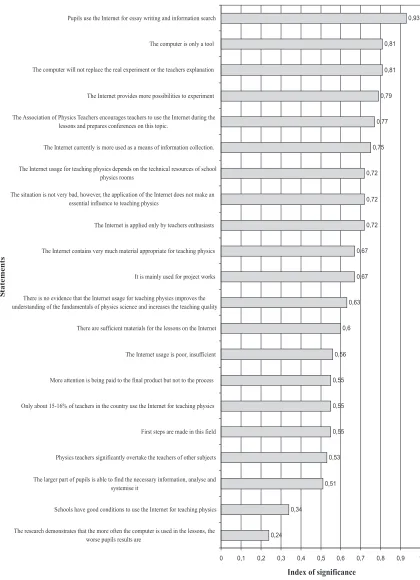
Having studied and generalised the first stage results, the new questionnaire for the sec-ond stage of the study was prepared. The experts assessed the current situation by a three score ordinal scale. The results are presented in Figure 1. All statements are placed on an index of the significance. The generalisation of the experts’ opinions resulted in the identifica-tion of the Internet usage situaidentifica-tion.
The majority of experts fully agree with 10 statements, partially agree with 12 statements and do not agree with one statement.
68
Figure 1. Current situation in the Lithuanian general education school /ac-cording to the generalised experts’ assessments/.
69
Volume 1, 2007 Table 3. The most important mostly influencing factors (hindering and
en-couraging).
The analysis of the limiting factors discloses that essentially they pertain to the conditions and possibilities of school provision, the organisation of the teaching process and the very teacher’s competence in the field of ICT application. Having carried out the analogous rank-ing of the encouragrank-ing factors it can be stated that they relate to the teachers’ wish (endeav-our) to interest pupils and to encourage their interest in physics. Another important point is to visualise these phenomena, which are not possible to perceive otherwise, pupils find them difficult to imagine. As it was expected the third group of factors could be related to the short-age of various instruments at schools. This forces teachers to search for more effective teach-ing methods.
We have analysed the experts’ recommendations and ranked them in the order of signifi-cance.
Table 4. Recommendations on Internet usage for the development of teach-ing physics and makteach-ing it more effective.
Recommendations/proposals
It is necessary to create Lithuanian Internet websites for teaching physics and provide all other neces-sary information: addresses, teachers’ comments, discussions, etc.;(1)
Physics rooms must be equipped with overhead projector (-s) (2)
To establish a specialised centre, so that every teacher does not have “to invent a bicycle”; (3) To prepare the methods for Internet usage for teaching physics;(4)
Computer usage for physics teaching should not be overestimated (5)
It was identified that the most important factors, hindering the Internet usage were as follows: poor computerisation of physics rooms and the shortage of the Internet access, poor school technical possibilities and poor funding, shortage of specialized Internet websites and of websites applied for teaching physics, poor knowledge of foreign languages, etc. The most important stimulating factors: the wish to interest pupils and search for more diverse teaching forms, the possibility to present the phenomena to the pupils that they find difficult to imag-ine, the diversification of the demonstration and laboratory teaching aids, etc.
Hindering factors Promoting factors
Physics rooms are poorly computerised, shortage of Internet access (1)
Poor technical resources of schools, poor school funding in general (2)
It is difficult to coordinate time for work in the computer classroom at school (3)
Shortage of specialised websites applied for teaching physics, the Internet resources in the Lithuanian language are limited (4)
Poor knowledge of foreign languages (5)
The wish to interest pupils, search for more diverse teaching forms (1)
The possibility to present the phenomena to the pupils that they find difficult to imagine (2)
The diversification of the demonstration and laboratory teaching aids (3)
The Internet is a necessity during astronomy lessons (4)
70 The results of the third stage of the study
In the third stage of the study the experts had to assess the generalised second stage results. In many cases the experts approved the generalised assessment of the current situa-tion; however, they noted that the situation in town schools and village schools differed. The experts clearly expressed their concern regarding the immoderate ICT usage in the teaching process and emphasized that the computer will never replace the teacher’s explanation and natural experiments with real physical bodies in the real environment. At the same time it is emphasized that in the conditions of catastrophically poor resources of the physics rooms virtual environment and virtual experiments partially solve the funding situation of teaching aids for natural sciences that is difficult to solve. The dominating opinion is that more atten-tion should be allocated to the creaatten-tion of computerized physics teaching programmes, whilst the Internet is not that convenient and is more significant for the communication between teachers and pupils, experience exchange, information, methodical material announcement, etc. The importance of Internet usage for teaching physics is understood in the broader educa-tion context too, bearing in mind not only learning physics but also the development of general abilities. It is noted that pupils are not able to search, select and systemise information on the Internet; besides, teachers find it a difficult task too. It was also noticed that teachers still focused on the result but not on the process and that the activity was organised according to the following algorithm: the teacher announces the topics, the pupils search for information and make “presentations”. The analysis of such “products” and of the authors’ reflection dis-closes the limitation of such learning.
The third stage of the study raises the issue of the importance and the shortage of educa-tional research in Internet usage for teaching physics: it is stated that teachers do not have research-based proofs that Internet usage for teaching physics is an efficient aids, i.e. that it improves the understanding of the foundations of physics science and increases the teaching quality; the Internet is used for teaching physics based on the belief that this is effective and useful. Another opinion related to the research proposes to repeat the inquiry after several years because the situation is permanently changing. In principal it could be possible to talk about long-term observation (monitoring).
Commenting the generalised assessments of the factors, limiting Internet usage for teaching / learning physics, the experts point out that most often computers appear in physics rooms from informatics rooms, when the latter are supplemented with new computers; that ICT us-age for teaching other subjects at schools is still not an important task; that in the opinion of school administration computerisation of physics rooms is a too big luxury; that teaching should take place in the state language, whilst on Internet useful information is most often given in other languages, therefore, it is emphasized that it is necessary to create a Lithuanian data basis for teaching physics on Internet; it is emphasized that the teachers and university lectur-ers’ methodical activities should be better coordinated.
Commenting the generalised assessments of the factors, encouraging Internet usage for teaching / learning physics, the experts point out that in recent years at schools, particularly in the basic school stage, the motivation of learning is decreasing and the teachers use the Internet mostly to interest pupils in physics, in the subject and to increase the prestige of physics science and partially one’s own prestige. The experts also emphasize the possibility to find filmed material on Internet and solve the issue of poor resources of physics rooms, demonstrating various physical phenomena, particularly the ones that cannot be directly observed. The ex-perts repeatedly emphasize the possibility to find information about the newest discoveries in physics science on Internet that is not and cannot be found in the textbooks and other printed sources. At the same time they disclose the concern that due to the shortage of teaching aids the Internet may just supplement the formation of the perverted view of reality. Besides, at-tention is paid to the problems of safety during experiments: on one hand virtual experiment ensures pupils’ safety, on the other hand, the school must teach to behave with instruments cautiously – this is more difficult to implement in the virtual environment.
71
Volume 1, 2007
as a means of communication is emphasized because teachers often would like to assist each other but there are no possibilities; for this purpose the specialised Internet website, which some experts imagine as a virtual textbook, could be of help. Experts relate the creation of the specialized data basis in the Lithuanian language on the Internet to saving teacher’s time, teaching, provision of the scientifically proved methods of ICT usage for teaching physics. Here the experts’ opinions part: some of them do not see the point why the teachers should “invent the bicycle” individually, others would like to encourage teachers’ pedagogical creativ-ity. The first are favoured by the ones who state that is it good to use the already tested and proved out methods because quality teaching is not possible without methods, whilst the proc-ess of their creation and testing may be long but necproc-essary; therefore, it is recommended to coordinate teachers’ and university lecturers’ methodical activities. It is recommended that the Internet is used in moderation because like elsewhere quantity may dwarf quality; the computer will not replace the teacher but the teacher has to be in the front; therefore, the teacher has to use modern technologies in his / her activity.
Conclusions
• The Internet possibilities for teaching physics are not being fully used both for ob-jective and subob-jective reasons.
• It is expected that during the nearest five years the Internet usage will increase only insignificantly.
• Higher effectiveness of ICT application for teaching physics can be achieved in the presence of continuous monitoring (how the situation changes, what influences it, etc.), on the other hand, the physics teachers need continuous methodical assist-ance, independent of their formal qualification. Effective ICT application for teach-ing physics is one of the composite parts of the competence of physics teachers.
• Continuous studies and in-service training institutions should allocate more atten-tion raising the qualificaatten-tion of physics teachers in this field.
References
Crook, C. (1996). Computers and the Collaborative Experience of Learning. London and New york: Routledge.
Jonassen, D.H. (1996). Computers in the Classroom: Mindtools for Critical Thinking. New Jersey: Prentice Hall Inc.
Lamanauskas, V., Vilkonis, R. (2005). Èñïîëüçîâàíèå èíòåðíåòà â îáó÷åíèè õèìèè. In.: „Kimijas izglitiba skola – 2005“ Rakstu krajums. Riga, p.89-95.
Kardelis, K. (2002). Moksliniø tyrimø metodologija ir metodai. Kaunas: JUDEX.
Markauskaitë, L. (2000). Informacijos ir komunikacijos technologijos integravimo á ugdymà krypèiø analizë. Informatika, Nr. 2(36), p. 59-85.
Maþulienë, I. (2002). Informaciniø technologijø átaka ugdymo procesui, fizikos pamokø ir projektinës veiklos planavimui. Informacinës technologijos mokykloje. Konferencijos medþiaga. Prieiga per internet¹: http://www.emokykla.lt/lt.php/konferenciju_medziaga/207 (2007-0629).
Monkevièius A. (2002). Informacijos ir komunikacijos technologijos – Lietuvos ðvietimo kaitos katalizatorius. Informacinës technologijos mokykloje. Konferencijos medþiaga. Prieiga per internet¹: http:/ /www.emokykla.lt/lt.php/konferenciju_medziaga/207 (2007-0629).
Slabin, U. (2002). Promoting chemistry and community via environmental educational website. In.:
Gamtamokslinis ugdymas bendrojo lavinimo mokykloje (VIII respublikinës mokslinës praktinës konferencijos straipsniø rinkinys). Ðiauliai, p. 86-95.
72 Vingeliene, S. (2006). Informacinës technologijos. Ðvietimo ir mokslo ministerija. Komentarai. [Interaktyvus]. Þiûrëta 2006-01-24. Prieiga per internetà < http://www.pedagogika.lt/komentarai/ informacines.pdf >
Woessmann, L. (2005). Computers could harm learning. European News, Vol. 47, Issue 8/9.
Zylbergold, S. (2003). MCH multimedia: the future of secondary and postsecondary science education.
Journal of Science Education, Vol. 4, No. 1, p. 21-24.