Scenarios and business models for mobile network
operators utilizing the hybrid use concept of the UHF
broadcasting spectrum
S. Yrjölä
1,*, P.Ahokangas
2and P. Talmola
31Nokia Networks, Oulu, Finland 2Oulu Business School, Oulu, Finland 3Nokia Technologies, Salo, Finland
Abstract
This paper explores and presents scenarios and business models for mobile network operators (MNOs) in the novel hybrid use spectrum sharing concept of the Ultra High Frequency broadcasting spectrum (470-790 MHz) used for Digital Terrestrial TV (DTT) and Mobile Broadband (MBB). More flexible use of the band could lead to higher efficiency in delivering fast growing and converging MBB, media and TV content to meet changing consumer needs. On one hand, this could be beneficial for broadcasters (BC), e.g., by preserving the spectrum, by providing additional revenues, or by lowering cost of the spectrum and, on the other hand, for MNOs to gain faster access to new potentially lower cost, licensed, below 1GHz spectrum to cope with booming data traffic. As a collaborative benefit, the concept opens up new business opportunities for delivering TV and media content using MBB network with means to introduce this flexibly. This paper highlights the importance of developing sound business models for the new spectrum use concept, as they need to provide clear benefits to the key stakeholders to be adopted in real life. The paper applies a future and action oriented approach to the MBB using the concept to derive scenarios and business models for MNOs for accessing hybrid UHF bands. In order to address the convergence and transformation coming with the concept, business models are first developed for the current situation with separate exclusive spectrum bands. Novel business scenarios are then developed for the introduction of the new flexible hybrid UHF spectrum concept. The created business model indicates that the MNOs could benefit significantly from the new UHF bands, which would enable them to cope with increasing data traffic asymmetry, and to offer differentiation through personalized broadcasting and new media services. Moreover, it could significantly re-shape the business ecosystem around both the broadcasting and the mobile broadband by introducing new convergence opportunities in business and technology for the 4G evolution towards 5G.
Keywords: broadcasting, business model, cognitive radio, mobile broadband, mobile network operator, scenarios, spectrum sharing, UHF, 5G.
Received on $SULO, accepted on $XJXVW, published on 6HSWHPEHU
Copyright © 6<UM|Ol et al., licensed to ($,. This is an open access article distributed under the terms of the Creative Commons Attribution licence (http://creativecommons.org/licenses/by/3.0/), which permits unlimited use, distribution and reproduction in any medium so long as the original work is properly cited.
doi: 10.4108/HDL
1. Introduction
The demand for mobile broadband (MBB) is growing at an increasing pace [1], placing growing needs for the scarce radio spectrum resource. As mobile data traffic is more and more consisting of downstream video, asymmetry in mobile
*Corresponding author. Email:[email protected]
broadband traffic is increasing: currently the average downlink traffic in Europe is eight times the uplink [2]. Indeed, changing consumer usage habits and high capacity demand anytime and anywhere put Mobile Network Operators (MNOs) against a disruptive change in their MBB business. At the same time, Digital Terrestrial Television (DTT) as the main delivery vehicle for the TV media content has been challenged not only by the alternative content
2 delivery mechanisms but also by Over the Top (OTT) services and higher spectrum fees required from all using the UHF band. Even if consumers’ interest in TV content remains and even increases in the future, the ways how TV content is delivered and consumed will, and has, already started to change. Users are increasingly receiving TV content via cable, satellite, fixed broadband and, especially, via MBB, and at the same time, changing their consumption habits from linear real time to non-linear usage with the growing demand for interactivity [3].
With these sights to the future, spectrum regulators are, on one hand, considering gradually compressing and withdrawing some DTT licenses of lower demand and repurposing these frequencies for MBB. On the other hand, in order to continue fulfilling the national Public Service Media (PSM) obligations, the most used and, in particular national broadcasters’, DTT licenses will continue to the foreseeable future as long as required. The traditional spectrum auctioning & re-farming process is becoming more difficult in the future due to high costs, time needed, and difficulties in finding unused exclusive spectrum needed for the re-allocation process. Spectrum sharing where systems operate in the same spectrum band has lately received growing interest among regulators considering new ways of fulfilling the different spectrum demands and how to meet the mobile traffic growth while maintaining the rights of the original incumbent systems operating in the bands [4]. This transformation of the business environment influences the broadcaster spectrum holders and as it opens up new business opportunities as well as brings them new risks stemming from increasing pressures for innovative flexibility and sharing in the spectrum usage. To date, broadcasting (BC) community has not been offered incentives to change their spectrum usage. On the contrary, we have seen unilateral acts from regulators and MNOs towards further compressing DTT bands to give room for new MBB spectrum. The UHF broadcast spectrum was originally from 470 to 862 MHz, and 800 MHz band (790-862) is now been deployed for MBB use throughout the Europe. The World Radiocommunication Conference (WRC) already in 2012 made a decision on the 700 MHz band to be used for the MBB after the WRC-15 [5]. As a part of the new International Mobile Telecommunications (IMT) spectrum identification point of discussion, the WRC’15 addressed the co-primary allocation with mobile of the lower UHF band (470–694 MHz) that currently has a primary allocation to broadcasting [6]. Further, the Federal Communications Commission (FCC) in the USA has lately made a decision on 600MHz incentive auctions [7].
The co-existence between MBB and DTT on Digital Dividend (DD) spectrum has been widely addressed in regulation and standardization forums and supported by extensive research. The DD1 at 800 MHz and interleaved UHF spectrum concept has widely been studied by the Federal Office of Communications (OFCOM), e.g., [8] and [9], focusing on the performance of the DVB-T receiver in the presence of interference from real LTE signals. In [10], co-existence of the DTT and the LTE in the 700 MHz band was analyzed based on system level simulations, and in [11]
extended with laboratory measurements and link budget analysis. In [12], the analysis of the interference between the digital terrestrial multimedia broadcast (DTMB) and the LTE below 698 MHz was discussed. In [13], generic requirements for the co-existence between DVB-T/T2 and LTE for fixed outdoor and portable indoor DTT reception is summarized based on the system level Monte Carlo simulations. In [14], Antonopoulos proposed additional physical infrastructure sharing deployments and architecture scenarios. Regulatory and system architecture scenarios towards 5G are discussed, e.g., in [15] and [16].
In the recent European spectrum debate, the European Commission (EC) set up a High Level Group consisting of mobile and broadcast sectors to deliver strategic advice on the future use of the UHF spectrum. Accordingly, The European Conference of Postal and Telecommunications Administrations (CEPT) set up Task Group 6 (TG6) ”Long term vision for the UHF broadcasting band” [17], to identify and analyze possible scenarios for the development of the band, taking into account technology and service evolution.
In this paper, we focus on analyzing the scenario of hybrid usage of the band by DTT and MBB. In support of this scenario, the EC released a decision proposal in February 2016 to limit the terrestrial use other than BC on this band to downlink-only [18]. We consider the hybrid use of UHF, and its key enabling technologies in general, to represent one of these new emerging concepts that are expected to reshape business models and whole business ecosystems within the BC and MBB sectors [19]. This reshape is expected to provide new opportunities for value creation and capture with innovative business models for the key stakeholders. Previous works on business models for shared DTT spectrum use are limited, as focus has been on TV White Spaces (TVWS) concept, e.g., [20] and [21]. The general business drivers, enablers and potential impacts of the spectrum sharing on the MBB market were described in [22], and incentives and strategic dynamic capabilities for the key stakeholders in the hybrid use of the UHF were discussed in [23]. Furthermore, there are several studies on the optimal contract design, e.g., [24]. However, in earlier research there is no complete MNO business model related to the hybrid use of UHF being discussed. The focus has been on identifying the opportunities and discussing the business model only regarding a limited amount of business elements.
The purpose of this paper is to explore and discuss MNOs’ business model transformation when they are doing business based on hybrid shared use of the UHF spectrum. Particularly, we are focusing on the European regulatory regime. This paper seeks to answer the following research questions:
x What are the usage and technology scenarios for and key characteristics of the future use of UHF?
x What are the business opportunities the hybrid usage concepts could open up for MNOs?
x What kind of business models MNOs could be built on the identified business opportunities?
&"* &OEPSTFE 5SBOTBDUJPOTon CoHOJUJWF$PNNVOJDBUJPOT |Volume |Issue |e5
EAI
European AllianceThe research methodology applied in this paper is anticipatory action learning in a future-oriented mode [25]. The scenarios and business models presented are developed by utilizing the capacity and expertise of the policy, business and technology research communities.
The rest of this paper is organized as follows. First, the hybrid DTT MBB usage concept is presented in Section 2. Theoretical background for scenarios and business models is introduced in Section 3. The research methodology applied, the scenarios and the business models for MNOs in using hybrid concept are derived in Section 4. And finally, conclusions are drawn in Section 5.
2. The hybrid use of UHF broadcasting
spectrum concept
In their vision work, the CEPT Task Group 6 created the following scenarios how the UHF band 470-694 MHz can accommodate the delivery of the TV content as well as provide additional capacity for the MBB [17]:
x Class A: Primary usage of the band by existing and future DVB terrestrial networks.
x Class B: Hybrid usage of the band by DVB and/or downlink LTE terrestrial networks.
x Class C: Hybrid usage of the band by DVB and/or LTE (including uplink) terrestrial networks.
x Class D: Usage of the band by future communication technologies.
In particular, the spectrum sharing scenario in the class B introduces a flexible way of transferring TV channels to mobile use while maintaining the capability to deliver TV content both in conventional living room large screen use cases as well as in new mobile use cases on smart phones and tablets. In the following analysis, TV media content, consumption and delivery mechanisms are considered as different, separate matters. Although the number of users interested in the TV media content remain at the same level or even increases, the ways how TV content is delivered and received will be and have already been changed. Increasingly, users are receiving TV programs via cable, satellite, fixed broadband and, especially, via MBB. In addition, non-linear usage is fast increasing, as is the demand for interactivity in the services.
Recent studies show that the demand and the value for DTT as the main delivery mechanism of TV content will decrease [3]. Based on this, it could be assumed that some ‘underutilized’ and lower valued TV frequencies will be reassigned and/or shared with mobile use. As the freed TV channels can be different in different geographical areas and countries, we propose them to be assigned first for the MBB supplemental downlink (SDL) use only. The SDL is more compatible, compared with the traditional Frequency Division Duplex (FDD) or the Time Division Duplex (TDD) use, with the remaining DTT to be used in the country or across the national borders. The freed TV spectrum channels could be taken into mobile use in a flexible way by using
functionalities that are already developed for shared spectrum access such as, e.g., the recently widely discussed Licensed Shared Access (LSA) concept [26], which guarantees Quality of Service (QoS) and certainty for the DTT investment, while allowing different time schedules in different regions and countries, if needed. The SDL Carrier Aggregation (CA) technology [27] allows both the traditional MBB DL and the LTE evolved Multimedia Broadcast Multicast Service Broadcast (eMBMS) [28] flexibly used for optimizing the capacity on demand. The SDL use would also support the trend that the future MBB traffic is strongly becoming asymmetric towards downlink direction.
The evolution scenario of the hybrid use concept of the UHF spectrum can follow the market demand. Potential evolutionary scenarios for Europe are illustrated in the Fig. 1. Already in the first phase, the hybrid SDL CA concept could speed up the take-off of the 700 MHz through better co-existence characteristics with across-the-border TV transmitters. The spectrum usage can evolve so that the DTT use could be moved towards the lower end of the 470-694 MHz band, as more spectrum is freed from DTT. It should also be noted that as the SDL base stations start replacing the DTT frequencies one by one locally, there is no change in the availability of interleaved spectrum used for example for Program Making and Special Events (PMSE). Depending on the national regulation and market demand, it should also be possible in the long-term vision to fully migrate to the LTE using either the SDL and/or the eMBMS to deliver TV content and hence completely replace current DTT technologies with a converged delivery platform [23].
Figure 1. Evolution of the UHF band usage with the hybrid use scenario.
3. Scenarios and business model
elements
3.1. Scenarios
Companies from both industries, BC and MBB, share the same universal challenge: how to prepare for an unknown future with increasing speed of change and the business environment becoming systemic, networked, turbulent and uncertain. At the same time, firms have to be able to rapidly adapt themselves to the changing industry environment, business ecosystems and novel technologies. A commonly
DTT and MBB SDL (MBB & eMBMS)
69x
30 MHz
DL 30 MHzUL
790 791 821 832 862
700 MHz WRC-12/15
470
DTT
800 MHz 700 MHz
Starting point
Mobile SDL (MBB & eMBMS)
30 MHz
DL 30 MHzUL
700 MHz WRC-12/15
800 MHz 700 MHz
Interim “Hybrid DTT- MBB use” scenario
30 MHz
DL 30 MHzUL
700 MHz WRC-12/15 DTT
Future “Flexible DTT- MBB use” scenario Digital Dividend 2(from 2015) Digital Dividend 1(since 2010) US Incentive
4 used approach to research the future is the scenario technique. To a certain degree, firms and industries as a whole can influence their own future. Reshaping the environment is possible for example through the development of new technologies, business models, policies and other innovations [29]. Firms and industries are more than ever connected to each other, co-creating and co-capturing value by employing hybrid business models. It is essential to explore and anticipate the issues likely to change in the future; what are the drivers for the changes, characteristics of those changes and what impact do they have on future choices regarding technologies, policies and business. Playing with different future scenarios can be a useful approach to anticipate change and therefore scenarios have widely been utilized in communication businesses.
The scenario approach considers multiple alternative futures, not just the one the management expects [30]. Working with scenarios enables recognition of critical change factors and experimentation with future alternatives both at industry and as well as single company level. At the industry level, focus could be on impacts of the technology, industrial environment, or the dynamics of the ecosystem. At the company level, scenario work can be used to identify business opportunities and risks related to the future of the company, so that the business model may be built on a “known" ground. The scenarios are based on change factors that have the greatest estimated impact on the industry domain or on one company’s future, but the consequences of which are not easy to predict. It is common practice to prepare scenarios in the form of a matrix, where the outcomes are radically spread out and differ from each other [31].
Van Der Hejden [31] emphasizes the importance of the scenario process itself, in particular when facing uncertainty about the future: “Scenarios are the best possible language for the strategic conversation, as is allows both differentiation in views, but also brings people together towards a shared understanding of the situation, making decision making possible when the time has arrived to take action”. The challenge for scenario work is how to employ the team fully and creatively, particularly when trying to persuade disruptive thinking and take on a wider perspective on future business [32].
3.2. Business model elements
Business research provides us with numerous examples of business model concepts and elements utilized. Often referred to [33] defines the business model as consisting of nine elements: key partners, key activities, key resources, value proposition, customer relationships, customer segments, channels, cost structure and revenue streams. The other view widely used in analyzing new ventures is to refer business model to comprise of the elements: strategic choices, value proposition, value creation and delivery system and value capture [34]. Traditional approaches, however, include several limitations; they do not build around the business opportunity, have only weak linkages to the systemic complexities of the business context, depict structures rather
than activities, and lack the element of locations prevalent in current businesses. In this paper, for the MNO we adopt the approach and conceptualization presented in [35], that helps to answer to the concerns discussed above in business modelling, and consists of the following elements:
x What: Offer, value proposition, customer segmentation, unique differentiation
x How: Key operations, basis of competitive advantage, mode of delivery, selling, marketing
x Why: Base of pricing, way of charging, cost elements and cost drivers
x Where: Location of activities/elements perspective (i.e., are activities carried out internally of by external partners) of all the preceding items.
4. Analysis of the scenarios and MNO
business models for hybrid UHF use
The research methodology applied, scenarios and business models created and their analysis are summarized in this section.
4.1. Methodology
The Business model scenarios presented in this paper were created utilizing the Anticipatory Action Learning (AAL) approach that is a particular action research method conducted in a future-oriented mode [25]. In developing foresight, the method represents a unique style of questioning the future from transformational point of view, using business model as the unit of analysis. In this interactive and collaborative approach, conversation and dialog among cross-disciplinary participants, from multiple domains concerned with the research project is essential.
The business model elements presented in this paper were created in a series of future-oriented workshops in 2015, organized by the Finnish Future of the UHF (FUHF) research project utilizing the capacity and expertise of the policy, business and technology research communities. The research process comprised:
x identifying the critical change factors,
x assessing their impact and possible consequences on key stakeholders,
x building and selecting the scenario axes,
x creating the business scenarios, and
x evaluating them.
Foresight, by definition, is future focused, thereby making the reliability and validity of the scenario-based research difficult to control. Instead, attention needs to be paid to the qualitative focus of research, especially how probable, plausible, and preferable the outcomes appear [25]. In addition, as scenarios are produced through a collaborative and conversation-based method, the way in which the
&"* &OEPSTFE 5SBOTBDUJPOTon CoHOJUJWF$PNNVOJDBUJPOT |Volume |Issue |e5
EAI
European Alliancescenarios were created was regarded as a way to ensure the quality of the research. [36]
4.2. Scenarios
Four key scenarios were identified for future UHF usage by using media/content consumption and delivery as the key drivers, as depicted in Fig. 2. The fundamental trends driving the development behind the future scenarios are connected to the changing media consumption culture and the shifting media landscape. For creating the scenarios, consumption was classified to fixed or mobile, depending on the location. Delivery was seen to consist of either OTT/Internet protocol television (IPTV) unicast or traditional BC delivery mechanisms. Even though a changing user culture affects, and is affected by, technology development and a shifting spectrum usage, from the technology perspective the scenarios remain quite neutral. In the following, the scenarios are discussed in detail.
Media usage scenarios
Traditional free to air at home
In the traditional free-to-air at home scenario, broadcast consumption level remains at a high level in the home area with no major change in consumption or delivery models, even though a certain degree of parallel unicast consumption is acknowledged. Professional curated content remains important at the same time as both user generated and other types of media content and services grow at a slow pace. Program schedule based linear TV channels have cultural and social value in addition to live events. Convergence with fixed broadband services complements DTT offering. DTT is becoming more and more combined and used with other delivery platforms, e.g., via internet enabled TV sets. In this scenario, interactivity in media consumption remains quite low, although young ‘digital natives’ are faster to adapt to and create novel media consumption trends. Existing BC networks’ infra assets will be fully utilized under stable WRC-15 [6] regulatory environment and evolutionary migration from SDTV to HDTV and UHDTV.
In this ‘linear broadcasting channel’ scenario, even though the actual consumption remains at a high level, the value of it is slowly decreasing in the minds of the consumers. The consumers are aware of other alternative distribution channels, and value personalisation of the service concerning both content and technology, e.g., user devices.
TV theatre from the cloud
The TV theatre from cloud scenario shares the above-discussed basic scenario elements regarding its focus on consumption behaviour towards more personalised as well as niche content services. Big TV screens at home remain an important part of consumer’s everyday media consumption habits and home remains as the primary place of consumption but with fixed broadband services as a substitute. In particular, OTT and IPTV plays strong role in the change utilizing alternative fixed delivery channel.
My personalized mobile services
Personalisation is the key trend in this scenario representing a larger sociocultural change compared to the other scenarios. Media consumption becomes device and platform independent and completely mobile. Consumers value and expect not only personalised content, but also personalised profiles in any user equipment at all times. In the personalized mobile services scenario, connected TV services has become successful as in the TV theatre scenario, but with a disruptive change in the consumption pattern from fixed to mobile use. Media consumption is assumed to change radically towards a culture where broadcast media delivery loses its importance and big screens are not used in the same manner as in the other scenarios; instead, mobile devices will be multiple with many form factors and to be used in and outside home. A shift from consumers still valuing linear broadcast channels to completely abandoning these channels takes place at a rapid pace. Convergence in broadcast and broadband has progressed from the delivery of prime time broadcasting content to long tail of new media and user generated content. A large downlink pipe can deliver broadcast or unicast content in addition to MBB services supporting interactivity. Furthermore, BCs are able to adjust their operation flexibly to media delivery changes regardless of the speed of the change. My personalized mobile services also opens up an assortment of new transformational business opportunities for all stakeholders.
In the scenario, UHF spectrum regulation has become optimized and flexible as a result of new technology introduction by year 2020, and further by 2030, all terrestrial TV broadcasting spectrum has been co-primary or fully allocated to 5G.
Any screen TV
In the any screen TV scenario, TV media consumption remains mainly linear with extended reach to smart devices of digital natives at home and on the move. Outside home special events like sports and concerts will be early adopters that utilize new consumption models. In this scenario, delivery convergence will continue from fixed broadband to MBB. With LTE Broadcast, linear, traditional TV broadcasts can be extended to mobile devices. It provides the flexibility to combine linear and non-linear TV, on-demand and interactive TV, which could lower the cost of change to meet evolving customer and market needs. Variations in TV payloads could be utilized via releasing spectrum to downlink unicast as in the preceding scenario.
6 The current DTT broadcasting technology does not enable delivery to mobile terminals. Only collaboration between BC and MBB industries can extend the reach of the terrestrial distribution platform to mobile devices. Furthermore, it is unrealistic to mandate the adoption of BC receivers in mobile devices, since such devices typically address a worldwide market. Hybrid usage of the band by DVB and/or downlink LTE terrestrial networks is a more reasonable alternative to address the mobile services market. Potential hybrid models with mobile broadband could happen independently of the converged connection platform already by 2020.
Figure 2. Scenarios for the UHF band media usage
Technology scenarios
As discussed in the usage scenarios above, content is increasingly provided independently of the platform, and consumers of today have a choice between DTT and MBB platforms as a delivery vehicle for the linear and non-linear media consumption. To date, convergence across MBB and DTT has not taken place in the technology domain mainly due to different policy and technology constrains such as regulatory obligations, mobility and quality associated with each platform. The situation is changing with global LTE standard evolution that covers currently both the unicast and broadcast technologies on the common LTE platform. In this vein, new research has paid attention to the converged broadcast broadband platforms covering technology, policy and business perspectives [17].
Novel flexible solution discussed in this paper, is to co-allocate traditional DTT in the 470-790 MHz band with downlink only MBB services in cases where there is no or declining demand for DTT at national level. As both the DTT and MBB LTE transmitters are fixed at known locations, the interference between systems could be controlled by applying careful network planning and in
special cases appropriate mitigation systems. The use of SDL addresses mobile data asymmetry today and could be an efficient tool over a transitional period to converged solutions.
Fig. 3 depicts how the hybrid LTE/DVB concept is positioned in the UHF band technology scenarios. The vertical delivery axis represent the type of content suitable either for unicast with just a few people sharing the same content simultaneously or broadcast delivery, where the same content is consumed by a large audience at the same time. On the horizontal consumption axis, we have the two used technologies, traditional broadcast technologies like DVB on the left and cellular technologies like LTE on the left. Flexible LTE/DVB concept can use both technologies in a flexible manner, depending on the type of content to be delivered. In case there is more live broadcast type of content, more resources on the broadcast technology like DVB can be used, and if the content is largely personal unicast, more LTE SDL can be used. In a similar way, the used broadcast technology can either be traditional DVB-type or it could be LTE eMBMS sharing the common LTE platform with SDL. A combination of eMBMS and unicast with the supplemental downlink concept would generate a very efficient and flexible integrated platform for delivering content as well as traditional broadband services to fixed and mobile users.
Figure 3. Technology scenarios for the UHF band
4.3. Business models
Using the future-oriented action research method and the scenarios created, we developed business models for MNOs deploying the hybrid UHF concept applying the business model framework from [35]. Potential changes in the
Deliv
ery
Consumption
Unicast
Broadcast DVB-T2
DVB
Mobile Broadband
LTE eMBMS LTE SDL
Hybrid
DTT / MBB
Com
m
on
LT
E
platf
or
m
Converging platforms Broadcast
Deliv
ery
OTT/IPTV
Fix
ed
Mobile
Consumption
Trad free-to-air at home TV theater from cloud
Any screen TV My personalized
mobile services Conv
ergence
Conv
ergence
&"* &OEPSTFE 5SBOTBDUJPOTon CoHOJUJWF$PNNVOJDBUJPOT |Volume |Issue |e5
EAI
European Alliancebusiness models caused by the deployment of the novel spectrum sharing concept were analyzed by creating foresighted business models. In the traditional model, the MNOs are using exclusively licensed IMT spectrum possibly including upper DD spectrum bands (e.g. 800MHz). The future hybrid UHF business scenario is based on the additional flexible shared access to lower UHF spectrum. The business models were created applying the above discussed business model format where elements responding Why, What and How questions are presented in the form of rectangles inside the sector in question. Internal and external (outsourced) arranged operations, the Where question, is depicted in the locations of the rectangles as shown in the Fig. 4.
MNO business model in the traditional exclusive UHF licensing case
We started with sketching business models for the MNO in the traditional case, where exclusive spectrum bands without additional downlink UHF bands are utilized. The developed business model is shown in Fig. 4. In general, an MNO wishes to maintain and grow its current market position. The overall opportunity for the MNO is to serve as a “Mobile data pipe” or a “Mobile smart data pipe” corresponding to acting merely as an access channel or providing services on top of the access, respectively.
In the What element of the business model, the offering is MBB services that guarantee mobility, high data rates and services to customers. Both in consumer and enterprise customer segments customers at large may be treated as a mass. MNOs’ offering mainly consists of voice, messaging and data services. Traditionally, customer lock-in has been achieved via subscription. Lately, QoS, in particular data speed, as well as the bundling of subscriptions and services has become important elements of value proposition and in achieving customer retention.
The key operations in the How element that the MNO wants to keep under its own control are customer interface and billing. In this case, competitive advantages are based on infrastructure and exclusive spectrum licenses, which guarantee QoS for end users and operational long-term certainty needed for the large infrastructure investments for the MNO. MNOs seize the harmonized and scaled 3GPP LTE ecosystem within their infrastructure. Exclusive long-term licenses and installed base infrastructure provide a strong position against new entrants who would need big investments to support full services (and coverage) to customers. The traditional sales mode include direct sales, own shops and distributors such as retail chains. MNOs exploit their existing customer base and related customer data in marketing, sales, and service design and are in unique position to leverage customer big data analytics, which offers them an opportunity to strengthen their position against new entrants.
Considering the Why sector of the business model, pricing is based on flat or usage based prices with regular subscription charges. The key technical cost drivers include expenditures related to implementing and operating the infrastructure with the real estate of the mobile broadband
spectrum license fee. Customer acquisition and retention play essential role in the heavily competitive MBB industry.
MNO business model in the hybrid UHF case
After the common insight on the present business model state-of-the-art, we developed a new business model for the situation where new spectrum bands based on the hybrid shared use with DTT on the UHF spectrum becomes available as presented in Fig. 5. The basic opportunity for the MNO with UHF is to gain access to lower cost spectrum and seek growth when courting to meet the growing mobile broadband data traffic needs. Gaining faster access to new licensed low frequency UHF spectrum presents an opportunity for the MNO to build data coverage with favourable propagation, and build market penetration more cost-efficiently than what would be the case of densifying the existing infrastructure in the current exclusive higher spectrum bands. Additional downlink only spectrum in particular helps an operator to cope firstly with rising downlink asymmetry mainly caused by the video content. Secondly, it helps to open up a real option to deliver media and traditional broadcasting content in their MBB networks. An additional benefit of the early introduction of the co-primary hybrid use of the UHF bands, compared to traditional exclusive licensed, is in the avoidance of the lengthy spectrum re-farming, clearing and cross-border optimization process, which provides faster access to new spectrum on a harmonized basis.
8 differentiation can be based on strong existing spectrum and infrastructure assets to realize the full benefits of the additional spectrum. The subscriber data management and customer experience management will be unique assets in the design of new services and service levels. In order to expand offering to media distribution with collaborative benefits with media content, providers such as national TV broadcasters and content aggregators distribution channels should be expanded from still valid direct sales and distributors to broadcasters and content providers.
In the business model Why element, the service level differentiation could lead to new service level based pricing models charged via subscription fees. Converged media distribution services will introduce new opportunities for revenue sharing, e.g., with venue owners, event organizers, content and service providers and advertisement partners. These distribution services could be further expanded to applications, firmware software and Internet of Things updates and content deliveries. The business model cost drivers and elements continue to include infrastructure, implementation and operational expenditures. However, spectrum license costs resulting from the hybrid licenses may differ from those of today’s auctions. In fact, the license costs of the hybrid UHF bands will be lower due to restrictions in the conditions of using the band, but at the same time, they could be free from, e.g., coverage obligations.
Figure 4. MNO’s “Mobile data pipe” business model in the traditional exclusive license case.
Figure 5. MNO’s the Smart ubicast business model scenario for the hybrid UHF usage case.
4.3. Discussion
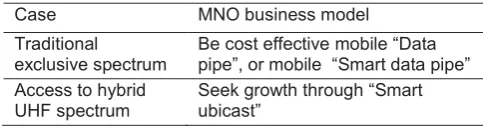
The developed future MNO business models are summarized in Table 1. The transition in the business model with additional flexible downlink data capacity is not only about avoiding costs, or scouting further growth within the mobile data, but to expand business towards ubiquitous customer experience in the converging media, internet and communication era. Faster access to QoS licensed below 1GHz spectrum without mandatory coverage obligations could allow the operators to strengthen their existing market position and enabling new more personalized service level based offerings with enhanced QoS and QoE to different customer segments. New downlink bands complement the current spectrum assets, and offer improved QoE by allowing load balancing and traffic steering to match best the personalized user demand with the network capacity supply.
The following “Smart ubicast” service opportunities enabled by the flexible UHF business model were identified:
x Extra MBB capacity and coverage to cope with asymmetric data traffic benefit,
x PSM service to broadcast aggregated TV channels flexibly via broadcast or unicast, as demand can be met most efficiently,
x Live TV/radio broadcast, similar to PSM, with different coverage, content, content protection and funding models,
x Event & venue casting delivers premium content services at key events, high density locations like sports stadiums or local service businesses,
Consumers as a mass
Enterprises
Voice, Text and Data
Mobility, QoS/QoE, Services
Subscription price
Exclusive spectrum
Infrastructure (Installed base) Customer
billing
Customer experience management Brand and service design
Direct sales, Distributors
Flat rate, usage based
pricing
Subscription charge
Exclusive spectrum license fee
Infrastructure implementation
and operations Customer acquisition &
retention Mobility
Mobile data pipe
LTE ecosystem
Segmented Consumers Media & broadcasting
segment Converged broadband & broadcast data
Personalized media content to mobiles
UHF spectrum Uni/multicast infrastructure
Customer billing
Customer experience management
Brand and service design Direct sales, Distributors
Service class charging Subscription
charge
Harmonized UHF spectrum license fee Infrastructure implementation
and operations New segment
customer acquisition QoS & QoE classes
Data speed, Data coverage
Smart Ubicast
Content delivery fee
Media partnerships Traffic steering
&"* &OEPSTFE 5SBOTBDUJPOTon CoHOJUJWF$PNNVOJDBUJPOT |Volume |Issue |e5
EAI
European Alliancex Media on demand that allows numerous users to subscribe to relevant content, e.g., news, sports, stock, weather, and a variety of user generated content either through live broadcasts or device caching, to view them at their convenience,
x Off-peak media & software delivers high demand pre-recorded content, e.g., TV shows, movies, YouTube, subscription content, e.g., eNewspapers, eMagazines and music, applications and firmware updates at off-peak times, and
x Internet of things (IoT) connects to the clouds to provide ease of management, location-based media services, updates and content deliveries, e.g., smart meters, public TV terminals, connected cars).
Table 1. Summary of Developed Business Models.
Case MNO business model
Traditional
exclusive spectrum Be cost effective mobile “Data pipe”, or mobile “Smart data pipe” Access to hybrid
UHF spectrum
Seek growth through “Smart ubicast”
5. Conclusion
In this paper, we have developed scenarios and business models for MBB network operators utilizing UHF spectrum bands with the hybrid shared concept with broadcasting DTT. The situation in the 470-694 MHz band is highly varied across Europe and globally, limiting currently the scale and harmonization of the developed models. It is therefore suggested to develop an international and/or European framework as flexible as possible so that each country can adopt a regulatory framework to its national situation. The hybrid usage model concept discussed allows MNOs to access new SDL UHF licensed QoS spectrum bands to respond to the growing asymmetric video and new media driven downlink data traffic, while ensuring QoS and protecting the incumbent DTT usage and investments.
In this paper scenario framework is used for analyzing the key changes in media consumption and delivery patterns from business and technology perspectives. Discussing and strategizing around these scenarios were found to be an important tool for challenging existing knowledge and opening up our avenues toward new creative business opportunities and business model designs. Based on the developed scenarios, opportunity driven business models were developed to address the basic questions of a business model: What, How, Why and Where to act regarding the business. The concept discussed could open up new business opportunities for MNOs through dynamic load and traffic management of the significantly increased downlink capacity that can be used to provide different service levels to different customer segments. The lower frequency UHF bands are a cost-efficient solution for the MNO to respond to the growing data traffic demand in a flexible and timely fashion.
Moreover, the concept could help operators to win over new customers by offering personalized mobile broadband data and “Smart ubicast” media delivery services to selected customer segments. With MBB broadcast concept on hybrid UHF spectrum, e.g., linear, traditional TV broadcast can be extended to mobile devices providing the flexibility to combine linear and non-linear TV, on-demand and interactive TV. This can significantly re-shape the business ecosystem around the mobile broadband and media, and open up new converging and co-operative business opportunities with transforming media and TV industry towards 5G. MNOs are optimally positioned to explore new business model opportunities in parallel with their traditional business model.
In the future, hybrid UHF usage concept business modelling studies will need to be expanded to cover also other key stakeholders. In particular, co-operative business model with broadcast domain will be an important aspect to scout.
Acknowledgements.
This work has been performed as a part of Future of UHF (FUHF) project. The authors would like to acknowledge the project consortium Digita Networks, Elisa, Finnish Communications Regulatory Authority, Nokia, RF-tuote, Schneider Finland, Telia Sonera, Turku University of Applied Sciences, University of Turku, VTT Technical Research Centre of Finland, YLE Finnish Broadcasting Company, Åbo Akademi University, and Tekes Finnish Innovation Fund.
References
[1] ITU-R M.2243 (2011) Assessment of the global mobile broadband deployments and forecasts for International Mobile Telecommunications.
[2] Cisco white paper (2015) Cisco Visual Networking Index: Global Mobile Data Traffic Forecast Update, 2014-2019. http://www.cisco.com/c/en/us/solutions/collateral/service- provider/visual-networking-index-vni/white_paper_c11-520862.html
[3] Lewin, D., Marks, P., Nicoletti, S. (2013) Valuing the use of spectrum in the EU. GSMA
[4] The White House (2012) Realizing the Full Potential of Government-Held Spectrum to Spur Economic Growth. PCAST Report
[5] ITU-R (2012) Final Acts - WRC-12, Geneva.
[6] ITU-R (2015) Provisional Final Acts - WRC-15, Geneva. [7] FCC (2012) report 12-118: Broadcast Television Spectrum
Incentive Auction NPRM.
http://www.fcc.gov/document/broadcast-television-spectrum-incentive-auction-nprm
[8] Federal Office of Communications (OFCOM) (2012) Coexistence of New Services in the 800 MHz Band with Digital Terrestrial Television-Further Modelling. http://stakeholders.ofcom.org.uk/binaries/consultations/94973 1/annexes/DTTCo-existence.pdf
[9] OFCOM (2011) report 2221/PCFT/R/1.2: The co-existence of LTE and DTT services at UHF: a field trial.
http://www.ofcom.org.uk/static/research/co-existenceLTEDTTservicesatUHF.pdf
10 [11] Ribadeneira-Ramírez, J., Martínez, G., Gómez-Barquero, D.,
Cardona, N. (2016) Interference Analysis Between Digital Terrestrial Television (DTT) and 4G LTE Mobile Networks in the Digital Dividend Bands. IEEE Trans. Broadcasting 62(1): 24-34.
[12] Li, W., et al. (2012) Performance and Analysis on LTE System under Adjacent Channel Interference of Broadcasting System. In Proceedings of IEEE 12th Int'l. Conf. Computer and Info. Technology, 290-294.
[13] ITU-R WRC-15 (2012) Agenda Item 1.2: Lower Edge of Mobile Allocation and Adjacent Band Compatibility, CPG-PTD (13)010
[14] Antonopoulos, A., Kartsakli, E., Bousia, A., Alonso, L., Verikoukis, C. (2015) Energy-efficient infrastructure sharing in multi-operator mobile networks. IEEE Commun. Mag. 53(5):242-249.
[15] Razzac, A.A., et al. (2013) Dimensioning and Profit Sharing in Hybrid LTE/DVB Systems to Offer Mobile TV Services. IEEE Trans. Wireless Commun. 21(12): 6314-6327.
[16] Calabuig, J., Monserrat, J.F., Gomez-Barquero, D. (2015) Fifth Generation mobile networks: A new opportunity for the convergence of mobile broadband and broadcast services. IEEE Commun. Mag. 52(2): 198-205.
[17] ECC Report 224 (2014) Long Term Vision for the UHF broadcasting band. On long-term vision for the UHF broadcasting band out for public consultation.
[18] EC (2016) COM/2016/043: Proposal for a Decision of the European Parliament and of the Council on the use of the 470-790 MHz frequency band in the Union.
[19] Delaere, S., Ballon, P. (2007) The business model impact of flexible spectrum management and cognitive networks. Info 9 (5): 57-69.
[20] Mwangoka, J., Marques, P., Rodriguez, J. (2011) Exploiting TV White Spaces in Europe: The COGEU Approach.
http://www.ict-cogeu.eu/pdf/publications/Y2/IEEE%20DySPAN2011_COG EU_paper.pdf.
[21] Luo, Y., Gao, L., Huang, J. (2015) Business Modeling for TV White Space Networks. IEEE Commun. Mag. 53: 82 – 88. [22] Chapin, J. and Lehr, W. (2007) Cognitive radios for dynamic
spectrum access - The path to market success for dynamic spectrum access technology. IEEE Commun. Mag. 45 (5): 96-10
[23] Yrjölä, S., Ahokangas, P., Matinmikko, M., Talmola, P. (2014) Incentives for the key stakeholders in the hybrid use of the UHF broadcasting spectrum utilizing Supplemental Downlink: A dynamic capabilities view. In Proceedings of International Conference on 5G for Ubiquitous Connectivity (5GU), 215 – 221.
[24] Duan, L., Gao, L., Huang, J. (2011) Contract-based cooperative spectrum sharing. In Proceedings of Dynamic Spectrum Access Networks (DySPAN) IEEE Symposium, 399-407
[25] Inayatullah, S. (2006) Anticipatory action learning: Theory and practice. Futures 38: 656-666
[26] ECC (2013) Report 205: Licensed Shared Access.
[27] 3GPP (2012) technical report TR 36.808: Evolved Universal Terrestrial Radio Access (E-UTRA); Carrier Aggregation; Base Station (BS) radio transmission and reception.
[28] 3GPP TS 25.346: Multimedia Broadcast/Multicast Service (MBMS); Protocols and Codecs
[29] Kagermann, H., Osterle, H. and Jordan, J. (2010) It-driven business models. Global case studies in transformation. New Jersey, John Wiley & Son.
[30] Bishop, P., Hines, A. and Collins, T. (2007) The current state of scenario development: an overview of techniques. Foresight, 9(1): 5-25.
[31] Van Der Hejden, K. (2007) Scenarios - The art of strategic conversation, 2nd ed. England: John Wiley & Sons.
[32] Mason, D. and Herman, J. (2003) Scenarios and strategies: making the scenario about the business. Strategy & Leadership 31(1): 23-31.
[33] Osterwalder, A. and Pigneur, Y. (2010) Business Model Generation. John Wiley and Sons.
[34] Richardson, J. (2008) The business model: an integrative framework for strategy execution. In Strategic Change 17, 133-144.
[35] Ahokangas, P., Juntunen, M., Myllykoski, J. (2014) Cloud Computing and Transformation of International e-Business Models. In: Sanchez, R & Heene, A.: Building competences in dynamic environments, Research in competence-based management 7: 3-28.
[36] Floyd, J. (2012) Action research and integral futures studies: A path to embodied foresight. Foresight 44: 870-882.
&"* &OEPSTFE 5SBOTBDUJPOTon
CoHOJUJWF$PNNVOJDBUJPOT |Volume |Issue |e5