Volume 21 Number 6 pp. 507–513 C The Author(s) 2018 doi:10.1017/thg.2018.64
Study Design and Rationale for the Mood and
Methylation Study: A Platform for Multi-Omics
Investigation of Depression in Twins
Eric Strachan,1Jinying Zhao,2Peter P. Roy-Byrne,1Emily Fowler,1and Tamara Bacus3 1Department of Psychiatry and Behavioral Sciences, University of Washington, Seattle, WA, USA 2Department of Epidemiology, University of Florida, Gainesville, FL, USA
3Department of Pediatrics, University of Washington, Seattle, WA, USA
Major depression is a complex disorder with no single, direct causal mechanism. Morbidity has been linked to genetic processes, developmental history, and unique environmental exposures. Epigenetic mechanisms, especially DNA methylation, are also likely important factors in the pathogenesis of major depressive disor-der (MDD). A community-based twin sample has many advantages for epigenetic studies, given the shared genetic and developmental histories of same-sex twin pairs. This article describes the rationale and study design for the Mood and Methylation Study in which 133 twin pairs (101 monozygotic and 32 dizygotic), both discordant and concordant for lifetime history of MDD, were evaluated on a large number of vari-ables related to MDD. The twins also provided blood samples for an epigenome-wide association study of differentially methylated regions (DMR) relevant to MDD. Although MDD is typically considered a disorder of the central nervous system, it is unfeasible to obtain a large sample of brain tissues. However, epige-netic variation is not limited to the affected tissue but can also be detected in peripheral blood leukocytes. Thus, this study focused on monocytes for the major analyses. Additional plans for the study include gene expression analysis from the same set of twins using RNA-seq and validation of significant DMRs in post-mortem brain tissues from a separate sample. Moreover, sufficient samples have been collected to perform future ‘multi-omic’ analyses, including metabolome, microbiome, and transcriptome. Our long-term goal is to understand how epigenomic and other ‘omic’ factors can be manipulated for diagnostic, preventive, and therapeutic purposes for MDD and its related conditions.
Keywords:depression, methylation, epigenome, microbiome, transcriptome, metabolome, twins
Major depressive disorder (MDD) is a complex and some-times devastating condition that affects millions of people across the globe every year. To date, no single, direct causal mechanism has been identified in MDD but MDD morbid-ity has been linked to genetic and epigenetic processes, de-velopmental history, and unique environmental exposures. Epigenetic mechanisms, especially DNA methylation, are increasingly being recognized as factors in the pathogen-esis of MDD, and several published studies from both small and large samples have shown depression-related differ-ences in methylation of genes related to inflammation, G-protein coupled receptor G-protein signaling, and axon guid-ance among others (Byrne et al., 2013; Crawford et al.,
2018; Davies et al.,2014; El-Sayed et al.,2012; Sabunciyan et al.,2012; Shimada et al.,2018; Story Jovanova et al.,2018; Uddin et al.,2011; Zhao et al.,2013).
DNA methylation involves the addition of a methyl group to the fifth carbon of a cytosine base. It occurs most
frequently within CpG islands (i.e., genomic regions that contain a high frequency of CpG sites) in the promoter regions of many genes, although most CpG islands are unmethylated. Unlike the DNA sequence itself, which is stable during development, DNA methylation is highly dy-namic and often induced by exposure to a range of fac-tors such as nutrition, behavior, and chemicals (Dolinoy & Jirtle,2008; Dolinoy et al.,2007). These factors can directly affect methylation, chromatin remodeling, and other epi-genetic pathways, resulting in alterations of epigenome and
received 17 July 2018; accepted 31 October 2018. First pub-lished online 29 November 2018.
subsequent gene expression, thereby contributing to disease etiology (Dolinoy & Jirtle,2008; Dolinoy et al.,2007; Jiang et al.,2004; Tsankova et al.,2007). However, the biologi-cal pathways linking aberrant methylation to MDD remain largely unknown, either because the function of the methy-lated genes is not known or because the methylation results have not been compared to actual differences in gene ex-pression or other mechanisms. This uncertainty hampers our ability to implement early diagnosis, prevention, and treatment for this debilitating disorder.
To address these challenges, we designed a twin study known as the Mood and Methylation Study (MMS). This study recruited monozygotic (MZ) and dizygotic (DZ) twin pairs discordant or concordant for a lifetime history of MDD, and collected detailed clinical phenotypes for MDD, MDD-related traits, and environmental factors for each twin participant. Biospecimens were also collected for the primary methylome and transcriptome analyses but also to promote future multi-omic studies. Discordant MZ twin pairs provide a natural experiment to study epigenetic dif-ferences in MDD, because MZ twins match exactly on ge-netic background, age, and sex, thus totally eliminating the effects of these important confounders (Fraga et al.,
2005; Relton & Davey Smith,2010). In addition, identical twins share developmental environment, providing further control for confounding by early life experience, which is known to have a long-lasting impact on the epigenetic plas-ticity of the human genome (Rutten & Mill,2009). There-fore, a discordant co-twin control approach provides a pow-erful model for epigenomic research.
MDD is typically considered a disorder of the central nervous system, and it is known that DNA methylation is, to some extent, cell-type- and tissue-specific. But, what-ever the degree of tissue specificity, it is unfeasible to ob-tain a large sample of brain tissues for epigenetic analyses. That said, there is increasing evidence that leukocytes may be a useful cell model to evaluate epigenetic changes, be-cause epigenetic variation may not be limited to the affected tissue but can also be detected in peripheral blood leuko-cytes (Crawford et al.,2018; Story Jovanova et al.,2018). In fact, the study of peripheral blood may have some ad-vantages over the use of brain tissue in that they are likely to accumulate fewer epigenetic changes induced by disease-related external factors, which could be confounding factors in postmortem studies (Pidsley & Mill,2011). Importantly, blood samples are much easier to obtain and could be used for large-scale epidemiologic studies, tracking changes as-sociated with depression as the disease develops (Story Jo-vanova et al.,2018). Although a great deal more research is needed, it appears that the patterns of methylation across CpG sites in brain and peripheral blood leukocytes are sim-ilar (Murphy et al., 2008; Yuferov et al.,2011) and cor-relations of DNA methylation profiles between different human tissues are reasonably high and can be evaluated us-ing publicly available tools such as the Blood–Brain
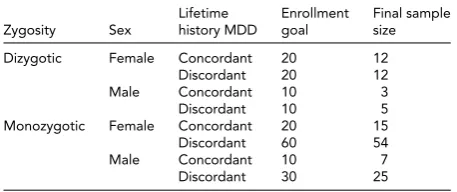
Epige-TABLE 1
Study Recruitment Goals
Lifetime Enrollment Final sample Zygosity Sex history MDD goal size
Dizygotic Female Concordant 20 12
Discordant 20 12
Male Concordant 10 3
Discordant 10 5
Monozygotic Female Concordant 20 15
Discordant 60 54
Male Concordant 10 7
Discordant 30 25
netic Concordance (BECon) application (Bromberg et al.,
2010; Brown & Robinson, 2000; Edgar et al.,2017; Han-non et al.,2015). Because there are several cell types within leukocytes, we decided to isolate one type — monocytes — for this study.
Thus, we designed our study to first conduct an epigenome-wide association study (EWAS) using mono-cyte DNA extracted from whole blood in twin pairs discordant for lifetime history of MDD. In an effort to replicate significant differentially methylated regions (DMRs) in the central nervous system, we obtained clinically well-characterized postmortem brain tissues from the Stanley Medical Research Institute’s Depression Collection, with control samples from non-depressed brains. We also downloaded brain DNA methylation data (HumanMethylation450K BeadChip) through the publicly available Gene Expression Omnibus (GEO; https://www.ncbi.nlm.nih.gov/geo/info/datasets.html) database GSE41826. Finally, we planned to determine the functional impact of DMRs via gene expression analyses using RNA-seq with postmortem brain gene expression data (RNA-seq) through GEO database GSE101521. With this combination of approaches, we anticipate discovering epigenetically dysregulated genomic regions for MDD, in addition to uncovering functional epigenetic alterations that may play a causative role in MDD pathogenesis.
zygosity and concordance). This combination of twin pairs allows for maximum flexibility in answering important questions about the heritability of individual phenotypes and the simultaneous effects of genes and environment on multiple phenotypes. Finally, the twins in this sample are community volunteers interested in participating in re-search and significant efforts are made by the Washington State Twin Registry to say in contact with the volunteers. It will therefore be possible to return a large percentage of them in the future for longitudinal analysis and new collec-tion of MRI analyses to assess the connectome.
Methods
Washington State Twin Registry Description and In-volvement
Recruitment for the present study was completed via the community-based Washington State Twin Registry (WSTR; previously known as the University of Washington Twin Registry). Complete details of the construction and current components of the WSTR are available elsewhere (Afari et al.,2006; Strachan et al.,2013). Briefly, recruitment into the WSTR itself relies on initial identification of twins from the Washington State Department of Licensing (DOL), which asks all driver license and state ID applicants: ‘Are you a twin (Y/N)?’ Based on a data-sharing agreement between DOL and the University, the names and contact informa-tion of all twin respondents are then sent to the WSTR. Twins are contacted with information about the Registry and an enrollment survey. After both members of the pair complete the survey, the pair is enrolled in the Registry. The Registry contacts the twins multiple times each year with birthday cards, newsletters, and study invitations in order to keep contact information current. At the time recruitment began, the average age of enrolled twins was 37, and 41% of the twins reported being married. Approximately 4% of the Registry reported being Hispanic and 86% reported be-ing White. All other racial categories were<4%. In terms of educational achievement, 25% completed high school or GED, an additional 34% had some college/vocational school, and 33% had a bachelor’s degree or higher.
Twin Sampling and Recruitment for the Mood and Methylation Study
All participants provided informed consent for the study procedures and all procedures have been reviewed and ap-proved by the University of Washington Institutional Re-view Board. Enrollment into the study required at least one member of the pair to have a lifetime history of MDD as measured by expert structured interview. Non-depressed twins were required to have no lifetime history of a major depressive episode and to have Beck Depression Inventory (BDI-II) scores below 13 at prescreening (Beck et al.,1996). In addition, both members of the pair had to be willing to come to the University of Washington Medical Center for
the in-person blood draw and data collection visit. Provi-sion of stool samples, urine, saliva, and toenail clippings was optional. The primary exclusionary conditions for twin pairs were schizophrenia, bipolar disorder I and II, current substance use disorder, cancer, uncontrolled sleep apnea, and certain autoimmune, and uncontrolled endocrine dis-orders known to be associated with depressive symptoms. In order to avoid problems related to population stratifica-tion, only adult, same-sex, non-Hispanic, White twin pairs who were reared together, were enrolled.
Recruitment
In order to enroll participants from the WSTR into the study, we sent an introductory letter to potentially eligible WSTR members via postal mail and/or email. Participants in the Registry have already agreed to be approached for research projects by Twin Registry staff (all WSTR mem-bers were aged 18+at the time this study began). We then followed up with those who expressed an interest with a prescreen survey (phone or online depending on partici-pant preference) using approved scripts to screen for in-terest and eligibility. Once both members of the twin pair completed the prescreening without triggering any exclu-sionary criteria, each member was individually interviewed via telephone by a PhD-level psychologist using the rele-vant sections of the Structured Clinical Interview, Research Version, for the DSM-IV (SCID-RV), which was the latest version available at the time the study began (First et al.,
1995). The SCID-RV is a semi-structured interview guide for making Axis I DSM-IV diagnoses. For the purposes of this study, participants completed the Mood Episodes, Psychotic and Associated Symptoms, Psychotic Disorders, Mood Disorders, Substance Use Disorders, and Anxiety Disorders modules. They did not complete the Somato-form Disorders, Eating Disorders, or Adjustment Disor-ders modules. Any questions or concerns about the de-pression phenotype or exclusionary psychiatric conditions were referred to the senior clinician for evaluation and final decision-making.
Figure 1shows the enrollment funnel for the study and
Individual twins in the WSTR at the time of MMS study enrollment:
18,140
Eligible twins contacted based on
race, age, sex, and geography:
2,398
Twins that completed
pre-screening:
1,297
SCID Interviews:
693
Final enrollment:
266 (133 pairs)
FIGURE 1
Enrollment funnel for the Twin MMS study.
Biospecimen and Phenotype Data Collection
Table 2shows the interviews and questionnaires adminis-tered over the course of the study andTable 3shows the outline of the biospecimen collection procedures.
At-home procedures. Prior to coming in for the in-person study visit, participants received a package that contained questionnaires along with stool, saliva, and toenail sample collection kits. The questionnaires included two measures of depression symptom severity, the BDI-II mentioned above and the Quick Inventory of Depressive Symptoma-tology (QIDS-SR16). The BDI-II is a self-administered 21-item scale that has acceptable sensitivity and speci-ficity with regards to DSM criteria for MDD. The QIDS is also self-administered and was designed to assess the severity of depressive symptoms (Rush et al.,2003). The questionnaire packet also included measures of lifetime exposure to stressful events that may influence epigenetic variations leading to disease (Franklin et al.,2010; Water-land,2009). Exposure to childhood traumatic stress was measured with the Early Trauma Inventory (Bremner et al.,
2000). This self-administered instrument assesses not only the frequency and nature of traumatic events, but also the emotional impact of the stressor on the individual imme-diately after and across the life span, and the impact on so-cial and occupational functioning. We also measured hos-tility using the Cook–Medley Hoshos-tility Inventory (Barefoot et al.,1989) and anger by means of the Spielberger’s Anger Expression Inventory (Spielberger,1988). These factors are
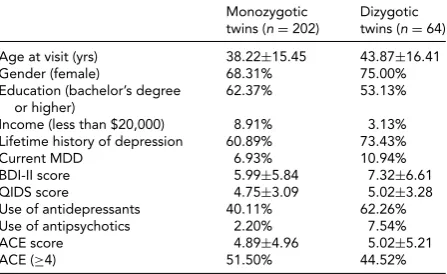
related to incidence of MDD (Keilp et al.,2006) and might also influence epigenetic alterations (Waterland,2009). Fi-nally, we measured social and emotional support by means of the Enhancing Recovery in Coronary Heart Disease (EN-RICHD) Social Support Inventory, a five-item scale as-sessing both social and emotional support (ENRICHD In-vestigators,2001).Table 4 shows initial demographic and clinical data broken down by zygosity.
The self-collection stool sample kits consisted of a col-lection bowl that sits on the participant’s toilet along with two tubes that have a scoop built onto the cap. The tubes have formalin fixative inside in order to stabilize the sam-ple, along with small glass beads to aid in mixing the fixative into the sample. The participant used the cap scoop to col-lect a small amount of stool from the colcol-lection bowl and placed it inside the tubes. The tubes were then repeatedly inverted to distribute the fixative and stored in the partic-ipant’s freezer until they attended the in-person visit. The soluble stool collection bags were flushed down the toilet.
Saliva collection was also self-administered three times within the same day. The first was upon waking in the morning, the second was between 4:30 and 6:00 pm, and the third was prior to bedtime. The kits were absorbant cotton balls that were placed in the mouth until wet, then placed into sealed bags and brought to us at the in-person visit. For toenail collection, we included clippers and a pre-labeled plastic bag for participants to cut a sample from each nail on one foot, and place them in the bag to return to us at the in-person visit.
TABLE 2
Study Measures and Administration
Prior to recruitment
•Twin Registry Health and Well-Being Questionnaire (HWB)
Prescreening •Beck Depression Inventory II (BDI-II)
•Exclusionary criteria •
Quick Inventory of Depressive Symptomatology (QIDS-SR16)
Clinical interview •Structured Clinical Interview, Research Version, DSM IV (SCID-RV)
At-home collection
•Adverse Childhood Events Questionnaire (ACE) •Early Trauma Inventory (ETI) •Agreeableness Questionnaire
•Alcohol Use Questionnaire (AUDIT)
•Baecke Habitual Physical Activity Questionnaire •Bipolar Spectrum Diagnostic Scale (BSDS) •Cohen Perceived Stress Scale (PSS) •Cook-Medley Hostility (HO) Scale •Drug Use Questionnaire (DUDIT) •Enriched Social Support Inventory (ESSI)
•Food Frequency Questionnaire (FFQ) •McGill Pain Questionnaire Short Form (SF-MPQ •Prescription Medication History
•Smoking history and exposure
•Spielberger’s Anger Expression Inventory (STAXI) •Twin Registry Health and Well-Being Questionnaire (HWB)
In-person study visit •Beck Depression Inventory II (BDI-II)
•Quick Inventory of Depressive Symptomatology (QIDS-SR16)
•Height •Weight •Heart rate •Respiration rate
•Blood pressure (sitting and standing) •Waist circumference
•Hip circumference
TABLE 3
Biospecimen Collections
Tissue type Amount Storage Location
Monocyte DNA 2–4 tubes each at 50–100µl -80°C UW Monocyte RNA 6–8 tubes each at 15–20µl -80°C UW RNA PAXgene 4 tubes at 10 ml -80°C UW DNA PAXgene 1 tube at 10 ml -80°C UW Serum 2 tubes each at .5 ml, 1 ml,
and 2ml
-80°C UW
Plasma 2 tubes each at .5 ml and 1 ml
-80°C UW
4 tubes each 2 ml and 5 ml
EDTA whole blood 1 tube at 4 or 6 ml -80°C NIMH
Stool 2 tubes -80°C UW
Saliva 3 tubes -80°C UW
Urine 4 tubes at 5 ml -80°C UW
5 tubes at 2 ml
DNA Methylation and Gene Expression Analysis Using the collected peripheral blood monocytes, we are cur-rently conducting an EWAS on MDD in 133 MZ and DZ pairs. DNA methylation is currently being assayed using the Infinium MethylationEPIC BeadChip. Compared to whole-genome sequencing, the BeadChip covers a small propor-tion of CpG sites. However, those sites are well distributed across the genome and the chip provide a cost-effective way to begin investigating methylation and disease. Gene expression—also using monocytes from the same sample of twins—will be measured by RNA-seq. Statistical anal-yses will be conducted to identify differentially methy-lated genes/regions (DMRs) associated with MDD. An ini-tial power analysis indicated that our sample size has 80% power to detect a minimum of 9.7% methylation difference between cases and controls, assuming covariates account-ing for 20% of phenotypic variability (Tsai & Bell, 2015). Functional importance of the identified DMR genes will be
TABLE 4
Demographic and Clinical Data by Zygosity
Monozygotic Dizygotic twins (n=202) twins (n=64)
Age at visit (yrs) 38.22±15.45 43.87±16.41
Gender (female) 68.31% 75.00%
Education (bachelor’s degree or higher)
62.37% 53.13%
Income (less than $20,000) 8.91% 3.13% Lifetime history of depression 60.89% 73.43%
Current MDD 6.93% 10.94%
BDI-II score 5.99±5.84 7.32±6.61 QIDS score 4.75±3.09 5.02±3.28 Use of antidepressants 40.11% 62.26% Use of antipsychotics 2.20% 7.54%
ACE score 4.89±4.96 5.02±5.21
ACE (≥4) 51.50% 44.52%
Note: BDI-II=Beck Depression Inventory-II; QIDS=Quick Inventory of De-pressive Symptomatology; ACE=Adverse Childhood Experiences.
validated by linking to gene expression and further con-firmed in postmortem brain tissue using available GTEx datasets. Sophisticated bioinformatics analyses will also be performed to investigate the potential functional role of the identified genes in MDD pathology. Also, given the col-lected specimens (e.g., plasma, stool samples), we plan to generate multi-omics datasets for all MMS twins, and con-duct integrated omics analyses to identify novel biomark-ers and biological pathways for MDD using a systems bi-ology approach. DNA sample and the omics datasets will be publicly accessible through the NIMH biorepository or NIH dbGaP.
Future Directions
opportunity to evaluate MDD from a multi-omics perspec-tive, and investigators interested in collaboration are en-couraged to contact us. Our group has begun a pilot anal-ysis of the gut microbiome from the MZ discordant pairs based on 16s RNA identification of gut microbiome di-versity. Additional proposed research seeks to character-ize MDD-associated changes in the plasma metabolome as-sociated with microbial metabolism of neurotransmitters, neuroactive compounds, and neurometabolites and to mea-sure differences in bacterial endotoxin expomea-sure, meamea-sured as lipopolysaccharide binding protein, associated with leaky gut in MDD.
We anticipate that this twin sample will reveal promis-ing directions for research on MDD treatment and preven-tion, but we also recognize that any significant results will require extensive replication and validation in samples dif-ferent from the one described here. Greater racial diversity will be critical, along with additional focus on age-related effects and differences in early childhood exposures.
Acknowledgment
This research was funded by the National Institute of Men-tal Health (R01 MH097018: Zhao, Strachan).
Conflicts of Interest
None.References
Afari, N., Noonan, C., Goldberg, J., Edwards, K., Gadepalli, K., Osterman, B., ... Buchwald, D. (2006). University of Wash-ington twin registry: Construction and characteristics of a community-based twin registry.Twin Research and Human Genetics, 9, 1023–1029.
Barefoot, J. C., Dodge, K. A., Peterson, B. L., Dahlstrom, W. G., & Williams, R. B. J. (1989). The Cook-Medley hostility scale: Item content and ability to predict survival. Psycho-somatic Medicine, 51, 46–57.
Beck, A. T., Steer, R. A., & Brown, G. K. (1996).BDI-II. Beck Depression Inventory: Second edition. San Antonio, TX: The Psychological Corporation.
Bremner, J. D., Vermetten, E., & Mazure, C. M. (2000). Devel-opment and preliminary psychometric properties of an in-strument for the measurement of childhood trauma: The early Trauma inventory.Depression and Anxiety, 12, 1–12. Bromberg, A., Levine, J., Belmaker, R. H., & Agam, G. (2010).
Hyperhomocysteinemia does not affect global DNA methy-lation and nicotinamide N-methyltransferase expression in mice.Journal of Psychopharmacology, 25, 976–981. Brown, C. J., & Robinson, W. P. (2000). The causes and
conse-quences of random and non-random X chromosome inac-tivation in humans.Clinical Genetics, 58, 353–363. Byrne, E. M., Carrillo-Roa, T., Henders, A. K., Bowdler, L.,
McRae, A. F., Heath, A. C., … Wray, N. R. (2013). Monozy-gotic twins affected with major depressive disorder have
greater variance in methylation than their unaffected co-twin.Translational Psychiatry, 3, e269.
Crawford, B., Craig, Z., Mansell, G., White, I., Smith, A., Spaull, S., … Murphy, T. M. (2018). DNA methylation and inflammation marker profiles associated with a history of depression.Human Molecular Genetics, 27, 2840–2850. Davies, M. N., Krause, L., Bell, J. T., Gao, F., Ward, K. J., Wu,
H., … Wang, J. (2014). Hypermethylation in the ZBTB20 gene is associated with major depressive disorder.Genome Biology, 15, R56.
Dolinoy, D. C., & Jirtle, R. L. (2008). Environmental epige-nomics in human health and disease.Environmental and Molecular Mutagenesis, 49, 4–8.
Dolinoy, D. C., Weidman, J. R., & Jirtle, R. L. (2007). Epige-netic gene regulation: Linking early developmental envi-ronment to adult disease.Reproductive Toxicology, 23, 297– 307.
Edgar, R. D., Jones, M. J., Meaney, M. J., Turecki, G., & Kobor, M. S. (2017). BECon: A tool for interpreting DNA methy-lation findings from blood in the context of brain. Transla-tional Psychiatry, 7, e1187.
El-Sayed, A. M., Halossim, M. R., Galea, S., & Koenen, K. C. (2012). Epigenetic modifications associated with suicide and common mood and anxiety disorders: A systematic re-view of the literature.Biology of Mood & Anxiety Disorders, 2, 10.
ENRICHD Investigators. (2001). Enhancing Recovery in Coronary Heart Disease (ENRICHD): Baseline character-istics.American Journal of Cardiology, 88, 316–322. First, M. B., Spitzer, R. L., Williams, J. B. W., & Gibbon, M.
(Eds.). (1995).Structured clinical interview for DSM IV-Pationet edition (SCID-P). Washington, DC: American Psy-chiatric Press.
Fraga, M. F., Ballestar, E., Paz, M. F., Ropero, S., Setien, F., Ballestar, M. L., … Esteller, M. (2005). Epigenetic differ-ences arise during the lifetime of monozygotic twins. Pro-ceedings of the National Academy of Sciences of the United States of America, 102, 10604–10609.
Franklin, T. B., Russig, H., Weiss, I. C., Graff, J., Linder, N., Michalon, A., … Mansuy, I. M. (2010). Epigenetic trans-mission of the impact of early stress across generations. Bi-ological Psychiatry, 68, 408–415.
Hannon, E., Lunnon, K., Schalkwyk, L., & Mill, J. (2015). In-terindividual methylomic variation across blood, cortex, and cerebellum: Implications for epigenetic studies of neu-rological and neuropsychiatric phenotypes.Epigenetics, 10, 1024–1032.
Jiang, Y. H., Bressler, J., & Beaudet, A. L. (2004). Epigenetics and human disease.Annual Review of Genomics and Hu-man Genetics, 5, 479–510.
Keilp, J. G., Gorlyn, M., Oquendo, M. A., Brodsky, B., Ellis, S. P., Stanley, B., & Mann, J. (2006). Aggressiveness, not impulsiveness or hostility, distinguishes suicide attempters with major depression.Psychological Medicine, 36, 1779– 1788.
Pidsley, R., & Mill, J. (2011). Epigenetic studies of psychosis: Current findings, methodological approaches, and impli-cations for postmortem research.Biological Psychiatry, 69, 146–156.
Relton, C. L., & Davey Smith, G. (2010). Epigenetic epidemiol-ogy of common complex disease: Prospects for prediction, prevention, and treatment.PLoS Medicine, 7, e1000356. Rush, A. J., Tirivedi, M. H., Ibrahim, H. M., Carmody, T. J.,
Arnow, B., Klein, D. N., … Keller, M. B. (2003). The 16-item Quick Inventory of Depressive Symptomatology (QIDS) Clinician Rating C) and Self-Report (QIDS-SR): A psychometric evaluation in patients with chronic major depression.Biological Psychiatry, 54, 573–583. Rutten, B. P., & Mill, J. (2009). Epigenetic mediation of
environmental influences in major psychotic disorders. Schizophrenia Bulletin, 35, 1045–1056.
Sabunciyan, S., Aryee, M. J., Irizarry, R. A., Rongione, M., Webster, M. J., Kaufman, W. E., … Consortium, G. (2012). Genome-wide DNA methylation scan in major depressive disorder.PLoS One, 7, e34451.
Shimada, M., Otowa, T., Miyagawa, T., Umekage, T., Kawamura, Y., Bundo, M., … Sasaki, T. (2018). An epigenome-wide methylation study of healthy individuals with or without depressive symptoms.Journal of Human Genetics, 63, 319–326.
Spielberger, C. D. (1988).Professional manual for the state-trait anger expression inventory. Tampa, FL: University of South Florida.
Story Jovanova, O., Nedeljkovic, I., Spieler, D., Walker, R. M., Liu, C., Luciano, M., … Amin, N. (2018). DNA methyla-tion signatures of depressive symptoms in middle-aged and
elderly persons: Meta-analysis of multiethnic epigenome-wide studies.JAMA Psychiatry, 75, 949–959.
Strachan, E., Hunt, C., Afari, N., Duncan, G., Noonan, C., Schur, E., … Buchwald, D. (2013). University of Washing-ton twin registry: Poised for the next generation of twin re-search.Twin Research and Human Genetics, 16, 455–462. Tsai, P. C., & Bell, J. T. (2015). Power and sample size
estima-tion for epigenome-wide associaestima-tion scans to detect differ-ential DNA methylation.International Journal of Epidemi-ology, 44, 1429–1441.
Tsankova, N., Renthal, W., Kumar, A., & Nestler, E. J. (2007). Epigenetic regulation in psychiatric disorders.Nature Re-views Neuroscience, 8, 355–367.
Uddin, M., Koenen, K. C., Aiello, A. E., Wildman, D. E., de los Santos, R., & Galea, S. (2011). Epigenetic and inflammatory marker profiles associated with depression in a community-based epidemiologic sample. Psychological Medicine, 41, 997–1007.
Waterland, R. A. (2009). Is epigenetics an important link be-tween early life events and adult disease?.Hormone Re-search in Paediatrics, 71, 13–16.
Yuferov, V., Nielsen, D. A., Levran, O., Randesi, M., Hamon, S., Ho, A., … Kreek, M. J. (2011). Tissue-specific DNA methy-lation of the human prodynorphin gene in post-mortem brain tissues and PBMCs.Pharmacogenetics and Genomics, 21, 185–196.