General Procedures for Evaluation of a Managerial Level of a Company
Kristina LAZARIDIAbstract
The article discusses an opportunity to check managerial effectiveness of a company on the basis of principles of management and cybernetic approach. In order to craft successful strategy of a company’s activity it is necessary to understand how well operates a com-pany as an organization and how effective is a comcom-pany’s management. For these reason the paper offers the general procedure in the form of universal questionnaire, which will assist the owners, shareholders, top managers of any company to get more deeply the problems of a company’s management, improve their luck (if any) and become more successfully.
Keywords: principles of management, Emerson, Fayol, Weber, cybernetic approach. JEL: M10
Introduction
Management principles determine the philosophy and strategy of an organization; they are basic concepts, direc-tions and reflect the natural laws and rules of behavior for managers as they perform management functions. Various managers, theoretic and practitioners paid attention to the problems of management. Among them more important are the works of F.Tailor, H. Emerson, H. Fayol, M. Weber, J.Burn, P.Drucker. For today it is possible to say that the theory of management is formed completely, but the prob-lem is how to use the achievements of Management Theo-ry in order to manage a company successfully. EveTheo-rybody understands -theoretical knowledge only is not enough for the success. Nevertheless, understanding of the exist-ing problems of management system should be assisted to managers to improve a company’s activity. On the basis of analyses of various principles of effective management (“12 Principles of Efficiency” of Emerson, “14 manage-ment principles” of Fayol, “Rational Bureaucracy” prin-ciples of M.Weber) and Cybernetic approach the authors of the article offer the general procedure for evaluation of a managerial level of a company with indication of weak-ness of existing management systems that, in accordance with the authors opinion, will assist managers to improve a company’s activity.
The article consists from abstract, introduction, body and conclusion. The first section examines existing sys-tems of management’s quality evaluation such as Emer-son’s 12 principles of efficiency, Fayol’s 14 principles of management, Weber’s bureaucratic principles and cyber-netic structure. The second section is focused on the analy-sis of evaluation methods on an organizational level and procedures for the construction of universal questionnaire for the evaluation of a company’s organizational level and the universal questionnaire itself.
1. Existing systems of management’s quality assess-ment
What factors make an organization to reach a high organizational level and therefore to be successful? The answer is the application of the principles of management in everyday activities of an organization as they serve the organization as a guideline for subsequent thoughts and ac-tions.
Managers of organizations implement administration on the basis of positions and rules which are called the principles. These draw the line of behavior and actions of a manager of any stage. Principles of management deter-mine system, structure and process of management. Prin-ciples of management can be described as ideas, patterns, and maximum of law of managers when they implement functions of management. Principles are worked out by theory and practice, absorbing achievements of different socio-economical and exact sciences. Knowledge and skill in handling of principles of management enables manager to solve multitude problems. These management principles directly influence into organizational structure of manage-ment, modifies and improves it if needed; it is based on this that the principles are important.
In order to check management’s quality and organi-zational level of an organization we use four main basic methods that serve as alpha and omega in theory of man-agement. They are the following: 1) The twelve principles of efficiency by H. Emerson, 2) The fourteen principles by H. Fayol, 3) The bureaucratic organizations approach by M. Weber, and 4) Cybernetic conception.
The main idea is that true labor productivity always pro-duces maximum results through minimum efforts.
According to Emerson (1924), the principles of effi-ciency are simple and are the following: 1) Clearly defined ideals, 2) Common sense, 3) Competent counsel, 4) Dis-cipline, 5) The fair deal, 6) Reliable, immediate, adequate and permanent records, 7) Dispatching, 8) Standards and schedules, 9) Standardized conditions, 10) Standardized operations,11) Written standard-practice instructions and 12) Efficiency – reward.
Another remarkable contribution into management made Henri Fayol (1841-1925). He is often called a father of a modern theory of administration. Fayol demonstrated his expertise as being a good organizer. Fayol developed fourteen principles of management and explained that the principles should be adjusted according to the specific needs; their implementation guarantees efficiency in man-agement. The principles embody manager’s individual, subjective experience and philosophy. They are not strong-ly interconnected and thus, depending on a situation, they can be substituted, complemented or transformed. The ag-gregate of the principles is always opened and is enrich-ing by a new managerial experience. The 14 principles of management of Henry Fayol are the following: 1) Division of work, 2) Authority with corresponding responsibility, 3) Discipline, 4) Unity of Command, 5) Unity of Direction, 6) Subordination of individual interest to the general inter-est,7) Remuneration of staff, 8) Centralization (or Decen-tralization), 9) Scalar chain (Line of Authority), 10) Order, 11) Equity, 12) Stability of Tenure of Personnel, 13) Initia-tive and 14) Esprit de Corps.
We select Fayol’s principles for our analysis because he is a well-known manager-practitioner, and he is one of the founders of theory of management. He is the first who was engaged in working out of approaches for manage-ment perfection in a whole.
The next method for management’s quality assessment we use belongs to Max Weber(1864-1920). He made a great contribution into development of managerial thought and practice. In history of management Weber is known as a founder of classical theory of bureaucracy. He formulated principles of construction of an ideal organization. Accord-ing to Weber, bureaucratic form of organization is the most effective form of administration which is implemented by qualified professionals in compliance with predefined rules. He wanted to create basis of ideal organization that would assure maximum reasonableness of human behavior. Ideals of bureaucracy are a guaranteed occupation, career devel-opment and, accuracy and pedantry at implementation of responsibilities. According to Weber, advantage of bureau-cratic organization is that it is always possess technological advantage over other kinds of organizations. Ideal mecha-nism of bureaucratic organization in comparison with other kinds of organization gives great advantages. Weber states
that bureaucratic form of organization is universal because it promotes to an increase of efficiency in different organi-zations. There is no ideal bureaucracy in a real life. This is just a theoretical model of how individual should plan work in large organizations. Weber distinguished the fol-lowing characteristics of ideal bureaucracy: 1)Impersonal character, 2) Principle of hierarchy, 3) Division of labor and specialization, 4) Rules of selection of employees, 5) Rules and regulations, 6) Principle of career, 7) Concentra-tion on a single task and 8) RemuneraConcentra-tion.
We use Weber’s principle for construction of universal questionnaire due to the reason that officialdom of man-agement especially strongly developed today and bureau-cracy is irreplaceable in a modern society.
The last method for assessment of an organizational level we use is cybernetic conception. Basic purpose of cybernetics as a science about management is to construct such systems, such organization of systems’ functioning, such an interaction of elements inside of these systems and such an interaction with external environment in order to get the best results of functioning of systems; that is result of the functioning would bring more quickly to defined goals of functioning with minimum spending of resources. This is what we call optimization. Thus, a basic goal of cybernetics is optimization of management system.
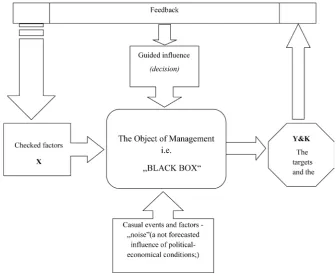
Figure 1 shows general structure of a management model from the point of cybernetics.
The solving problem of the object of management (company, society, country, etc.) is examined as a “black box”; the processes taking place inside are unknown or little known for us. At our disposal there are outside pro-cesses acting on the object and the reaction of the objects on this influence. (G.Bagaturia, 2009, p.56). This model allows us not to pay attention to insignificant details and enables us to single out the main things in the system eval-uation and its regulation; it enables a regulation process to be understandable for any person.
Using the cybernetic conception of management we can enrich methodology of investigation of a company as an organization as cybernetic method is universal method of management. From the point of view of cybernetics the following factors should be taken into consideration:
1. Goal that determine functioning of an organiza-tion. Therefore, we should find out if a company has the goals and how well these goals satisfy generally accepted requirements of management.
2. Whether a company has criterions of evaluation of organizational activities, which are those methods ap-plied that we can evaluate the attainability of the goals, character of regulation and so on.
factors stipulate activities of an organization.
4. Guided factors, which are those factors with help of a management which a company implements.
5. Influence of “noise”, that is influence of those factors whose influence we feel but we do not know their origin, source, intensity and duration. As a rule such fac-tors can be external, internal, economic, social-obstructive influence. Usually these factors are unknown but we can assume them, and we can plan management of a company in a way that will defend a company from pernicious influ-ence of the noise.
6. How feedback is provided and whether it is pro-vided at all. Presence of the feedback shows efficiency of work of management.
7. And at last, company’s efficient activities depend to a large extent from interconnection of the company’s different subdivisions, the quality of which (of intercon-nection) can be evaluated by the presence of the strategi-cally global criterion of optimization of a whole company. 2. Development of universal questionnaire
Principles of management are instructions for manag-ers about how to manage an organization. They serve man-agers as guidelines for managerial decision making and actions. These procedures are reflected in construction of universal questionnaire for estimation of a company’s or-ganizational level. Clearly defined goals are very important
for an organization and its overall survival because they provide an organization with well-defined courses of ac-tions. Goals serve as a lighthouse which helps organization to orient by. Goals should be real; each sub-ordinate should be introduced with organizational goals and their subse-quent actions should be oriented toward goals implementa-tion. Analyze of any movement, any action should be ac-complished through the use of common sense. A competent counsel is also very important tool for management and for organizational success because a counselor possess with specific knowledge. Counselor analysis specific situation and changes in external environment, corrects the actions of managers and personnel on a whole, and it provides a valuable tool for rational advice. Discipline is one of the components for success as it ensures that all the human resources within an organization follow established rules. Discipline forms the fundamental of friendly, harmoni-ous, well-organized, and effective working conditions, and such improved relations toward subordinates should be fair and kindly. It leads to harmonious environment within an organization and its better functioning. Reliable, imme-diate and adequate records are important as they provide organization and management with necessary information, advice or warning. Dispatching ensures that well-defined management activities can be carried out. They should be an essential part of management; dispatching ensures unin-terrupted work for the organization as a whole.
Dispatch-Figure 1. Common Model of Business Administration / Management
ing is based on accurate and well-defined rules, records, fixed norms and schedules. Dispatching should be applied in every field of activities. Standards and schedules are important as they define and measure every shortcoming in an organization and decreases losses generated by these shortcomings. Standardized conditions are important as they ensure achievement of better results using the same efforts. Written-standard instructions provide personnel and subordinates with clear rules for their performing their jobs; everything is written and understandable, actions of workers are coordinated by written instructions and standard operation procedures. Written-standard instruc-tions help individuals to make headway relying on accu-mulated experience of previous generation. Each worker should receive encouragement for his efficiency. Reward is important and a worker should realize and be sure that for additional efficiency he will be rewarded. Reward can be a stimulus for workers to increase personal efficiency and therefore efficiency of an organization. Reward system should be fair. Division of labor and specialization is valu-able because the volume and quality of work increases as a worker obtains experience doing narrow duty; division of labor increases workers’ qualification.
Human resources are selected based on their knowl-edge and qualification that leads to better functioning of an organization, and for bringing about an increase in organi-zational efficiency. The position held by a worker is exam-ined as being his or her main task and this leads to com-plete concentration of a worker to fulfilling that particular task. Career development is possible if a worker deserves it, if his or her activities were successful. Consequently kinship, connection and other relations should not play any role whatsoever in career advancement. This is very impor-tant. Employees work hard in order to receive promotion in career. Impersonal character of an organization means to treat all employees equally and not to be influenced by personal opinion; there is no place for subjective assess-ments. Unity of command along with unity of direction is very important principles. This means that sub-ordinates should have one boss, who provides workers with a plan – the course of actions, - and they should work harmoniously in order to accomplish assigned tasks. Actions of whole personnel should be directed to accomplish general goals of the organization. Authority with corresponding respon-sibility is important principle in achieving this. Emphasis is placed on an individual who has responsibilities and as a result should receive the right to utilize organizational resources and to issue commands for sub-ordinates, to fur-ther direct their actions in accomplishing various tasks. Re-sponsibility and authority should be balanced. Subordina-tion of individual interest to the general interest is another significant principle. It is obvious that individual interests should not prevail over goals of an organization. An or-ganization has goals that it has to achieve and the results
are favorable for each member of an organization and for the society as a whole because an organization produces goods and services which are socially beneficial. Hierarchy should not be over-stretched or consist of too many levels; the quantity of levels should be minimal. Hierarchy means necessity of centralization. Hierarchy in this meaning rep-resents division of labor vertically. Management-subordi-nation relationship in every level is established. Hierarchy ensures an order and stability of an organizational struc-ture. Choice between centralization and decentralization depends on the size of an organization. Management of an organization should determine an extent of centralization and decentralization to apply. If an organization is small centralization should be applied; if an organization is large then decentralization should be selected. Centralization should be used relative to those decisions that identify the policy of an organization, its goals and strategies.
Decentralization should be used relative those deci-sions which bear a relation to operational management. Order is valuable, because this principle states that eve-rything and everybody should be in order; both material order and social order are necessary. Order creates a cor-porate culture within an organization. Stability of tenure of personnel is critical for an organization because stability of personnel increases efficiency of an organization and adds to its prosperity. Initiative is significant because it provides opportunity to sub-ordinates to be creative, to develop new ideas and innovations, and to share them with manage-ment. Some ideas can be really innovative; they can be re-alized and added to the strength of an organization.
Esprit de Corps is also substantial principle because without healthy, harmonious, friendly relations among the workers an organization can’t be successful. Stressful en-vironment negatively influences on job performance and therefore on activities of a whole organization. Determin-ing of checked and guided factors is critical for an organi-zation. Management of an organization should realize what kind of checked factors stipulate activity of an organization and what kind of guided factors help to manage an organi-zation.
viable and healthy organism, and where each system is ef-fectively coordinated by the brain whose “strategic global criterion” is to maintain life.
Hence, after the analyses of principles of management I arrived at a conclusion that in modern conditions man-agement needs to clarify these issues.
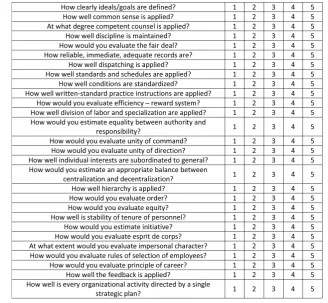
I would suggest for researchers to make use of the fol-lowing universal questionnaire for estimation of a com-pany’s organizational level. When questionnaire is applied for investigation of an organizational level, researcher can understand from the obtained results where an organization at present is. The higher the score obtained the higher is an organizational level. Universal questionnaire is repre-sented in the Table 1.
It is possible to develop the general procedure for evaluation of a managerial level for any company by their employees on the basis of above mentioned principles of management. The offered universal questionnaire (Table 1) allows an organization to obtain a comprehensive pic-ture about its activities, and to serve as the basis of identifi-cation various sides of a company (strong and weak points; high-priority directions for improvement; and so on).
In the basis of methodology of estimation of a com-pany’s organizational level lies a scoring system which provides managers the opportunity to compare acquired re-sults with a standard or with benchmark indicators of other organizations. Also a score system provides opportunity to
trace dynamics of improvement in process of implemen-tation of repeated estimation. Diagnostic estimation of a company’s organizational level is implemented through method of questionnaire which consists from 28 questions. Each question assumes five options with opportunity to select only one option. The rating scale reflects five fol-lowing conditions: 5 – excellent; 4 – good; 3 – average; 2 – fair; 1 – poor.
After obtaining of results a manager can clearly ob-serve directions which require an immediate improvement. Improvement of one principle will influence on operation of other principles because they are interrelated.
For the obtaining of unbiased results it is necessary to create a representative sample. In this case it is necessary to determine a sufficient number of respondents1. Selec-tion of respondents is made in accordance with the stand-ard requirements on formation of a representative sample. After obtaining of the filled questionnaires it is necessary to determine average value of criterion on each parameter (mean, median, and mode), and the dispersion of opinions on each parameter (variance, standard deviation, coef-ficient of variation). These data jointly with coefcoef-ficient of asymmetry and excess produce full information about importance of the given criterion. The results of the poll should be further analyzed not only from the point of view of quantitative results but also from the point of view of reasons that cause this or that estimation. The final
tion of a company’s organizational level is made by aver-aging of all averaged results by each criterion. Certainly a grand average of the estimation is necessary to obtain on each statistical parameter that are specified above, namely on the four central moments.
An offered algorithm for an organizational level as-sessment offers equivalence of all examined criterions. Further for this or that company prevailing can be differ-ent criterions. This is a subject for a specific research of a given company. After obtaining of results a manager can clearly observe directions which require an immediate im-provement. Improvement of one principle will influence on operation of other principles because they are interrelated.
Conclusion
The goal of this research was to develop general pro-cedures to evaluate a company’s organizational level. In meeting the goal it is necessary to have constructed the universal questionnaire for evaluation of a company’s or-ganizational level that could be used by managers or re-searchers who are interested to investigate a company and determine its organizational level. Universal questionnaire is defined as method to study an organization in a whole, which permits over a short period of time to obtain a clear-er picture of the functioning of an organization, to identify organizational problems, both strengths and weaknesses. The practice of management as a response should allow for actions to be initiated in solving organizational problems and to overcome and make up for the weaker aspects of an organization.
1. Sample size calculator: http://www.raosoft.com/samplesize.html, http:// www.surveysystem.com/sscalc.htm, http://www.macorr.com/sample-size-calculator.htm last seen January 30, 2012
References
Bagaturia, G. (2009). Strategic Planning. p. 56. Retrieved May 3,
2011, from: http://www.gtu.edu.ge/publishinghouse/book4/ bagaturia.pdf
Bagaturia, G., &Bagaturia, O. (2009).Cybernetic methods of strategic management. pp. 75-80.Retrieved May 9, 2011,
from: http://www.gtu.edu.ge/publishinghouse/book4/baga-turia,%20bagaturia%20A5.pdf
Emerson, H. (1924). The twelve principles of efficiency. pp. 59-367.Retrieved November 19, 2010, from http://www.ar -chive.org/details/twelveprinciples00emerrich
Frolov, S. S. (2001). Sociology of organizations. Retrieved No -vember 29, 2010, from: http://www.i-u.ru/biblio/archive/ sociolorg/5.aspx
Management innovations.(2008). Henry Fayol’s 14 principles of
management. Retrieved November 20, 2010, from: http://