Published by Faculty of Science, Kaduna State University
Modelling the Effect of Education-Based Intervention in the Control of Malaria
MODELLING
THE
EFFECT
OF
EDUCATION-BASED
INTERVENTION IN THE CONTROL OF MALARIA
MUSA Samuel1, GONI A. Nathan2*
1,2Department of Mathematics, School of Physical Sciences, Modibbo Adama University of Technology, Yola, Nigeria 1[email protected], 2[email protected]
* Corresponding Author Email Address: [email protected] Phone: +2347032143146
ABSTRACT
In this study, we propose a mathematical model for the transmission dynamics of malaria by incorporating behavioural change via education as a control strategy against the spread of malaria. Analytical study is carried out to investigate the local stability of the system, given a threshold parameter known as the basic reproduction number R ,0 which is obtained using the next generation matrix method. Result showed that disease-free equilibrium of the system is locally asymptotically stable ifR0 1. Numerical simulation carried out on the system shows that behavioural change significantly alters the dynamics of malaria infection towards achieving a malaria-free society in finite time.
Keywords: Education, behavioural change, Disease-Free Equilibrium, Basic reproduction number, Local stability
INTRODUCTION
Malaria is one of the most devastating infectious diseases in the world, infecting millions of people annually and is a major cause of mortality. The World Health Organization (WHO) reported that in 2016, there were 216 million cases of malaria and about 90% of reported cases occurred in Africa (WHO 2018). This life-threatening disease is caused by the single-celled genus plasmodium parasites which are transmitted through bites of infected anopheles mosquitoes, biting mainly between dusk and dawn. Plasmodium vivax, plasmodium ovale, plasmodium malariae, plasmodium falciparum, and plasmodium knowlesi are five parasite species identified to cause malaria in humans. Plasmodium falciparum (P. falciparum) causes most of the severe diseases and deaths which is most prevalent in Sub-Saharan Africa. Children below age 5 and pregnant women are most susceptible to the disease. In particular, malaria claims the life of a child every 2 minutes. The major symptoms of malaria include fatigue, chill, headache, abdominal and back pain, diarrhoea, vomiting and fever. Severe malaria infection can result in serious complications affecting brain, lungs, kidneys and other organs (WHO, 2014). Despite global efforts to control malaria, the incidence of the disease is increasing in endemic regions such as, sub-Saharan Africa. While Africa accounts for 91% of malaria deaths worldwide, Nigeria being the most populous country on the continent accounted for 24% of malaria deaths globally in 2016 (WHO, 2018).
Mathematical modelling has been used as a tool to understand the transmission dynamics of infectious diseases. From the year 1911 till present, various mathematical models have been derived which take into account various possible scenarios of the transmission dynamics of malaria. Some of these include
(Koella,1991), (Chitnis, 2005), (Tumwiine et al, 2007), (Tumwiine et al, 2008), (Peter, 2010), (Francis et al, 2012), (Adamu and Kimbir, 2013), (Xiongwei et al, 2014), (Bakare and Nwozo, 2015), (Adamu et al, 2015), (Sunisa et al, 2015), (Abadi and Harald, 2015), (Bakary et al, 2017). In another attempt to alleviate the problem of malaria transmission, (Olaniyi and Obabiyi, 2013) developed a model that considered the impact of antibodies produced by both human and mosquito populations in response to the presence of malaria parasites. It has been observed that in many regions where the disease burden is high, very few people live above the poverty level. In other words, humans will be able to boost production of antibodies with the intake of the right food or supplements when hunger and poverty has been eradicated knowing that malaria affects some of the poorest regions of the world, with very limited resources (Chitnis, 2005). However, (Maliyoni et al, 2012) observed that when interventions such as education are introduced in the fight against infectious diseases, trends improve in the population.
In this paper, we developed a mathematical model that incorporates an education-based behavioural change as an extension of (Olaniyi and Obabiyi, 2013) where the human population follows the susceptible-exposed-infectious-recovered (SEIR) pattern and the mosquito population follows susceptible-exposed-infectious (SEI) pattern. Hence, our aim is to determine the effect of behavioural change as a control strategy against the spread of malaria.
MATERIALS AND METHODS
The model comprises of two interacting (human and mosquito) populations as developed by (Olaniyi and Obabiyi, 2013). And a modified version is presented which incorporates an additional class of humans called, protected humans. Thus, the human population follows the susceptible-protected-exposed-infectious-recovered (SPEIR) pattern and the mosquito population follows susceptible-exposed-infectious (SEI) pattern.
Table 1: Description of the state variables of the models
Fu
ll L
en
gt
h Rese
ar
ch
Modelling the Effect of Education-Based Intervention in the Control of Malaria Table 2: Description of the parameters of the models
Epidemiological Flow Diagrams
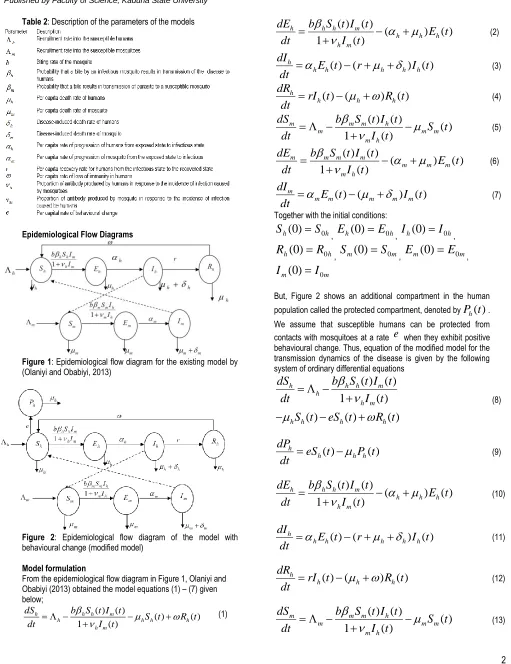
Figure 1: Epidemiological flow diagram for the existing model by (Olaniyi and Obabiyi, 2013)
Figure 2: Epidemiological flow diagram of the model with behavioural change (modified model)
Model formulation
From the epidemiological flow diagram in Figure 1, Olaniyi and Obabiyi (2013) obtained the model equations (1) – (7) given below;
( ) ( )
( ) ( )
1 ( )
h h h m
h h h h
h m dS b S t I t
S t R t
dt I t
(1)
( )
( )
(
)
( )
1
( )
h h h m
h h h
h m
dE
b
S t I
t
E t
dt
I
t
(2)( ) (
) ( )
hh h h h h
dI
E t
r
I t
dt
(3)( ) (
)
( )
hh h h
dR
rI t
R t
dt
(4)( ) ( )
( )
1
( )
m m m h
m m m
m h
dS
b
S
t I t
S
t
dt
I t
(5)( )
( )
(
)
( )
1
( )
m m m m
m m m
m h
dE
b
S
t I
t
E t
dt
I t
(6)( ) (
)
( )
mm m m m m
dI
E t
I
t
dt
(7)Together with the initial conditions: h
h
S
S
(
0
)
0 ,E
h(
0
)
E
0h,I
h(
0
)
I
0h, hh
R
R
(
0
)
0 ,S
m(
0
)
S
0m,E
m(
0
)
E
0m, mm
I
I
(
0
)
0But, Figure 2 shows an additional compartment in the human population called the protected compartment, denoted by
P t
h( )
. We assume that susceptible humans can be protected from contacts with mosquitoes at a ratee
when they exhibit positive behavioural change. Thus, equation of the modified model for the transmission dynamics of the disease is given by the following system of ordinary differential equations( )
( )
1
( )
( )
( )
( )
h h h m
h
h m
h h h h
dS
b
S t I
t
dt
I
t
S t
eS t
R t
(8)
( )
( )
hh h h
dP
eS t
P t
dt
(9)( )
( )
(
)
( )
1
( )
h h h m
h h h
h m
dE
b
S t I
t
E t
dt
I
t
(10)( )
(
)
( )
hh h h h h
dI
E t
r
I t
dt
(11)( ) (
)
( )
hh h h
dR
rI t
R t
dt
(12)( ) ( )
( )
1
( )
m m m h
m m m
m h
dS
b
S
t I t
S
t
dt
I t
(13)Modelling the Effect of Education-Based Intervention in the Control of Malaria
( )
( )
1
( )
(
)
( )
m m m m
m h
m m m
dE
b
S t I
t
dt
I t
E t
(14)( ) (
)
( )
mm m m m m
dI
E t
I
t
dt
(15)Together with the initial conditions: 0
(0)
h h
S
S
,P
h(0)
P
oh,
E
h(0)
E
0h, 0(0)
h h
I
I
,R
h(0)
R
0h,S
m(0)
S
0m, 0(0)
m m
E
E
,I
m(0)
I
0mRESULTS
Existence of Disease-free Equilibrium Point
The disease free equilibrium point
E
0,
of the system (8) - (15) is obtained by setting the right hand side of (8)-(15) equal to zero whenE
h
0,
I
h
0,
R
h
0,
E
m
0,
I
m
0
and is given by* * * * * * * * 0
(
,
,
,
,
,
,
,
)
(
,
, 0, 0, 0,
, 0, 0)
(
)
h h h h h m m m
h h m
h h h m
E
S P E I R S
E
I
e
e
e
(16)Basic Reproduction Number
The basic reproduction number denoted by,
R
0, is an important parameter which is used to study the behaviour of epidemiological models. (Diekmann et al, 1990), defined the basic reproduction number as the the expected number of secondary cases produced, in a completely susceptible population, by a typical infective individual. It is an important threshold parameter that determines whether or not, an infection will spread through a given population. We apply the next generation matrix technique by (Diekmann and Heesterbeek, 2000) to obtain the basic reproduction number,R
0, by considering the diseased compartments of the system (8) - (15) and is given by2
0
( )( )( )( )( )
h h h m m m
h h h h h m m m m m
b R e r (16)
Local Stability of Disease-free Equilibrium
The basic reproduction number (16) is used to analyse the local stability of the equilibrium point of the system (8)-(15).
Proposition
The disease-free equilibrium,
0
E , is locally asymptotically stable if
R
0
1
and unstable if0 1
R
Proof:
The Jacobian of the system (8)–(15) evaluated at the disease-free equilibrium point,
0
E
, is obtained as:11 15 18
21 22 33 38 43 44 0 54 55 64 66 74 77 87 88
0
0
0
0
0
0
0
0
0
0
0
0
0
0
0
0
0
0
0
0
0
0
0
(
)
0
0
0
0
0
0
0
0
0
0
0
0
0
0
0
0
0
0
0
0
0
0
0
0
J
J
J
J
J
J
J
J
J
J E
J
J
J
J
J
J
J
J
(17) Where,11
(
h),
J
e
J
15
,
18 h h,
hb
J
e
J
21
e
,
22 h
,
J
J
33
(
h
h),
38 h h,
hb
J
e
43 h
,
J
J
44
(
r
h
h),
J
54
r
,
55
(
h),
J
64,
m m m
b
J
J
66
m,
74
,
m m mb
J
J
77
(
m
m),
J
87
m,
88
(
m m)
J
The characteristic equation of (17) is given as
11 22 33 44 55 66 77 88
0 0 0 0 0
0 0 0 0 0 0
0 0 0 0 0 0
0 0 0 0 0 0
0
0 0 0 0 0 0
0 0 0 0 0 0
0 0 0 0 0 0
0 0 0 0 0 0
h h h h h h h m m m m m m m b J e e J b J e J r J b J b J J (18)
We need to show that all the eigenvalues of the characteristic equation (18) are negative. Thus, evaluating the equation and simplifying (18) yields
(
h)(
m
)( (
e
h)
)( (
h
)
)
0
So that,
1
h,
2
m,
3
(
h
e
),
4
(
h)
andModelling the Effect of Education-Based Intervention in the Control of Malaria
( ) 0 0
( ) 0 0
0
0 ( ) 0
0 0 ( )
h h h h
h
h h h
m m
m m m
m m m
b e
r
b
(19)
Therefore, simplifying (19) further we obtain
2
(
)(
)
(
)(
)
0
(
)
h h h h
m m m m
h h h m m m
h m
r
b
e
(20)
Now, let
B
1
h
h,
B
2
r
h
h,
3 m m
,
B
B
4
m
m so, we obtain1 2 3 4
2
(
)(
)(
)(
)
0
(
)
h h h m m m
h m
B
B
B
B
b
e
(21)
By expanding and simplifying (21), we get
4 3 2
4 3 2 1 0
0
A
A
A
A
A
(22)Where,
4
3 1 2 3 4
2 1 2 3 4 1 2 3 4
1 1 2 3 4 3 4 1 2
2
0 1 2 3 4
2
1 2 3 4 0
1
(
)(
)
(
)
(
)
(
)
(1
)
h h h m m m
h m
A
A
B
B
B
B
A
B
B
B
B
B B
B B
A
B
B B B
B
B B B
b
A
B B B B
e
B B B B
R
(23)
Thus, applying the Routh-Hurwitz criterion which states that all roots of the polynomial (22) have negative real parts if and only if the coefficients,
A
i, are positive and the determinants of the matrices,H
i
0
. Fori
0,1, 2, 3, 4
. Therefore, from equation (23), we see thatA
1
0,
A
2
0,
A
3
0,
and4
0
A
, sinceB B B B
1,
2,
3,
4are all positive. That is, 1 3.0
H
A
3 4
2 2 3 1 4
1 2
0
A
A
H
A A
A A
A
A
3 4 3 1 2 3
0 1
0 0 0
A A
H A A A
A A
and
3 4
1 2 3 4 4
0 1 2 0
0 0
0 0
0 0 0
A A
A A A A
H
A A A
A
Therefore, all the eigenvalues of the polynomial (22) have negative real parts, implying that
5
0,
6
0,
7
0,
8
0
. Hence, since all the values of
i
0,
for1, 2, 3, 4, 5, 6, 7,8
i
whenR
0
1
we conclude that the disease-free equilibrium point is locally asymptotically stable. However, ifR
0
1
, we observe thatA
0
0
and by Descartes’ rule of signs, (Polyanin and Manzhirov, 2007), there is exactly one sign change in the sequence,4
,
3,
2,
1,
0.
A A A A A
of the coefficients of the polynomial (22), implying that, there exists one eigenvalue with positive real part. Hence, the disease-free equilibrium point will be unstable.Numerical Experiments
Numerical experiments were performed using MATLAB to study and compare the behaviour of the Olaniyi and Obabiyi (2013) model and the model with behavioural change given by the system (8)-(15) on the human populations.
Table 3: Parameter values and initial variables
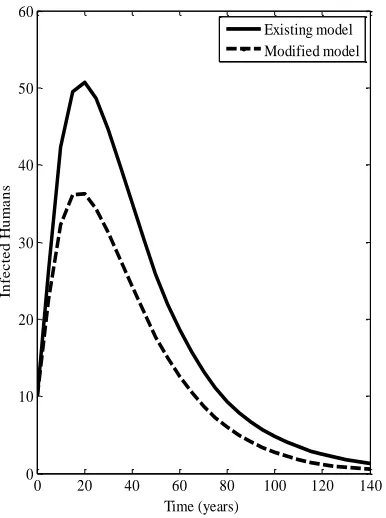
Two approaches were deployed in conducting the numerical the experiments. First, we considered a case where no antibody is produced as a form of immune response to the presence of malaria parasites while varying the rate of behavioural change. Figures 3, 4, and 5 show the varying effect of behavioural change
Modelling the Effect of Education-Based Intervention in the Control of Malaria
on the infected human populations while parameter values in Table 3 remained unchanged and
0 1
R .
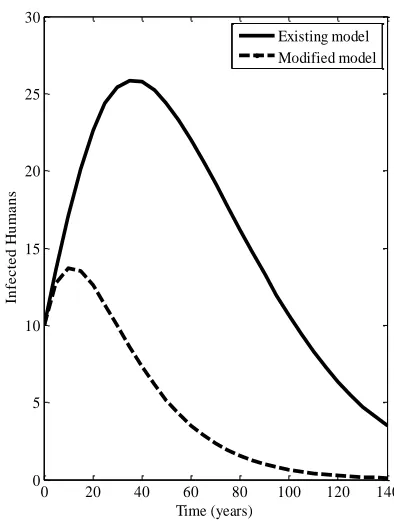
Secondly, we considered implementing the proportions of antibodies produced by susceptible humans and mosquitoes in response to the presence of malaria parasites at 50% and varied the proportion of behavioural change of protected humans as shown in Figures 6, 7, and 8
Figure 3: The behaviour of the models when
e
0.25
Figure 4: The behaviour of the models when
e
0.5
Figure 5: The behaviour of the models when
e
0.75
0 20 40 60 80 100 120 140
0 10 20 30 40 50 60
Time (years)
In
fe
c
te
d
H
u
m
a
n
s
Existing model Modified model
0 20 40 60 80 100 120 140
0 10 20 30 40 50 60
Time (years)
In
fe
c
te
d
H
u
m
a
n
s
Existing model Modified model
0 20 40 60 80 100 120 140
0 10 20 30 40 50 60
Time (years)
In
fe
c
te
d
H
u
m
a
n
s
Existing model Modified model
Modelling the Effect of Education-Based Intervention in the Control of Malaria Figure 6: The behaviour of the models when
e
0.25
Figure. 7: The behaviour of the models when
e
0.5
Figure. 8: The behaviour of the models when
e
0.75
DISCUSSIONThe disease-free equilibrium for the system (8)-(15) was established. The next generation matrix method was used to derive an explicit formula the basic reproduction number,
R
0. Further studies was carried out using Routh-Hurwitz criteria and results showed that the disease-free equilibrium point is locally asymptotically stable whenR
0
1
, indicating that malaria eradication is possible within the population.The numerical experiment showed that when the production of antibody is suspended in both susceptible humans and mosquitoes, and varying the rate of behavioural change results in further decrease in the population of infectious humans as shown in Figures 3–5. Similarly, results indicate that when we combine the intervention of antibodies and behavioural change as illustrated in Figures 6-8, there is a greater improvement in controlling the spread of the disease in the entire human population compared to single intervention as illustrated in Figures 3-5. In other words, the combined intervention yields greater improvement in the population and hastens the time at which malaria is eradicated from the population.
Conclusion
Incorporating an education-based intervention strategy into the model due to (Olaniyi and Obabiyi, 2013) yields better performance of the modified model. Stability analysis of the modified model revealed an asymptotically stable Disease free equilibrium under specified conditions. Malaria can be eradicated in finite time when
0 1
R . Otherwise, it persists in the population.
Furthermore, behavioural change will drastically reduce the disease burden in regions where the level of education is high unlike areas with poor education where the disease continues to thrive. Therefore, massive and continuous health education is
0 20 40 60 80 100 120 140
0 5 10 15 20 25 30
Time (years)
In
fe
c
te
d
H
u
m
a
n
s
Existing model Modified model
0 20 40 60 80 100 120 140
0 5 10 15 20 25 30
Time (years)
In
fe
c
te
d
H
u
m
a
n
s
Existing model Modified model
0 20 40 60 80 100 120 140
0 5 10 15 20 25 30
Time (years)
In
fe
c
te
d
H
u
m
a
n
s
Existing model Modified model
Modelling the Effect of Education-Based Intervention in the Control of Malaria
highly recommended as an intervention alongside other forms of intervention for all members of communities invaded with malaria.
REFERENCES
Abadi, A. G. and Harald, E. K. (2015), Mathematical Modelling of Endemic Malaria Transmission. American Journal of Applied Mathematics. Vol. 3, No. 2, 2015, pp. 36-46. doi: 10.11648/j.ajam.20150302.12
Adamu, A. K. and Kimbir, A. R. (2013), Modeling the Epidemiology of Malaria and Control with Estimate of the Basic Reproduction Number, Pure and Applied Mathematics Journal. Vol.2, No. 1, pp. 42-50.
Adamu, A. K., Ochigbo, J., Williams, B and Okorie, C. (2017), Local Stability Analysis of a Susceptible Protected Infected Treated Recovered (SPITR) Mathematical Model for Malaria Disease Dynamics. FUW Trends in Science & Technology Journal, www.ftstjournal.com e-ISSN: 24085162; p-ISSN: 20485170: Vol. 2 No. 1A, pp. 169-174.
Bakary T., Boureima S., and Sado T. (2017), “A Mathematical Model of Malaria Transmission with Structured Vector Population and Seasonality,” Journal of Applied Mathematics, vol. 2017, Article ID 6754097, 15 pages (on-line version), https://doi.org/10.1155/2017/6754097. Bakare E. A. and Nwozo C. R. (2015), Mathematical Analysis of
the Dynamics of Malaria Disease Transmission Model, International Journal of Pure and Applied Mathematics, Volume 99 No. 4, 411-437. ISSN: 1314-3395 (on-line version), http://www.ijpam.eu
Chitnis N., (2005). Using Mathematical Models in Controlling the Spread of Malaria, Ph.D. thesis, Program in Applied Mathematics, University of Arizona, Tucson, AZ.
Diekmann, O., Heesterbeek, J.A.P., and Metz, J. A. J., (1990). On the definition and the computation of the basic reproduction ratio in models for infectious diseases in heterogeneous populations, J. Math. Biol. 28 (1990) 365.
Diekmann, O. and Heesterbeek J. A. P. (2000), Mathematical Epidemiology of Infectious Diseases: “Application of Matrix Theory to Model Building, Analysis and Interpretation. JAMA 271(9): 698-702
Francis T. O., Gabriel A. O. and George T. A. (2012), Transmission Dynamics of Malaria in Ghana, Journal of Mathematics Research; Vol. 4, No. 6; doi:10.5539/jmr.v4n6p22 URL: http://dx.doi.org/10.5539/jmr.v4n6p22
Koella K. C., (1991). On the use of mathematical models of malaria transmission, Acta Tropica, 49, pp. 1-25.
Maliyoni M., Mwamtobe P. M. M., Hove-Musekwa S. D. and Tchuenche J. M. (2012), Modelling the Role of Diagnosis, Treatment, and Health Education on Multidrug-Resistant Tuberculosis Dynamics, International Scholarly Research Network ISRN Biomathematics Volume, Article ID 459829, 20 pages
Olaniyi S., and Obabiyi O. S. (2013). Mathematical Model for Malaria Transmission Dynamics In Human and Mosquito Populations with Nonlinear Forces of Infection, International Journal of Pure and Applied Mathematics, Volume 88 No. 1, 125-156. ISSN: 1314-3395 (on-line version), url:
http://www.ijpam.eu
Peter, M. M. M., (2010), Modelling the Effects of Multi-Intervention Campaigns for the Malaria Epidemic in Malawi, M.Sc. Thesis, University of Da res Salaam
Polyanin A. D. and Manzhirov A. V., (2007). Handbook of Mathematics for Engineers and Scientists, Chapman and Hall/CRC. Taylor and Francis Group
Sunisa, I., Kadkanok, N. and Surapol N., (2015), Effect of Mosquito Repellant on the Dynamics Model of Malaria. Aust. J. Basic & Appl. Sci., 9(13): 81-88, 2015
Tumwiine, J., Mugisha, J. and Luboobi, L. (2007), A mathematical model for the dynamics of malaria in a human host and mosquito vector with temporary immunity. Applied Mathematics and Computation 189 (2007) 1953–1965:
www.sciencedirect.com
Tumwiine, J., Mugisha, J. and Luboobi, L. (2008). Threshold and stability results for a malaria model in a population with protective intervention among high‐risk groups. Mathematical Modelling and Analysis, 13. 443-460. 10.3846/1392-6292.2008.13.443-460.
Xiongwei L., Junjun X., Xiao W., and Lizhi C. (2014), Behaviors and Numerical Simulations of Malaria Dynamic Models with Transgenic Mosquitoes, Abstract and Applied Analysis Volume 2014, Article ID 378968, 8 pages; http://dx.doi.org/10.1155/2014/378968
World Health Organization (2014). Fact Sheet on Malaria. Electronic, www.who.int/mediacentre/factsheets/fs094/en/
World Health Organization (2018), World Malaria Report. WHO Global Malaria Programme, http//www.who.int/malaria.