Modular Polymorphic Defunctionalization
Georgios Fourtounis, Nikolaos S. Papaspyrou, and Panagiotis Theofilopoulos National Technical University of Athens
School of Electrical and Computer Engineering Software Engineering Laboratory {gfour, nickie, ptheof}@softlab.ntua.gr
Abstract. Defunctionalization is generally considered a whole-program transfor-mation and thus incompatible with separate compilation. In this paper, we formal-ize a modular variant of defunctionalization which can support separate compilation for a functional programming language with parametric polymorphism. Our tech-nique allows modules in a Haskell-like language to be separately defunctionalized and compiled, then linked together to generate an executable program. We provide a prototype implementation of our modular defunctionalization technique and we discuss the experiences of its application in compiling a large subset of Haskell to low-level C code, based on the intensional transformation.
Keywords:defunctionalization, separate compilation, polymorphism, Haskell.
1.
Introduction
Separate compilation allows programs to be organized in modules that can be compiled separately to produce object files, which the linker can later combine to produce the fi-nal executable. Modern compilers support separate compilation for many reasons: (a) it saves development time by avoiding the recompilation of all the source code every time a change is made, (b) object files can be collected together in the form of libraries, which can be distributed as closed-source code, and (c) it can be used by build systems like maketo tractably recompile big code bases [1].
Defunctionalization [32] is a technique which transforms higher-order programs to first-order programs. It does so by eliminating all closures of the source program, replac-ing them with simple data types and invocations of special first-orderapplyfunctions.
The technique has been used in the implementation of programming languages, where the compiler uses an intermediate first-order language [7,8,38]. Such implementations can have an advantage when running on certain processors, making closure dispatch cheap and presenting opportunities for code inlining [31]. The transformation was also rediscov-ered in the context of higher-order logic programming [40] and was used to implement the HiLog language [10]. Defunctionalization has been used in the implementation of type-preserving garbage collectors [39] and a variant of it has been used to apply the first-order Catch analysis tool to higher-first-order programs [23]. It has also been used to support higher-order functions in first-order database programming [19,20].
Mitchell and Runciman [23]. It is the inverse of Church encoding [12] and can be used to reason about programs in terms of data structures, rather than higher-order functions. In particular, Ageret al.used defunctionalization to derive abstract machines and compilers from compositional interpreters [2,3] and Danvy presents it as an important transforma-tion, part of a toolbox of techniques, that can be used to reason about program representa-tion, evaluation order, and abstract machines [13]. Defunctionalization has also been used to prove correct control-flow-based program transformations in functional programming languages [5]. The transformation can be applied in a type-safe way in monomorphic and polymorphic languages [6,31] and its correctness has been proved [5,26]. In practice, when the transformation is used to improve performance, it can also be seen as working in the opposite direction compared to optimizations that introduce higher-order struc-tures [16,28,29].
So far, defunctionalization has been presented as a whole-program transformation, a property that has been frequently cited as its major shortcoming [24,31,35,38], rendering it unsuitable as a realistic implementation approach for most compilers. Although it is used in compilers that run in whole-program mode, such as MLton [41] and UHC [15], it has not yet been used in compilers that support separate compilation to native code.
This paper is a self-contained extension of our previous work [18], where we demon-strated how defunctionalization of a simply-typed functional programming language can be combined with separate compilation. Here we modify this technique to support para-metric polymorphism, using an adaptation of the technique suggested by Pottier and Gau-thier [31]. We add support for over-saturated higher-order function calls; in our previous work, it was assumed that all functions returned a result of ground type but this was not a real nuisance for lazy languages in the absence of polymorphism. Moreover, we describe a modification of the technique with a lightweight heuristic, which significantly reduces the number of closures that need to be generated during defunctionalization.
In the rest of this paper, we give an introduction to polymorphic defunctionaliza-tion and describe the problems that appear when we attempt to combine it with separate compilation. We then demonstrate how these problems can be overcome usingmodular polymorphic defunctionalization, a variant that supports separate compilation of modules and linking. We give a formalization of our transformation and describe how it has been implemented in a compiler for a subset of Haskell. To our knowledge, this is the first time defunctionalization is implemented for a functional programming language with paramet-ric polymorphism, in a way that supports separate compilation to native code.
2.
Defunctionalization
In this section we introduce the reader to the basics of defunctionalization, a program transformation that takes a higher-order program and produces an equivalent first-order program with additional data types representing function closures.
Assume that we have the following higher-order program written in Haskell. result =high (add 1) 1 +high inc 2
high g x = g x
inc z = z +1
There are three higher-order expressions in this program:
1. add 1is a partial application of theaddfunction yielding a closure ofaddthat bindsato1; the closure has residual typeInt→Int.
2. incis the name of theincfunction yielding a (trivial) closure that binds no variables and has residual typeInt→Int.
3. gis a higher-order formal variable of typeInt→Int.
Defunctionalization will then convert this program to an extensionally equivalent one, using only first-order functions. This is achieved by introducing a data typeClosure for closures, with one constructor for each different type of closure. In addition, a spe-cial functionapplyis introduced that recognizes these constructors and does function dispatch.
result =high (Add 1) 1 +high Inc 2 high g x =apply g x
inc z = z +1
add a b = a +b
data Closure =Add Int | Inc
apply c c0 = case c of
Inc → inc c0
Add a0 → add a0 c0
Defunctionalization is a well-known technique, first introduced by Reynolds as an implementation technique for higher-order languages in an untyped setting [32]. Notice that, in the example presented above, both closures conveniently expect one argument of typeIntand return a result of typeInt. Had this not been the case, our functionapply would not typecheck in Haskell; we would either have to use several different types of closures and apply functions (the approach that we took in our previous work [18]) or resort to GADTs (as we do in the rest of this paper).
The simple example above captures the basic idea of defunctionalization; the next case contains polymorphism. Assume the following polymorphic source program in System F; it is written again in Haskell with explicit types for convenience.
result :: Int
result= if h id True then h add 17 25 else h (add 2) 5
h :: (a → b) → a → b h g x = g x
add :: Int → Int → Int add a b =a + b
Here,his a polymorphic function taking a higher-order parameterg; it is used three times with three different instantiations for the type parametersaandb. Notice that the second call tohinresultisover-saturated: it takes three arguments, when the definition ofh only mentions two. This is legal here becausehis a polymorphic function and, in this call, the type parameterbis instantiated with the function typeInt→Int; the third argument (25) will be passed to the function that is the result of the call toh.
As Pottier and Gauthier have noted [31], we can defunctionalize polymorphic pro-grams in a typed setting if our target language is System F with GADTs [42]. The defunc-tionalized counterpart of our example program is then the following and it typechecks in Haskell, if GADTs are allowed. We use explicit types, again, to facilitate the comparison with the original program.
result :: Int
result= if h Id True then apply (h Add 17) 25 else h (Add1 2) 5
h :: Closure a b → a → b h g x = apply g x
add :: Int → Int → Int add a b =a + b
id :: a → a id z = z
data Closure par res where Id :: Closure a a
Add :: Closure Int (Closure Int Int) Add1 :: Int → Closure Int Int
apply :: Closure par res → par → res apply cl arg =case cl of
Id → id arg
Add → Add1 arg
Add1 i → add i arg
3.
The Source and Target Languages
In this section we describeHLM, a higher-order functional language with modules that will serve as the source language for modular defunctionalization. We also describeFL, its first-order subset that is the target language of our algorithm. Finally, we discuss how standard defunctionalization fails to separately transformHLM modules.
3.1. The Source LanguageHLM
The languageHLM is a Haskell-like higher-order functional language based on System F, with GADTs [30,36] and modules [14].
A program inHLM is organized in modules, each having a name, a list of imports consisting of data types and functions defined in other modules, a list of data type decla-rations, and a list of function definitions.HLMis defined by the following abstract syntax, wheremranges over module names,dranges over data type names,branges over basic data types,xranges over function parameters and pattern variables,opranges over built-in constant operators,f ranges over top-level functions,r ranges over function arities (natural numbers),tranges over type variables, andκranges over constructors. The star notation is used to denote zero or more repetitions.
p ::= M∗ program
M ::= modulem whereI∗ D∗ F∗ module
I ::= importm(m.d)∗(v/r:τ)∗ import
D ::= datam.d t∗ where(m.κ:τ)∗ data type
τ ::= b | t | m.d τ∗ | τ→τ type
F ::= m.f x∗= e definition
e ::= (x | v | op)e∗ | casee ofb∗ expression
v ::= m.f | m.κ top-level variable
b ::= m.κ x∗ → e case branch
InHLM we assume that type names (d), top-level function names (f) and constructor names (κ) are always qualified by the name of the module (m) in which they are defined. Function parameters and pattern variables (x) are local names; they are not qualified. In this way, every module has its own namespace: every top-level function is distinct and two different modules can define functions, data types or constructors with the same name, without the danger of name clashes. In our presentation, we will follow Haskell’s convention: all functions and variables start with a lowercase letter, while data types, constructors, and modules start with an uppercase letter.
An example program organized in two modulesLibandMainis the following. For the sake of simplicity, let us assume that the types ofLib.highandMain.highare monomorphic.
module Lib where
Lib.h y =y +1
Lib.test =Lib.high Lib.h 1 Lib.add a b =a +b
module Main where
import Lib ( Lib.high/2 :: (Int→Int)→Int→Int , Lib.test/0 :: Int
, Lib.add/2 :: Int→Int→Int )
Main.result= Main.f 10 + Lib.test
Main.f a = a + Main.high (Lib.add 1) +Lib.high Main.dec 2 Main.high g = g 10
Main.dec x = x - 1
3.2. The Target LanguageFL
The languageFLis the first-order subset ofHLM, without modules. In other words, in programs written inFL:
1. All functions and data type constructors are first-order.
2. Module qualifiers are considered parts of the names of functions, data types and con-structors.
3. Module boundaries are eliminated; programs are lists of data type declarations and function definitions.
For the purpose of our presentation,FLis used as the target language of our defunc-tionalization transformation. In a real compiler,FLwould be replaced by (or subsequently transformed to) native object code.
3.3. The Problem with Na¨ıve Separate Defunctionalization
Let us go back to the two modulesLibandMaindefined in Section 3.1. If we defunc-tionalize them separately, we obtain the following two pieces of code.
-- module Lib where
Lib.high g x =Lib.apply g x
Lib.h y =y +1
Lib.test =Lib.high Lib.H 1 Lib.add a b =a +b
data Lib.Closure par res where Lib.H :: Lib.Closure Int Int
Lib.apply c z =case c of
-- module Main where
Main.result= Main.f 10 + Lib.test
Main.f a = a + Main.high (Lib.Add 1) +Lib.high Main.Dec 2 Main.high g = Main.apply g 10
Main.dec x = x - 1
data Main.Closure par res where
Lib.Add1 :: Int → Main.Closure Int Int Main.Dec :: Main.Closure Int Int
Main.apply c z = case c of
Lib.Add a → Lib.add a z Main.Dec → Main.dec z
First of all, we see that the two different modules generate two different declara-tions of aClosuredata type, each having possibly different constructors. Assuming that these two pieces of code are linked successfully and the twoClosuretypes are blindly merged, the problem will become evident when the expressionLib.high Main.Dec 2will be evaluated:Lib.highwill callLib.apply, which does not know the closure constructorMain.Decand the program will terminate with an error.
We observe that closure data types, closure constructors and closure dispatching func-tions must be treated in a special way, if funcfunc-tions from different modules are to exchange higher-order expressions. On the other hand, all other data types, constructors and func-tions can be safely compiled separately and coexist, since it is guaranteed that there are no name clashes.
4.
Modular Defunctionalization
The solution to the problem described in the previous section is to have a proper way of managing the code that is generated by defunctionalization: closure data types, clo-sure constructors and their dispatchers must be collected together from all modules and code for them must only be generated at link-time. Our technique applies defunctionaliza-tion separately to each module, transforming fromHLM source code toFLtarget code, introducing closure constructors and invoking closure dispatchers whenever needed. It remembers the closure constructors that were required for each module and collects this information together with the target code generated for each module. Subsequently, in a final linking step, it merges the closure data type declarations and generates code for the closure dispatcher, based on the collected information.
Our modular defunctionalization is therefore a two-step transformation:
constructors and dispatching functions are external symbols to be resolved later, at link-time.
2. Linking: The separately defunctionalized code is combined and the missing code is generated for closure constructors and dispatching functions, using the defunctional-ization interfaces from the previous step. The missing code can then be compiled and linked with the rest of the already generated code, to produce the final program. This section formally presents a module-aware variant of defunctionalization. The two steps mentioned above are described in the next two subsections.1
4.1. Separate Defunctionalization
This step defunctionalizes each module, generating a list of defunctionalized data type and function definitions, and a list of all closure constructors that correspond to the top-level functions defined in this module. In the rest of this section, we describe how a single moduleM is defunctionalized.
We assume that type checking (and/or type inference) has already taken place and that all type information is readily available. To simplify presentation, we assume that expressions are annotated with their types (e.g.,eτ) but most of the times we will omit such annotations to facilitate the reader.
We also assume a mechanism for generating uniquenamesduring defunctionalization. All such names will be free of module qualifiers and suitable for use inFL. In particular: – N(m.d),N(m.f), and N(m.κ) generate names for module-qualified types,
top-level functions and constructors that appear in the source code of a module;
– C`(τ0, τ1)generates the GADT corresponding to closures that take arguments of type τ0and return a result of typeτ1(we usedClosureτoτ1in the examples);
– C(v, n)generates the name of a constructor corresponding to the closure ofv, binding
narguments; and
– Agenerates the name of the closure dispatching function (we usedapplyin the examples).
A number of auxiliary functions for manipulating types will be useful:
– arityT(τ)returns the arity of a type (i.e., how many formal arguments must be sup-plied before a value of ground type is reached).
arityT(b) = 0.
arityT(t) = 0.
arityT(m.d τ∗) = 0.
arityT(τ1→τ2) = 1 +. arityT(τ2)
– arityV(v)returns the arity of a top-level function or constructor (i.e., how many ar-guments exist in its definition). This is known from the syntax, for top-level func-tions of the current module, or from information present in theimport clause. Notice that, for a given top-level function f of type τ, it is always the case that arityV(f) ≤ arityT(τ); however, the two arities are equal only if the body of the function’s definition is of ground type.
1A prototype implementation in Haskell of the technique described in this section is available at:
– ground(τ)converts higher-order types to ground types, by replacing function types with the corresponding closure types.
ground(b) =. b
ground(t) =. t
ground(m.d τ∗) =. N(m.d)ground(τ)∗ ground(τ1→τ2)
.
= C`(ground(τ1),ground(τ2))
– lower(τ) converts higher-order types to first-order, by replacing the arguments of function types with the corresponding closure types, if necessary.
lower(b) =. b
lower(t) =. t
lower(m.d τ∗) =. N(m.d)ground(τ)∗
lower(τ1→τ2) .
= ground(τ1)→lower(τ2)
The defunctionalization process is formalized using four transformations:T(D),D(F), E(e), B(b), for type declarations, top-level function definitions, expressions and case branches, respectively. They are defined as follows.
T(datam.d t∗where(m.κ:τ)∗) =.
dataN(m.d)t∗where(N(m.κ) :lower(τ))∗
D(m.f x∗ = e) =. N(m.f)x∗ = E(e)
E(x e1 . . . en)
.
= A. . .(AxE(e1)). . .E(en) E(v e1 . . . en)
.
= C(v, n)E(e1) . . . E(en) ifn < n0 =arityV(v)
E(v e1 . . . en)
.
= A. . .(A(N(v)E(e1) . . . E(en0))E(en0+1)). . .E(en)
ifn≥n0 =arityV(v) E(ope1 . . . en)
.
= opE(e1) . . . E(en) E(caseeofb∗) =. caseE(e)ofB(b)∗
B(m.κ x∗ → e) =. N(m.κ)x∗ → E(e)
In principle: (i) data types are also defunctionalized: all higher-order types in the signa-tures of constructors are replaced by the corresponding closure data types; (ii) functional parameters or pattern variables are applied by using the corresponding closure dispatch-ing functions; (iii) partial applications of top-level functions and constructors are replaced by closure constructors; (iv) over-saturated calls are replaced by applications of closures returned as function results.
During the first step of the transformation, useful information is collected for every closure corresponding to a top-level function or constructor. This is achieved with function F(vτ), defined as follows. We assume thatvis a top-level function or constructor andτ is its type.
F(vτ) =. info(v, τ,[ ])
info(v, τ, τ∗) =. {(v/r, τ∗,ground(τ))} ∪info(v, τ2, τ∗++ [ground(τ1)])
FunctionF(vτ)returns a set of triples, one for each possible closure in whichvcan be used. Each triple contains: (i) the namevand the arityrof the corresponding top-level function, (ii) a list with the types of the arguments that have already been supplied, and (iii) the type of the corresponding closure.
As an example, consider a functionaddwith three integer arguments. add a b c = a + b + c
This function of arity 3 has typeInt→Int→Int→Int; it can be used in three closures, when 0, 1 and 2 arguments are supplied:
F(addInt→Int→Int→Int) =
{(add/3,[ ],Closure Int (Closure Int (Closure Int Int))),
(add/3,[Int],Closure Int (Closure Int Int)),
(add/3,[Int,Int],Closure Int Int)}
It is possible that not all of the different closures generated by functionF(vτ)will actually be used in the final program. The implementation is free to use a subset of these closures, e.g. taking just the ones that are generated in the code of the module. However, the final set of closures after linking is not just the union of those generated in the code of each linked module; more closures need to be automatically generated by the dispatching functions, in the case of partial application. We will come back to this point, when we describe our heuristic in Section 5.
4.2. Linking
After separately defunctionalizing a number of modules, we are left with object code, i.e., defunctionalized definitions, and information about closures. To link the final executable program, we must merge all defunctionalized definitions and add the missing closure dispatching functions. Let I be the union of closure information from all modules to be linked. As our presentation is at the source level, we start by generating data type definitions for closures; this would not be necessary if we were linking native code.
The data type for closures, parameterized by the type of the closure’s argumentaand the type of the resultb, is defined as follows.
dataC`(a, b)where { C(v, n) :τ∗→τ |(v/r, τ∗, τ)∈I, n=length(τ∗)}
whereτ∗→τis an abuse of notation for constructing function types with more than one curried arguments, e.g.,[τ1, τ2, τ3]→τ
.
= τ1→τ2→τ3→τ.
To generate the closure dispatching functionA, we use again the closure information
I. As the program is closed at link-time, we only need to generate a bigcaseexpression with one branch for each closure constructor found inI. The result of such branches can be of two different types: (i) if by supplying one more argument we have reached the corresponding function’s arity, then a full application of this function can be performed; or (ii) if more arguments remain to be supplied, a new closure (expecting one argument less) is returned. The two alternatives are treated in common by the auxiliary function next(v/r, n), defined below.
next(v/r, n) =. N(v) ifn=r
The definition forAcan then be written as follows.
Ac x = casecof{ C(v, n)y1 . . . yn →next(v/r, n+ 1)y1 . . . ynx |(v/r, τ∗, τ)∈I, n=length(τ∗)}
4.3. Example Revisited
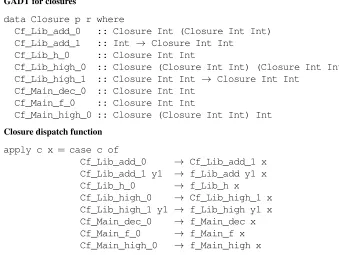
We now return to the example of Section 3.1. Applying the first step of the technique described in the previous section, we obtain two defunctionalized pieces of code and two sets of closure information. Both are given in Fig. 1. The code is very similar to that
Defunctionalized module Lib
f_Lib_high g x =apply g x f_Lib_h y =y +1
f_Lib_test =f_Lib_high Cf_Lib_h_0 1 f_Lib_add a b =a + b
Closure information for module Lib
(f_Lib_add/2, 0, Closure Int (Closure Int Int)) (f_Lib_add/2, 1, Int → Closure Int Int)
(f_Lib_h/1, 0, Closure Int Int)
(f_Lib_high/2, 0, Closure (Closure Int Int) (Closure Int Int)) (f_Lib_high/2, 1, Closure Int Int → Closure Int Int)
Defunctionalized module Main
f_Main_result =f_Main_f 10 +f_Lib_test f_Main_f a = a +f_Main_high (Cf_Lib_add_1 1)
+f_Lib_high Cf_Main_dec_0 2 f_Main_high g =apply g 10
f_Main_dec x = x - 1
Closure information for module Main
(f_Lib_add/2, 0, Closure Int (Closure Int Int)) (f_Lib_add/2, 1, Int → Closure Int Int)
(f_Lib_high/2, 0, Closure (Closure Int Int) (Closure Int Int)) (f_Lib_high/2, 1, Closure Int Int → Closure Int Int)
(f_Main_dec/1, 0, Closure Int Int) (f_Main_f/1, 0, Closure Int Int)
(f_Main_high/1, 0, Closure (Closure Int Int) Int)
Fig. 1.The result of defunctionalization for the example of Section 3.1.
GADT for closures
data Closure p r where
Cf_Lib_add_0 :: Closure Int (Closure Int Int) Cf_Lib_add_1 :: Int → Closure Int Int
Cf_Lib_h_0 :: Closure Int Int
Cf_Lib_high_0 :: Closure (Closure Int Int) (Closure Int Int) Cf_Lib_high_1 :: Closure Int Int → Closure Int Int
Cf_Main_dec_0 :: Closure Int Int Cf_Main_f_0 :: Closure Int Int
Cf_Main_high_0 :: Closure (Closure Int Int) Int
Closure dispatch function
apply c x =case c of
Cf_Lib_add_0 → Cf_Lib_add_1 x
Cf_Lib_add_1 y1 → f_Lib_add y1 x
Cf_Lib_h_0 → f_Lib_h x
Cf_Lib_high_0 → Cf_Lib_high_1 x Cf_Lib_high_1 y1 → f_Lib_high y1 x Cf_Main_dec_0 → f_Main_dec x
Cf_Main_f_0 → f_Main_f x
Cf_Main_high_0 → f_Main_high x
Fig. 2.Code generated during linking for the example of Section 3.1.
5.
Optimizing Closure Constructors
For big programs containing a large number of top-level functions, the technique that we described in Section 4 may end up with a large number of closure constructors and an equally largeapplyfunction. Here we describe a heuristic that can eliminate a poten-tially significant number of closure constructors (and corresponding cases in theapply function), based on a very simple usage analysis for closure constructors.
Our analysis is based on the observation that currying always appends arguments to the right of the argument list of a closure. Therefore, the only closures that can appear during program run-time are those closures that are initially created (and appear in the program text), or the new closures that result from appending extra arguments to existing closures.
We define the set of all closure constructors that may be generated during program run-time asCu=C0∪Ca, where:
1. C0is the set of all constructors appearing in the defunctionalized bodies of top-level
functions.
2. Cais the set of all constructors that be created by appending one or more arguments to all closures represented byc∈C0.
do not use all of their functions to form closures, we believe this is a lightweight enough heuristic that is useful in practice.
To make use of this heuristic in a modular way, our technique described in Section 4 must be slightly modified. The defunctionalization interface of a module must not keep information about the “exported” closures that can be formed from its top-level functions and constructors. Instead, it must keep information about the closures that the module actually uses, either formed by local functions and constructors, or by imported ones. Again, the set of all possible closures used in the program will be the union of all such information from all modules, gathered during linking.
Applying this heuristic to the example of Section 3.1, we end up with aClosure GADT containing just three constructors, in comparison to the eight constructors in Fig. 2. The obtained GADT andapplyfunction are given in Fig. 3.
GADT for closures
data Closure p r where
Cf_Lib_add_1 :: Int → Closure Int Int Cf_Lib_h_0 :: Closure Int Int
Cf_Main_dec_0 :: Closure Int Int
Closure dispatch function
apply c x =case c of
Cf_Lib_add_1 y1 → f_Lib_add y1 x Cf_Lib_h_0 → f_Lib_h x
Cf_Main_dec_0 → f_Main_dec x
Fig. 3.Code generated during linking for the example of Section 3.1, with our heuristic.
6.
Modular Defunctionalization in a Haskell-to-C Compiler
Apart from a simple prototype implementation for a small subset of a Haskell-like lan-guage with modules, we have implemented this technique in GIC,2a compiler from a large subset of Haskell to low-level C that is based on the intensional transformation [17]. De-functionalization is used in the front-end of the GIC compiler, transforming from Haskell to a first-order language with data types, which is subsequently processed by the inten-sional transformation [33,34] to generate C code using lazy activation records [9].
As in our prototype implementation, defunctionalizing a Haskell module in GIC gen-erates a set of function definitions. These can be transformed to C and then compiled to native code. The defunctionalized definitions contain references to external symbols cor-responding to closure dispatching functions and constructors. Closure constructor infor-mation for each module is kept in a separate file, which describes thedefunctionalization interfaceof the module.
2
This technique permits each module to be independently compiled to an object file. These files can be combined by the linker, which does the following:
– It builds the final closure constructor functions and closure dispatchers for all closures in the defunctionalization interfaces;
– It compiles the generated code of closure constructors and dispatching functions to a separate object file; and
– It calls the C linker to combine the compiled code of the modules and the compiled generated code of defunctionalization, in order to build the final executable.
Modular defunctionalization enables incremental software rebuilding for our Haskell subset. Moreover, it enables the building of shared libraries from defunctionalized Haskell code, provided that defunctionalization interfaces are distributed together with object files; such libraries can then be used by any third-party source code that has an appro-priate linker.
7.
Related Work
Pottier and Gauthier point out that defunctionalization can be modular for languages that are richer than ourHLM and support recursive multi-methods [31]. Our technique is sim-pler, as it only records closure constructor information for every module. In effect, our separate defunctionalization and linking can be seen as implementing the multi-methods needed by modular defunctionalization.
GRIN’s front-end had some support for separate compilation, but the back-end was a whole-program compiler [7]. The Utrecht Haskell Compiler (UHC), which is also based on the GRIN approach, supports separate compilation for a special bytecode format that runs on an interpreter but not for native code [15]. In the context of the specialization transformation in UHC, Middelkoop pointed out that to fully support separate compilation in the presence of defunctionalization, some information should be kept that looks like the abstract syntax tree of a function [22]. We do the same by keeping only closure constructor type information, which is enough to generate the final abstract syntax tree of the required closure dispatchers.
A variant of defunctionalization that introduces no closure constructors nor dispatch-ers was proposed by Mitchell [23]. Consequently, it is not affected by modularity prob-lems of generated code and is compatible with separate compilation. However, it cannot defunctionalize all higher-order programs, while our transformation is equally powerful with traditional defunctionalization.
Tolmach sketched an extension of his typed closure conversion [37] that can support separate compilation. His sketch shares ideas with our approach: it postpones the genera-tion of constructors and a set of dispatching funcgenera-tions for linking time. However it applies to monomorphic languages and uses extensible data types and a special analysis of global-vs-local closures and dispatching functions, while we support System F with GADTs and a uniform treatment of all function closures, based on module-qualified names. In sub-sequent work [38], Tolmach mentions that his technique can be applied to polymorphic programs, again using extensible data type declarations.
just a feature missing from the compiler front-end: our approach supports type classes, if their concretization encoding is used [31]. This contrasts our technique with MLton’s monomorphisation [8], JHC’s alternative approach based on a whole program analysis and the lambda cube [21] and GHC and UHC’s type classes with dictionaries [4,15].
8.
Conclusion
To the best of our knowledge, our approach is the first concrete implementation of the de-functionalization transformation that supports separate compilation of polymorphic func-tional programs to native code. We do so by defuncfunc-tionalizing program modules sepa-rately while at the same time recording information about closure constructors. We then build and compile closure dispatchers for these constructors and for all program modules at link-time.
Our technique may lose opportunities of inter-module optimizations such as inlining, but loss of these optimizations is a general problem of separate compilation. Although what we described in this paper is related to separate compilation and static linking, it is also applicable to language implementations with dynamic linking without significant modifications, provided that the dynamic loader and linker handles not only the object code but also the defunctionalization interfaces.
Acknowledgments.This research has been co-financed by the European Union (European Social Fund — ESF) and Greek national funds through the Operational Program “Education and Life-long Learning” of the National Strategic Reference Framework (NSRF) — Research Funding Pro-gram: THALES. Investing in knowledge society through the European Social Fund. Project code: MIS 380153. The authors would like to thank the anonymous reviewers for their valuable comments and suggestions to improve this paper.
References
1. Adams, R., Tichy, W., Weinert, A.: The cost of selective recompilation and environment pro-cessing. ACM Transactions on Software Engineering and Methodology 3(1), 3–28 (Jan 1994) 2. Ager, M.S., Biernacki, D., Danvy, O., Midtgaard, J.: From interpreter to compiler and virtual
machine: A functional derivation. Tech. Rep. BRICS RS-03-14, DAIMI, Department of Com-puter Science, University of Aarhus (Mar 2003)
3. Ager, M.S., Biernacki, D., Danvy, O., Midtgaard, J.: A functional correspondence between evaluators and abstract machines. In: Proceedings of the 5th ACM SIGPLAN International Conference on Principles and Practice of Declarative Programming. pp. 8–19. ACM, New York, NY, USA (2003)
4. Augustsson, L.: Implementing Haskell overloading. In: Functional Programming Languages and Computer Architecture. pp. 65–73. ACM Press (1993)
5. Banerjee, A., Heintze, N., Riecke, J.G.: Design and correctness of program transformations based on control-flow analysis. In: Kobayashi, N., Pierce, B.C. (eds.) Theoretical Aspects of Computer Software, Lecture Notes in Computer Science, vol. 2215, pp. 420–447. Springer Berlin Heidelberg (2001)
7. Boquist, U., Johnsson, T.: The GRIN project: A highly optimising back end for lazy functional languages. In: Proceedings of the 8th International Workshop on Implementation of Func-tional Languages. pp. 58–84. No. 1268 in Lecture Notes in Computer Science, Springer-Verlag, Berlin, Heidelberg (Sep 1996)
8. Cejtin, H., Jagannathan, S., Weeks, S.: Flow-directed closure conversion for typed languages. In: Smolka, G. (ed.) Programming Languages and Systems, Lecture Notes in Computer Sci-ence, vol. 1782, pp. 56–71. Springer Berlin Heidelberg (2000)
9. Charalambidis, A., Grivas, A., Papaspyrou, N.S., Rondogiannis, P.: Efficient intensional im-plementation for lazy functional languages. Mathematics in Computer Science 2(1), 123–141 (2008)
10. Chen, W., Kifer, M., Warren, D.S.: HiLog: A foundation for higher-order logic programming. The Journal of Logic Programming 15(3), 187 – 230 (1993)
11. Chin, W., Darlington, J.: A higher-order removal method. Higher-order and Symbolic Compu-tation / Lisp and Symbolic CompuCompu-tation 9, 287–322 (1996)
12. Danvy, Olivier; Nielsen, L.R.: Defunctionalization at work. In: Proceedings of the ACM SIGPLAN Conference on Principles and Practice of Declarative Programming. pp. 162–174 (2001), a more comprehensive version is available as Technical Report BRICS-RS-01-23, De-partment of Computer Science, University of Aarhus
13. Danvy, O.: An analytical approach to programs as data objects. Doctor scientarum thesis, Uni-versity of Aarhus (2006)
14. Diatchki, I.S., Jones, M.P., Hallgren, T.: A formal specification of the Haskell 98 module sys-tem. In: Proceedings of the ACM SIGPLAN Workshop on Haskell. pp. 17–28. ACM, New York, NY, USA (2002)
15. Dijkstra, A., Fokker, J., Swierstra, S.D.: The architecture of the Utrecht Haskell compiler. In: Proceedings of the 2nd ACM SIGPLAN Symposium on Haskell. pp. 93–104. ACM, New York, NY, USA (2009)
16. Fernandes, J.P., Saraiva, J.: Tools and libraries to model and manipulate circular programs. In: Proceedings of the 2007 ACM SIGPLAN Symposium on Partial Evaluation and Semantics-based Program Manipulation. pp. 102–111. ACM, New York, NY, USA (2007)
17. Fourtounis, G., Papaspyrou, N., Rondogiannis, P.: The generalized intensional transformation for implementing lazy functional languages. In: Sagonas, K. (ed.) Practical Aspects of Declar-ative Languages, Lecture Notes in Computer Science, vol. 7752, pp. 157–172. Springer Berlin Heidelberg (2013)
18. Fourtounis, G., Papaspyrou, N.S.: Supporting separate compilation in a defunctionalizing com-piler. In: Leal, J.P., Rocha, R., Sim˜oes, A. (eds.) Proceedings of the 2nd Symposium on Lan-guages, Applications and Technologies. OpenAccess Series in Informatics (OASIcs), vol. 29, pp. 39–49. Schloss Dagstuhl–Leibniz-Zentrum f¨ur Informatik, Dagstuhl, Germany (Jun 2013) 19. Grust, T., Schweinsberg, N., Ulrich, A.: Functions are data too (defunctionalization for
PL/SQL). Proceedings of the VLDB Endowment 6(12), 1214–1217 (2013)
20. Kennedy, O., Ahmad, Y., Koch, C.: DBToaster: Agile views for a dynamic data management system. In: Proceedings of the 5th Biennial Conference on Innovative Data Systems Research. pp. 284–295 (2011)
21. Meacham, J.: JHC: John’s Haskell compiler (2007),http://repetae.net/computer/ jhc/
22. Middelkoop, A.: Uniqueness typing refined. Master’s thesis, Universiteit Utrecht, The Nether-lands (2006)
23. Mitchell, N., Runciman, C.: Losing functions without gaining data: Another look at defunc-tionalisation. In: Proceedings of the 2nd ACM SIGPLAN Symposium on Haskell. pp. 13–24. ACM, New York, NY, USA (2009)
25. Nelan, G.: Firstification. Ph.D. thesis, Department of Computer Science, Arizona State Univer-sity, U.S.A. (1991)
26. Nielsen, L.R.: A denotational investigation of defunctionalization. Tech. rep., BRICS (2000),
http://brics.dk/RS/00/47/BRICS-RS-00-47.pdf
27. Nishimura, S.: Deforesting in accumulating parameters via type-directed transformations. In: Asian Workshop on Programming Languages and Systems. pp. 145–159 (2002)
28. Pardo, A., Fernandes, J.P., Saraiva, J.: Shortcut fusion rules for the derivation of circular and higher-order programs. Higher-Order and Symbolic Computation 24(1-2), 115–149 (2011) 29. Pettorossi, A.: Program development using lambda abstraction. In: Nori, K.V. (ed.)
Founda-tions of Software Technology and Theoretical Computer Science, Lecture Notes in Computer Science, vol. 287, pp. 420–434. Springer Berlin Heidelberg (1987)
30. Peyton Jones, S., Vytiniotis, D., Weirich, S., Washburn, G.: Simple unification-based type in-ference for GADTs. In: Proceedings of the 11th ACM SIGPLAN International Conin-ference on Functional Programming. pp. 50–61. ACM, New York, NY, USA (2006)
31. Pottier, F., Gauthier, N.: Polymorphic typed defunctionalization and concretization. Higher-Order and Symbolic Computation 19, 125–162 (2006)
32. Reynolds, J.C.: Definitional interpreters for higher-order programming languages. In: Proceed-ings of the 25th ACM Annual Conference. vol. 2, pp. 717–740. ACM, New York, NY, USA (1972), reprinted inHigher-Order and Symbolic Computation, 11(4):363–397, 1998
33. Rondogiannis, P., Wadge, W.W.: First-order functional languages and intensional logic. Journal of Functional Programming 7(1), 73–101 (Jan 1997)
34. Rondogiannis, P., Wadge, W.W.: Higher-order functional languages and intensional logic. Jour-nal of FunctioJour-nal Programming 9(5), 527–564 (Sep 1999)
35. Sch¨opp, U.: On interaction, continuations and defunctionalization. In: Hasegawa, M. (ed.) Typed Lambda Calculi and Applications, Lecture Notes in Computer Science, vol. 7941, pp. 205–220. Springer Berlin Heidelberg (2013)
36. Schrijvers, T., Peyton Jones, S., Sulzmann, M., Vytiniotis, D.: Complete and decidable type inference for GADTs. In: Proceedings of the 14th ACM SIGPLAN International Conference on Functional Programming. pp. 341–352. ACM, New York, NY, USA (2009)
37. Tolmach, A.: Combining closure conversion with closure analysis using algebraic types. In: Proceedings of the ACM SIGPLAN Workshop on Types in Compilation (1997)
38. Tolmach, A., Oliva, D.P.: From ML to Ada: Strongly-typed language interoperability via source translation. Journal of Functional Programming 8(4), 367–412 (Jul 1998)
39. Wang, D.C., Appel, A.W.: Type-preserving garbage collectors. In: Proceedings of the 28th ACM SIGPLAN-SIGACT Symposium on Principles of Programming Languages. pp. 166– 178. ACM, New York, NY, USA (2001)
40. Warren, D.H.D.: Higher-order extensions to Prolog: Are they needed? In: Michie, D. (ed.) Machine Intelligence, vol. 10, pp. 441–454. Edinburgh University Press (1982)
41. Weeks, S.: Whole-program compilation in MLton. In: Proceedings of the ML Workshop. pp. 1– 1. ACM, New York, NY, USA (2006), invited lecture, available fromhttp://www.mlton.
org/guide/20130715/References.attachments/060916-mlton.pdf
(ac-cessed: Mar. 2014)
42. Xi, H., Chen, C., Chen, G.: Guarded recursive datatype constructors. In: Proceedings of the 30th ACM SIGPLAN-SIGACT symposium on Principles of programming languages. pp. 224–235. ACM, New York, NY, USA (2003)
Nikolaos Papaspyrouis an Associate Professor in the School of Electrical and Computer Engineering of the National Technical University of Athens. His research interests focus in the theory and implementation of programming languages.
Panagiotis Theofilopoulosobtained his Diploma in Electrical and Computer Engineering from the National Technical University of Athens in 2011 and his M.Sc. in Computer Science from the University of Athens in 2014. His research interests include functional programming, progarm transformations, and type systems.