Geschke Center
Doctoral Dissertations Theses, Dissertations, Capstones and Projects
2017
There is a Monster in my House, Cultura Cura
Uncovering 11 Milliones de Sueños:
Understanding the Emotional and Psychological
Experiences of Undocumented and Mixed-Status
Youth and Finding Healing Spaces
Belinda Marie Hernandez-Arriaga
University of San Francisco, [email protected]
Follow this and additional works at:https://repository.usfca.edu/diss
Part of theMental and Social Health Commons, and theSocial Work Commons
This Dissertation is brought to you for free and open access by the Theses, Dissertations, Capstones and Projects at USF Scholarship: a digital repository @ Gleeson Library | Geschke Center. It has been accepted for inclusion in Doctoral Dissertations by an authorized administrator of USF Scholarship: a digital repository @ Gleeson Library | Geschke Center. For more information, please [email protected].
Recommended Citation
Hernandez-Arriaga, Belinda Marie, "There is a Monster in my House, Cultura Cura Uncovering 11 Milliones de Sueños:
Understanding the Emotional and Psychological Experiences of Undocumented and Mixed-Status Youth and Finding Healing Spaces" (2017).Doctoral Dissertations. 351.
The University of San Francisco
THERE IS A MONSTER IN MY HOUSE, CULTURA CURA UNCOVERING 11 MILLONES DE SUEÑOS: UNDERSTANDING THE EMOTIONAL AND
PSYCHOLOGICAL EXPERIENCES OF UNDOCUMENTED AND MIXED-STATUS YOUTH AND FINDING HEALING SPACES
A Dissertation Presented to
The Faculty of the School of Education International and Multicultural Education
In Partial Fulfillment of the Requirements for the Degree
Doctor of Education
by
Belinda Hernandez-Arriaga San Francisco
ii
THE UNIVERSITY OF SAN FRANCISCO Dissertation Abstract
There is a Monster in my House, Cultura Cura Uncovering 11 Milliones de Sueños: Understanding the Emotional and Psychological Experiences of Undocumented
and Mixed-Status Youth and Finding Healing Spaces
This research gives voice to the emotional experiences of mixed-status and
undocumented youth, and explores the Mexican cultural arts as a healing space for this community of children. This research expands our mental health understanding of
undocumented and mixed status children, capturing the undocu-trauma these participants describe in narrating the chronic fear they live with. Their stories speak to the monster of fear, la migra, witches in the field, Trump, racism, societal violence and trauma that is invisible in their home but alive in their daily lives. The participants in this study narrate the power of the cultural arts to heal and create comunidad through a non-profit that has concentrated its efforts on using ballet folklórico, Mariachi, education, culture, and social justice and social work as a temascal of healing in their community.
iii
organization opened the doors for a community to unite behind these children and families using a combination of the cultural arts, education, and social justice to uncover the cultural citizenship of these folklore heroes. The program of 11 Millones de Sueños has transformed into a space of cariño to capture the orgullo, esfuerza, corazón, and resistance of these youth to help them withstand the emotional suffering that has gone unrecognized for too long. Their participation in the program, their cultural wealth, resistance, determination and familia has inspired a cultural citizenship that extends beyond papers. Their citizenship is rooted in character, leadership, community service,
comunidad, orgullo y alegria, danza, mariachi y folklore. No longer afraid to be seen, these youth stand strong against the societal monsters that have attempted to dismantle their humanity.
iv
This dissertation, written under the direction of the candidate’s dissertation committee and approved by the members of the committee, has been presented to and accepted by the Faculty of the School of Education in partial fulfillment of the requirements for the degree of Doctor of Education. The content and research methodologies presented in this work represent the work of the candidate alone.
Belinda Hernandez-Arriaga May 18, 2017
Candidate Date
Dissertation Committee
Emma Fuentes May 18, 2017 Chairperson
Shabnam Koirala-Azad May 18, 2017
v
ACKNOWLEDGEMENTS
This research has been rooted in my determination to finish a road and promise to my dad I began eighteen years ago when I left my home of Texas to come to California to pursue my doctorate. Shortly after I arrived, my dad, who is the inspiration for my social justice spirit left this world suddenly, dying in his sleep. My heart ached with a grief nothing could heal. With this, I pushed away my dreams of a doctorate to begin my mental health work in the community. As the years passed, I kept hearing my dad’s voice in my heart, almost as if he was reminding me of the dream I had promised him. The last day we saw each other, without knowing what awaited him, we stood at the airport and hugged tightly. With tears in my eyes, I said “Dad, if ever something happened to you, I know you will always be my guardian angel”. He smiled and said “Yes mija that is right, that is right”.
Dad, this dissertation is dedicated to you, my guardian angel and my hero. I know that you have watched over me in this process- those nights where I was so tired and suddenly I was filled with an unexplained energy- you must have been you by my side. Since I was a little girl you taught me to fight for the rights of others. Taking me to live in Panama as a little girl molded my heart to understand the beauty of culture, poverty, faith, family and what happiness really is. Your love and patience with me was endless. You taught me to value family, faith, hope and love. I have hung on to each of these during this dissertation journey. Moments along the way you gave me inspiration to continue. The doors of heaven opened for this research to happen. Thank you for giving me my heart and showing me what it truly means to serve with a humble heart. Your spirit is present in this research, in my work and in my community service. I love you dad.
At the end of this work, I have had moments of tears flooding these pages. I realized that as I was coming to the end of this work, there was a joy in completing the promise I had made my dad so long ago, but also a feeling as if I was letting him go in some way. It’s hard to describe all that I have held in this research, not only of the youth but also of my own journey.
To you mom, thank you! You have stayed by my side, helping me raise my three daughters as I have spent countless hours in school, writing and doing my community work. For sure I couldn’t have done this without you mom! Thanks for inspiring me and believing in me always. Thank you for your endless prayers. Your love is a rock in my life that cannot be moved or ever replaces. You have always been my compass. I love you, mi Tejana!
vi
believing in me. You’re the best—this dissertation journey could not have happened without you. I love you!
To my three daughters, Bela, Lucia, and Dulce, you have inspired my writing in so many ways along this journey. Every day that I see the three of my “tres Marias” learning, dancing, singing and serving others, I see cultural wealth that is alive in you as little girls. You are my tocayo’s and mi corazón. Thank you for cheering me on when I felt at times that I was ready to run to the beach. Each of you have blessed me with gifts to finish this process in special ways. As a first-generation college student, I hope to have opened paths that I struggled with for you to run through. Someday I hope each of you will be able to write your own dissertation—know I will be there for you too.
Bela, I began this journey when you were six years old, you grew up watching me go to class, studying late into the night and sharing your free time helping me in this
dissertation journey. Thanks for staying up with me late nights and sitting by my side reading, laughing and telling me stories to keep me going. Thanks for always giving me hope, for inspiring me and for being my personal assistant along the way. You are
amazing. When I see you sing mariachi and dance, my heart is filled with joy. You have a gift that I never had as a little girl—cherish the beauty of our culture, your voice and sing your song with pride. I hope this dissertation inspires you to believe that you can do whatever you set your mind to. You are strong, beautiful and I am so grateful for your support. I love you, Mija!
To Dulce, thanks for being so sweet to help me through this process. For six years, you grew up watching me go through this educational journey since you were two years old. I’ve watched you grow into a strong little girl throughout this process. Thank you for making me smile, for keeping me laughing and for giving me that Orzabal energy to never give up. Your determined spirit teaches me so much. The strength in your voice when you sing mariachi and the grace you dance with is powerful. You carry the legacy of playing the guitar in our family—keep growing your love for mariachi and ballet folklorico—that is a piece of you that grounds you in our love for Mexico and our culture. I love you Chula!
To Lucia, you have been a light to me in this process. Thanks for praying for me, giving me words of encouragement when you have seen me tired and for holding my hand when I needed an angel. Your sweetness has helped me to keep going. I am super excited that my work has inspired you to be a Social Worker when you grow up. I am equally proud to see you grow up with a love for nuestra cultura. Watching you dance lights up my corazón. You are an artist and a performer. I am excited you are growing your mariachi voice. Dance with pride! Always believe in yourself I am passing on this research as a torch for you to serve others in the future. I love you Hermosa!
vii
been one day that I am not grateful for having three strong sheroes on my committee- you have kept my words true to communities of color, have inspired action and advocacy and have breathed life into my dissertation.
To Emma Fuentes, my dissertation chair, you have been the compass of my doctorate education and this dissertation journey. I am so honored and privileged to have been mentored by you. Class after class that you taught, I always walked away inspired to do and give more to my community. Your passion, instruction and energia inspired my social work action to do more. You taught me to believe that we can create our own social movements that starts with us believing. Thank you! You have guided my research with care and a commitment to the voices of these youth to rise out of the shadows. Thank you for cheering me on and giving me animo when there were moments I felt this was impossible. You gave me the spirit of si se puede! Thank you for helping me find my own testimonio in this journey. Mil gracias y un gran abrazo! Your care is a footprint in my heart that I will always treasure.
To Dean Shabnam Koirala Azad, from the first day I arrived at USF, I admired you grace and beauty that lights up a room. When you speak, I know your words come straight from your Corazon—always inspiring action and care. Thank you for driving this same spirit in my research, your advice and spirit of social justice is embedded in this work. I hope that this research carries the same spirit of community that you have taught all of us at University of San Francisco. I am so blessed and grateful to have had you as part of my committee—knowing how much your mentorship is spread to all of us. Thank you for believing in my community work and for the gift of bringing my youth voices into academia. I am forever grateful—your social justice leadership is the foundation of my action and this research. Thank you!
To Dr. Leyla Perez-Gualdron, I am so thankful for your support through this dissertation process. I was so excited and blessed to have your expertise in mental health as part of my research guidance. Your voice added so much life to frame the emotional and psychological experiences of the children and families I have represented in this work. I will never forget your teachings of resilience vs. resistance. That moment moved a roadblock in my work and in myself. In many ways, it gave permission for me to speak of resistance and move my own self out of resilience. Thank you! I am also grateful for your mentorship and kindness that you sprinkle into my day when I see you. This research is better because of you! Thank you.
To each of the participants in this study, your testimonio resonates hope and
viii
To all the children and families of 11 Milliones de Sueños, les doy la gracias de todo corazón.
Thank you with all my corazón to Dr. Josie Mendez Negrete and Dr. Jorge Negrete for mentoring me, supporting me and believing in my dream to pursue my doctorate. Josie, you inspired me to dream and opened the doors to California. You have been by my side since graduate school and I am so grateful. You are my guerrera and mentor, you taught me to find my voice in the fight for others. This dissertation could not be possible without you.
To My USF familia: I am forever grateful for all of you that cheered me on, lifted me up and never let me give up even in the hardest of moments. I have been blessed by angels with all of you and I am so happy to have been surrounded by love and support during this process. To my USF faculty team in the MFT program—each of you are amazing! Thank you for opening the door for me to teach and be in a place of inspiration every day. I am committed to being there for all of you in the same way. During the last phase of my dissertation, you ran the last leg with me- thank you!
Dr. Katz—a very special thank you for your mentorship and all you inspired me to be! Your passion for human rights and our program helped me find my voice of advocacy in this process- mil gracias!
Dr. Flores—I admire all you have done to pave the way for Latinas in mental health. Thank you for believing in me and for supporting me all this years from near and far. I am so blessed to be working with you side by side and look forward to all I will learn. Thanks for believing in me!
Danny, a special thank you comrade for cheering me on and entering my life at a time I needed a comrade to help me finish this emotional work. I am so grateful for you, and I am looking forward to writing and learning together for years to come.
To my USF hermanos y hermanas in IME since day one I sat alongside you in class, learned together and found myself in magical spaces in your presence. Each of you taught me what advocacy is, I lived social justice through your words, actions and teachings, you gave words to my heart that I couldn’t speak on my own. You inspired me and made this process possible with friends like you.
A special thanks to Tío Garrett—I literally couldn’t have done it without you! Your friendship, consistency in my life and your support for me through this process has been unwavering and meant so much. I am truly blessed to have you in my life and hope to write and journey together in life and academia.
ix
comunidad will forever leave a footprint in these pages. Thank you for believing in me, my community y mis niños. I am forever grateful amigo.
Oli, thanks for your voice of advocacy and for being that warrior that leads the way. You inspire me and I am so grateful.
Amy Aregnal since human rights you were right there with me. I admire how you live what we learn and your constant love of giving back has meant so much to me in my own life and in this process. Thank you amiga!
Aaron Horn, thanks for always having my back and being there for me throughout this entire process. Your unconditional support and our accountability partnership has been a foundation of my life that supported this process forward. I am forever grateful.
Kelly Delaney, thank you so much amiga for all you have done to run the race with me in my community, with the youth I work with and supporting me in this dissertation
process. I couldn’t have done it without you and I am so grateful for you being right there for me.
Melissa Canales, thank you amiga for your smile and all mentorship through this process- you ran the race with so much grace and love for all of us and I am so grateful for the light you shone on this process for me. Thank you!
Maisha, thanks amiga for being with me in class and out. Your laughter and joy made this process fun and infused a joy that will forever mark this moment.
Monika Hudson, thank you so much for your ongoing mentorship, you have helped me navigate this process with a confidence that someone was there besides me to help anytime I needed. Thank you, amiga!
Yuni, thank you for patience in working to register us, help me in the most complicated moments of this process. You are amazing and I could not have done this without your leadership in our department of IME. Thank you!
For all of you who I didn’t name individually, I am so thankful to each of you that were there for me in my journey.
To all my Texas family! I love you guys. To all my Orzabal and Hernandez family, I am sending a big hug of gratitude for always being there for me, believing in me and praying for me. Your faith and humildad stands as a compass for my life.
Dominic, love you! I am so grateful you are my brother. Thank you for always being there for me and being a light to our family.
x
and masses that you offered for this dissertation to be a reality kept me going. Thank you! I was so happy to have a piece of you with me when I walked the stage with my rebozo. Nika, Gabby Frank, Blanca, and Bruce, you have always held my hand and be there for these most significant moment. Mamo, I love and miss you abuelita. Your corazón and cariño for me as a little girl is represented in these pages.
Uncle George, Aunt Lilly, and family—I love you all so much. When I was a little girl, you taught me what it means to be a hard worker—to keep going despite any obstacle and to keep my orzabal spirit going strong. Your unconditional love has kept me going.
Aunt Sylvia, Missy, Jaye ,and Pumpkin! You have always been there for me from
undergrad to now. For all the laughs, stories, tears and Tejanita memories we have shared together-thank you! From San Antonio to California you have been a rock of love for me and I am forever grateful. Even though the miles separate us, the joy and family you give me grounds me in love and familia. Couldn’t do it without each one of you! I am truly blessed. You’re the sisters I always wanted and am so lucky to have.
Uncle Jesse—there are no words to complete the sentence of how much I love you. Right after walking the stage you went to meet mi apa in heaven. All of these years, you carried me as a father and I will always have an empty space in my heart. Your love inspired this journey and your belief in faith, hope and love have marked these pages and have given hope to this dissertation journey. Aunt Mary, Aunt Helen, Aunt Chris and Aunt Lupe and Uncle Ben, I love all of you—thank you Hernandez family for your prayers and constant showering of love. I am blessed with all of you! To all my Hernandez cousins, thank you for opening your arms of love to me and my family. I always know that I am surrounded by so much peace and encouragement with all of you—making this dream possible.
To Zenon Barron, muchas gracias por todo! Su amistad y enseñanzas que me das dia de tras dia son inolvidable. No hay palabras para decir el regalo que eres en mi vida. Sin ud. Este programa no pudiera existir. Ud. Nos da esperanza y me has dado el regalo de mi cultura, para mi, mis hijas y nuestra comunidad. Gracias Maestro! Su voz es la danza- gracias por dar día detrás día todo que puedes. Gracias por participar en este estudio- y gracias por traer México a nuestra país de Estados Unidos. Estoy sumamente agradecida! There are not enough words to say all that you have given me. As a little girl, I grew up void of any opportunity for cultural arts. I dreamed of what it would be like for me to dance ballet folklorico. You have given me my own hope, my soul is healed every time I enter spaces of danza in our program that you have guided. Your love for Mexico and the cultural arts inspires me to keep going. Mil gracias Maestro! TQM
xi
medicine than hearing the voice of our children singing mariachi every week. I am forever grateful.
To my Coastside family that has partnered with me, believed in me, and have created a temascal of love in 11 Milliones de Sueños, none of this could happen without you. There are so many words of gratitude and thanks to give. I couldn’t do any of this without all of you! Thank you to Judith Guerrero, the Sencion family, Vero Rodriguez and family, Marie, Gianina and Matthew, Patty Ramirez and family, Josefina Godoy and family, Tony Serrano, Kique Bazan, Joaquin, Yolanda and all of the Latino Advisory Board. Thank you Mr. G and Mayra Rodriguez for all your support at Cunha School. Gracias Padre Juan Manuel y Padre Fernando por su apoyo y oraciones.
To my CAL family at Tang and University Village, thank you for the eight years that I worked and learned from you. You all breathed passion and social justice into my work in mental health and beyond. I will always hold you close in my heart and grateful for the gifts you have given me.
Pepper Black—a special thank you for being my soul sister, my mentor and my teacher. Your unwavering belief in me and in this process has made this moment possible. I am grateful for your teachings and the example that you give every day in your fight for others. This dissertation journey would not have been possible without you. I look forward to many more years together- learning and growing. Thank you Pepper!
Tony Serrano—hermano gracias por todo—por creer en mí y por estar allí siempre. Your butterfly wings lifted me to be able to finish this work in our community.
Dr. Cristobal Salinas, thank you for your mentorship towards the end of this path when I needed guidance. I so appreciate you taking me on as a tocayo in this process. I look forward to working together on our mariachi project and more.
Maria Molina—thank you for being an angel in my life and guiding this process with prayer and faith. You have been an unwavering prayer warrior for me and I couldn’t have done this without you. In all my ups and downs—siempre has estado allí conmigo. Gracias Maria!
To all my San Antonio amistades—gracias por todo. Life is a fiesta because of you—you have taught me what comunidad is. I will always miss all of you. To my Edna girls from day one you have taught me what true friendship is. All of you have inspired my
education forward. Gracias!
xii
To all of you who have been part of my journey, I am forever grateful for all you have done to mentor me, care for me and support my learning and dissertation journey. I wish I could name every person that has made a footprint along my educational journey as I recognize that this process is not one I did alone. It is also not one that happened only in the last six years. This road was a long road I walked to get here with so many teaching me and journeying with me along the way. This dissertation is a collective of all that I have been given and learned from all of you along the way. Gracias con todo mi corazón a todos. All of you have given me alas to fly.
Finally, I dedicate this work to all the children who wake up worried about being
separated from their families day after day. I dedicate this to their parents who struggle to work hard and make a difference in our country, often never being recognized for their hard work and cultural citizenship they contribute. For all those that have died at the border, for parents that have been forced to be separated from their children, my heart aches for the pain you have endured. I hope this dissertation and my passion to keep fighting for immigration reform will give voice to the undocu-trauma that is real and must be addressed.
xiii
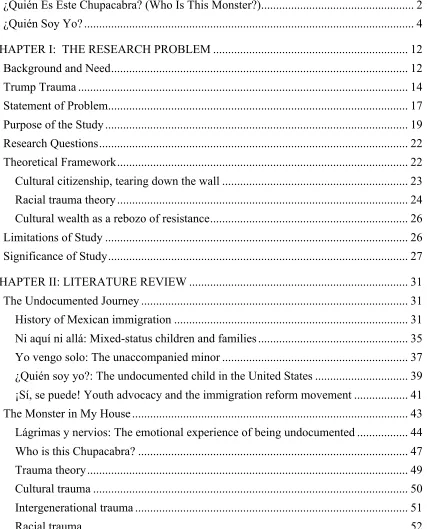
TABLE OF CONTENTS
Acknowledgements ... v
Table of Tables ... xvi
INTRODUCTION ... 1
¿Quién Es Este Chupacabra? (Who Is This Monster?) ... 2
¿Quién Soy Yo? ... 4
CHAPTER I: THE RESEARCH PROBLEM ... 12
Background and Need ... 12
Trump Trauma ... 14
Statement of Problem ... 17
Purpose of the Study ... 19
Research Questions ... 22
Theoretical Framework ... 22
Cultural citizenship, tearing down the wall ... 23
Racial trauma theory ... 24
Cultural wealth as a rebozo of resistance ... 26
Limitations of Study ... 26
Significance of Study ... 27
CHAPTER II: LITERATURE REVIEW ... 31
The Undocumented Journey ... 31
History of Mexican immigration ... 31
Ni aquí ni allá: Mixed-status children and families ... 35
Yo vengo solo: The unaccompanied minor ... 37
¿Quién soy yo?: The undocumented child in the United States ... 39
¡Sí, se puede! Youth advocacy and the immigration reform movement ... 41
The Monster in My House ... 43
Lágrimas y nervios: The emotional experience of being undocumented ... 44
Who is this Chupacabra? ... 47
Trauma theory ... 49
Cultural trauma ... 50
Intergenerational trauma ... 51
xiv
When trauma goes untreated ... 53
Resistance vs. resilience ... 56
Cultura cura: Healing spaces in our communities ... 59
A blessing way ... 60
Freedom bus ... 62
Flor de piña ... 63
El sistema: música y resistencia ... 65
Summary of Literature Review ... 67
CHAPTER III: METHODOLOGY ... 70
Research Design ... 71
Research Questions ... 74
Research Setting ... 74
Participant Selection ... 82
Cultural Considerations ... 83
Data Collection ... 84
Data Analysis ... 85
Ethical Considerations ... 86
Protection of Human Subjects ... 89
Participants in Research Study ... 89
CHAPTER IV: FINDINGS ... 98
My Testimonio Journey ... 99
Our Voices Together ... 103
Testimonio Moments ... 104
Ceremonia: Opening Sacred Space to Honor Palabras Shared ... 106
Theme 1: Psychological and Racial Battlegrounds of Trauma ... 108
Fighting against status, understanding the seeds of fear ... 114
The emotional war against racism ... 116
Standing against the negative narratives of Mexico ... 118
The wall of poverty ... 121
Victimization ... 123
Theme 2: Trump, Witches, La Migra, y Historias de Mi Alma ... 124
Trump trauma ... 126
xv
La Migra ... 130
Papeles ... 133
Theme 3: Escuela, We are Part of this World ... 134
Bullying in school ... 135
Ingles, mi segunda idioma ... 138
Navigating borders in school ... 140
Barriers to parent participation ... 141
Spirituality/Faith ... 142
Theme 4: Cultura Cura, a Temascal of Hope, 11 Millones de Sueños ... 144
Cultural arts as healing ... 145
Cultural citizenship & cultural pride ... 149
Hope ... 151
Connecting to familia in Mexico, nuestras raices ... 151
Somos familia, eres mi tocayo ... 152
Hay que bonito es mi tierra ... 154
Cuando sueñe el Mariachi el mundo canta ... 155
La danza y mi alma ... 156
Libros, libros y más libros ... 157
CHAPTER V: EN ESTE PAIS, MI PAIS, TU PAIS ... 159
Psychological and Racial Battlegrounds of Trauma ... 162
Exposing Trauma Narratives ... 164
Undocu-trauma ... 169
Basic Needs ... 171
Trump, Witches, La Migra, and Historias de Mi Alma ... 173
Undocu-trauma, the Brain Connection, and Escuela ... 175
Escuela, We Are in This World ... 176
Cultura Cura, Una Temascal con 11 Milliones de Sueños ... 179
Undocumented and Mixed-Status Cultural and Emotional Needs Theory for Latino Children ... 182
Future Implications for Expanded Research ... 186
xvi
TABLE OF TABLES
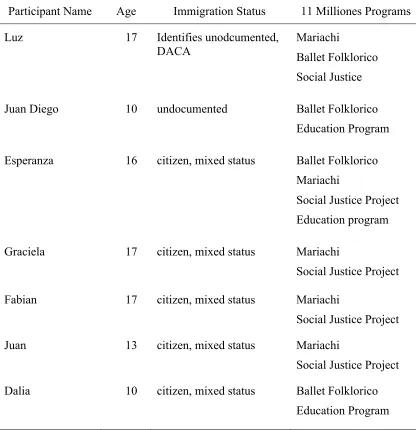
Table 1. Student Participants’ Age, Status, and Program Participation in 11 Milliones .. 90
Table 2. Parent Participants in Research with Immigration Status and Occupation ... 91
INTRODUCTION
I approach this dissertation as a Latina licensed clinical social worker and educator who has journeyed through hidden spaces witnessing stories of suffering,
tristezas, miedo, racism, and strength in undocumented and mixed-status children, all the while discovering Mariachi heroes, alegría, and zapateados along the way that have healed a community of children and inspired this dissertation. In my work and education, I have had the privilege of working with undocumented and mixed-status Latino youth who have opened my heart to see, hear, and understand the complicated emotional experiences they grapple with in silence on a daily basis. I have seen the fear in their eyes, and at the same time have witnessed these young people take center stage to transform an audience with their gritos of Mariachi pride and zapateados to the rhythms of Mexico. This research specifically addresses the emotional experiences of mixed-status and undocumented youth and at the same time to understand cultural arts as a healing intervention. In finding a way to narrate the power of the cultural arts to heal, this research explores one specific program that has concentrated its efforts on using ballet folklórico, Mariachi, education, culture, and social justice as a circle of healing in their community.
power. My hope for this dissertation is that the testimonios will push this community of children to center stage, shining the spotlight on how one non profit organization opened the doors for a community to unite behind these children and families using a
combination of the cultural arts, education, and social justice to uncover the cultural wealth of these folklore heroes. 11 Millones de Sueños in Northern California has captured the orgullo, esfuerza, corazón, and resistance of these youths while using a shield of cultural wealth to help them withstand the emotional suffering that has gone unrecognized for too long. Their participation in the program and their voice that has grown in the community has uncovered and ignited a cultural citizenship that extends beyond papers that is rooted in character, leadership, community service, comunidad, orgullo and Corazon para su familia. No longer afraid to be seen, these youth stand strong against the societal monsters that have attempted to dismantle their humanity.
¿Quién Es Este Chupacabra? (Who Is This Monster?)
As an educator and clinician, I dedicate this work as a counter-model of therapy that uses the power of cultura to support the healing of a community of children while creating spaces of cultural wealth, resistance, and cultural citizenship that rally against the societal injustices that have become the chupacabras in their home. The fear that many children have of the scary Mexican urban myth monster, La Chupacabra can be an analogy to consider the visible monster they fear of Immigration Customs and
An abundance of research exists that underscores the impact of trauma or post-traumatic stress disorder (PTSD) on brain development and academic functioning in children. Existing research makes clear the connection of trauma to neurological development, and the ways it impacts how children learn and engage with the world. This research study underscores the need for an urgent response to support both the emotional and physical development of children using culturally relevant practices that can have numerous healing benefits. The challenge is to expand our understanding of the notion of trauma, which may be unique for culturally diverse populations of children. Specifically, we must develop language that gives voice to the trauma of undocumented and mixed-status children while exploring this trauma’s connection to educational achievement. Until expanded research in education and psychology motivate our understanding of how this chronic fear, stress, anxiety, and the effects of societal racism have on undocumented and mixed-status youth, we cannot fully understand the
consequences these symptoms can have on the neurological, emotional, and educational development of these children.
This study also explores the use of cultural arts as indigenous counter-spaces of healing trauma that give these children a voice of collective pride and resistance and defines them as cultural citizens, rooting them in their community and identity.
¿Quién Soy Yo?
In this dissertation, I include my own testimonio as a Latina social worker in an agricultural community providing mental health counseling and support for both
undocumented and mixed-status children contending with chronic trauma that stems from racism, stigma associated with their immigration background and/or that of their families, and cultural, economic and social disenfranchisement. As a doctoral student in Education at the University of San Francisco my research has been inspired by cultural wealth theory, racial trauma and cultural citizenship, all of which recognized and give voice to the strengths and struggles of community of color. In my 18 years of working as a licensed social worker, specializing in working with Latino/a children who have experienced chronic trauma, the general areas I focused on within community mental health are domestic violence, abuse, and recovery from serious victimization. Over the years, I have witnessed first-hand the impact of trauma on children. I have also observed that, given support, care, and safe spaces, children are capable of healing and
transitioning from being victims to survivors.
As the years passed, I noticed patterns of behavior and took note of the many different experiences of Latino/a children I worked with in juvenile hall, schools,
Particularly, I wanted to focus on children who were struggling in school and who were undocumented, whose parents were undocumented, or were from a mixed-status home.
My private practice in a predominantly Mexican agricultural community with many hard-working families with strong family values opened my eyes to new
perspectives. My past work with community mental health limited my opportunities to be fully cognizant of whether clients were undocumented, in addition to their experiences with domestic violence, abuse, and other traumas. My immersion into understanding the psychological impact of a child’s immigration status grew as each case that was referred to me either consisted of a child who was a U.S. citizen with undocumented parents, or an undocumented child living with his/her family. Parents who attended counseling sessions displayed a great deal of courage in openly sharing their legal status with me.
Looking around at who fuels the economic engine of our community, it became obvious to me that the parents of the children I work with are the foundation of our Northern California tourism industry. Many of them work in the agricultural industry or well-known fisheries, while others support our thriving tourism industry at local
restaurants and hotels. Yet others work in community service sectors, such as schools, construction, daycare support, and much more. These families work tirelessly to provide for their families and children. Our community, like many others, is built and sustained on the hard work of Latino/a immigrants who consistently make the United States stronger.
As I listened to each story, similar patterns became apparent. Parents would share that their child was a buen niño or a good kid. They also expressed, Él/ella está dedicado a su escuela; Le gusta escuela, pero está batallando (He or she is dedicated to school; they like school, but they are struggling). They expressed that their children worked diligently at home on their homework, but were concerned about their overall academic
performance. Approximately three-quarters of children I have worked with identified behavioral challenges in school along with general complaints of not feeling good, feeling alone, worried, or experiencing low self-esteem and an overall feeling of tristeza, or sadness. Many also shared that their children had issues with anger or frustration that manifested while they were in school.
Outside of the school setting, parents identified similar symptoms in their
children. I was surprised to hear the same symptoms repeated in case after case. Parents described their child as “sick to their stomach” and experiencing “stomach pains” and unexplainable feelings of nausea. I referred each child who came in with these issues to a physician for medical evaluation. However, I learned that many children had already been seen by a general medical practitioner and were following up on the medical recommendation to seek out counseling services. Time after time, parents shared that their child’s medical results indicated no significant physical diagnosis. The frequent explanation for these physical symptoms was psychological stress.
parents and peers. Each parent I met was invested in their child’s well-being and wanted to be a proactive part of creating support networks for them. I began to gather weekly narratives from children and the parents, visiting them frequently at schools to meet with the children as well as school staff.
As I listened to the children and parents’ testimonios, I was struck by the hidden emotional toll they had suffered with for years. I began to see the similarities in clinical symptoms, behavior, and academic performance in many of the children. I also
witnessed and identified symptoms of trauma I had seen before in my practice. Over time, it became clear that the children in my practice were primarily suffering from chronic trauma, but I was also aware that many had not been direct victims of crime or serious accidents. As I began to delve deeper into their lives, I unraveled the common symptom shared by all of them: fear. The daily stress and fear of being separated from their parents due to the undocumented status of either one or both of their parents framed many of their daily experiences and interactions. While many of the children could not articulate their feelings through words, they shared their emotions through drawings and the telling of stories and testimonios.
play therapy training and attachment therapy models, I delved into all areas of play and work that focused on the latest neuroscience work. However, I never considered the trauma of fear about possible separation from the girl’s parents related to deportation until one day, after months of play therapy, she drew a picture for me of a “mama cat and a baby cat.” On the baby cat, she wrote the words “papers.” On the mama cat, she wrote the word “no papers” with a circle and an “x” over the words. With tears flooding her eyes, she shared with me the following story: “The baby cat is really worried what will happen to the mama cat when she is taken away because she doesn’t have papers.”
Until that moment, no one had been able to identify the source of the girl’s stomach pains or night terrors. It was in this moment that her words released the psychological flood gates of the reality of what she and many children live with daily. She spoke for the countless children who carry chronic trauma and fear with them daily in an invisible backpack. There is not a clear description of this type of trauma
experienced by children that I know of. In all my 18 years of counseling, I have not had a training model that identifies and teaches ways of working through these emotional experiences that are lived by these children and their families. It is through their eyes, their stories, and their resistance through the cultural arts that I have learned and am energized to write about healing spaces for this community. For the purposes of this dissertation and my work with these youths, I am using the term undocu-trauma to narrate the emotional symptoms experienced, as it relates to the specific fear of being separated from family, the fear of being undocumented, or having one or more
anxiety, fear, panic, chronic separation anxiety, and other emotional symptoms that directly impact the emotional experiences of these children and youth.
This little girl’s case and her bravery to speak of her fear marked a significant moment in how I came to understand this population, and provoked in me a need to redefine healing for this community of children. For this child and the many I have seen, they suffer from a rich cultural identity marked by societal inequities and political
oppressions that marginalize their identities and label them with a stigma as the other, the outsider, the immigrant, the criminal. In my clinical practice, it was clear that individual therapy was beneficial, but I began to wonder if this was enough. As I began to consider what unique needs this community needed to heal, I became increasingly aware that there was a glaring gap in our community related to cultural recognition of these children. In other words, there was nothing in our community that identified their cultural wealth as Mexicans/Mexican-Americans or honored them as significant for who they were as contributing community members. Rather, they were pushed to the margins of our town in low-income housing, the children were bused across town, passing two schools they could attend, to be placed at the furthest one away from their home. The consistent negative messages they received at school for being English-language learners insinuated that Spanish, their first language, was not valued. Finally, the societal message of
belonging includes having papeles, which reinforced the societal action of pushing these children aside.
justice advocacy that was needed for a deeper level of healing to begin. After years of building trust with community members, I began to work to build a cultural arts program that celebrates our Mexican culture in a space that lacks recognition of who we are. Using the cultural arts, our program birthed a space of resistance, cultura and healing that has inspired cultural citizens to come out of the shadows and lead our program of 11 Millones de Sueños forward. I have given this non-profit organization a pseudonym to protect the youth and families in my research study. The name 11 Millones de Sueños gives voice to the many individuals who are the backbone of our country, working tirelessly to make a difference in the workplace, in communities and within their familia.
11 Millones de Sueños recognizes the impact emotional disparities can have on both development and academic functioning. This work seeks to find alternative healing spaces birthed out of culture, the arts, community, familia, social justice, and resistance that gives hope and provides new culturally relevant methods of treatment and therapy for working with undocumented and mixed-status children and families. My research challenges academia to further consider the impact of the mental health of our Latino and mixed-status children on their educational advancement. It forces us to recognize
arts can transform these youth and create spaces of cultural citizenship is necessary and imperative, giving them cultural superhero powers needed to fight against the
chupacabra of fear.
CHAPTER I: THE RESEARCH PROBLEM Background and Need
population. In addition, youth-led activism, the DACA program, and an increased push for immigration reform in Washington, D.C. have all invigorated dialogue on issues of education, poverty, and health care as they relate specifically to the experiences of
undocumented young people. Along with the wave of activism calling for reform, we are also witnessing one of the worst eras of anti-immigrant rhetoric in U.S. history. Our contemporary moment is marked by greater border entrenchment and increasing anti-immigrant sentiment and legislation across the country that vilifies undocumented families.
The heightened focus on immigration reform and migration as a human right, while necessary and critical in many ways, is largely devoid of conversations regarding the psychological struggles and mental health needs of undocumented Latino/a youth and children, including those who are part of mixed-status families. Daily experiences of undocumented youth and children with trauma, fear, racism, and anxiety have largely gone unacknowledged by mental health professionals, educators, and others, as is evident by the minimal research available. The drive for basic survival in a society that has criminalized the undocumented population has overshadowed the psychological toll that many live with silently.
or have others ask questions. They do their best to blend in and disappear because there is safety in not being noticed (Androff, Ayon, Becerra, Gurrola, Salas 2011). Immigrant rights activists have ignited a movement to demand a change in policies. Nonetheless, the study of mental health implications of how stressful experiences can lead to a number of negative emotional and behavioral outcomes for undocumented children – including anxiety, fear, depression, anger, and social isolation – has been limited.
According to Chaundry, Capps, Pedroza, Castañeda, Santos, Scott 2010), In the short term, six months or less after an arrest, about two-thirds of children experienced changes in eating and sleeping habits. More than half of children in our study cried more often and were more afraid, and more than a third were more anxious, withdrawn, clingy, angry, or aggressive. (p. 23)
It is imperative to understand the psychological implications for Latino/a children living under this type of stress. It is also critical to highlight the many ways structures,
institutions, and ideologies both contribute to the chronic trauma experienced by these children, and function to silence them.
Trump Trauma
are continuously scratched open by societal injustices can have significant and long lasting consequences if we do not take action to create community healing spaces. The wall that we must build is our own cultural resistance to protect a community with steel enforcements of cultural wealth and a concrete foundation of indigenous knowledge that grounds us in collective healing. Six years ago, when I began this research, I saw
glimmers of hope for immigration reform, the possibility of making dreams come true for millions. Sadly, this hope turned to shock during what I witnessed as the harshest
political rhetoric that has demonized and plagued our immigrant communities with a fear that is energized by a political agenda focused on silencing immigrants, the
undocumented community, women, Muslims, the LGBTQ community, and anyone else considered to be the other.
Even in the face of all of this xenophobic rhetoric, undocumented students and youth are rising up across the United States and declaring themselves “undocumented and unafraid.” The immigrant community can no longer can we wait for immigration policies to make the difference. Sanctuary cities are not going to be the sole saving grace from ICE raids or forced deportation. Comunidad must become sanctuary to these youth. The action must come from a collective effort to create culturally relevant community spaces of healing. In order to have strength to withstand the anti-immigrant forces, our
communities must be unified, prepared and emotionally cared for by each other. Of particular importance is that of our children, we must be on the front lines ready to find ways to shield them from this undocu-trauma. We must understand and return to
own temescals of cultural healing and resistance for these children, families, and ourselves. There must be a continued movement on the front lines to create sanctuary from within, using our professions as teachers, counselors, educators, elders, along with our indigenous practices, nuestro orgullo, y nuestra cultura para sanar.
I hope to contribute to this movement by shifting these powerful youth
testimonios from the margins, a position they occupy all too often in their lives, to the center. Furthermore, I hope to center their voices to understand how the cultural arts can be used para sanar (to heal), proposing the notion of cultura cura as a purposeful direct practice for healing the open wounds society has cut open in these children, creating the monster they fear.
In finding a way to narrate the power of the cultural arts to heal, this research explores one specific program that has concentrated its efforts on using ballet folklórico, Mariachi, education, culture, and social justice as a circle of healing in their community. This research opens doors to understand how cultural wealth, resistance, identity, the arts, and social justice practices combine to create a space for healing a group of children in a Northern California community non-profit program. With no funding or initiatives to begin, 11 Millones de Sueños began with a grass roots effort to develop a cultural arts program that infuses a combination of the arts, education, counseling and community leadership that has molded a rich experience of youth transformation and resistance. 11 Millones de Sueños has shown the spotlight on these youths with the shout of presente!
before them, their voices and danza stand as a collective resistance to being silenced of culture and identity. With chants of “build the wall” echoing loudly on the political front, 11 Millones de Sueños has broken down border walls to create a community cultural arts
temascal to celebrate, honor, heal and rise as leaders in the community. We can no longer ignore the healing that this population of children demand; it is time to further the research and development of community programs that will support the emotional crisis of this community of children to uncover their dreams for a better life.
Statement of Problem
With the growing population of Latinos/as in the United States, there is an increasing need for culturally specific mental health research and practice. Latino/a mental health research continues to have significant gaps, especially in the area of working with undocumented and mixed-status children. In sharp contrast, the field of education boasts an abundance of scholarship focusing on Latino/a children and disparities surrounding issues of race, health, and economic barriers (Androff, Ayon, Becerra, Gurrola, Salas 2011) There is a growing body of research that focuses
community, it is important that the mental health field understand the power of cultural arts and traditions be used as a specific healing methodology to treat trauma in Latino communities.
In recent years, scholars at Harvard, Baylor, UC Davis as well as other
universities have generated research and medical recommendations for the general child population with trauma histories. Yet, what is missing are studies that explicitly focus on the mental health of undocumented or mixed-status Latino/a children. Studies also lack focus on the impact of chronic trauma stemming fromracial profiling, ongoing
discrimination, fear of immigration raids in their communities and forced separation of families etc. These phenomena can significantly impact the emotional and physical development of Latino/a children. Conradi (2007) notes,
Just as the research understands the profound connection between trauma and academic performance for the general population (Schore 2001) so too must the literature reflect the same interest in undocumented and mixed-status Latino children. In addition, we must continue to explore alternative ways to support healing for these children and families through culture, arts, advocacy, and a commitment to honoring them for the most important papers they hold, that of strong cultural citizens with an abundance of cultural wealth that makes America great every day. Specifically, this research looks at how one program’s combination of the Mexican cultural arts of ballet folklórico, Mariachi
education, and music combined with social justice advocacy and education has become a powerful temascal of healing and transformation for a group of children and families.
Purpose of the Study
The main purpose of this study will be to use testimonios to analyze how community spaces – in the form of cultural arts, education, and social justice – support undocumented and mixed-status children of Mexican immigrants in an agricultural community to engage in the process of healing from chronic trauma. In other words, the cultural arts will serve as entry point to document how children involved in a local community program are empowered to explore the psychological “monster” that takes the form of fear, panic, stress, and anxiety of the looming threat of having their families suddenly separated. The presence of the monster in these children’s lives is often evident in the mental health symptoms they exhibit in school and at home, such as fear of the dark or something menacing lurking in the closet or under the bed. Most children outgrow these fears as they transition into young adolescence. However, for
legend of the Chupacabra, come alive with fear of sudden separation from family or a persistent feeling of not belonging that is perpetuated by pervasive criminalization of undocumented immigrants and anti-immigrant rhetoric.
Children that have lost a parent through deportation experience a complete loss of a significant attachment and caregiver in their lives. The sudden grief they experience is life-altering. It is critical to understand and consider the psychological harm that happens to a child and the impact on their development when a parent is involuntarily torn from the family. To further compound the trauma of deportation, it is often true that the parent and child have relatively no or very limited physical contact when they are separated from one another. There is a general assumption that most undocumented children are impacted most by the fear of deportation. However, this is also a reality in the case of mixed-status families with a child who is a citizen and is equally impacted by fear of deportation of an undocumented parent.
This study represents an opportunity to give voice to the psychological
experiences undocumented and mixed-status children live with and provides a framework to explore emotional conditions that I have witnessed but have not been able to
conceptualize. This study will seek to challenge and expand the consideration of psychological implications of trauma in a group of children. Finally, this study delves into the experience of youth and families in the program of 11 Millones de Sueños to understand how the cultural arts, social justice, education, cultural citizenship and the honoring of the cultural wealth of a community becomes an indigenous healing space to address the emotional and social disparities of this population. The Mexican arts of
evidence of how the arts can break through the chains of social stigma and oppression that can minimize the cultural wealth, leadership, and power these youths are born with. No longer are they seen as the “other”; rather, their smiles, poise, songs, stage presence, and folklórico pride demonstrate the passion of being proud of who they are. There are no papers to monitor their identity or that of their family; their trajes rich with color and movement honor the legacy that Mexico has had both in the United States and in the world. As Director Carlos Martinez of the well-known Mariachi Vargas said, “When we sing Mariachi in whatever part of the world we are in, we are the flag of Mexico” (C. Martinez, personal communication, December 3, 2016).
It is both the emotional experiences, resistance and the cultural strength of these
undocumented and mixed-status children that I have captured using their testimonios in
this study. In naming their fear and the traumatic conditions they suffer, they have
uncovered ways to show others how they raise their voices in an attempt to assert their
humanity. In the words of one youth, “When I speak, I want people to feel the pain that I
go through, see the reality of what we all have to struggle with, we need to raise our
voices to speak” (Hernandez-Arriaga, 2012, p. 75). In one rural Northern California
community, these same youth voices are rising out of the shadows using the cultural arts
as a space to create resistance, solidarity, community, and healing as they dance and sing
unified with the power of the arts. Through the zapateados of the regional dances of
Mexico, dressed with the charro-inspired trajes of Mariachi, these youth voices have
transformed one community into advocates, reclaiming pride in their culture, honoring
the rich traditions of their families, and refusing to hide their culture in the shadows.
healed, inspired, and unified a community of immigrant Latino youth, both from
mixed-status and undocumented experiences. These youth voices magnified through the arts are
emphasizing a cultural resistance to counter the fear and trauma, moving forward to
create indigenous counter-spaces of cultural therapy and heal as a community con orgullo
ycultura.
Research Questions
The questions that this research addresses are the following:
1. What are the experiences of undocumented and mixed-status youth as expressed through their testimonios?
2. How do youth and their families demonstrate pain, hope, and resistance in the face of trauma and what is the cultural wealth that sustains them? 3. How does 11 Millones de Sueños’ combination of cultural arts, education,
and social justice advocacy provide collective and/or individual healing spaces for youth in the program?
Theoretical Framework
arts as a shield for their soul. For the purposes of this study, Latino critical race theory grounds the research in understanding how race, racism, social class, and political labels of identity and influence impact emotional states in Latino youth. To understand the psychological consequences that can present themselves as a result of chronic
experiences with racism and continuously being placed in the category of the “other,” racial trauma theory offers a relevant and emerging concept regarding the psychological impact of racism.
Cultural citizenship, tearing down the wall
The framework for this research is grounded in cultural citizenship theory and its connection to healing, resistance, advocacy, and a rooted belonging in community. It is vital to understand the importance of being rooted in spaces that allow for one to reclaim their humanity of belonging and contributing to the greater society regardless of status. Cultural citizenship embraces one’s humanity and cultural wealth, shutting down the political agenda that only acknowledges belonging as having legal status. Renato (1994) developed this notion of cultural citizenship
as how Latinos conceive of community, where they do and do not feel a sense of “belonging,” and how they claim rights to belong to America. In our view, the process of claiming rights both defines communities (Rosaldo 1989) and comprises a renegotiation of belonging in America. Latinos' identity is, in part, shaped by discrimination and by collective efforts to achieve full membership for themselves and their culture. (p. 57)
individual strengths of the community, recognizing the indigenous assets and mestiza knowledge they own as a people. In 11 Milliones de Sueños, individuals, families and children stand strong with their bandera of culture and identity that recognizes their voice and their movement to reinforces a sense of belonging that is institutionalized as a strong cultural community with a vision that goes beyond status. Cultural citizenship disrupts the societal acceptance that only legal status allows you to be a citizen. For 11 Milliones de Sueños and for the millions of undocumented in this country, cultural citizenship stands as a beacon of humanity and affords each individual the right to claim their own founded citizenship in this country. Psychological walls are able to be torn down when there is a full acceptance of individuals for who they are, minimizing the daily societal vilifications that plague the undocumented community. Creating spaces of reclaiming a country that was once Mexico, cultural citizenship lifts up the voices of a community that can no longer accept the status quo of not belonging, rather they are lifted up individually to acknowledge the strengths and contributions they give the United States every day.
Racial trauma theory
community explains, “When the moderating effects of type of psychological outcome (e.g., depression, anxiety, somatization, PTSD) are examined, the findings lend support to theorists who are calling for experiences of racism to be considered within the context of trauma” (Carter, 2007). This concept of racial trauma is a new field of study that speaks to the daily chronic emotional struggles of a community plagued by racism.
The reality that racism extends itself beyond culture to include the political marginalization of a group of people in this country is visible and felt by many. The connection between race and traumatic stress is necessary to understand and
acknowledge as a staggering symptom in the emotional well-being of undocumented or mixed-status families. The statements in the political arena by Donald Trump
Cultural wealth as a rebozo of resistance
The third theory that frames this research is cultural wealth and its connection to healing, resistance, advocacy, and the bridge to cultural citizenship. It is vital to
understand the embracing of culture as both a protective and healing tool for the community of children and families in this study. Further, it is imperative to
acknowledge how cultural wealth informs the community that is actively engaged in creating healing spaces for themselves every day. The cultural wealth model represents a
rebozo of strength. This model narrates all that is familia, culture capital, language, and aspirations that drive the Latino community to navigate a society that will embrace their humanity (Yosso, 2005). Cultural wealth molds the concrete of resistance for people to stand against the status quo of social inequities that dehumanizes them. It also gives voice to the collective and individual strengths of the community, recognizing the indigenous assets and mestiza knowledge they own as a people. Cultural wealth theory breaks down the deficit model that often frames the negative societal perspective of the undocumented community. Using a spotlight of pride and strength, cultural wealth theory ignites a new dialogue that honors respeto, humildad, esfuerza and embraces the spiritual and cultural wealth of this community as they stand firm on nuestra tierra.
Limitations of Study
purposefully used and written about how the cultural arts have healed the undocumented community. While we know that cultural arts programs around the country are critical to the well-being of children and communities, what is less researched is how they exist as a healing space and as a specific therapeutic modality for this specific population of
children. The limited research does not mean that the phenomenon does not exist, but rather signals that there may be a minimization of the power of the arts as a form of cultural therapy for this community. This study would benefit from additional research that provides qualitative data to understand the emotional and psychological symptoms undocumented and mixed-status children suffer from and new cultural interventions for healing.
A final limitation of this study is that the participants and program explored in this study is located in the progressive area of Northern California. While the community where the research was conducted is a more conservative area of the region, there are still spaces of advocacy that undocumented individuals living in the Bay Area can access. This advocacy does not erase the fear they live with; however, there may be unique experiences that other undocumented individuals live with in other parts of the country in predominantly Republican regions where anti-immigrant sentiment is even higher. For example, it would be important to conduct similar studies in regions of the South, where undocumented and mixed-status children may feel a greater sense of alienation with fewer ally voices and spaced in their midst.
Significance of Study
large group of children and families. The debate on immigration reform has come to occupy a central position in political and social discourse. Nevertheless, the political discourse is largely devoid of discussions about the very real impact of chronic trauma on undocumented and mixed-status children. These children internalize the feeling of being labeled as “other” and often live isolated from their peers who are citizens. The
demonizing of their parents as “rapists, criminals, and sometimes, good people” (as Donald Trump said on the campaign trail in 2016) reinforces the negative messages of marginalization. Coming out of the 2016 election, Latinos have stood on the front lines of an assault on their character and culture. This escalating societal stigmatization causes some children to live in constant fear of friends and peers revealing their immigration status or questioning their cultural citizenship. These experiences can build a mountain of shame that further contributes to feelings of isolation, depression, and chronic fear that can drive them to hide their cultural identity. Messages of inclusiveness, cultural pride,
orgullo, strength, and leadership are silenced or become muted whispers for these children and their families. However, it is clear that when given the opportunity, these children are overflowing with knowledge that can be used to understand how to stay emotionally strong when fighting the societal monsters of racism, oppression, trauma, and fear.
In lieu of waiting for immigration laws to change, the community spaces of these children and the cultural arts are utilized to heal this community. The rich culture of ballet folklórico, Mariachi, and indigenous celebrations that are used to revive our
significance of this research lies in defining, naming, and understanding how these spaces can heal the emotional trauma of this specific group of children and families. These cultural arts should be further understood by the counseling and social work profession as medicine for the soul, with properties that restore the brain-body balance and can add significant contributions to cultural sensory motor practices that impact the
neurodevelopment of these youths. This study seeks to redefine the cultural arts as a practice of healing with critical cultural wealth properties that can impact the brain, heal undocu-trauma, and redefine new ways of understanding culturally relevant sensory motor interventions in the neuroscience treatment of trauma.
Gathering testimonios on the impact of being undocumented or mixed-status children in a rural community explores cultural resiliency and understands what is needed for these children to engage in healing that strengthens identity and creates critical spaces of community. Witnessing their suffering and strength has given me the opportunity to contribute to the field of psychology and education by providing a deeper understanding of the psychological consequences that arise as a result of marginalization. This study provides a gathering of stories and cultural immersion that I hope will help immigration activists and advocates envision new strategies for improving the lives of undocumented children and families in the United States. This work contributes to the field a new way of conceptualizing the cultural arts as a clinical therapeutic intervention, with a new focus on understanding their connection to sensory motor development and the treatment of trauma in Latino children.
Latino/a children are living with each day. Therefore, it is critical to expand research that explores the undocu-trauma experienced by these children. This research also identifies tools mental health professionals who work with undocumented and/or mixed-status children can use in their practice, including testimonios and cultural arts. Through these youth testimonios we are able to understand the significance of embracing culture, traditions, art, familia, and comunidad as a healing space. Finally, this research
CHAPTER II: LITERATURE REVIEW
This literature review is divided into four main sections. The first section highlights the history of Mexican immigration to the United States and provides an overview of the youth immigration advocacy movement. The second section focuses on psychological stressors and trauma related to undocumented status. The third section focuses on literature on healing and recognition of resistance in undocumented and mixed-status children,and the final section speaks to the cultural arts as a healing practice that contributes to the healing of this community of children.
The Undocumented Journey
I walked for four days on my own, the coyote left me behind, I was left to die. I saw snakes, almost got bit, almost died. I ate nopales so I wouldn’t starve to death. When I couldn’t walk no more and was about to give up, I thought of my children in the U.S. I looked up to the sky, prayed and rain started to fall. (Father of a child in the 11 Milliones program, January 15, 2016.)
History of Mexican immigration