CLOUD ENVIRONMENT
by
Jake Douglas
A thesis
submitted inpartial fulfillment
of the requirements for the degree of
Master of Science inComputer Science
Boise State University
DEFENSE COMMITTEE AND FINAL READING APPROVALS
of the thesis submitted by
Jake Douglas
Thesis Title: Querying Over Encrypted Databases in a Cloud Environment
Date of Final Oral Examination: 8th March 2019
The following individuals read and discussed the thesis submitted by student Jake Douglas, and they evaluated the presentation and response to questions during the final oral examination. They found that the student passed the final oral examination.
Jyh-haw Yeh, Ph.D. Chair, Supervisory Committee
Yantian Hou, Ph.D. Member, Supervisory Committee
Min Long, Ph.D. Member, Supervisory Committee
The adoption of cloud computing has created a huge shift in where data is
processed and stored. Increasingly, organizations opt to store their data outside
of their own network to gain the benefits offered by shared cloud resources. With
these benefits also come risks; namely, another organization has access to all of the
data. A malicious insider at the cloud services provider could steal any personal
information contained on the cloud or could use the data for the cloud service
provider’s business advantage. By encrypting the data, some of these risks can be
mitigated. Unfortunately, encrypting the data also means that some commonly used
operations, such as equality testing or search, do not work because encryption also
obfuscates these properties.
This thesis proposes a system that allows for data to be encrypted with a minimal
impact on data accessibility and usability in its encrypted format. This is achieved by
carefully selecting the encryption methods used with the goal of preserving properties
of the data that are required for the SQL server’s functionality. By preserving only
order, equality, and the ability to perform addition, common data operations can still
be performed. The system was implemented in Java as a proof-of-concept to show
that the encrypted data is still operable on, and to compare it to existing systems.
The impact from implementing this system on the database size, query encryption
and decryption time, and data security is measured and compared to a similar system,
showing that it is feasible for use.
ABSTRACT . . . iv
LIST OF TABLES . . . viii
LIST OF FIGURES . . . x
1 Introduction . . . 1
1.1 Objective of this work . . . 3
1.2 Motivation . . . 3
2 Related Work . . . 5
2.1 Early Attempts . . . 5
2.2 Enterprise Solution . . . 5
2.3 CryptDB . . . 6
2.4 Tree-Based Solutions . . . 8
2.5 Hardware-Based Soltions . . . 8
2.6 Secure Multiparty Computing . . . 9
3 Cryptosystems . . . 10
3.1 Paillier Encryption . . . 11
3.1.1 Derivation from the Original . . . 12
3.1.2 Hardness of the derivation . . . 13
3.2 Boldyreva’s Order Preserving Encryption . . . 13
4 Description of the System . . . 16
4.1 Definitions . . . 16
4.2 Access Models . . . 16
4.2.1 Web Server Model . . . 17
4.2.2 Decentralized Model . . . 17
4.3 Encryption Types . . . 18
4.4 Walkthough of Software . . . 20
4.4.1 Key Store . . . 21
4.4.2 Encrypted Data Format . . . 21
4.4.3 Select Statements . . . 23
4.4.4 Substring Matching . . . 24
4.4.5 Insert Statements . . . 26
4.4.6 Update Statements . . . 27
4.4.7 Delete Statements . . . 28
4.4.8 Create Statements . . . 28
4.4.9 Alter Statements . . . 29
5 Experimentation . . . 30
5.1 Experimental Method . . . 31
5.2 Space Overhead . . . 31
5.3 Timing Overhead . . . 33
5.3.1 Initial Database Creation and Insert Statements . . . 33
5.3.2 Select Statements . . . 34
5.3.3 Update Statements . . . 44
5.4 Security . . . 49
5.4.1 Confidentiality . . . 49
5.4.2 Authenticity . . . 50
5.4.3 Integrity . . . 51
6 Conclusion . . . 53
6.1 Limitations . . . 54
6.2 Future Work . . . 54
REFERENCES . . . 56
A Select Statement List . . . 60
A.1 Where Clause List . . . 61
A.2 Join List . . . 62
B Update Statement List . . . 63
C Delete Statement List . . . 65
D Employees Database Table and Column List . . . 67
5.1 Size comparisons among encryption schemes. . . 32
5.2 Time comparison for encrypting the same database among encryption
schemes. . . 34
5.3 Size increase of returned data. . . 35
5.4 The impact of the various systems on the time taken to retrieve
infor-mation from the database. (Tabulated data from Figure 5.1a). . . 37
5.5 The methods’ effect on throughput speed. Throughput is represented
as bytes per second. . . 38
5.6 The impact of the various systems on the time taken to retrieve
in-formation from the database when a “where” clause is added to the
query. (Tabulated data from Figure 5.2). . . 40
5.7 The impact of the various systems on the time taken to retrieve
infor-mation from the database when a join clause is added to the query.
(Tabulated data from Figure 5.5). . . 43
5.8 Time taken to compute the sum of the salary column with a total of
2844047 rows. . . 44
5.9 Time taken to count the number rows in the salary column with a total
of 2844047 rows. . . 45
5.10 The impact of the various systems on the time taken to update
infor-mation in the database. (Tabulated data from figure 5.6) . . . 46
5.12 The impact of the various systems on the time taken to delete
infor-mation from the database. (Tabulated data from Figure 5.7) . . . 48
3.1 An illustration of order preserving encryption. . . 14
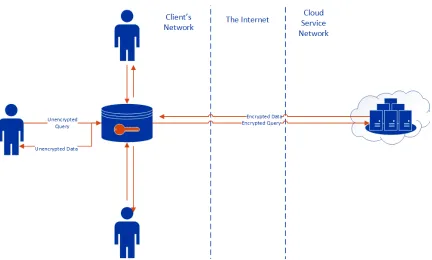
4.1 A centralized web server model. . . 18
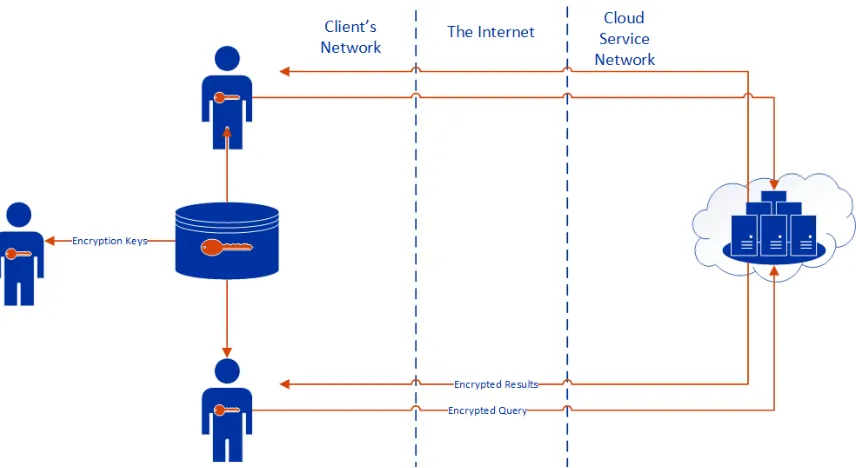
4.2 A distributed key-sharing model. . . 19
4.3 An example of the table the keys are stored in. The keys are truncated
due to their length. . . 22
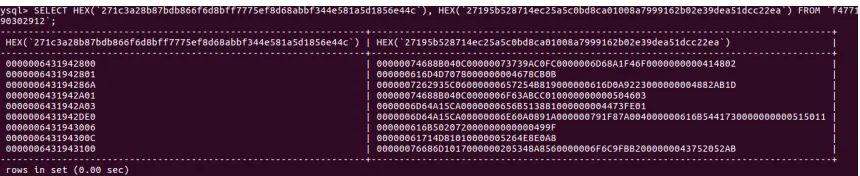
4.4 An example of data stored in it’s encrypted format. . . 22
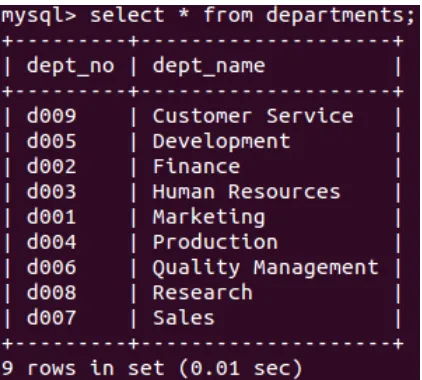
4.5 The same data as Figure 4.4 in its unencrypted format. . . 23
5.1 Average query execution times as the number of returned rows
in-creases for select statements. Note that the x-axis is in log scale, so
the linear increase in time appears to be exponential. . . 37
5.2 Average query execution times as the number of returned rows increases. 40
5.3 The difference between a plain select statement and a select statement
with a where clause. CryptDB shows a greatly reduced time because
the encryption level changed. See 5.4 for an equal comparison. . . 41
5.4 The difference between a plain select statement and a select statement
with a where clause when CryptDB is at a lower encryption level. . . 41
5.5 Select queries with joined tables. . . 43
5.6 Update statements as the number of rows affected increases. . . 46
of data being removed increases. . . 48
CHAPTER 1
INTRODUCTION
Data storage in a cloud environment is extremely popular and offers benefits to
organizations of all sizes. Gartner, a research group, predicts that global public cloud
revenue will grow 17.3% to $206.2 billion in 2019 [9]. Any amount of data stored by
an organization, and the services that rely on that data, can take advantage of the
security, reliability, and scalability provided by cloud services. For example, smaller
organizations that host online content often won’t have dedicated security engineers
or experienced server technicians, which can lead to vulnerabilities. Misconfigured
servers were number six in the Open Web Application Security Project (OWASP)
Top 10 vulnerabilities in 2017 [40]. Even large organizations often lack the required
security workforce: the 2017 Global Information Security Workforce Study by Frost &
Sullivan, a business consulting firm, revealed that 66% of 19,175 respondents said that
there were “too few information security workers in my department” [7]. Outsourcing
a database to the cloud allows for at least some of the risk to be mitigated since the
cloud service provider will have security engineers on staff, reducing the possibility of
a data breach by an outside attacker.
Additionally, hosting data in a cloud environment also allows for improved
relia-bility and scalarelia-bility in the event of a power outage or natural disaster. Major cloud
Azure’s geo-redundant storage [8] or Amazon Web Service’s Disaster Recovery plan
[43]. During normal day-to-day operation, data centers are capable of handling large
amounts of network traffic. Some businesses, especially small and home businesses,
may not have the capacity to process large amounts of data on their own network.
They also allow for quicker scaling since resources can be almost instantly expanded or
reduced based on current traffic. For a business-critical application, a long downtime
caused by an influx of new customers or small bandwidth could result in lost profits
and reduced competitiveness. For large data sets, an important consideration is that
cloud storage is much cheaper than physical storage. For this reason, many large data
sets are outsourced to the cloud.
Using these services does not come without risk; while attacks from outsiders
might be mitigated, the data owner is trusting another entity with their data.
Log-icMonitor, a cloud configuration platform, surveyed 283 professionals and found that
66% reported security as a major challenge in cloud adoption [3]. In some cases,
such as storing personal information or credit card data, it might be unwise. In
others, such as secret government data or certain types of personal information, it
could be illegal. Encrypting the data allows users to gain the benefits of cloud service
without exposing their data to potentially malicious actors. However, encrypting data
without regard to how it will be processed causes some problems with the usability
of the data: encryption destroys certain properties of data. For example, encrypting
multiple messages using the RSA encryption scheme means that the messages can’t
be sorted or summed, but can still be multiplied [42]. Encryption using AES means
that all properties of the data are destroyed, rendering it equivalent to a random
1.1
Objective of this work
By leveraging the properties that are preserved after certain types of encryption, we
aim to build a database encryption scheme which allows for operation on the data
while it is still encrypted. The goal is to create a system that is transparent to
the database server which also provides confidentiality using a minimum amount
of additional resources. In this context, transparency means that the database
management server (DBMS) does not need to be modified for the software to function.
This is important to allow the system to be used on a commercially available public
cloud database system.
1.2
Motivation
The use case scenario for this thesis is a database system used by only one
organi-zation. The organization might want to put their data on the cloud for a variety of
reasons, including low start-up costs, quick scaling, or geographic redundancy. A few
possible scenarios could be:
• Email server: Emails may contain sensitive company or personal information
• Web shop back end: Customers’ credit card and address information are likely stored
• Personal data in a smart city: Some information might be applicable to group computations (weather, traffic volume), but other information (license
plate numbers, facial recognition data) should not
Email servers and web shops are both areas where the high availability afforded by
Downtime for a web shop directly leads to lost sales, especially when another provider
is likely a few clicks away. In a business setting, a lack of access to email can lead to
a loss in productivity.
Smart city systems is a growing area where sensitive private data is being stored
on cloud servers. In a smart city, data is collected from various sensors including
surveillance cameras, traffic congestion sensors, and fire detection sensors. Since
they are often running all the time, these sensors can generate a large amount
of data that might become costly for a government entity to store. While some
data may not be sensitive (e.g. air quality, temperature), other types of data may
contain personally identifiable information, such as license plate numbers, movement
tracking information, or video feeds. AWS provides support for integrating city
government functions into their cloud environment. City governments are already
using this service to store their information, including the New York City Department
of Transportation, the Singapore Land Transport Authority, and the City of Chicago
[2].
These use case scenarios support the need for a database structure where only
one organization is accessing the data. This is in contrast to privacy-preserving
CHAPTER 2
RELATED WORK
Other methods to preserve the confidentiality of a database have been proposed in
the past. They range from encryption schemes without regard to SQL operations to
complex interactive tree-based systems.
2.1
Early Attempts
Hakan Hacig¨um¨u¸s’ 2002 paper [23] is an early example of attempts to solve this
problem. It has a similar general setup as both this system and CryptDB [39], but
relies more heavily on client-side processing than either system. This becomes a
major disadvantage as the size of the data grows. The large ciphertexts need to be
transported to the client to be decrypted and filtered. This also severely weakens one
of the advantages of cloud computing: increased processing power.
2.2
Enterprise Solution
Microsoft Always Encrypted offers client-side encryption integrated directly with
Azure. Sensitive columns can be encrypted with either deterministic or random
encryption. Advanced Encryption Standard (AES) is used to encrypt all values
in this system. When random encryption is being used, the initialization vector
of the plaintext value is used as the IV. Encrypted columns are accessed through
special drivers installed on the client’s computer, which perform the encryption and
decryption. Columns with random encryption can’t have any operations performed
on them besides a plain select and cannot be used in any statement’s clauses. Columns
with deterministic encryption can be used for equality testing and as primary keys,
however other comparisons (e.g. order, substring matching) are not available. There
are also no homomorphic encryption options, meaning functions like sum or average
would be performed on the client machine. Instead, Always Encrypted does not
support any mathematical operations on encrypted data.
2.3
CryptDB
CryptDB [39] approaches the problem in a similar manner as this paper, but with
more complexity. All data is encrypted up to seven times to achieve different security
properties. For example, a string would be encrypted, then that ciphertext would
be encrypted, then that ciphertext would be encrypted again, creating three “layers”
of encryption. Together, the multiple layers of encryption are called an “onion”.
The same string would be encrypted again three times with different methods of
encryption to form a second onion, then separately encrypted again one more time.
This results in three cipher texts (three onions) representing the same data, and seven
encryption keys that need to be stored per column. Any sensitive portions of queries
over this data also need to be encrypted up to three times and data returned will need
to be decrypted up to three times. As sensitive properties of the data are required
for the database server to perform a query (e.g. order, equality), the data will be
user passwords as they log in so that a compromised client server doesn’t release keys
of not-logged-in users.
The system outlined in this thesis takes a simpler approach with less initial security
guarantees, but similar guarantees to CryptDB after the system has been in use.
The system in this thesis encrypts and stores data only once or twice per datum
depending on the data type. This gives faster processing times per query and lower
space requirements (see section 5 for a comparison). When the client pays for their
data storage based on its size or network usage, the costs can quickly add up when
the data is inflated. The per-query execution time is also lower, meaning constantly
faster queries. As the system is used, the ciphertexts can reach their lowest layer of
encryption, meaning that CryptDB would provide no additional security guarantees
while still requiring additional storage and processing power.
Finally, CryptDB cannot be adapted for use in many popular cloud systems
because of its dependence on User Defined Functions (UDFs). UDFs are SQL
func-tions written in C or C++ that are added to the server but do not require the
recompilation of the DBMS. CryptDB uses UDFs for changing the layer of encryption
(i.e., decrypting the onion to reveal a ciphertext with more properties) on a given
column and other operations. Popular cloud DBMSs, including Microsoft Azure
and Amazon Web Services (AWS), don’t allow for the installation of UDFs on their
database-only services (such as AWS’s Relational Database Service) as not to allow
untrusted software run on a shared resource (the underlying server). In order to use a
cloud service, one must instead use a virtual machine with their SQL server of choice
installed. This preserves many of the benefits of cloud computing, but does not allow
2.4
Tree-Based Solutions
Poddar’s, Boelter’s, and Popa’s Arx [37]; Egorov’s and Wilkison’s ZeroDB [19];
and Popa’s, Li’s, and Zeldovich’s encryption scheme [38] encrypt all data with the
randomized AES encryption scheme and use encrypted tree structures to perform
operations over the data. The DBMS remains unmodified, but two additional servers
are required: a client proxy server that rewrites queries and a server proxy that
performs interactive tree traversals with the DBMS. The storage and time penalties
for the extra trees and the encryption are high. In the case of Arx, the encrypted
database is approximately sixteen times larger than the original database. ZeroDB,
a commercial solution, can require multiple decryptions, interactions between the
server and client, and traversals of a B-tree for a single query. This introduces a high
performance penalty and network load.
2.5
Hardware-Based Soltions
TrustedDB [14] and Cipherbase [13] use a trusted hardware extension of the server to
process sensitive data. This allows for faster execution of queries as they don’t need
to be transformed before they are handled. The queries are either handled by the
tamper-proof hardware or are forwarded to the regular query processor if they don’t
contain secret data. Using the secure processor does incur a performance penalty, but
it is less than encryption-only systems. This system requires that a secure module is
allowed to be integrated into the system, which is not possible when using commodity
2.6
Secure Multiparty Computing
Secure multiparty computing, or privacy-preserving computing, is a related but
dis-tinct research area: the product of this thesis would be used to secure a production
database where the data is owned by a single entity or shared between entities where
data does not need to be hidden. Privacy-preserving computing, on the other hand,
is used to generate aggregate information from data sets with different owners. For
example, Wang et al. [45] is a system to allow a third party auditor to access an
organization’s data to ensure integrity. In the use case for this thesis, allowing an
external user to do any kind of analysis of the data should not be allowed. This is
CHAPTER 3
CRYPTOSYSTEMS
Multiple cryptosystems, or methods for the encryption of data, are necessary to reveal
different properties of the data while still maintaining confidentiality. To achieve our
goal, we require a cryptosystem that reveals the order of the plaintext data and one
that allows addition without revealing the terms or the sum to the machine performing
the computation. We also make use of a hashing method to protect certain types of
data.
In this chapter, the following conventions apply for readability:
• m refers to the plaintext message
• e refers to the encrypted message
• encrypt() is the encryption function of the cryptosystem such that encrypt(m) = e
• decrypt() is the decryption function of the cryptosystem such that decrypt(e) =m
• hash(x) is the SHA-3 hash of x
• lcm(x, y) is the lowest common multiple ofx and y
3.1
Paillier Encryption
Paillier encryption was created in 1999 by Pascal Paillier to introduce a new additively
homomorphic encryption scheme. It is based on the discrete log problem, i.e., the
problem stating that it is computationally hard to find m given y, n and the value
ym mod n [35]. This cryptosystem was selected for this application instead of a
more popular cryptosystem such as RSA or ElGamal because it preserves the additive
property, while RSA and ElGamal only preserve multiplication [42] [20]. Preservation
of addition was chosen over multiplication because commonly used SQL functions like
SUM or AVERAGE depend on the availability of addition. Furthermore,
multiplica-tion of an encrypted value is still possible if it is being multiplied by a non-sensitive
constant. Raising the column to the power of the constant will produce the encrypted
product of the plaintext value and the multiplier, i.e. decrypt(ex mod n2) = m·x where x is the multiplier.
Much like RSA, Paillier keys are generated from two large primes, p and q. To
find the complete key, find n, λ, and µ.
n=p·q
λ= lcm((p−1)·(q−1))
µ= [(g
λ mod n2)−1
n ]
−1 modn
Let g be a positive non-zero integer less than n2. The public key is (n, g) and the
private key is (λ, µ). To encrypt a message, compute
whereris a random number regenerated with every encryption. To decrypt a message,
compute
m = (c
λ modn2)−1
n ·µ modn Addition is just multiplication modulo n2.
m1+m2 = decrypt(encrypt(m1)×encrypt(m2) modn2)
Multiplication can be achieved by computing the ciphertext to the power of the
multiplier, i.e. m·x= decrypt(ex mod n2). This reveals the multiplier to the server and can only be used if x is not sensitive. The value of m is never revealed to the
entity performing the multiplication.
In section 5 of Paillier’s original paper [36], he describes an alternative encryption
scheme by the same method. To fit a longer message into a single ciphertext, it is
split into two parts, m1 and m2 where m1 can be any message and m2 ∈ Z∗n. m2 is used in place of r, and the rest of the equation remains unchanged. Using this
method, messages less than n2 can be encrypted in one ciphertext. Bothm1 and m2
are recoverable.
3.1.1 Derivation from the Original
In order to test the equality of two values after an encrypted addition has occurred (i.e.
a=? b+c), the encryption of the numeric values must be deterministic. In the original
Paillier encryption scheme, the random r prevents this. To make the cryptosystem
deterministic, the r is replaced with the SHA-3 hash of the value. This allows for
a deterministic encryption without risking exposure of small messages (when the
The trapdoor from section 5 can’t be used directly here because it breaks the additive
property. Instead of splitting the message m as required by the system, we are
defining our m as the paper’s m1 and the hash of m as m2. So, the paper’s m is
our m||hash(m). We ignore m2 during the decryption phase since it will become corrupted by any additions and it is unnecessary. The original paper warns that m2
(hash(m)) must be in Z∗n. This is guaranteed in our setting because the hash is at
most 512 bits, the size of either prime and therefore less than the product of them.
3.1.2 Hardness of the derivation
Givenc= (gm mod n)×hash(m) mod n2, assumemis not computationally difficult to find. To isolate m, the attacker will first need to find gm mod n or hash(m) to
begin solving for m. Assuming this is possible, the attacker is left with gm mod n
and hash(m). Assuming the attacker is able to findm fromgm mod n, the discrete
log problem1 is not hard. Assuming the attacker is able to use hash(m) to findm, the
hash function does not provide preimage resistance. Since the discrete log problem
is known to be hard, modern hash alogrithms provide preimage resistance [35], and
the attacker has no way to findgm mod n or hash(m), finding mis computationally
difficult.
3.2
Boldyreva’s Order Preserving Encryption
Order preserving encryption is a cryptosystem where the ciphertexts of a set of
messages appear in the same order as the original messages. This is done by
de-1The discrete log problem (DLP) says that “Given the finite cyclic group
Z∗p of orderp−1 and
a primitive elementαZ∗p and another element βZ∗p. The DLP is the problem of determining the
terministically assigning each message a value in a subrange of the total encryption
range. This is illustrated in Figure 3.1. Since the plaintexts are assigned to a subrange
in the same order as the original messages, the ciphertexts remain in the correct order.
Figure 3.1: An illustration of order preserving encryption.
The order preserving encryption used in this scheme is Boldyreva’s Order
Preserv-ing Encryption (OPE) [15], the first provably secure order preservPreserv-ing method. OPE
allows for direct comparison between any two ciphertexts, allowing for efficient and
transparent ”where” and ”order by” clauses when both ciphertexts are encrypted
by the same key. A consequence of using any order preserving encryption scheme
is that up to half of the plaintext bits can be derived from the ciphertext [38]. In
fact, Boldyreva’s original paper shows that it is impossible for any OPE scheme to
produce ciphertexts that are indistinguishable under a chosen-plaintext attack. Since
the client does not provide an encryption oracle, the attacker shouldn’t have access
to a chosen plaintext. Tree-based solutions like Popa’s ”An Ideal-Security Protocol
for Order-Preserving Encoding” [38] have been proposed, but incur large space and
time penalties, and require interaction between the client and the server. Even using
a tree-based cryptosystem, the data can often be derived using a non-crossing attack
3.3
Secure Hash Algorithm 3
Hashing algorithms generate a numeric representation of some data by operating on
it in such a way that any original meaning of the data is destroyed. Famous hashing
algorithms include Rivest’s MD5 [41] and the Secure Hash Algorithm family [18] [26].
Since the plaintext is not recoverable from the hash, hash functions are not encryption
methods per se, but are still useful in many applications. The irreversibly of hash
functions is called pre-image resistance and is integral to their use. Other important
characteristics of a good hash function are second pre-image resistance and collision
resistance. Second pre-image resistance means that, given a message, it is hard to
find another message with the same hash. Collision resistance means that it should
be hard to find any two messages with the same hash. Furthermore, a hash function
is especially useful if it generates any given hash with about the same probability as
any other hash.
Secure Hash Algorithm 3 (SHA-3) [17] is used in this program to protect table and
column names. A hashing algorithm was chosen over encryption for speed: generating
the hash of a string is generally much faster than encrypting it. Additionally, these
names need to be stored by the client regardless, so there is no need to recover
them from the server. SHA-3 was chosen because it is the most recent National
Institute of Standards and Technology (NIST) approved hashing method. Older
hashing schemes are still commonly used, but are becoming less secure due to both
increased computing power availability and inherent weaknesses. For example, a
collision in SHA-1 was found last year by researchers at Google [44]. Using flaws in
the mathematical foundations of the hashing method, the researchers were able to
CHAPTER 4
DESCRIPTION OF THE SYSTEM
In this section, I will describe how the system components work together to create a
lightweight encrypted database system.
4.1
Definitions
• Client: The data owners
• Proxy: The software that encrypts queries and decrypts result sets
• Key store: A SQL server that contains the encryption keys, hashes, and other database metadata. It does not contain any of the user’s data and is always
owned by the client.
• Cloud server: The SQL server hosted by another organization, which is accessed via the internet
4.2
Access Models
4.2.1 Web Server Model
In this model, one central proxy server - owned by the data owner and residing on
their network - processes all query encryptions and result set decryptions. This server
could be queried by either connecting client applications to it as an intermediary, or by
providing a web interface with which the clients could interact. The main advantage
of this model is that it allows for increased portability since a user could access
the databases from any computer without having to install any additional software.
Another advantage of this model is that key revocation becomes a non issue since all
cryptographic operations take place on the server. The primary disadvantage of this
model is that the server may become a performance bottleneck since the cryptographic
functions require significant computational power. Additionally, it imposes a higher
start up cost on the client because they must invest in a server that is capable of
performing multiple encryption and decryption requests at a time, removing a main
advantage of using cloud computing. This setup is outlined in Figure 4.1.
4.2.2 Decentralized Model
In the decentralized model, encryptions and decryptions are performed by the users’
machines themselves, i.e. the proxy software is installed on every user’s machine. The
users’ machines would retrieve the encryption keys from a small local SQL server or
keep the key store on their own machine, then use the proxy software installed on their
devices to interact with the cloud database. This model would scale more easily than
the centralized model since the server doesn’t have to perform the cryptographic
functions for the users; as the number of users increases, so does the computing
Figure 4.1: A centralized web server model.
server, but rather one can distribute small amounts of data when a user connects to
a database for the first time. Key revocation would be difficult as the users would
have copies of the keys on their local machines. Changing the keys would mean that
the data would have to be downloaded and re-encrypted. Additionally this would
require installation of some software, so the data would not be accessible from public
workstations. Figure 4.2 demonstrates how interactions in this model could look.
4.3
Encryption Types
There are four types of data that are encrypted in this scheme: Identity (I-type),
Numeric (N-type),String (S-type), andSubString (SS-type).
I-type data includes database, table, and column names. This is hashed using
Figure 4.2: A distributed key-sharing model.
is faster than encrypting. An implication of hashing is that the database, table,
and column names cannot be recovered from the hash. This is acceptable because
reversing the hash is not necessary since the plaintext names must be stored by the
proxy anyway so that they can be tied to their encryption keys. Also, because the
proxy has access to the plaintext query, it knows what data was requested.
The N-type label is used for any numeric data. The data are encrypted once
using OPE and one using Paillier encryption. This is because each type provides a
different necessary property for the database functionality. OPE provides both order
checks and equality checks. Paillier ciphertexts provide homomorphic operations for
addition, subtraction, and non-sensitive multiplication. Since they are maintained as
two separate columns, when one is updated, they both need to be changed. This is
straightforward when the column is being set to a constant (e.g. myint = 10) since the
it is more complicated when the homomorphic property is being taken advantage
of during an update query (e.g. UPDATE tbl SET myint = myint + 10). This is
discussed further in section 4.4.6.
S-type data are encrypted using only OPE. This is possible because addition is
not applicable to strings. In S-mode, the entire string is encrypted together and
substring matching is not possible. SS-type data are encrypted block-by-block, by
default using whitespace as a delimiter. The user can select a custom delimiter
to better complement their data set, such as a hyphen (“-”). Date type data are
automatically encrypted as SS-type data with hyphens as the delimiter to allow for
year, month, or day matching. Since the dates are saved in the order year-month-day
by default, no adjustment is needed to preserve order [31].
4.4
Walkthough of Software
When the user sends a SQL query, it is first parsed by the proxy software using
JSQLParser [10]. JSQLParser transforms a SQL statement into hierarchical Java
classes which can be traversed using the visitor pattern [27]. For example, the
statement “SELECT col FROM table” would be transformed into a Select object,
which has references to a Column object and a Table object. Using the visitor pattern,
a Visitor class would first visit the Select object. Inside the Select object the Column
and Table objects would also be recursively visited and hashed. As each object is
visited, the relevant content is added to a StringBuilder object that is owned by the
visitor object and shared between recursive calls. The result of the StringBuilder is
then sent to the DBMS. Data is returned to the proxy over the internet in its encrypted
arithmetic operations, and finally reveals the data to the user.
4.4.1 Key Store
Keys are stored in a small MySQL database instance that is owned by the client. In
the decentralized model, this would be a database on a server on the client’s network.
In the centralized model, the proxy server and this key store would run on the same
server. Each encrypted database is represented by a local database and each table is
represented by a local table. Each column is represented as a row in the table. The
local tables contain four columns: the data column name, the hashed data column
name, the data type, and the encryption type. None of the data itself is stored on
the local key server. A local MySQL instance is used because it allows for quick key
finding and manipulation. Storing the encryption keys in a MySQL instance also
allows for easy key privilege partitioning. The permissions built in to MySQL can be
used to only allow only those who should have access to retrieve the keys by setting
their select privilege on a per-database or per-table basis.
In this implementation, 512-bit Paillier keys and 128-bit OPE keys are used in
order to allow for a better comparison against CryptDB, which uses keys of those
sizes. Ideally, a 256-bit OPE and a 2048-bit Paillier key would be used to provide a
higher level of security.
4.4.2 Encrypted Data Format
The database retains it’s original structure. Database names, table names, and
column names are represented by their hashed names. Besides the hashed names,
only the data types and number of columns are different. All columns are stored as
datatype, i.e. it holds any amount of binary data [32]. Numeric data has two values,
so it is stored in two columns: one that is just the hash of the original column name
and one that is the hash with “ hom” (for homomorphic) appended to it.
Because the encryption methods take only numeric inputs, strings must be
pre-sented as integers. To convert strings to a numeric format, they are reprepre-sented as a
byte array of ASCII values. The byte array is passed to the BigInteger constructor,
which interprets it as a number which can be encrypted. If the string is longer than
32 bits, it is broken into 32-bit sections. Each section is encrypted independently. If
the final section is not 32 bits long, it is right-padded before encrypting. Encrypting
this way maintains order. Numeric values are encrypted without modification.
Figure 4.3 shows how the keys are stored in the client-side database. Figure 4.4
shows how the data is stored on the cloud server. Figure 4.5 is the same data if it
were stored in an unencrypted database instance.
Figure 4.3: An example of the table the keys are stored in. The keys are truncated due to their length.
Figure 4.5: The same data as Figure 4.4 in its unencrypted format.
4.4.3 Select Statements
Select statements allow users to retrieve data from the database. As the parser
traverses the statement and encounters column names, it inserts the hashed column
names into the encrypted version of the statement. If all columns are being selected
(“SELECT *”), the * is replaced by the list of column names to avoid selecting the
homomorphically encrypted data, which are not necessary and whose ciphertexts are
very large relative to the datasize and to the OPE ciphertext size. When a ”where”
clause is encountered, the column name is hashed and the value is encrypted with
its key or processed accordingly if it is an expression. The encrypted query is then
forwarded to the server. As an example, the query
SELECT fname FROM employee ;
becomes
SELECT
FROM b e 9 3 f 6 2 e 2 7 3 0 e 7 7 d f a 0 a 9 9 0 b f 5 1 1 c 7 6 4 9 8 f d 4 9 e b 0 5 9 4 f 3 e 9 9 8 2 4 f 8 2 a
;
on this system.
When the server returns the requested data, the proxy can begin to decrypt it.
The proxy does not need to look up the table names because it has the unencrypted
query for reference. Before it begins, it retrieves all the necessary encryption keys
from the key store. The proxy then retrieves the data from the cloud server
line-by-line, decrypts each column’s data, and prints the result. The columns that contain
the Paillier encryption of the data are never selected unless as part of an aggregate
function due to their larger ciphertext size. The OPE ciphertexts is used for simplicity
and speed: simplicity because we only need to perform one type of decryption for all
columns, and speed because OPE decryption is much faster than Paillier decryption.
Additionally, the size of the ciphertexts are smaller resulting in a faster transmission.
4.4.4 Substring Matching
When the column is marked as applicable to substring matching (SS-type), the data
is encrypted on a word-by-word basis. By default, words are delimited by white space
and hyphens. This setting is changeable by the user. Encrypting using this method
will induce a storage and security penalty. The storage penalty will result from
when a plaintext message that would fit in a single ciphertext is split into multiple
messages, resulting in an increase in the number of ciphertexts. The security penalty
is introduced because frequency analysis attacks [25] have a more granular view of
Joining Tables
Joined tables within a select statement do not need any special treatment and can
be hashed as usual, i.e. “tbl1 JOIN tbl2” becomes “68..7d JOIN 42..77”. Joins
are only available for columns related by foreign key. This is because foreign key
columns are encrypted deterministically with the same encryption key, so matching
can occur without modification. MySQL will only index 3072 bytes per table between
all of the columns used as an index [33]. Because of this, only the first 1000 bytes
of each ciphertext column are matched, which corresponds to the first 500 bytes of
the plaintext. 1000 bytes is used instead of 3000 to allow for indexes with multiple
columns.
Functions
Aggregate functions require UDFs to compute the sum or average of a column. UDFs
are SQL functions that are written in C and added to MySQL as a library. They
allow the application of powerful C functionality to data in a SQL database. In this
case, UDFs are required for aggregate functions because MySQL does not support
calculation using large integers.
To find the sum of two Paillier ciphers, a modular multiplication with a large
modulus (i.e., n2, see 3.2) needs to be performed. If the encryption key (and
conse-quently the modulus) were small enough to be operated on by MySQL, it would be
insecure. To allow for a large key, a UDF must be used. The BigDigits C library
is used to provide operations on large numbers. The use of UDFs is not usually
considered modifying the MySQL software [38] because adding them does not modify
the MySQL DBMS software [34]. When UDFs can’t be installed, sums and averages
can be found by first retrieving all the data from the cloud server, then finding the
sum of the data after it has been downloaded.
On the cloud server, the sum UDF retrieves each value and homomorphically adds
it to the running total. When there are no more values, the result is sent to the proxy
for decryption. If the sum were to be larger thann2, the sum would become corrupted.
Because n2 is larger than the maximum integer size in MySQL, no functionality is
lost due to encryption. In an unencrypted database, the too-large sum would overflow
and cause an error anyway.
To compute the average, a sum is computed on the column homomorphically and
a count is retrieved from the database server in clouds. The sum is decrypted by the
proxy, divided by the count, and returned to the user. A division could be performed
by the database server by bringing the sum σ to the power of the modular inverse
of the column count x(modular division, σx−1 mod n2), but this will fail if the sum
is not a multiple of of the count. Instead, both the sum and the column count are
retrieved and the division is done on the proxy.
4.4.5 Insert Statements
Insert statements require hashing column and table names as with select statements,
but also involve retrieving the necessary data types and keys to encrypt the data
to be inserted. If no columns are specified, the data is encrypted in order of the
table’s columns. When the data is numeric type, it is encrypted once using OPE and
once using Paillier and inserted into the appropriate columns. “ON DUPLICATE
KEY” subqueries tell the server what to do when it tries to insert a tuple where the
without modification because the data is deterministically encrypted. Data is sent as
hexadecimal numbers in the format “x‘0F1..E82’”. For example the query
INSERT INTO t b l VALUES ( ’ h i ’ ) ;
becomes
INSERT INTO ‘ 4 0 1
b f d 8 f 5 c 0 5 7 3 d 6 2 d 5 b 6 5 f b 1 a 0 1 b 5 4 a 0 b a 4 7 2 1 9 e f 8 3 8 6 3 e a 8 7 3 3 3 5 d ‘
VALUES ( x ’ d 0 d 2 1 1 3 a b f ’ ) ;
4.4.6 Update Statements
Update statements change already existing rows. This is simple when the update is
changing a column to a static value, e.g. “UPDATE tbl SET col1 = 10;”. However,
when the additive Paillier property is being used, e.g. “UPDATE tbl SET col2 =
col2 + 2;”, the update on the homomorphic (Paillier) column can be done directly
by the database server, but the OPE column must be updated manually. Manual
updates involve downloading the modified ciphertexts to the client, decrypting them,
reencrypting them using OPE, and reuploading them. This process could take a
large amount of resources, but is unavoidable since a cryptosystem that preserves
both addition and order would allow for easy guessing with any known plaintext.
When a non-static update is performed, the update of the OPE column could
happen in two places: either at the time the update is performed or when the order
preserving property is required. A delayed update can be implemented by overwriting
the old OPE value to NULL when the homomorphic update is initially performed.
The reencryption can be triggered when all of the following are true: the order
null (indicating the OPE value should also not be null). The benefit of reencrypting
only when the order preserving property is used is that if an order query is never
executed, the expensive computations can be avoided. The advantage of doing the
reencryption when the initial update is performed is predictability/reliability. If the
reencryption is performed at a later time, a time-sensitive select query with an ”order
by” clause may trigger the reencryption without the user realizing the query will take
a long time.
4.4.7 Delete Statements
Delete statements remove entire rows from a database. Lines can be targeted for
deletion by ”where” and ”limit” clauses. To delete encrypted data, no special
pro-cessing is required beyond hashing the I-type data and encrypting any values in a
where clause.
4.4.8 Create Statements
Create statements are used to add new tables to a database. While the sensitive
information is being hashed and added to the encrypted query, encryption keys must
be generated and added to the key store in the proxy. First, the table name is
extracted from the unencrypted query. A table is created in the key store with
the same name. Then, as each column name and data type is encountered, a key is
generated using Java’s SecureRandom [28]. For Paillier keys, two probable primes are
found using the BigInteger [29] class in combination with the SecureRandom class.
The key is stored as one prime concatenated with the other and the required values
are recalculated when the key is used. For numeric data, the OPE key is the first 128
the column is a foreign key reference, a new encryption key is not generated. Instead,
the encryption key for the foreign column being referenced is copied. If the column is
string-type, the user is prompted to indicate whether the data will require substring
matching. The column name, type, encryption key, and hash are then inserted into
the key store. All data types are replaced with “BLOB” in the encrypted statement.
Finally, the hashed create statement is sent to the database server.
4.4.9 Alter Statements
Alter statements allow users to make changes to existing tables. Their usability in
an encrypted database system might be limited depending on the specific alteration
being requested, but most operations are still possible. Adding columns is no more
difficult than the initial creation of a column, and only involves hashing the column
name and adding its encryption key to the key store. Similarly, dropping a column
only requires the row containing the key to be removed from the key store before
sending the hashed drop statement to the server. Adding primary keys is also easy
and requires no actual alterations to the data or key store; only hashing the column
name and primary or foreign key name is needed. Renaming a column is as simple
as updating the key store with the new name. Adding a foreign key relationship
requires more work since the encryption key must change. In order to add a foreign
key relationship after the initial table creation, the data in the column must be
CHAPTER 5
EXPERIMENTATION
In order to test the penalties introduced by the system, we compare it against an
unencrypted instance of MySQL server and against CryptDB. We want to test these
systems based on the following metrics: storage penalty, database creation time
penalty, query time penalty, and security.
To guarantee the fitness of the system in a cloud environment, this system and the
unencrypted system were also tested for correctness using a virtual machine instance
on Microsoft Azure. Since the available implementation of CryptDB does not allow
for a remote database, it is not tested in the cloud. This data was only checked for
correctness.
The proxy was developed in Java and the MySQL User Defined Functions (UDFs)
were developed in C. The proxy uses JSQLParser [10] to parse the SQL statements,
SECRAM [6] and BouncyCastle [12] for cryptography, and Oracle’s Java Database
Connectivity (JDBC) [30] for interaction with the databases. In the UDFs, the
BigDigits C library [16] was used to support operations on very large numbers, namely
5.1
Experimental Method
All three systems were tested on a virtual machine with 4GB of RAM and 1 virtual
processor. VirtualBox was used as the hypervisor, Ubuntu as the operating system,
and MySQL from Oracle as the SQL server. Each virtual machine was reset to a
snapshot between each round of testing to ensure a consistent test environment. The
tests were run with the proxy system and the encrypted database on the same system.
This is required for testing because the implementation of CryptDB publicly available
on Github does not allow the encrypted database to be located anywhere besides the
local machine. This also removes the network load variable since all operations happen
on the same machine.
We used the employees sample database set provided by Oracle [11] for testing.
The database consists of 6 tables with a combined 24 columns and 3,919,015 total
rows. Tables connecting each specific employee’s information (employees, salaries,
titles) are linked together with foreign keys by the employee’s id (emp no). The
department tables (departments, dept emp, dept manager) are linked by the
depart-ment’s id number (dept id). A complete list of tables and columns can be found in
Appendix D.
5.2
Space Overhead
The size of our encrypted database is heavily impacted by the number of numeric
(N-type) columns. This is partially because the data is inserted into the database
twice (once encrypted with order preserving encryption (OPE) and once with Paillier
encryption). The size increase is also because the ciphertexts of an asymmetric
sym-metric cryptosystem like Boldyreva’s OPE. The Paillier ciphertexts are in the rage
of n < c < n2, where n is the product of two large primes. Specifically in this
implementation, the Paillier ciphertexts are in the range of 21023 to 22048 since each
prime is 512 bits. On the other hand, the OPE ciphertexts are ds
32e ·64 bits where s is the bit size of the plaintext value. We know this because each plaintext is split
into maximum 32 bit blocks, then each block is encrypted to form a 64 bit ciphertext
block.
This data set contains 18 string values and 6 numeric values, corresponding to
24 OPE ciphertexts and 6 Paillier ciphertexts. For this implementation of OPE, the
plaintext space is 32 bits and the ciphertext space is 64 bits, resulting in ciphertexts
about twice the size of the plaintexts. Paillier encryption is much more expensive,
resulting in about a 64 times increase from plaintext to ciphertext. Specifically, 4
byte integers become 256 byte ciphertexts. Minimizing the amount of data stored as
an integer can help reduce the size of the encrypted database. Below, we compare
the size of this database to the size of the unencrypted database and to the size of
CryptDB.
Table 5.1: Size comparisons among encryption schemes.
Method Size (MB) Increase Factor
Unencrypted 160.6 0
Thesis 1205.5 6.5
CryptDB 3229.4 19.1
Table 5.1 shows the impact of encryption on the database’s size. Increase Factor
is defined as
Increase Factor = e−u u
Encryption with our method causes a 6.5 times increase in data size, while encrypting
the same data set with CryptDB created a 19.1 times increase.
As discussed above, integers make up a disproportionate amount of the increase
for this method. Of the 1205.5 megabytes (MB) of encrypted data, 579.5 MB (48%)
are Paillier ciphertexts. Of the 160.6 MB of original data, only 43 MB (26%) were
integers. This demonstrates a 13.4 times increase in integers, which is much higher
than the general expansion rate. CryptDB’s expansion rate is much greater because
the same data is stored in the database three times regardless of the data’s type, and
because each layer of encryption creates a larger ciphertext than the last.
5.3
Timing Overhead
The time required to perform various operations can be loosely compared between
implementations. Since they are programmed in different languages, the underlying
technology can change the time taken to run. For example, Gherardi’s, Brugali’s
and Comotti’s paper [21] shows that a Java implementation of a commonly used
robotics algorithm is 1.09 to 1.91 times slower than the same algorithm in C++,
which CryptDB is implemented in. Even so, the reduced amount of cryptographic
operations performed shows a clear reduction in the time required to interact with
the database.
5.3.1 Initial Database Creation and Insert Statements
Creation of the initial database requires generating encryption keys and encrypting
the create statements and several dump files containing the data itself as a series of
insert statements.
Encryption of the create statements is fast, since only the table and column names
need to be hidden and the keys generated. Each create statement encryption and key
generation took around 1 millisecond. Encryption of the actual initial data is done
via a series of insert statements, taking a total of 14,614,472 ms (4.05 hours). By
comparison, not encrypting the data took 123 ms to create and load the database,
and CryptDB took 25,404,584 ms (7.05 hours) to create and load it. That is the
expected behavior since this method is encrypting the data fewer times compared
to CryptDB. Table 5.2 shows the time necessary to create the database using each
method, as well as the increase factor. Here, the increase factor is e−uu where e is
the time taken to encrypt the database using the specified method andu is the time
taken to create and load the unencrypted database.
Table 5.2: Time comparison for encrypting the same database among encryption schemes.
Method Time (ms) (min) Increase Factor
Unencrypted 123 .002 0
Thesis 14614472 243.5 118815.84 CryptDB 25404584 423.4 206540.33
5.3.2 Select Statements
Select statements are used to retrieve data from the database. When received by the
proxy, the statements are converted using the process described in section 4.4.3. This
causes a small increase in size, since the 256-bit hash names are likely larger than the
original table and column names. This is especially true for select all (“SELECT
Paillier encrypted columns. It is beneficial to avoid downloading those columns since
they are not usually necessary and are much larger than the OPE-encrypted columns,
resulting in a reduction in the amount of data transmitted even with the larger query.
The majority of the total transmission size consists of the requested data itself.
Table 5.3 shows the size of the data that is transmitted back to the user for
the query “SELECT ∗ FROM employeesLIMIT 100000;”. The size of the data returned by this method is about 3.5 times larger than the unencrypted data, while
CryptDB caused an about 7.7 times size increase compared to the unencrypted query.
This is a result of CryptDB’s larger ciphertexts, which are a result of the layers of
encryption creating a blow-up effect. Since only the OPE encrypted columns need to
be transmitted, the size of numeric data in transit is less than the size of the same
data at rest on the cloud. Reductions in the size of the returned data are especially
helpful in cloud systems that charge for outbound data usage, such as AWS [1] or
Google’s cloud solution [5].
Table 5.3: Size increase of returned data.
Method Returned Data Size (MB) Increase Factor
Unencrypted 4.7 0
Thesis 16.5 2.5
CryptDB 36.2 6.7
Figure 5.1 (tabulated in Table 5.4) compares the time taken by the three systems
to perform the same select queries. 5.1a shows the average total time for each
query (including the client side encryptions and decryptions as well as the server
side SQL operations), while 5.1b shows the time taken by the server to execute the
query. Total time is used instead of client processing time to minimize the amount
represents the real impact on the user. The data points represent the retrieval
of 1,000; 5,000; 10,000; 50,000; and 100,000 rows from the employees table, i.e.
“SELECT ∗ FROM employees LIMIT 1000”. The complete query list can be
found in Appendix A. Before the testing phase, one row is selected from the database
to allow for any required initialization of the systems (encryption key retrieval, etc.).
This more accurately reflects the impact of the system since the proxy isn’t likely be
restarted between queries.
When selecting a smaller amount of records, this method takes more time than
CryptDB because the implementation of OPE that is used has a high start-up time.
When the number of rows is higher, the cost is shared between the rows and the total
decryption time is less. This can be verified by looking at the per-row decryption time.
For 1,000 rows, the average query time per row is 1.19 ms. For 10,000 to 100,000
rows, the average is about .2 ms, less than one fifth of the time required for a lesser
amount of rows and about a third of the time required by CryptDB. The increase in
time required for a select query as the number of rows returned grows is about linear
once the impact is shared among enough rows. The server-side processing time for
this method is about the same as that of an unencrypted database, while CryptDB
is consistently higher. This is probably because of the larger amount of data that the
server needs to retrieve from the disk.
Throughput
Throughput is the amount of data that is transferred in a given amount of time.
Faster throughput makes more responsive applications, and is especially important
in the web service industry. Measuring throughput reveals the real effect on the end
(a) Average total processing time (b) Average server processing time
Figure 5.1: Average query execution times as the number of returned rows increases for select statements. Note that the x-axis is in log scale, so the linear increase in time appears to be exponential.
Table 5.4: The impact of the various systems on the time taken to retrieve information from the database. (Tabulated data from Figure 5.1a).
Method Rows Affected Total Time (ms) Time / Row (ms)
Unencrypted 1000 7 0.006
5000 8 0.002
10000 18 0.002
50000 63 0.001
100000 129 0.001
Thesis 1000 1190 1.19
5000 1657 .33
10000 2817 .28
50000 10850 .22
100000 21526 .22
CryptDB 1000 714 0.7140563557
5000 3725 0.75
10000 6031 0.60
50000 41712 0.83
measured by taking the size of the actual, plaintext information being transmitted
divided by the time taken for any query. Throughput of an encrypted database is
impacted by the larger size of the data being transferred and the time taken to decrypt
the results. Table 5.5 compares the average plaintext bytes transferred per second
of a select statement (Average query timeplaintext data size ), and the percentage of the transmission speed
that represents (Unencrypted throughputMethod’s throughput ×100). To calculate these results, the data from the query returning 100,000 rows is used. Our method has a significant impact (slow
down) on throughput, but is still six times faster than CryptDB. These results are
shown in Table 5.5.
Table 5.5: The methods’ effect on throughput speed. Throughput is represented as bytes per second.
Method Throughput (B/s) Percent Throughput
Unencrypted 35890.9 100
Thesis 215.4 0.6
CryptDB 68.9 0.1
“Where” Clauses
“Where” clauses allow the user to filter the data that is returned to them. The
differ-ence between the select statement with the “where” clause and the select statement
without is measured. This measures the impact of including a where clause in a select
query for the three systems we tested. The “where” clauses were chosen so that they
should return the same data as the statement without the clause. See Appendix A.1
for the list of statements used.
When the “where” clause is introduced, CryptDB must lower its security level
to allow for equality matching. The outermost layer of encryption is removed to
performed before the testing takes place since it only happens once and therefore does
not impact day-to-day operations.
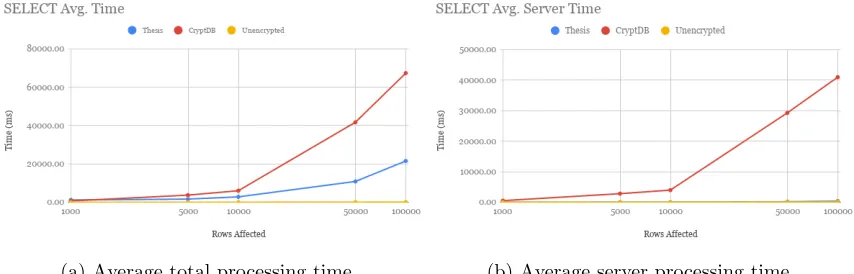
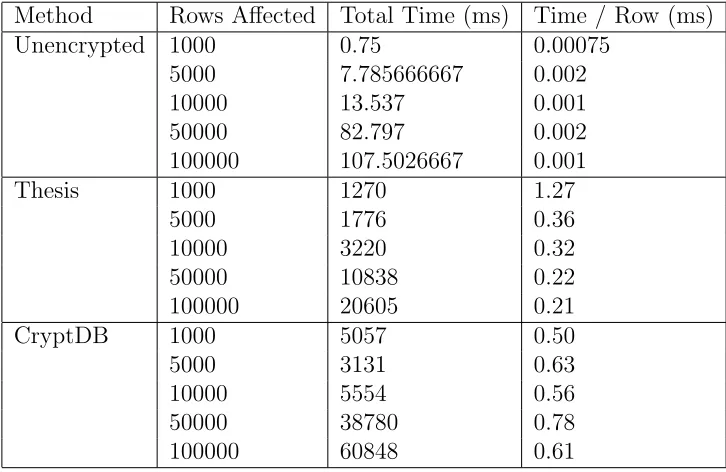
Figure 5.2 (tabulated in Table 5.6) shows the time required for a select query
with a “where” clause. Including a “where” clause doesn’t change the overall form
of the trends; CryptDB begins taking more time than this method after retrieving
around 1200 records and this method still creates about the same server load as an
unencrypted database. Figure 5.3 graphs the time taken for a select statement with
a where clause minus the time for a select statement without one, i.e. how much
longer the query takes when the where clause is added. Initially, CryptDB showed
a decrease on both the client and server side. This is because the security level was
downgraded, meaning that less decryptions needed to be performed in order to find
the plaintext data. In order to test the actual difference between a select statement
with and without a “where” clause, the outermost layer of encryption needed to
be first removed. Figure 5.4 shows the new comparison. When the select without
a “where” is run at a lower security level, i.e. the security level the system is at
after equality matching is required, all three systems register little difference between
plain select statements and those with ”where” clauses until about 5,000 records are
returned, when CryptDB starts requiring more computation time. As with the plain
select statement, the increase is approximately linear after about 10,000 rows are
returned due to the start up cost of the OPE implementation.
From these results, we see that none of the three systems require much extra time
when a “where” statement is introduced as compared to the same statement without
it. This is encouraging because it shows that introducing encryption does not always
significantly increase the time needed to perform equality matches on data despite
(a) Average total processing time (b) Average server processing time
Figure 5.2: Average query execution times as the number of returned rows increases.
Table 5.6: The impact of the various systems on the time taken to retrieve information from the database when a “where” clause is added to the query. (Tabulated data from Figure 5.2).
Method Rows Affected Total Time (ms) Time / Row (ms)
Unencrypted 1000 0.75 0.00075
5000 7.785666667 0.002
10000 13.537 0.001
50000 82.797 0.002
100000 107.5026667 0.001
Thesis 1000 1270 1.27
5000 1776 0.36
10000 3220 0.32
50000 10838 0.22
100000 20605 0.21
CryptDB 1000 5057 0.50
5000 3131 0.63
10000 5554 0.56
50000 38780 0.78
(a) Average total processing time difference (b) Average server processing time difference
Figure 5.3: The difference between a plain select statement and a select statement with a where clause. CryptDB shows a greatly reduced time because the encryption level changed. See 5.4 for an equal comparison.
(a) Average total processing time difference (b) Average server processing time difference
Join Clauses
Join clauses allow for data from two tables to be temporarily combined, e.g. pair
an address from the employees table with a salary from the salaries table. Join
statements couldn’t be tested on CryptDB because the version available on Github
does not have foreign key assignments correctly implemented.
Joins using this method do not require any special transformations by the SQL
proxy, but do take extra time on the server due to the larger size of the data. The
result of the experiment is shown in Figure 5.5 (tabulated in Table 5.7). The queries
(a) Average total processing time (b) Average server processing time
Figure 5.5: Select queries with joined tables.
Table 5.7: The impact of the various systems on the time taken to retrieve information from the database when a join clause is added to the query. (Tabulated data from Figure 5.5).
Method Rows Affected Total Time (ms) Time / Row (ms)
Unencrypted 1000 20.11 0.020
5000 11.90 0.002
10000 7.92 0.001
50000 77.81 0.002
100000 103.01 0.001
Thesis 1000 627.33 0.63
5000 2498.33 0.50
10000 2608.00 0.26
50000 16052.67 0.32
100000 16418.67 0.16
Aggregate Functions
Aggregate functions, such as sum, average, or count, are important tools for a SQL
programmer. Both this method and CryptDB make use of Paillier encryption’s
additive homomorphic property in order to compute the sum of any numeric data.
Computing the encrypted sum requires modular multiplications, which are
required to compute the encrypted sum is increased above an unencrypted sum query.
To test the time required to compute a sum, the entire salary column, with a total
of 2844047 rows, is summed in the salaries table. This allows for testing the function
without any possible interference from a “where” or a “limit” clause. This also shows
that large numbers can be added without causing overflow issues as all three methods
calculated the same value. Table 5.8 shows the amount of time needed to compute
the sum of the column.
SELECT SUM( s a l a r y ) FROM s a l a r i e s ;
Table 5.8: Time taken to compute the sum of the salary column with a total of 2844047 rows.
Method Sum Function Time (ms) (min) Increase Factor
Unencrypted 1.4 0.00002 0
Thesis 620312.6 10.3 443079.4
CryptDB 2450771.314 40.8 1750549.9
The count function in our system does not need to be modified from the one used
in the unencrypted database, i.e. only the column, table, and database names are
changed, not the number of rows. This is possible because “null” (empty) values are
not encrypted, so they will not be counted. In the encrypted databases, the count
takes longer to compute because of the larger data size and because of the delay
introduced by the intermediary software. Table 5.9 shows the results of the test.
SELECT COUNT( s a l a r y ) FROM s a l a r i e s ;
5.3.3 Update Statements
Update statements allow users to change columns in rows that already exist. In the
Table 5.9: Time taken to count the number rows in the salary column with a total of 2844047 rows.
Method Count Function Time (ms) (min) Increase Factor
Unencrypted 1.5 0.00002 0
Thesis 14126.3 .235 9397.9
CryptDB 1319385.0 21.9 877854.6
database. For the query we tested, the data only had to be encrypted once and
could be applied to all rows in the column. Work done by the server accounted for
most of the work for both encr