* To whom all correspondence should be addressed. E-mail: [email protected]
Effect of Fly Ash on Growth of Mustard and Corn
Cailie Carlile, Snehalata Nadiger* and Joel Burken
Civil, Architectural & Environmental Engineering, Missouri University of Science & Technology, MO 65409, USA.
*Indian Academy Degree College, Bangalore - 560 043, India. DOI: http://dx.doi.org/10.13005/bbra/1164
(Received: 15 July 2013; accepted: 23 September 2013)
Fly ash is generated as a by-product of coal combustion and contains many nutrients, such as Ca, K, Na, Mg, and S, as well as toxic metals such as As, B, Cd, Cr, Hg, and Pb. For this project, the goal is to optimize a phytoremediation technique to stabilize the toxic metals and produce biomass which could have benefit for example as biofuel. The hypothesis was that different amendments would improve the water holding properties of the ash and reduce metals availability and toxicity. Flyash was combined with leaf mulch (1%, 3%, 5%, 10%, 20%), wood mulch (1%, 3%, 5%, 10%, 20%), and soil (1%, 5%, 25%, 75%, 90%) in varying concentrations and distributed into 9 “cone-tainers” for each mixture. Water holding capacity was determined for each amendment and the leachates from the cone-tainers were then analyzed to determine pH, EC (electrical conductivity), and TDS (total dissolved solids) for the different mixtures. Zea mays, Brassica juncea, and poplar were planted and germination times were recorded. Plants were harvested at 7 weeks for Brassica juncea and 8 weeks for Zea mays and biomass and height were recorded. For Brassica juncea and Zea mays, plants grew best in soil amendments. For Brassica, leaf mulch appeared to have a negative effect on growth. Further analysis of metal content using ICP-MS is planned.
Key words: Brassica juncea, Metals , Phytoremediation, Zea mays.
Fly ash is generated as a by-product of coal combustion (Carlson and Adriano, 1993).. There is a need for a sustainable, low cost method of remediation because fly ash is produced on such a mass scale and contains toxic elements ((Rautaray et al., 2003; Lee et al., 2006; Tiwari et al., 2008). In addition to the toxic elements, fly ash also contains nutrients which could make it an ideal candidate for phytoremediation ( Bilski et al. 1995, Bilski et al. 2011 . The potential for the produced biomass to be used as biofuel is an added benefit (Pandey, (2009).
Fly ash was used as an amendment for agricultural purpose since it consists of valuable elements like K, Mg, S and P and which relate to higher uptake of nutrients and increase in plant growth ((Kalra et al., 1997; Singh et al., 1997 , (Aitken et al., 1984). Fly ash was used to study the growth and other parameters on several plants , to name a few: alfalfa, sorghum (Sorghum bicolor), field corn (Zea mays), millet (Echinochloa crusgalli), carrots (Daucas carota), onion (Allium cepa), beans (Phaseolus vulgaris), cabbage (Brassica oleracea), potatoes (Solanum tuberosum) and tomatoes (Lycopersicon esculentum) (Furr et al. (1977)), etc
increase the water retention capacity of the growth medium. In our study we dealt with three types of amendments: soil, leaf mulch and wood mulch. Soil
Addition of soil to fly ash improves the fertility and the physico-chemical properties of soil such as pH, EC, porosity, water holding capacity, etc (Singh et al , 2007, (Khan and Khan, 1996). Singh et al (1994) reported that soil amendments increased biomass production.
Wood and leaf mulch: Organic matter like wood and leaf mulch is absolutely essential. It binds together soil particles into porous crumbs or granules which allow air and water to move through the soil. Organic matter also retains moisture (humus holds up to 90 percent of its weight in water), and is able to absorb and store nutrients. Most importantly, organic matter is food for microorganisms and other forms of soil life. In Western Australia, improved tree growth has been recorded for orchard trees where 5-6cm was applied as a mulch (Paulin 2000). In India, Panwar and Bhardwaj (2000) showed that farmyard manure when mixed with fly ash showed increase in biomass of trees.
In the present study Fly ash with amendments like soil, wood mulch, leaf mulch was tested on plants like Brassica juncea, Zea mays L and poplar. Poplar did not show any detectable results. Brassica juncea was chosen because it is known to phytoaccumulate metals (Gupta AK, Sinha S.2006) and Zea mays was chosen because it has been previously shown to grow well in fly ash amended soils (Naveen Kalra, 1998).
MATERIAL AND METHODS
Amendments
Several types of fly ash amendment mixtures were prepared by mixing by hand. The following are the mixtures prepared with the percentage of amendment (leaf mulch, woof mulch, or soil) added by weight.
Leaf mulch: 1%, 3%, 5%, 10%, 20% Wood mulch: 1%, 3%, 5%, 10%, 20% Soil: 1%, 5%, 25%, 75%, 90% 100% Fly Ash
Leachate Testing
1. Cone-tainers filled with fly ash mixtures were placed over conical centrifuge tubes
to catch leaching water
2. 70 mL of water was added to each of the fly ash amendment mixtures
3. The amount of water that leached out and the time taken was recorded.
4. The leachate water was then analyzed for pH, electrical conductivity, and total dissolved solids.
Planting
Fly ash amendments were poured into cone-tainers and planted with three different plant types. The three plant types used were Zea mays, Brassica juncea, and poplar. For Zea mays and Brassica juncea plants were grown from seed, while cuttings were used for poplar. There were three replicates of each plant in each mixture. A conical centrifuge tube was placed underneath each cone-tainer to retain some water. Plants were watered as needed. Germination dates were recorded for all plants.
Harvest
Poplars were not harvested because they did not produce any significant new growth for analysis. Zea mays was harvested at 8 weeks and Brassica juncea was harvested at 7 weeks. The plants were cut off approximately 1 cm above the fly ash amendment. Height and weight were measured for both Z. mays and B. juncea. For B. juncea, the number of leaves, pods, and flowers was also recorded.
Metals Analysis
Metals analysis for elements including B, Se, As, Cr, Cu, Mn, Mo, Ni, Pb, V, Zn, Cd, K, Mg, and Na is planned. Plants were first air dried in a hood, and then freeze dried and crushed with mortar and pestle in preparation for digestion with a Multiwave 3000 microwave digester system. Digestion and analysis with ICP-MS is planned. DATA
Table 1, 2, 3 Figure 1, 2, 3
RESULTS
Soil amendment
Table 1. Leachate Rate
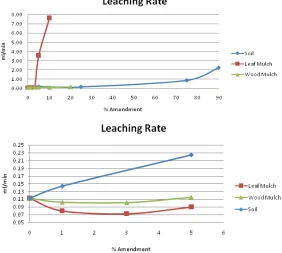
Soil % ml/min Leaf Mulch % ml/min Wood Mulch% ml/min
Amendment Amendment Amendment
0 0.1119 0 0.0802 0 0.1119
1 0.1432 1 0.0725 1 0.1025
5 0.2245 3 0.0900 3 0.1016
25 0.1508 5 3.5667 5 0.1143
75 0.8838 10 7.6333 10 0.1049
90 2.2500 20 20 0.1512
Table 2. Germination Data
Zea mays Brassica juncea
# germinated/total Percentage # germinated/total Percentage
planted planted
All Soil Amendments 8/45 17.8% 20/75 26.7%
All Wood Mulch 15/45 33.3% 31/75 41.3%
Amendments
All Leaf Mulch 9/45 20% 13/75 17.3%
Amendments
Total Number of Plants Germinated 5 days after Planting
Table 3. Leachate Analysis
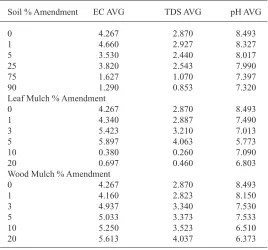
Soil % Amendment EC AVG TDS AVG pH AVG
0 4.267 2.870 8.493
1 4.660 2.927 8.327
5 3.530 2.440 8.017
25 3.820 2.543 7.990
75 1.627 1.070 7.397
90 1.290 0.853 7.320
Leaf Mulch % Amendment
0 4.267 2.870 8.493
1 4.340 2.887 7.490
3 5.423 3.210 7.013
5 5.897 4.063 5.773
10 0.380 0.260 7.090
20 0.697 0.460 6.803
Wood Mulch % Amendment
0 4.267 2.870 8.493
1 4.160 2.823 8.150
3 4.937 3.340 7.530
5 5.033 3.373 7.533
10 5.250 3.523 6.510
20 5.613 4.037 6.373
rate. Fly ash is able to hold the water containing heavy metals.
Leaf mulch amendment
The leaching rate, when leaf mulch is
amended in fly ash, is grossly higher than that of soil amendments. Here too the percentage of leaching rate increases from 0.08 to 7.6 ml/min.
leaf mulch amendment decreases from 20 to 0%, the leaching rate increases from 0.08 ml/min to 7.6 ml/min. More the leaf mulch more the leaching rate, more the fly ash less the leaching rate. Wood mulch amendment
The leaching rate in wood mulch amendment in fly ash is grossly lower than that of soil amendment. Whether there is an increase or decrease in the percentage of fly ash and wood mulch in the mixture from 0-20% , the leaching rate is almost constant at 0.1ml/min.
Germination Data (Fig. 2)
Seeds of Zea mays and Brassica when planted in cone-tainers containing fly ash and other amendments like soil, wood mulch and leaf mulch showed germination after 5 days of planting. Wood mulch as an amendment with fly ash showed maximum percentage of seeds germinating. Therefore , in all, wood mulch in combination (any percentage) is best suited for germination of both Zea mays and Brassica juncea.
Leachate analysis
Electrical conductivity, Total dissolved Salts (TDS) and pH decreases as the percentage of soil present in fly ash increases from 0 to 90% or conversely increases as the percentage of fly ash
decreases from 90 to 0%. An almost similar trend is seen in case of electrical conductivity, Total dissolved Salts (TDS) and pH of fly ash amended with leaf mulch. But in case of wood mulch as an amendment to fly ash, there is slight increase of electrical conductivity and TDS from 0 –20% and slight decrease of pH from alkalinity to acidity. Harvest Data – Zea mays (Fig 2)
Plant Height Data: Maize plants grown in soil (90%) amended with fly ash (10%) attain maximum height of 30 cms. In case of leaf mulch (20%) amended fly ash a maximum of 25 cms is attained and least height is observed when plants are grown in wood mulch amended with fly ash. Plant Weight Data: 90% soil and 10% fly ash shows a maximum plant weight of 2gms. Leaf mulch (20%) and wood mulch (20%) show a reduced plant weight of 1gm and 0.5 gms respectively. Harvest Data- Brassica juncea (Fig. 3) Plant Height Data
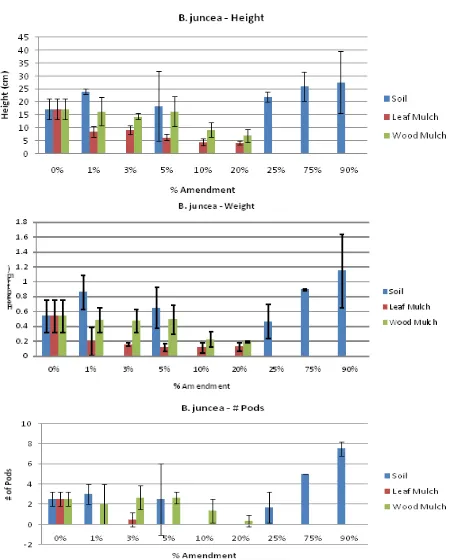
Brassica plants grown in soil (90%) amended with fly ash (10%) attain maximum height of 25cms. In case of leaf mulch (20%) amended fly ash a maximum of 5 cms is attained and least height is observed when plants are grown in wood mulch amended with fly ash.
Fig. 2. Harvest Data: Zea mays
Note: For 25% soil amendment for Zea mays, all 3 replicates were transferred to a pot to grow and therefore showed significantly more growth than the plants left in the cone-tainers. Because of this it was not included on the graphs.
Fig. 3. Harvest Data: Brassica juncea
Plant Weight Data
90% soil and 10% fly ash shows a maximum plant weight of 1.2gms. Leaf mulch (20%) and wood mulch (20%) show a reduced plant weight of 0.1gm and 0.2 gms respectively.
Number of pods in Brassica juncea plants: Brassica plants grown in soil (90%) amended with fly ash (10%) show a maximum of 9 pods per plant. In case of leaf mulch (20%) amended fly ash and wood mulch (20%) amended fly ash a maximum of 2 pods and 1 pod respectively was observed..
DISCUSSION
Fly ash has been utitlized in agriculture because of its mineral content (Kalra et al, 1997, Singh et al, 1997). Addition of fly ash in soil has seen increase in plant growth and crop yield in crops like alfalfa, barley, Bermuda grass and white clover (Aitken et al, 1997; Weinstein et al (1989).
The increased leaching rate associated with higher leaf mulch percentage may have inhibited growth of B. juncea. This increased leaching rate may not have affected the Z. mays because it puts out a deep taproot which could reach the water retained in the centrifuge tube underneath the cone-tainer.
Adding other amendments like wood mulch reduces erosion of fly ash (Gorman 2000). Wood mulch is also known to increase dissolved solids and electrical conductivity (Sinha, Gupta 2005). It is may be because of this reason that germination frequency is higher when Brassica and Zea mays are grown in wood mulch amendments.
Soil as an amendment with fly ash showed increase in height and no. of pods. It has been reported that there is a increase in the yield of tomato when grown in soil as an amendment of fly ash (Khan and Khan 1996) . Lau and Wong (2001) also showed an increase in plant height when lettuce was grown in 5% fly ash amended with soil.
For Brassica juncea, growth appears to be best in plants grown in soil amendments, followed by wood mulch amendments, then leaf mulch amendments. For Zea mays, plants grew best in soil amendments, followed by leaf mulch amendments, then wood mulch amendments.
CONCLUSION
Fly ash with its amendments like soil, wood mulch and leaf mulch have a positive effect on plants like Brassica juncea and Zea mays. Both Brassica juncea and Zea mays germinate well in all wood-mulch amended with fly ash. But soil-amended (90%) with fly ash (10%) produce taller plants, greater mass, more pods and more leaves. Moderate quantities (about 10%) of fly ash when added to soil increases soil fertility and thereby increase the yield of the crops.
ACKNOWLEDGMENTS
Dr. Snehalata Nadiger - Fulbright-Nehru Leadership Program Fellowship- 2011 C.Carlile -EPA GRO Fellowship Support
REFERENCES
1. Aitken, R.L., D.J.Campbell and L.C.Bell, Properties of Australian fly ash relevant to their agronomic utilization. Australian Journal of Soil Research., 1984; 22: 443-453.
2. Bilski, J., Alva A.K., Sajwan O.S. Agricultural uses of coal fly ash., In Environmental Aspects of Soil Amendments, Vol. 1: Inorganic Fertilizers, Ed: Jack E Rechcigl, Lewis Publishers, Boca Raton, Florida 1995; 255-291.
3. Carlson, C.L., and Adriano, D.C., Environmental impact of coal combustion residues. J. Environmental Quality 1993; 22: pp 227234. 4. Furr, A.K., T.F. Parkinson, R.A. Hinrichs, D.R.
Van Campen and C.A. Bache et al., National survey of elements and radioactivity in fly ashes. Absorption of elements by cabbage grown in fly ash soil mixtures. Environmental Science & Technology 1977; 11: 1194-1201.
5. Gupta AK, Sinha S., Role of Brassica juncea (L.) Czern. (var. Vaibhav) in the phytoextraction of Ni from soil amended with fly ash: selection of extracting for metal bioavailability. J. Hazardous Material. 2006; 136(2): 371-8.
6. James M. Gorman, John C. Sencindiver, Donald J. Horvath, Rabindar N. Singh and Robert F. Keefer., Erodibility of Fly Ash Used as a Topsoil Substitute in Mineland Reclamation.
Journal of Environmental Quality. 2000; 29(3): 805-811.
7. Jerzy Bilski., Environmental health aspects of coal ash phytoremediation by selected crops.
International Journal of Environmental Sciences
8. Kalra, N., H.C.Joshi, A, Chaudhary . R, Chaudhary and S.K.Sharma. Impact of fly ash incorporation in soil on germination of crops.
Bioresource. Technology., 1997; 61: 39-41. 9. Khan, R.K. and M.W. Khan, The effect of
fly ash on plant growth and yield of tomato.
Environmental. Pollution., 1996; 92: 105-111. 10. Lau, S.S.S. and J.W.C. Wong, Toxicity evaluation
of weathered coal fly ash amended manure compost. Water, Air Soil Pollution., 2001; 128: 243-254.
11. Lee, H., H.S. Ha, C.S. Lee, Y.B. Lee and P.J. Kim, Fly ash effect on improving soil properties and rice productivity in Korean paddy soil.
Bioresource Technology., 2006; 97: 1490-1497. 12. Naveen Kalra, , M.C. Jain, H.C. Joshi, R.
Choudhary, R.C. Harit, B.K. Vatsa, S.K. Sharma, Vinod Kumar., Flyash as a soil conditioner and fertilizer. Bioresource Technology, 1998; 64(3): 163-167.
13. Panwar, P. and Bhardwaj, S. D. Rehabilitation of mined area through grasses. Advances in Forestry Research in India. 1999 ; 21: 162-172.
14. Paulin, B., Using compost to boost yields in Perth region. Bio Cycle 2000; 74-76.
15. Rautaray, S.K., B.C. Ghosh and B.N. Mittra, Effect of fly ash, organic wastes and chemical fertilizers on yield, nutrient uptake, heavy metal content and residual fertility in a rice-mustard cropping sequence under acid lateritic soils.
Bioresource. Technology., 2003; 90: 275-283. 16. Singh A, Agrawal SB. Response of mung
bean cultivars to fly ash: growth and yield.
Ecotoxicology & Environmental Safety. 2010;
73(8):1950-8.
17. Singh, A. K., Bhowmik, A. K., Williams, A. J. S. R. B., and Banerjee, S. K., Effect of compost and fertilizer on nutrient accumulation of Albizia procera in coat mine over burden. Indian J. For.
1994; 17: 166.
18. Singh, R.S. and Tripathi, S.M., Impact of Fly Ash-Soil Amendment on Vegetable Production.Indian Journal of Environmental and Ecoplanning 2007;
14 (1-2). pp. 303-309.
19. Singh, S.N., K.Kulshreshtha and K.J.Ahmad, Impact of fly ash soil amendment on seed germination, seedling growth and metal composition of Vicia faba L. Ecological. Engineering., 1997; 9: 203-208.
20. Tiwari, S., B. Kumari and S.N. Singh, Evaluation of metal mobility/immobility in fly ash induced by bacterial strains isolated from the rhizospheric zone of Typha latifolia growing on fly ash dumps.
Bioresource. Technology., 2008; 99: 1305-1310.