1
GPFI: 2017 Work Plan
Outline
I. Overview ... 2
II. Priorities for 2017 ... 3
III. GPFI priority activities in 2017 ... 4
1. Update of the G20 Financial Inclusion Action Plan ... 4
2. Update of GPFI processes and key documents ... 4
3. Activities on Financial Inclusion of Forcibly Displaced Persons ... 4
4. Activities on the Implementation of the G20 High-Level Principles for Digital Financial Inclusion ... 5
IV. Subgroup specific work plans for 2017 ... 6
1. Regulation and Standard-Setting Bodies Subgroup ... 6
2. SME Finance Subgroup ... 8
3. Financial Literacy and Consumer Protection Subgroup ...11
4. Markets and Payment Systems Subgroup ...11
V. GPFI Timeline of Outputs ...14
2
I.
Overview
The Global Partnership for Financial Inclusion (GPFI) through its four Subgroups conducts its work with respect to the G20 Financial Inclusion Action Plan (FIAP) and on the occasion of the Leaders request. The 2014 G20 FIAP provides a strategic framework for the GPFI to progress G20 work on financial inclusion up to the year 2018. In this transition year between the 2014 G20 FIAP and the revised G20 FIAP to be endorsed in May 2017, this 2017 Work Plan is framed in relation to the 2014 G20 FIAP; this approach provides the basis for launching the work of the GPFI to be accomplished this year; course corrections will be made to take into consideration the final version of the 2017 G20 FIAP.
This document presents the key outcomes for the GPFI during 2017. The GPFI currently organizes its work through four subgroups: Regulation and Standard-Setting Bodies (SSBs); Small and Medium- Enterprises (SME) Finance; Financial Consumer Protection and Financial Literacy; and Markets and Payment Systems.
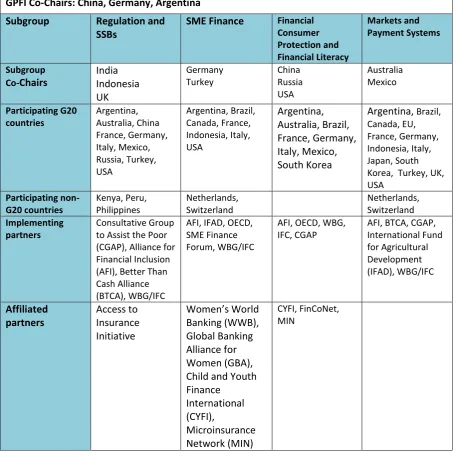
Table 1 summarizes the current structure of the GPFI and members of each Subgroup.
Table 1: GPFI Structure, 2017
GPFI Co-Chairs: China, Germany, Argentina Subgroup Regulation and
SSBs
SME Finance Financial Consumer Protection and Financial Literacy Markets and Payment Systems Subgroup Co-Chairs India Indonesia UK Germany Turkey China Russia USA Australia Mexico Participating G20 countries Argentina, Australia, China France, Germany, Italy, Mexico, Russia, Turkey, USA Argentina, Brazil, Canada, France, Indonesia, Italy, USA Argentina, Australia, Brazil, France, Germany, Italy, Mexico, South Korea Argentina, Brazil, Canada, EU, France, Germany, Indonesia, Italy, Japan, South Korea, Turkey, UK, USA Participating non-G20 countries Kenya, Peru, Philippines Netherlands, Switzerland Netherlands, Switzerland Implementing partners Consultative Group to Assist the Poor (CGAP), Alliance for Financial Inclusion (AFI), Better Than Cash Alliance (BTCA), WBG/IFC
AFI, IFAD, OECD, SME Finance Forum, WBG/IFC
AFI, OECD, WBG, IFC, CGAP
3
In 2017, the GPFI leadership established two temporary steering committees to (1) work on “Financial Inclusion of Forcibly Displaced Persons”1 and (2) to update GPFI processes and key documents2.
The GPFI benefits from the support of Her Majesty Queen Máxima of the Netherlands, the UN Secretary General’s Special Advocate for Inclusive Finance for Development (UNSGSA) and Honorary Patron of the GPFI.
II.
Priorities for 2017
Guided by the three pillars of the German G20 Presidency: ‘building resilience, improving sustainability, and assuming responsibility’, the GPFI will work in 2017 towards further strengthening the functioning of the GPFI and will pursue the implementation of the 2014 G20 FIAP and subsequent 2017 revised G20 FIAP.3 This year, the GPFI will put particular focus on:
a. Review and Update of the G20 Financial Inclusion Action Plan (See III. 1.)
b. Implementation of the G20 High-Level Principles for Digital Financial Inclusion (See III. 4)
c. Implementation of the G20 Action Plan on SME Financing (See IV. 2. a)
d. Increased focus, underpinned by policy work, on the financial inclusion of vulnerable groups: forcibly displaced persons (See III. 3.)
These four priorities, plus action areas, cross-cutting issues, and overarching objectives outlined in the 2014 G20 FIAP, and subsequently in the 2017 G20 FIAP, will guide the work of the GPFI in 2017. There will be a special attention paid to the financial inclusion of women, youth, poor people and people living in remote rural areas.
The GPFI Troika drives this ambitious agenda. Each G20 member country, non-G20 member country and each Subgroup has an important role to play in shaping and delivering the overarching GPFI deliverables and objectives. The 2017 G20 FIAP will incorporate a results framework to assess progress of actions. Overarching topics such as the update of the G20 FIAP, the review and update of GPFI processes, the issues of Financial Inclusion of Forcibly Displaced Persons as well as digitization are covered in the 2017 work plan. In addition to this, each GPFI Subgroup has a stream of ongoing work and priorities that it will progress throughout 2017 and that ensures continuity of GPFI’s work. These agendas are set out below (see section IV).
1 Members: Germany (Chair), EU, Netherlands, Turkey, UK, and US; AFI, BMGF, CGAP, OECD, and the World
Bank Group.
4
III.
GPFI priority activities in 2017
1.
Update of the G20 Financial Inclusion Action Plan
The G20 Financial Inclusion Action Plan (FIAP) was first endorsed at the G20 Summit in Seoul in 2010 and was then revised in 2014. In order to reflect current G20 commitments and priorities, the 2017 review and update of the G20 FIAP was announced in the 2014 G20 FIAP and reaffirmed by the leaders in the 2016 Hangzhou Action Plan. The 2017 G20 FIAP will enable appropriate attention to be given to the global challenges and opportunities of the present time. This includes aligning the FIAP with new global agendas such as 2030 Agenda and Addis Ababa Action Agenda as well as with the digital dimension of financial inclusion. New action areas, cross-cutting issues, and vulnerable groups as well as an accountability framework will be adequately reflected in the 2017 G20 FIAP. A stocktaking and assessment of GPFI activities based on the 2014 G20 FIAP (G20 FIAP Progress Report 2014-2017) will be conducted in the first half of 2017; the revised G20 FIAP is expected to be endorsed at the 4 May 2017 GPFI Plenary. In the second half of 2017, downstream from the endorsement of the 2017 G20 FIAP, the Subgroup Terms of Reference will be updated4. Work on the 2014 - 2017 stocktaking report,
the G20 FIAP update, and the update of the Subgroup Terms of Reference is conducted by the German Presidency in close cooperation with the GPFI member countries and Implementing Partners.
Key Outputs:
a. G20 FIAP Progress Report 2014-2017 b. 2017 G20 Financial Inclusion Action Plan c. Subgroup Terms of Reference
2.
Update of GPFI processes and key documents
In addition to the update of the G20 FIAP, GPFI processes will be reviewed in 2017. A principal activity is the revision of the 2014 GPFI Terms of Reference. This process will address issues including membership categories, the organization of work, roles and responsibilities of the GPFI, and clarification on Subgroup processes defined in the GPFI Terms of Reference.
Key Outputs:
a. Updated GPFI Terms of Reference
b. Clarification of related organizational issues, including guidance notes for GPFI Troika
3.
Activities on Financial Inclusion of Forcibly Displaced Persons
In order to address the challenges with regard to access to adequate financial services for Forcibly Displaced Persons (FDPs) in their host countries and communities, GPFI members agreed on establishing a temporary steering committee (TSC) on financial inclusion of FDPs, led by the German G20 Presidency.
The TSC will guide the preparation of a G20 Policy Paper on Financial Inclusion of FDPs, which aims to provide policy makers and other relevant stakeholders with information on common regulatory challenges, other beneficial or problematic framework conditions as well as promising solutions to facilitate the financial inclusion of FDPs. The TSC will further support the preparation of an AFI Special Report on current national regulatory approaches for the financial inclusion of FDPs (case studies) and will guide the organization of the GPFI/AFI High-Level Forum on the Financial Inclusion of Forcibly
4 The Subgroup Terms of Reference address the content of the work of the Subgroups and are therefore
5
Displaced Persons on 26 April 2016 in Berlin, Germany. The Forum provides the opportunity to disseminate the results of both reports and to discuss draft policy recommendations and proposed G20 actions. All documents should be available for discussion at the High-Level Forum and in time for submission to the GPFI Plenary. The TSC will further support the organization of a related thematic conference and/or side event at a relevant international conference to take the recommendations forward, stimulate further debate and support their translation into action.
Key Outputs:
a. G20 Policy Paper on ‘Financial Inclusion of Forcibly Displaced Persons’ b. AFI Special Report (country cases)
c. GPFI/AFI High-Level Forum on Financial Inclusion of Forcibly Displaced Persons, 26 April 2017 in Berlin
d. Thematic conference or side event (second half of 2017)
4.
Activities on the Implementation of the G20 High-Level Principles for Digital
Financial Inclusion
The G20 High-Level Principles (HLP) for Digital Financial Inclusion were endorsed by the G20 Leaders under the Chinese Presidency in 2016 to accelerate the process of digital financial inclusion and to balance the risks and opportunities of digital financial inclusion.The German G20 Presidency will take the first steps to implement the HLPs and to pave the way for future G20 measures in the field of digital financial inclusion. In 2017, the GPFI will take stock of emerging practices to accelerate the uptake of digital technologies to expand financial inclusion. This includes the preparation of a G20 Report on Emerging Approaches to Digital Financial Inclusion. The report will focus primarily on regulatory and policy approaches to develop an enabling legal and regulatory environment and expand the infrastructure ecosystem for digital financial services (i.e. the initial core 4 HLP). Further, the 2017 Responsible Finance Forum (RFF) will address opportunities and risks in digital financial services with a focus on consumer protection and data privacy.
These activities outline the overall coverage of digitization and the implementation of the HLP within the GPFI. At the 1st GPFI Meeting under the German G20 Presidency in January 2017, GPFI members
agreed to address digitization as overall cross-cutting issue within GPFI activities including in the four Subgroups. Thus, the four Subgroups will take forward the work on the implementation of the HLPs more specifically and in detail in their 2017 work plans (see activities and outcomes in section IV).
Key Outputs:
a. G20 Report on Emerging Approaches to Digital Financial Inclusion (exp. April 2017)
6
IV.
Subgroup specific work plans for 2017
The work of the four GPFI Subgroups is organized around the objectives (activities) incorporated in the Subgroup’s Terms of Reference (2014), which take into consideration the action areas outlined in the 2014 G20 FIAP and will be adjusted pragmatically during this transition year from the 2014 G20 FIAP to the 2017 G20 FIAP. The Subgroups will strengthen the collaboration with other G20 work-streams to support the overall effort to avoid duplication and to enhance efficiency and effectiveness. All Subgroups will support the review and update of the 2017 G20 FIAP by refining its Subgroup specific action areas and indicators.
1.
Regulation and Standard-Setting Bodies Subgroup
The planned activities of the GPFI Regulation and Standard-Setting Bodies Subgroup build on the recommendations from Part VI of the GPFI White Paper, “Global Standard-Setting Bodies and Financial Inclusion – The Evolving Landscape“, released in March 2016.
In 2017, the Regulation and Standard-Setting Bodies Subgroup will work on the implementation of the following priorities:
a. Mainstream financial inclusion in the work of the standard-setting bodies and other relevant global bodies and increase understanding of the interdependence of financial inclusion, stability, integrity and consumer protection (2014 G20 FIAP action area 4)
Reinforcement of focus on financial inclusion and coordination among the SSBs:
- To contribute to a better understanding of SSBs activities relevant to financial inclusion and to identify opportunities for joint work, a rigorous tracking of SSBs activities in relation to financial inclusion, notably, but not exclusively, in the area of FinTech and RegTech, will be formalized;
- The process of regular consultations with the SSBs will be maintained, focusing on opportunities for joint work in relation to financial inclusion objectives; and
- Opportunities for the enhancement of the role of FSI as a co-convener on financial inclusion-related activities will be identified and pursued.
Encouragement of joint activities on themes of relevance to multiple SSBs. Examples of possible themes include:
- Privacy and data protection, including new challenges posed by digital delivery and new technology-based approaches to mitigating risks;
- Financial exclusion risks, consequences of ‘de-risking,’ and potential alternatives to conventional cross-border transfers, especially FinTech and RegTech solutions; contribution to the GPFI/Financial Stability Board (FSB), and joint work and meeting(s) on remittance services and access to correspondent banking services, coordinated by FSB; and
- Structures and approaches to enhance coordination and cooperation across a broadening range of relevant country-level and regional supervisory and oversight bodies.
Support by the Subgroup, its members, and Implementing Partners for activities of relevance to financial inclusion of specific SSBs and other relevant global bodies. Examples could include:
7
- Further guidance related to financial inclusion developed by the Financial Action Task Force (FATF); and
- Exploration of further opportunities for work with other global bodies (e.g. International Telecommunications Union (ITU), International Organization for Standardization (ISO), International Financial Consumer Protection Organisation (FinCoNet), International Organisation of Pension Supervisors (IOPS)): This is expected to include work downstream from the ITU Focus Group on Digital Financial Services i.e. the launch of the Financial Inclusion Global Initiative.
Contributions on regulation and standard-setting relevant to other GPFI activities (e.g. effective approaches to implementation of G20 High-Level Principles for Digital Financial Inclusion and/or work on the financial services needs of forcibly displaced persons) and to other Subgroups, in particular the Markets and Payment Systems Subgroup (e.g. regulatory issues around payments and specifically remittances), the Financial Consumer Protection and Financial Literacy Subgroup (e.g. regulatory and supervisory issues around data privacy, customer protection, and cyber security).
b. Encourage effective and consistent incorporation of financial inclusion in financial sector assessments (2014 G20 FIAP action area 5)
Further development of methodologies and other tools employed in financial sector assessments to better integrate financial inclusion considerations. Examples could include:
- Engagement on the guidance note on financial inclusion under the Financial Sector Assessment Program (FSAP) of the World Bank Group and International Monetary Fund (IMF) and analysis of the lessons learned from the 2016 FSAP pilot exercises (including exchanges with SSBs); and
- Engagement with the International Association of Insurance Supervisors (IAIS), if deemed timely, regarding work downstream from its self-assessment process.
Increased understanding of financial inclusion by financial sector assessors reflected in more consistent incorporation of financial inclusion in assessment reports and findings. Examples could include:
- Analysis of the integration of financial inclusion in Article IV consultations (regular, comprehensive consultations between the IMF staff and individual member countries); and
- Stepped-up engagement with the IMF overall in relation to financial inclusion.
Promotion of enhanced engagement with, and feedback from, national authorities undergoing assessments on the question of implementation of global standards and guidance. Activities could include:
- Specific country engagements to build knowledge on implementation challenges;
- Initiation of work to distil country experiences, in collaboration with other such efforts, including those of AFI, FSI, IMF, and the World Bank Group; and
- Assessment of capacity-building needs and how these may be addressed.
c. Frame and prepare work to be undertaken during Argentina’s G20 presidency, in the context of the revised G20 FIAP
8
Exploration of thematic work in relation to the work of global standard-setting bodies of interest to the Argentinian G20 presidency and in relation to the revised G20 FIAP.
2.
SME Finance Subgroup
The general objective of the SME Finance Subgroup is to accelerate and replicate successful policy reforms that facilitate the expansion of financial services to SMEs. The key guiding document for the activities in the SME Finance Subgroup is the G20 Action Plan on SME Financing, which was endorsed in 2015 and is now being rolled-out according to the respective Implementation Framework.
Under the German Presidency, an important cornerstone with regard to SME Financing has been the G20 Workshop “Helping SMEs Go Global – Moving Forward in SME Finance”. During this workshop, policy makers, private sector actors, DFIs, Fintechs, etc. discussed how to bridge the SME financing gap.
In 2017, the SME Finance Subgroup will work on the implementation of the following priorities:
a. Roll out of the G20 Implementation Framework on SME financing
The Implementation Framework of the G20 Action Plan on SME Financing adopted at the 2016 Hangzhou Summit will be rolled out in 2017. The results of the first baseline report will be presented at the GPFI Plenary in May 2017. The baseline report includes a self-assessment by all G20 countries regarding the status of their credit infrastructure compared to international standards in three areas5.
The WBG as Implementing Partner will consolidate the country self-assessments in one baseline report and deliver it under the German Presidency. This report will be updated every two years and will show progress on the reform measures implemented by the G20 countries. The promotion of implementing the Action Plan in interested non-G20 countries will also be explored.
b. Financial Services for SMEs in Sustainable Global Value Chains
At the G20 Summit in Hangzhou, the G20 representatives reaffirmed that promoting SMEs and integrating them into global supply chains is an important driver for sustainable development and therefore enjoys a high priority. In 2017, the GPFI SME Finance Subgroup will conduct a stocktaking study to identify, map and analyse existing financing models, good practices and policies with regard to SME integration into sustainable Global Value Chains. The paper focuses on how access to affordable financing helps incentivizing SMEs linked to GVCs to improve social, environmental, health, and safety standards. It is foreseen that the study will offer options and recommendations for the different stakeholders: G20 policy makers, IFIs and DFIs as well as for other global value chain actors.
c. Climate smart financing for rural MSMEs - enabling policy frameworks
The GPFI SME Finance Subgroup supports the development of a policy paper that will provide recommendations for evidence based climate smart MSME policy options. The paper reviews existing policies incentivizing and regulating rural MSME climate smart financing and analyze evidence regarding performance and results of these policies. Based on this analysis, evidence from case studies and the modeling of climate smart MSMEs, the policy paper will elaborate policy options for G20 policy makers.
5 These areas are: a) improving framework conditions for credit reporting for SMEs; b) reform measures meant
9
d. Alternative Data and SME Finance
The Subgroup will conduct a stocktaking of the types of institutions using new, digital-oriented approaches to SME lending; including a review of the types of data they collect, from which market segments, identifying patterns and trends. Furthermore, a dedicated section of the report will look into the opportunities and risks as well as new policy issues, with reference to the G20 High-Level Principles for Digital Financial Inclusion.
The stocktaking report will be presented to the GPFI leadership, with the main finding shared with the public during the GPFI Forum in May 2017.
e. Data Harmonization
At both the national and financial institution levels, there are a number of data collection exercises on SME finance that would benefit from better coordination, with a view to a process of harmonization of definitions and methodologies at the national and DFI levels. As a first step in this effort, the Subgroup will provide an overview/stocktaking of existing and planned multilateral initiatives in data collection on SME finance. This stocktaking exercise will include information on the purpose, objectives and scope of each initiative, in addition to methodological aspects. This exercise will serve to inform a discussion among relevant stakeholders with the aim of reducing redundancies, improving the compatibility of different statistical initiatives and lightening the administrative burden on reporting countries.
Based on the results of the stocktaking, the G20, led by the GPFI will produce an Action Plan for review and approval during Argentine presidency, similar to that developed for SME Financing, to promote data coordination/harmonization at both the macro- and micro- levels.
On-going activities of the GPFI SME Finance Subgroup
a. SME Finance Compact
In an effort to promote SME finance policies and approaches that spur economic growth, the G20 GPFI announced the SME Finance Compact in 2012 to promote the development of innovative models and approaches to address the specific challenges and constraints faced by low income developing countries (LIDCs) with regards to SME finance.
The implementation of the SME Finance Compact is ongoing in partnership with the Alliance for Financial Inclusion and the World Bank Group to support peer learning amongst regulators, identify regulatory and policy challenges, develop data indicators for SME finance and document successful policy approaches, as an important initial step and to support further activities under the AFI SME Finance Initiative and the World Bank Group Financial Inclusion Support Framework (FISF).
b. Financial Inclusion and Youth
The SME Finance Subgroup, together with its Affiliated Partner Child and Youth Finance International (CYFI) launched a Global Platform for young entrepreneurs called Global Ye Community in September 2015.
The Subgroup will continue to promote the focus on youth entrepreneurship. One highlight in 2017 will be the Global Inclusion Awards ceremony on 03 May 2017 in Berlin, including the Ye! Youth Entrepreneurship Award to highlight exemplary youth entrepreneurs.
10
c. Implementation of Private sector engagement strategy
In order to better harness the potential investment, capacity and reach of financial service providers, the SME Finance Subgroup, led by its implementing partner the SME Finance Forum, in coordination with the other Subgroups and the B20 Financing Growth and SMEs and Entrepreneurship working groups, developed a private sector engagement strategy as a part of the GPFI Private Sector Engagement Strategy endorsed by G20 Leaders in 2015.
The GPFI Private Sector Engagement Strategy aims to advance and showcase the right type of dialogue with regards to SME Finance at the global level. The Strategy seeks to maximize the positive contribution of the private sector to advance financial inclusion. In 2017, dialogue with the B20 will continue, so as to invite B20 representatives to all major GPFI events.
GPFI and its Implementing Partners to date have established two platforms related to SME Finance which facilitate such exchange and cooperation: the SME Finance Forum, and the AFI Public Private Dialogue (PPD) platform. The SME Finance Forum will host its annual Global SME Finance Forum in Berlin 02-03 November, which will involve presentations, debates, demonstrations and a marketplace for investors and firms. The meeting also will debut the annual SME Finance Awards program, which will showcase outstanding institutions working in the field.
d. Women’s Economic Empowerment
Women-led SMEs require a variety of financial and non-financial services in order to build and grow their business, as well as save for the future. Insurance plays an important role in the financial inclusion agenda and contributes to numerous development agendas such as social protection, agricultural development and food security, disaster risk management and climate change, small and medium enterprise development, gender and youth promotion. For 2017 the following activities are planned:
- A compendium on “Women in Inclusive Insurance”, jointly developed by BMZ/GIZ, Women’s World Banking and IFC. The compendium intends to orient the various stakeholders by identifying potential entry points for gender-sensitive insurance approaches and proposing ways for implementing those more effectively. It should assess the current state of gender mainstreaming in insurance and develop a “good-practice toolbox” including short case studies.
- GBA is in process of coordinating a gender Insurance working group with its members that will yield substantive insights and best practice in a research document.
Furthermore, the GPFI SME Finance Subgroup will reach out to the W20, which focuses on financial inclusion for women in 2017, focusing on “Promoting female entrepreneurship and access to finance for women”.
e. Support for country level actions to implement the High-Level Principles for Digital Financial Inclusion
11
3.
Financial Literacy and Consumer Protection Subgroup
The objective of the Financial Literacy and Consumer Protection Subgroup (FCPFL) for the next five years is to build the capacity of developing and emerging economies to implement audience-appropriate, evidence-based financial consumer protection and financial literacy programs. Additionally, the Subgroup will identify best practices, emanating from the public, private, and NGO sectors, in consumer protection and financial education policies that support use of digital financial products and services.
In 2017, the FCPFL will work on the implementation of the following priorities:
a. Improve the capacity of public authorities and other relevant stakeholders to develop, implement, and rigorously evaluate financial literacy and consumer protection initiatives and policies.
b. Promote consumer protection and financial education good practices for financial services and products, including existing and emerging technologies.
Detailed expected outcomes:
a. The Subgroup serves as the hub within the GPFI for technical content addressing risks in consumer financial markets and identifying tools and resources that contribute to consumers making well-informed financial decisions. Additionally, the Subgroup provides direct inputs to other GPFI Subgroups considering policy options affecting consumers and MSMEs in consumer financial markets.
b. The Subgroup collaborates with its implementing partners and others in developing targeted and practical guidance for consumer finance measures and financial literacy initiatives by promoting voluntary peer review and exchange, harmonizing policy and regulatory inputs addressing financial consumer protection and financial literacy issues, and identifying either gaps that may hinder financial inclusion or innovations that may broaden financial inclusion. c. The Subgroup promotes the development of data, conduct of rigorous evaluation, and
dissemination of findings on financial literacy and consumer protection policies and initiatives in G20 countries and interested non-G20 countries.
Under the above mentioned outcomes, the FCPFL Subgroup has agreed upon specific activities to advance learning and improvements with the following works to be expected:
OECD/INFE survey on financial literacy and inclusion in G20 economies;
Final Report on the implications of digital finance for financial literacy and consumer protection by the OECD/INFE;
Report from the G20/OECD Task Force on financial consumer protection on innovation and digitalization; and
Support the RFF learning agenda on data protection/ data privacy as well as contribute to the Responsible Finance Forum 2017.
4.
Markets and Payment Systems Subgroup
12
Subgroup will focus on emerging technologies and business models and will incorporate strong links to market-based approaches through engagement with financial service providers. The Subgroup responds to the call in the G20’s St. Petersburg Development Outlook for the GPFI to explore “targeted actions to… harness emerging mechanisms such as electronic payments and mobile technology that can significantly improve access”.
In 2017, the Markets and Payment System Subgroup will work on the implementation of the following priorities:
a. International agendas and engagement with the private sector
Supporting the G20’s 2016 commitment to align its work with the 2030 Agenda, the Subgroup will develop actions to support progress towards achieving the targets under the Sustainable Development Goals. Specifically, this will include actions to progress SDG 10 to reduce remittance costs to less than 3 per cent and eliminate remittance corridors with costs higher than 5%, including revising National Remittance Action Plans and country case studies on correspondent banking.
In addition, the Subgroup will commence a short publication series on how digitization of payments can drive the SDGs. The priorities are currently, SDG 7 on Affordable and Clean Energy; SDG 2 on Zero
Hunger; SDG 5 on Gender Equality and/or SDG 8 on Decent Work and Economic Growth. The current
plan is to complete two reports under the German Presidency and two or more under the Argentinian Presidency.
Furthermore, the Subgroup will also explore options for partnership with the private sector to support innovative technologies and digital financial inclusion in accordance with the High Level Principles for
Digital Financial Inclusion endorsed in the G20 Finance Ministers and Central Bank Governors Meeting,
in July 2016 in Chengdu, and measurement activities to support the implementation of the HLP. The Subgroup will be reporting on the results of this engagement in 2018.
b. Monitoring progress and update of the G20 National Remittance Plans
In 2014, G20 Leaders agreed to the G20 Plan to Facilitate Remittance Flows, which mandates the GPFI to report on progress made by countries against their national remittance plans. National remittance plans were finalized under Turkey’s presidency along with a monitoring framework. This framework outlines that the GPFI will review progress on the national remittance plans annually, and plans shall be updated every two years. Consistent with these arrangements, the Subgroup will:
- Monitor progress towards achieving the cost reduction goals and reporting on such progress; and
- Coordinate the efforts of the G20 members to update their national remittance plans in 2017.
The update of the national remittance plans will encompass key commitments by the G20 since the finalization of the plans under Turkey’s presidency. This will include:
- Alignment with the 2030 Agenda and Addis Ababa Action Agenda, including the
Sustainable Development Goals target to reduce remittance costs to less than 3 per cent
and eliminate remittance corridors with costs higher than 5 per cent by 2030;
- Application of the High-Level Principles for Digital Financial Inclusion adopted by the leaders at the Hangzhou Summit in 2016; and
13
c. Guidance note on building inclusive digital payments ecosystems
This work will draw on the insights from the G20 GPFI 2015 stocktaking report on Innovative Digital
Payment Mechanisms Supporting Financial Inclusion and the G20 2016 High Level Principles for Digital
Financial Inclusion. The terms of reference document to guide this work were completed in 2015,
informing deliverables for 2016 and 2017.
This note will be a summary of G20 GPFI and related guidance on building inclusive digital payment ecosystems which will highlight the importance of a collaborative approach between businesses (FSP, PSPs, corporates, SMEs etc.) and the different institutions within governments (including regulators), in building relevant infrastructure and driving adoption. It will provide policy-makers and other government officials with an overview of the major practical issues to consider when planning the expansion of financial inclusion through the use of digital payments ecosystems. It briefly describes the potential of such ecosystems to advance financial inclusion. It then outlines how to address four key challenges when implementing the principles and policy recommendations of the G20, its Implementing Partners and by global financial system standard setters.
d. Coordinated approaches to improving the environment for remittances
The Markets and Payment Systems Subgroup will support the GPFI in deepening its exchange with relevant international organizations to improve the environment for remittances, including on the topics of de-risking and correspondent banking relationships.
In 2017, the Subgroup, in collaboration with the Regulation and Standard Setting Bodies (SSB) Subgroup, will work with the Financial Action Task Force (FATF) and Financial Stability Board (FSB) to support the coordination of public-private workshops that seek to deepen this exchange. The first workshop, “Special Session on Remittances and De-Risking”, will be held in the context of the FATF Private Sector Consultative Forum on 22 March 2017 in Vienna.
14
V.
GPFI Timeline of Outputs
Date
Output
Subgroup/
Steering Committee
Spring 2017; Fall 2017
Semi-annual table of SSBs activities for the previous 12 months and the coming 12 months.
SSBs
March 2017 Final Report on the Implications of Digital Finance for Financial Literacy and Consumer Protection by the OECD/INFE
CPFL
March 2017 Workshop Report on Helping SMEs Go Global – Moving Forward in SME Finance
SME
April 2017 Guidance Note on Building Inclusive Digital Payments Ecosystems
MPS
4 May 2017 G20 2017 Financial Inclusion Action Plan GPFI 24 May Results and Launch of PISA Financial Literacy () CPFL May 2017 G20 Financial Inclusion Action Plan Progress Report
(2014-2017)
GPFI
May 2017 G20 Policy Paper on Financial Inclusion of Forcibly Displaced Persons
GPFI
May 2017 Special Report on Financial Inclusion of Forcibly Displaced Persons: The Financial Regulatory Perspective
GPFI
May 2017 Report on Alternative Data Models and Policy Considerations
SME
May 2017 Stocktaking Report on Data Harmonization SME June 2017 OECD/INFE Survey on Financial Literacy and
Inclusion in G20 Economies
CPFL
July 2017 Baseline Study on the Implementation of the G20 Action Plan on SME Financing
SME
July 2017 Policy Paper on Climate Smart Financing for Rural MSMEs
SME
September 2017
Stocktaking Report on Financial Services for SMEs in Sustainable Value Chains
SME
September 2017
Good Practices on Financial Consumer Protection CPFL
October 2017 Results and Launch of Consumer Protection and Financial Literacy Survey
CPFL
Throughout 2017
Joint activities on themes of relevance to multiple SSBs, e.g.: privacy and data
protection; financial exclusion risks; enhanced coordination and cooperation across country-level and regional supervisory and oversight bodies.
SSBs
Throughout 2017
Activities of relevance to specific SSBs, e.g. work of the Financial Inclusion Work Stream of the Basel Consultative Group (BCG); further FATF guidance on financial inclusion; and work downstream from the ITU Focus Group on Digital Financial Services (launch of the
15
Date
Output
Subgroup/
Steering Committee
Financial Inclusion Global Initiative). Second
semester 2017
FSAP Output on Financial Inclusion: Guidance for Covering Financial Inclusion in FSAPs ()
SSBs
Second semester 2017
Analysis of the Integration of Financial Inclusion in IMF Article IV Consultations
SSBs
TBD Survey Instrument on Financial Literacy of Micro and Small Entrepreneurs
CPFL
TBD Report on Financial Consumer Protection on Innovation and Digitalization
CPFL
TBD Demand-Side Survey on Consumer Risks in Digital Delivery of Consumer Credit
CPFL
TBD Report on Financial Education and MSMEs CPFL TBD Progress Report on Core Competencies on
Financial Literacy for MSMEs
CPFL
TBD Report on Behavioural Insights to Support Financial Consumer Protection Policies
CPFL
May-November
16
VI.
GPFI Timeline of relevant Events
Date Event Location Activities
23 January 2017 GPFI Workshop: Review and Update of the Financial Inclusion Action Plan
Wiesbaden, Germany
24 January 2017 GPFI Meeting incl. SG Meeting Wiesbaden, Germany 25-26 January G20 Conference: Digitizing
Finance, Financial Inclusion & Financial Literacy
Wiesbaden, Germany
23 February 2017 GPFI Workshop: Climate Smart Financing for Rural MSMEs
Frankfurt, Germany 24 February 2017 G20 Workshop: Helping SMEs
go Global – Moving Forward in SME Finance
Frankfurt, Germany
11-18 March 2017 8th AFI SME Finance Working Group and 13th CEMC WG Joint Meeting
Victoria, Seychelles
14-15 March 2017 Open Seminar on Innovation and Financial Consumer Protection G20/OECD Task Force on Financial Consumer Protection
Paris, France The Task Force meeting will discuss the implementation of the G20 Principles on Financial Consumer Protection
22 March 2017 Joint Meeting among the FSB, FATF and the GPFI with Banks and MVTs (public-private workshop)
Vienna, Austria
Discussion of issues related to remittance services, in particular remittance providers’ access to correspondent banking services
27 March -2 April 2017
Global Money Week Global In Germany: Host by
Bundesbank in collaboration with the German G20 Presidency; Global advocacy and social media campaigns in all participating countries 21-23 April 2017 IFC/WB Spring Meetings Washington
DC, USA
G20 German Presidency to be featured
Side Event “Access to Insurance for Women” at WB Spring Meeting
25-26 April 2017 Women20 Summit Berlin,
Germany
Financial Inclusion is priority area
26 April 2017 GPFI/AFI High-Level Forum on Financial Inclusion of Forcibly Displaced Persons
17
Date Event Location Activities
27-28 April 2017 Responsible Finance Forum VIII Berlin, Germany
2-3 May 2017 GPFI Forum Berlin,
Germany 3 May 2017 Global Inclusion Awards
(CYFI, BMZ)
Berlin, Germany
4 May 2017 GPFI Plenary Berlin,
Germany
22-24 May 2017 OECD/INFE Technical Committee
OECD/GFLEC Policy Research Symposium on Financial Literacy for Youth
Paris, France PISA 2015 Financial Literacy Launch
30-31 May 2017 IFI/DFI working Group Meeting on SME Finance
London, UK Emerging trends in SME finance, exploring partnerships and coordination with other peer institutions, sharing good practices
15-16 June 2017 Global Forum on Remittances, Investment and Development organized by IFAD, the World Bank and UN DESA
New York, USA
Global bi-annual event, bringing stakeholders from the public and private sectors and civil society to facilitate dialogue on the contribution of remittances to development – in 2017 the focus will lay on the Global Compact on Migration and the SDGs
7-8 July 2017 G20 Leader’s Summit Hamburg,
Germany
10-14 July 2017 AFI-BNM Behavioural Economics Training
Kuala Lumpur, Malaysia 13-15 September
2017
AFI Global Policy Forum (GPF) Sharm el Sheikh, Egypt
30 September 2017
18
Date Event Location Activities
TBC BTCA Mexico Ecosystem Event Mexico D.F. Ecosystem event that brings together representatives of the government, corporate and development sector. October TBD 2017 G20/OECD Task Force on
Financial Consumer Protection
Paris, France The TF is open to OECD, G20, FSB public authorities as well as relevant SSBs and IOs.
23 October 2017 Foromic 2017 (Inter-American Forum on Microenterprise)
Buenos Aires Financial Inclusion event hosted this year in Argentina by IADB 2-3 November
2017 (with study tours on 1 Nov.)
Global SME Finance Forum Berlin, Germany
6-10 November 2017
OECD/INFE Technical Committee
OECD/India Global and Asian Conference on Financial Literacy
OECD/INFE Annual Roundtable on Financial Literacy and Inclusion in Asia