International Journal of Health Sciences and Research
www.ijhsr.org ISSN: 2249-9571
Review Article
Vision Health and Public Health Concepts:
Overview for Helping Vision Health Activities in
Developing Countries
Dr GV Fant
Public Health Epidemiologist, Visiting Professor, Public Health (Epidemiology & Biostatistics), Jodhpur School of Public Health, Rajasthan, INDIA
ABSTRACT
The World Health Organization (WHO) reported that an estimated 1.3 billion people across the globe live with some type of vision impairment. Globally, the leading causes of vision impairment are uncorrected refractive errors and cataracts. WHO, also, found that 80% of all vision impairments can be considered avoidable. The health prevention and disease control focus of public health suggests that the practice of public health might be a component of community level activities designed to improve vision health and prevent vision loss among the population. A review of the concepts of vision health and the application of public health is presented to help public health professionals who plan to partner with community leaders and other vision care professionals to help prevent vision loss, especially in developing countries. This review is designed to guide the reader into an appreciation for the connection between vision health and public health for preventing vision loss at the community level.
This paper is not intended to provide vision treatment advice for individuals needing vision care services. Key words: Vision Health, Vision Loss Prevention, Public Health, Applied Epidemiology, Developing Countries
INTRODUCTION
The World Health Organization (WHO) reported key facts about visual impairment and blindness from a global perspective: [1]
An estimated 1.3 billion people live with vision impairment: 36 million are blind and 217 million have moderate to severe vision impairment.
The majority of people with vision impairment are aged 50 years and older. Globally, the leading causes of vision
impairment are uncorrected refractive errors and cataracts.
Over 80% of all vision impairment can be considered avoidable.
The causes of vision loss and blindness are mainly preventable or avoidable. Organized efforts of community
members, government, advocates,
optometric professionals, other eye/vision professionals, and public health professionals are needed to minimize the impact of poor eye health and blindness in a population, especially among those who are poor or at-risk and living in developing countries.
and functions of the human eye; basic human optics; common vision conditions; basic assessment of the human visual system; and the public health contributions to vision health at the community level. It is hoped that this review may assist the public health professional involved with vision health and vision loss prevention activities in a developing country.
Description: Human Vision
We begin by describing human vision. Vision has been defined, simply, as sight, or the act of seeing. [2] It is a human sense where the qualities that frame an object’s appearance (i.e., color, shape, size, etc.) are perceived. The perception of these qualities occurs when light rays that enter the eye, strike the retina, and are converted into chemical-electrical impulses in a process known as phototransduction. These impulses are transmitted to the brain via the optic nerve where the impulses are received and provided with meaning. Specifically, rods and cones are sensory nerve endings found in the retina that are stimulated by light. Phototransduction is involved with visual sensation. These visual sensations are of four varieties: Light Sense; Form Sense; Color Sense; and Visual Acuity. [3]
Basic Anatomy and Functions of Human Eye
The eye is the organ of vision. The eye has many structures contributing to its function. The image that follows presents some of the key parts of the eye (see Figure 1).
Figure 1: Basic Parts of Human Eye
Image from Medlineplus.gov
(URL: https://medlineplus.gov/ency/imagepages/8867.htm)
The parts of the eye and function are briefly described: [3-5]
Eyelid--Protects the eyeball from injury and excess exposure to light, thereby regulating the entry of light into the pupil.
Iris--Pigment that gives eye its color; controls the amount of light entering the eye.
Pupil--Black part of the eye; a hole that takes light directly into the eye.
Sclera--White, outer coating of eye; for protection.
Cornea--Outer, dome-shaped, covering of the eye that refracts light into the eye; accounts for 66% to 70% of the total, refractive power of the of the eye. Anterior Chamber (not labeled)
--Space between the cornea and the iris; filled with aqueous humor.
Lens--Suspended by ligaments and located behind the iris; refracts light entering the interior of the eye onto the retina at the back of the eye. Accounts for about 30% of the total refractive power of the eye.
Vitreous humor (not labeled)-Transparent liquid/gel filled with nutrients located between the lens and the back of the eye that helps give shape to the eye and, also, helps keep the retina against the back of the eye.
Retina (not labeled)--Light sensitive tissue on the back of the eye that contains rods and cones; the macula (not labeled) is an oval area on the retina that contains a “Yellow Spot” that sees fine details and allows the performance of tasks like reading.
Optic Disc (not labeled)--Raised disk on the retina where the optic nerve enters the eye; no light receptors.
Optic Nerve- Part of the Cranial Nerve used to transmit the visual impulse to the brain from the retina.
rectus; inferior rectus; medial rectus; lateral rectus; superior oblique; inferior oblique. The muscles of the eyes work together to allow the eyes to conduct light onto the retina.
The eyes are located in the skull, inside a bony orbit. This orbit is made up of seven bones:
1. Frontal 2. Sphenoid 3. Ethmoid 4. Lacrimal 5. Palatine 6. Maxilla 7. Zygomatic
The orbit has several important features. The volume of the orbit is 30ml. The eyeball occupies only 20% of the orbital volume. The contents of the orbit include: Eyeball; Optic nerve; Extrinsic muscles; Lacrimal apparatus; Adipose tissue; Fascia bulbi (or Tenon’s capsule); Nerves and vessels which supply the above structures. The optic nerve is responsible for transmitting visual impulses to the brain that are necessary for vision. [3,6]
Basic Human Optics
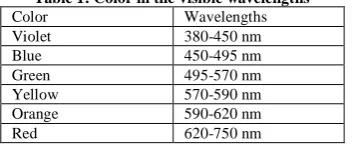
Human optics is about the study and behavior of light in the human visual system. What is light? It is that portion of the electromagnetic spectrum that is visible to the human eye. The visible light band (ca 380-750 nm) is responsible for visual sensation, and each color of light has a different range of wavelengths (see Table 1). [7]
Table 1: Color in the visible wavelengths
Color Wavelengths
Violet 380-450 nm
Blue 450-495 nm
Green 495-570 nm
Yellow 570-590 nm
Orange 590-620 nm
Red 620-750 nm
Ultraviolet light and infrared light are on either side of the visible light wavelengths.
Light travels in a straight line in a vacuum, and the speed of light (186,262
miles/second; or 299,792
kilometers/second) slows as it passes
through solid or liquid media. When light rays travel in open space and strikes an object, the study of basic physics reminds us that light may behave in one of four ways: reflection, refraction, diffraction, and interference. Refraction involves the bending of light when it passes from one medium into another of different density, and this behavior of light is important to human vision. The optical system of the human eye can bend light into the eye and on to the retina. Refraction is determined by the refractive media of the eye-mainly the cornea and lens-and the axial length of the eye.
The process of accommodations involves focusing near objects clearly on the retina by increasing the convergence power of the eye. [8,9] This is achieved by increasing the refractive abilities of the crystalline lens through increasing the curvature of its anterior surface. Lenses are sometimes needed to help a person’s eyes focus light onto the retina.
Common Vision Conditions at Primary Level
There are some common vision conditions that are likely to be encountered at the primary level of a health system in a developing country. A brief description of these conditions is provided for the public health professional. [8-10]
Emmetropia: A person with normal eyes that can adequately focus light onto the retina; eyes have no refractive error. Near-sightedness (myopia): A person
can clearly see objects close-up, but cannot see objects at a distance very well. The image is focusing at a point in front of the retina because the axial length of the eye is a little too long. A minus-sphere lens is needed for correction.
plus-sphere lens is needed for correction.
Astigmatism: Unequal refraction because part of the image in one plane is out-of-focus; the curvature of the cornea is uneven. A cylinder lens with an angle is needed for correction.
Presbyopia: Age-related, gradual loss of the focusing power of the lens; the lens is stiffening. Usually noticed between ages 38 to 42 yrs. Correction using additional plus-lens.
Lazy Eye (amblyopia): Occurs in early childhood when one or both eyes do not develop properly because the nerve pathways between the eyes and the brain were not well simulated resulting in the eyes is not working together.
Dry Eye: This occurs when eyes do not produce tears or the tear dries-up quickly.
Meibomian Gland Dysfunction: Blockage of Meibomian Glands around the margin of the eyelids so the gland is unable to secrete enough oil into the tear leading to fast evaporation of the tear. Cataract: Clouding of the lens; most
common cause of blindness in the world.
Macular Degeneration: The macula gradually becomes destroyed due to age. Diabetic Retinopathy: Blood vessels supplying the retina become damaged from diabetes; can lead to blindness. Glaucoma: A build-up of pressure in
the eye that can damage the optic nerve and lead to vision loss.
There are many other causes of vision problems that are not included in this review.
Basic Assessment of Human Visual System
The assessment of the visual system in a person, at minimum, requires a few tests and measurements. Public health professionals might be asked to help vision care professionals in their work with individuals presenting to a “health camp” designed to screen for the health needs of an at-risk/poor population.
In these circumstances, it might be useful for the public health professional to be knowledgeable to the basic assessments of the visual system that may be used by the vision care professional in a developing country. There are basic examinations to assess the visual system: [10]
Visual acuity measurement
Pinhole testing in any eye with subnormal vision
Refraction, if necessary
Cross-confrontation visual-field testing
Motility (movement) and binocular alignment testing (integrity of the extraocular muscles)
External examination, including eyelids, sclera, cornea, conjunctiva, and lacrimal system
Anterior segment examination, including anterior chamber depth, pupillary reactivity and size, and status of lens (possible presence of cataract)
Possible presence of opacity of the media
Posterior segment examination of the fundus of the eye, including the retina, macula, and optic nerve
Tonometer (measurement of intraocular pressure)
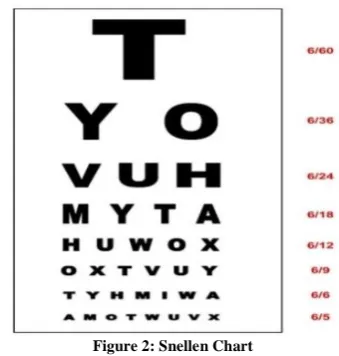
Visual acuity is the most important measurement that is performed in the basic assessment of the visual system. [10] This is often measured using a visual acuity chart (see Figure 2).
Figure 2: Snellen Chart
Source: Snellen Chart. VISEN
The above chart is the Snellen Chart using the metric system. The “Snellen Fraction” is interpreted as follows:
6/6 vision means normal, human vision. An individual sees the letters at 6 meters that a person with normal vision sees at 6 meters.
If a person has (6/”x”) vision, it means that when the individual stands at 6 meters from the chart, the individual can see what a normal person can see at “x” meters from the chart.
20/20 vision is normal, human vision at 20 feet from the Snellen Chart
The Snellen Chart is the most common chart used to measure visual acuity. Visual Acuity charts are available in various languages and, also, in symbols should the individual be unable to read letters.
Public Health Contributions to Vision Health at Community Level
The practice of public health can help in preventing vision loss at the community level. For this to be effective, it is important to consider the study and practice of public health as applied to vision health and the prevention of vision loss at the community- or population-level.
For our purpose, let us agree on a common definition of public health: [11]
Public Health: the science and art of
preventing diseases, prolonging life,
promoting health through organized
community effort and informed choices of society, organizations, public and private communities, and individuals.
Notice in the definition, for example, that organized community effort is used to prevent disease and promote health and well-being for the population. The primary focus of public health is on populations with emphasis on health promotion and disease prevention strategies for the population.
There is a definite public service ethic in public health work as an extension of concern for the needs of the individual. In practice, public health provides special effort to promote health and well-being and prevent disease among those in the population who are without socioeconomic means to purchase needed health services.
Generally, the public health paradigm uses interventions aimed at human behavior and lifestyle, the environment and medical services. These interventions are related to the core activity areas of the study and practice of public health: [11]
1. Preventing epidemics.
2. Protecting the environment, workplace, food and water.
3. Promoting healthy behavior.
4. Monitoring the health status of the population.
5. Mobilizing community action. 6. Responding to disasters.
7. Assuring the quality, accessibility, and accountability of medical care.
8. Research to develop new insights and innovative solutions.
9. Leading the development of sound health policy and health planning.
Given this description, the application of public health principles and methods to vision health and the prevention of vision loss at a population-level require critical thinking: What are the vision health care needs of a population? Consider the core activity areas of public health and the related vision health examples that would help to functionally describe the application of public health to vision health at the community- or population-level:
1. Preventing epidemics.
Example: Monitoring ocular diseases and poor vision in the population, noting where rates are higher than expected.
2. Protecting the environment, workplace, food and water.
3. Promoting healthy behavior.
Example: Working with low income communities to help members understand how diet and human behavior can contribute to protecting eye sight.
4. Monitoring the health status of the population.
Example: Monitoring ocular diseases and eye conditions impacting human vision in a geographic area.
5. Mobilizing community action.
Example: Working with community leaders to host a vision screening activity in a local school for school-aged children who have never had their eyes examined for healthy functioning and good vision and, where possible, link those in-need to medical and optometric systems for further treatment of ocular pathology, systemic disease, and problems with vision.
6. Responding to disasters.
Example: Monitoring and screening eye health among those displaced by natural or man-made disasters and providing primary eye care, as needed.
7. Assuring the quality, accessibility, and accountability of medical care.
Example: Monitoring the availability and use of optometric services in a community or region of a country, especially among the poor.
8. Research to develop new insights and innovative solutions.
Example: Developing new public health interventions and programs to help improve eye health and protect human vision in an at-risk population.
9. Leading the development of sound health policy and health planning. Example: Working with political leaders and advocates to help develop national policies to improve the eye health and vision status of a country in keeping with work of the World Health Organization and the International Agency for the Prevention of Blindness.
Applied epidemiology is one of the basic sciences that underpin public health action. [12] The collection of public health data related to vision health and the
prevention of vision loss by the applied epidemiologist may be useful to guide public health action in developing countries. Recall the definition of epidemiology from the World Health Organization: [12]
Epidemiology: The study of the distribution and determinants of health-related states or events in specified populations, and the application of this study to the prevention and control of health problems.
Suppose a vision health education and vision screening activity was held in a particular geographic location. During a specific month, public health professionals worked with community leaders and vision care professionals to provide vision health education, screening and vision referral services in a geographic location (and the surrounding areas) where no, permanent vision care professional was engaged in practice. Data was collected from each individual who came to this event.
There are several assumptions associated with this hypothetical activity: 1) a presenting individual can have a residence in only-one, surrounding area; 2) the presenting individual attended only-one vision health education and screening event in the geographic location; and 3) in addition to participation in the vision health education activity, the individual may be found to have any other vision condition. The applied epidemiologist would carefully construct a basic table of the community vision health education and screening event (see Table 2).
could be recorded has having another condition. To prevent “double-counting” of individuals being reported in the “Total Participants” column, some cells have been “grayed out.” The value in the “Total Participants” cell in the table should be the
same value found in the title of the table. The public health professional and applied epidemiologist would assist local health decision-makers with the interpretation of the information in this table.
Title 2: Vision Health Education and Vision Screening Event, Geographic Location and surrounding areas, Month, 2018 (total participants =####)
Vision Health Education
Dry Eye Diabetic Retinopathy
Uncorrected Errors of Refraction*
Total Participants Sex
Female Male
Age Grp at presentation
0-4 yrs 5-15 yrs 16-39 yrs 40-49 yrs 50+ yrs
Surrounding areas
Area A Area B Area C
Overall ####
*Using WHO levels of visual impairments
This table in addition to related cross-tabulation tables can be of great assistance to community leaders and public health professionals in monitoring the burden for vision health need and in health planning activities to help prevent vision loss in a community over a long period of time. Monitoring the burden of vision health need is a critical component for assessing access to vision services in a community. [13] Furthermore, public health professionals practicing in vision health programs can play a critically important role in generating evidence on the magnitude and causes of vision loss at the community level, providing expertise in health planning and program development to strengthen national vision health policies, and participating in partnerships to improve vision health in developing countries and global health initiatives. [14]
CONCLUSION
This paper presented a review of the concepts of vision health and the application of public health to issues related to vision health that might be useful for public health professionals who partner with community leaders and other vision care professionals
to help promote vision health and prevent vision impairments, especially in developing countries. Topics covered in this discussion included: Description of human vision; basic anatomy and functions of the human eye; basic human optics; common vision conditions; basic assessment of the human visual system; and the public health contributions to vision health at the
community level. Public health
professionals with expertise in vision health seem well-positioned to contribute their expertise to help governments and communities in developing countries advance vision health in keeping with the global objectives for universal eye health.
REFERENCES
1. WHO fact sheet: Blindness and vision
impairment. 11 October 2018.
URL:https://www.who.int/news-room/fact-
sheets/detail/blindness-and-visual-impairment
2. Merriam-Webster Dictionary.URL:
https://www.merriam-webster.com/dictionary/vision
4. Root T. OphthoBook-Introduction to the Eye. Middletown, DE: Ophthobook.com; 2016.
5. Fekrat S, Weizer J. All About Your Eyes. Durham: Duke University Press; 2006. 6. Negussie D, Assefa Y, Kassa A, Melese
A.Ophthalmology-lecture notes for health science students. Atlanta: The Carter Center; 2004.
7. “Electromagnetic Spectrum.” Humboldt
State University. URL: gps.humboldt.edu 8. Elliott D. Clinical Procedures in Primary
Eye Care, fourth edition. London: Saunders Ltd; 2013.
9. Prakash N. Handbook of Optometry and
Eye Disorders. New Delhi: Jaypee
Publishers; 2006.
10. Schwab L. Eye Care in Developing Nations,
Fourth Edition. London: Manson
Publishing; 2007
11. Centers for Disease Control and Prevention (CDC). Introduction to Public Health. In: Public Health 101 Series. Atlanta, GA: U.S. Department of Health and Human Services,
CDC; 2014. Available at:
https://www.cdc.gov/publichealth101/public -health.html.
12. Bonita R, Beaglehole R, Kjellstrom T. Basic epidemiology, second edition. Geneva: World Health Organization; 2006.
13. Zhang X, Andersen R, Saaddine J, et al. Measuring Access to Eye Care: A Public
Health Perspective. Ophthalmic
Epidemiology. 2008; 15:418-425.
14. World Health Organization. Universal eye health: a global action plan 2014-2019. Geneva: World Health Organization; 2013.
******