Available online on 15.07.2019 at http://jddtonline.info
Journal of Drug Delivery and Therapeutics
Open Access to Pharmaceutical and Medical Research
© 2011-18, publisher and licensee JDDT, This is an Open Access article which permits unrestricted non-commercial use, provided the original work is properly cited
Open Access
Research Article
Development and Evaluation of Clopidogrel Bisulphate Multi-Unit Floating
Mini-Tablets
Kotharapu Rama Koteswararao* & Dr. Lankalapalli Srinivas
Department of Pharmaceutics, GITAM Institute of Pharmacy, Visakhapatnam- 530045, Andhra Pradesh, India
ABSTRACT
The objective of the present work was to formulate and characterize multi-unit floating drug delivery system of Clopidogrel bisulphate to increase the bioavailability and sustain the drug release properties up to 8 h with more predictable drug release kinetics that avoids all or nothing emptying effect wherefore to improve patient compliance. Clopidogrel bisulphate floating mini-tablets were prepared by effervescent approach with melt granulation and direct compression techniques alone and in combination using Hydroxypropyl methylcellulose (HPMC) K100M and Compritol 888 ATO at different concentrations (20%, 30% and 40% w/w) alone and in combination. Sodium bicarbonate at concentration 10% w/w was optimized as gas generating floating agent. Evaluations were carried out on physical parameters, floating behavior and influence of type of polymer on drug release rate of prepared mini tablet formulations. All the formulations were subjected to various quality control and in-vitro dissolution studies and corresponding dissolution data were fitted to popular release kinetic equations in order to evaluate release mechanisms and kinetics. All the Clopidogrel bisulphate floating mini tablet formulations followed zero order kinetics. As per Korsmeyer-Peppas equation, the release exponent “n” ranged 0.561-0.758 indicating that drug release from all the formulations was by non-Fickian diffusion mechanism. Based on the results, Clopidogrel bisulphate floating mini tablets prepared by employing combination of 20% w/w HPMC K100M and 20% w/w Compritol 888 ATO offered desired in-vitro floating time and drug dissolution profile.
Keywords: Bioavailability, Clopidogrel bisulphate, floating mini-tablets, release kinetics, sustained release.
Article Info:Received 09 May 2019; Review Completed 21 June 2019; Accepted 24 June 2019; Available online 15 July 2019
Cite this article as:
Rama Koteswararao K, Srinivas L, Development and Evaluation of Clopidogrel Bisulphate Multi-Unit Floating Mini-Tablets,
Journal of Drug Delivery and Therapeutics. 2019; 9(4):173-180 http://dx.doi.org/10.22270/jddt.v9i4.3169
*Address for Correspondence:
Kotharapu Rama Koteswararao, Department of Pharmaceutics, GITAM Institute of Pharmacy, Visakhapatnam- 530045, Andhra Pradesh, India
INTRODUCTION
Oral controlled release drug delivery systems with ability to retain in the stomach are called gastro-retentive drug delivery system (GRDDS) which are aimed to enhance drug therapy with or without targeted action by prolonging the gastric residence time after oral administration [1].
The controlled gastric retention of the formulation may be achieved by the various approaches such as floatation, mucoadhesion, sedimentation, expansion and modified shape systems. Among the various approaches, floating drug delivery system (FDDS) is one of the potential approach for prolonged gastric retention to improve solubility, reduces drug waste thereby improves bioavailability for the drugs that are less soluble in a high pH environment. FDDS offer
single unit floating dosage forms made them unreliable and irreproducible in prolonging the gastric residence time, which led to the development of multiple unit floating systems [3].
Clopidogrel is a thienopyridine class inhibitor of P2Y12 adenosine-5-diphosphate (ADP) platelet receptors and used to inhibit blood clots in coronary artery disease, peripheral vascular disease and cerebrovascular disease. Clopidogrel is a pro-drug of carboxyl clopidogrel activated in the liver by cytochrome P450 and CYP2C19 enzyme. The active metabolite has elimination half-life of about 7-8 h and acts by forming a disulfide bridge with the platelet ADP receptor. Clopidogrel bisulphate is a BCS class II drug and exhibits pH dependent solubility and it is very soluble at pH value < 3. Following oral administration, it is well-absorbed with bioavailability of about only 50% due to poor water solubility. The main side effects of the drug are gastric bleeding and clopidogrel drug resistance during chronic treatment [6].
A sustained release floating clopidogrel formulation may be desired for a number of reasons, such as improving the bioavailability and to minimize the side effects of the drug such as gastric bleeding and to prevent the development of drug resistance wherefore to improve patient compliance [7]. Various single and multiple units of clopidogrel floating formulations has been reported in the literature, but very little work was carried in the field of multi-unit mini-tablets technology. The aim of the present study was to formulate and characterize clopidogrel bisulphate multi-unit floating mini-tablets to increase the bioavailability and sustain the drug release properties up to 8 h with more predictable drug release kinetics and avoiding all or nothing emptying effect using hydrophilic polymer, HPMC K100M and hydrophobic polymer, Compritol 888 ATO.
MATERIALS AND METHODS
Materials
Clopidogrel bisulphate Form-I (gift sample from Dr. Reddy’s laboratories, Hyderabad), Compritol ATO 888, HPMC K100M, Sodium bicarbonate, Microcrystalline cellulose, Magnesium stearate, Talc and all other ingredients are of laboratory grade.
Drug-excipient compatibility studies
Drug-excipient compatibility studies were performed for pure drug and physical mixture of optimized formulation of drug with polymers. The physical mixture samples were subjected to Fourier Transform infrared (FT-IR) studies. Spectra of drug and optimized formulation were taken and analyzed for any major interaction due to presence of polymers and other ingredients [8].
Micromeritic properties
The pure drug and prepared formulation powder blends before compression were evaluated for the angle of repose, bulk density (BD), tapped density (TD), Carr’s index(CI) and Hausner’s ratio(HR).
Angle of repose was determined by fixed funnel method by placing ten grams of powder blend in a plugged glass funnel and was then allowed to flow through the funnel orifice by removing the cotton plug from the funnel orifice. The height of the heap (h) formed as well as the radius of the heap (r)
was noted. The angle of repose () was calculated as: Tan =
(h/r).
BD and TD of 10 g of powder blend were determined by using 50 ml graduated cylinder. The volume occupied by the blend was read and the BD calculated in g/ml. The cylinder containing the blend was tapped until constant volume was obtained using bulk density apparatus from a height of 2 cm and the TD calculated in g/ml. The percentage compressibility (CI) was calculated from the difference between the TD and the BD divided by the TD and the ratio expressed as a percentage. The HR is the ratio between the TD and BD [9].
Determination of lambda (ʎ) max by Ultra Violet (UV)
spectroscopy
The stock solution (1000 µg/ml) of Clopidogrel bisulphate was prepared in 0.1N hydrochloric acid (HCl). This solution was appropriately diluted with 0.1N HCl to obtain a concentration of 10 µg/ ml. The UV spectrum was recorded in the range of 200-400 nm on double beam UV-visible spectrophotometer. The spectrum and wavelength of maximum absorption were recorded.
Preparation of standard curve
The stock solution (1000 µg/ml) of Clopidogrel bisulphate was prepared in 0.1 N HCl and from this 10 ml of solution was taken and the volume was adjusted to 100 ml with 0.1N hydrochloric acid (100μg/ml). The above solution was suitably diluted with 0.1N hydrochloric acid to get the series of dilutions containing 10, 20, 30, 40, 50μg/ml of clopidogrel bisulfate solutions. The absorbance of these solutions were measured at 270.4 nm against blank i.e. 0.1 N HCl. The coefficient of correlation and equation for the line are determined [10].
Preparation of clopidogrel bisulfate floating mini tablets
The clopidogrel bisulfate floating mini matrix tablets were
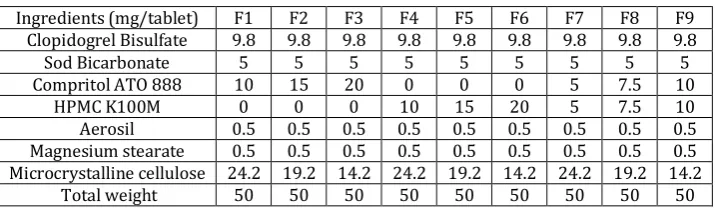
Table 1: Composition of clopidogrel bisulfate floating mini tablets
Ingredients (mg/tablet) F1 F2 F3 F4 F5 F6 F7 F8 F9
Clopidogrel Bisulfate 9.8 9.8 9.8 9.8 9.8 9.8 9.8 9.8 9.8
Sod Bicarbonate 5 5 5 5 5 5 5 5 5
Compritol ATO 888 10 15 20 0 0 0 5 7.5 10
HPMC K100M 0 0 0 10 15 20 5 7.5 10
Aerosil 0.5 0.5 0.5 0.5 0.5 0.5 0.5 0.5 0.5
Magnesium stearate 0.5 0.5 0.5 0.5 0.5 0.5 0.5 0.5 0.5
Microcrystalline cellulose 24.2 19.2 14.2 24.2 19.2 14.2 24.2 19.2 14.2
Total weight 50 50 50 50 50 50 50 50 50
Evaluation of physical parameters of floating mini matrix tablets [11]
Tablet weight uniformity:
A total of 20 mini tablets were weighed individually, average weight was calculated and the individual tablet weights were compared with the average weight. The tablets will meet the USP test if not more than two tablets are outside the percentage limit (± 10%) and if no tablets differ by more than two times the percentage limit.
Thickness test:
The thickness of three randomly selected mini-tablets from each formulation was measured with a Vernier calliper scale and their thickness was recorded and the average thickness along with the standard deviation is reported.
Hardness test:
Hardness of the tablet is the force applied across the diameter of the tablet to break the tablet. The hardness of 10 tablets was determined using Monsanto hardness tester and the average is calculated and reported with the standard
deviation and expressed in kg/cm2.
Friability test:
The friability of tablets was determined using Roche
friabilator. Six mini tablets (6) were initially weighed (W0)
and transferred into friabilator. The friabilator was operated at 25 rpm for 4 min or run up to 100 revolutions. The tablets were weighed again (W). The % friability was then calculated by the following equation.
%F = (1−W/W0) × 100
% Friability of tablets <1% are considered as acceptable. Drug content:
A total of 30 mini tablets were weighed and powdered. The quantity of powder equivalent to 98 mg of clopidogrel bisulfate was dissolved in 100 ml of 0.1 N HCl. Then the solution was filtered, diluted suitably and analyzed using an UV-visible spectrophotometer at 270.4 nm.
In-vitro buoyancy studies
The in-vitro buoyancy was determined using the USP dissolution apparatus II at 50 rpm containing 900 ml of 0.1 N HCl as the dissolution medium was maintained at 37 ± 0.5 ℃. Ten mini-tablets were dropped in a basket and the time required for the tablet to rise to the surface and float was determined as floating lag time (FLT) and the duration of the time the tablet constantly floats on the dissolution medium
rpm for 8 hours. Ten mini-tablets equivalent to 98 mg of clopidogrel bisulphate were placed in 900 ml of dissolution medium i.e. 0.1 N HCl maintained at 37± 0.5℃. Aliquots of 5 ml were withdrawn at specified intervals of time, filtered and replenished with 5 ml fresh dissolution medium. Sample’s
absorbance was measured at ʎmax 270.4 nm using
UV-visible spectrophotometer. The studies were performed in triplicate. The cumulative percentage drug released was calculated at each time interval using slope obtained from the standard curve.
Kinetic modeling of drug release [12]: The data obtained
from in vitro drug release studies were fitted to the following kinetic equations:
Zero order release kinetics equation: Qt = Q0+ K0t; Where Qt
is the amount of drug dissolved in time t, Q0 is the initial
amount of drug in the solution (most times, Q0 = 0) and K0 is
the zero order release constant expressed in units of concentration/time and graph was plotted for cumulative amount of drug released vs. time.
First order release kinetics equation: Log C = log
C0−Kt/2.303; where C0 is the initial concentration of drug, K
is the first order rate constant and t is the time and graph was plotted for log cumulative percentage of drug remaining vs. time.
Higuchi equation defines a linear dependence of the active fraction released per unit of surface (Q) on the square root of
time and can be expressed as Q = KH t1/2; Where, KH is the
release rate constant. This equation describes drug release as a diffusion process based on the Fick’s law, square root time dependent.
In order to define a model, which would represent a better fit for the formulation, dissolution data were further analyzed by Peppas and Korsmeyer equation: Mt/M∞ = Ktn; Where Mt/M∞ is a fraction of drug released at time t, K is the release rate constant and n is the release exponent. In this model, the value of n characterizes the release mechanism of drug. For the case of cylindrical tablets, n = 0.45 corresponds to a Fickian diffusion mechanism, 0.45 < n < 0.89 to non-Fickian transport, n = 0.89 to Case II (relaxation) transport, and n > 0.89 to super Case II transport.
RESULTS AND DISCUSSION
Calibration curve of clopidogrel bisulphate
Fig. 1: UV scan spectrum curve of clopidogrel bisulfate Fig. 2: Calibration curve of clopidogrel bisulfate at 270.4 nm
Drug-excipient compatibility studies
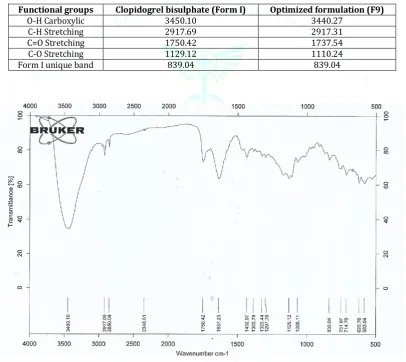
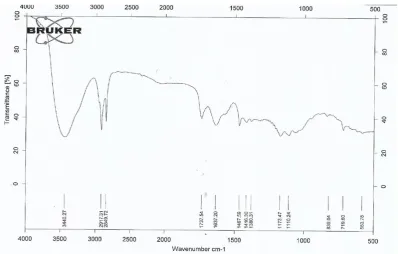
The FT-IR spectrum of pure drug was compared with optimized formulation. The characteristic peaks which are
observed for the pure drug in the FTIR spectra (Fig. 3a) were also observed for optimized formulation (Fig. 3b) with little shifting of peaks suggesting that there is no interaction between drug and excipients (Table 2).
Table 2: Functional groups and range for Clopidogrel bisulphate and optimized formulation
Functional groups Clopidogrel bisulphate (Form I) Optimized formulation (F9)
O-H Carboxylic 3450.10 3440.27
C-H Stretching 2917.69 2917.31
C=O Stretching 1750.42 1737.54
C-O Stretching 1129.12 1110.24
Form I unique band 839.04 839.04
Fig. 3b: FT-IR spectra of physical mixture of clopidogrel bisulphate formulation F9 blend with HPMC K100M and Compritol 888 ATO.
Micromeritic properties
The micromeritic properties of pure drug of clopidogrel bisulfate showed good flow properties as per observed values of CI (11.11) and angle of repose (26.10). The flow
properties of the formulation powder blends were also showed fair flow properties as per observed values of CI and angle of repose. The micromeritic properties of pure drug and optimized batch of the formulation were shown in Table 3.
Table 3: Micromeritic properties of drug and optimized batch of clopidogrl blend
Parameters Pure drug F9
Angle of repose 26.10 30.54
Carr’s index (%) 11.11 17.78
Hausner’s ratio 1.12 1.21
Evaluation of physical parameters of floating mini tablets
All the prepared formulations were tested for various physical parameters such as thickness, weight variation, hardness and friability. Results of the physical tests were shown in Table 4. The hardness of all the formulations was
found to be in the range of 4-5 kg/cm2. The friability of all
the formulations was found to be <1%. The drug content of the formulations was in between 98% and 102%. Hence, all the clopidogrel floating mini tablet formulations were of good quality and fulfilled the official pharmacopoeial specifications with regard to drug content, hardness and friability.
Table 4: Physical characteristics of clopidogrel floating mini tablet formulations
Formulation
code Thickness(mm)-(n=3) Weight Variation (n=20) Hardness (kg/cm2) (n=10)
Friability (%) (n=6)
Assay (%) (n=3)
F1 2.62±0.02 50.29±1.10 4.16±0.06 0.12 101.21±0.88
F2 2.61±0.01 48.11±1.11 4.25±0.02 0.15 100.01±0.90
F3 2.61±0.02 49.84±1.15 4.18±0.07 0.17 99.95±1.17
F4 2.62±0.02 50.87±1.12 4.23±0.01 0.15 102.98±1.05
F5 2.64±0.03 50.22±1.10 4.20±0.08 0.16 99.23±1.23
F6 2.65±0.02 51.12±1.06 4.15±0.03 0.18 100.20±0.96
Floating properties of clopidogrel floating mini matrix tablets
All the formulations were tested for floating properties such
as floating lag and total floating time. The results of in-vitro
buoyancy study are shown in the Table 5. Sodium
bicarbonate was used as gas generating agent at 10% w/w
concentration. The sodium bicarbonate induces CO2
generation in the presence of acidic dissolution medium (0.1 N HCl). The gas generated is trapped and protected within the gel formed by hydration of the polymer, thus decreasing
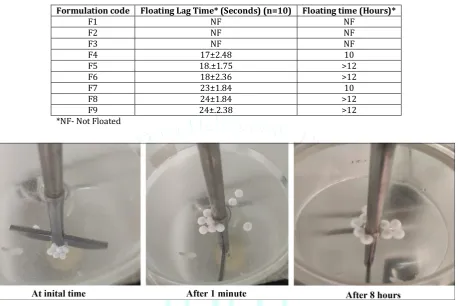
the density of the tablet below 1 gm/ml, and the tablet becomes buoyant. Mini tablet formulations prepared with Compritol 888 ATO (F1 to F3) did not show floating behaviour because the formulations did not swell and hence
failed to form a gel and the CO2 generated did not get
entrapped, thus these formulations failed to float the tablet. The total floating time of other formulations (F4 to F9) was observed in between 10 to 12 h with floating lag time <1 min and showed better and desired floating characteristics. Pictorial presentation of in-vitro buoyancy study results of optimized formulation (F9) was shown in Figure 4.
Table 5: In-vitro buoyancy data of clopidogrel floating minitablets
Formulation code Floating Lag Time* (Seconds) (n=10) Floating time (Hours)*
F1 NF NF
F2 NF NF
F3 NF NF
F4 17±2.48 10
F5 18.±1.75 >12
F6 18±2.36 >12
F7 23±1.84 10
F8 24±1.84 >12
F9 24±.2.38 >12
*NF- Not Floated
Fig. 4: Pictorial presentation of in-vitro buoyancy study of optimized formulation (F9)
In-vitro drug release studies
The release of clopidogrel bisulphate from all the mini tablet formulation was found to be slow and sustained. The in-vitro drug release profiles of the formulations prepared with hydrophobic polymer, Compritol are shown in Figure 5a. The drug release extended from 4-8 h and the 1 h initial drug release was varied between 21% and 49%. F1 formulation released more than 90% of drug within 4 h whereas formulation F2 and F3 showed 98% and 96% drug released in 7 and 8 h respectively. However, these formulations did not show any floating characteristics as the tablet formulations did not swell.
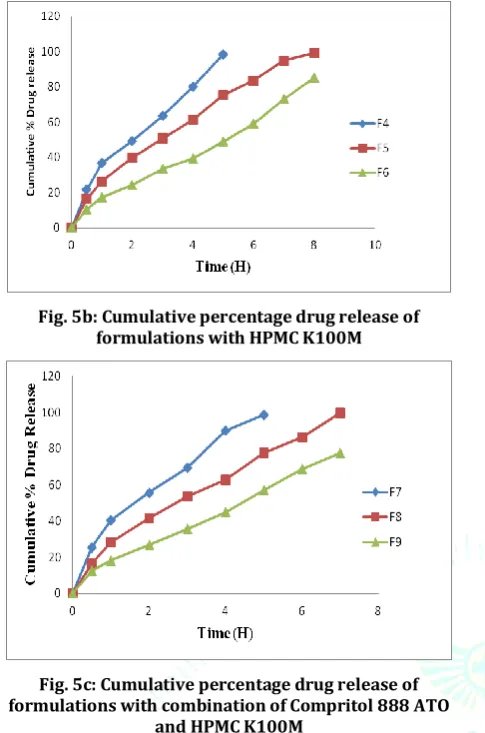
Fig. 5b: Cumulative percentage drug release of formulations with HPMC K100M
Fig. 5c: Cumulative percentage drug release of formulations with combination of Compritol 888 ATO
and HPMC K100M
The in-vitro drug release profiles of the formulations prepared with hydrophilic polymer, HPMC are shown in Figure 5b. The 1 h initial drug release was varied between 17-36%. F4 and F5 formulations released more than 90% of drug within 5 h and 7 h respectively whereas the drug
release from F6 formulation was slow and failed to release the complete drug at 8 h. It shows that the increase of HPMC content affects significantly the matrix tablet release behaviour. The formulations prepared with hydrophilic polymer HPMC showed greater drug release retardation than the hydrophobic polymer Compritol formulations at their defined respective concentrations as more than 96% drug was released in 8 h from matrix tablets containing 30% compritol but matrix tablets containing 30% HPMC only released 85 % drug at the same time.
The in-vitro drug release profiles of the formulations prepared with combination of Compritol and HPMC are shown in Figure 5c. The 1 h initial drug release was varied between 18-40%. F7 and F8 formulations released almost 90% of drug within 4 h and 6 h respectively. F9 formulation released more than 90% of drug within 8 h and showed better and desired drug release profile, hence it was considered as an optimized formulation. Incorporation of compritol with HPMC increases drug release from the formulation. This may be attributed to increased penetration of the solvent molecules in presence of the hydrophobic polymer, leading to enhance drug diffusion from the matrix. Formulations F1, F4 and F7 showed rapid/bust drug release almost 35-50% in 1 h which may be due to insufficient polymer concentration.
Kinetic modeling of drug release
Analysis of the drug release data as per zero order and first order kinetic models indicated that all the formulations followed zero order kinetics and dissolution rate constant (K) values were presented in Table 6. Higuchi plots were
found to be linear with “r2” > 0.9633 in all the clopidogrel
floating mini tablets. In the analysis of release data as per Korsmeyer-Peppas equation, the release exponent “n” was in the range 0.561-0.758 indicating non-fickian diffusion as the release mechanism from all the clopidogrel floating
minitablets. The drug release rate of clopidogrel was found
to be affected by the type and concentration of the polymer used in the formulation. As the concentration of the polymer was increased, the drug release was found to be retarded.
Table 6: Regression coefficient (R2) values of floating minitablet formulations for different kinetic models
Formulation code R2 Peppas (n) Zero order rate constant (K)
Zero First Higuchi Korsmeyer–Peppas
F1 0.9354 0.8294 0.9841 0.9480 0.758 22.98
F2 0.9678 0.8721 0.9869 0.9914 0.587 13.40
F3 0.9932 0.8111 0.9633 0.9888 0.634 11.39
F4 0.9710 0.7887 0.9758 0.9864 0.576 17.89
F5 0.9758 0.8283 0.9828 0.9994 0.623 11.95
F6 0.9882 0.8934 0.9645 0.9917 0.667 9.75
F7 0.9558 0.8621 0.9903 0.9954 0.561 18.37
F8 0.9794 0.6268 0.9785 0.9957 0.632 13.19
F9 0.9935 0.8702 0.9674 0.9874 0.637 10.65
CONCLUSION
In this research work, an attempt has been made to develop multi-unit floating mini-tablets of clopidogrel bisulphate by effervescent approach using the polymers HPMC K100M and
REFERENCES
1. Swarbrick J. Encyclopedia of Pharmaceutical Technology. 3rd ed. Vol 2. New York: Informa Healthcare; 2007. pp. 1082–103. 2. Kawashima Y, Takeuchi H, Yamamoto H. Handbook of
Pharmaceutical Controlled Release Technology. New York: Marcell Dekker Inc; 2000. pp. 505–25.
3. Meka L, Kesavan B, Kalamata VN, Eaga CM, Bandari S, Vobalaboina V, Yamsani MR, Design and evaluation of polymeric coated minitablets as multiple unit gastroretentive floating drug delivery systems for furosemide, J. Pharm. Sci. 2009; 98: 2122-2132
4. Ishak RAH, Awad GAS, Mortada ND, Nour SAK. Preparation, in vitro and in vivo evaluation of stomach-specific metronidazole-loaded alginate beads as local anti-Helicobacter pylori therapy. J. Control Release.2007; 119: 207–214.
5. Priyanka, Kumar K, Teotia D, A comprehensive review on pharmaceutical mini tablets, Journal of Drug Delivery and Therapeutics. 2018; 8(6):382-390
6. Patel PR, Kothari JS, Roy SB. Modified release clopidogrel formulation. U.S. Patent US20100145053 A1, Jun 10, 2010.
7. Rao KR, Lakshmi KR. Design, development and evaluation of clopidogrel bisulfate floating tablets. Int J Pharm Investig. 2014; 4(1), 19–26.
8. Koradia V, Chawla G, Bansal AK. Qualitative and quantitative analysis of clopidogrel bisulphate polymorphs. Acta Pharm 2004; 54, 193–204.
9. Lachman L, Lieberman HA, Kanig JL. The Theory and Practice of Industrial Pharmacy. 3rd ed. Bombay: Varghese Publication House 1987; p. 171-96.
10. Saadet Dermiş, Ekrem Aydoğan. Rapid and accurate determination of clopidogrel in tablets by using spectrophotometric and chromatographic techniques. Commun.Fac.Sci.Univ.Ank. Series B V 2009; 55 (1), 1-16. 11. Sally A, El-Zahaby, Abeer A. Kassem , Amal H. El-Kamel. Design
and evaluation of gastroretentive levofloxacin floating mini-tablets-in-capsule system for eradication of Helicobacter pylori. Saudi Pharmaceutical Journal 2014; 22, 570–579. 12. Dash S, Murthy PN, Nath L, Chowdhury P. Kinetic modeling on