Themed Section : Engineering and Technology
A Comparative Study : Reviewing Performance of Routing
Protocols in Mobile Ad-hoc Network
Deepali Aggarwal*, Shivani Gaba
CSE, N.C. College of Engineering, Israna, Distt. Panipat, Haryana, India
ABSTRACT
Mobile Ad-hoc Network is nothing but a collection of hosts which are mobile and can configure, organize and maintain themselves according to the network. It is an independent network where the nodes are connected to other nodes through wireless links. The nodes are mobile in nature and don’t need any organization, configuration, and administration. As the network topology frequently changes due to the mobility of nodes, routing in such network becomes extremely difficult. Routing solves various concerns related to network like its dynamic topology, bandwidth, overhead, delay, traffic etc. Hence based on the above issues, a comparative study has been done between the reactive, proactive and hybrid protocols on the basis of their pros and cons, to evaluate the performance of all 6 protocols (DSDV, OLSR, AODV, DSR, ZRP and FSR). So that it would be easy to choose an efficient routing protocol based on network complexity.
Keywords: Mobile ad-hoc network, Routing Protocols, DSDV, OLSR, AODV, DSR, ZRP, FSR
I.
INTRODUCTIONThis Mobile Ad-hoc Network is nothing but a collection of hosts which are mobile and can configure, organize and maintain themselves according to the network. Host node provides information from/to other nodes and router discovers and maintains routes for other nodes in the networks. These mobile hosts communicate with each other through wireless channels having no centralized control [4]. Those routing protocols that not only discover but also store more than one route in the routing table for each destination node are called to be multipath routing protocols.
As the routes are broken in the wireless network due to movement of nodes, hence transmission of data becomes unreliable and prone to error. In order to overcome the unreliability, load, congestion and fault in the wireless network due to the use of single path routing protocols, multipath routing protocols are
being used [14]. In mobile ad hoc network, nodes communicate with one another using multi-hop wireless links. Each node acts as a router and host in its respective network. Under the wireless network, all nodes are given an ability to communicate with the rest of the network while being mobile. Intermediate nodes are used to route the nodes which are out the range to bring them back into the network. Dynamic topology, Energy, security and bandwidth are some constraints of Mobile ad hoc network[1]. To furnish and maintain the network, antennas are being used in the form of wireless transmitters and receivers.
II.
LITERATURE REVIEWnetwork was to ensure that routing protocol is correct and also messages are being delivered in an appropriate time frame. It also ensured that the route must work with minimum overhead and information consumed must be measured in a fine manner. The paper provided a comparison between eight different routing protocols along with their advantages and disadvantages.
In 2008, Roy, S. Chatterjee, D.; Mukherjee, N.bestowed their work “Capability aware routing algorithm for Mobile Ad-Hoc Network in workplace” that mainly emphasized on the potentials of mistreatment of laptops of users within an workplace. Users needed to submit their job requirements request which can go through the painter in order to look for a node which would be ready to respond back to the user[12]. For such a mistreatment, the paper proposed a capability aware ad-hoc routing algorithmic (CAODV) program.
In 2009, K. Lego, P. K. Singh and D. Sutradhar, “Comparative Study of Adhoc Routing Protocol AODV, DSR and DSDV in Mobile Adhoc NETwork” bestowed their work in order to compare three well know protocols AODV, DSR and DSDV by using three performance metrics packet delivery ratio, average end to end delay and routing overhead. The comparison was done using simulation tool NS2. Through the simulation results it was concluded that found that overall performance of DSR is better than other two routing protocols because of lower end to end delay.
In 2010, S. A. Ade & P.A. Tijare, “Performance Comparison of AODV, DSDV, OLSR and DSR Routing Protocols in Mobile Ad Hoc Networks”, did the realistic comparison of three routing protocols DSDV, AODV and DSR. It was concluded that on the basis of packet delay and dropped packets ratio, DSR/AODV performed better than DSDV with large number of nodes. It was also found that in case of real time traffic, AODV is preferred over DSR and DSDV.
And in case of lessnumber of nodes and less mobility, DSDV’s performance was superior[10].
In 2011, S. Senthilkumar, B. Ananthampillai, “A comparative survey of routing protocols in mobile ad hoc networks”, the objective was to evaluate CGSR, DSR and ZRP routing protocols on the basis of their uniqueness, functionalities, pros and cons. It also emphasized on the enhancement of different protocol’s performance.
In 2014, E. Edwin Lawrence, Dr. R. Latha, “A Comparative Study of Routing Protocols for Mobile Ad-Hoc Networks” an attempt was made to study and analysed six routing protocols DSDV, OLSR, AODV, DSR, FSR & ZRP and also a comparison has been made between Proactive, Reactive and Hybrid protocols [13]. It was found that FSR and ZRP were efficient in discovering and maintaining routes, DSDV and OLSR had faster connection times. AODV performance was good to maintain connection by periodic exchange of data’s and DSR performed better when there were lesser number of nodes.
III.
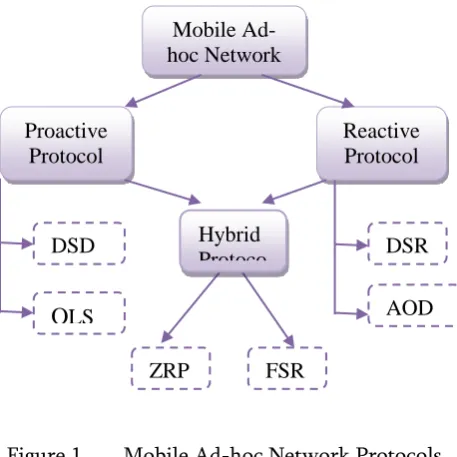
ROUTING PROTOCOLFigure 1. Mobile Ad-hoc Network Protocols Classification
A. Proactive Protocol
Proactive protocol is the one in which each node within the mobile network maintains one or more routing tables which are being updated regularly this is because routing table helps to know the network topology[17]. As node broadcasts the data packet to other nodes, the routing information will be available in case if there is any change in topology of the network. An additional overhead cost is needed in order to maintain or update the routing information within the routing table. As all the routes are maintained at all the times hence such protocols have very less possibility of intermission. DSDV (destination sequence distance vector), OLSR (optimized link state routing) protocol, are examples of Proactive protocols[6].
1) DSDV: The protocol is basically based on bellman-ford theory of shortest path algorithm. The protocol avoids the loop formation while transmitting the data packet within the network, by allotting a sequence number to every route. The routing table records and maintains the information like: the next hop towards the destination node, the sequence number of the last data packet, the metric and the time to reach the destination node[4]. The route with the highest
sequence number helps to identify and separate the old routes from that of the new ones and thereby helping to avoid loop formation.
2) OLSR: OLSR is an optimization of pure link state algorithm in ad hoc network. The routes are always immediately available when needed due to its proactive nature. Hop by hop routing is used in forwarding packets. The most distinctive feature of OLSR is MRP (Multipoint Relays), responsible for controlling traffic over the network[14]. The Topology Control (TC) message helps to exchange the topological information that is being broadcasted throughout the network. The protocol is suitable for those projects that avoid long delays in the transmission of the data packet. The protocol is not a good choice for the network where the number of nodes increases, as the overhead increases to keep the control messages for each and every route.
B. Reactive Protocol
In the reactive routing protocol or on-demand routing protocol, the routes are created only when needed. There is no need to maintain the network topology from time to time. Once a route gets discovered, the route is maintained until that route is no longer available or required[8]. Some of the Reactive routing protocols are DSR, AODV, etc.
1) DSR: DSR is a source based routing protocol, only the source node provides the information about the whole path. Intermediate node does not play any role in providing any information about the destination node. DSR consists of RREQ and RREP messages[7]. The protocol forms a route only when requested by transmitting computer. The reply message for the whole route is generated by the destination node, consisting of the addresses list received while requesting the route and transmits it back to the source node along the same path. But when the data packet is not being received by the destination node, the source node tries to retransmits the same message until not being received by the destination node. But if it still persists, the destination
Mobile Ad-hoc Network
Reactive Protocol Proactive
Protocol
DSD V
O
LS AODV DSR
FSR ZRP
node generates a route error message specifying the link creating a problem, and transmits it to the source node. It is a protocol that organises and configures itself without the requirement of network setup and need of central administration.
2) AODV: AODV is both unicast as well as multicast routing protocol. Unlike DSR, both source and intermediate nodes are involved in providing path information[16]. AODV not only uses the periodic beaconing but also the sequence numbering procedure. It follows route discovery procedure similar to that DSR. The two main differences between AODV and DSR are as follows:
i. In DSR, data packet carries full routing information, whereas in AODV the data packets carry the destination address. Hence, AODV has less routing overheads than that of DSR[15].
ii. DSR Route Reply carries the address of every node along the route, whereas in AODV it only carries the destination address and the sequence number.
C. Hybrid Protocol
It has the combined features of both proactive and reactive protocols. It overcomes latency and large overhead issue by using the table maintenance process of proactive protocol and route discovering mechanism by reactive protocol[12]. But the protocol fails in large topological network where large routing information is required to be maintained which consumes more memory and power.
1) FSR: It is based on the Fisheye Technique given be Kleinrock and Stevens, under which the information size is reduced in the graphical format. In this protocol the fish’s eye captures the details of data which is near to the focal point. As the distance from the focal point decreases the information detail decreases. A table called as link state table is maintained which is being shared in between the neighbouring nodes[11]. As the messages are being sent from time to time in an
up to date manner, a lot of bandwidth is consumed in whole process. So in order to overcome this routing scope is done to reduce the message size, and significantly reduces the bandwidth.
2) ZRP: The protocol is mainly used in LANs and makes use of a mechanism called query-reply. ZRP practices two types of routing that is Inter-zone and Intra-Inter-zone routing, which not only gives flexibility in discovering the routes but also helps in maintain them in ad-hoc networks. Globally, Inter-zone routing is performed through the use of reactive protocol. While locally, Intra-zone routing is preformed through that of proactive protocol[5]. Advantage of using such protocol is that, it helps to reduce the delay caused because of reactive routing protocol, and helps to reduce the overhead caused through the proactive routing protocol.
IV.
CONCLUSIONAs the paper brings out the comparison between all 6 protocols, it’s very difficult to bring out best among all of them. From the study it has been concluded that for faster connection purpose OLSR and DSDV are best, because of the availability of routing information. Route discovery and maintainability are best served by ZRP and FSR protocols. While that of DSR works best when used in small network. Future work can be done on bringing out the security in MANETs which has not yet been carried out.
V.
REFERENCES[1] Shilpa Shukla, Shelja Sharma,“study & analysis
of dsdv, aodv & dsr” , International Journal of
Advanced Research in Computer and Communication Engineering Vol. 2, Issue 5, May 2013
[2] S.A.Ade, P.A.Tijare, “Performance Comparison of AODV, DSDV, OLSR and DSR Routing
International Journal of Information Technology and Knowledge Management. July-December 2010, Volume 2,No. 2, pp. 545-548.
[3] Dr.S.S.Dhenakaran, A.Parvathavarthini, “An Overview of Routing Protocols in Mobile
Ad-Hoc Network”,International Journal of
Advanced Research in Computer Science and Software Engineering, Volume 3, Issue 2, February 2013
[4] J Broch, D. Maltz, D. Johnson, Y.C. Hu, and J. Jetcheva, “A performance comparison of multihop wireless ad hoc network routing
protocols,” MOBICOM ’98, pp. 85-97, October
1998.
[5] Jeroen Hoebeke,Ingrid Moerman,Bart Dhoedt,Piet Demeester, “An Overview of Mobile Ad Hoc Networks:Applications and
Challenges”Journal of the communication
networks,July 2004.
[6] A.E. Mahmoud, R. Khalaf & A, Kayssi,
“Performance Comparison of the AODV and
DSDV Routing Protocols in Mobile Ad-Hoc
Networks”, Lebanon, 2007.
[7] Mohd Izuan Mohd Saad and Zuriati Ahmad Zukarnain, “Performance Analysis of Random-Based Mobility Models in MANET Routing
Protocol”, European Journal of Scientific
Research, vol. 32, no.4, pp.444-454, 2009.
[8] Azizol Abdullah, Norlida Ramly, Abdullah Muhammed, Mohd Noor Derahman,
“Performance Comparison Study of Routing
Protocols for Mobile Grid Environment”,
IJCSNS International Journal of Computer Science and Network Security, pp 82-88, Vol.8 No.2, February 2008
[9] A. Boukerche, “Performance Evaluation of Routing Protocols for Ad Hoc Wireless
Networks, Mobile Networks and Applications” ,
Vol. 9, Netherlands, 2004, pp. 333-342.
[10] Dr.D. Siva Kumar “Review: Swarm Intelligent based routing Protocols for Mobile Adhoc
Networks”, International Journal of Engineering
Science and Technology, Vol. 2 (12), 2010, 7225-7233.
[11] S. Mueller, R. P. Tsang and D. Ghosal, "Multipath Routing in Mobile AdHoc
Networks: Issues and challenges", Performance
Tools and Applications to Networked Systems,
pp. 209-234, 2004
[12] A. K. Bhatt, C. Mohini and S. Thakur, "A New Efficient and Reliable On-Demand Routing
Protocol for MANET (ERORPM)" International
Journal of advanced research in Computer Science and software engineering, vol. 3, no. 5, 2013
[13] I. Panda, "A survey on routing protocols of
manets by using qos metrics" International
journal of advanced Research in computer science and software engineerin,vol. 2, 2012
[14] G. Jayakumar and G. Gopinath, "Ad Hoc Mobile Wireless Networks Routing Protocols – A
Review", Journal of Computer science, vol. 3,
no. 8, 2007.
[15] A. Kumar, C. L. Reddy and P. S. Hiremath, "High performance Modified DSR with Power Consumption Optimization for Mobile Ad Hoc
Networks", International Journal of Computer
Science and Network Security, vol. 7, no. 5, 2007.
[16] M. R. Kumar and N. Geethanjali, "A Literature
Survey of Routing Protocols in MANETs",
International Journal of Science and research, 2013.
[17] D. B. Johnson, D. A. Maltz and J. Broch, "DSR: The Dynamic Source Routing Protocol for
Multi-Hop Wireless Ad Hoc Networks", Ad hoc