* To whom all correspondence should be addressed.
The Computerized Simulation of the Neuro-fuzzy
System for Recognizing the Parameters of the
Geographically Distributed Systems Equipment
Vladimir Mikhailovich Vatutin1,
Andrei Borisovich Semyonov2 and Sergey Sergeyvich Shavrin3
1Russian Research Institute of Space Device, 53 Aviamotornaja str., 111250, Moscow 2Moscow Technical University of Communications and Informatics,
8a Aviamotornaja str., 111024, Moscow. doi: http://dx.doi.org/10.13005/bbra/1479
(Received: 27 September 2014; accepted: 10 October 2014)
The possibility of neural networks control over emergency and pre-emergency situations by predicting their development with the equipment of geographically distributed systems based on computer technology, which is operating under the conditions of uncertainty, has been investigated. The errors of the neural network and the choice of algorithm for training and testing the network have been evaluated; the methods for the neuro-fuzzy control by using a computer neural network with a training set have been claimed.
Key words: Computer technologies; fuzzy control; neural network.
The absence of accidents (nonstandard situations) is one of the main criteria of the system equipment performance, the system based on computer technology coordinating the work of the maintenance entity in real time mode. The emergency shutdown system provides the process shutdown or switching it to the safe mode to prevent the emergency evolution.
The work1 offers the methods of technical operation based on the emergency correction before its occurrence by identifying the pre-emergency state of the maintenance entity.
The work2 offers the integration of knowledge about the similar nonstandard situations at geographically distributed entities of
The report4 analyzes the effectiveness of expert methods for the emergency situations predicting and draws the conclusion about the acceptance of an approach based on the fuzzy measure theory and fuzzy integral calculus. However, in the report4 there are no estimates of quantitative and qualitative information about the maintenance entity, and the applied mathematical support for detecting the parameters of these objects by using the suggested methods has not been specified. Statement of research results
The evaluation, analysis and prediction of the technical state of the equipment for geographically distributed systems based on computer technology for the development of appropriate regulatory measures and eliminating nonstandard situations. The nonstandard situation means a situation where for some (usually unspecified) reasons there is a failure of the normal process behavior and there is a need for deciding on further actions.
Methods of the fuzzy game theory and fuzzy integral calculus are suggested for the implementation by a neural network using the training set and the software package Matlab.
The construction of mapping XY at the simulation of the neuro-fuzzy system of detecting parameters of computing machinery equipment performs the following tasks:
a) The formation of the correct input signals in accordance with all the patterns of the training set;
b) The formation of the correct output signals in accordance with all possible input signals, which are not included in the training set.
The control results obtained by using the utility program Performance Monitor (information is collected daily and packed into weekly reports) are considered at forming the training set for controlling the computing systems equipment parameters. The remote control is used to control the parameters of the main communication link. The remote control for small systems is carried out through the communication ports RS232 and RS485, relay contacts and SNMP adapters. For the complex geographically distributed systems the remote control is carried out by using the primary sensors, controllers, and control software5-13.
Various types of neural networks for the neuro-fuzzy control have been analyzed:
homogeneous neural networks, multi-layered neural networks, and cyclic operation neural networks. The theoretical basis for constructing the mapping on the basis of homogeneous neural networks is the following statement: for any set of pairs of input - output vectors of arbitrary dimension {(Xk, Yk), k=1...K} there is a
homogeneous two-layer neural network with sequence links, with sigmoid transfer functions and with a finite number of neurons, which for each input vector Xk generates a corresponding output
vector Yk.
It should be possible to build with the help of neural networks the function, where Y is of an arbitrary dimension. The theoretical basis for constructing such functions on the basis of homogeneous neural networks is the following statement: For any set of pairs of input-output vectors of arbitrary dimension {(Xk, Yk), k=1...K}
there is a homogeneous two-layer neural network with sequence links, with sigmoid transfer functions and with a finite number of neurons, which for each input vector Xk generates a
corresponding output vector Yk.
The purpose of the neural network training is to minimize the error which occurs at each output element in the training data set. Since an error can be positive or negative, the error value is taken into account when measuring the mean accuracy of the network as a whole. The error character is important only when the distinct error between the actual network output and the reference value is computed. The significance must be modified so that the error value was close to zero.
Three types of errors have been analyzed 1) The error of a unit output element, which is
necessary for the procedure of error back propagation;
2) The entire network error at a particular input signal which provides information about how correct the network response is at a given time;
3) The average network error computed after showing the entire set of training data, which shows how well the network has learned a pattern set of training data (an average of the entire set training data error value of the second type).
computed as a distance (module), this error value is always positive, and its averaging does not require computing the absolute value.
There are also a number of individual measures of errors, each of which is determined by the specific network requirements. The most commonly used is the measure of error as a simple difference between the standard value and the value of the corresponding network output for each input value of the training sequence:
e = t
i - ai ...(1)
where ti is the standard value for the i
output, and ai is the current value of the same output.
In order to compute the error of the entire output layer, the standards and outputs are treated as points in a multidimensional space, and the distance between them is computed. The distance between the two points is computed as the quadratic root of the sum of squares of the coordinate differences. The error of the network output with the N output element is equal to the square root of the sum of squares of each output element errors
ni
i i
i
t
a
1
2
)
(
...(2)This error is known as the squared error RSE (from the English root squared error). One of the varieties of RSE is a weighted RSE, a weighted error. The term “weight” in this case refers not to the value of the network weight, but to the measure of Wp importance assigned to each of the training patterns:
e = Wpi (ti-ai) ...(3) The weight Wpi is associated with each pattern of the training data set and indicates the importance of this pattern, or its “quality”. The weights values should be between 0 and 1. In this case RSE is determined as
ni
i i pi
i
W
t
a
1
2
)
(
...(4)For the categorization problems the threshold can be set the way that the outputs of the output elements take the values of either 0 (does not belong to the class) or 1 (belongs to the class). It is not enough to know “yes” or “no” for computing the error measures, it is necessary to compute the deviation value.
According to preliminary estimates, we can estimate the amount of training data. As for the training sequence size and the error, E. Baum and D. Hausler have shown a simple estimate to be
used in practice. Assuming the errors limits 0 e 1/8, the number of training patterns should be approximately equal to the number of network weights multiplied by the reciprocal error value. For example, it is necessary to use a training sequence (n) 10 times bigger than the weights (w) quantity for the error limit e=0,1. This dependence is described as
e
w
n
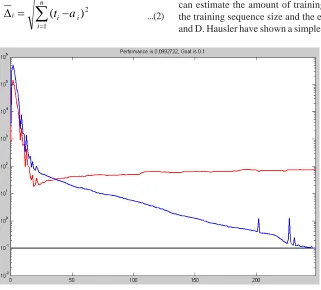
...(5)The number of training sequences is much less than the existing data set. The reason that the error value is significant is associated with the generalization capability-to-accuracy ratio. Small error of the retrained network cannot be considered a training success. Equation (5) shows that it is necessary to use more weights than the amount that can fill the data set, so we need to stop at a higher training error in order to keep the generalizing ability. This forces us to sacrifice the accuracy to the network ability for generalizing and limits the number of hidden layers in the network. A complex model does not generalize as well as a simple one does, but it is sufficient enough. Fig. 1 shows the process of the error change in the training and test set.
As it can be seen from Fig. 1, after some time the error in the independent set stops decreasing and even slightly increases and approaches the value of 80, whereas the error in the training set tends to 0.1. Thus, the available data is not enough for a valuable study. But the training can be terminated earlier that will save time and will not reduce the network generalization ability.
CONCLUSIONS
The methods of neuro-fuzzy control for detecting and eliminating the emergency and pre-emergency situations while operating the systems based on computing technologies have been suggested. The methods suggest the use of a computer neural network with a training set.
REFERENCES
1. Sachkov, N.G., E.A. Rusakova and A.V. Parshin, Basic concepts of operational maintenance of
information systems of railway transport. Moscow: MARSHRUT, 2005.
2. Farionova, N.A., Systemic approach to building algorithms and models of systems of decision-making support. Avtomatika. Avtomatizatsiya. Elektrotekhnicheskye Kompleksy i Sistemy, 2008; 2(22).
3. Method of robust, neuro fuzzy and adaptive control, Textbook, Eds., Egupov, N.D. Moscow: Bauman MSTU Publiching House, 2001 4. Tkalich, S.A., Application of expert systems in
accident free control. Elektrotekhnicheskye Komleksy I Sistemy Upravleniya, 2010; 2. 5. Vokin, G.G., N.A. Vasilyev and T.S. Abbasova,
Development of the algorithm of teaching neuron network to recognize parameters of the equipment, 2014; 6.
6. Artuschenko, V.M. and B.A. Kucherov, Adaptive control signal parameters satellite ground station. In the Proceedings of X mezinárodní vdecko-praktická konference «Vda a technologie: krok do budoucnosti – 2014». Díl 30. Moderní informa, ní technologie. Praha, Publishing House «Education and Science» s.r.o., 2014; 19-24.
7. Artuschenko, V.M. and B.A. Kucherov, Evaluation of interference situation on board the spacecraft and earth stations in the corporate satellite communication systems. In the Proceedings of the X International scientific and practical conference «Trends of modern science». Vol. 26. Technical sciences. Sheffield, Science and education LTD, 2014; 65-67. 8. Artuschenko, V.M. and B.A. Kucherov,
Optimization of parameters of ground station of satellite communication system. European Science and Technology: In the Proceedings of the VII international research and practice conference, Vol. II, Munich, April 23th – 24th, 2014. Germany, Munich: the publishing office Vela Verlag Waldkraiburg, 2014; 397-400. 9. Artuschenko, V.M. and B.A. Kucherov, Analisi
della uso della tecnologia nella distribuzione dei controlli veicoli spaziali. Italian Science Review, 2014; 3(12): 50-53.
10. Artuschenko, V.M. and B.A. Kucherov, Analysis of information exchange in the process of distribution of control facilities for spacecrafts with resource restrictions. European Science and Technology: In the Proceedings of the VII international research and practice conference, Vol. II, Munich, December 27th – 28th, 2013. Germany, Munich: the publishing office Vela Verlag Waldkraiburg, 2013; 243–246.
Analysis of the possibilities of using spacecraft flight model for the distribution of funds management. In the Proceedings of the IX Mi’dzynarodowej naukowi-praktycznej konferencji «Perspektywiczne opracowania s nauk technikami-2013», Vol. 34. Nowoczesne informacyjne technologie. Przemy[l, Nauka i studia, pp: 26-30.
12. Artyushenko V.M. and V.I. Volovach, Statistical Characteristics of Envelope Outliers Duration of non-Gaussian Information Processes. In the
Proceedings of the IEEE East-West Design & Test Symposium (EWDTS’2013), Rostov-on-Don, Russia, September 27–30, 2013. Kharkov: KNURE, 2013; 137-140.