70
Correlation between Structure Characteristics and Pair Radial
Distribution Function in Silica Glass under Compression
Mai Thi Lan
*, Tran Thu Thuy, Le Thi Hong Lien, Le Van Vinh
Hanoi University of Science and Technology
Received 28 November 2018
Revised 25 December 2018; Accepted 26 December 2018
Abstract: We have studied structure of silica glass at different pressures and temperature of 300K by using Molecular Dynamics simulation (MD) method. The model consists of 6000 atoms (2000 Si, 4000 O atoms) with the periodic boundary condition. We applied the Morse-Stretch potentials which describe the pairwise interactions between ions for SiO2 system. There is structural phase
transformation from tetrahedra (SiO4) to octahedra (SiO6) network structure. There is splitting in the
Si-Si pair radial distribution function (PRDF) at high pressure (100 GPa). The original of this splitting relates to the edge- and face-sharing bonds. The new second peak of the O-O PRDF at the high pressure originates from oxygen atoms of the edge-sharing bonds. Thus, there is rearrangement of O atoms. O atoms have tendency to more order arrangement that leads to form some oxygen hcp and fcc structure in the model at high pressure.
Keywords: Molecular Dynamics simulation (MD), Silica (SiO2), Structure, the peak splitting.
1. Introduction
Silica (SiO2) is one of the most intensively investigated materials due to its importance in high
technology materials (ceramic, semiconductor, solar cell) and geophysical sciences. SiO2 is typical
network-forming oxide that studied for a long time by both experiments (X-ray diffraction, neutron diffraction, nuclear magnetic resonance, …) and simulations. These studies have shown that under different temperature and pressure conditions, the change of network structure have a great influence on the physical properties of the SiO2 material. Zachariasen [1] predicted that the structure of SiO2 in
amorphous and liquid state comprised mainly by SiO4 basic structural units that are linked together to
form network structure at different temperature. This prediction is confirmed by Mozzi and Warren through X-ray diffraction [2]. The short- range order structure are determined by calculation of the coordination number, the radial distribution function of the Si-Si, Si-O and O-O pairs, distribution of
________
Corresponding author. Tel.: 84-988277387.
Email: [email protected]
the O-Si-O and Si-O- Si bond angles in SiOx units. The Si-O-Si bond angle in the SiO2 glass is about
144o. The result of the high-energy X-ray diffraction for amorphous SiO
2 presented the Si-O-Si bond
angle is 147o. By the 17O NMR spectrum analysis of SiO
2 glass, the mean Si-O-Si bond angle is 144 °
[1]. By using MD simulation, network structure of SiO2 is built from basic structural units SiO4 at low
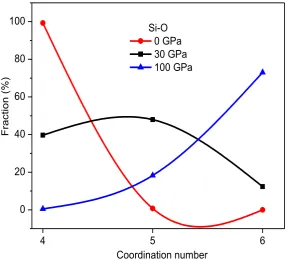
pressure. Under compression, there is transformation from SiO4 structure to SiO6 structure via SiO5 unit.
At high pressure, structure of SiO2 is a mixture of SiOx (x=4,5, 6) units [3-5]. At all temperature and
ambient pressure, structure of SiO2 is mainly SiO4 units that form tetrahedra network. The fraction of
SiO5 is very negligible. Thus, SiO5 units are the same as structural defects in SiO2 [6-8]. The properties
of silica depend on the change of fraction of SiOx units as well as the type of linkages and the spatial
distribution of SiOx units. Therefore, the studying of structure of SiO2 at different temperature and
pressure conditions is necessary. In this paper, we use MD simulation and visualization of MD data to investigate SiO2 system. The aim of this work is to clarify the correlation between structure
characteristics and pair radial distribution function, explain the splitting of Si-Si PRDF and the second peak of O-O PRDF in Silica glass under compression.
2. Calculation method
We used MD simulation method and employed the Morse–Stretch potential to construct MD models for SiO2. Details about potential parameters can be found in reference [9]. The MD initial configuration
is generated by randomly placing 6000 atoms (2000 Si, 4000 O atoms) in cubic box (44.65×44.65×44.65 Å) with periodic boundary condition. To remove the effect of remembering initial configuration, the sample is heated up to 6000 K and relaxed after 2.104 MD steps to reach the equilibrium. Then, the
sample was cooled down to the designed temperature and pressure (300K and 0 GPa, denoted M1 model) and relaxed in a long time. After that, the models at different pressures (0, 30 and 100 GPa) were constructed by compressing M1 model. Next, these models were relaxed for 106 MD steps in NPT
ensemble to reach the best equilibrium. The structural characteristics of considered models are determined by averaging over 1000 configuration during the last 2.104 MD steps.
3. Result and discussion
The network structure of SiO2 glass at different pressures is visualized in figure 3. We found that,
the SiOx units are connected each other by sharing one, two or three oxygens and these ones
corresponding to the corner-, edge- or sharing bonds. The bond statistics corner-, edge- and face-sharing bonds between two adjacent SiOx units are showed in table 1.
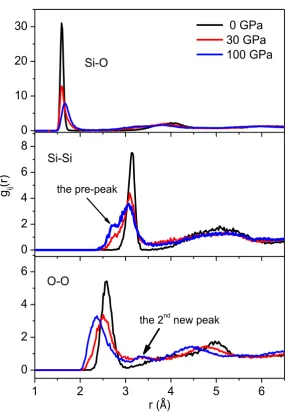
Figure 1. The dependence of the pair radial distribution functions of SiO2 glass on pressures
Table 1. The number of oxygen corner-sharing (Nc), edge-sharing (Ne) and face-sharing (Nf)
atoms in SiO2system.
P (GPa) 0 30 100
Nc (%) 99.65 66.67 17.20
Ne (%) 00.35 30.85 70.85
Nf (%) 00.00 02.48 11.95
0
10
20
30
0
2
4
6
8
1
2
3
4
5
6
0
2
4
6
Si-O
0 GPa
30 GPa
100 GPa
Si-Si
g ij
(r)
O-O
the pre-peak
the 2nd new peak
Figure 2. The dependence of coordination number on pressures.
The result shows that at 0 GPa, links between two adjacent SiOx units are mainly corner-sharing
bonds (99.65 %). When pressure increases, the fraction of corner-sharing bonds decreases, the fraction of edge- and face-sharing bonds increases. At high pressure, links between two adjacent SiOx units are
mainly the fraction of edge-sharing bonds. As above mentioned, the structure of SiO2 is mainly build by
SiO4 tetrahedra units at 0 GPa and SiO6 octahedra units at 100 GPa. It means that links between two
Figure 3. The network structure of SiO2 glass at different pressures.
a)
0 GPa
a)
30 GPa
c)
100 GPa
4 5 6
0 20 40 60 80 100
F
ra
ct
io
n
(%
)
Coordination number Si-O
adjacent SiO4 units are mainly corner-sharing bonds, meanwhile links between two adjacent SiO5, SiO6
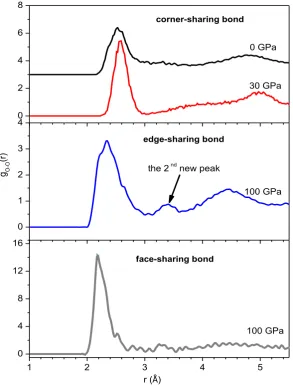
units are mainly edge-, face- sharing. Thus, the first peak splitting in the Si-Si PRDF at r1 = 2.70 and r2 =3.10 Å at 100 GPa relates to the edge-, face-sharing bonds. Next, we focus on explaining the origin of appearance of the second new peak in O-O PRDF at 100 GPa. We calculated and analyzed the O-O PRDF of oxygen corner-, edge- and face-sharing atoms. This result is presented in figure 4.
For the O-O PRDF of oxygen corner- and face-sharing atoms, they have only single peak that located at about 2.50 Å and 2.26 Å, respectively. However, the new second peak is observed in the O-O PRDF of oxygen edge-sharing atoms. This demonstrated that oxygen edge-sharing atoms cause the second peak of the O-O PRDF located at 3.40 Å. Moreover, we found that, with further increasing pressure, both of Si and O sublattices have a slight change. Meanwhile Si sublattice is more easily compressed than O sublattice at high pressure. O atoms have tendency to more order arrangement that leads to form some hexagonal close-packed (hcp) and faced centered cubic (fcc) structure of oxygen atoms in the model at high pressure. This result is visualized in figure 5.
Figure 4. The O-O pair radial distribution functions of oxygen corner-, edge- and face-sharing atoms.
1 2 3 4 5
0 4 8 12 16 0 1 2 3 4 0 2 4 6 8
r (Å)
100 GPa
g
O-O
(r)
face-sharing bond
100 GPa
the 2nd new peak edge-sharing bond
corner-sharing bond
0 GPa
Figure 5. The fcc O atoms in blue color and hcp O atoms in red color at 100 GPa.
4. Conclusion
In this paper, we have obtained the main results as following:
(i) The structure of SiO2 is built by SiOx (x=4,5,6) basic structural units, meanwhile, the structure of
SiO2 is comprised mainly by SiO4 units at low pressure and SiO6 units at high pressure. There is
structural phase transformation from tetrahedra (SiO4) to octahedra (SiO6) network structure via SiO5
units.
(ii) The SiOx units are connected each other by the corner-, edge- and/or face-sharing bonds.
(iii) The splitting in the Si-Si PRDF at high pressure due to the edge- and face-sharing bonds and
oxygen edge-sharing atoms cause the second peak of the O-O PRDF.
(vi) Under compression, O atoms have tendency to more order arrangement that leads to form some hcp and fcc structure of O atoms in the model at high pressure.
Acknowledgements
This research is funded by the Vietnamese Ministry of Education and Training project (B2018-BKA-57)
References
[1] W. Zachariasen, J. Am. Chem. Soc. 54, pp. 3841–3851(1932) [2] Mozzi và Warren, J. App. Cryst. 2, pp. 164–172 (1969) [3] Jin W, Kalia RK, Vashishta P, Phys Rev B. 50:118–131 (1994) [4] Sato T, Funamori N. Phys Rev B. 82, 184102 (2010)
[6] Inamura Y, Katayama Y, Utsumi W, Phys Rev Lett. 93, 015501 (2004).
[7] P. K. Hung, N. V. Hong, and L. T. Vinh, J. Phys.: Condens. Matter 19, 466103 (2007). [8] Vollmayr-Lee K, Zippelius A, Phys Rev E. 88:052145 (2013)
[9] P. Tangney and S. Scandolo, .J. Chem. Phys.117, 8898 (2002). [10] P. K. Hung, N. V. Hong, and L. T. Vinh, J. Phys.: Condens. Matter 19,
466103 (2007).
[11] A. Zeidler, K. Wezka, R. F. Rowlands, D. A. J. Whittaker, P. S. Salmon, A. Polidori, J. W. E. Drewitt, S. Klotz, H. E. Fischer, M. C. Wilding, C. L. Bull, M. G. Tucker and M. Wilson, Phys. Rev. Lett. 113, 135501 (2014). [12] L. I. Tatarinova, in The Structure of Solid Amorphous and Liquid Substances (Nauka, Moscow, 1983).
[13] M. Guerette, M. R. Ackerson, J. Thomas, F. Yuan, E. B. Watson, D. Walker and L. Huang, Sci. Rep. 5, 15343 (2015).