Original Research Article
Internet addiction among engineering students in Belagavi city:
cross sectional study
Ravikiran Kamate
1*, Sulakshna Baliga
2, M. D. Mallapur
2INTRODUCTION
Internet is an important tool of modern society used frequently for communication and information sharing in school, business and social life. Problematic internet use as been debated all over the world as there has been an explosive growth in the use of internet for past decade not only all over the world but also India.1 Easy access and low cost of Internet packs- are main cause of development of increased internet use in India. In 2014 number of internet users in India was estimated to be 243 million and ranked second globally after China with
highest internet users of 300 million.2 Internet addicts spend most of their life in front of the computer passing time with e-mails, chatting, discussion forums and online games.3 Internet addiction is not clinical diagnosis, but a potentially pathological behavioral pattern with symptoms: a loss of control over the behavior, preoccupation with the Internet, using the Internet to modify mood, and withdrawal symptoms. Internet addiction can cause children and adolescent physical and psychological health problems, such as depression and suicidal ideation, loneliness, interpersonal problems, time management problems, sleeplessness, destructive
ABSTRACT
Background: Internet addiction is not clinical diagnosis, but a potentially pathological behavioral pattern with symptoms: a loss of control over the behavior, preoccupation with the Internet, using the Internet to modify mood, and withdrawal symptoms. Easy access and low cost of Internet packs- are main cause of development of increased internet use in India. Internet addiction– factors like gender, environmental factors, socioeconomic status, etc. have effect on internet use.
Methods: Cross-sectional study conducted during January 2016 to February 2016. Data was collected among 500 engineering students of four engineering colleges of Belagavi city using young's questionnaire. Analysis was performed using SPS 20. Chi-square applied as statistical test of significance for the association between age, sex, residence, SES and schooling. P<0.01 was considered to be statistically significant.
Results: The present study revealed that 16.2 and 6.2% of participants had moderate and severe form of internet addiction respectively. With increase in age prevalence of addiction increased. Internet addiction was more among Males when compared to females. Addiction was seen more in students whose both parents were working.
Conclusions: Internet addiction is an emerging form of addiction among students with males more than females mostly among engineering students who are dependent on internet for their work, carrier and completion of course Hence it's time to develop comprehensive intervention approach to promote healthy and safe internet use from family, college and peers.
Keywords: Internet addiction, Young's questionnaire, Engineering students
Department of Community Medicine, 1BKL Walawalkar Rural Medical College, Sawarde, Chiplun, Maharashtra,
2JNMC KAHER, Belgavi, Karnataka, India
Received: 12 December 2018 Revised: 11 February 2019 Accepted: 13 February 2019
*Correspondence: Dr. Ravikiran Kamate,
E-mail: [email protected]
Copyright: © the author(s), publisher and licensee Medip Academy. This is an open-access article distributed under the terms of the Creative Commons Attribution Non-Commercial License, which permits unrestricted non-commercial use, distribution, and reproduction in any medium, provided the original work is properly cited.
lifestyles and poor dietary behaviors and the increase of blood lead concentration.4
The term “addiction” has generally been associated with substance but excessive dependence and addictive pattern has led to emergence of word internet addiction. Several risk factors have been identified as determinants of internet addiction including: being male, living in metropolitan areas, not living with biological parents, low parental involvement, parental unemployment, low educational level of parents, being so young when using internet for the first time, overusing of social and game network sites. Hence internet addiction is a new and attractive subject considered as a behavior-based addiction in recent years.5
Objectives
The objective of this study was to know the prevalence of Internet addiction and study risk factors of internet addiction among engineering students of Belagavi city.
METHODS
Sample size: Calculated using formula:
n=Z2pq/d2
(where Z=1.96 at 95%confidence; p=prevalence of internet addiction; q=1-p; d= absolute allowable error).
For this study maximum variability was assumed with p=0.5; q=0.5; d=10% of p and sample of 486 was obtained where in round sample of 500 was taken.
Source of data
Five hundred engineering students of two engineering collages of Belagavi city, Karnataka were taken.
Study design
This study is a community based cross sectional study.
Study period
The study was conducted between January 2016 and February 2016.
Inclusion criteria
All the students who were taken admission and were studying in the respective collage and who gave informed consent were included in the study.
Exclusion criteria
Students who refused to give informed consent and students who were absent during the period of excluded.
Ethical approval was taken from ethical committee.
Study instrument
Pretested & predesigned questionnaire Young’s questionnaire11
Study variables
Age, sex, religion, area of residence, socioeconomic status, etc.
Sampling method
Simple random sampling method was used in the study.
Statistical analysis
Statistical analysis was done using Microsoft excel worksheet 2013 and SPSS version 20. Chi-square test was used for analyzing variables. P<0.01 was considered as significant.
RESULTS
In the present study, the prevalence of internet addiction was found to be 61% (Figure 1).
Figure 1: Prevalence of internet addiction.
Figure 2: Distribution of students according to type of addiction.
In this study, mild form of internet addiction was highest (44.6%), followed by moderate form of addiction (16.2%) and least (0.6%) use was seen with severe form of internet addiction (Figure 2).
39%
61%
Absent Present
44.6 % 16.2 %
0.6%
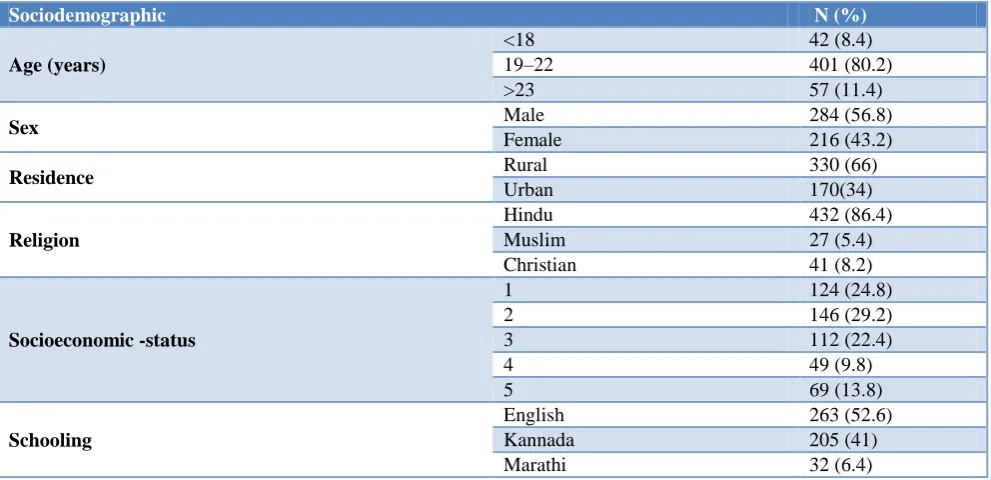
Table 1: Sociodemographic profile.
Sociodemographic N (%)
Age (years)
<18 42 (8.4)
19–22 401 (80.2)
>23 57 (11.4)
Sex Male 284 (56.8)
Female 216 (43.2)
Residence Rural 330 (66)
Urban 170(34)
Religion
Hindu 432 (86.4)
Muslim 27 (5.4)
Christian 41 (8.2)
Socioeconomic -status
1 124 (24.8)
2 146 (29.2)
3 112 (22.4)
4 49 (9.8)
5 69 (13.8)
Schooling
English 263 (52.6)
Kannada 205 (41)
Marathi 32 (6.4)
Table 2: Patterns of internet use.
Prevalence (%)
Own computer Yes 320 (64.0)
No 180 (36.0)
If no computer, place of use of internet
Internet cafe 59 (32)
Mobile 90 (51)
Friends computer 21 (12)
Others 10 (5)
Use of internet before Yes 459 (91.8)
No 41 (9.2)
Age of onset of use of internet (years)
≤12 48 (10.2)
13-16 206 (44.8)
17-22 205 (44)
Most common use of internet device
Computer 70 (14)
Mobile 391 (78.2)
Tablet 13 (2.6)
Laptop 26 (6.2)
Mode of access of internet
Wi-fi 151 (28.2)
Broadband 19 (3.8)
Data card 39 (5.8)
Mobile internet 291 (62)
Average use of internet (in hours)
≥5 80 (16)
3–5 80 (16)
2–3 134 (26.8)
≤2 206 (41.2)
Preferred website
No preferred website 120 (24)
Chatting 92 (18.4)
General site (wikipedia) 127 (25.4) Social networking 107 (21.4)
Games 11 (2.2)
Others 43 (8.6)
Do they feel use of internet helps in getting marks Yes 368 (73.6)
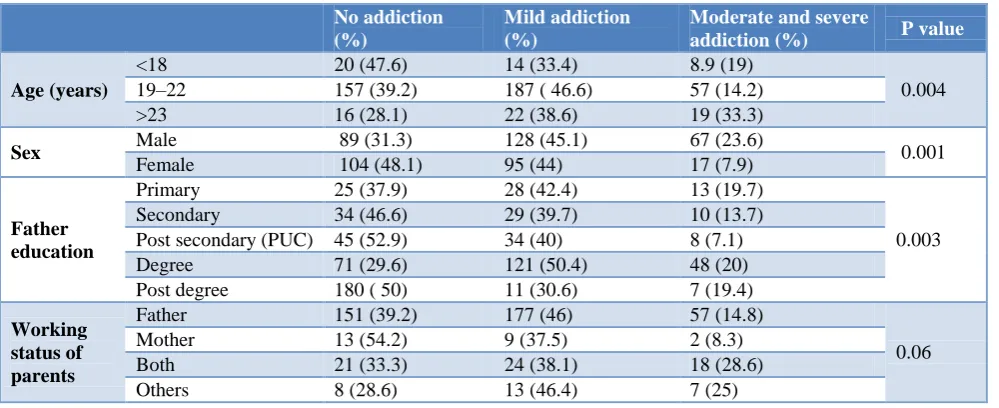
Table 3: Association of factors associated with internet use. No addiction
(%)
Mild addiction (%)
Moderate and severe
addiction (%) P value
Age (years)
<18 20 (47.6) 14 (33.4) 8.9 (19)
0.004 19–22 157 (39.2) 187 ( 46.6) 57 (14.2)
>23 16 (28.1) 22 (38.6) 19 (33.3)
Sex Male 89 (31.3) 128 (45.1) 67 (23.6) 0.001
Female 104 (48.1) 95 (44) 17 (7.9)
Father education
Primary 25 (37.9) 28 (42.4) 13 (19.7)
0.003 Secondary 34 (46.6) 29 (39.7) 10 (13.7)
Post secondary (PUC) 45 (52.9) 34 (40) 8 (7.1)
Degree 71 (29.6) 121 (50.4) 48 (20)
Post degree 180 ( 50) 11 (30.6) 7 (19.4)
Working status of parents
Father 151 (39.2) 177 (46) 57 (14.8)
0.06
Mother 13 (54.2) 9 (37.5) 2 (8.3)
Both 21 (33.3) 24 (38.1) 18 (28.6)
Others 8 (28.6) 13 (46.4) 7 (25)
Socio demographic characteristics of the study participants and pattern of internet use presented in Table 1 and Table 2. The direct correlation of internet use with factors has been depicted in Table 3.
DISCUSSION
In the present study the term internet addiction has been used many times and has been described as an emerging psychiatric disorder but many health practitioners and researchers are uncertain if it should be considered as a true legitimate mental disorder.6 It is synonymous to problematic Internet use (PIU), resembles the DSM-IV definition of impulse control disorder or pathological gambling other various names associated with Internet addiction include cyberspace/online/net addiction, high Internet dependency, Internet addicted disorder, pathological internet use, problematic internet use, excessive internet use, and compulsive internet use.7
In the current study prevalence of internet addiction was found to be 61% and in 39% not associated with internet addiction. In contrary studies show that the prevalence of internet addiction varies between 2.4 and 18.8%. This rate is reported to vary between 0 and 26.3% in the USA and 4.4 and 13.5% in the European Union.3 A study conducted in Mumbai, India shows prevalence of 0.7%.8 In our study prevalence was found to be higher which could be due to early onset of use of internet, easy availability of mobile and cheap internet packs.
A study conducted in Jabalpur city, Madhya Pradesh in age group of 15-25 years showed males were more addicted than females which was almost similar to our study among males 68.7% were found to be addicted and 52% of females were found to be addicted.9 Similarly a study conducted on internet addiction reveled 50% increased odds for males to be addicted to the Internet (OR=1.5, 95% CI=1.1–2.2) when compared with females.10
Of the 500 students, 223 (44.6%) were revealed to have mild internet addiction, 81 (16.2%) moderate internet addiction and 3 (0.6%) severe internet addiction which was almost similar to study conducted in Jabalpur Madhya Pradesh.9
In our study there was significant correlation between age and internet addiction i.e. prevalence in less than 18 years was 42 (52.3%), between 19 to 22 years internet addiction was 401 (60.8%) and age above 23 years addiction prevalence was 57 (71.9%). This finding was similar to study conducted among adolescents in China.12
Other factors associated with pattern of internet use was assessed in our study which were – own a computer, age of onset of use of internet, most common use of internet device, average use of internet, preferred website.
CONCLUSION
16.2 and 6.2% of participants had moderate and severe form of internet addiction respectively. With increase in age prevalence of addiction increased. Internet addiction was more among males when compared to females. Addiction was seen more in students whose both parents were working. Risk factors such as age, sex, working status of parents and father’s education were found to be statistically significant.
Recommendations
which could be done by raising awareness among parents, teachers and students about internet use.
Funding: No funding sources Conflict of interest: None declared
Ethical approval: The study was approved by the Institutional Ethics Committee
REFERENCES
1. Srijampana VKR, Endreddy AR. Prevalence and patterns of internet addiction among medical students. Medical J Dr DY Patil University. 2014;7(6):709-12.
2. Krishnamurthy S, Chetlapalli SK. Internet Addiction: Prevalence and Risk Factors: A Cross-Sectional Study among College Students in Bengaluru, the Silicon Valley of India. Indian J Public Health. 2015;59(2):115-21.
3. Sasmaz T, Oner S, Kurt AO, Yapici G, Ertekin A. Prevalence And Risk Factors of Internet Addiction In High School Students. Eur J Public Health. 2013;24:15-20.
4. Li Y, Zhang X, Lu F. Internet Addiction Among Elementary And Middle School Students In China: A Nationally Representative Sample Study. Cyberpsychol Behavior Social Networking. 2014;17:111-6.
5. Hashemian A, Direkvand-Moghadam A. Prevalence Of Internet Addiction Among University Students In Ilam:A Cross-Sectional Study. Int J Epidemiologic Res. 2014;1:9-15
6. Morahan-Martin J. lnternet use and abuse and psychological problems. In Oxford Handbook of Internet Psychology Oxford University Press; 2007: 331–346.
7. Yeh YC, Lin SSJ, Tseng YH. The Questionnaire of Lifestyle Change In Regard To Problematic Internet Use:Factor Structure And Concurrent And Cross-Year Predictive Utilities. The Turkish Online J Educ Tech. 2012;11:315-24.
8. Goel D, Subramanyam A, Kamath R. A study on the prevalence of internet addiction and its association with psychopathology in Indian adolescents. Indian J Psychiatry. 2013;55:140-3.
9. Sharma A, Sahu R, Kasar PK, Sharma R. Internet addiction among professional courses students:A study from central India. Int J Med Sci Public Health. 2014;3:1069-73.
10. Lam LT, Peng ZW, Mai JC, Jing J. Factors associated with Internet addiction among adolescents. J Cyberpsychol Behav. 2009;12:551-5. 11. Young KS, de Abreu CN. Internet Addiction: A
Handbook and Guide to Evaluation and Treatment. New York: Wiley; 2010: 23.
12. Ko CH, Yen JY, Liu SC, Huang CF, Yen CF. The associations between aggressive behaviors and internet addiction and online activities in adolescents. J Adolesc Health. 2009;44:598–605.