Original Research Article
A KAP study on water, sanitation and hygiene among residents of Parla
village, Kurnool district, Andhra Pradesh
Rekha Hothur
1, Sreedevi Arepalli
2*, Anusha Doddoju Veera Bhadreshwara
1INTRODUCTION
Safe and readily available water is important for public health, whether it is used for drinking, domestic use, food production or recreation purposes. In 2015, 71% of global population (5.2 billion people) used a safely managed drinking water service – that is, one located on premises available when needed, and free from contamination. 89% of the global population (6.5 billion people) used at least a basic service. A basic service is an improved drinking water source within a round trip of 30 minutes to collect water. Globally at least 2 billion people use a
drinking water source contaminated with faeces. Contaminated water can transmit diseases such as diarrhoea, cholera, dysentery, typhoid and polio. Contaminated drinking water is estimated to cause 502000 diarrhoeal deaths each year.1
Hygienic sanitation facilities are crucial for public health. In 2015, 39% of the global population used a safely managed sanitation service– defined as a toilet or improved latrine, not shared with other households, with a system in place to ensure that excreta are treated or disposed of safely. Globally 2.3 billion people still do not ABSTRACT
Background: Ensuring access to safe drinking water and sanitation for rural people is the key catalyst for economic and human growth. However extreme poverty inhibits a significant portion of rural population from getting access to sanitation facilities and safe drinking water services. The study was conducted to assess knowledge, attitudes and Practices (KAP) with regard to water, sanitation and hygienic practices and to identify the socio-demographic factors in relation.
Methods: A cross-sectional study sample comprising of 236 households was conducted in the rural field practice area after obtaining Institutional Ethics Committee approval. Proportionate sample of 20% households were taken from each ward and houses were selected by systematic random sampling method. Knowledge, attitude and practices regarding water, sanitation and hygiene were assessed using pretested semi-structured questionnaire.
Results: Out of 236 households majority interviewed were females 169 (71.6%), illiterate (54.2%) and unskilled workers 122 (51.7%) belonging to class V socio-economic status 165 (69.9%). Household lavatory is absent in 114 (48.3%) households. Out of 122 (51.7%) households having sanitary lavatories only 59 (48.4%) were fully utilizing them remaining 63 (51.6%) households were going to open defecation even though sanitary lavatory was present. A significant association between defecation practice and socio-economic status, education were observed.
Conclusions: This study shows that even though they have sufficient knowledge on water purification, Sanitation and hygiene this was not translated into practice because of poor attitude.
Keywords: Water, Sanitation and hygiene, KAP, Kurnool, Socio-demography
Department of Community Medicine, 1RVMIMS and RC, Telangana, 2Kurnool Medical College, Kurnool, Andhra Pradesh, India
Received: 20 February 2019 Accepted: 30 March 2019
*Correspondence: Dr. Sreedevi Arepalli,
E-mail: [email protected]
Copyright: © the author(s), publisher and licensee Medip Academy. This is an open-access article distributed under the terms of the Creative Commons Attribution Non-Commercial License, which permits unrestricted non-commercial use, distribution, and reproduction in any medium, provided the original work is properly cited.
have basic sanitation facilities such as toilets or latrines, of these 893 million still defecate in the open, for example in street gutters, behind bushes or into open bodies of water. Poor sanitation is linked to transmission of diseases such as cholera, diarrhoea, dysentery, hepatitis A, typhoid and polio. Inadequate sanitation is estimated to cause 280,000 diarrhoeal deaths annually and is a major factor in several neglected tropical diseases, including intestinal worms, schistosomiasis and trachoma. Poor sanitation can also contribute to malnutrition.2
Hygiene is multi-faceted and can comprise much behaviour, including hand washing, menstrual hygiene and food hygiene. International consultations among WASH sector professionals identified hand washing with soap and water as a top priority in all settings and hundreds of millions of people have no access to soap and water to wash their hands, preventing a basic act that would empower them to block spread of disease.3
Millennium development goal-7 (MDG-7) targets to halve the proportion of people without sustainable access to safe drinking water and basic sanitation by 2015.4 As SDG goal 6 calls for clean water and sanitation for all people targets (6.1, 6.2) to achieve universal and equitable access to safe and affordable drinking water for all and achieve access to adequate and equitable sanitation and hygiene for all and end open defecation by 2030.5
In India 2015, 85% of rural population has at least basic drinking water supply, open defecation in rural population is 56%.3 Nine out of ten people who practice open defecation lives in rural areas.6 Govt of India launched Swachh Bharat Mission (Gramin) in 2014 with aim of improving the levels of cleanliness in rural areas through Solid and Liquid Waste Management activities and making Gram Panchayats Open Defecation Free (ODF), clean and sanitised.7
Access to safe drinking water and basic sanitation is essential to human health and survival, but for many people living in low resource settings these vital services remain out of reach.8 As there are few reports on WASH practices, particularly from rural India we conducted a baseline study in rural population and this information was used to conduct awareness campaign to improve the knowledge of the rural population on water, sanitation and hygienic practices.
Objectives
Assess knowledge, attitudes and Practices (KAP) with regard to water, sanitation and hygiene.
Identify the socio-demographic factors associated with water, sanitation and hygienic practices.
METHODS
This is a Cross-sectional study carried out in parla village rural field practice area of Kurnool medical college, Kurnool district in Andhra Pradesh, India in 2015.
Selection of study population and sampling procedure
The village, with a population of 6500 (1193 houses) is divided into 9 wards, situated 17kms from Kurnool. Proportionate sample of 20% households were taken from each ward and total 239 households were selected by systematic random sampling method. Out of 239 households 3 houses were locked. So total 236 households were included in the study.
Inclusion criteria
Inclusion criteria were households with residents residing for at least 6 months duration and having Individuals of age 18 and above.
Exclusion criteria
Exclusion criteria were locked houses, households with residents residing for less than 6 months duration.
Ethical consideration
Permission for conduction of study was obtained from Institutional Ethical Committee and from Panchayat sarpanch of Parla village. Informed consent of each individual interviewed was obtained after explaining purpose of the study.
Data collection
Pretested semi-structured questionnaire consisting of WHO & UNICEF “core questions on drinking water and sanitation for households” was used.9
This questionnaire consists of a set of harmonized questions widely used by nations in their surveys to make data accurate and comparable across the globe. This questionnaire was modified according to local conditions after conducting pilot study and was used for data collection. In each household head of the family was interviewed. In case if head of family was not available adult above age 18 was interviewed who was available at the time of interview. Information was obtained on socio-demographic, housing, water source, water collection, household water purification, hand washing practices, waste disposal, toilet facilities etc.
Statistical analysis
RESULTS
A total of 236 households were interviewed. Majority of study population interviewed belongs to age group of 18-29 years (36.9%) with an average family size of 5.3 (SD) and majority interviewed were females 169(71.6%) and more than half of the interviewed participants were illiterate (54.2%) and unskilled workers (51.7%). More than half of the households were nuclear 131(55.5%) followed by joint (31.8%) and three generation (12.7%) and majority were residing in pucca (92.8%) houses. Majority of households belongs to class V socio-economic status 165(69.9%) followed by class IV, III, II, I according to modified BG Prasad socio-economic status classification.64.8% of study participants perceived that available water is safe for drinking. 57.2% of the participants perceived that quality of water can affect health. Majority of participants perceived that most common effects of drinking unsafe water were fever (85), Gastro intestinal (56) and cold and cough.
Table 1: Water and sanitation facility and uses.
Frequency %
Source of drinking water
Piped water into dwelling/yard 152 64.4
Public tap 47 19.9
Bottled water 11 4.7
Unimproved source 26 11.0
Time for fetching water
<30 min 207 87.7
≥30 min 29 12.3
Distance of water source from dwelling place (in meters)
<50 179 75.8
50-200 32 13.6
>200 25 10.6
Household water treatment
Filter 51 21.6
Boiling 16 6.8
Nothing 169 71.6
Lavatory in house
Present 122 51.7
Absent 114 48.3
Defecation practice
Sanitary 59 25.0
Open 177 75.0
Solid waste disposal
Sanitary 128 54.2
Insanitary 108 45.8
Table 1 shows that piped water in yard (62.3%) and public tap (19.9%) were the main sources of drinking water. Roundtrip hauling time between household and water source was less than 30 min for majority of households (87.7%) and distance of water source from dwelling place was less than 50 metres in majority of households (75.8%). 71.2% of households were not practising any household water treatment methods, only 21.6% and 6.8% of households were using water filter and boiling respectively for household water treatment. The reason for not practising any household water treatment were they think that water was already clean, methods of purification were expensive, lack of time, and don’t know the methods of water treatment. Household solid waste disposal is sanitary in 128 (54.2%) and insanitary in 108 (45.8%) families.
Results showed that 75% of study households were practicing open field defecation practices. Household lavatory is absent in 114 (48.3%) households and there was no community lavatory in the village. Major constraints for not having toilet were financial in 85 (74.6%) households and lack of space in 29 (25.4%) households. Out of 122 (51.7%) households having sanitary lavatories only 59 (48.4%) were fully utilizing them remaining 63 (51.6%) households were going to open field defecation even though sanitary lavatory was present.
All participants knew that hands should be washed prior to eating and after defecation. 120 (50.9%) and 176 (74.6%) participants knew that hands should be washed before handling food and when entering home from outside respectively. Material used for hand washing after defecation was soap and water in 98 (41.5%) families and water only in 138 (58.5%) families. Material used for hand washing before eating were water only in 193 (81.8%) families, soap and water in 34 (14.4%) families and 9 (3.8%) families were not practising hand washing before eating.
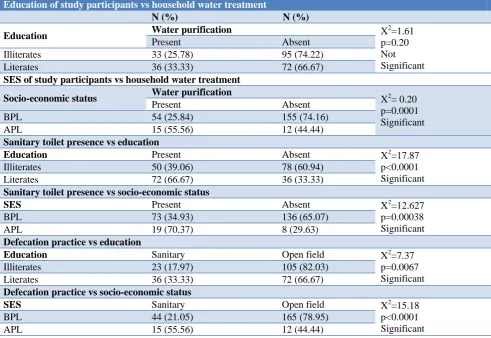
Table 3 shows that there was significant association between socioeconomic status and household water purification. Significant association was observed between presence of toilet in house, defecation practice and socio-economic status of households, education of interviewers.
Table 2: Knowledge and practice of study population on hand hygiene.
Knowledge Water only Water and soap
N (%) N (%) N (%)
Before handling (cooking) food 120 (50.9) 41 (17.37) 8 (3.39)
Before eating 236 (100) 193 (81.8) 34 (14.4)
After defecation 236 (100) 138 (58.5) 98 (41.5)
Table 3: Association between socio-demographic factors and WASH practices.
Education of study participants vs household water treatment
N (%) N (%)
Education Water purification X
2
=1.61 p=0.20 Not Significant
Present Absent
Illiterates 33 (25.78) 95 (74.22)
Literates 36 (33.33) 72 (66.67)
SES of study participants vs household water treatment
Socio-economic status Water purification X2= 0.20
p=0.0001 Significant
Present Absent
BPL 54 (25.84) 155 (74.16)
APL 15 (55.56) 12 (44.44)
Sanitary toilet presence vs education
Education Present Absent X2=17.87
p<0.0001 Significant
Illiterates 50 (39.06) 78 (60.94)
Literates 72 (66.67) 36 (33.33)
Sanitary toilet presence vs socio-economic status
SES Present Absent X2=12.627
p=0.00038 Significant
BPL 73 (34.93) 136 (65.07)
APL 19 (70.37) 8 (29.63)
Defecation practice vs education
Education Sanitary Open field X2=7.37
p=0.0067 Significant
Illiterates 23 (17.97) 105 (82.03)
Literates 36 (33.33) 72 (66.67)
Defecation practice vs socio-economic status
SES Sanitary Open field X2=15.18
p<0.0001 Significant
BPL 44 (21.05) 165 (78.95)
APL 15 (55.56) 12 (44.44)
DISCUSSION
Ensuring access to safe drinking water and sanitation for rural people is key catalyst for economic and human growth. Lack of access to sanitation facilities and safe drinking water and its impact on human welfare, including health of women and children, education and income, contributes to significant cause of poverty in developing countries.
In the present study 89% of the households were consuming water from improved source which was higher than NFHS-4 state wise (Andhra Pradesh) report where 73.6% rural households had an improved drinking-water source.10
71.6% interviewed households were not following any household water purification method in present study which were in consistent with Bhattacharya et al and Tripathy et al studies where 72% and 68.5% of households were not following any household purification methods respectively.11,12
In the present study sanitary toilet was present in 51.7% households but only 46% were fully utilizing them. 75% households were practicing open field defecation which was higher than WHO/UNICEF JMP report where open
defecation in India rural population was 56% in 2015.3 In study conducted by Banda et al among household interviewed 30.9% had toilets but only 83.3% used them.13 74.2% of respondents defecated in open fields. In the current study for hand washing before eating, 81.8% were using only water, while only 14.4% were using soap and water. 41.5% used soap for hand washing after defecation. In Ahmed et al study, 96% of people were found to use only water while only 4% of them used soap before taking food and 33% used soap for hand washing after defecation.14 In a baseline survey conducted by UNICEF in Myanmar observed that 40% washed their hands with soap and clean water before eating and69% said they wash their hands with water and soap after defecating these differences.15
CONCLUSION
that with health education is important to increase awareness and for better utilization existing facilities.
Knowledge of correct hygiene practices is high; Hand washing is relatively common; however the use of soap is not. Knowledge is not translated into practice, and a major attitudinal change is essentially required showing the need for behaviour change communication using various media to increase their knowledge about water, sanitation and hygienic practices.
ACKNOWLEDGEMENTS
We would like to thank the Sarpanch and people of Parla village for all their kindness and cooperation.
Funding: No funding sources Conflict of interest: None declared
Ethical approval: The study was approved by the Institutional Ethics Committee
REFERENCES
1. World Health Organization. News-room, Fact Sheets, Drinking Water. Available at https://www. who.int/en/news-room/fact-sheets/detail/drinking-water. Accessed on 04 February 2019.
2. World Health Organization. News-room, Fact Sheets, Sanitation. Available at: https://www.who. int/en/news-room/fact-sheets/detail/sanitation. Accessed on 04 February 2019.
3. WHO/UNICEF JMP Progress on drinking water, sanitation and hygiene: 2017 update and SDG baselines.
4. World Health Organization. Millennium Development Goals. Available at https://www. who.int/topics/millennium_development_goals/mdg 7/en. Accessed on 04 February 2019.
5. Clean Water and Sanitation. The Global goals. Available at: https://www.globalgoals.org/6-clean- water-and-sanitation. Accessed 04 February 2019. 6. Progress on Drinking Water and Sanitation-2014
Update. Joint Monitoring Programme for Water Supply and Sanitation 2014 Available at: http://www.who.int/water_sanitation_health/publica tions/jmp-2017/en/. Accessed on 04 February 2019. 7. Ministry of Drinking water and Sanitation.
Guidelines for Swachh Bharat Mission Gramin. Available at: http://swachhbharatmission.gov.in/ SBMCMS/writereaddata/images/pdf/Guidelines/Co
mplete-set-guidelines.pdf. Accessed on 06 February 2019.
8. UN Water Global analysis and Assessment of sanitation and drinking water GLASS 2014 report. Available at: http://www.unwater.org/publications/ investing-water-sanitation. Accessed on 04 February 2019.
9. WHO/UNICEF Joint Monitoring Programme, Core questions on Drinking water and Sanitation for households surveys. Available: https://www.who. int/water_sanitation_health/monitoring/oms_brochu re_core_questionsfinal24608.pdf. Accessed 20 January 2019.
10. National Family Health Survey (NFHS – 4), State Fact Sheet - Andhra Pradesh, 2015 -16: IIS, Mumbai, India. Accessed on 04 February 2019. 11. Bhattacharya M, Joon V, Jaiswa V. Water Handling
and Sanitation Practices in Rural Community of Madhya Pradesh: A Knowledge, Attitude and Practice Study. Indian J Prev Soc Med. 2011;42(1):93-7.
12. Tripathy RM, Acharya GC, Karmee N. Assessment of wash practices among women in urban slums of Berhampur, Odisha: a cross sectional study. Int J Res Med Sci. 2017;5:4846-51.
13. Banda K, Sarka R, Gopal S, Govindarajan J, Harijan BB, Jeyakumar MB, et al. Water handling, sanitation and defecation practices in rural southern India: a knowledge, attitudes and practices study. Trans R Soc Trop Med Hyg. 2007;101(11):1124-30. 14. Ahmed A, Khan S, Alam M. Pilot Baseline Survey in Sarail Upazila of Brahmanbaria District”. Pilot baseline survey report for the Environmental Sanitation, Hygiene and Water Supply in Rural Area (ESHWSRA) project, prepared by UNICEF & DPHE. Proceedings of the 27th WEDC International Conference, Lusaka, Zambia. 2001: 51-53.
15. Department of Health and UNICEF. Knowledge, Attitude and Practice Study into Water, Sanitation and Hygiene in 24 Townships of Myanmar. Yangon, Myanmar, 2011.