Review Article
A glance on public private partnership: an opportunity for developing
nations to achieve universal health coverage
Reena Titoria
1*, Anu Mohandas
2INTRODUCTION
India, home to almost a fifth of the world’s population, has very diverse health needs based on the cultural, socio-economic and ethnic diversity. Along with the dual burden of disease i.e. increasing non-communicable diseases and resurgence of communicable diseases, the strikingly high load of malnutrition is posing a huge challenge to India’s health system. India is catering to these health issues through a mixed type of healthcare system which consists of public and private health-care providers. Although, over the past the health indicators have improved continuously, the interstate and intra state differences are significantly high.1
India is embarking on an ambitious target to provide Universal Health Coverage (UHC), in order to provide health services to all without any discrimination at an affordable cost ensuring equitable access to achieve the United Nation's Sustainable Development Goals (SDG).2
The advent of Ayushman Bharat- National Health Protection Scheme (AB-NHPS), is a step towards achieving UHC as it aims to provide comprehensive healthcare to all and bridge the cost, quality and access gaps by a combination of health and wellness center (HWC) along with insurance coverage. However, on one end ABNHPS demands to establish HWC to reach the unreached and provide comprehensive health care to all, but on the other end it is also increasing the need for additional investment in health where public healthcare infrastructure remains inadequate and lacks the necessary management and patient care workforce.
The National Health Profile-2018, prepared by Central Bureau of Health Intelligence (CBHI), observed that the average population served by one public sector allopathic doctor is 11039, a figure 11 times higher than WHO recommendation (1:1000). Adding to the plight, it also stated that the government is spending Rs 1,112 per capita for health, i.e., 1.02 % of GDP, which is
ABSTRACT
The government of India has joined hands with the rest of the world aiming at universal health coverage (UHC) and has set the target for 2022. The huge population, the difficult land terrain, unequal distribution of health care system, socio-economic and cultural factors are posing serious challenges. Public private partnership (PPP) even though not exactly a novel concept, some innovations can tackle these challenges to an extent and give us a smooth track towards UHC. In the past, PPP models were utilized to some extent for development and refurbishment of health infrastructure. But expanding the partnership between the two sectors to human resource, service delivery and financial management with supervision and monitoring by the government may bring out the needed significant difference.
Keywords: Universal health coverage, Public sector, Private sector, Public private partnership, Health infrastructure
1
MAMTA-Health Institute for Mother and Child, Greater Kailash-II, Delhi, India
2
Department of Community Medicine, Government Medical College, Kozhikode, Kerala, India
Received: 10 January 2019 Accepted: 08 February 2019
*Correspondence: Dr. Reena Titoria,
E-mail: [email protected]
Copyright: © the author(s), publisher and licensee Medip Academy. This is an open-access article distributed under the terms of the Creative Commons Attribution Non-Commercial License, which permits unrestricted non-commercial use, distribution, and reproduction in any medium, provided the original work is properly cited.
considerably low compared to the global spending of 6% GDP.3 The 71st national sample survey reported that private sector caters to higher burden of diseases with little difference between urban and rural areas. Detailing that in rural area the hospitalization was 42% in public hospital where as 58% in private, likewise, in urban area it was 32% in public and 68% in private hospitals.4 This clearly depicts an asymmetrical network of healthcare services across India that is disproportionately scattered between the public and private sector.
These fiscal constrains experienced by the country has resulted in the development of new innovative approaches to overcome the barriers and meet the health needs of the people. The traditional role of the government as the sole provider of health services is gradually being supplemented by the private sector expertise. The government’s think tank NITI Aayog proposed that the ministry of health and family welfare should adopt the Public Private Partnership (PPP) model to address the existing health gap in providing adequate diagnostic and treatment facilities.5 As a measure to progressively achieve UHC, the National Health Policy (NHP) 2017 advocates strategic purchasing of services in health care deficit areas from private care providers, not-for-profit followed by for profit private sector, to ensure improved access and affordability of quality secondary and tertiary care services.2 Hence, in order to provide quality healthcare services to all its citizens, joining hands between public and private entity with the government being the guarantor and enabler is imperative.
CONCEPT
The origin of PPP models in India can be traced back to liberalization and globalization of economy in 1990s. The enabling environment created in our country with the planning commission, the department of economic affairs in the ministry of finance and the political will of central and state governments played a significant role for PPP to happen. In the past, PPP models were mainly focused on infrastructure development. The 10th, 11th and 12th five year plans showed huge investments being done on PPP projects with states like Karnataka, Andra Pradesh, Madya Pradesh, Maharashtra and Gujarat being the leading states as per the number of PPP projects. A sector wise analysis of the PPP projects in India showed that it was utilised to the maximum for roads (53.4%) and urban development (20%), while that for health care (1.06%) was less.6
Department of economic affairs has defined Public Private Partnership (PPP) as an arrangement between the government/statutory entity/government owned entity on one side and a private sector entity on the other, for the provision of public assets and/or public services, through investments being made and/or management being undertaken by the private sector entity, for a specified period of time, where there is well defined allocation of
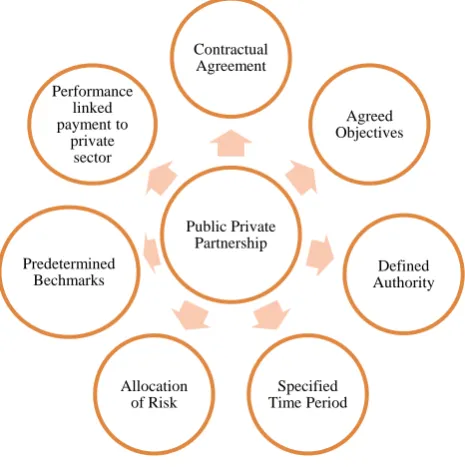
risk between the private sector and the public entity and the private entity receives performance linked payments that conform (or are benchmarked) to specified and pre-determined performance standards, measurable by the public entity or its representative.7 The key points according to this definition includes: (a) a contractual agreement between government and the private sector, (b) provision of assets/services by private sector, (c) investment or management by private sector, (d) substantial risk sharing, (e) performance linked payments, (f) monitoring by government based on pre-determined performance standards. Public private partnership is a mode for creation of assets as well as to improve service delivery (Figure 1). It highlights three vital elements: defined authority of each partner, a commitment to agreed objectives and mutual benefit of the stakeholders.
The above definition broadly indicates that it is a limited period contractual arrangement where a private sector entity provides an asset or service which is traditionally provided by the government in return of some performance based payment. The role of the government is redefined as a facilitator and enabler. On the other hand, the private sector plays the role of builder, financer and operator.8 The focus is on a strong element of service delivery and compliance to pre-determined and measurable standards to be specified by the sponsoring authority. The central focus is on performance and not merely provision of service, thus aiming to combine the skills and expertise of both the sectors. It is a holistic approach to strengthen the health system by provision of financial and/or non-financial investment by the private sector and the intent of the arrangement is to harness the private sector efficiency in the delivery of quality services to the users.
Figure 1: Characteristics of PPP.
Public Private Partnership Contractual Agreement
Agreed Objectives
Defined Authority
Specified Time Period Allocation
of Risk Predetermined
Bechmarks Performance
linked payment to
Typically, PPP is not privatization as there is a difference between the two which is essential to understand. When responsibility of ownership, delivery or management lies with the private sector, it is essentially privatization. On the other hand, in PPP, the full responsibility and legal ownership is retained by the government sector.9 In privatization the nature and scope of the service is determined by the private entity, while it is determined mutually by the parties in PPP. One of the key characteristics of PPP is sharing of risks and rewards between government and private sector, however, in privatization the owner inherits these.
Conceptually, there are three approaches of establishing a partnership with the private sector, namely:10
Competitive bidding: This refers to a well-designed bidding process to ascertain the capabilities of the service provider. The selection of the service provider is done amongst the bidders depending on the lowest bid in terms of operation and maintenance cost and highest equity premium and revenue share.
Competitive negotiation: This approach is a variant of the competitive bidding, difference being that the government negotiates the contract with the bidders. The negotiation can be direct or indirect type, which involves a master contractor who handles the dealings with all the sub-contractors of the services. Hence, the government monitors the master contractor and not all sub-contractors.
Swiss challenge approach: In this approach the government receives a proposal from the private sector stating all the details regarding its technical, financial and managerial capabilities and viability. If the proposal meets the priorities of the policy, then the government may invite counter proposals from other parties. In case a better proposal is received, the original proponent is given an opportunity to modify its proposal and the better of the two is selected.
NECESSITY OF PUBLIC PRIVATE PARTNER-SHIP
It has been already stated that majority of the Indians seek health services from the private facilities when faced with an illness. National Sample Survey Organization (NSSO) data showed that people opted for private sector even though it cost almost four times as much as treatment in government institutions due to the enormous gap between demand and supply.11 Hence, government has much to gain by engaging the private health sector for several reasons:12-15
Increase in efficiency: Pooling of resources can help in addressing the issues that cannot be addressed by a single entity. Upgrading the health infrastructure wherever the government's funding lacks will improve the quantity and quality of service.
Improved accessibility: The private entity working closely with public sector will expand the reach of the health services to hard to reach areas.
Improved affordability: Only about 20% of Indian’s have any form of health insurance.16 PPP will reduce the burden of 80% out of pocket expenditure (OOPE) incurred on the people who are forced to seek services from the unregulated private sector.17 Risk sharing: It will motivate the establishment of
partnership with new and emerging private sector, unloading the burden and instead promoting the financial and operational risk sharing between the partners.
Improved coverage of national health programs: Engagement with the private sector will not only promote the coverage of national health programs, but also assist in delivery of the services along with its monitoring and evaluation.
Implementation of standard treatment guidelines: Partnership with the private healthcare professionals will aid in implementing similar standard treatment guidelines in both public and private health sectors thereby ensuring uniform quality of services. Scale-up successful operational models: Private
sector expertise and successful experiences can be utilized in PPP projects implementation and vice-versa.
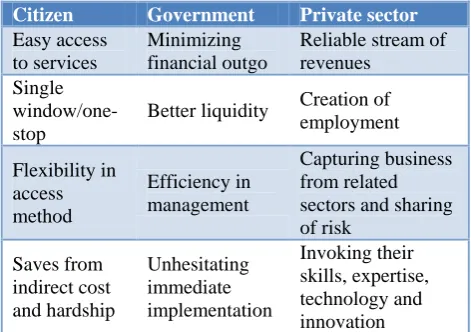
Table 1: Benefits of public private partnership (PPP).
Citizen Government Private sector
Easy access to services
Minimizing financial outgo
Reliable stream of revenues
Single window/one-stop
Better liquidity Creation of employment
Flexibility in access method
Efficiency in management
Capturing business from related sectors and sharing of risk
Saves from indirect cost and hardship
Unhesitating immediate implementation
Invoking their skills, expertise, technology and innovation
CHALLENGES
In the process of PPP, from planning to implementation, including monitoring and evaluation, there are a number of challenges faced.18,19 Of utmost importance is the assessment of needs based on which the PPP model is prepared. This will not only address the needs of the people, but also lead to enhanced participation of the community and reduce the opposition by the stakeholders. It creates an enabling business opportunity for the partners, while also reducing the conflicts.
involving both, individual project risks and aggregate PPP program risks, so as to assess the feasibility and terms based on which the risk may be allocated to the partners. This forms an essential part of strategic planning. To achieve the full potential of PPP it must serve and fulfill the gap in the services provided to the people.
A strong political commitment is a challenge that needs to be addressed and it calls for the development of PPP policy and institutional framework. This will enable managing communication and public acceptability of PPP. Clear messages for policy makers should be used to explain the rationale for PPPs. A PPP Unit can be useful in developing and supporting a communication strategy to underpin the PPP program based on sound technical and data input. The PPP Unit can also be available to provide answers to enquiries from parliamentary representatives and citizens. It is also required to manage the stakeholders i.e. to look into the queries and concerns of those involved in the PPP program, so that the concerns can be addressed, better clarity be provided and acted upon appropriately without delay.
CONCLUSION
India has committed for attainment of universal health coverage (UHC), consisting of three domains, namely, population coverage, financial coverage and service coverage by 2022. But there exists an asymmetry between the public healthcare providers and users, thus giving a monopolistic power to the private providers resulting in greater out of pocket expenditure (OOPE) for the people in the country. Public health specialists view PPP model as a key solution for this concern.
The PPP model is evolving to address the inadequacies in public healthcare system but it is also essential to consider that this partnership requires to be tailored by government in line with the local context. In this partnership by leveraging private sector in financing, expertise, capacity building and management, the health system will strengthen itself overall and provide a bundled approach aiding in achieving the dream of universal health coverage irrespective of the purchasing power of the citizens.
The political will of government has already laid the building stones and an enabling environment is created for going forward with PPP. It is crucial to bring innovations and test the PPP model on pilot basis so that the pit falls can be identified and rectified far ahead of implementation. Setting guidelines for effective monitoring and evaluation of PPP to improve the credibility of the model is essential. The main concern is to engage the private partners for critical gap filling in public health system and after the contractual period the government should be powered enough to continue providing the services independently.
Funding: No funding sources Conflict of interest: None declared Ethical approval: Not required
REFERENCES
1. World Bank Support to the Health Sector in India. World Bank, 2010. Available at: http://www.worldbank.org/en/news/feature/2010/04/ 06/worldbank-india-health-support. Accessed on 1 September 2018.
2. National Health policy 2017. Ministry of Health and Family Welfare, Government of India, 2017. Available at: https://mohfw.gov.in/documents /policy. Accessed on 12 September 2018.
3. National Health Profile 2018. Central Bureau of Health Intelligence, Directorate General of Health Services. Ministry of Health & Family Welfare, Government of India, 2018. Available at: http://www.cbhidghs.nic.in/index1.php?lang=1&lev el=2&sublinkid=88&lid=1138&theme=Blue. Accessed on 12 September 2018.
4. Kumar A, Jain N, Nandraj S, Furtado K. NSSO 71st round: same data, multiple interpretations. Economic and political weekly. 2015;46(1):84-7. 5. Bakshi H, Sharma R, Kumar P. Ayushman bharat
initiative: What we stand to gain or lose. Indian J Community Med. 2018;43(2):63-6.
6. Kutumbale, Vishakha, Telang. Public Private Partnerships in India (An Overview of Current Scenario), 2015. Available at: https://www.researchgate.net/publication/28102475 2_PUBLIC_PRIVATE_PARTNERSHIPS_IN_IND IA_An_Overview_of_Current_Scenario. Accessed on 1 September 2018.
7. National Public Private Partnership Policy. Draft, Department of Economic Affairs, Ministry of Finance, Government of India, 2011. Available at:
https://ppp.worldbank.org/public-private- partnership/library/india-national-public-private-partnership-policy. Accessed on 1 September 2018. 8. Public-Private Partnership Options toward
Achieving Universal Health Coverage in the Philippine Setting. PIDS Discussion Paper Series. 2014. Available at: http://hdl.handle.net/10419/ 127010. Accessed on 1 September 2018.
9. London R. Tools for governing: Privatization, public-private partnerships, and entrepreneurial management. Public Administration Review. 2002;62(2):118-23.
10. Amit P, Ramani KV, Mavalankar D, Agarwal AK, Shilpa M, Beena N. Implementing a Public Private Partnership Model for Managing Urban Health in Ahmedabad. Indian Institute of Management Ahmedabad, Research and Publication Department. 2007;12(7).
12. Research Paper No. 092016. Jomo KS, Chowdhury A, Sharma K, Platz D. Public-private partnerships and the 2030 Agenda for Sustainable Development: fit for purpose? New York: United Nations, Department of Economic and Social Affairs. 2016; 2.
13. Chunchu SD. CSR as A Public Private Partnership Model. IOSR J Business Management. 2013;10–4. 14. Thomas G, Krishnan S. Effective public-private
partnership in healthcare: Apollo as a cautionary tale. Indian J Med Ethics. 2010;7(1):2–4.
15. Jutting J. Public-private-partnership and social protection in developing countries : the case of the health sector. Ext Soc Prot. 1999;1–14.
16. National Family Health Survey-4. International Institute for Population Studies, 2017. Available at: http://rchiips.org/nfhs/factsheet_nfhs-4.shtml. Accessed on 1 September 2018.
17. Buse K, Waxman A. Public-private health partnerships: a strategy for WHO. Bulletin of the World Health Organization. 2001;79:748-54. 18. Report of the PPP Sub-Group on Social Sector
Public Private partnership 2004. Planning Commission, Government of India, 2004. Available at: http://planningcommission.nic.in/reports/genrep/ rep_ppp.pdf. Accessed on 10 September 2018. 19. Chakravarty N, Sadhu G, Bhattacharjee S, Nallala
S. Mapping private-public-partnership in health organizations: India experience. Int J Med Public Health. 2015;5(2):1-5.