* To whom all correspondence should be addressed. E-mail: [email protected]
Expression of a Sheep Pox Virus Gene in Plant Systems
under the Control of Plant Viral Regulatory Elements
and with Sub-Cellular Targeting
Daniyar Beisenov*, Gulshan Stanbekova, Leila Nadirova, Andrey Zhigailov and Bulat Iskakov
Aitkhozhin Institute of Molecular Biology and Biochemistry, 86, Dosmukhamedov Str., Almaty, Kazakhstan.
http://dx.doi.org/10.13005/bbra/1995
(Received: 01 January 2016; accepted: 19 February 2016)
The aim of this work was to investigate the feasibility of producing the sheep pox virus surface antigen that is an ortholog of vaccinia viral A27L in wheat germ cell free system and then in transgenic tobacco plants. Insertion into the A27L-mRNA 5'-untranslated region (5' UTR) of various translational enhancers (TEs) from plant viruses, as well as an artificial TE, allowed to increase the level of A27L protein synthesis in a wheat germ cell-free system. When the 5' UTR of potato virus Y genomic RNA was used as a TE, synthesis of an additional polypeptide that was approximately 2 kDa larger than the primary product of translation was observed in both plant and mammalian cell-free systems. The DNA constructs used for stable transformation of tobacco plants, besides 5' TEs, contained the transit-peptide-coding sequences for targeted accumulation of synthesized A27L protein. The amount of recombinant protein in the leaves of transgenic plants varied from 0.01 to 0.03 % of the total soluble protein.
Key words: A27L protein, Sheep pox virus, Potato virus Y.
Sheep pox virus (SPPV) is the causative agent of a highly dangerous disease in small ruminants and can cause substantial economic losses as a consequence. Attenuated SPPV strains are used as vaccines for prophylactic control of the disease1. The “NISKHI” strain is used in the Republic of Kazakhstan and Central Asia. The engineering of transgenic plants that produce viral proteins offers an alternative strategy for vaccine development2,3.
The SPPV 17.5 kDa protein is the ortholog of the A27L protein of vaccinia virus (VACV), which is localized in the lipoprotein membrane of the
intracellular mature virion (IMV). Antibodies produced against the A27L protein of VACV were able to neutralize IMVs in vitro. Mice immunization with recombinant A27L protein synthesized in
Escherichia coli or injection of anti-A27L monoclonal antibodies provides full protection against a lethal dose of VACV4,5.
expression of the transgene. The ability of these UTRs to increase the expression of mRNAs has been shown earlier6-10.
Heterologous proteins synthesized in plant cells may undergo degradation by proteases in the cytoplasm. In addition to using TEs, specific intracellular localization with the help of signal peptides can provide greater accumulation of recombinant protein11. We used transit peptides from the small RuBisCO subunit of tomato (Lycopersicon esculentum)12 and calreticulin of tobacco (Nicotiana plumbaginifolia)13 that help to transport synthesized protein into the chloroplast and endoplasmic reticulum, respectively. From the endoplasmic reticulum, the synthesized recombinant protein can be further translocated into the apoplast14,15,16.
MATERIALS AND METHODS
The open reading frame (ORF) of the
SPPV-NISKHI 113 gene (A27L, VBRC accession
no. VP0044772, http://vbrc.org/) was amplified
by PCR with direct primer 5' GCATCATATGG ACAGAGCGTTATC AATCTTTCCAGGCGA (NdeI restriction site is underlined) and reverse primer 5' GCATCTCGAGTCACTTTAGTG TTGTAATTCTTCCTGTTT (XhoI site is underlined). The resulting 450 bp PCR product was used for subsequent plasmid construction.
Translation in the wheat germ cell-free system
Recombinant mRNAs were synthesized by transcription in vitro with the RNA polymerase (Thermo Scientific) of bacteriophage T7 according to the manufacturer’s protocol. A cell-free system was prepared from wheat germ (Triticum aestivum L.) cultivar “Kazakhstanskaya 10”17. The reaction mixture in a 25 µl volume contained 20 mM Tris (OAc, pH 7.6), 90 mM KOAc, 2 mM Mg(OAc)2, 1 mM ATP, 0.1 mM GTP, 10 mM phosphocreatine (Fluka Chemie AG, Buchs, Switzerland), 0.12 mg creatine phosphokinase/ml (Sigma-Aldrich), 0.1 mM spermidine, 0.1 mM of each of 20 amino acids, 1 µg of mRNA and 11 µl of wheat germ extract. The reaction mixture was incubated for 1 h at 26 °C.
Translation in the rabbit reticulocyte cell free system
The reaction mixture in a 25 µl volume contained 15 µl of rabbit reticulocyte lysate
(Promega), 25 mM HEPES KOH (pH 7.6), 120 mM KOAc, 1 mM Mg(OAc)2, 1 mM DTT, 10 mM phosphocreatine (Fluka), 1 mg creatine phosphokinase/ml (Sigma-Aldrich), 1 mM ATP, 0.2 mM GTP, 20 µg of hemin, 0.04 mM of each amino acid (except methionine), 0.075 mM [35S] methionine (37 MBq) and 1 µg of mRNA. The reaction mixture was incubated for 1 h at 34 °C.
Western blot analysis
Electrophoresis of proteins in a 15 % polyacrylamide gel in the presence of 0.1 % of sodium dodecyl sulfate (SDS-PAGE) was performed according to standard techniques. After electrophoresis, proteins from in vitro translation reactions were transferred from the gel to a PVDF membrane that was treated with anti-oligo-histidine antibodies conjugated with horseradish peroxidase (5 Prime), and then recombinant proteins containing oligo His were detected by treatment with 3,3' diaminobenzidine (Sigma Aldrich). For detection of recombinant proteins in transgenic plants, polyclonal rabbit antibodies specific to the A27L protein were used as primary antibodies. Goat anti-rabbit antibodies conjugated with alkaline phosphatase (Sigma Aldrich) were used as secondary antibodies. Alkaline phosphatase activity was detected by the Fast Red TR/ Naphthol AS MX substrate (Sigma Aldrich).
To estimate the level of A27L protein synthesis, densitometric analysis of blots was performed using the ImageJ software (NIH, USA). On each electrophoretic track, an equal rectangle was scanned covering the zones from 15 to 30 kDa and areas under the peaks were calculated as percentages and arbitrary units.
Transformation of plants and analysis of transgene expression
was performed with both direct and reverse primers for the A27L gene. Two equal leaf discs were cut out of each plant and homogenized in 150 µl of CellLytic™ P Cell Lysis Reagent for plant cell lysis (Sigma Aldrich) with addition of the protease inhibition cocktail (Santa Cruz). The debris was removed by centrifugation in a 1.5 ml tube for 5 min at 14000 g, and protein concentration was measured by the Bradford procedure. Total soluble protein (TSP) from each transgenic plant in 50 µg amounts was mixed with sample buffer and after heating for 3 min at 70 °C was analyzed by electrophoresis in a 15 % SDS-PAG.
RESULTS AND DISCUSSION
In vitro synthesis of A27L protein
To test the ability of A27L mRNA to correctly function in plant systems under the control of different TEs we first constructed a set of plasmids for transcription in vitro. All constructs contained the 3' TMV and differed only in the structure of the 5' UTR (Fig. 1). In this work, we used five different leaders: “pl” (polylinker derived), 5' UTRs of the plant viruses AMV, TEV and PVY, and the artificial 5¹ UTR “5×ARC1”, which contained five copies of a synthetic oligonucleotide (10 nt long) complementary to the region 1115-1124 of the plant 18S rRNA7.
The structure of the mRNAs containing the A27L ORF under the control of different 5' UTRs is schematically shown in Fig. 2.
Plasmids were linearized with EcoRI before in vitro synthesis of uncapped full-length mRNAs. After transcription, the mRNAs were isolated and checked for integrity by electrophoresis in 1 % agarose. Equal amounts of mRNAs were translated in the wheat germ cell free system for 1 h at 26 °C, and then the recombinant A27L protein was analyzed by SDS-PAGE and subsequent western blotting (Fig. 3). Anti-His tag antibodies readily detected a polypeptide that corresponded to recombinant A27L. Recombinant A27L protein synthesized in vitro seem to have larger size because of the high voltage applied during electrophoresis, but correspond in size with positive control. The efficiency of mRNA translation was evaluated by densitometry of developed blots using the program ImageJ 1.46q. The amount of protein synthesized from the mRNA ‘pl-A27L’ was taken as one arbitrary comparative unit because the polylinker derived leader “pl” does not enhance translation19. The
Fig. 1. Schematic presentation of recombinant DNA constructs for in vitro transcription.T7, promoter of bacteriophage T7; 5' UTR, sequence corresponding to one of the 5¹ UTRs (pl, AMV, TEV, PVY, 5×ARC1);
His10, nucleotide sequence of 10×His tag; A27L,
SPPV-NISKHI 113 gene; 3' TMV, 3' UTR of the TMV gRNA; HindIII, NcoI, NdeI, BamHI,
SacI and EcoRI, sites of unique restrictases
presence of the PVY, TEV or “5×ARC1” 5¹ UTRs increased translation efficiency more than 2 fold with respect to the control leader “pl”, while the AMV 5' UTR gave almost no enhancement. Notably, the PVY 5' UTR caused synthesis not only of A27L protein of expected size (20.3 kDa), but also of an additional polypeptide of larger size, which was apparently a variant of A27L extended by several amino acids at the N terminus.
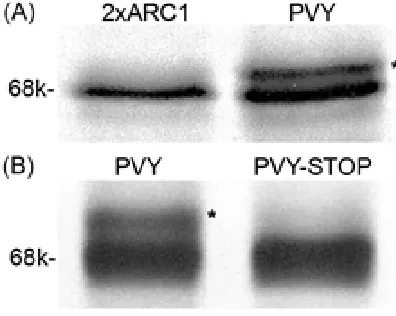
Interestingly, when the uidA mRNA was translated under the control of the PVY 5' UTR in the rabbit reticulocyte cell free system in the presence of [35S] methionine, we also observed the formation of two protein products: (i) a main one with a molecular mass of about 68 kDa that corresponded to β glucuronidase (GUS) and (ii) an additional one (GUS*) with a molecular mass
approximately 2 kDa larger (Fig. 4a). The additional polypeptide of larger size was not observed when two copies of the artificial translational enhancer ARC1 (2×ARC1) was used as the 5' UTR.
The amount of additional polypeptide was about 20–30 % of the primary one as evaluated by densitometry of the images presented in Figs. 3 and 4 using the ImageJ 1.46q software.
Synthesis of the additional larger polypeptide in the wheat germ (Fig. 3) and rabbit reticulocyte (Fig. 4a) cell-free systems programmed by mRNAs with the PVY 5' UTR suggests that this 5' TE contains an additional upstream initiation site that can be recognized by the translation apparatus of both plants and animals. The universality of this initiation site is emphasized by the fact that it functions with various ORFs.
Fig. 3. Western analysis of A27L protein synthesized in a wheat germ cell-free system through translation
of mRNAs with different 5'-UTRs. Detection with anti-His-tag antibodies, C+, positive control (50 ng of
A27L expressed in E. coli); C-, negative control (cell free system without A27L mRNA); pl, PVY, ARC1, AMV and TEV, translation products of mRNAs with
the respective 5' UTRs; M, marker proteins with known molecular masses (indicated at the left). Numbers beneath the lanes indicate arbitrary units of respective mRNA translation efficiency; an additional
polypeptide is marked with an asterisk
Fig. 4. Expression of the uidA gene in cell free system. (a) – Autoradiography of proteins synthesized in a rabbit reticulocyte cell-free system in the presence of [35S] methionine. Lanes denoted as
2×ARC1 and PVY represent products of translation of recombinant mRNAs with the respective 5' UTRs; an additional polypeptide is marked with an asterisk. (b) – Autoradiography of proteins synthesized in a
wheat germ cell free system in the presence of [35S] methionine. Lanes denoted as PVY and PVY
STOP represent products of translation of recombinant mRNAs with the respective 5' UTRs; an
additional polypeptide is marked with an asterisk
Because the 5' UTR PVY does not contain upstream AUG codons (Fig. 2), it is obvious that initiation of the larger protein synthesis begins with a non AUG codon. To verify that the aberrant peptide is the larger one, we generated additional construct with PVY 5' UTR containing in frame stop codon before initiating AUG codon (Fig. 5).
Inserted stop codon led to the termination of the synthesis of the larger peptide in wheat germ cell free system (Fig. 4b). The average molecular weight of an amino acid is 110 Da. Assuming the
aberrant peptide is about 2 kDa larger, initiating codon should be located some 17-18 triplets upstream of the ORF’s start AUG codon.
A similar effect was observed earlier when mRNA with the TMV 5' UTR (Ω sequence) was translated in plant systems in vitro and in vivo. It was established that several upstream AUU codons in the Ω sequence could be used for translation initiation, leading to the synthesis of undesired by product proteins extended at the N terminus20,21. Because the PVY 5' UTR induces the
Fig. 6. Schematic presentation of the T DNA region of the agrobacterial vector pCAMBIA A27L for targeting the A27L recombinant protein into the cytoplasm (a), chloroplast (b) and apoplast (c). 35S pro, CaMV 35S promoter; 5×ARC1, AMV and TEV, the respective 5' UTRs; His10 or His6, nucleotide sequences encoding ten or six histidines; A27L, the SPPV-NISKHI-113 gene; rbcs, the signal peptide sequence of the tomato gene Rbcs 2A; cal, signal peptide sequence from the tobacco cal1 gene; NOS ter, transcription terminator of the nopaline synthase gene; npt II, neomycin phosphotransferase gene; 35S ter, CaMV 35S terminator; RB, right border; LB, left border of the T DNA
Fig. 7. Detection of A27L-mRNA by RT PCR in total RNA samples extracted from transgenic tobacco plants. M, DNA markers of known length in nucleotides (indicated at the left);
1-7, independent transgenic tobacco lines; WT, wild type (untransformed) plant
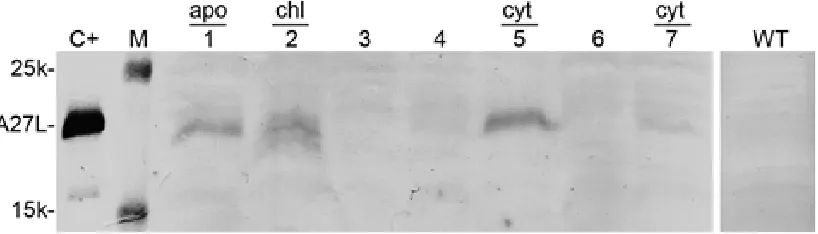
Fig. 8. Western blot analysis to determine the presence of the A27L protein in leaves of transgenic tobacco plants. C+, positive control (500 ng of A27L expressed in E. coli); M, marker proteins; 1, plant transformed with the apoplast targeting cassette “TEV-cal-A27L”; 2, plant transformed with
synthesis of undesired by product proteins we did not use this 5' TE to increase transgene expression in vivo.
Nevertheless, the PVY 5' UTR can provide a significant increase in the mRNA translation rate7,22. Non canonical start codons in this 5' TE deserve additional examination to identify and prevent undesired polypeptide synthesis by inserting stop codons, as was suggested earlier22. Moreover, the reproducibility and universality of translation initiation at non AUG codons in the PVY 5' UTR allow us to use this phenomenon as a model system to study its molecular mechanism.
Synthesis and accumulation of A27L protein in transgenic tobacco plants
Binary vectors carrying the A27L gene were constructed and transfected into
A. tumefaciens EHA105 cells, which were then used for co cultivation with leaf discs to transform tobacco cells. As shown in Fig. 6, the expression cassettes contained the following functional segments: the constitutive CaMV 35S promoter, various 5' UTRs (5×ARC1, AMV 5' UTR, TEV 5' UTR), the A27L gene without or with N terminal signal peptides (from the tomato RuBisCO small subunit or tobacco calreticulin), and the polyadenylation signal from the nopaline synthase gene (253 bp). The TMV 3' UTR (3' TMV, 246 bp) that was used in constructs for in vitro translation was intentionally excluded from agrobacterial DNA constructs between the A27L gene and NOS
terminator, because its presence would result in the mRNA having too long a 3' UTR. It was shown recently that 3' UTRs longer than 300 nucleotides cause mRNA instability in plant cell nuclei23.
After transformation, tobacco plants were regenerated from leaf segments on regeneration medium containing 50 mg kanamycin/ l. The DNA of most regenerated plants directed the synthesis of the expected PCR product, which confirmed insertion of the A27L gene into their genomes. In many plants, the A27L-mRNA was detected by RT of total RNA and PCR amplification using specific primers (Fig. 7).
Accumulation of the recombinant A27L protein was determined in samples of total soluble protein (TSP) extracted from the leaves of transgenic plants that were positive in RT PCR analysis. After SDS PAGE, the recombinant protein
was identified by immunoblotting using A27L specific polyclonal antibodies. In some transgenic lines, a polypeptide of expected size was detected as shown in Fig. 8. It can be seen that the viral and artificial translation enhancers promoted synthesis of approximately equal amounts of A27L protein (compare lanes 1, 2 and 5). Additionally to transgenic plants used for western blot of the proteins in Fig. 8, we also obtained transgenic plants with subcellular localization to apoplast and chloroplast that did not show the presence of the A27L protein.
According to our estimates, the amount of SPPV A27L in the leaves of transgenic tobacco plants varied from 0.01 to 0.03 % of the total soluble protein. Approximately the same level of VACV A27L protein production was achieved previously in plants transformed through the nuclear genome24.
CONCLUSIONS
In this work, we compared several 5'-UTRs of plant viruses and an artificial translational enhancer (ARC1) by their ability to stimulate translation of a downstream ORF. Unlike the leader of the naturally capped AMV RNA4, 5' UTRs of the naturally uncapped gRNAs of TEV and PVY, as well as the artificial 5' UTR ARC1, increased the translation of uncapped mRNAs in a wheat germ cell-free system. The PVY 5' UTR contains a non AUG start site (approximately 17-18 triplets upstream of the ORF’s AUG codon) that is functional in both wheat germ and rabbit reticulocyte cell free systems.
ACKNOWLEDGEMENTS
Authors are grateful to Dr. V.L. Zaitsev and Dr. O.V. Chervyakova (Research Institute for Problems in Biological Safety, Kazakhstan) for DNA preparations of SPPV “NISKHI” strain and for polyclonal rabbit antibodies specific to SPPV A27L protein. Plasmid “pl-GUS” was kindly provided by Dr. D.R. Gallie (University of California, Riverside, CA, USA).
This work was done with financial support from grant 1877/GF3 (State registration number: 0113RK00354) of the Committee of Science of the Ministry of Education and Science of the Republic of Kazakhstan.
REFERENCES
1. Rao, T.V.S., Bandyopadhyay S.K. A
comprehensive review of goat pox and sheep pox and their diagnosis. Anim Health Res Rev., 2000; 1(2): 127–136.
2. Daniell, H., Streatfield, S., Wycoff, K. Medical molecular farming: production of antibodies, biopharmaceuticals and edible vaccines in plants.
Trends Plant Sci., 2001; 6: 219-226.
3. Tiwari, S., Verma, P.C., Singh, P.K., Tuli, R. Plants as bioreactors for the production of vaccine antigens. Biotechnol. Adv., 2009; 27: 449-467.
4. Fogg, C.N., Americo, J.L., Earl, P.L., Resch, W., Aldaz-Carroll, L., Eisenberg, R.J., Cohen, G.H., Moss, B. Disparity between levels of in vitro neutralization of vaccinia virus by antibody to the A27 protein and protection of mice against intranasal challenge. J. Virol., 2008; 82: 8022-8029.
5. Berhanu, A., Wilson, R.L., Kirkwood-Watts,
D.L., King, D.S., Warren, T.K., Lund, S.A., Brown, L.L., Krupkin, A.K., Vandermay, E., Weimers, W., Honeychurch, K.M., Grosenbach, D.W., Jones, K.F., Hruby, D.E. Vaccination of BALB/c mice with Escherichia coli-expressed vaccinia virus proteins A27L, B5R, and D8L protects mice from lethal vaccinia virus challenge.
J. Virol., 2008; 82: 3517-3529.
6. Gallie, D.R., Walbot, V. RNA pseudoknot domain of tobacco mosaic virus can functionally substitute for a poly(A) tail in plant and mammal cells. Genes Dev., 1990; 4: 1149-1157.
7. Akbergenov, R., Zhanybekova, S., Kryldakov,
R., Zhigailov, A., Polimbetova, N., Hohn, T., Iskakov, B. ARC-1, a sequence element complementary to an internal 18S rRNA
segment, enhances translation efficiency in plants when present in the leader or intercistronic region of mRNAs. Nucleic Acids Res., 2004; 32: 239-247.
8. Datla, R.S.S., Bekkaoui, F., Hammerlindl, J.K., Pilate, G., Dunstan, D.I., Crosby, W.L. Improved high-level constitutive foreign gene expression in plants using an AMV RNA4 untranslated leader sequence. Plant Sci., 1993; 94: 139-149. 9. Carrington, J.C., Freed, D.D. Cap-independent enhancement of translation by a plant potyvirus 5' nontranslated region. J. Virol., 1990; 64(4): 1590-1597.
10. Kneller, E.L.P., Rakotondrafara, A.M., Miller, W.A. Cap-independent translation of plant viral RNAs. Virus Res., 2006; 119: 63–75.
11. Doran, P.M. Foreign protein degradation and
instability in plants and plant tissue cultures.
Trends Biotechnol., 2006; 24: 426-432. 12. Pichersky, E., Bernatzky, R., Tanksley, S.D.,
Cashmore, A.R. Evidence for selection as a mechanism in the concerted evolution of Lycopersicon esculentum (tomato) genes encoding the small subunit of ribulose-1,5-bisphosphate carboxylase/oxygenase. Proc. Natl. Acad. Sci. U.S.A., 1986; 83: 3880-3884. 13. Borisjuk, N., Sitailo, L., Adler, K., Malysheva,
L., Tewes, A., Borisjuk, L., Manteuffel, R. Calreticulin expression in plant cells: developmental regulation, tissue specificity and intracellular distribution. Planta, 1998; 206(4): 504-514.
14. Borisjuk, N.V., Borisjuk, L.G., Logendra, S., Petersn, F., Gleba, Y., Raskin, I. Production of recombinant proteins in plant root exudates. Nat. Biotechnol., 1999; 17: 466-469.
15. Kalthoff, D., Giritch, A., Geisler, K., Bettmann, U., Klimyuk, V., Hehnen, H., Gleba, Y., Beer, M. Immunization with plant-expressed hemagglutinin protects chickens from lethal highly pathogenic avian influenza virus H5N1 challenge infection. J. Virol., 2000; 84: 12002-12010.
16. Dai, Z., Hooker, B.S., Anderson, D.B., Thomas, S.R. Improved plant-based production of E1 endoglucanase using potato: expression optimization and tissue targeting. Mol. Breed., 2000; 6: 277-285.
17. Akbergenov, R.Z., Zhanybekova, S.S.,
18. Dilworth, E., Frey, J.E. A rapid method for high throughput DNA extraction from plant material for PCR amplification. Plant Mol. Biol. Rep., 2000; 18: 61-64.
19. Gallie, D.R., Sleat, D.E., Watts, J.W., Turner, P.C., Wilson, T.M.A. A comparison of eukaryotic viral 5'-leader sequences as enhancers of mRNA expression in vivo. Nucleic Acids Res., 1987; 15: 8693-8711.
20. Schmitz, J., Prüfer, D., Rohde, W., Tacke, E. Non-canonical translation mechanisms in plants: efficient in vitro and in planta initiation at AUU codons of the tobacco mosaic virus enhancer sequence. Nucleic Acids Res., 1996; 24: 257-263.
21. Ohta, T., Matsuoka, H., Nomura, Y., Tozawa, Y. Control of translational initiation in the wheat-embryo cell-free protein expression system for
producing homogenous products. Protein Expr. Purif., 2010; 73(1): 15–22.
22. Levis, C., Astier-Manifacier, S. The 5'
untranslated region of PVY RNA, even located in an internal position, enables initiation of translation. Virus Genes, 1993; 7(4): 367-379.
23. Schwartz, A., Komarova, T., Skulachev, M.,
Zvereva, A., Dorokhov, Yu., Atabekov, J. Stability of plant mRNAs depends on the length of the 3'-untranslated region. Biochemistry, 2006;
71: 1377-1384.