RESEARCH ARTICLE
EFFECTIVE UTILIZATION OF NATURAL FIBERS (SISAL, JUTE AND BANANA) IN FRAMING
COMPOSITE MATERIAL FOR REPLACEMENT OF COMPRESSED WOOD
1
Jeyaram, A.,
2Vethamoorthy, A.,
3Thangaraj, M.,
4Sheik Arafath, I.,
5Nambiraj, N. and
*
6Gopikumar, S.
1, 6
Assistant Professor, SCAD College of Engineering and Technology, Tirunelveli-627414- India
2,3,4,5
UG Student, Department of Mechanical Engineering, SCAD College of Engineering and Technology,
Tirunelveli-627414 - India
ARTICLE INFO
ABSTRACT
The usage of natural fiber composites is growing at a faster rate and is actively being measured as an alternate material for synthetic fiber and wood. In the present work, an attempt has been made to fabricate the sisal-jute-banana fibers by knitting together and placed unidirectional mixed with polyester resin composite and to evaluate the mechanical properties such as tensile strength and flexural strength. Five types of hybrid laminates composites are fabricated using manual layup technique. Polyester resin is used as matrix material in the present work. The specimens are prepared according to ASTM standard and the experiments were conducted on a universal testing machine (UTM). From the experimental results it has been perceived that the sisal-jute-banana fiber hybrid composites showed superior properties when compare to pure composites.
Copyright © 2018,Jeyaram et al. This is an open access article distributed under the Creative Commons Attribution License, which permits unrestricted use, distribution, and reproduction in any medium, provided the original work is properly cited.
INTRODUCTION
In recent years, the natural fiber reinforced composites have concerned substantial importance as a potential structural material. The attractive features of the natural fibers jute, sisal and banana have been their low cost, light weight, high specific modulus, renewability and biodegradability. Non-conventional fibers such as jute, sisal, banana, palm fibers etc. are extracted from stem/leaf/fruit of plants. Among all these fibers, jute and sisal have a benefit over other fibers. Banana fiber can be gained easily from the plants which are condensed as a waste after the fruits had seasoned. Jute fiber is extracted from jute plant. Jute is easily available for all the rural area. Sisal is extracted from sisal plant by using sisal extracting
machine (Anaidhuno et al., 2017). Madhukiran et al. 2017
evaluate the mechanical properties of sisal-coir composites the usage of natural fiber reinforced composites are growing at a faster rate and is actively being considered as an alternative material for synthetic fiber. The specimens are prepared according to ASTM standards and the experiment was
conducted on a universal testing machine (UTM).Amitkumar
et al. 2014 calculated the tension test, compression test of the
jute-bamboo-coir fiber composites in which they concluded that the bamboo fiber composites have more tensile and compression strength.
*Corresponding author: Gopikumar, S.,
Assistant Professor, SCAD College of Engineering and Technology, Tirunelveli-627414- India.
Madhukiran et al. (2013) in which work has been carried out
to investigate the flexural properties of composites made by reinforcing banana and pineapple as the new natural fibers into epoxy resin matrix. The natural fibers were extracted by retting and manual process. The hybridization of the reinforcement in the composite shows great flexural strength when compared to individual type of natural fiber reinforced
composites. Senthilet al. (2014) in their work focuses on the
fabrication of polymer matrix composites by using natural fibers like jute, coir, hay which all abundant in nature in desire shapes by the help of various structures of patterns and calculating the material characteristics by conducting test like flexural test, hardness test and water absorption test.
Venkateshwaran et al. (2013) in which natural fibers offer
many advantages over synthetic fibers but the notable disadvantage of natural fibers is its hydrophilic nature. This hydrophilic nature decreases the properties of the composites. In this work, alkali (NaOH) of various concentrations was used to treat the fiber surface and the effects on these concentrations on the mechanical and viscos-elastic behavior
of the composites were carried out. Sanjay et al. (2016)
observed the present scenario of natural fiber composite field due to its better formability, cost effective and eco-friendly. This paper execution out line on natural fibers and its composites utilized as a part of different commercial and engineering applications. It helps to provide details about the potential use of natural fibers and its composite materials and physical properties and some of the applications in engineering
sectors.
ISSN: 0976-3376
Asian Journal of Science and Technology Vol. 09, Issue, 04, pp.7976-7980, April,2018SCIENCE AND TECHNOLOGY
Article History:
Received 14th January, 2018
Received in revised form 28th February, 2018
Accepted 24th March, 2018
Published online 30th April, 2018
Key words:
Sathish et al. (2014) reviewed on the tensile and impact properties of natural fiber hybrid composites. Natural fibers having good mechanical properties, high specific strength, low cost. In this paper two different hybrid composites were manufactured by compression moulding and properties of tensile and impact results are conducted as per ASTM
standard. Savita Dixit et al. (2017) in which chemically treated
natural fiber shows better improvement in properties than untreated fibers. This review aims at explaining about the research and development in the improvement in properties of natural fiber reinforces polymer composites along with its
applications. Ashiket al. 2015 in which natural fibers will take
a major role in the emerging green economy based on energy efficiency and it reduces carbon emissions and recyclable materials that minimize waste. This review paper summarized the history of natural fibers and its applications. Also these papers focused on different properties of natural fibers and its applications which were used as substitute glass fiber. Arpitha
et al. (2014) this paper presents a brief over view of the tensile
properties of fiber reinforce polymer materials. Natural fibers and particle fiber composites results in lighter properties compare to SFRPCs with equivalent mechanical strength.
Subbareddy et al. 2017 which evaluates the tensile, flexural,
impact strength of the banana fiber composites. They concluded more tensile strength obtained from 35% of fiber
volume.
Chandramohanet al. (2013) in this research natural fiber like
sisal banana and rosella are used. Sisal and banana (hybrid), Rosella and banana (hybrid) and rosella and sisal (hybrid) of fabricated with bio epoxy resin using moulding method. Green materials are very important to form environmental friendly from renewable resources. In this work,tensile and hardness of sisal and banana, rosella and banana, rosella and sisal
composite at dry and wet condition were studied. Kayodeet
al. (2017) this study was done with the aim of accessing the
feasibility of mechanically recycled glass fiber particleboards made from wood particle with epoxy as binder. An increase of over 80% in MOE values was obtained for the board with 10
weight % glass fiber inclusion.Rameshet al. (2014) in which
the present experiment banana fiber reinforced epoxy composite are prepared and the mechanical properties of this composites are evaluated the sample were subjected to the mechanical testing such as tensile, flexural and impact loading.
Yasunari et al. (2017) Effects of ultrasonic vibrations on
mechanical properties of fiber reinforced plastics were investigated during molding resin impregnation processing vacuum assisted resin transfer molding. The results revealed that ultrasonic waves improved transverse tensile flexural interlaminar shear and compressive strength of the carbon fiber laminates and interlaminar shear and compressive strength of the glass fiber laminates.
MATERIALS AND METHODS
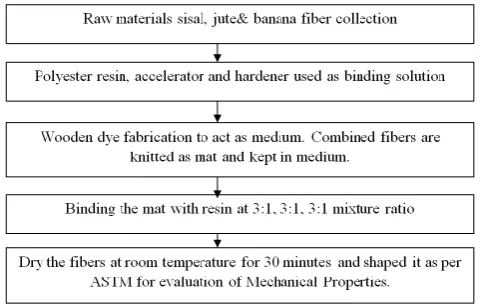
The banana fibers purchased from Coimbatore green fibers through courier. Jute fibers purchased at agro market of Town Tirunelveli. Sisal fibers purchased from cast foundation Tirunelveli. These fibers were collected successfully after three fibers knitting by manually from cast foundation Tirunelveli. Finally let us arranged unidirectional knitted fibers by using fevicol then the polyester resin, hardener and accelerator were purchased from Madurai.
The composite dye was prepared by us in SCAD College of engineering and technology at cheranmahadevi. Sisal-jute-banana hybrid polymer composite at 3:1, 3:1, 3:1 mixture ratio, 0.1, 0.2 volume fraction mixture using unsaturated
polyester resin, Methylethylketone (catalyst), cobalt
(accelerator), Vaseline (releasing agent) brought from SCAD College of engineering and technology. Fibers strands were reinforced with unsaturated polyester resin. The unsaturated polyester low temperature curing resin and corresponding harder Methylethylketone hardener and cobalt accelerator at a ratio of 10:1:0.5 by weight as recommended. The different composites are fabricated for tensile, flexural, compression, hardness and impact test. The casting of each composite was consolidated with a roller load weight of 50g and cured under room temperature at 4hours before the sample was removed from the mould. Then the specimens were cured in the air for another 12hours after removing from the mould. Test specimens were subjected to various mechanical tests as per ASTM standard using instron 3369 Universal testing machine.
Methodology
Figure 1. Proposed Methodology
RESULTS
The samples of four different combinations tested for their tensile, flexural and compression strength showed better result with sisal/banana/jute which has been used in both tests.
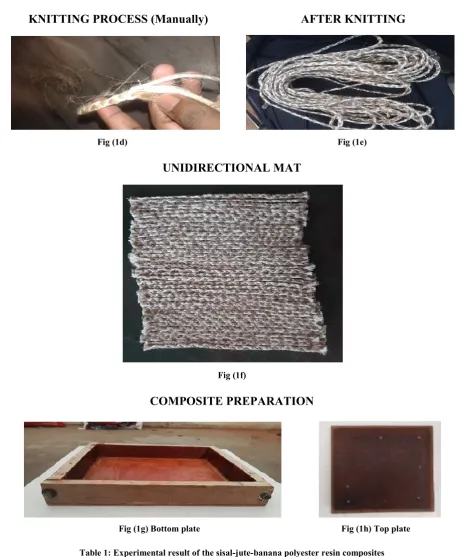
BEFORE KNITTING
KNITTING PROCESS (Manually)
AFTER KNITTING
Fig (1d) Fig (1e)
UNIDIRECTIONAL MAT
Fig (1f)
COMPOSITE PREPARATION
Fig (1g) Bottom plate Fig (1h) Top plate
Table 1: Experimental result of the sisal-jute-banana polyester resin composites
Mechanical Properties 10 % fibers 90% resin 20% fibers 80% resin
Max tensile strength 33.9658 Mpa 36.6432 Mpa
Max flexural strength 84.5648 Mpa 86.773 Mpa
max compression strength 99.6587 Mpa 101.365 Mpa
Max impact strength 10.6 joules 11.1 joules
Brinell hardness number value 210.3 212.5740
Table 2. Tensile Strength
S.No Length
Mm
Width Mm
Thickness Mm
Tensile Strength Mpa
1 165 12.60 4.00 58.16
2 165 12.80 3.50 30.34
3 165 12.60 3.80 55.92
Fig. 2. Result of Tensile Strength Test
Table 3. Flexural Stength
S. No Span Length
mm Brzeadth mm Thickness mm Flexural Strength Mpa
1 120 18.25 4 165.20
2 120 20 3.20 138.15
3 120 21.60 3.80 120.52
4 120 24.25 3.80 124.25
Fig 3. Result of Flexural Strength Test
Table 4. Compression Strength
S.no Length
mm Width mm Thickness mm Compression strength Mpa
1 79 12.60 4 93.74
2 79 12.40 3.40 91.25
3 79 12.80 3.80 87.56
4 79 12.90 3.50 85.30
Table 5. Physical Properties of Natural Fibers (Sisal, Jute, Banana)
S.No Property Range
1 Cellulose (%) 71-74
2 Hemi cellulose (%) 22
3 Lignin (%) 8
4 Moisture (%) 12-13
5 Density (g/cm3) 2-2.5
6 Elongation at break (%) 6.5-8.5
7 Young’s modulus (Gpa) 35
8 Microfibriller angle (deg.) 14
9 Lumen size (mm) 8
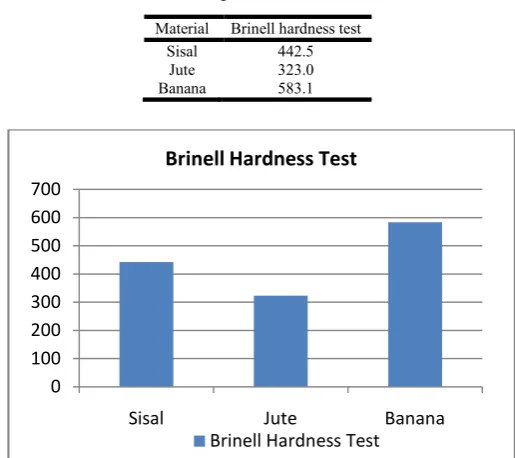
Table 6. Material comparison for Brinellhardness test
Material Brinell hardness test
Sisal 442.5
Jute 323.0
Banana 583.1
Fig. 5. Result of Brinell hardness Test
Conclusion
By experimental investigation, it is concluded that the usage of natural fiber composites is growing at a faster rate and is actively being measured as an alternate material for synthetic fiber and wood. In the present work, an attempt for fabricate the sisal-jute-banana fibers by knitting together and placed unidirectional mixed with polyester resin composite and to evaluate the mechanical properties such as tensile strength and flexural strength. Five types of hybrid laminates composites are fabricated using manual layup technique.
REFERENCES
Amitkumar Tanwer, 2014. Effect on mechanical properties for jute, coir and bamboo natural fiber reinforced epoxy based
composites. American International journal of Research in
science, Technology, Engineering & Mathematics
(AIJRSTEM 14-717), ISSN: 2328-3491 volume 8.
Anaidhuno, U.P. and Edelugo, S.O. 2017. Evaluation of the mechanical properties and simulation of sisal/jute hybrid
polymer composite failure in automobile chassis
panel.International Organization of Scientific Research
Journal of Engineering (IOSRJEN), Volume 07, ISSN:
2278-8719, PP 56-64.
Arpitha, G.R, Sanjay, M.R. and Yogesha, B. 2014. Review on Comparative Evaluation of Fiber Reinforced Polymer
Matrix Composites. Advanced Engineering and Applied
Sciences: An International Journal, Volume 4, pp. 44-47.
0 10 20 30 40 50 60 70
specimen 1 specimen2 specimen3 specimen4
Tensile strength
Tensile strength 0 20 40 60 80 100 120 140 160 180specimen 1 specimen 2 specimen 3 specimen 4
Flexural strength
Flexural strength 80 82 84 86 88 90 92 94 96specimen 1 specimen2 specimen3 specimen 4
Compression strength
Compression strength 0 100 200 300 400 500 600 700Sisal Jute Banana
Brinell Hardness Test
Ashik, K.P., Ramesh, S. and Sharma, 2015. “A Review on Mechanical Properties of Natural Fiber Reinforced Hybrid
Polymer Composites”. Journal of Mineralsand Materials
Characterization and Engineering, 2015, Volume 3, pp.
420-426.
Chandramohan, D. and Bharanichandar, J. 2013. Natural fiber reinforced Polymer Composites for Automobile
Accessories. American Journal of Environmental Science,
pp. 494-504 Volume 9, issue 6.
Kayode, E., Oluwabunmi, Lee, M., Smith, Sheldon, Q and Shi, 2017. Wood particle-Recycled Glass fiber hybrid
composites. Open journal of composite materials, Volume
7, ISSN: 2164-5655.
Madhukiran, J. and Venkateswara Rao, T. 2017. Evaluation of the properties on sisal-coir hybrid natural fiber
composites. International Journal of Engineering Research
and Development(IJERD), volume 13, pp.43-49.
Madhukiran, J., Srinivasa Rao, S. and Madhusudan, S. 2013. Fabrication and Testing of Natural Fiber Reinforced
Hybrid Composites Banana/Pineapple International
Journal of Modern Engineering Research, (IJMER)
Volume 3, Issue.4, pp-2239-2243.
Ramesh, M., Aswin, U.S. and Eashwar, H. 2014. Processing and mechanical property evaluation of banana fiber
reinforced polymer composites. Elsevier Procedia
Engineering, PP: 563-572.
Sanjay, M.R., Arpitha, G.R. and Laxmana Naik, L, 2016.
Applications of natural fibers and its composites. Scientific
research publishing (scirp), Volume 7, PP: 108-114.
Sathish, S., Kumaresan, M. and Karthi, N. 2014. Tensile and impact properties of natural fiber hybrid composite
materials. International Journal of modern engineering
research (IJMER). Volume 4, ISSN: 2249-6645.
Savita Dixit, Ritesh Goel, Akash Dubey, (2017). Natural fiber
reinforced polymer composite materials. Polymers from
renewable resources, Volume 8.
Senthil, P.V. and Aakashsirsshti 2014. Studies on material and
mechanical properties of natural fiber reinforced
composites. The International Journal of Engineering and
Science (IJES), Volume 3, ISSN: 2319-1805.
Subba Reddy, D.N. and Thyagaraj, N.R. 2017. Evaluation of mechanical properties in banana fiber reinforced polymer
composites. Iconic Research and Engineering Journals,
(IRE) Volume 1,ISSN: 2456-8880.
Venkateshwaran, N., Elaya, P.A. and Arunsundaranayagam, D. 2013.“Fiber surface treatment and its effect on mechanical and viscos-elastic behavior of banana/epoxy
composite” Materials & Design, volume 47, pp. 151–159.
Yasunari Kuratani, Aya Miki and Norimichi Nanami, 2017. Effects of ultrasonic waves during resin impregnation on the mechanical properties of unidirectional composite
materials. Open journal of composite materials scientific
research publishing. ISSN: 2164-5655 Volume 8.