Original Research Article
Knowledge, attitude and perceived barriers towards conducting
research among students in a medical college, India
Chibi R. Vairamani*, Brogen S. Akoijam
INTRODUCTION
Research is a neglected but extremely important component in the development of medical science including health care. It would be almost impossible to catch up with the changes occurring in diseases and their determinants without research. It is essential that health care providers, especially doctors, possess adequate knowledge and skill of conducting research. Research activity of medical students is important as it promises better clinical care, critical reasoning, lifelong learning and future research activity.1 Research methodology is a
process of deciding study design, making questionnaire, data collection, analysis, interpretation, and assessment procedures conducted in a planned manner in order to find solutions to a problem.
To become an efficient researcher, one has to be equipped with ample skills and knowledge about the research methodology. Training in research methodology is an important but neglected part of medical education curriculum, which needs to be paid more attention.2 Medical students therefore have a limited understanding of research and what it entails. Our medical graduates,
ABSTRACT
Background: Health research is a low priority area in the developing world, mostly due to inadequate research budgets and financially not rewarding venture. Medical students have a limited understanding of research and what it entails. Training on research theory to application, is an important but neglected part of medical education curriculum in the country, which needs to be paid more attention. The objective of the study was to assess the knowledge, attitude and perceived barriers towards conducting research among medical students in a remote medical college of India.
Methods: This cross sectional study was done in the easternmost medical college of India during November-December 2015. A self-administered questionnaire was used to collect data from postgraduates and interns. Data were summarized using descriptive statistics. Chi-square test was used for comparing proportions. A p-value of <0.05 was considered significant.
Results: Out of the total 493 eligible participants, 440 responded to the questionnaire. More than 3/5th of the respondents had inadequate level of knowledge of conducting research. Inadequate training (87%), lack of funding (76%), lack of motivation (67%) and no mentorship program (66%), were the major reasons cited by the respondents for not participating in research projects. Ever conducted research was associated with better knowledge of research. Majority of the participants wanted to know more about research.
Conclusions: The study revealed inadequate knowledge but a positive attitude towards research. Sufficient training in research methods, skills and institution of mentorship program can boost participation in research.
Keywords: Research, Medical students, Mentorship
Department ofCommunity Medicine, Regional Institute of Medical Sciences, Lamphelpat, Imphal, Manipur, India
Received: 21 December 2017
Accepted: 11 January 2018
*Correspondence:
Dr. Chibi R. Vairamani,
E-mail: [email protected]
Copyright: © the author(s), publisher and licensee Medip Academy. This is an open-access article distributed under the terms of the Creative Commons Attribution Non-Commercial License, which permits unrestricted non-commercial use, distribution, and reproduction in any medium, provided the original work is properly cited.
with a lack-lustre research curriculum during their training, become less interested in the field of research. Irrespective of the level of interest among medical students, they are still unable to carry out research due to absence of mentors, time issues and personal limitations.
Thus, formulating effective research training sessions at undergraduate level will create interest and increase research oriented personnel, thereby ameliorating the insufficiency of research oriented physicians. Keeping this in mind, we assessed the knowledge, attitude and perceived barriers towards conducting research among students in a remote medical college of India.
METHODS
A cross sectional study was conducted in the easternmost medical college of India during November and December 2015 among postgraduates and interns. This medical college has been producing medical graduates and post-graduates for the six states in the northeast India for the last 25 years. The study intended to cover all the postgraduates and interns during the study period and hence no sample size was calculated. Those who could not be contacted even after three consecutive visits and those who refused to participate were excluded.
A self-administered questionnaire was used to collect data. The questionnaire has four sections – background characteristics, eleven questions related to knowledge on research, ten questions in Likert scale exploring attitude towards conducting research and perceived barriers to conduct of research.
The knowledge questions were scored. Two questions carried maximum score of three and two respectively. Remaining nine questions had maximum score of one. Minimum score of all the questions were zero, giving maximum and minimum obtainable score of 14 and 0 respectively. Taking median value of 7 of the obtainable score, knowledge level was categorised into “Lower quartiles” (≤7) and “Highest quartile” (>7), also categorised as inadequate knowledge (≤7) and adequate knowledge (>7). For analysis purpose, attitude responses “agree” “neither agree nor disagree” and “disagree” were further divided into “positive”, “neutral” and “negative” attitudes.
Data were analysed by SPSS (IBM) version 21.0. Data were summarized with proportion & mean. Chi-square test was used to assess the association between background characteristics and other variables with knowledge level. A p value of <0.05 was considered significant.
Approval was obtained from the Institutional Ethics Committee before the beginning of study. Verbal consent from all the participants was obtained. Names of the participants were not recorded and data were kept safely in the investigator’s locker and could be accessed only by
the research team. Individual data were masked and only group data without identifying individual were presented.
RESULTS
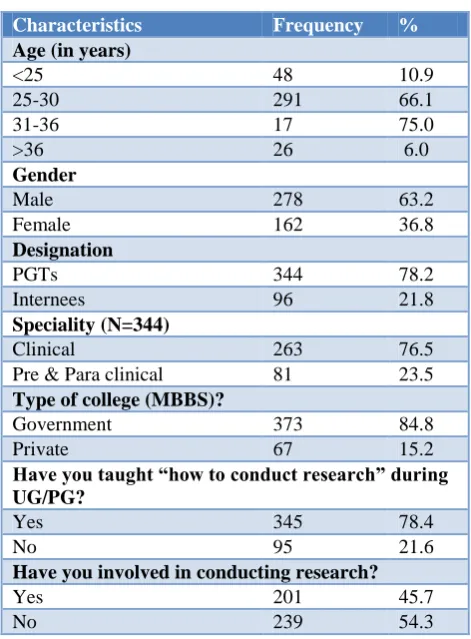
Out of the total 493 eligible participants, 440 responded to the questionnaire giving a response rate of 89%. Age of the respondents ranged from 23 years to 45 years with a mean of 28.8±4 years. Table 1 describes the background characteristics of study participants. More than half (63.2%) of respondents were female. More than three-fourth (78.2%) were Postgraduates, out of which 76.5% belong to clinical departments. Ninety five participants (21.6%) [87 PGTs, 8 interns] responded that they have not been taught about research methodology in their medical school and majority (43.3%) of them were from private medical colleges in India. More than half (54.3%) of the respondents did not involve in conducting research.
Table 1: Baseline characteristics of the study population (N=440).
Characteristics Frequency %
Age (in years)
<25 48 10.9
25-30 291 66.1
31-36 17 75.0
>36 26 6.0
Gender
Male 278 63.2
Female 162 36.8
Designation
PGTs 344 78.2
Internees 96 21.8
Speciality (N=344)
Clinical 263 76.5
Pre & Para clinical 81 23.5
Type of college (MBBS)?
Government 373 84.8
Private 67 15.2
Have you taught “how to conduct research” during UG/PG?
Yes 345 78.4
No 95 21.6
Have you involved in conducting research?
Yes 201 45.7
No 239 54.3
Table 2: Attitude questions towards conducting research (N=440).
Attitude questions Agree
N (%)
Neutral N (%)
Disagree N (%)
It is important for medical students to know about research
methodology 384 (87.3) 35 (8) 21 (4.7)
Patient outcome improves with continued medical research 369 (84) 54 (12) 17 (4)
Research is useful for my future career 337 (76.6) 68 (15.4) 35 (8.0)
Research methodology should be made compulsory for
postgraduate students 334 (75.9) 60 (13.6) 46 (10.5)
Conduction of research is difficult 300 (68.2) 47 (10.7) 93 (21.1)
Undertaking research increases burden on already overworked
students/trainees 278 (63.2) 72 (16.4) 90 (20.5)
I feel confident in interpreting and writing a research paper 183 (41.6) 122 (27.7) 135 (30.7)
Table 3: Perceived barriers towards conducting research (N=440).
Perceived barriers Yes
N (%)
Can’t say N (%)
No N (%)
Lack of training on research 386 (87.7) 34 (7.7) 20 (4.6)
Lack of funding 335 (76.1) 59 (13.4) 46 (10.5)
Lack of motivation 300 (68.2) 72 (16.4) 68 (15.4)
Lack of skills and knowledge 296 (67.3) 67 (15.2) 77 (17.5)
Lack of sufficient mentorship 294 (66.8) 71 (16.1) 75 (17.0)
Lack of interest in research 261 (59.3) 80 (18.2) 99 (22.5)
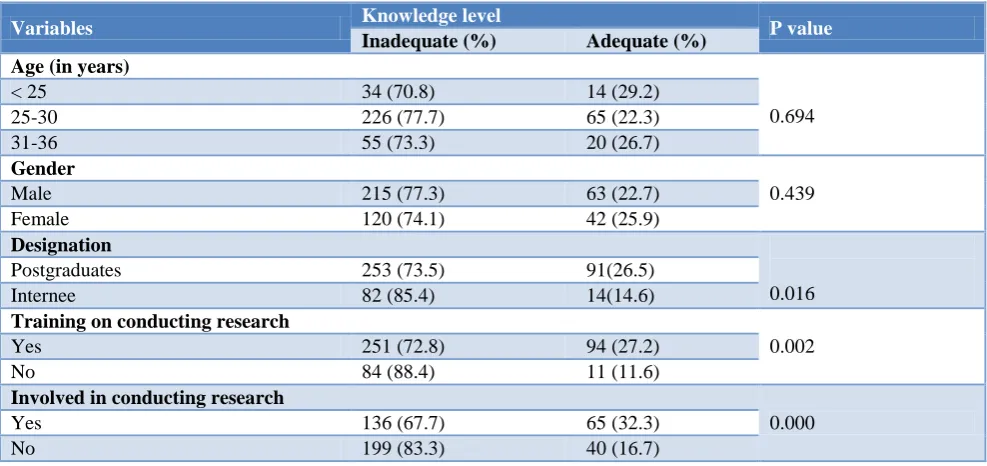
Table 4: Association between Knowledge and socio demographic variables (N=440).
Variables Knowledge level P value
Inadequate (%) Adequate (%) Age (in years)
0.694
< 25 34 (70.8) 14 (29.2)
25-30 226 (77.7) 65 (22.3)
31-36 55 (73.3) 20 (26.7)
Gender
0.439
Male 215 (77.3) 63 (22.7)
Female 120 (74.1) 42 (25.9)
Designation
0.016
Postgraduates 253 (73.5) 91(26.5)
Internee 82 (85.4) 14(14.6)
Training on conducting research
0.002
Yes 251 (72.8) 94 (27.2)
No 84 (88.4) 11 (11.6)
Involved in conducting research
0.000
Yes 136 (67.7) 65 (32.3)
No 199 (83.3) 40 (16.7)
Table 3 demonstrates that inadequate training (87.7%), lack of funding (76%), lack of motivation by faculty members (67%) and no mentorship program (66%) were the main barriers perceived by the respondents for not participating in research projects.
More than 3/4th of the respondents had inadequate level of knowledge of conducting research. Post-graduate trainees
DISCUSSION
In the present study, majority of the students had inadequate knowledge on research. This finding was similar with other studies that were conducted among college students by Hrenand Ibrahim.3,4 One plausible reason could be the orientation of the curriculum in India is very theoretical and not much priority is given to research. This has led to knowledge gap and misconceptions amongst the medical professionals who play a major role in conducting clinical research. This notwithstanding, there could be other reasons for the observed results like lack of time, perceived complexity of clinical research, lack of monitoring and a casual attitude that leads to undermining the importance of good clinical practices in clinical research.
The study showed that there was a significant relationship between knowledge about research and those who had been taught and involved in conducting research. This
coincides with the results of Jayakrishnan and
Sabzwari.5,6 Students are taught theoretical essentials of research methodology, statistics and epidemiology during the second year of their medical curriculum. This is
followed by mostly community health projects
undertaken by groups of students. During these projects, students are involved in designing and implementing their research questions, analysing their data and writing a detailed report of their project. Participation in research activities has been almost mandatory for the students and perhaps, it improves students' knowledge towards research.
As per the Medical Council of India (MCI) requirements, post graduates have to carry out a dissertation project as a part of their MD/MS curriculum.7 In order to encourage research orientation in postgraduate students, currently MCI has made it mandatory to not only attend one international/national conference, but also give an oral/poster presentation and send the article for publication.8 Moreover, more or less stringent screening procedures of the protocols followed in the institute have made the post-graduate trainees to read and learn more on research. This explains the reasons for post graduates to have higher knowledge than the interns. This signifies a relatively satisfactory contribution of medical curriculum in developing research skills among medical students through well-structured intensive training.
The negative attitude of medical students toward research have been found to serve as an obstacle to learning associated with poor performance in research.9 This study found that although majority (87%) of medical students felt that participation in research activities was likely beneficial to their education, only 41% were confident in interpreting and writing a research paper and more than half (63%) agreed that conducting research increases burden on already overworked students/ resident doctors. This finding was similar to the study performed in Canada.9 In our study, three fourth (75.9%) believed that
engaging medical students in conducting research will develop research skills and help boost their careers, but only 44.7% participated in research during medical curriculum.
In the study, only 12% of respondents felt that there was sufficient training in research during the medical course and only 24% agreed that there were adequate funds provided to carry out research. Good mentorship, an essential component of sustaining research activities, was difficult to find as opined by 67% of respondents in this study. Other problems identified included lack of time, lack of statistical support and lack of interest in research. Apart from the student projects, since most of the faculty in the institute did not actively involved in conducting research, medical graduates fail to imbibe and understand the importance of research in medical science. Other studies have also found that inadequate training, lack of funding, lack of motivation and no mentorship program to be the major obstacles to carrying out research.9-13
CONCLUSION
The study revealed inadequate knowledge but a positive attitude towards research. Ever involved in research was associated with better knowledge of research. Students desired to know and involve more in research but barriers were present. A well planned competency based curriculum for research, institution of mentorship program and incentivising research activities can boost participation in research.
ACKNOWLEDGEMENTS
The authors would like to thank all internees and post graduates for their support and cooperation and also the fourth semester students posted during that period to our Community Medicine Department for their help during data collection.
Funding: No funding sources Conflict of interest: None declared
Ethical approval: The study was approved by the Institutional Ethics Committee
REFERENCES
1. Hebert RS, Levine RB, Smith CG, Wright SM. A
systematic review of resident research curricula. Acad Med. 2003;78(1):61-8.
2. Zehra N, Hassaan A, Mushtaq S. Research Amongst
Junior and Senior Medical Students; Comparison of Knowledge, Attitude and Practice. Prof Med J. 2015;22(1):121-6.
3. Hren D, Lukic IK, Marusic A, Vodopivec I,
4. Ibrahim NK, Fetyani DM, Bashwari J. Assessment of the research-oriented knowledge, attitude and practice of medical students and interns of the King Abdulaziz University, Jeddah and the adoption of a research-intervention educational program. Rawal Med J. 2013;38(4):432-9.
5. Jayakrishnan T, Honhar, Jolly GP, Abraham J.
Medical education in India: Time to make some changes. Natl Med J India. 2012;25(30):164-7.
6. Sabzwari S, Kauser S, Khuwaja AK.
Experiences,attitudes and barriers towards research amongst junior faculty of Pakistani medical universities. BMC Med Educ. 2009;9(1):68.
7. Post Graduate Medical Education Regulations.
Medical Council of India. 2000. Available at:http://www.mciindia.org/RulesandRegulations/P GMedicalEducationRegulations2000.asx. Accessed on November 19, 2015.
8. Medical council of India Postgraduate medical
education regulations, 2000. Available at:
http://www.mciindia.org/rules‑and-regulation/ Postgraduate‑Medical‑Education‑Regulations‑
2000.pdf. Accessed on 2nd November 2015.
9. Siemens DR, Punnen S, Wong J, Kanji N. A survey
on the attitudes towards research in medical school. BMC Med Educ. 2010;10(1):1.
10. Kumar HHN, Jayaram S, Kumar GS, Vinita J, Rohit
S, Satish M, et al. Perception, practices towards research and predictors of research career among UG medical students from coastal South India: A cross-sectional study. Indian J Community Med. 2009;34:306-9.
11. Pawar DB, Gawde SR, Marathe PA. Awareness
about medical research among resident doctors in a tertiary care hospital: A cross-sectional survey. Perspect Clin Res. 2012;3:57-61.
12. Nel D, Burman RJ, Hoffman R, Randera-Rees S.
The attitudes of medical students to research. S Afr Med J. 2013;104(1):33-6.
13. Segal S, Lloyd T, Houts PS, Stillman PL, Jungas RL, Greer 3rd RB. The association between students' research involvement in medical school and their postgraduate medical activities. Acad Med. 1990;65(8):530-3.