Materials Science and Engineering Expert Committee (MatSEEC)
Computational Techniques,
Methods and Materials Design
Science Position Paper
European Science Foundation (ESF)
The European Science Foundation is an independent, non-governmental organisation, the members of which are 78 national funding agencies, research performing agencies, academies and learned societies from 30 countries.
The strength of ESF lies in the influential membership and in its ability to bring together the different domains of European science in order to meet the challenges of the future.
Since its establishment in 1974, ESF, which has its headquarters in Strasbourg with offices in Brussels and Ostend, has assembled a host of organisations that span all disciplines of science, to create a common platform for cross-border cooperation in Europe.
ESF is dedicated to promoting collaboration in scientific research, funding of research and science policy across Europe. Through its activities and instruments ESF has made major contributions to science in a global context. The ESF covers the following scientific domains:
• Humanities
• Life, Earth and Environmental Sciences • Medical Sciences
• Physical and Engineering Sciences • Social Sciences
• Marine Sciences
• Materials Science and Engineering • Nuclear Physics
• Polar Sciences • Radio Astronomy • Space Sciences
www.esf.org
Materials Science and Engineering Expert Committee (MatSEEC)
MatSEEC is an independent science-based committee of over 20 experts active in materials science
and its applications, materials engineering and
technologies and related fields of science and research management. Committee members are nominated by the member institutions of ESF and they maintain strong links with their nominating organisations and their respective scientific communities.
The aim of MatSEEC is to enhance the visibility and value of materials science and engineering in Europe, to help define new strategic goals, and evaluate options and perspectives covering all aspects of the field.
www.esf.org/matseec
Working Group members
This MatSEEC Science Position Paper has been complied with the valuable contributions of the following members of the Working Group:
Professor Risto Nieminen (Aalto University, Finland); Dr David John Jarvis (European Space Agency, The Netherlands); Professor Krzysztof Jan Kurzydlowski (Warsaw University of Technology, Poland);
Professor Roberto Lazzaroni (Université de Mons, Belgium); Professor Dierk Raabe (Max Planck Institut, Germany); Professor Paul Van Houtte (Katholieke Universiteit Leuven, Belgium).
Contact details
Dr Ana Helman, Science Officer Ms Barbara Weber, Administrator Tel: +33 (0)3 88 76 21 63 / 71 35 Email: [email protected] www.esf.org/matseec
Cover picture:
Simulation of electric energy density for Bragg reflector resonator. © Jonathan Breeze
Contents
Foreword 3
Executive summary 4
1. General survey 5
2. Landscape 6
3. Objectives and prerequisites 8
4. Scientific outlook 9
4.1. Examples of research challenges 4.2. Examples of computational challenges
5. European organisation of computational materials science: recommendations 11
Co
m
pu
ta
ti
on
a
l T
ec
h
n
iq
u
es
, M
et
h
od
s a
n
d M
at
er
ia
ls D
es
ign
3
The Materials Science and Engineering Expert Committee (MatSEEC), founded at the European Science Foundation in October 2009, presents hereby its first report Computational Techniques, Methods and Materials Design. Under the leadership
of Professor Risto Nieminen, a working group con-sisting of Dr David John Jarvis, Professor Krzysztof Jan Kurzydlowski, Professor Roberto Lazzaroni, Professor Dierk Raabe and Professor Paul Van Houtte, developed this report.
Beyond any doubt Europe has a worldwide lead-ing position in computational materials science. A significant number of codes which are used world-wide for material science and engineering both in academia and in industry were conceived and fur-ther developed by European researchers.
However, we can witness a change of focus from pure modelling to modern predictive materials sci-ence based on recent groundbreaking advances in the methodologies. In order to maintain the strong position of European scientists and engineers in this field, to strengthen their role even further and to consolidate often fragmented and dispersed efforts, this report provides a number of recommendations. These are based on the insight that measures have to
be taken which go beyond the capabilities of indi-vidual countries. The report recognises in particular the need for a stable European organisation in com-putational materials science, with strong links to European industry. The central recommendation is to establish the already existing CECAM, based in Lausanne, as a focal European organisation with links to national organisations and well-defined goals as outlined in the document.
This report aims at convincing the European funding agencies to find avenues for implementing its recommendations.
Foreword
l l l
Professor Marja Makarow
ESF Chief Executive
Professor Günther Bauer
Co
m
pu
ta
ti
on
a
l T
ec
h
n
iq
u
es
, M
et
h
od
s a
n
d M
at
er
ia
ls D
es
ign
4 Computational materials science is an exciting field
which holds much future potential. In the modern “bottom-up” and “multiscale” approaches to mate-rials development, it plays a crucial role. However, its approaches have to be developed to be even more robust and systematic, seamlessly coupled, and connected to the rapidly growing materials data-bases. What is also needed are more systematic approaches to verification of the simulation results and the development of error estimates of the com-putationally predicted properties. If these issues are addressed, computational materials science will be totally indispensable for materials discovery and design during the next decade.
The research community in this area is very wide and dispersed, with the hundreds of research groups embedded in a variety of environments and organisational structures. Good networking of these groups is essential to achieve excellence by world standards.
Executive summary
l l l
The central recommendations of the MatSEEC Working Group are:
• European activity in computational materials science can be considerably strengthened and consolidated through establishing CECAM1 as the focal organisation with funding links to national organisations. This should be com-plemented by grass-roots research networks supporting topical working groups, workshops, researcher training, and cross-thematic confer-ences. A mechanism for the long-term funding of these activities needs to be worked out. Links to experimental efforts need to become stronger, and technology transfer to industry needs to be vigorously pursued.
• The presently dispersed arrangements for sup-porting computational materials science are vulnerable. The long-term viability of this criti-cally important field requires greater investment in and strengthening of CECAM.
• Code and database development, maintenance, distribution and support should be put on a more professional basis, in the context of European infrastructure developments in scientific com-puting, such as those outlined in the LINCEI Initiative and the PRACE project.
• A high-level policy unit should be established at CECAM to discuss scientific priorities and advise funding agencies.
Co m pu ta ti on a l T ec h n iq u es , M et h od s a n d M at er ia ls D es ign 5
1.
General survey
l l l
Computational methods and techniques are at the heart of modern materials research and devel-opment. Materials science and engineering is becoming a typical example of “simulation-based science and engineering”. Firstly, powerful, predic-tive theoretical and computational methods are used to facilitate the discovery and design of mate-rials with new functionalities and desired properties. Secondly, computational methods have a major role in the design and optimisation of routes for materi-als synthesis, processing and preparation, ranging from chemical reactions for growth to long-term annealing and recovery routes of materials. The third role for computational research is in the analysis and interpretation of experimental char-acterisations, often based on sophisticated probes. Nanotechnology is a striking example of the inte-gration of computational science with engineering to develop new materials and structures, for such application areas as information technologies, energy harvesting and conversion, as well as bio-mimetic and biocompatible devices. The crucial role of materials research, including computational approaches, to global energy challenges is amply described in a recent document1.
Materials modelling utilises several tools already widely used in engineering practice, such as finite-element and finite-difference methods for solving continuum equations in mechanics, fluid dynamics and diffusion, or free-energy minimisation pro-grammes for phase equilibria. However, modern predictive materials modelling goes much further 2.
1. Science for Energy Technology: Strengthening the Link between Basic Research and Industry, U.S. Department of Energy, Basic Energy Sciences Advisory Committee (BESAC) Report, USA 2010. 2. M. Stoneham: Predictive Materials Modelling, in European White Book on Fundamental Research in Materials Science, Max-Planck Institute, Germany 2002.
It is necessary to dig down to the atomic level and to understand and exploit atomistic structure and behaviour. Electronic structure calculations, atom-istic and molecular dynamics, kinetic and statatom-istical modelling, together with new and emerging tech-niques and increased computational power can provide answers to versatile and complex questions related to materials manufacture, properties, per-formance and technological applications.
The keys to the emergence of computational materials science have been the dramatic advances in the methodologies for multi-scale and multi-phys-ics/chemistry simulations, spanning several temporal and spatial scales, and the increasing availability of powerful computing resources now routinely running at a performance level of teraflops and reaching petaflops in the near future.
The importance of modelling to industry and scaling-up of new processes and technologies is dra-matically rising. In many areas of high-tech product development, such as semiconductor foundries and heterogeneous catalysis, the potential for cost and time savings as well as risk reduction is considerable. There is a clear industrial driving force for model-ling as a way to enhance the global competitiveness of European industry.
Co m pu ta ti on a l T ec h n iq u es , M et h od s a n d M at er ia ls D es ign
6 The subject area of (computational) materials
sci-ence is vast. On the physics side, it covers more than half of the PACS (Physics and Astronomy Classification System) titles. It includes solid-state and materials chemistry, physical and chemical metallurgy, granular materials, foams and flocks. Biological, biomimetic and biocompatible materials from DNA to replacement hips are in its domain. The field also continues to grow to encompass new areas. One example of materials with new proper-ties is that of artificially engineered metamaterials with unique and unexplored responses to electro-magnetic and elastic waves across a wide spectrum of frequencies.
Computational materials science has simultane-ously developed in several research communities. Some observations are given below.
The first-principles community uses quantum-mechanical methods to solve for the electronic structures of condensed matter and then calculate properties of materials and devices based on these solved structures.
Any process that involves making or/and breaking of bonds between atoms requires such an approach, because bonding between atoms is funda-mentally a quantum effect, and no generally useful method exists to represent it by classical interatomic force models.
This area has progressed tremendously dur-ing the past several decades and has reached a level where well-documented and tested software can be used to solve problems of wide variety and increasing complexity. For small system sizes at the molecular level, subtle quantum phenomena can be investigated by using sophisticated many-body quantum-mechanical methods. For larger systems, methods based on the density-functional theory and
its extensions can now handle unit cells with thou-sands of atoms, especially for their structural and thermodynamic properties. Atomic and molecular dynamics can also be handled from first principles, with similar system sizes and time-spans in the nanosecond regime.
If the quantum-physical treatment is replaced with techniques based on less accurate semi-empirical force laws, system sizes can be extended to millions (or even billions) of atoms, also in the molecular-dynamics case.
One aspect of first-principles methods is the abil-ity to attack interpretation problems arising from the rapid development of various spectroscopic techniques, probing electronic excitations and their decay. This has given the impetus for the European Theoretical Spectroscopy Facility (ETSF)1, which now provides services for the experimental spec-troscopy community using advanced methods for quantum-mechanical spectroscopy calculations.
For mesoscopic simulations in the micrometre regime, several techniques are available for more coarse-grained calculations that can also span much longer time scales. These include various kinetic Monte Carlo and cellular automata methods, as well as stochastic techniques based on the Master Equation and its derivatives.
Approaching the macroscopic (continuum) limit, a wealth of computational techniques is available. These include the micromechanical and micromag-netism calculations, as two specific examples, based on classical theories of elasticity and electromag-netism, respectively. For fluid-mechanical problems, such techniques include lattice-Boltzmann meth-ods and eventually Navier–Stokes equations of
1. www.etsf.org
2.
Co m pu ta ti on a l T ec h n iq u es , M et h od s a n d M at er ia ls D es ign 7
continuum fl ow. Th e fi elds of computational fl uid dynamics and computational mechanics are mature, with high-quality soft ware widely available. Th e research challenges are focused towards nonlinear and non-equilibrium behaviour and the complexity arising from multi-physics/chemistry application (e.g. reactive multiphase fl ow in external fi elds). Th ermochemical modelling and simulation based on phase equilibria, oft en combined with chemical kinetics and fl uid fl ow, are now systematically used in materials processing research.
As shown by these examples, the research mode in computational materials science is thus truly many-faceted. As well as there being the great diver-sity of techniques depending on diff erent areas of basic science, the research is also highly dispersed among thousands of small groups across Europe. Th e situation is very diff erent from that in some research fi elds cohering around just one or few large central facilities and organisations, such as CERN. For example, in Cambridge University (UK) alone, active computational materials science groups oper-ate in the Departments of Physics, Moper-aterials Science, Earth Science, Physical and Th eoretical Chemistry, Electrical Engineering, and Engineering Materials. Such diversity is typical, and in contrast to some other research fi elds that have just one or few large
central facilities and organisations. Computational materials science also plays a very prominent role in PhD and post-doctoral research training, and the young scientists are in demand in both industry and academia.
Such wide dispersion and diversity are also refl ected in the spectrum of methodological and soft ware tools used. Th ere are hundreds of diff erent methods and computer codes, as well as a large vari-ety of computational platforms ranging from laptops to massive supercomputer resources. It is crucial that mechanisms for enabling permanent European networking are implemented in the near future. In this fi eld, each calculation is ultimately done by one person at one computer, with researchers and com-puter hardware largely supported through national funding. However, the calculations also depend on a large amount of expertise originating elsewhere across Europe.
In response to the wide dispersion of researchers among many groups, even in one subfi eld or tech-nique, some networks have grown up but almost all are informal and/or temporary. Th ere appears to be no funding niche in Europe for long-term networking support unlinked to large experimen-tal facilities.
Figure 1.
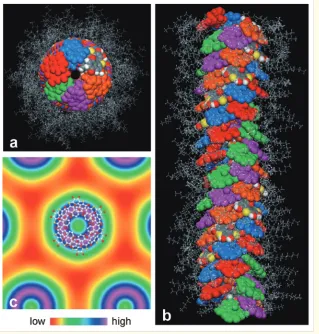
Molecular organisation in the 6-stranded 132 helical column of a chiral helicene compound with four tethered alkyl chains. One repeat period of the helix (fi g. b) contains two helical turns and 78 molecules, grouped in 13 units of six, hence six colours. (a, c) Views along column axis, (b) side view, showing the “pine-tree” structure. In (a) the aromatic cores and the alkyl tails are shown with space-fi lling and stick models, respectively, while in (c) only the aromatic cores of one 6-molecule unit are shown as ball-and-stick. In (c) a 6-molecule unit, without hydrogens, is superimposed on the electron density map, reconstructed from X-ray diffraction data. The high electron density ring (purple) is due to the high-density aromatic groups. The columns have a hollow core.
Co
m
pu
ta
ti
on
a
l T
ec
h
n
iq
u
es
, M
et
h
od
s a
n
d M
at
er
ia
ls D
es
ign
8 The foremost objective is naturally scientific
excel-lence by world standards. Paraphrasing Sir Nevill Mott: “In basic research, second-class work is almost not worth doing”. In addition to ambitious exploration of underlying theoretical ideas and their computational implementation, scientific excellence requires close contact and collaboration with experi-mental efforts. Recognising the scientific value and European strength in computational materi-als science, the European Science Foundation
has recently launched a new Research Networking Programme in Advanced Concepts in ab-initio Simulations of Materials (Psi-k), which contin-ues the highly successful work of the previous Psi-k Programmes.
Among the obvious prerequisites for success is also access to computational resources, software tools and databases. These needs are shared with many other areas of computational science and engi-neering. They are elaborated upon in the LINCEI Forward Look1 prepared by the European Science Foundation. Computational materials science, nan-otechnology and quantum molecular science are important pillars of that initiative. Materials science and condensed-matter sciences are also underpin-ning the scientific case for PRACE, the Partnership for Advanced Computing in Europe2 supported by the infrastructure funds of FP7 of the European Union.
To achieve and maintain global leadership, no European country is large enough to have the nec-essary wide and deep expertise in the underlying theoretical methods and their computational
imple-1. European Computational Science Forum: The LINCEI Initiative: From Computers to Scientific Excellence, European Science Foundation 2009.
2. www.prace-project.eu
mentation. Thus European cooperation is crucial. This does not mean large sums of money pooled to a common European pot. Given the dispersed and diverse nature of the activities, normal national funding for research manpower and resources is adequate as the basic structure for research fund-ing, augmented by European and international programmes.
However, European networking is the abso-lutely necessary element, the healthy state and sustained support of which need to be secured. The European computational materials science community has developed a common culture and a worldwide leading position. Through various temporary funding schemes and mechanisms it has flourished, but needs now a stable solution to enable extensive, high-class European networking that is easily accessible and unencumbered by exces-sive bureaucracy. The national Research Councils should strive without prejudice for a pan-European network in computational materials science, a multifaceted “CERN-like” organisation in a hugely important area, for a tiny fraction of the cost of the megascience projects such as CERN or ITER, or even compared with the sums spent on advanced comput-ers. A possible organisational solution is presented later in this document.
3.
Co m pu ta ti on a l T ec h n iq u es , M et h od s a n d M at er ia ls D es ign 9
4.
Scientific outlook
l l l
With the exciting developments in many areas and with the advent of ever-increasing and pervasive computational resources, huge opportunities arise for computational materials research in Europe. While some projects do require the use of the larg-est available computers, most are in fact done on local clusters or modest regional supercomputers. We mention here just a few challenges and research
opportunities. Many more examples are described in the cited LINCEI and PRACE documents 1,2.
4.1. Examples of research
challenges
• The most pressing research challenge has to do with the integration of the various length and time scales relevant for materials science, briefly outlined above. Multiscale materials simulation is the holy grail of present research, where much effort must be focused towards more seamless integration of the length and time scales, from the electronic and atomic levels to the contin-uum. A typical example of a multiscale materials problem is chemical vapour deposition (CVD) or atomic layer deposition (ALD) growth of thin films and coatings, where the scales vary from the sub-nanometer surface region to the metre-scale reactor.
• The accurate description and robust model-ling of non-equilibrium properties remains a challenge. At the atomic scale this poses major challenges for treating excitations and
dynam-1. European Computational Science Forum: The LINCEI Initiative: From Computers to Scientific Excellence, European Science Foundation 2009.
2. www.prace-project.eu
ics far from the ground state, with all the decay and dissipation channels properly included. Non-equilibrium thermodynamics and statisti-cal physics are also highly relevant for the longer length and time scales and need to be robustly integrated into computational platforms. • There are new and emerging classes of strongly
correlated and quantum materials, where our understanding of the underlying physics and chemistry is still severely limited and is ham-pering technological applications. Examples of such materials are topological insulators, multif-erroic materials and exotic superconductors. The complexity of the quantum properties of these materials requires both new theoretical ideas and large-scale computer simulations.
• Another exciting new topic is that of programma-ble materials, where bio-inspired building blocks such as DNA are used to grow pre-designed nanoscale objects and structures to a molecu-lar- and atomic-scale precision. To exploit the opportunities presented by programmable materials requires new capabilities for predic-tive modelling of inter-molecular interactions and the self-assembly of nanoscale units in non-equilibrium conditions.
4.2. Examples of computational
challenges
Co
m
pu
ta
ti
on
a
l T
ec
h
n
iq
u
es
, M
et
h
od
s a
n
d M
at
er
ia
ls D
es
ign
10
from the point of view of application to various materials-science problems, ranging from dif-ferential equations to stochastic simulation. • To be able to describe materials, processes
and devices with increasing complexity, ever larger system sizes and ever longer simulation sequences are necessary. The computational cost often increases as power law with a large exponent as a function of system size. It is thus obvious that only highly parallel computing plat-forms, with tens of thousands of cores will be useful in the future. This requires critical investi-gation of the algorithms and their computational implementation to enable such platforms to be utilised. Truly massively parallel computing is a major challenge for the future.
• Special-purpose processors, such as powerful graphics cards, offer low-cost and scalable solu-tions for high-performance computing. Their usability depends critically on the problem type and its computational solution (molecular-dynamics, finite-element simulation, etc.). The utility of special architectures for computational materials science must be systematically exam-ined.
• A rapidly emerging trend in computational materials science is the growth of databases of information relating to material properties, derived both from experiments and large-scale computational screening. The curating and min-ing of these databases is crucial. Standards have to be developed to structure the databases, and new methods are needed for their systematic mining. The databases must also be integrated with the other simulation platforms to allow seamless transfer of information between data-bases and simulation results. Advanced methods such as those based on neural networks can be used for combinatorial screening and optimisa-tion of materials design for desired properties.
Figure 2.
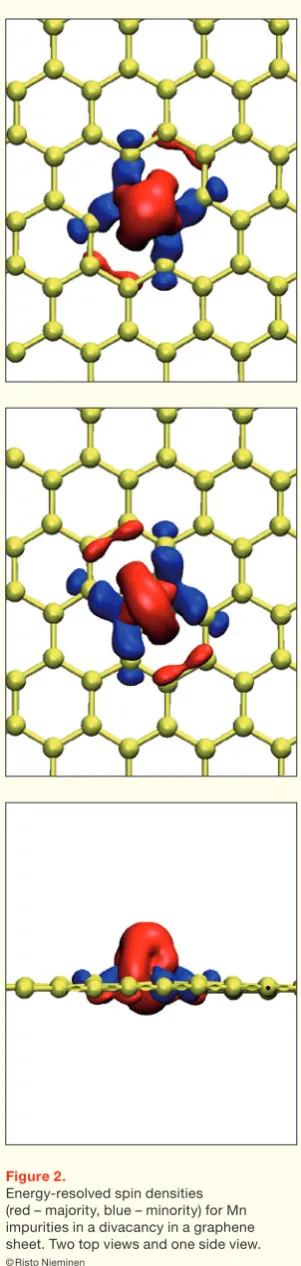
Energy-resolved spin densities (red – majority, blue – minority) for Mn impurities in a divacancy in a graphene sheet. Two top views and one side view.
Co m pu ta ti on a l T ec h n iq u es , M et h od s a n d M at er ia ls D es ign 11
As already noted, the funding of researchers and computer hardware in materials science is dealt with through national agencies, but the provision of sys-tems to promote networking to bring together all the required expertise has been badly neglected.
The need for a stable European organisation in computational materials science is obvious and acute. Such an organisation should engage all European countries where there are active research efforts in the area. The permanent organisation would provide the platform for various types of activities, ranging from topical research networks and software-sup-port services for the computational community, to interfaces and services to experimental communi-ties and industrial research.
As the central hub, we suggest the strengthen-ing and broadenstrengthen-ing of CECAM (Centre Européen de Calcul Atomique et Moléculaire)1 to become a true pan-European organisation.
CECAM is a solid, permanent organisation, an arm of several national Research Councils and organisations. Its headquarters are in Lausanne, Switzerland. CECAM has undergone a transition where it is developing a distributed structure with ‘nodes’ in several European countries, such as Germany, the Netherlands, Spain and Ireland. More countries, such as Austria, Finland and Sweden are now considering joining CECAM. We strongly sup-port such initiatives, and encourage all countries to join. CECAM is an efficiently run, lean organisation, which can provide the necessary, stable and official platform for sustained activities in computational materials science.
There are and have been several successful research networks around specific aspects and
tradi-1. www.cecam.org
tions of computational materials science, such as the
Psi-k, MolSimu, SimBioMa, and other networks and programmes, also sponsored by the European Science Foundation. These grass-roots, bottom-up networks are a necessary complement to the perma-nent organisation (CECAM), in that they embrace the whole research community. The activities of those networks range from individual research visits and small topical workshops to large conferences.
The European organisation for computational materials science would thus evolve to address the following key issues.
• To provide a strong, permanent central research organisation (CECAM) with active nodes in sev-eral European countries. This would provide stability and foresight and would develop to include all the multifaceted aspects of materials research.
• The central organisation should have a policy unit to follow the overall development of the field, to establish priorities for future developments, and to convey the opinion and needs of the research community to European and national funding agencies and research-policy bodies. The pol-icy unit could act as an interface between the European Science Foundation and the compu-tational materials science community.
• A selection of topical bottom-up networks with activities in specific topics, such as method and code development, research training, and hands-on workshops.
• The funding instruments for networking activi-ties should be jointly developed by the national Research Councils. The added value and return on investment are exceedingly good, as the low-cost networks have developed efficient working mechanisms and traditions.
5.
European organisation of
computational materials science:
recommendations
Co
m
pu
ta
ti
on
a
l T
ec
h
n
iq
u
es
, M
et
h
od
s a
n
d M
at
er
ia
ls D
es
ign
12 There are presently several strong research
commu-nities in Europe, working with different aspects of computational materials science. A typical example is the electronic-structure community, based on physics/chemistry/materials-science departments of European universities and research establish-ments. This community is world-leading and has produced most of the software now globally used in atomic-scale materials research. There are other similar success stories, such as several networks in molecular modelling, computational chemistry, and related areas.
However, the integration of these various aspects into a more monolithic, materials-based approach is lacking. What are needed are platforms for exchanging information and expertise between the communities. This could enable the formulation of overarching efforts under which true multiscale capabilities would thrive. In addition to the overarching organ-isational solution outlined above, cohesion of the fragmented activities should be increased.
• One vehicle towards better integration would be European-level research programmes in compu-tational materials science, where a prerequisite would be the multiscale approach, better linking the now somewhat disparate communities. • Another vehicle, which would be relatively
easy to implement, is to improve the possibili-ties for cross-breeding and exchange of ideas, for example in the form of targeted symposia for computational materials science in the meetings of the European Materials Research Society
(E-MRS). While there are national programmes of a similar nature in place (for example in the Max-Planck-Society in Germany), such targeted activities would enhance interactions at the European level.
6.
Other specific measures
l l l
• Code development and maintenance should be organised in conjunction with European infrastructure efforts in scientific comput-ing. Computer codes used in materials science have become very complex, with hundreds of thousands of lines, sophisticated libraries and versatile functionalities. As a resource they are a software equivalent of other major scientific infrastructures such as synchrotron beamlines, and need to be given appropriate attention and support by funding agencies. Modern methods of applied computer science and software engi-neering should be adopted to raise the level of professionalism in code development, mainte-nance, distribution and support.
European Science Foundation
1 quai Lezay-Marnésia • BP 90015 67080 Strasbourg cedex • France Tel: +33 (0)3 88 76 71 00 Fax: +33 (0)3 88 37 05 32 www.esf.org