Original Research Article
Quality of life among menopausal women in an urban area of Siliguri,
West Bengal, India
Banalata Adhikari
1, Romy Biswas
2*
INTRODUCTION
Quality of life is a wide, multidimensional idea which is difficult to define in medical literature. According to the World Health Organization, quality of life is individuals’ perception of their position in life in the context of the culture and value systems in which they live and in relation to their goals, outlooks, principles, and concerns.1,2
Quality of life is an important aftermath of health care, and considering the influence of menopause on quality of life is a critically important part of the care of symptomatic postmenopausal women.3
Women spend almost one-third of their lifetime after menopause. Menopause is a normal physiological process and is also an adaptation process during which women go through a new biological and psychological changes.4
ABSTRACT
Background: Women who lay the foundation of the whole society are most neglected in our society, especially in their mid-life. Physical and psychosocial symptoms among post -menopausal women had a positive relation with the quality of life.
Methods: A total of 110 women of an urban area of North Bengal region of West Bengal, India were interviewed with help of schedule to obtain information regarding the personal characteristics and MENQOL tool to assess four domains means on the basis of 29 symptoms.
Results: The mean menopausal age was 44.58±3.11 years. The means and standard deviation found in different domains are, vasomotor domain (5.35±2.94), physical domain (27.95±10.25), psychosocial domain (13.81±4.70) and sexual domain (1.99±2.91). In the vasomotor domain, muscles ache, joint ache and low back ache were the common symptoms. In psycho-social domain, 99% of the women suffered from poor memory and 97.2% of them felt depressed or down/blue. In sexual domain, 33.6% were bothered by changes in their sexual desires and avoided intimacy. In physical domain, age category, financial and decision autonomy had significant association. In the sexual domain, age category, literacy status, money and sexuality had a significant difference.
Conclusions: Post-menopausal women are vulnerable group for whom appropriate and practical measures should be provided in their post-menopausal age in order to have a contented and pleasant life till they die.
Keywords: Domain, Menopausal quality of life, Post-menopausal, Women
1North Bengal Medical College and Hospital, Darjeeling, West Bengal, India
2Department of Community Medicine, Coochbehar Government Medical College and Hospital, Coochbehar, West
Bengal, India
Received: 15 September 2019
Revised: 16 October 2019
Accepted: 18 October 2019
*Correspondence:
Dr. Romy Biswas,
E-mail: [email protected]
Copyright: © the author(s), publisher and licensee Medip Academy. This is an open-access article distributed under the terms of the Creative Commons Attribution Non-Commercial License, which permits unrestricted non-commercial use, distribution, and reproduction in any medium, provided the original work is properly cited.
Menopause is characterized by the permanent cessation of menses in women as a result of reduced ovarian hormone secretion usually between the ages of 45 and 55 years. During this period, women can experience many symptoms including hot flashes, night sweats, sleep and mood disorders, impaired memory, lack of concentration, nervousness, depression, insomnia, bone and joint complaints, and reduction of muscle mass. The duration, severity, and impact of these symptoms vary extremely from person to person, and population to population.5
Some women have severe symptoms that greatly affect their personal and social functioning quality of life. Vasomotor symptoms are common physical conditions experienced by midlife women in the transition through menopause and early post menopause. Menopausal women are often found to be suffering from various mental illnesses some of the most common are depression and anxiety disorders.
Lack of social support, unemployment, surgical menopause, poor overall health status, abuse or physical torture or domestic violence, low educational status, low socio-economic status, the feeling of worthlessness could be contributing factors that lead to peri-menopausal depression. A study conducted by Ray et al to assess quality of life of post-menopausal women in a rural area of West Bengal, showed 77% had poor quality of life.5
During menopausal transition, as done in a community-based study of rural West Bengal by Karmakar et al there is a lot of fluctuation in the hormone levels, and thus women may experience many symptoms and conditions6. In another study conducted in Puducherry by G.K. Poomalarin 2012 claimed that women spend almost one-third of their lifetime after menopause.7
In this perspective, the present study has been conducted with the aim of generation information regarding Quality of Life among menopausal women in an urban area in North Bengal, West Bengal, India. The study was conducted with the following objectives, to assess the quality of life among menopausal women in an urban area of Siliguri Municipal Corporation area, West Bengal and, to find out the factors related with the quality of life among the menopausal women.
METHODS
A community based descriptive study with cross-sectional design was done during August to September 2018 among menopausal women residing in two urban wards of Siliguri municipal corporation (SMC) area which serves as the field practice area of North Bengal Medical College, West Bengal, India. Women belonging to age 40-60 years and who had menopause at least one year ago were included as the study population.
Sampling
The prevalence of poor quality of life varies from 20% to 90% in different regions of India, so prevalence of 50% is chosen to get the maximum sample size. Considering, the proportion of poor quality of life as 50%, taking Z(1-α/2)
=1.96 at 95% confidence interval and absolute precision 10, P=50, sample size determination is computed by using the formula,
n = z2(1 -α/2)P(1- P) /d2
Applying the formula, the sample size comes out to be 96. Assuming 10% nonresponse rate, which comes to be 9.6, final sample size is 96+9.6 which is rounded to 110. Only one adult eligible subject was chosen randomly from each household.
Tools and technique
Predesigned, pretested questionnaire, having two parts -one which is adapted from MENQOL and the other about the background profile was used. The original MENQOL questionnaire consists of 29 questions developed by Hilditch.9. Each item assesses the impact of one of four domains of menopausal symptoms as experienced by the women in last one month. Vasomotor (item 1-3), psychosocial (item 4-10), physical (item 11-26) and sexual (Item 27-29). Means are computed for each subscale by dividing the sum of the domain's items by the number of items within that domain. It was translated in the local language (Bengali) which was then back translated to verify content and used on the menopausal women of 40-60 years after obtaining informed consent from them.
According to the scoring system of original version of MENQOL, each question should have been scored by 8 points. However, a 4 point-Likert scale elicited better, clearer in this urban area after conducting a pilot study. The content validity of the modified questionnaire and four-point scoring system was approved. A pilot study with the modified questionnaire among 20 menopausal women was done before the study proper.
In these 4 point-Likert scoring methods, each question was scored by (0 point: subject had no problem, 1 point: subject had a problem causing mild distress, 2 points: subject had a problem resulting into moderate distress, 3 points: subject had a problem that causes relatively severe distress). Hereby, scores for vasomotor aspect ranged from 0 to 9, for psychosocial aspect from 0 to 21, for physical aspect from 0 to 48 and for sexual aspects from 0 to 9. The total score of quality-of-life for each participant could be from 0 (the lowest level) to 87 (the highest level) points. Lower the score better was the quality of life.
Study variables
The background characteristics included were education, occupation, marital status, type of family, per capita income, no. of children, male child present or not, monetary support from children, monetary autonomy, decision making in family, history of abortion, hysterectomy done or not etc.
To assess the quality of life four domains- vasomotor domain, physical domain, sexual domain and psycho-social domain were considered as per MENQOL.
After necessary approval from authorities, data was collected at the households of selected participants with
prior informed consent maintaining privacy,
confidentiality and anonymity.
Data analysis
After collecting the data, it was entered in Microsoft Excel datasheet 2007. Data analysis was done using the principles of descriptive statistics. Analysis of the data was done by using IBM statistical package for social sciences version 20 (SPSS 20).
RESULTS
About 110 women aged 40-60 years were interviewed from 2 urban wards from SMC. The mean age of participating women was 52.06±4.92 years. The mean menopausal age was 44.58±3.11 years.
The results of this study are presented under the following three headings:
Socio-demographic characteristics of the women
Symptoms as per MENQOL Domains, and
Quality of life scores among menopausal women.
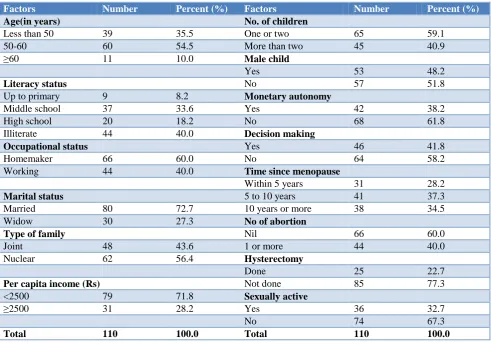
It is revealed from Table 1 that among 110 study women, 35.5% were in the age group of less than 50 years, 54.5% were in the age group of 50-60 years, 10% were above 60 years. In our study group, 40.0% women were illiterate while the rest received some education. In this study, 60.0% of these women were homemakers while the rest were working women, who either worked as maids, or hospital workers or shopkeeper or bidi workers. Out of these women, 72.7% were married, while rests of them were widowed.
Table 1: Socio-demographic profile of the post-menopausal women.
Factors Number Percent (%) Factors Number Percent (%)
Age(in years) No. of children
Less than 50 39 35.5 One or two 65 59.1
50-60 60 54.5 More than two 45 40.9
≥60 11 10.0 Male child
Yes 53 48.2
Literacy status No 57 51.8
Up to primary 9 8.2 Monetary autonomy
Middle school 37 33.6 Yes 42 38.2
High school 20 18.2 No 68 61.8
Illiterate 44 40.0 Decision making
Occupational status Yes 46 41.8
Homemaker 66 60.0 No 64 58.2
Working 44 40.0 Time since menopause
Within 5 years 31 28.2
Marital status 5 to 10 years 41 37.3
Married 80 72.7 10 years or more 38 34.5
Widow 30 27.3 No of abortion
Type of family Nil 66 60.0
Joint 48 43.6 1 or more 44 40.0
Nuclear 62 56.4 Hysterectomy
Done 25 22.7
Per capita income (Rs) Not done 85 77.3
<2500 79 71.8 Sexually active
≥2500 31 28.2 Yes 36 32.7
No 74 67.3
In this study, 59.1% of the women had just one child and 51.8% did not have any male child.
About 61.8 % of the women did not have monetary autonomy in their family and 58.2% did not have any say in decision making in the family. 60% of the women never had abortion. 77.3% did not have hysterectomy and 67.3% were not sexually active.28.2% of the women had attained menopause within five years and 34.5% of them had their menopause more than ten years ago.
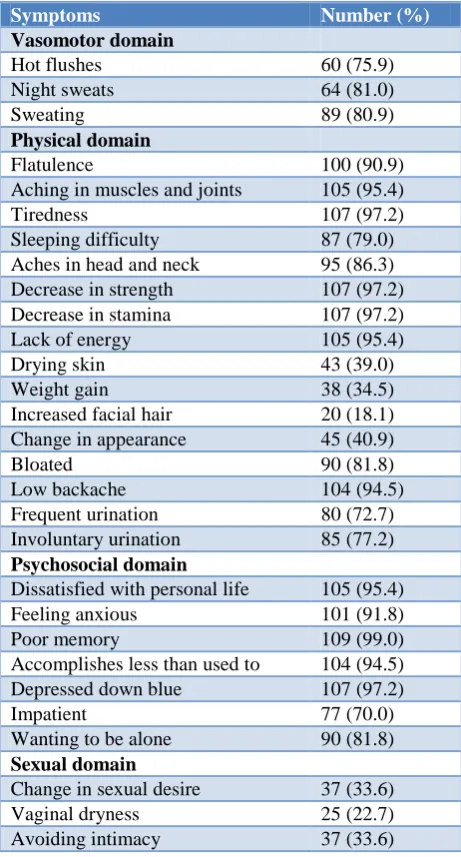
Table 2: Post-menopausal symptoms as per MENQOL domains.
Symptoms Number (%)
Vasomotor domain
Hot flushes 60 (75.9)
Night sweats 64 (81.0)
Sweating 89 (80.9)
Physical domain
Flatulence 100 (90.9)
Aching in muscles and joints 105 (95.4)
Tiredness 107 (97.2)
Sleeping difficulty 87 (79.0)
Aches in head and neck 95 (86.3)
Decrease in strength 107 (97.2)
Decrease in stamina 107 (97.2)
Lack of energy 105 (95.4)
Drying skin 43 (39.0)
Weight gain 38 (34.5)
Increased facial hair 20 (18.1)
Change in appearance 45 (40.9)
Bloated 90 (81.8)
Low backache 104 (94.5)
Frequent urination 80 (72.7)
Involuntary urination 85 (77.2)
Psychosocial domain
Dissatisfied with personal life 105 (95.4)
Feeling anxious 101 (91.8)
Poor memory 109 (99.0)
Accomplishes less than used to 104 (94.5)
Depressed down blue 107 (97.2)
Impatient 77 (70.0)
Wanting to be alone 90 (81.8)
Sexual domain
Change in sexual desire 37 (33.6)
Vaginal dryness 25 (22.7)
Avoiding intimacy 37 (33.6)
Symptoms as per MENQOL domains
The means and standard deviation found in different domains are, vasomotor domain (5.35±2.94), physical
domain (27.95±10.25), psychosocial domain
(13.81±4.70) and sexual domain (1.99±2.91).
The participants were asked about the menopausal symptoms and a score was given. Score 0 was considered to be not bothered by the symptom at all, while any score above 0, i.e. 1, 2 or 3 were considered to be a symptom bothering the participant. In this case, the intensity of botheration was not taken into consideration. In this basis the prevalence of different symptoms was shown on Table 2.
In the vasomotor domain, 80.9% of the women were bothered by sweating while in the physical domain, 95.4% of these women were bothered by aching in muscles and joints, 90.9% were bothered by flatulence, and 97.2% were affected by tiredness and also decrease in strength and stamina. 94.5% suffered from low backache while 77.2% faced involuntary urination during coughing, sneezing or laughing.
In psycho-social domain, 99% of the women suffered from poor memory and 97.2% of them felt depressed or down/blue. About 95.4% women were dissatisfied with their personal life at various levels and 94.5% of them felt that they accomplished less than used to. In sexual domain, 33.6% were bothered by changes in their sexual desires and avoided intimacy.
Quality of life scores among menopausal women
From Table 3, the relationship between different socio-demographic variables and post-menopausal symptoms of the women in this study is shown.
Different variables like, age, literacy, working status, per capita income, number of children, monetary autonomy, decision making and sexual activity were compared with the prevalence of symptoms as per the four domains of MENQOL, - vasomotor, physical, psycho-social and sexual. Among these, it was found in this study that there was a significant difference of mean between Literacy Status of being literate/educated or being illiterate and the prevalence of Sexual symptoms among the menopausal women.
It was also seen that all the symptoms from all three domains, vasomotor, physical and sexual domains as per MENQOL were significantly affected among those who were above 50 years or were below the age of 50 years. There was a significant difference in mean among those who had less than two children or had more than two and the prevalence of symptoms in vasomotor domain.
Table 3: Association of socio-demographic factors with different domains of study population.
Socio-demographic
factors Number
Vasomotor
domain Physical domain
Psychosocial
domain Sexual domain
Age category in years Mean (SD) Mean (SD) Mean (SD) Mean (SD)
Less than 50 41 6.10 (2.74) 30.98 (9.61) 14.73 (4.13) 3.63 (3.50)
50 or more 69 4.90 (2.98) 26.14 (10.26) 13.26 (4.96) 1.01 (1.95)
P value 0.038 0.016 0.113 0.000
Literacy status
Literate 66 5.47 (1.07) 28.89 (0.57) 13.55 (0.71) 2.56 (0.86)
Illiterate 44 5.16 (0.94) 26.52 (0.69) 14.20 (0.63) 1.14 (0.82)
P value 0.590 0.237 0.474 0.012
Working status
Homemaker 66 4.92 (3.04) 27.76 (10.26) 14.52 (4.53) 2.00 (2.80)
Working 44 5.98 (2.69) 28.23 (10.36) 12.75 (4.80) 1.98 (3.11)
P value 0.066 0.815 0.053 0.968
Per capita income
Less than Rs. 2500 79 5.48 (3.01) 27.76 (10.44) 14.30 (4.74) 1.96 (2.89)
Rs. 2500 or more 31 5.00 (2.78) 28.42 (9.92) 12.55 (4.44) 2.06 (3.03)
P value 0.443 0.763 0.078 0.869
Number of children
One or two 65 5.86 (2.48) 28.55 (9.83) 13.91 (4.34) 2.06 (2.94)
More than two 45 4.60 (3.40) 27.07 (10.88) 13.67 (5.22) 1.89 (2.90)
P value 0.026 0.457 0.793 0.762
Monetary autonomy
Yes 42 4.86 (3.17) 24.31 (9.82) 13.43 (4.42) 1.67 (2.54)
No 68 5.65 (2.77) 30.19 (9.93) 14.04 (4.88) 2.19 (3.13)
P value 0.173 0.003 0.508 0.362
Decision making
Yes 46 5.22 (2.85) 25.26 (9.92) 13.24 (4.85) 1.09 (2.26)
No 64 5.44 (3.02) 29.88 (10.13) 14.22 (4.58) 2.64 (3.16)
P value 0.701 0.019 0.253 0.005
Sexually active
Yes 36 4.64 (3.58) 27.89 (9.95) 14.33 (4.04) 4.94 (2.89)
No 74 5.69 (2.53) 27.97 (10.47) 13.55 (5.00) 0.55 (1.51)
P value 0.079 0.968 0.418 0.000
Figure 1: Scatter plot diagram showing vasomotor
Figure 3: Scatter plot diagram showing psychosocial domain mean score with the age.
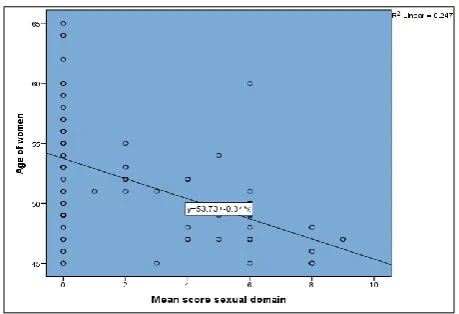
Figure 4: Scatter plot diagram showing sexual domain mean score with the age.
There was also a significant difference in mean among those who did or did not take decisions in their families and the prevalence of symptoms in all Physical and Sexual domains.
The relationship between the age of the women and four domains of the MENQOL tool- vasomotor, physical, psychosocial and sexual domain is shown in scatter plot graphs with their correlation equation in Figure 1-4.
DISCUSSION
Menopause is a transitional period that every woman goes through. The physical as well as mental response to menopause and other associated hormonal changes varies considerably due to genetic, cultural, lifestyle, socioeconomic, education, and dietary factors, and varies in every individual. Certain pre-disposing factors always influence the outcome of menopause thus, consequently affects quality of life after menopause.
Maintaining good or fair quality of life is a now a priority issue for women. In this study, assessment of the quality of life of woman was done, with respect to menopausal symptoms using MENQOL questionnaire. It was
vasomotor, psychological, physical and sexual. The menopause-specific quality of life questionnaire (MENQOL) was introduced as a tool to assess health-related quality of life in the post-menopausal period. An assumption of the MENQOL is that disease states and conditions like menopause, which produce symptoms, may disrupt emotional, physical, and social aspects of an individual’s life, which must be considered concomitantly with treatment decisions.9
In this present study, 35.5% were in the age group of less than 50 years. This result is similar to the study done by Ray et al and Dasgupta et al on QOL among post-menopausal women where 34.3% were in the same age group5. This is in accordance with the result of a study done by Mohammed HAE et al, on quality of life among menopausal women where 62.0% of the women’s age ranged from less than 50 years.8
The ranges of menopausal age falls lie between when compared with the previous researches. The mean age and standard deviation of participating women was 52.06±4.92 years. The mean menopausal age was 44.76±3.68 years. A review article which was written by Palacios et al10 showed that the median age at menopause in Europe ranged from 50.1 to 52.8 years, that in North America, it ranged from 50.5 to 51.4 years, which in Latin America ranged from 43.8 to 53 years, but in Asia, it ranged from 42.1 to 49.5 years.
A significant difference of mean was observed between literacy status of being literate or being illiterate with the prevalence of sexual symptoms among the menopausal women. In other studies, literacy has been found to have an important role to play in determining QOL of the women. In several studies, they concluded those women who had more than a high school educational level had experienced less disturbing and fewer symptoms during menopause. In two studies, it was shown that educational level had a significant association on all QOL domains where higher education rendered a better quality of life, in contrary to the current study findings, where literacy came out to be a significant predictor of poor QOL in sexual domain.
In the present study group, 40.0% women were illiterate while 60.0% received some education. In relation to the educational level, it was found that, more than half of the women did not have any formal education; this may reflect women's cooperation during conduction of the study. In addition, about more than one half of the women were housewives (60%). This result is supported by the result of the study carried out in a rural area by El Sabagh and Abd Allah who reported that 58.3% of women were housewives.11
feeling depressed/down or blue, being dissatisfied with their personal life, low backache, lack of strength and stamina and, while the mild symptoms in these domains were hot flushes, feeling anxious or nervous, aches in back of neck or head, increased facial hair involuntary urination on laughing/coughing and change in their sexual desire and avoiding intimacy. This may correlate with fluctuating levels of estrogen in the blood from premenopausal to postmenopausal period. These results are in accordance with the results of many studies reported that “hot flushes‟ and “sweating‟ were the most common and severe symptoms in menopausal women.
Vasomotor symptoms are usually related to hormonal changes during menopause periods so this difference may have been due to genetic or socio-cultural diversity and also differences in diet, especially the consumption of phyto-estrogen foods.12
In addition, a study by Jahanfar et al, contradicted the results of the present study as they reported that the most common and severe symptoms were found to be joint and muscle discomfort (84.3%), followed by anxiety (71.4%), physical and mental discomfort (67.2%), hot flushes and sweating (67.1%).13 These differences in frequencies of symptoms may be associated to differences of race, life style, culture, genetics and diet. In a study conducted by Waidyasekera et al, they reported that the joint and muscle discomfort, physical and mental exhaustion and hot flashes were the most prevalent menopausal symptoms.14 The results of current study are similar with the study conducted by Gharaibeh et al, who found that vasomotor symptoms were reported to have the highest scores as hot flushes and night sweating.15
A study by Ray et al in Kolkata found 77% of the women having poor quality of life.5 Multivariate analysis revealed that poor QOL was more among those who did not live with their own children, were monetarily dependent on their children, not living under one roof with children and had attained menopause more than 5 years. This was in accordance with the present study, where the relationship between symptoms as per MENQOL domains and monetary autonomy of menopausal women in family showed a significant difference of mean between those who had monetary autonomy in their family and those who did not have any monetary autonomy in the family, with respect to the prevalence of Physical symptoms among them. This is in accordance with most studies. Monetary autonomy is pivotal in shaping the basic quality of life enjoyed by a woman. However, in most parts of our country this practice is usually rare due to social norms.
There was also a significant difference in mean among those who did or did not take decisions in their families and the prevalence of symptoms in physical and sexual domains. This was a significant finding that showed how having a major decisive role in the family can affect the quality of life of a woman.
It was also seen that all the symptoms from all four domains as per MENQOL were significantly affected among those who had more than two children or had number of children less than two. Monetary autonomy of menopausal women in family, decision making, Sexual activity all of these factors influenced QOL among menopausal women as per our study. Decision making is more necessary in case of HRT among post-menopausal women.16
It is generally believed that menopause is welcomed as a favorable event among rural women in India unlike in the West. This is attributed to the many perceived benefits of menopause such as freedom from cultural restrictions imposed on younger women and the burden of childbirth as well as the discomforts associated with menstruation. Postmenopausal women in India are said to enjoy a higher social status assigned to ageing women.17 Similar study was also done in US showing related findings.18
With appropriate counseling, health information and an understanding of the menopause and its dimensions, menopause can become a time of beginning, rather than an end19,20. Employment and number of children decreased the risk of having psychosocial scores above the median among post-menopausal women in Iran21. Caring for menopause entails more than providing medication. Successful strategies for coping with menopause across cultures are self-care practices, role models and education, privileges and rewards, having an accepting and positive attitude toward life transitions, and medication including herbs. It is the responsibility of the nurses to organize, give care and teach the clients the importance of acceptance in promoting and improving the quality of life of menopausal women.
CONCLUSION
It can be concluded that the most severe symptoms of vasomotor, psychosocial, physical and sexual domains were, hot flushes, poor memory, and dissatisfaction with personal life, low backache, and change in sexual desire.
Lack of social support, unemployment, surgical menopause, poor overall health status, abuse or physical torture or domestic violence, low educational status, low socio-economic status, the feeling of worthlessness - could be contributing factors that lead to peri-menopausal depression.
Depression during menopausal period, has not been extensively researched and consequently awareness regarding this deficit among a majority of population.
Recommendations
from children, living apart from children, degradation of relationship with husband after menopause have to be investigated more.
Depression arising out of post-menopausal symptoms should be dealt with utmost care. Approaches building on the self-care measures of menopausal women and supporting constructive practices is essential in order to help them handle with menopausal symptoms.
ACKNOWLEDGEMENTS
We would like to thank Indian Council of Medical Research for awarding research grant for STS.
Funding: No funding sources Conflict of interest: None declared
Ethical approval: The study was approved by the Institutional Ethics Committee
REFERENCES
1. WHO-QOL BREF, Introduction, administration, scoring and generic version of assessment. Field
Trial Version; 1996. Available at:
http://www.who.int/mental_health/media/en/76.pdf Accessed on September 2018.
2. World Health Organization. Quality of life assessment: international perspectives. Berlin: Springer; 1994.
3. Vaze N, Joshi S. Yoga and menopausal transition. J Midlife Health. 2010;1:56-8.
4. Mishra G, Kuh D. Sexual functioning throughout menopause: the perceptions of women in a British cohort. Menopause. 2006;13:880-90.
5. Ray S, Dasgupta A. An assessment of QOL and its determining factors of post-menopausal women in arural area of West Bengal, India. International
Journal of Medicine and Public Health.
2012;2(4):12-9.
6. Karmakar N, Majumdar S, Dasgupta A, Das S. Quality of life among menopausal women: a community-based study in a rural area of West Bengal. J Midlife Health. 2017;8(1):21-7.
7. Poomalar GK, Arounassalame B. The quality of life during and after menopause among rural women. Journal of clinical and diagnostic research. JCDR. 2013;7(1):135.
8. Hilditch JR, Lewis J, Peter A, van Maris B, Ross A, Franssen E, et al. A menopause-specific quality of life questionnaire: development and psychometric properties. Maturitas. 1996;24(3):161-75.
9. Palacios S, Henderson VW, Siseles N, Tan D, Villaseca P. Age of menopause and impact of
climacteric symptoms by geographical region. Climacteric. 2010;13:419-28.
10. El Sabagh E, Abd Allah E. Menopausal symptoms and the quality of life among pre/post-menopausal women from rural area in Zagazig city. Life Sci J. 2012;9(2):283.
11. Nisar N, Ahmed S. Frequency of menopausal symptoms and their impact on the quality of life of women: a hospital-based survey. J Pak Med Assoc. 2009;59(11):752-6.
12. Jahanfar S, Abdul Rahim A, Shah Reza B, Nor Azura I, Sharifah D, Siti R. Age of menopause and menopausal symptoms among malaysian women who referred to health clinic in Malaysia. Shiraz E-Med J. 2006;7:1-9.
13. Waidyasekera H, Wijewardena K, Lindmark G, Aessen T. Menopausal symptoms and quality of life during the menopausal transition in Sri Lankan women. Menopause. 2009;16:164-70.
14. Gharaibeh M, Al-Obeisat S, Hattab J. Severity of menopausal symptoms of Jordanian women. Climacteric. 2010;13(4):385-94.
15. Clark HD, O’Connor AM, Graham ID, Wells GA. What factors are associated with a woman’s decision to take hormone replacement therapy? Evaluated in the context of a decision aid. Health Expectations. Int J Pub Participate Health Care Health Policy. 2003;6(2):110-7.
16. Obermeyer CM. Menopause across cultures: a review of the evidence. Menopause. 2000;7(3):184-92.
17. Williams RE, Levine KB, Kalilani L, Lewis J, Clark RV. Menopause specific questionnaire assessment in US population-based study shows negative impact on health-related quality of life. Maturitas. 2009;62(2):153-9.
18. Sagdeo MM, Arora D. Menopausal symptom: a comparative study between rural and urban India. JK Sci. 2011;13(1):23-6.
19. Li C, Borgfeldt C, Samsioe G, Lidfeldt J, Nerbrand C. Background factors influencing somatic and psychological symptoms in middle-age women with different hormonal status. A population-based study of Swedish women. Maturitas. 2005;52(3-4):306-18. 20. Fallahzadeh H. Quality of life after the menopause in Iran: a population study. Quality Life Res. 2010;19(6):813-9.