IJSRSET185430 | Published : 28 February 2018 | January-February-2018 [(5) 4 : 162-168 ]
National Conference on 'Advanced Analytical Tools for Materials Characterization' (AATMC-2018) © 2018 IJSRSET | Volume 5 | Issue 4 | Print ISSN : 2395-1990 | Online ISSN : 2394-4099 Themed Section: Science and Technology
Application of Spectroscopic Techniques for analysis of
interaction between Thermophiles and metal ions
Sonali Zankar Patil*, Geetha Unnikrishnan
Birla College of Arts, Science and Commerce, Kalyan, Maharashtra, India
ABSTRACT
The thermophiles are adapted to the environment containing sulfate and other heavy metals, its potential use in bioremediation will be significant. There are various compounds or substances that are responsible for bioremediation. Depending upon the microorganisms, the bioremediation processes can be due to proteins and enzymes that are responsible for carrying out this process or other factors like extracellular polymeric substances (EPS). Quantitative and qualitative determination of biomolecules and microbial assisted phenomena by spectroscopy is a pioneer approach. This research presents the features of protein and EPS from thermophiles with a view to establish their role as central elements in bioremediation of heavy metals. A coordinated physicochemical analysis of water and molecular survey of microbes was conducted for Vajreshwari and Ganeshpuri hot springs. The results of this study expands the current understanding of the microbiology in Vajreshwari and Ganeshpuri hot springs and provide a basis for comparison with other geothermal systems around the world. The study will aid in engineering the extracellular polymeric substances with enhanced characteristics of metal sorption for effective bioremediation of heavy metals of environmental concern.
Keywords: Thermophiles, Extracellular Polymeric Substances, Spectroscopic Techniques, Metal Ions.
I.
INTRODUCTIONMicrobes are the most fascinating group, with huge diversity devising myriad functional applications in the field of medicine, pharmaceuticals, environmental remediation, and industries. Quantitative and qualitative determination of biomolecules and microbial assisted phenomena by spectroscopy is a pioneer approach. It facilitates the study of atomic and molecular geometries, energy levels, chemical bonds, and interactions between molecules and microbes.
The thermophiles are adapted to the environment containing sulfate and other heavy metals, its potential use in bioremediation will be significant.
substances with enhanced characteristics of metal sorption for effective bioremediation of heavy metals of environmental concern.
II.
METHODS AND MATERIAL1. Sampling and media for isolation of thermophiles:
Water samples were collected from seven different hot springs (fromVajreshwari&Ganeshpuri, Thane) Mumbai. Surface water samples were taken from the Hot Springs using a grab sampler. A 500-ml plastic cup attached to a 2-m pole was dipped into the water twice to rinse it. The sample was then transferred to a clean, new, polyethylene container with a snap-on lid. The temperature of the sample was taken with a laboratory thermometer and recorded. All samples were taken on the same day to prevent discrepancies due to sample date. Samples were kept cool during transport to the laboratory and processed within 12 h of collection (Vieille C. 1996).
Bacillus Medium described by Postgate (1969) was used for routine stock maintenance and all enrichment culture studies.
Bacillus Medium contained (g/ Lit.: Soluble starch – 30.0 g, Agar – 20.0 g, Peptone – 5.0 g, Yeast Extract – 5.0 g, Distilled Water – 1000 ml, pH 7.5 ± 0.2 (45°C). Colonies were isolated from anaerobic roll tubes (Hungate et. al. 1969) containing Medium and 4% (w/v) purified agar. Stock cultures of all strains were prepared from single isolated colonies that proliferated on transfer in Media. All stock cultures were incubated at 50°C. Cultures were routinely checked for contamination (Zeikuset, al. 1979).
towards bioremediation. The screening was done by using 500ppm of heavy metals containing 5 specific heavy metals i.e. Cd, Cr, Cu, Fe, Zn (5 heavy metals were chosen as these are common pollutant in industrial wastewater).
3. Bioremediation efficiency by Atomic Adsorpption Spectroscopy:
100 ml Sterile Nutrient broth containing 500 ppm of Cd2+,Cr2+,Cu2+,Fe2+and Zn2+were prepared and were
inoculated with 24 hour old culture suspensions of all the five bacterial isolates namely SZP 16 and SZP 18. The inoculated flasks were kept at 45oC±2oC for 24 hrs.
After that, the broths were centrifuged at 6000 rpm for 20 minutes (Sinha and Khare, 2012). The supernatant was analyzed for residual heavy metal by ICP-AES (At SAIF,IIT, Powai, Mumbai, M. S.).
4. Strain identification by 16s rRNA Method:
The isolated colonies showing high tolerance to heavy metals were sequenced for its conserved sequences and analysed for partial 16s rRNA by geneOmbio, Pune, Maharashtra. The predicted 16S rRNA sequences from this study were compared with 16S rRNA sequences in a BLASTable database constructed from sequences downloaded from the Ribosomal
Database Project (release 8.1;
http://rdp8.cme.msu.edu). Comparisons were made
using the program BLAST
(ftp://ftp.ncbi.nih.gov/BLAST/executables/LATEST/) and a FASTA-formatted file containing the predicted 16S rRNA sequences. All the sequences were deposited into NCBI database.
The thermophiles isolated from hot water springs of Vajreshwari and Ganeshpuri, Thane, Maharashtra, were studied for the effect of heavy metals on the EPS production. And comparison of EPS production from control and treated isolates were studied qualitatively and quantitatively by FTIR analysis.
The protein contents of EPS and total neutral- carbohydrate content were confirmed by FTIR analysis. FT-IR analysis of the bacteria is required to know and to confirm the chemical bonds that played a role in the Bioremediation of metal.
III.
RESULTS AND DISCUSSION1. Characterization of in situ Bioremediation:
Microbial heavy metal reduction at high temperatures was studied at several sites in Vajreshwari & Ganeshpuri hot springs. Enrichment cultures were initiated with Bacillus Medium. After incubation of all
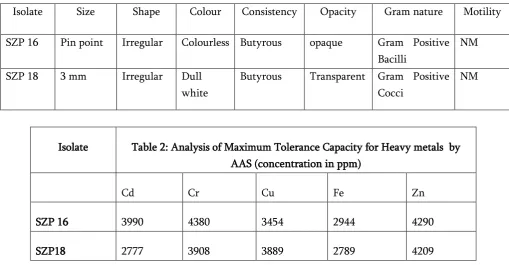
enrichments for 6 d at in situ temperature, the cultures formed a dense colonies (table 1).
2. Bioremediation
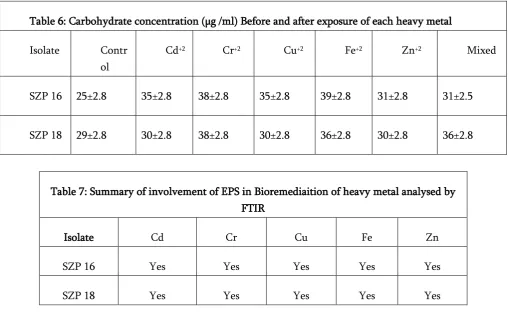
The MTC for both the strains for bioremediation of heavy metals were found to be above 1000 ppm (Table 2),
3. Bioremediation efficiency:
The bioremediation of heavy metals were determined by ICP-OES, at SAIF, IIT, Powai, Mumbai, M. S. (Table 3). The data from statistical analysis at 95% confidence limit showed that there is no significant difference in heavy metal (Cd2+,Cr2+,Cu2+,Fe2+and Zn2+)
bioremediation potential of all the selected isolates (SZP 16 and SZP 18). Thus, either of the isolate can be used for bioremediation of heavy metals (Cd2+,Cr2+,Cu2+,Fe2+and Zn2+).
Table 1: Colony characteristics of selected isolates
Isolate Size Shape Colour Consistency Opacity Gram nature Motility
SZP 16 Pin point Irregular Colourless Butyrous opaque Gram Positive Bacilli
NM
SZP 18 3 mm Irregular Dull
white
Butyrous Transparent Gram Positive Cocci
NM
Isolate Table 2: Analysis of Maximum Tolerance Capacity for Heavy metals by AAS (concentration in ppm)
Cd Cr Cu Fe Zn
SZP 16 3990 4380 3454 2944 4290
Table 3. Heavy metal reduction by selected isolates for standard
Me tal
Metal removal (%) after 24 hrs.
SZP 4 SZP 8 SZP 12 SZP 16 SZP 18
Cd B66.00 c±1.8 B64.00 c±2.8 A54.00 e±2.6 A59.30 e±2.8 A44.00 d±1.2 Cr A45.80
d±3.0 A78.20 e±1.8 A41.30 d±2.3 B78.60 e±1.3 B61.60a ±2.9 Cu C57.40
e±1.5 D51.00 e±2.8 B64.20a ±1.4 A51.00 e±2.6 A52.20 e±2.2 Fe A50.20
c±1.2 C29.00 b±2.8 B60.80 d±2.4 A58.80 c±1.2 B53.60 c±2.0 Zn B64.00a
±2.4 A44.60 a±1.4 C32.00 b±2.2 C58.60 a±1.8 A37.40 b±1.2 Key : Values are mean ± S. D. (n=3)
4. Identification of selected thermophiles by 16s rRNA :
The selected five strains were sequenced for 16s rRNA (Table 4.4). After comparing the sequence using BLAST database, genus and species were confirmed.
These sequences were deposited in NCBI database and has been given specific strain name (Table 4).
5. FTIR analysis of EPS:
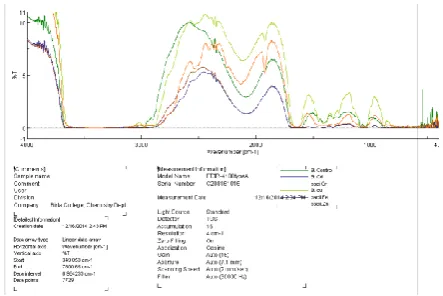
Qualitative and quantitative analysis of protein and carbohydrate was carried out by biochemical method and was confirmed by FTIR (Table 5 and 6, fig. 1, 2, 3 and 4). FT-IR analysis of extracted EPS was carried out and intensity of peaks was compared with that of control spectra (Table 7). The most remarkable difference between the control and test spectra was at intensity of 1600-1700 cm-1 and 2500 cm-1
representing hydroxyl (-OH) and amine (-NH2) group
respectively. This signifies the involvement and changes that occurs during Bioremediation of heavy metals by EPS isolated from the selected isolates (Fig. 5 and 6).
Table 4: NCBI Accession Number of identified strains:
Thermophile Strain name Accession number
Geobacillus stearothermophilus (SZP 16) BHALPRAVIN KM527211
Streptococcus thermophiles (SZP 18) ROHANMANALI KM527213
Table 5: Protein concentration (µg /ml) Before and after exposure of each heavy metal
Isolate Contr
ol
Cd+2 Cr+2 Cu+2 Fe+2 Zn+2 Mixed
SZP 16 28±1.5 35±1.6 39±1.3 35±2.0 41±1.9 30±1.0 35±2.0
Table 6: Carbohydrate concentration (µg /ml) Before and after exposure of each heavy metal
Isolate Contr
ol
Cd+2 Cr+2 Cu+2 Fe+2 Zn+2 Mixed
SZP 16 25±2.8 35±2.8 38±2.8 35±2.8 39±2.8 31±2.8 31±2.5
SZP 18 29±2.8 30±2.8 38±2.8 30±2.8 36±2.8 30±2.8 36±2.8
Table 7: Summary of involvement of EPS in Bioremediaition of heavy metal analysed by FTIR
Isolate Cd Cr Cu Fe Zn
SZP 16 Yes Yes Yes Yes Yes
SZP 18 Yes Yes Yes Yes Yes
Figure 1. Protein Concentration before and after
Figure 3. Protein Concentration before and after treatment for SZP 16
Figure 4. Carbohydrate Concentration before and after treatment for SZP 18
Figure 5. Protein Concentration before and after
Figure 6. FTIR analysis of EPS production by SZP 18
IV.
CONCLUSIONAbove studies on tnteractions between metal and EPS produced by selected isolates have established the phenomenon of bioremediation of toxic heavy metal by EPS which plays a central role. Study has developed a simple model system which will provide an insight into the basic mechanism(s) of EPS-metal binding, highlight the specific role of each EPS component including proteins and carbohydrates and justify the interaction(s) amongst the components thereof. The study will aid in engineering the extracellular polymeric substances with enhanced characteristics of metal sorption for effective bioremediation of heavy metals of environmental concern. The research summarizes traditional spectroscopic techniques used for the study of microbes and microbial-assisted products as well as illustrates its application in the field of microbial diversity and remediation.
V.
REFERENCES[1]. Baptista, M. S., Vasconcelos, M. T. Cyanobacteria metal interactions: requirements, toxicity, and ecological implications. Crit. Rev Microbiol, 2006. 32:127–137.
[3]. Burnat, M., Diestra, E., Esteve, I., Sole, A. In situ determination of the effects of lead and copper on cyanobacterial populations in microcosms. PLoS ONE 4, 2009. e6204. [4]. C. Selle, W. Pohle, H. Fritzsche, Progress in
Fourier Transform Spectroscopy, J. Mink, G. Keresztury, R. Kellner (Eds.), Mikrochim. Acta. 1997. 14 449-450 Supplimentry issue. [5]. De Philippis, R., Paperi, R., Sili, C.,
Vincenzini, M. Assessment of the metal removal capability of two capsulated cyanobacteria, Cyanospira capsulata and
Nostoc PCC7936. J. Appl. Phycol. 2003. 15: 155–161.
[6]. Fabienne, F., Carine, L., Jean-Michel, G., Paul, S., Florence Brian-Jaisson, Grégory M., Manon, Daniel G., Anne-Laure M.,David, P., Jean, P., Séverine, Z., Sylvie, R. Isolation and Characterization of Environmental Bacteria Capable of Extracellular Bisorption of Mercury. Applied and Environmental Microbiology. 2011. 1097–1106.
[7]. Fiore, M. F., Trevors, J. T. Cell composition and metal tolerance in cyanobacteria. Biometals. 1994. 7:83–103.
[8]. Gadd G M. Micrbiol. 2010, 156: 609-643. [9]. Heng, L. Y., Jusoh, K., Ling, C. H. M., Idris,
M. Toxicity of single and combinations of lead and cadmium to the cyanobacteria Anabaena flos-aquae. Bull Environ Contam Toxicol. 2004. 72:373–379.
[10]. Nies, D. H. c. Microbial heavy-metal resistance in prokaryotes. FEMS Microbiologcal Reviews. 1999, 27: 313-339. [11]. Patil Sonali, Geetha Unnikrishanan.
“Isolation, characterization and identification of heavy metal tolerating thermophiles from hot water spring”, European Journal for Biotechnology and Biosciences. 2015, Volume: 3, Issue: 7, 17-22. [12]. Patil Sonali. “Factors responsible for bioremediation in thermophiles”. Photon
Journal of Microbiology, 2017, Photon, 110, 283-286.
[13]. Pereira, S., Ernesto, M., Andrea, Z., Arlete, S., Pedro, M., Paula T.,De Philippis R. Using extracellular polymeric substances (EPS) producing cyanobacteria for the bioremediation of heavy metals: do cations compete for the EPS functional groups and also accumulate inside the cell?
Microbiology, 2011,157:451–458.
[14]. Roy, S., Ghosh, A. N., Thakur, A. R. Uptake of Pb2+ by a cyanobacterium belonging to the genus Synechocystis, isolated from East Kolkata Wetlands.
Biometals. 2008. 21:515–524.