Original Research Article
Analysing maternal determinants and characteristics of obstetric
referrals at a tertiary care centre in Kerala, India
Heera Shenoy T.
1, Sheela Shenoy T.
2, Remash Krishnan
3*
INTRODUCTION
Emergency obstetric transfers should be carried out effectively and efficiently to avoid maternal and foetal morbidity and mortality. An institution referral is when a pregnant woman seeks care at a lower level health facility (basic emergency obstetric care) and is referred onwards to a higher level health facility (comprehensive emergency obstetric care). ‗‗Referral systems‘‘ have been considered to be an important component of health
systems in developing countries since the emergence of primary healthcare. Referral is especially important within obstetrics due to the high numbers of professionals who support a woman through pregnancy and birth, the speed with which action often needs to be taken and the global burden of maternal mortality.1 The World Health Organization estimates that at least 88–98% of maternal deaths can be averted with timely access to existing, emergency obstetric care using effective and efficient referral systems. A good and well sustained referral system needs referral- protocols, improved support
ABSTRACT
Background: Timely and prompt referral of high risk pregnancies is an integral part of emergency obstetric care and is one of the effective strategies to avoid adverse pregnancy outcomes. This study aims to assess the maternal determinants and characteristics of obstetric referrals to Travancore Medical College and Hospital.
Methods: This observational study reviewed 124 obstetric referrals over 3 years. Maternal risk factors and sources of referral were looked into. Distance travelled, referral-arrival interval, mode of transport, gestational age at referral, medical co-morbidities necessitating emergency/elective transfers to this tertiary centre have been analysed.
Results: Referral rate was 7.03%. Mean age was 26. Primipara and multipara went hand in hand. 95% were graduates. Materno-fetal (58%) contributed the bulk of obstetric referrals. 83.1% were from private hospitals and 64 were in-labour referrals. 71.6% had referral arrival distance of <15 kms. Mode of transport used by the referred patients was by ambulances (73.9%). Around 48% of our population had GA of 33-36.6 weeks. 73% had emergency decision among which caesarean was 83%. Anaemia (34%), HDP (30.5%), GDM (14.2%) and hypothyroidism (17.7%) were medical co-morbidities necessitating referrals. There was 1 maternal death and 4 near miss mortality cases. Mean hospital stay in private sector referrals was 10.17 days and it was 7.62 days in government referrals.
Conclusions: Timely referrals with detailed referral slips imparting information regarding treatment received at the referring hospital has helped in early and optimal intervention in the study.
Keywords: Referrals, Obstetric, Maternal, Foetal, Perinatal, Morbidity
Department of Obstetrics and Gynaecology, 1K.M.C.T. Medical College, Kozhikode, 2Government Medical College, Thiruvananthapuram, Kerala, India
3Department of Cardiology, Metro-med Interventional Cardiac Centre (MICC), Kozhikode, Kerala, India
Received: 18 October 2019
Revised: 20 November 2019
Accepted: 21 November 2019
*Correspondence:
Dr. Remash Krishnan,
E-mail: [email protected]
Copyright: © the author(s), publisher and licensee Medip Academy. This is an open-access article distributed under the terms of the Creative Commons Attribution Non-Commercial License, which permits unrestricted non-commercial use, distribution, and reproduction in any medium, provided the original work is properly cited.
(especially transportation), community awareness, and feedback system.2
India has a national public health sector which provides free care, and a prominent private sector which charges for services and is largely unregulated .India has a maternal mortality ratio (MMR) of 162 deaths per 100,000 live births and accounts for 17% of global maternal deaths.3 Kerala is a high-performing Indian state with regards to health indicators, with an MMR of 31 per 100,000, an institutional delivery rate of 99% and almost universal antenatal care (ANC). Kerala has a 94% literacy rate and over 90% of houses having electricity and a toilet facility 4 Even though state of Kerala has state of art health care, limited studies have been conducted to analyse determinants of referrals and characteristics of referral in obstetric care.
In this study, we have analysed maternal determinants of referral, Gestational age and in-labour referrals, referral characteristics (source of referral, referral-arrival interval,
transport systems, distance travelled to receive
comprehensive emergency obstetric care, referral documentation), mode of delivery, mean maternal hospital stay and morbidities in the mother.
Aims and objectives
The main aim and objective of this study is to analyse the maternal determinants of obstetric referrals-maternal age, parity, income, education, employment during pregnancy
and medical disorders necessitating inter-hospital
transfers, to look into the referral characteristics-source of referral, distance travelled and mode of transport and referral-arrival interval and to know the gestational age at referral and delivery outcomes, morbidity and hospital stay.
METHODS
An observational study conducted at Travancore Medical College, Kollam, a tertiary care teaching institution which receives inter-hospital transfers from Primary health centres (PHC), Community health centres and private hospitals in and around Kollam. The sample population consisted of 124 obstetric referrals of 24 weeks and beyond during June 2013 to February 2016. All booked cases and obstetric referrals of less than 24 weeks and 6 out referrals were excluded from the study. Study protocol was approved by the ethical committee. Using a pre structured designed questionnaire, socio demographic details, medical co-morbidities, indications for referral-maternal and foetal were obtained. Referral slips were analysed and source of referral, distance travelled and
mode of transport and referral-arrival interval,
documentation patterns were sought. Patient referred while in labour were noted. Gestational age at referral and mode of delivery was highlighted. Intra partum variables and surgical morbidities were evaluated. Need for ventilation and multi-disciplinary team work, mean
hospital stay was looked into. Data was analysed for descriptive statistics such as mean, standard deviation and percentages were computed using SPSS for Windows version 20. P value <0.05 was significant.
RESULTS
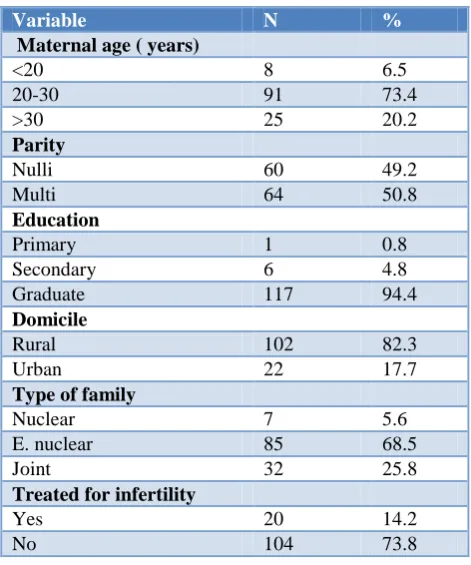
The study population comprised 124 obstetric referrals which included 21 public sector and 103 private sector referrals. The socio-demographic data, maternal age, domicile, maternal education and employment during pregnancy were noted.
Table 1: Socio-demographic profile of obstetric referrals (n=124).
Variable N %
Maternal age ( years)
<20 8 6.5
20-30 91 73.4
>30 25 20.2
Parity
Nulli 60 49.2
Multi 64 50.8
Education
Primary 1 0.8
Secondary 6 4.8
Graduate 117 94.4
Domicile
Rural 102 82.3
Urban 22 17.7
Type of family
Nuclear 7 5.6
E. nuclear 85 68.5
Joint 32 25.8
Treated for infertility
Yes 20 14.2
No 104 73.8
Private sector referrals comprised the bulk (83.1%). Among 16.9 % of government referrals, 15 were from District hospital and were either in labour or required Emergency Obstetric Care or Level III.
Figure 1: Source of obstetric referrals.
12%
3% 2%
83%
Public sector had statistically significant in labour referrals (p value=0.04). All the obstetric referrals from public health sector reached within half an hour while one third of private sector referrals travelled more than an hour for emergency obstetric care (p value=0.001).
Figure 2: Distance travelled for care from hospital of referral.
58% travelled in ambulance provided by the referring hospital while 24% had to hire a private vehicle for inter-hospital transfer. All the obstetric referrals from public health sector reached within half an hour while one third of private sector referrals travelled more than an hour for emergency obstetric care (p value=0.001).
Figure 3: Mode of transportation of referrals.
Figure 4: Documentation in obstetric referrals.
Figure 5: Gestational age at referral.
Figure 6: Medical conditions associated with referral.
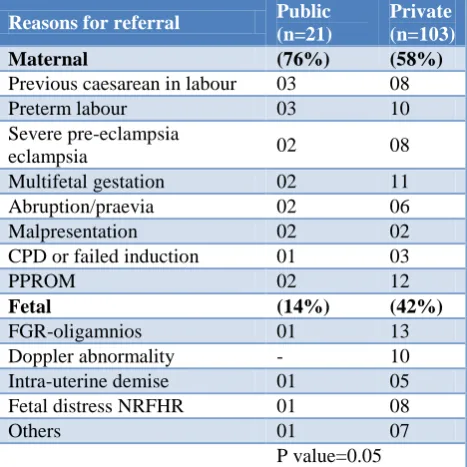
Table 2: The reasons for obstetric referrals.
Reasons for referral Public (n=21)
Private (n=103)
Maternal (76%) (58%)
Previous caesarean in labour 03 08
Preterm labour 03 10
Severe pre-eclampsia
eclampsia 02 08
Multifetal gestation 02 11
Abruption/praevia 02 06
Malpresentation 02 02
CPD or failed induction 01 03
PPROM 02 12
Fetal (14%) (42%)
FGR-oligamnios 01 13
Doppler abnormality - 10
Intra-uterine demise 01 05
Fetal distress NRFHR 01 08
Others 01 07
P value=0.05
In our study, 70% of private sector referrals had structured letters and 28% had unstructured ones and 2%
0 20 40 60 80 70.96
11.29 16.12
Re fe rr a l ca se s
Distance In Kms
<15km 15-30km >30 Ambulance Private vehicle Own vehicle 0 20 40 60 80 72
30 22
R efe rr a l ca se s
Ambulance Private vehicle Own vehicle
0% 50% 100%
N=21 N=103 17 72 3 29 1 2 Documentation R ef er ra l ca ses STRUCTURED UNSTRUCTURED
NO DOCUMENT AVAILABLE
0% 20% 40% 60% 80% 100% n=21 n=103 Government Private 0 25 6 32 6 28 9 18 R ef er re d c a ses
Source of referral
24 - 30.6 31 – 33.6 34 - 35.6 36—40
0 10 20 30 40 50 48 43
22 21
6 3
Medical morbidity
ANAEMIA HDP
GDM THYROID
had no document available at referral while documentation was slightly better in the public sector.
There were no referrals from public sector <31 weeks while 55% were referred <31 weeks from private hospitals for neonatal care with significant p value (p=0.016).
Asthma was significant morbidity for public sector referrals (p value=0.001).
Many patients had multiple complications at the time of referral and the main reason was chosen as the reason for obstetric referral. Maternal reasons pre-dominated public sector referrals while foetal causes dominated private referrals (p value=0.05).
Figure 7: Mode of delivery among obstetric referrals.
Caesarean section accounted for 83% of referrals. Previous caesareans (obstetric historical risk) and high risk obstetric referrals accounted for the bulk.
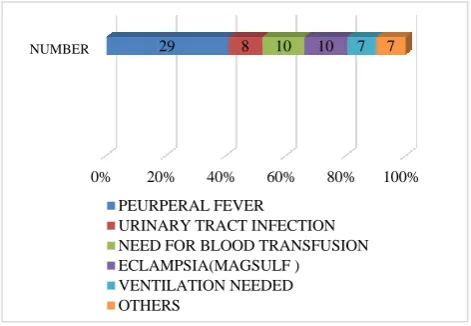
Figure 8: Postoperative maternal morbidities in referrals.
Ten cases needed blood transfusion. 12 cases were given magnesium sulphate regime for impending eclampsia /eclampsia /severe preeclampsia. There were 2 cases of
posterior reversible encephalopathy syndrome. All the 7 mothers who needed ventilator support not related to anesthesia were referred from the private sector.
DISCUSSION
Referral rate and maternal demographics
Referral rate was 7.03% in this research. Alka et al in their similar study noted 24.16% of cases were referred.5 The proportion of referred cases at Gwalior was 20.86%.6
Maternal age
Banu et alon assessing the overall age distribution found that majority (74%) of the respondents were between 20-35 years.7 In the present study, the maximum number of patients were in the 20-30 years of age group as 73.4% similar to 78% in Gwalior.6
Parity
Gupta et al found 52.17% patients were primigravida, which is comparable to 47% primigravida cases found in
Gwalior while our population was nearly equally
distributed in both primigravida and multigravida as in study by Bindal.6,8-9 We had nearly equal numbers of obstetric referrals both antepartum and intrapartum while 56%, 30% and 14% of referrals were in their intrapartum, antepartum and postpartum period respectively in a similar referral study in Gwalior. Similar results were found by Devineni et al in their ―study of spectrum of referral pattern at a tertiary teaching hospital towards better obstetric care‖.10
Domicile
There were 82.3% were from the rural area, also in Vinayak et al and Wahane et alreported 77 %.11-12 This high proportion of rural population may be due to delay in access to health care and lack of awareness and poor transport facilities. Infertility treated obstetric referrals were at significant risk of referral (p value=0.002).
Education
Kerala has a 94% literacy rate and as evidenced by 94.4% graduates in this population.
Referral characteristics
Source of obstetric referral
Private sector referrals comprised the bulk (83.1%). Among 16.9% of government referrals, 15 were from District hospital and were either in labour or required Emergency Obstetric Care or Level III. The high proportion of referrals and the experience faced during the same are probably a reason why pregnant women in India chose to deliver at private institutions to avoid
67%
1% 15% 1%
7%
3% 1% 2% 3%
LSCS
Classical CS
LSCS + Sterilisation
Caesarean Hysterectomy Vaginal delivery
Preterm
Full Term
Forceps Delivery
Breech
IUFD Expulsion
0% 20% 40% 60% 80% 100%
NUMBER 29 8 10 10 7 7
PEURPERAL FEVER
URINARY TRACT INFECTION NEED FOR BLOOD TRANSFUSION ECLAMPSIA(MAGSULF )
transfers.13 Neonatal care, Kirti et al in a similar study had 34% referrals from state general hospitals and27% rural hospitals while 9% were only from private hospitals.14
Distance travelled to referral centre
Chandrayan et alobserved that 70% cases travelled more than 50 km distance before reaching to hospital and had increased incidence of intra operative complications and haemorrhage.15 70.96% of our obstetric referrals. travelled less than 15 kms for comprehensive emergency obstetric care while 16.12% travelled more than half an hour to receive the same. 64.75% cases in Gwalior 6were referred from within 50 km distance, 23.4% cases travelled 50-150 km distance before reaching the hospital and 11.85% case travelled for more than 150km.
Mode of transportation to referral centre
58% travelled in ambulance provided by the referring hospital while 24% had to hire a private vehicle for inter-hospital transfer. In a study conducted by Vinayak et al, only 11% patients travelled by ambulance.11 Only 38% referrals travelled in ambulance while 62% patients used their private vehicles in Gwalior study.6 58% travelled in ambulance provided by the referring hospital while 24% had to hire a private vehicle for inter-hospital transfer .Arranging a private vehicle when faced with obstetric emergency necessitating referral takes time and costs money. 17% reached in their own transport mode to our referral centre.
Referral-arrival interval
All the obstetric referrals from public health sector reached within half an hour while one third of private sector referrals travelled more than an hour for emergency obstetric care (p value=0.001).
Documentation slip to the referral centre
In our study, 70% of private sector referrals had structured letters and 28 % had unstructured ones and 2%
had no document available at referral while
documentation was slightly better in the public sector. Ohn et al had 19.4% referrals with no referral slips.16 In Chaturvedi et al studyand Madhya Pradesh study, 72% in-referred cases had a referral slip however they mostly did not contain the reasons for referral and the treatment provided before referral.17,18
Gestational age at referral
There were no referrals from public sector <31 weeks while 55% were referred <31 weeks from private hospitals for neonatal care with significant p value (0.016).
Why was the obstetric referral done and what was the mode of delivery?
Maternal 62% and foetal 38% were major reasons for obstetric referrals. Common causes of maternal referrals include previous caesarean in labour, preterm labour, severe preeclampsia, multi foetal gestation while preterm premature rupture of membranes, fetal growth restriction (FGR), oligamnios, abnormal doppler were the common foetal causes. Fortunately most asthma attacks were mild but could have been serious and received care here. 27.6% were hypertensive disorders and 34.5% were in preterm labour in Agarwal et al. There were 2 HBSAg +ve obstetric referrals in the present study as is with Agarwal et al.12 There were multiple reasons necessitating obstetric referral in our study. Multifetal gestation in a first time mother who was gestational diabetes mellitus (GDM) on insulin, had polyhydramnios and preterm premature rupture of the membranes (PPROM) at 32 weeks of pregnancy needed emergency caesarean. Four mothers with impending eclampsia, Doppler abnormality with FGR were given magnesium sulphate regimen landed in emergency preterm caesarean. Emergency intervention were done for previous caesarean in labour, antepartum haemorrhage, preterm labour and higher order pregnancies remote from term (IVF pregnancy). According to Agarwal et alpatients came with eclampsia that is a major preventable cause of maternal mortality.12,16 Elderly Primi, treated for infertility, came
with features of intestinal obstruction due to
endometriotic band at 34 weeks underwent emergency classical caesarean. 64.5% of our obstetric referrals received antenatal corticosteroid before emergency decision. In this study, previous caesareans (obstetric historical risk) and high risk obstetric referrals resulted in caesarean delivery in 81% which was 61% and 43.5%.19,20 Intra- uterine foetal demise also resulted in 7% of our referrals.
Medical factors necessitating obstetric referral
Patel HC et al, in their study found that causes of referral were preeclampsia (16%).21 In present study, however, anaemia followed by hypertensive disorders of pregnancy were the major causes of referral to the tertiary care hospital. Multiple co-morbidities were present in 12% of our obstetric referrals. In-referrals in Rajasthan had reasons such as obstructed labour (25%), antepartum haemorrhage (16%), pregnancy induced hypertension (16%), severe anaemia (14%), complicated abortion (12%), post-partum haemorrhage (6%) and twin pregnancy (6%).22
Morbidities and the course in the hospital
days and 7.62 days in government referrals in the study. Goswami et al reported 8.02% needed obstetric ICU admissions.9 Shelat et al in their study concluded that emergency obstetric referrals were exposed to highest risk of maternal complications.23
CONCLUSION
Timely referrals with detailed referral slips imparting information regarding treatment received at the referring hospital has helped in early and optimal decisions and averted maternal near -misses in the study .Adhering to referral protocols during interhospital referrals in Kerala and prompt documentation of the referral characteristics will go a long way to keep a track of these in the near future and thereby preventing maternal morbidity and mortality.
ACKNOWLEDGEMENTS
Authors would like to thank the staff of Department of Obstetrics and Gynecology, Travancore Medical College, Kollam, Kerala for their support during study.
Funding: No funding sources Conflict of interest: None declared
Ethical approval: The study was approved by the Institutional Ethics Committee
REFERENCES
1. World Health Organisation, UNICEF, UNFPA,
World Bank, UN Population Division. Trends in maternal mortality: 1990 to 2013. Estimates by WHO, UNICEF, UNFPA, the World Bank and the United Nations Population Division. Geneva: World Health Organisation; 2014.
2. Stefanini A. District hospitals and strengthening referral systems in developing countries. World hospitals and health services: World Hosp Health Serv. 1994;30:14-9.
3. Sharma S, Singh M, Pal R, Ranjan R, Pal S, Ghose
A. National health policy 2017. Can it lead to achievement of sustainable developmentgoals?. Al Ameen J Med Sci. 2018;11(1):4-11.
4. Chandramouli C. Census of India 2011: Provisional
population totals: Paper 1 of 2011. India: Series 1. New Delhi: Office of the Registrar General and Census Commissioner, India; 2011.
5. Puri A, Yadav I, Jain N. Maternal Mortality in an Urban Tertiary Care Hospital of North India. J Obstet Gynaecol India. 2011;61:280-5.
6. Agarwal N, Singla R, Dhaliwal L, SuriV. Audit of Emergency Obstetric Referrals–Apilot Study from Tertiary Care Centre of North India Bangladesh. J Obstet Gynaecol. 2015;30:25-9.
7. Morsheda B, Shamsun N, Hashima EN. Assessing
the MANOSHI Referral System Addressing Delays in Seeking Emergency Obstetric Care in Dhaka‘s
Slums. MANOSHI Working Paper Series Manoshi-WP10:1-36 published by ICDDR, B, BRAC; 2010: 10.
8. Bindal J, Agrawal N, Sharma DC. Over view of referred obstetric patients and their outcome In tertiary case Hospital. JMSCR. 2017;5:5.
9. Devineni K, Sodumu N. A study of spectrum of referral pattern at a tertiary teaching hospital towards better obstetric care. IAIM. 2016;3:193-8.
10. Vinayak NM, Panditrao SK, Ramkrishna MA.
Critical study of referrals in Obstetric Emergencies. J ObstetGynaecol India. 2004;54:258-9.
11. Wahane AR, Koranna PS. An Analysis of Maternal
Deaths in a Tertiary Care Centre. J Evol Med Dental Sci. 2014;3:8646-52.
12. Sodani PR, Sharma K. Training needs assessment of
public health programmes in maternal and neonatal care. Indian J Mat Child Heal. 2011;13(4):1-8. 13. Narsaria K, Mukhopadhaya P, Kyal A, Agarwal K,
Agarwal A, Sanghi S. Study of obstetric referrals - one year experience at a tertiary care centre in West Bengal HECS. Int J Com Health Med Res. 2017;3(3):32-6.
14. Chandrayan, Merawat RK, Parekh UP. Significance
of timely reference on maternal morbidity and mortality. Int J Reprod Contracept Obstet Gynecol. 2018;7:3985.
15. Ohn HT, Patrick DC, Zaw W, Mary K, Hnin YK, Herni B. Inter-hospital emergency obstetric referrals to the labour ward of RIPAS Hospital Brunei. Int Med J. 2011;7(1):22-33.
16. Chaturvedi S, Randive B, Diwan V, De Costa A. Quality of obstetric referral services in India's JSY cash transfer programme for institutional births: a study from Madhya Pradesh province. PloS One. 2014;9(5):e96773.
17. UNFPA. Concurrent assessment of Janani Suraksha
Yojana (JSY) in selected states: Bihar, Madhya Pradesh, Orissa, Rajasthan, Uttar Pradesh. New Delhi: UNFPA- India; 2011.
18. Ambreen A, Khurshid S, Khurshid M, Khan F,
Intisar A. Obstetric outcome of cases referred to a tertiary care hospital after trial of labour. Annals. 2012;18(1):71-80.
19. Goswami D, Makhija A. A study of high risk
obstetric referrals to a tertiary care hospital in Garhwal, Uttarakhand. IJSR. 2015;4(10):1091-3. 20. 21Patel HC, Singh BB, Moitra M, Kantharia SL.
Obstetric Referrals: Scenario at a Primary Health Centre in Gujarat. Natl J Community Med. 2012;3:711-4.
21. Hitesh J. Perceptions and constraints of pregnancy related referrals in rural Rajasthan. J Fam Welfare. 1996;42(1):24-9.
23. Shelat NR, Mehta AA, Jassawala MJ. Emergency, referred, and late admission for delivery. J Obstet Gynecol Ind. 1984;34:676-83.