Original Research Article
Prevalence of nomophobia among the undergraduate medical students
of Mandya Institute of Medical Sciences, Mandya
Harish B. R., Bharath J.*
INTRODUCTION
In the recent times information and communication technologies have become an important part of our lives. With mass production of inexpensive mobile devices, we are now living in a mobile age in which mobile information and communication technologies are quickly adopted. In this era of mobile phones, smartphones are considered one of the latest evolution of mobile information and communication technologies. The
popularity of smartphones among individuals especially youth is ascribable to the numerous features and functionalities they provide. Smartphones are helpful in, but not limited to calling and texting people, checking and sending email messages, scheduling appointments, surfing the Internet, shopping, social networking, searching for information on the Internet, gaming, etc.1
The term, ‘nomophobia’, is an abbreviation for no mobile-phone phobia and it was first coined during a study conducted in 2008 by the UK Post Office to
ABSTRACT
Background: Nomophobia (no mobile phobia), is the fear an individual gets if he is out of mobile phone contact due to no network, has run out of balance or run out of battery; the persons gets anxious, which adversely affects the concentration level of the person. Since the younger generation is the latest consumer of the mobile phones and the under 25 year age group in professional colleges like medical colleges use mobile phones quite frequently this study was conducted to determine the prevalence of nomophobia in the undergraduate students of Mandya Institute of Medical Sciences, Mandya.
Methods: This was a cross sectional study conducted at Mandya Institute of Medical Sciences during May 2018 to June 2018. All undergraduate students were included i.e. same as study population (n=450). Data collection was done during June 2018 using structured questionnaire.
Results: Mean age of the study participants was 20.1±1.3 years. Majority of the study population were hostelites. Approximate amount of money spent on last recharge/last postpaid bill was INR 354.1±185.0. Main reasons for using smartphones were ‘to call family members’, ‘using internet for academics’ and ‘for social networking’. Prevalence of moderate to severe nomophobia among the study population was 99.0%. No statistical significant difference was observed between gender and nomophobia.
Conclusions: Prevalence of nomophobia among undergraduate medical student was 99.0% and majority had moderate level of nomophobia. There was no association between nomophobia and gender, place of present residence, amount of money spent on last recharge.
Keywords: Nomophobia, Smartphones, Dependence, Mobiles
Department ofCommunity Medicine, Mandya Institute of Medical Sciences, Mandya, Karnataka, India
Received: 11 October 2018
Revised: 04 November 2018
Accepted: 13 November 2018
*Correspondence:
Dr. Bharath J.,
E-mail: [email protected]
Copyright: © the author(s), publisher and licensee Medip Academy. This is an open-access article distributed under the terms of the Creative Commons Attribution Non-Commercial License, which permits unrestricted non-commercial use, distribution, and reproduction in any medium, provided the original work is properly cited.
investigate anxieties mobile phone users suffer. Nomophobia is the fear an individual gets if he is out of mobile phone contact due to no network, has run out of balance or run out of battery; the persons gets anxious, which adversely affects the concentration level of the person.2
The use of mobile phones is now so extensive that in some countries the number of phone subscriptions outnumbers the population. Indian market is one of the largest in the world for mobile phones.3 Increased demand of cell phone mainly smart phones in recent years has attracted research attention. Given the large number of smartphone users, it is important to investigate, understand and monitor any potential public health impact. Among the students, the unregulated usage and over dependent attitude on these devices have caused distraction in their academic activities due to the excessive time channeled to these devices. Studies have shown a direct relationship between student’s performance and academic excellence as those using mobile phones are more distracted and are less attentive during lecture and other academic work.4
The students in professional courses like those in medical colleges use smartphones quite frequently and may be affected by nomophobia. Hence we conducted this study to determine the prevalence of nomophobia among undergraduate medical students of Mandya Institute of Medical Sciences, Mandya.
Objectives
To determine the prevalence of nomophobia among undergraduate medical students of Mandya Institute of Medical Sciences, Mandya.
METHODS
Study design and area: Cross-sectional study carried out in Mandya Institute of Medical Sciences, Mandya.
Study population: Undergraduate Medical Students of Mandya Institute of Medical Sciences, Mandya.
Inclusion criteria
Individuals who gave informed consent and present at the time of the survey.
Exclusion criteria
Individuals who were not using smartphones.
Sample size: 450 (All undergraduate medical students i.e same as study population).
Sampling method: Purposive sampling.
Data collection
Data collection was done during June 2018 using structured questionnaire. Validated Scale developed by Yildirim C & Correia A P was used to the assess the prevalence of nomophobia among the study population.1
Figure 1: Distribution of students according to mobile phone usage [n=418].
Statistical analysis
Data collected were entered in MS-Excel and analyzed using Epi-info software. Descriptive statistical measures like percentage, mean, and standard deviations were calculated. Inferential statistical measures like student t test, Pearson chi square test and One-Way ANOVA was used. Differences were interpreted to be statistically significant at α error of 5%.
RESULTS
Of the 450 students, 418 were present and consented to participate in the study.
Among 418 students who consented to participate in the study 1 student was not using any phone and 12 students were using ‘Dumb phone’(basic mobile phone without internet facility) and 405 students were using smartphones and were eligible for the further study (Figure 1).
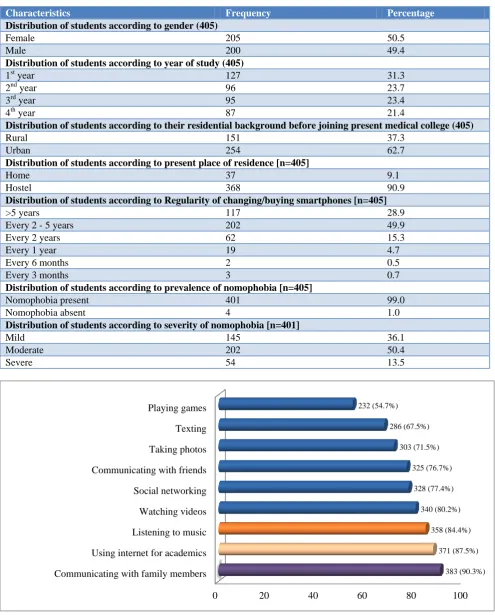
Prevalence of nomophobia in the study population was 401 (99.0%) and among those who had nomophobia, majority i.e 202 (50.4%) had moderate level of nomophobia (Table 1).
In the study population proportion of males and females were similar and majority i.e. 254 (62.7%) had residence in urban area before joining present medical college. Presently most of the students were residing in hostel 368 (90.0%) and majority i.e. 202 (49.9%) changed smartphones every 2-5 years. (Table 1).
Total number of students [418]
Dumb phone (without internet facility) [12]
Smartphone
[405]
Average money spent for recharge in last 3 months was more among males (INR 375.5±220.6) as compared to females (333.2±139.4) and there was a statistically
significant diffrence between the groups [t=2.309, df=403, p=0.021].
Table 1: Sociodemographic details and prevalence of nomophobia among the study participants.
Characteristics Frequency Percentage
Distribution of students according to gender (405)
Female 205 50.5
Male 200 49.4
Distribution of students according to year of study (405)
1st year 127 31.3
2nd year 96 23.7
3rd year 95 23.4
4th year 87 21.4
Distribution of students according to their residential background before joining present medical college (405)
Rural 151 37.3
Urban 254 62.7
Distribution of students according to present place of residence [n=405]
Home 37 9.1
Hostel 368 90.9
Distribution of students according to Regularity of changing/buying smartphones [n=405]
>5 years 117 28.9
Every 2 - 5 years 202 49.9
Every 2 years 62 15.3
Every 1 year 19 4.7
Every 6 months 2 0.5
Every 3 months 3 0.7
Distribution of students according to prevalence of nomophobia [n=405]
Nomophobia present 401 99.0
Nomophobia absent 4 1.0
Distribution of students according to severity of nomophobia [n=401]
Mild 145 36.1
Moderate 202 50.4
Severe 54 13.5
Figure 2: Distribution of students according to reasons for using smartphone (Multiple response) [n=405].
0 20 40 60 80 100
Communicating with family members Using internet for academics Listening to music Watching videos Social networking Communicating with friends Taking photos Texting Playing games
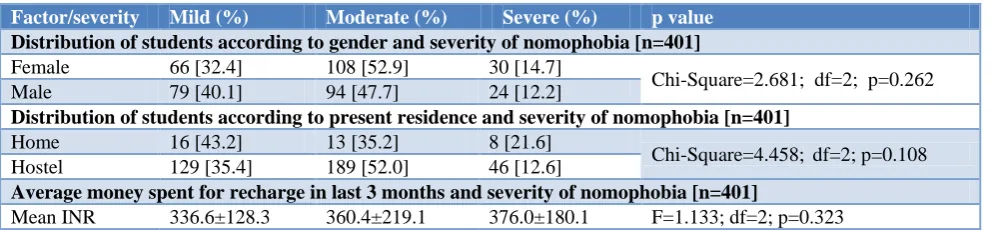
Table 2: Factors associated with severity of nomophobia.
Factor/severity Mild (%) Moderate (%) Severe (%) p value
Distribution of students according to gender and severity of nomophobia [n=401]
Female 66[32.4] 108 [52.9] 30 [14.7]
Chi-Square=2.681; df=2; p=0.262 Male 79 [40.1] 94 [47.7] 24 [12.2]
Distribution of students according to present residence and severity of nomophobia [n=401]
Home 16 [43.2] 13 [35.2] 8 [21.6]
Chi-Square=4.458; df=2; p=0.108 Hostel 129 [35.4] 189 [52.0] 46 [12.6]
Average money spent for recharge in last 3 months and severity of nomophobia [n=401]
Mean INR 336.6±128.3 360.4±219.1 376.0±180.1 F=1.133; df=2; p=0.323
Top three reasons given by the students for using smartphones were ‘communicating with family members, ‘using internet for academics’, ‘listening to music’ (Figure 2).
Table 2 shows that among both females and males majority had moderate nomophobia and severe nomophobia was more among those who were residing in home 8 (21.6%) and mean money spent for recharge in last 3 months was more among those who had severe nomophobia. But none of the above factors had statistically significant association with nomophobia.
DISCUSSION
Technology especially smartphones have eased many of the daily activities but with few negative consequences which have to be explored.
In the present study prevalence of nomophobia was 99.0% which is similar to the study conducted by Sethia et al at Bhopal in 2016 where the prevalence of nomophobia was 99.8%.5
Among those who had nomophobia 36.1%, 50.4%, 13.5% had mild, moderate and severe nomophobia respectively, which is similar to the study conducted by Sethia et al at Bhopal in 2016 where the mild, moderate and severe nomophobia was 32.15%, 61.5% and 6.15% respectively.5
In the present study 14.7% of the females and 12.2% of the males had severe nomophobia which is less compared to the study conducted by Farooqui et al in Pune during the year 2015-16 where 22.1% of the females and 24.2% of the males had severe nomophobia, the difference may be due to different geographic location and time gap between the two studies.6
In the present study severe nomophobia was more among those who were residing in home i.e. 21.6% but in the study conducted by Madhusudan et al in Kerala severe nomophobia was more among those who were residing in hostel.7 The difference may be due to different geographic location of the study population. And those who were residing in home may feel left out from the
majority and spend more time using smartphones to stay connected.
In the present study main reason for using smartphone was to communicate with family member which is similar to the study conducted by Madhusudan et al at Kerala in 2016-07.7
In the study conducted by Chandak et al, in Nagpur the prevalence of nomophobia was more among those who spend INR 500–1000/month.8 In the present study also severity of nomophobia was more among those who spend more money for recharge but the difference between the groups was not statistically significant.
In a study conducted by Dasgupta et al in West Bengal, among both engineering and medical students, nomophobia among medical students was 42.6% which is less compared to the present study which may be due to different geographic location of the study population and in there study engineering students showed a higher proportion of nomophobics (44.6%) as compared to medical students whereas our study is restricted to medical students and further research is needed among engineering students to know about the prevalence of nomophobia among them.9
CONCLUSION
Prevalence of nomophobia among undergraduate medical student was 99.0% and majority had moderate level of nomophobia. There was no association between Nomophobia and gender, place of present residence, amount of money spent on last recharge. Health education to restrict the dependence on smartphone should be given to the undergraduate medical students to prevent the adverse effects of nomophobia.
ACKNOWLEDGEMENTS
We acknowledge all the participants who have given information for this study.
Funding: No funding sources Conflict of interest: None declared
REFERENCES
1. Yildirim C, Correia AP. Exploring the dimensions of nomophobia: development and validation of a self-reported questionnaire. Comput Human Behav. 2015;49:130–7.
2. Royal Mail Group. Nomophobia, 2018. Available at: https://www.royalmailgroup.com/cy/lost-without-your-mobile-sounds-case-nomo-phobia. Accessed 3 October 2018.
3. Telecom subscriber base, 2018. Available at: https://www.trai.gov.in/sites/default/files/PR_60_TS D_Jun_170817.pdf. Accessed 3 October 2018. 4. Kibona L. Smartphones’ Effects on Academic
Performance of Higher Learning Students, 2018. Available at: http://www.jmest.org/content/uploads/ JMESTN42350643.pdf. Accessed 3 October 2018. 5. Sethia S, Melwani V, Melwani S, Priya A, Gupta M,
Khan A. A study to assess the degree of nomophobia among the undergraduate students of a medical college in Bhopal. IJCMPH. 2018;5(6):2442.
6. Farooqui IA, Pore P, Gothankar J. Nomophobia: an emerging issue in medical institutions? J Mental Health. 2017;1–4.
7. Madhusudan M, Sudarshan B P, Sanjay T V, Gopi A, Fernandes S. Nomophobia and determinants among the students of a medical college in Kerala. International J Med Sci Public Health. 2017;6(5):1. 8. Chandak P, Singh D, Faye A, Gawande S, Tadke R,
Kirpekar V, Bhave S . An Exploratory Study of Nomophobia in Post Graduate Residents of a Teaching Hospital in Central India, International J Indian Psychol. 2017; 4(3)
9. Dasgupta P, Bhattacherjee S, Dasgupta S, Roy JK, Mukherjee A, Biswas R. Nomophobic behaviors among smartphone using medical and engineering students in two colleges of West Bengal. Indian J Public Health. 2017;61:199-204.
Cite this article as: Harish BR., Bharath J.
![Figure 1: Distribution of students according to mobile phone usage [n=418].](https://thumb-us.123doks.com/thumbv2/123dok_us/1285335.1635000/2.595.321.532.153.334/figure-distribution-students-according-mobile-phone-usage-n.webp)