Performance Measurement in OFDM System by Using Combination of
Partial Transmit Sequence (PTS) & Clipping and Filtering PAPR
Reduction Technique
KRISHNO KANTO DAS1, SIYAM HASAN2, MD.TOUFIKUR RAHMAN3 AND SUMONTO SARKER4
1, 2, 3, 4 Department of Telecommunication and Electronic Engineering, Hajee Mohammad Danesh Science and Technology University Dinajpur-5200, Bangladesh.
1[email protected], 2[email protected], 3[email protected], 4[email protected]
ABSTRACT
The Orthogonal Frequency Division Multiplexing (OFDM) is a proficient way of data transmission for high speedy communication systems. Moreover, the major disadvantage of OFDM system is the high Peak to Average Power Ratio (PAPR) of the transmitted signals. Coding, Phase rotation, tone rejection, Partial transmit sequence, clipping & filtering are many PAPR reduction technique which had been proposed to overcome this problem. However, this proposed way could not solve this problem properly. Here I suggested two different PAPR reduction method that is partial transmit sequence (PTS) & clipping and filtering to solve this problem. Using this combined method we get a significant result comparing than previous techniques. In addition this is our main concern to find out better way.
Keywords: OFDM, Partial transmit sequence, clipping, PAPR, CCDF.
1. INTRODUCTION
The Orthogonal Frequency Division Multiplexing (OFDM) is used in broadband wireless communication systems. The main problem of the OFDM is the high value of Peak-to-Average Power Ratio (PAPR) of the transmitted signal. Due to the superposition of the many data subcarriers, the OFDM signal exhibits Rayleigh-like characteristics. The large amplitude variations lead to high values for the PAPR. These peaks require the high power amplifiers (HPA) to support wide linear dynamic range. Higher signal level at the input of HPA causes non-linear distortions at its output, leading to an inefficient operation of HPA. These distortions cause intermodulation products resulting unwanted out-of-band power. In order to reduce the PAPR of OFDM signals, many solutions have been proposed and analyzed. Some of the main characteristics of these methods are non-linearity, computation complexity and size of side information needed to be sent to receiver. Some of the well-known linear methods are selective
mapping (SLM), partial transmit sequence (PTS), and tone reservation (TR).
The PTS method uses a similar principle with the difference that same rotation angle is applied to more than one vector. The method considers the N complex values representing OFDM signal vectors as being grouped into K sub-blocks of N/K elements each. The case of blocks with contiguous carriers has the advantage of simplicity and is more suitable for detection systems. The case of noncontiguous carrier blocks offers better peak factor (PF) reduction capability at the cost of extra complexity. The method generates a set of signal variants by rotating the vectors from each block with one phase from a given set of K phases with values from a given finite set. Then, after calculation of the corresponding PAPR of each signal variant, the one with minimal PAPR is being chosen for the transmission. The efficiency of these methods increases with the number of phases from the considered set. The efficiency of the PTS method also increases when a higher number of blocks are used. The disadvantage is that a better efficiency requires an increased amount of computation at the transmitter’s side and receiver’s side. Because the receiver must know those phases’ sets and block sizes, another drawback of these methods is the additional information required to be sent to receiver. Optimizations of those methods have been proposed in several papers.
out-of-band power production. In order to overcome this problem, different filtering techniques have been proposed. Filtering can also cause peak regrowth, but less than the clipping before interpolation.
The rest of the paper is organized as follows. The second section describes the OFDM signal, some of its properties, and some aspects of the high power amplifier. The third section describes the proposed combine PAPR reduction scheme. Next, the numerical results highlighted by the computer simulation are presented and discussed. Based on the results obtained, some conclusions are presented.
2. OFDM SIGNAL & PAPR
TECHNIQUES
An OFDM-based communication system uses a complex multicarrier modulation. Each of the N subcarriers, having the frequencies {fn, n=0,1,…,N-1}, are modulated with a data sample from a block of symbols {Xn, n=0,1,…,N-1}. In order to reduce the bandwidth of the required frequency spectrum, the subcarriers are chosen to be orthogonal, that is fn=nΔf, where Δf=1/T, and T is the OFDM symbol period Considering these aspects, the resulting signal can be written as:
( ) √ ∑
In the many cases, the OFDM-based system communicates through multipath channels, which generate inter symbol interference (ISI).The amplified signal is applied to the antenna. At the receiver, after demodulation, the guard interval will be removed, the symbols being evaluated for time intervals of length T. Due to statistical independence of subcarrier the low pass time-domain OFDM signal in the complex domain presents a Gaussian distribution. Therefore, sporadically, the signal presents peaks, causing the PAPR problem. The expression of the PAPR for a given OFDM signal block is given by:
( ) (| ( )| )
| ( )|
Where E[.] denotes the expectation operator. The PAPR is usually evaluated using the complementary cumulative distribution function (CCDF) of the PAPR:
( ) ( ) ( )
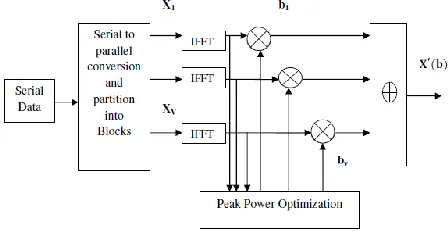
Now we separate study in OFDM PAPR reduction technique. Partial Transmit Sequence (PTS) algorithm is a technique for improving the statistics of a multicarrier signal. The basic ideas of partial transmit sequences algorithm is to divide the original OFDM sequence into several sub-sequences and for each sub-sequences
multiplied by different weights until an optimum value is chosen.
Fig. 1. Block diagram of PTS technique for PAPR reduction.
Figure 1 is the block diagram of PTS technique. From the left side of diagram, the data information in frequency domain X is separated into V non-overlapping sub-blocks and each sub block vectors has the same size N. So for each and every sub-block it contains N/V nonzero elements and set the rest part to zero. Assume that these sub-blocks have the same size and no gap between each other. The sub-block vector is given by:
∑
Where ( , -)* + is a weighting factor been used for phase rotation. The signal in time domain is obtained by applying IFFT operation on, that is
̂ ( ) ∑ ( ) ∑
For the optimum result one of the suitable factor from combination , - is selected and the combination is given by
, -=arg
min, - |∑ |
Where arg min [(·)] is the condition that minimize the output value of function.
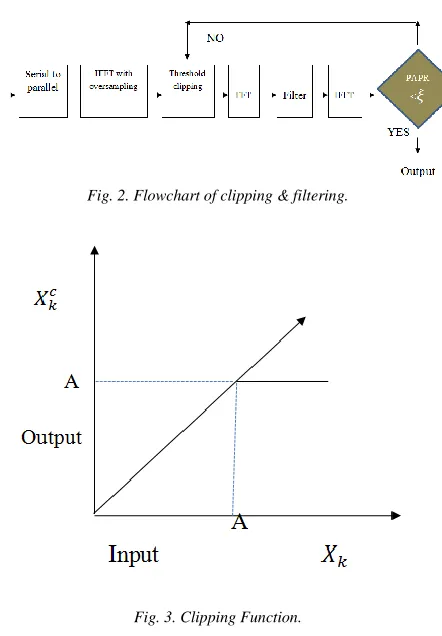
Now describe clipping & filtering,
Fig. 2. Flowchart of clipping & filtering.
Fig. 3. Clipping Function.
The clipping ratio (CR) is defined as,
Where, A is the amplitude and
is the root mean squared value of the unclipped OFDM signal. The clipping function is performed in digital time domain, before the D/A conversion and the process is described by the following expression,
{
( )
| |
| |
Where, is the clipped signal, is the transmitted
signal, A is the amplitude and ( ) is the phase of the transmitted signal .
3. PROPOSED SYSTEM
In this section, we present the proposed combine PAPR reduction technique which has been obtained by the association of PTS method with clipping method. The main idea for combining the two methods is relying on the observation that the cumulative signal processing for PAPR reduction significantly improves the overall outcome. Furthermore, the combine technique exploits the fact that each of the component methods is based on
a different principle. One performs linear transformation by rotating the vectors from the frequency-domain signal, and the other one performs a non-linear transformation represented by signal limitation. The block diagram of the proposed method is presented.
Fig. 4. Combined PAPR reduction technique.
The performance of the proposed PAPR reduction technique is analyzed with a MATLAB simulator as presented in Figure 3. Within this simulator, the samples from the generated signal are mapped from binary representation to the M-QAM or M-PSK constellation points. The obtained complex values are grouped in blocks of N elements each, forming the OFDM symbols. The obtained OFDM frames are applied sequentially to PTS block and then to clipping block. For a better evaluation of the proposed method, the results obtained only from clipping are also considered. The parameters of the resulting signal change according with the signal processing applied by the two PAPR reduction methods. In order to evaluate the performance and efficiency of o communication system based on the proposed PAPR reduction method, the simulator computes the bit error rate (BER) and power spectral density (PSD) for the original and processed signals. The PTS method operates on the frequency-domain signal iteratively until the best signal derivate is found. As already mentioned, the main idea of this method is to change the phases of the vectors composing the signal. This method considers the signal’s vectors as being grouped in disjoint blocks. The vectors from a block may have a contiguous displacement, or they may be interleaved with the vectors representing another block. The algorithm applies one phase shift for each block iteratively until the signal variant having the lowest PAPR is found. Our proposed diagram is to divide into two parts that’s transmitter & receiver parts.
Now we are trying to show how the total process occurred with our proposed system.
1. Input signal n=1, 2, 3 …….α
2. Signal processing by using Mapper (M-QAM/M-PSK)
3. Then OFDM signal modulating 4. Signal divided in PTS bock
5. Signals are divided with phase sets & block indexes using Phase rotation scheme
9. Generate PSD & CCDF evaluator
10. Applying AWGN to the clipping & filtering signal 11. Now signal demodulate
12. Also signal processing by using Mapper (M-QAM/M-PSK)
13. Finally output that is (BER/SNR) with comparing Tx & Rx
Fig. 5. Flowchart of our combined system.
4. RESULT & DISCUSSION
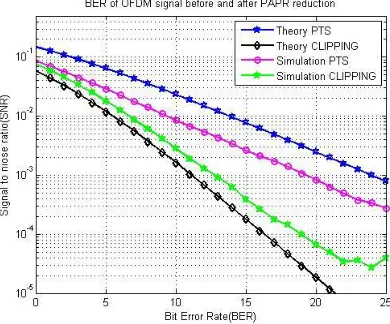
This Figure show that the signal to noise ratio vs bit error rate of PTS & CLIPPING PAPR reduction technique, where we also show that a basic difference of this two technique. Figure 6 describe the basic difference of theoretically & practically. In PTS technique the simulation graph is better than the theoretical graph. But in clipping technique, theoretical graph is better in performance than the simulation graph. If we combine two techniques, we may get the desire output or improved performance.
Fig. 6. comparison graph PTS & CLIPPING.
Figure 7 shows that the graph of complementary cumulative distribution function (CCDF) vs peak to average power ratio (PAPR). Here we combined the above two techniques. We also observe that the two techniques PTS & CLIPPING are almost same. Here we have used the complementary cumulative distribution function (CCDF), and then we get the desired output. Finally we observed that our proposed system give an improved output than the other two techniques separately. In our proposed algorithm the PAPR is decreased.
If we consider the original QPSK &16 QAM, 64 QAM, 256 QAM, 1024 QAM also show the symbol error rate vs SNR per symbol (db). This is our observation result &finally got it various signals.
Fig. 8. Signal to noise ratio after combined.
5. CONCLUSION AND FUTURE WORK
In this paper we proposed an alternative PAPR reduction technique based on the combination of a partial transmit sequence method with the clipping method. The PTS and clipping algorithms used within the combine technique are explained. The numerical results show that the combine scheme brings higher PAPR reduction than the previous methods. The considered two methods have few variants with different efficiency and performance. The PTS method may be implemented using different block structures, swapping tables and rotation angle tables. Additionally, the block marking can be implemented in various manners, determining different efficiency for PAPR reduction and different sizes of the search space at the receiver’s side. The clipping method, may consider various filtering techniques, each of them leading to various PAPR reduction efficiency. Therefore the efficiency of the combine method may vary when derivate of the component methods are used. In future work, we will consider different block configurations and different set of values for the tables within the PTS block. Some clipping derivate also may be considered.
REFERENCES
[1] E. V. Cuteanu & A. Isar, “PAPR Reduction of OFDM Signals using Partial Transmit Sequence and Clipping Combine Scheme” The Eighth Advanced International Conference on Telecommunications, ISBN: 978-1-61208-199-1 164,AICT 2012.
[2] M. Gouda & M. Hussien “Partial Transmit Sequence PAPR Reduction Method for LTE OFDM Systems” 4th International Conference on Intelligent Systems, Modelling and Simulation, 2166-0662/13 IEEE DOI 10.1109/ISMS.2013.78,2013.
[3] M. Uysal, N.Al-Dhahir,and C. N. Georghiades, “A
Space–Time Block-Coded OFDM Scheme for
Unknown Frequency-Selective Fading Channels” IEEE COMMUNICATIONS LETTERS, VOL. 5, NO. 10, OCTOBER 2001.
[4] N. Arora and P. Singh,” Partial Transmit Sequence
(PTS)-PAPR Reduction Technique in OFDM
Systems with Reduced Complexity” Conference on Advances in Communication and Control Systems 2013 (CAC2S 2013).
[5] A. Gangwar and M. Bhardwaj,” An Overview: Peak to Average Power Ratio in OFDM system & its Effect”, International Journal of Communication and Computer Technologies Volume 01 – No.2, Issue: 02 September 2012 ISSN NUMBER : 2278-9723.
[6] Z. Liu, Y. Xin, and G. B. Giannakis,
Space-Time-Frequency Coded OFDM Over
Frequency-Selective Fading Channels” IEEE TRANSACTIONS ON SIGNAL PROCESSING, VOL. 50, NO. 10, OCTOBER 2002.
[7] Md. Munjure Mowla1, Md. Yeakub Ali2 and S.M. Mahmud Hasan3.” A Modified Design Of Acf Operation For Reducing Papr Of Ofdm Signal”, International Journal of Next-Generation Networks
(IJNGN) Vol.6, No.1, March 2014.
[8] L. Wang and J. Liu, “PAPR Reduction of OFDM Signals by PTS With Grouping and Recursive Phase
Weighting Methods”, IEEE Transactions on
Broadcasting, vol. 57, no. 2, pp. 299-306, June 2011.
[9] Young Kyun Prasad, What is 4G, in 4G Roadmap and
Emerging Communication Technologies, Artech
House, 2006, pp. 12–13.
[10]Jaylath .Side Information in PAPR PTS-OFDM Signals Proceedings 14th IEEE Conference on Personal, Mobile Radio Communications.2003,vol. 1. PP. 226-230.
[11]B. Karakaya, H. Arslan, and H. A. Cirpan, ”Channel estimation for LTE uplink in high Doppler spread,” in Proc. WCNC, pp. 1126-1130, April 2008.