Original Research Article
Can personal hygiene act as a proxy indicator of morbidity profile? A
study on orphans of Uttarakhand region
Parul Ahlawat, Shaili Vyas*, Neha Sharma, Abhay Srivastava,
Ashok Srivastava, Jayanti Semwal
INTRODUCTION
Childhood is the most crucial and formative period of human life. A healthy childhood is essential for future growth and development. It is greatly influenced by parent, family, society and environment which formulate attitude, behavior, manner and emotions.1 Millions of children across the world are deprived of this crucial phase of life, those are the orphans and abandoned children. In the absence of the child’s parents, grandparents, or reluctant relatives not willing to take care of the child, orphanage act as an institution to provide care and support for these unfortunate children.2
Most of the orphans lack basic necessities for survival namely food, clothing, shelter, medical services, school
fees, psychological problems, early marriage, disruption of normal childhood and adolescents making orphans highly prone to undernutrition and infections and less likely to receive health-care than other children.3-6 Unfortunately, children living in such institutions face a variety of problems i.e., morbidity, nutrition and growth, cognitive development, socio-affective development, and physical abuses.7
Good personal hygiene not only forms part of preventive strategy but is also quite effective in reducing several morbidities not only in children but even in adults.8 The hygienic practices developed during childhood will enable to lead a healthy life in adulthood. Thus it is recognized that most of the health problems among orphans are due to lack of personal hygiene and thus can ABSTRACT
Background: A healthy childhood is essential for future growth and development. It is greatly influenced by parent, family, society and environment which formulate attitude, behavior, manner and emotions. Millions of children across the world are deprived of this crucial phase of life; those are the orphans and abandoned children.
Methods: This institution-based cross sectional study was carried out with the help of pre-designed semi-structured questionnaire amongst 193 orphans aged 5-14 years to assess the personal hygienic practices and morbidities among orphans and to find out the association between the morbidity with personal hygiene and other risk factors.
Results: The leading morbidities observed were poor oral hygiene (57.51%) as a morbidity followed by dental caries (50.58%) and pallor (30.57%). The average morbidity per child was found to be 2. There was significant association between ages, education, personal hygienic practices with the presence of morbidity in the orphans.
Conclusions: Practices related to personal hygiene was not satisfactory. There was a significant association between morbidity and personal hygiene. Despite of the fact that these children are highly vulnerable; their health needs are poorly understood and ill served.
Keywords: Morbidity, Orphanage, Personal hygiene
Department of Community Medicine, Himalyan Institute of Medical Sciences, Swami Rama Nagar, Dehradun, Uttarakhand, India
Received: 04 June 2019
Revised: 18 July 2019
Accepted: 19 July 2019
*Correspondence:
Dr. Shaili Vyas,
E-mail: [email protected]
Copyright: © the author(s), publisher and licensee Medip Academy. This is an open-access article distributed under the terms of the Creative Commons Attribution Non-Commercial License, which permits unrestricted non-commercial use, distribution, and reproduction in any medium, provided the original work is properly cited.
be prevented by following simple principles of hygiene. The foundations of personal hygiene if laid down in childhood, is important for the development of positive values about health and the use of health services.9
Studies on the morbidity pattern of orphans are scarce in India and particularly in Uttarakhand. Further no study has previously investigated morbidites and personal hygiene among orphans in this region. Hence, there is a need to address the special needs of this vulnerable group. In the present context, this research was undertaken to assess the healthy habits and practices related to personal hygiene of the orphans also to know the morbidity profile of orphans according to their sex and age groups and to determine the association between various risk factors and morbidity profile of orphans.
METHODS
The present study is a cross-sectional survey design and was carried out for a period of two months (May 2017- July 2017) in selected orphanages of District Dehradun. Before the commencement of the study, a list of the orphanages in Dehradun was obtained from Indian orphanages network children’s helpline and District Children Officer, Department of Social Justice and Empowerment. Dehradun has a total of 7 orphanages, for study purpose, 10% of the orphanage was selected by simple random sampling technique, which accounted to selection of 1 orphanage.
Inclusion criteria
Orphans <14 years residing in the orphanages and those who were willing to be a part of the study.
Exclusion criteria
Orphans severely ill or with any debilitating condition. Orphans >14 years of age.
All the children enrolled in the selected orphanage formed the study population. The sole objective of the research was well explained to individual orphanage authority and to all children participating in the study.
A pre-tested semi-structured questionnaire was used for the study purpose. A written informed consent was obtained from the authorities of the orphanage as they serve as guardian to orphans prior to filling the performa and clinical examination. A pilot study was conducted amongst 10% of the children from different orphanages of the same area (Dehradun) almost two-three weeks prior to the actual field work to evaluate the wording, expression, content, the sequence of questions and duration of interview and the reliability and clarity of the study tool. After piloting modifications were done in the questionnaire as per the local needs and feasibility.
The data regarding morbidity status was collected with the help of a pre-tested performa where inquiry regarding the occurrence of any episode of illness in the child was made in the last 15 days. Any additional information about children’s morbidity was also sought from the caretakers of the children. A detailed clinical examination of the children was also made and the identified health problems were treated on the same day along with free distribution of medicines.
Data on personal hygiene was collected by gathering information on materials used for hand washing, knowing whether hands were washed the day prior to the interview, frequency of bathing and brushing teeth etc. Children who reported taking bath daily were categorized as having good bathing hygiene while those who took a 4-6 times weekly but less than four times a week were as having adequate and poor bathing hygiene respectively.10 Also, children who reported brushing teeth daily were categorized as having good oral hygiene while those who brushed their teeth 4-6 times weekly but less than four times a week were categorized as having adequate and poor oral hygiene respectively.11
The questionnaire was developed keeping the study objectives in mind and was divided into five sections.
Section A
Covered the socio-demographic details of the child.
Section B
Covered details regarding the personal hygienic practices.
Section C
History of illness during the previous fortnight and findings of clinical examination.
RESULTS
A total of 193 children participated in the study. The bathing hygiene of large number of children was poor (94.8%) whereas only 4.7% and 0.5% of children were found to have adequate and good bathing hygiene whereas the brushing hygiene of maximum no of children was found to be adequate (67.4%) whereas 29% of children were having good brushing hygiene and only 3.6% of children were having poor brushing hygiene (Figure 1).
Majority of the orphans use to wash hands with soap both before eating and after defecation whereas only 31.09% of children were found to wash hands only with water. Higher no of children were washing hands with soap (98.4%) whereas only 1.6% of children were found to be washing hands only with water being equal among males and females (Figure 2).
Figure 2:Handwashing practices of orphans.
Most of children were found to be having poor oral hygiene (57.51%) as a morbidity followed by dental caries (50.58%) and pallor (30.57%) (Figure 3).
Morbidity profile of study subjects
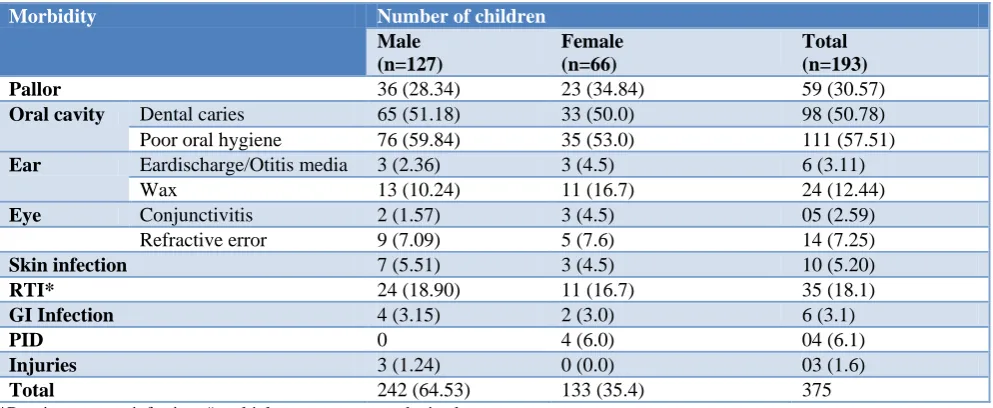
Table 1 shows sex-wise distribution of children according to their morbidities. Overall, a total of 375 morbidities were present in the orphans of which, 242 (64.53%) morbidities were in males and 133 (35.4%) morbidities were in females. Morbidity per child was found to be approximately 2, being equal among both the males and females (1.91 and 2.02 morbidity respectively). The pattern was similar in both boys and girls. Pallor, eye and ear infections were more common in girls whereas Respiratory tract infections, skin infections and injuries were more common in boys.
Table 1:Sex wise distribution of study subjects according to their morbidity profile.
Morbidity Number of children
Male (n=127)
Female (n=66)
Total (n=193)
Pallor 36 (28.34) 23 (34.84) 59 (30.57)
Oral cavity Dental caries 65 (51.18) 33 (50.0) 98 (50.78)
Poor oral hygiene 76 (59.84) 35 (53.0) 111 (57.51)
Ear Eardischarge/Otitis media 3 (2.36) 3 (4.5) 6 (3.11)
Wax 13 (10.24) 11 (16.7) 24 (12.44)
Eye Conjunctivitis 2 (1.57) 3 (4.5) 05 (2.59)
Refractive error 9 (7.09) 5 (7.6) 14 (7.25)
Skin infection 7 (5.51) 3 (4.5) 10 (5.20)
RTI* 24 (18.90) 11 (16.7) 35 (18.1)
GI Infection 4 (3.15) 2 (3.0) 6 (3.1)
PID 0 4 (6.0) 04 (6.1)
Injuries 3 (1.24) 0 (0.0) 03 (1.6)
Total 242 (64.53) 133 (35.4) 375
*Respiratory tract infection; # multiple responses were obtained.
Morbidity per child= ; Morbidity per male child= ; Morbidity per female child=
Table 2 shows morbidities of children as per their age-groups. Overall, majority of the morbidities were found to be among the age-group of 10-14 years (69.9%) as
compared to 5-9 years (30.1%). Morbidity per child was higher in 10-14 years age group (2.46) as compared to 5-9 years age group (1.78 approx. 2). Highest morbidity in 0.5
4.7
94.8
29
67.4 3.6
0 20 40 60 80 100
Good Adequate Poor
Brushing Hygiene bathing hygiene
0 20 40 60 80 100
HW BEFORE EATING HW AFTER DEFECATION
65.28
98.4
31.09
1.6
3.63 0
5-9 years age group was pallor (58.7) followed by dental caries (54.3%) and poor oral hygiene (52.2%) whereas in 10-14 years age group highest morbidity was poor oral hygiene (59.20%) and dental caries (49.7%) followed by pallor (21.8%). Morbidity status was found to be
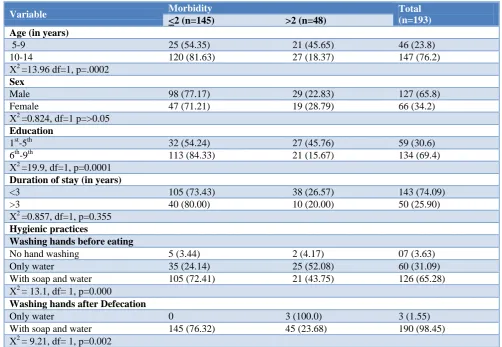
significantly associated with age, education, handwashing before eating and after defecation, bathing, oral hygiene and performance in school, as well. Nutritional status, diet and immunization status was not found to be significantly associated with morbidity.
Table 2:Age wise distribution of study subjects according to their morbidity profile.
Morbidity
Number of children 5-9 years
(n=46)
10-14 years (n=147)
Total (n=193)
Pallor 27 (58.7) 32 (21.8) 59 (30.6)
Oral cavity
Dental caries 25 (54.3) 73 (49.7) 98 (50.78)
Poor oral hygiene 24 (52.2) 87 (59.2) 111(57.51)
Ear Ear discharge/Otitis media 3 (6.5) 3 (2.0) 6 (3.11)
Wax 13 (28.3) 11 (7.5) 24 (12.44)
Eye Conjunctivitis 4 (8.7) 1 (0.7) 05 (2.59)
Refractive error 0 (0.0) 14 (9.5) 14 (7.25)
Skin infection 7 (15.2) 3 (2.0) 10 (5.2)
RTI* 7 (15.2) 28 (19.0) 35 (18.1)
GI Infection 2 (4.4) 4 (2.7) 6 (3.1)
PID 0 (0.0) 4 (2.7) 04 (6.1)
Injuries 1 (2.2) 2 (1.4) 03 (1.6)
Total Morbidities 113 262 375
Morbidity per child (1-4 years)= Morbidity per child (10-14 years)=
Table 3: Association of socio-demographic profile of the subjects with their morbidity status.
Variable Morbidity Total
(n=193)
<2 (n=145) >2 (n=48) Age (in years)
5-9 25 (54.35) 21 (45.65) 46 (23.8)
10-14 120 (81.63) 27 (18.37) 147 (76.2)
Χ2
=13.96 df=1, p=.0002
Sex
Male 98 (77.17) 29 (22.83) 127 (65.8)
Female 47 (71.21) 19 (28.79) 66 (34.2)
Χ2
=0.824, df=1 p=>0.05
Education
1st-5th 32 (54.24) 27 (45.76) 59 (30.6)
6th-9th 113 (84.33) 21 (15.67) 134 (69.4)
Χ2
=19.9, df=1, p=0.0001
Duration of stay (in years)
<3 105 (73.43) 38 (26.57) 143 (74.09)
>3 40 (80.00) 10 (20.00) 50 (25.90)
Χ2
=0.857, df=1, p=0.355
Hygienic practices
Washing hands before eating
No hand washing 5 (3.44) 2 (4.17) 07 (3.63)
Only water 35 (24.14) 25 (52.08) 60 (31.09)
With soap and water 105 (72.41) 21 (43.75) 126 (65.28)
Χ2
= 13.1, df= 1, p=0.000
Washing hands after Defecation
Only water 0 3 (100.0) 3 (1.55)
With soap and water 145 (76.32) 45 (23.68) 190 (98.45)
Χ2
Variable Morbidity Total (n=193)
<2 (n=145) >2 (n=48) Bathing regularly
Once a week 135 (73.77) 48 (26.23) 183 (94.82)
Alternate day 9 (100.0) 0 9 (4.66)
Daily 1 (100.0) 0 1 (0.52)
Χ2
=3.86, df=1, p=0.049
Cleaning teeth
Once daily 94 (72.31) 36 (27.69) 130 (67.36)
Twice daily 48 (85.71) 8 (14.29) 56 (29.00)
Irregularly 3 (42.86) 4 (57.14) 07 (3.63)
Χ2
= 4.05 df= 1, p=0.04
Diet
Non-veg 141 (74.60) 48 (25.40) 189 (97.93)
Veg 4 (100.0) 0 4 (2.07)
Χ2
=1.35 , df=1, p=0.245
Immunization status
Immunized 53 (75.71) 17 (24.29) 70 (36.27)
Unimmunized 92 (74.80) 31 (25.20) 123 (63.73)
Χ2
= 0.201 , df= 1, p=0.887
Performance in school
Excellent/good/average 130 (86.09) 21 (13.91) 151 (78.24)
Poor 15 (35.71) 27 (64.29) 42 (21.76)
Χ2
=9.88, df=1 p=0.002
Nutritional Status
Well nourished 89 (71.77) 35 (28.23) 124 (64.25)
Under nourished 56 (81.16) 13 (18.84) 69 (35.75)
Χ2
= 2.09, df= 1, p=0.148
Figure 3:Morbidity profile of orphans.
DISCUSSION
The study population comprised of children (orphans) less than 14 years. No child was found to be less than 5 years of age. Out of 193 orphans, bathing hygiene of large no of orphans was poor (94.8%) and only 0.5% children were reported to take bath daily. In contrast to our findings, Ansari in hyderabad observed that almost
81% and 56% students used to take bath regularly, reason for poor bathing practices in our study may be due to lack of personal hygiene items like bathing soaps, detergents hair oils etc., were out of orphanages’ budget and largely depended on donations which were mostly intermittent and hence resulted in poor bathing practices.10,11
Regarding brushing teeth, the brushing hygiene of maximum number of children was found to be adequate (67.4%), they use to brush daily. Our study findings are completely in line with a studyat Mysore by Shanbhog and by Tangail by Ferdoushi though our figures are quite low as compared to their study. Manjunath and Kumar also figured that 68% of children use to brush their teeth before going to bed.12-14 Children usually brush with either paste as per the availability or with water and brush only, at times, due to intermittent supply of tooth paste.
In the current study, a higher no of the children used to wash hands with soap and water before eating (65.28%) and after defecation (98.4%). Our findings are supported by Sarkar whose study shows that 84.62% washed their hands before eating and 94.23% children use to wash their hands after visiting toilet.9 Saleha in Hyderabad 98.1% also observed that children wash hand with soap or sanitizer after using toilet and 90% wash their hands before lunch in school.11 Hand washing practices was not present in our study reason being, though children were
30.57
50.78
57.51 3.11
12.44 2.59 7.25
5.2
18.1 3.1 6.1 1.6
Pallor Dental caries
Poor oral hygiene Ear discharge/Otitis media
Wax Conjunctivitis
Refractive error
Skin infection RTI
GI Infection PID
aware regarding the necessity of washing hands before meals, they perhaps fail to realize its importance and probably have been influenced by factors as laziness, rush to play with friends etc. Additionally, absence of taps near the orphanage dining area could have otherwise served as a reminder to wash hands before meals possibly could have contributed to these results. The less frequency of hand washing with soap may be due to the lack of soap most of the times due to its intermittent supply in the orphanage. It has also been argued that, even if knowledge of hygiene exists, lack of appropriate resources may negatively impair proper hygienic practices.
The major morbidity found in our study was poor oral hygiene and dental caries followed by pallor. The pattern was similar in both boys and girls. Pallor, eye and ear infections were more common in girls whereas respiratory tract infections, skin infections and injuries were more common in boys. Similar morbidity pattern was also found in a study at Mangalore where the most common morbidity was dental problems (32.4%) though the prevalence of dental caries was high in our study.15 In another study the leading causes of morbidity were pallor 30% dental caries (27.1%), skin diseases (16%) etc.16 In a study by Srinivasan at Tirupati the most common morbid conditions were skin disorders 25.7%, followed by dental caries 21.5%.17 In yet another study at Nellore, the leading causes of morbidity were pediculosis (83.2%), pallor (41%), dental caries (28%), skin diseases (26.4%), and defective vision (12%).18 Also similar pattern was observed in a study at Lucknow by Singh et al. the various morbid conditions found were inadequate oral hygiene (55.4%), and skin infections.19
The high prevalence of dental caries in our study may be due to poor oral hygiene and improper dietary habits. The reason for bad oral hygiene may be due to intermittent availability of tooth paste, the children in orphanages brushed their teeth with only brush or gargle only with water at times. Also there were frequent visitors to the orphanage who used to celebrate their birthdays or feast with orphans with sweets chocolates etc. Also the diet of majority was non-vegetarian, which requires brushing of teeth at least twice a day and rinsing mouth after meals, which was again lacking in these children. Due to lack of knowledge regarding rinsing or brushing mouth after having sweets, the orphans had high prevalence of dental caries.
Dental caries, pallor, skin infection, GI infection, eye infection, ear infection was more common in 5-9 years age group whereas poor oral hygiene, respiratory infection, PID was more common in 10-14 years age group.
A still higher prevalence of dental caries was found in a study at Jaipur by Sharma A where the prevalence of caries in 5 years old children was 68.3%.20 Similarly in another study by Muralidharan et al dental caries was
about 60% among 15 year old children.21 It was seen that orphans usually have unawareness; limited access to dental care, or non-existent dental health services resulting in higher levels of plaque and calculus than non-orphans. Another reason may be attributed to the poor oral hygiene practices and dental caries among children before they joined the orphanage and their lack of knowledge regarding brushing technique, lack of supervision, and reinforcement. Reason for pallor may be limited variety and diversity of foods served to the orphans, inadequate intake of iron rich food, few meals taken in a day, intake of cereals which have low bioavailability of iron and poor quality nutrients.
Morbidity status was found to be significantly associated with age and education reason being hygienic practices gets better both with advancement of age and education as knowledge and awareness gets better with both. This may also be related to the developmental adaptability of children with growing age. It is seen that with advancement of age there’s a huge surge in ability to comprehend and apply basic tips of personal hygiene. Further, personal hygiene in grown-ups depends also on active, passive, and assisted cues they observe and adopt in an integrated manner from people around.22 Also they are able to comply well with hygienic practices than their younger ones. Morbidity was also found to be associated with personal hygienic practices like handwashing before eating and after defecation, brushing hygiene as well. It was seen that orphans usually have unawareness; limited access to dental care, or non-existent dental health services resulting in higher levels of plaque and calculus than non-orphans.
CONCLUSION
We concluded the study by the following points, as most of the morbidities were higher in children lacking proper personal hygiene, it is important to focus on programs aimed at developing the foundations of personal hygiene. This research further suggested the need for quality health education sessions on personal hygiene as a means of primary prevention of illnesses. To ensure that children adhere to utmost personal cleanliness, regular inspection should be adopted by the orphanage authorities. Children are more receptive to learning and are very likely to adopt healthy behaviours if taught at a younger age. Hence, Teachers may play a leading role in imparting education at a younger age on personal hygiene so that it may go a long way in paving their way for a healthy adulthood.
ACKNOWLEDGEMENTS
Funding: No funding sources Conflict of interest: None declared
Ethical approval: The study was approved by the Institutional Ethics Committee
REFERENCES
1. Regional training seminar on Guidance and counseling Module 4. Behaviour modification. UNESCO; 2000: 1-69.
2. Children’s statistics. SOS children’s villages USA. Available at http//www.sos-usa.org/our-impact/ childrens-statistics. Accessed 25 May 2019.
3. Children’s statistics. SOS children’s villages USA. Available at http//www.sos-usa.org/our-impact/ childrens-statistics. Accessed 25 May 2019.
4. Naqshbandi MM. Orphans in orphanages of Kashmir and their Psychological problems. Int NGO J. 2012;7(3):55-63.
5. Skuse D, Albanese A, Stanhope R, Gilmour J, Voss L. A new stress-related syndrome of growth failure and hyperphagia in children, associated with reve rsibility of growth-hormone insufficiency. Lancet. 1996;348(9024):353-8.
6. Street Children in Kenya: Voices of Children in Search of a Childhood By Philip Leroy Kilbride, Collette A. Suda, Enos Hudson Nthia Njer Chap 3-cultural contexts for street children: family and childhood: 29.
7. Watts H, Gregson S, Saito S, Lopman B, Beasley M, Monasch R. Poorer health and nutritional outcomes in orphans and vulnerable young children not explained by greater exposure to extreme poverty in Zimbabwe. Trop Med Int Health. 2007;12(5):584-93.
8. Luby S, Agboatwalla M, Schnell BM, Hoekstra RM, Rahbar MH, Keswick BH. The effect of antibacterial soap on impetigo incidence, Karachi, Pakistan. Am J Trop Med Hyg. 2002;67(4):430-5. 9. M Sarkar. Personal hygiene among primary school
children living in a slum of Kolkata, India. J Prev Med Hyg. 2013;54(3):153-8.
10. Ansari SY, Warbhe PA. Assessment of the knowledge and practice regarding personal hygiene among school children from an urban area. Int J Curr Med Appl Sci. 2014;4:1-12.
11. Begum S, Rawoof R, Nureen Z. A study on impact of personal hygiene and eating practices on morbidity profile of school going children 7-13 year. Kijset. 2017;4(2):134-41.
12. Shanbhog R, Raju V, Nandial B. Correlation of oral health status of socially handicapped children with their oral heath knowledge, attitude, and practices
from India. J Natural Sci Biol Med. 2014;5(1):101-7.
13. Ferdoushi A, Rana M, Mahmud S, Datta D, Akter F. Health and Nutritional Status of the Selected Orphanage Children in Tangail City. Res & Reviews: J Food Sci Technol. 2014; 3(1):11-5. 14. Manjunath G, Kumar NN. Oral health knowledge,
attitude and practices among school teachers in Kurnool-Andhra Pradesh. J Oral Health Community Dent. 2013;7:17-23.
15. Motakpalli K, Indupalli AS, Sirwar SB, Jayaalakshmi KN, Bendigeri ND, Jamadar DC. A study on health hygiene among school children in rural field practice area of ajims mangalore in karnataka: India. Int J Bioassays. 2013;02(10):1407-10.
16. Wasnik V, Rao SB, Rao D. A study of the health status of early adolescent girls residing in social welfare hostels in Vizianagaram district of Andhra Pradesh State, India. Int J Collaborative Res Internal Med Public Health. 2012;4(1):72-83.
17. Srinivasan K, Prabhu GR. A study of the morbidity status of the children in social welfare hostels in Tirupati town. Indian J Community Med. 2006;31(3):25-30.
18. Susmitha KM, Jyothi C, Prabakaran J. Morbidity pattern among the adolescent girls: A study in the social welfare hostels for scheduled castes, Nellore city, A.P., India. Nat J Res Com Med. 2012;1(1):01-60.
19. Singh J, Singh V, Srivastava AK. Health status of adolescent girls in slums of Lucknow. Indian J Community Med. 2006;31(2):11-5.
20. Sharma A, Gaur A, Pareek S, Raja V, Sanadhya S, Sharma AB. Oral Health Status and Treatment Needs among Orphanage Children of Jaipur City. Scholars J of Appl Med Sci. 2014;2(5):1776-80. 21. Muralidharan D, Fareed N, Shanthi M.
Comprehensive dental health care program at an orphanage in Nellore district of Andhra Pradesh . Indian J Dent Res. 2012;23(2):171-5.
22. Robert Wood Johnson Foundation. Health in Everyday Living; 2008.